OCCASIONAL PAPERS
OF THE
BERNICE PAUAHI BISHOP MUSEUM OF
POLYNESIAN ETHNOLOGY AND
NATURAL HISTORY.
VOL. VI - No. 3
Director's Report for 1915
____________
1913
HONOLULU, H. I.
BISHOP MUSEUM PRESS.
1916
New Hawaiian Plants. — V.
CHARLES N. FORBES.
APRIL, 1916
:::
Page 68
Cyanea Juddii sp. nov.
Caule simplici, 12 dm. altus; foliis lato-lanceolatis, membranaceis, integerrimis, subter pubescentibus, 6dm. longis, 18 cm. latis, cum petiolis aculeis, 2.5 dm. longis; pedunculis 6-9 cm. longis, cum bracteis linearis ab base ad apicem, pedicellis bi-bracteis; floribus margnis, calyce puberulente vel glabrata, lobis linearibus, obtusis, fimbriatis, 9-10 mm. longis, corolla falciformi, extus pubescente 3.2-3.8 cm. longa. Bacca ignota.
Type locality, Pali at the head of Waiahole Valley, Oahu. Only one specimen was seen during a trip in the company of Messrs. Albert Judd, Dr. C. M. Cooke and others. C. N. Forbes, No. 1744, O. February 6, 1912.
Stem 12 dm. high, without branches Leaves widely lanceolate, entire, glabrous above, finely pubescent below, especially along the nerves and mid-vein which is also sparingly aculeate, 6 dm. long, 18 cm. wide, with a petiole 2.5 dm. long, sparingly armed with short, stout, yellowish prickles. Peduncles 6-9 cm. long, clothed from the base with linear oblong, obtuse bracts, which are finely fimbriate, 9-16 mm. long, 3 mm. wide, the 5-10 flowers near the apex, the pedicels bi-bracteate near the middle. Calyx sparingly puberulent or glabrous, the tube obconical, 6 mm. long, the lobes linear oblong, obtuse, with the edges finely serrate. Corolla falciform, striped with dark purple and white, densely puberulent but appearing glabrous in dried specimens, glabrous on the inside, with a deep dorsal slit, 3.2-3.8 cm. long. Staminal column glabrous, free. Berry not seen.
I have hesitated for some time in deciding that this is really distinct from C. tritomantha Gray, a species only known from the island of Hawaii. It differs in smaller flowers combined with minor characteristics. Both are readily separated from most other Cyanea by the densely bracted peduncle, but the Oahu species might be confused with the genus Rollandia. It may prove to be closely related to R. truncata Rock.
Page 69

CYANEA JUDDII FORBES.
Page 70
Cyanea profuga sp. nov.
Caule simplici, 18-24 dm. altus; foliis late-ellipticiis, acuminatis, basi acutis, undulatis, glabris, 23.4 cm. longis, 9.8 cm. latis, cum petiolis 12.2 cm. longis; pedunculis glabris, 2.8-4.1 cm. longis, pedicellis, 9-10 mm. longis; floribus albis, calyce glabris, tubis cylindricis, 7 mm. longis, lobis oblongis, 5 mm. longis; corollis sub-erectis, glabris, 3.4 cm. longis, columnis stamineis glabris. Bacca ignota.
Type locality, Mapulehu Valley, Molokai. C.N.Forbes, No. 313, Mo. July, 1912. The upper part of Mapulehu Valley was used as a place of refuge in times of war.
Stem simple, 18-24 dm. high. Leaves broadly elliptical, acuminate, acute at the base, undulate, somewhat irregularly so, glabrous, pale whitish below, the petioles rather long, 23.4 cm. long, 9.8 cm., wide, with petiole 12.2 cm long. Peduncle naked below, glabrous, 9-12-flowered, 2.8-4.1 cm. long, the pedicels 9-10 mm. long. Calyx cylindric-obconical, glabrous, the tube 7 mm. long, the lobes oblong with rounded apex, 5 mm. long. Corolla white, slender, sub-erect, glabrous, with dorsal slit nearly to the base, 3.4 cm. long. Staminal column and anthers glabrous. Berry not seen.
The habit of the plant and the leaves bear a striking resemblance to C. acuminata (Cham.) Hbd., but otherwise the plant is very different. Another plant, Forbes, No. 240, Mo., collected on the Pelekunu trail on the same island, is probably the same species; but not having flowers or fruit this cannot be definitely decided at the present.
Page 71

CYANEA PROFUGA FORBES.
Page 72
Cyanea palakea sp. nov.
Caule fruticosa; foliis spathulata-lanceolatis, sinuatis, acutis, aculeatis, subtus pubescentibus, 23.8-28.1 cm. longis, 3.7-5.1 cm. latis, cum petiolis 2-2.9 cm. longis; pedunculis 1.2-1.5 cm. longis, pedicellis 7-8 mm. longis; calyce glabra, tubo 5-6 mm. longo, lobis acutis 3-3.5 mm. longis; corolla alba, falciforma, glabra, 3.6 cm. longa; columna staminea glabra; bacca globosa, luteola, seminibus rubris.
Type locality, dense forest east of Palakea, about 10 miles north of Kilauea, Hawaii. C.N.Forbes, No. 1003, H. June 29, 1915.
Stem 6-9 dm. high, sparingly branching, armed with stout yellow or orange-colored spines, epiphyte on trees. Leaves spathulate-lanceolate in outline, sinuate, acute, contracting toward the base, glabrous above but more or less armed with stout yellow spines, pubescent below, especially along the rather prominent veins, and spiney, 23.8-28.1 cm. long, 3.7-5.1 cm. wide, with petiole 2-2.9 cm. long. Peduncle short, smooth, rather stout, 1.5-1.2 cm. long, the pedicels 7-8 mm. long. Calyx obconical, glabrous, the tube 5-6 mm. long, the teeth narrow acute, 3-3.5 mm. long. Corolla white, nearly glabrous, sparcely puberulent under a lens, falciform, 3.6 cm. long. Staminal column and anthers glabrous. Berry globose, orange-colored, rather flat-topped. Seeds crustaceous, smooth, reddish.
This species seems to be most closely related to C. platyphylla Hbd., from which it differs in habit and leaves. While only seen in this locality, it may be expected in other places in these dense woods which have not been thoroughly botanized.
Page 73
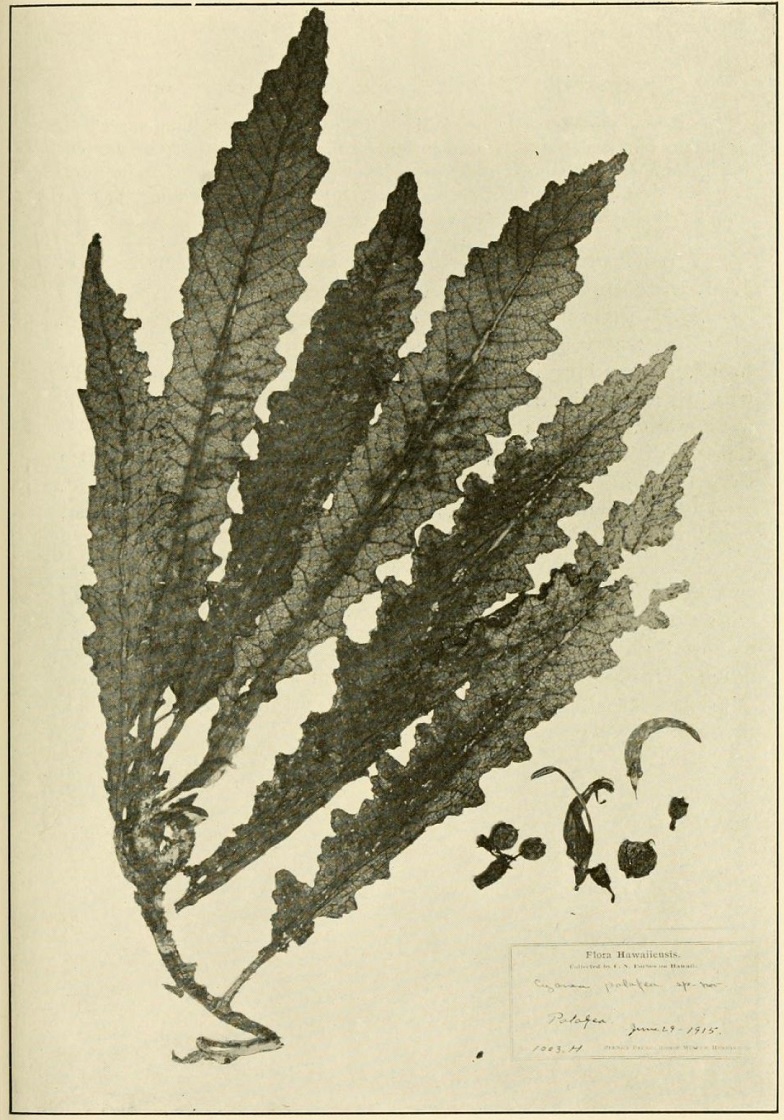
CYANEA PALAKEA FORBES.