OCCASIONAL PAPERS
BERNICE P. BISHOP MUSEUM OF
POLYNESIAN ETHNOLOGY AND
NATURAL HISTORY.
VOL. XIV
HONOLULU, HAWAII
PUBLISHED BY THE MUSEUM.
1938
Page 1
OCCASIONAL PAPERS
OF
BERNICE P. BISHOP MUSEUM
HONOLULU, HAWAII
| Volume XIV | February 7, 1938 | Number 1 |
An Open Bog on Oahu Descriptions of two new varieties of Styphelia and Lobelia
By F. R. FOSBERG AND E. Y. HOSAKA
Open bogs form a peculiar and highly localized aspect of the Hawaiian vegetation, heretofore considered to occur only on the four highest islands of the Hawaiian group — Kauai, Molokai, Maui, and Hawaii. Rock1 says that the bogs are usually confined to the summits of the mountains of the older islands or portions of islands, at an altitude of little over 1,500 meters, though they may be found also in the midst of the middle forest zone at about 1,200 meters; the well developed bog at Wahiawa, Kauai, is at 650 meters altitude. In genera, bogs occur in very wet regions on mountain tops and exposed slopes and in more or less level openings in the forest.
Hawaiian bogs are characterized by an extremely dwarfed growth of the species represented in the surrounding forest, and by a number of species practically endemic to the bogs. Most of the plants are deeply embedded in cushions and hummocks of mosses, hepatics, and turf-forming grasses and sedges. The uniformly low growth is interrupted only by tall lobelias, up to 2 meters high, scattered here and there. The area is saturated with water and there are often channels and pools between the hummocks.
___________
1 Rock, J. F., The indigenous trees of the Hawaiian islands, pp. 75-79, Honolulu, 1913.
Page 2
The most characteristic bog species in the Hawaiian islands are Selaginella deflexa, Schizaea robusta, Oreobolus furcatus, various dwarfed species of Acaena, Geranium humile, Drosera longifolia, Panicum, Viola kauaiensis and V. mauiensis, several species of Sanicula, Vaccinium pahalae, Styphelia Douglasii var. stuthioloides, various forms of native Plantago, the group of species of Lobelia centering around L. Kauaensis, Argyroxiphium Grayana and A. Caligini. Certain of these are of general occurrence in most of the bogs, while others are endemic to bogs of one or two islands.
The more familiar bogs of the islands are those in Alakai Swamp, Kauai; Kawela Swamp, Molokai; Puu Kukui, west Maui; and Kaala Bog, Kohala Mountains, Hawaii. Heretofore open bogs, as described above, have not been known on Oahu.
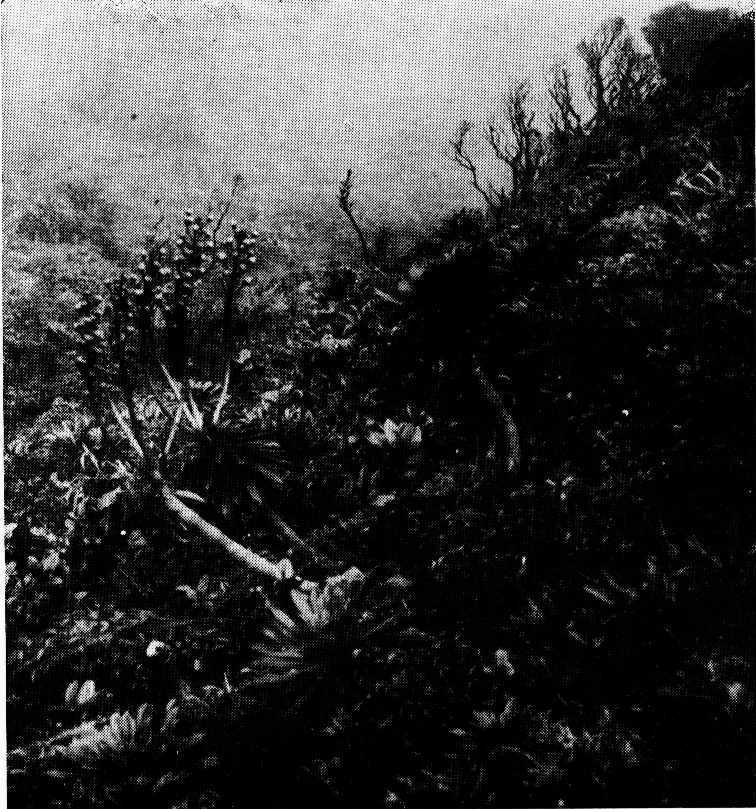 FIGURE 1. — Portion of the bog, showing Lobelia Gaudichaudii var. koolauensis in fruit.
The exposed, turfy crests of the Koolau Range, Oahu, show some resemblance to the open bogs, both floristically and physiognomically. The presence of a dwarf Panicum (P. koolauense), Lobelia Gaudichaudii, Plantago pachyphylla, Sanicula purpurea, and the dwarfing of the vegetation in general are significant in this respect. Viola oahuensis also, being more or less confined to this habitat, may almost be considered a bog species.
Page 3
On May 31, 1937, the writers discovered a small area in the cloud zone (see Hosaka, B. P. Bishop Mus., Occ. Papers, vol. 13, no. 17, p. 206, 1937) at the head of Kaipaupau and Kawainui gulches, Oahu, which, though lacking several of the common bog species, seems to have the floristic and physiognomic aspect of a true open bog (fig. 1). It lies on the brow of a bluff at the head of Kaipaupau Gulch on the summit of the Koolau Range in one of the wettest regions on Oahu, at an altitude of 850-860 meters. The actual bog area is about 25 meters square and slopes steeply at an angle of more than 45 degrees from the summit to the precipice below on the windward side. Winds, bearing rain-laden coulds, sweep the bog, apparently rather continuously. Both on our first visit and on a visit seven weeks later by F. R. Fosberg and Dr. Frank E. Egler the termperature was uncomfortably cold and seemed lower than in the surrounding forest. The water-saturated moss layer is from 3 to 6 decimeters thick, and sharply demarcated from the underlying, almost humus-free clay soil.
The following species are present which may be considered proper bog species: Schizaea robusta, Panicum koolauense, Viola kauaiensis, Viola oahuensis, Vaccinium pahalae, Styphelia Tameiameiae var. hexamera, Sanicula purpurea, and Lobelia Gaudichaudii var. koolauensis. Peperomia ellipticibacca is also a plant which seems to favor such situations. Of these, Lobelia Gaudichaudii var. koolauensis is a striking new variety with its closest relatives in the bogs of Kauai; and Styphelia Tameiameiae var. hexamera is a dwarf variety corresponding to S. Douglasii var. struthioloides of the bogs of other islands. These two new varieties are described below. Both are apparently confined to this one locality, extending slightly into the scrub surrounding the bog. Viola kauaiensis has not been reported previously outside the island of Kauai, where it is a conspicuous inhabitant of the bogs, and where it also occurs in a larger form in the forests. The specimens from Oahu correspond very well with the dwarf form from the bogs Vaccinium pahalae has been previously known only from Hawaii and Molokai. The Oahu specimens check favorably with the form from the Molokai bogs, though they are very depauperate and sterile. Schizaea robusta here attains a remarkably large size, some of the fronds reaching at least 2 decimeters in height and arising from a heavy vertical rhizome almost as long, buried in the moss.
Page 4
The following other species, found also in the surrounding forest, are present, most of them principally near the margins: Hymenophyllum lanceolatus (?), Cibotium Chamissoi, Cibotium Menziesii, Gleichenia linearis, Sadleria Hillebrandii, Sandleria polystichoides, Stenoloma chinensis, Elaphoglossum gorgoneum (?), Polypodium tamariscinum, Nephrolepis cordifolia, Lycopodium serratum, Lycopodium cernuum, Mariscus angustifolius, Isachne pallens, Eupritchardia sp., Anoectochilus sp., Peperomia latifolia, Broussaisia arguta, Pelea clusiaefolia, Metrosideros collina var., Metrosideros sp. (aff. rugosa), Cheirodendron platyphyllum (two forms), Vaccinium dentatum, Labordia sp., Nertera depressa, Scaevola glabra, Bidens macrocarpa.
A number of mosses and hepatics, as well as algae, are present in profusion. The genus Sphagnum has not been found on Oahu.
Styphelia Tameiameiae (Cham. and Schlect.) F. Muell. var. hexamera Fosberg and Hosaka, n. var.
Planta depaupera, maxime 3 dm., flores 5-7 (usiter 6) meri.
Shrub up to 3 dm. tall, flowers usually 6-merous, rarely 5 or 7, corolla lobes 1.3-1.5 mm. long, tube 1.8-2.0 mm. long.
Oahu: Koolau Range, main divide above Kaipaupau Gulch, alt. 850m., May 31, 1937, Fosberg and Hosaka 13971 (type in Bishop Mus.); same locality and altitude, July 24, 1937, Fosberg and Egler 14225.
A dwarf form, possibly not worth describing, but the increased number of flower parts is unusual in the genus, 5 being the ordinary number.
Lobelia Gaudichaudii A. DC. var. koolauensis Hosaka and Fosberg, n. var. (fig. 2).
Plantae 1-1.5 m. altae, foliis 12-17 cm. longis 2-2.5 cm. latis lance-spathulatus, inflorescentiis 3-6 divisiis 40-50 cm. longis, pediculis 2.5-3.0 cm. longis, corolla 5.8-6.5 cm. longa, 1.8-2.0 cm. lata, alba vel alba-viridis.
Plants 1-1.5 m. tall, stem unbranched, 3-4 cm. in diameter, leaves clustered at apex of stem; leaves 12-17 cm. long, 2-2.5 cm. wide, glabrous, coriaceous; inflorescence branching candelabra-like, glabrous, the 3-6 stalks 40-50 cm. long, with 20-35 flowers, the stalks bracteate but leafless; floral bracts 2.5-3.0 cm. long, 7-10 mm. wide, coriaceous, glabrous; pedicels 2.5-4.3 cm. long, glabrous; calyx tubes 8-11 mm. long, broadly obconical, glabrous, the lobes 10-15 mm. long, 3-6 mm. wide, lanceolate, glabrous; corolla 5.8-6.5 cm. long. 1.8-2.0 cm. wide, whitish to whitish green, glabrous; staminal column glabrous; anthers glabrous, the tips all bearded; stigma 2-lobed, bearded.
Oahu: Koolau Range, divide between head of Kawainui Gulch and Kaipaupau Gulch, alt. 860 m., on open, windswept, sloping bog, June 1, 1937, Hosaka and Fosberg 1915 (type in Bishop Mus.); same locality and altitude, July 24, 1937, Fosberg and Egler 14224.
Page 5
This variety comes close to Lobelia Gaudichaudii and L. kauaensis but closer to the latter with similar branching inflorescence.
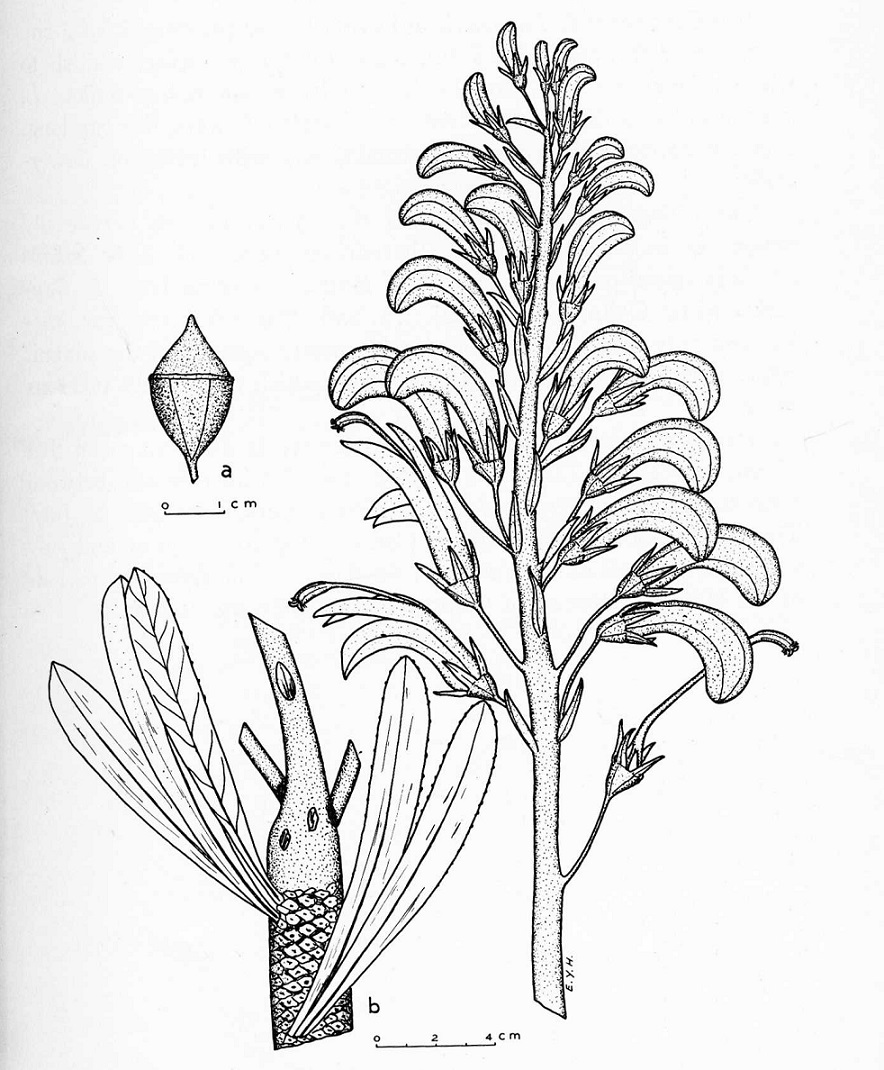 FIGURE 2. — Lobelia Gaudichaudii var. koolauensis: a, capsule; b, upper part of stem.
Page 6
It differs from L. Gaudichaudii in having a branching inflorescence, whitish to whitish green corollas and staminal columns, glabrous and softer textured leaves, and broader flowers, 1.8-2.0 cm. wide. L. Gaudichaudii has simple inflorescence (rarely branched), deep red-purplish corollas and staminal columns, thick leaves commonly with pubescent midribs and basal ciliate margin, smaller flowers, 7-10 mm. wide.
It differs from L. kauaensis in having longer pedicels, 2.5-4.3 cm. long, larger flowers, 5.8-6.5 cm. long, 1.8-2.0 cm. wide, whitish to whitish green corollas, and having no leaves on flower-stalks. L. kauaensis has pedicels 2.0-2.8 cm. long, smaller flowers, 4-6 cm. long, 1 cm. wide, with deep purplish streaks, and with leaves on flower-stalks.
The differences seem slight but the variety can be very easily recognized in the field and with herbarium specimens. Lobelia kauaensis is found only on the island of Kauai in summit bogs, L. Gaudichaudii on Oahu and Molokai (?), and L. Gaudichaudii var. koolauensis only in a small bog, about 25 meters square, on the summit ridge of the Koolau Range, Oahu, from which the variety takes its name.
The flowering period of this new variety is different from that of any species of Hawaiian Lobelia, all of which flower between August and December; this new variety flowers from May to July. There were about 15-20 matured plants in the area in June and July and these were all in some stage of flowering. The flowering periods of the Hawaiian species of Campanulaceae are quite definite.