THE
INDIGENOUS TREES
OF THE
HAWAIIAN ISLANDS
BY
JOSEPH F. ROCK
Botanist of the College of Hawaii
Consulting Botanist, Board of Commissioners of Agriculture and Forestry,
Territory of Hawaii.
ISSUED JUNE 26, 1913.
With Two Hundred and Fifteen Photo-Engravings
____________
PUBLISHED UNDER PATRONAGE.
____________
HONOLULU, T. H., 1913.
:::
Page 75
THE BOG REGION.
The bog region is usually confined to the summits of the mountains of the older islands or portions of islands, with an altitude of little over 5000 feet.
Waialeale, the summit of Kauai, at an elevation of 5280 feet, represents such a bog, as well as Puu Kukui, the summit of West Maui (5788 feet) and Kaala, the summit of the Kohala mountains on Hawaii (5505 feet). All these three localities have many species of plants in common, but also each locality has again its peculiar species.
The summits of these mountains are nearly always throughout the year enwrapped by clouds, with the excetion of a short period during which the south wind prevails. The best season for visiting these wonderful places is in October and the first part of November. The rainfall in these localities is enormous, but no definite record has been kept in these places, with the exception of Waialeale, where the U. S. Geological Survey placed a rain gauge with the capacity of holding 120 inches. The writer ascended Waialeale for the second time on October 20, 1922. One month before the rain gauge had been emptied. On arrival at the summit on the above date the rain gauge was found overflowing.
It may, however, be remarked that these bogs, with their peculiar flora, are not always confined to the summits of the mountains of an altitude of 5000 feet, but can also be found in the midst of the middle forest zone at an elevation of usually 4000 feet. Thus we have four bogs on Kauai besides Waialeale. The biggest one is situated a few miles back of Halemanu and extends almost to the edge of Wainiha gorge; this bog is known as Alakai swamp, and is about one and one-half miles across. Another much smaller bog is Kauluwehi swamp, situated at an elevation of 4200 feet, back of Kaholuamano on the trail to Waiakealoha waterfall; the smallest one is Lehua makanoe, "Lehua in the fog" — only about a mile back of Mr. F. Gay's mountain house. The next, though larger than either Kauluwehi or Lehua makanoe, is the bog of Wahiawa, at a much lower elevation than those previously mentioned.
On Molokai there is only one bog worth mentioning, and that Kawela swamp, back of Kamoku, not far from Pelekunu gorge (See Plate XXIV.)
On Maui we have besides Puu Kukui, the bog Mauna Eeke, situated above Honokahau gulch at an elevation of about 4100 feet. It is indeed of interest to note that most of the species of plants found on Puu Kukui are not peculiar to the bog region, but have been found by the writer on the steep walls in Kaupo gap in the crater of Haleakala.
In the Kohala Mountains there are several bogs besides the main one at the summit, the names of which are not known to the writer.
Page 76
THE BOGS OF KAUAI.
In the bogs situated on the central plateau we find the vegetation the same, while the great bog of Waialeale has its peculiar species besides most of those found in lower situated bogs.
The turfy soil is covered with tussocks of Gramineae and Cyperaceae, mainly Panicum monticola, Panicum imbricatum and P. isachnoides, together with the cyperaceous Oreobulus furcatus.
On these tussocks of grasses and Cyperaceae we find the European Drosera longifolia (Mikinalo), the so-called insect-eating plant, embedded. It has been said that D. longifolia is hardly ever found without its associate D. rotundifolia, but here on Kauai it is the only representative of the family Droseraceae. Drosera longifolia is more common in the lower swamps than on the summit, where only a few specimens of it have been found. Between these tussocks grow small bushes of Ohia lehua, or really called Lehua makanoe, from which one locality derives its name. The plant has been named by Heller Metrosideros pumila. In its shade grows the handsome blue-flowered violet, Viola Kauaiensis. Habenaria holochila was found by the writer in Alakai swamp in the turf, growing erect about three feet in height. It is the third species of our poor orchids.
The swamps are bordered by many tall-growing Cyperaceae, as Carex sandwicensis, which forms stands 4 to 5 feet high, together with Cladium sp., probably new, a tall plant with long, scaly, creeping rhizomes, with stems often 10 feet high. In the swamp proper we find Carex montis Eeka, Rhynchospora glauca var. chinensis, Deschampsia australis, Selaginella deflexa, Schizaea robusta, Styphelia imbricata var. struthioloides, a creeper, a species of Wikstroemia, Suttonia sandwicensis β var. denticulata, Vaccinium penduliflorum, etc.
The summit of Kauai, Mt. Waialeale, was visted first by Wawra, the botanist of the Austrian exploring expedition, in the year 1871; and it is peculiar that no other botanist or botanical collector had cared to visit the mountain again.
The writer ascended Waialeale in the year 1910 and again in 1911. The second time the ascent was very much facilitated through the trails which had been cut by the men of the U. S. Geological Survey. The vegetation of Waialeale is extremely interesting, and several new species were found and described by the writer. The ridges leading to the summit have an entirely different plant formation, composed of peculiar species. One of the striking plants is Pelea Waialeale (Anonia or Alaniwai), which grows together with Suttonia lanceolata, a very distinct species, both being shrubs but occasionally becoming small trees. Of Compositae we find Dubautia laxa var. pedicellata Rock v. n., which is here a shrub 10 to 15 feet high, in company with the rutaceous Pelea orbicularis var. ? and Pelea sp. ? and Dubautia paleata. A few small species of Labordia are not uncommon on the mossy tree trunks. Here we also meet with Lobelia Kauaiensis and Lobelia macrostachys var. Kauaiensis with deep crimson flowers. As we ascend, we enter the open plateau or bog iwth still a few shrubs, and even higher up in little depressions we find trees such as the newly-described Tetraplasandra Waialealae, the second species of Tetraplasandra that is to be found on this island. Cheirodendron platyphyllum is also found here as a small tree with sinuate-serrate leaves, while at lower elevation the leaves are entire. Among such shrubbery grows Lobelia macrostachys var. Kauaiensis, while L. Kauaiensis with either a simple or compound candelabra-like spike, with cream-colored purplish-streaked flowers, prefers the open, flat swamp where the vegetaton is stunted. Labordea Waialealae, a shrub, is peculiar to this locality, as well as Labordea fagraeoidea var. pumila, which is subherbaceous. Pittosporum Gayanum var. is here a shrub, differing from the species in its being glabrous throughout; with it occurs a stunted form of Eurya sandwicensis var. with rather large fruits; and also a species of Wikstroemia.
Page 77
In the open bog proper, we meet with the already-described Cyperaceae and Gramineae, besides a species of Cyperus and Deschampsia austalis var. pumila. Astelia Waialealae is scattered over the ground plentifully, but is, however, not peculiar to Kauai, as it has been met with by the writer in Kawela swamp on Molokai.
A curious species of Dubautia, named D. Waialealae, grows at the summit proper. On the outskirts together with the other shrubs grows Lysimachia Hillebrandii var. venosa, with rather long herbaceous branches.
In the grassy tussocks we find again Viola Kauaiensis, but only very small plants; in Sphagnum moss the pretty Geranium humile var. Kauaiensis (Nohuanu) occurs together with Plantago pachyphylla var. Kauaiensis, and Acaena exigua, as well as Sanicula sandwicensis var. β, with leaves much less incised; this latter plant had not been recorded previously from Kauai. Wawra's lantago pachyphylla var. pusilla occurs only in one locality, called Kawakoo. Metrosideros pumila is here a small glabrous creeper only a few inches in length. Another variety of Plantago pachyphylla, which is wholly glabrous, occurs at the summit, and is here named var. glabrifolia Rock v. n. Locopodium venustulum var. herpeticum is found trailing at the summit in company with Stenogyme purpurea var. Lobelia Kauaiensis is a exceedingly handsome plant and is quite common at the summit. It differs very materially from L. Gaudichaudii so common on Puu Kukui, West Maui, and when seen in the field no botanist can help but see the specific distinction.
Of interest may be the names of the various localities on the summit of Waialeale. Immediately after leaving the ridge leading into the open plateau a large patch of bright-red dirt is discernable; the natives used to go to this place, which they called Kaluaalaea, for this dirt, which they used for paint. The first point or hill on the plateau is called Honunamanu; where the rain gauge is situated the place is known as Manakauaalakai; the highest point, on which the copper plate of the U. S. Geological Survey is enclosed in cement, is Kapailoahiki. Where the Heiau is situated is Kawakoo, then comes a pool called Waialeale, and beyond it a hill overlooking Wailua, which is known as Waikini.
Page 78
THE SUMMIT BOG OF WEST MAUI, PUU KUKUI, ELEVATION 5788 FEET.
Puu Kukui is a large, open, more or less flat plateau, composed of light-gray, heavy, loamy soil. The vegetation is stunted, with the exception of such as occurs in depressions or small gulches, and at the head of Iao Valley, where trees belonging to the middle forest region abound.
The whole of Puu Kukui is a second Waialeale of Kauai, though a number of plants are peculiar to the former. We find the same globose tussocks of Oreobolus furcatus and the very interesting Carex montis Eeka, besides Gramineae, such as Deschampsia australis forma longius aristata, Calamagrostis Hillebrandii Hack. (nov. nom.), and others, while the juncaceous Luzula hawaiiensis var. glabrata grows in their company. One of the most striking vegetative features is the great abundance of the very beautiful Lobelia Gaudichaudii. In certain parts this plant covers the ground, and in the month of August it is indeed a beautiful sight. At about 5000 feet elevation these Lobelias are only about 3 to 4 feet high, while at the extreme eastern end of this interesting bog the plant is from 8 to 15 feet high and branches candelabra-like into usually five erect racemes, bearing from 40 to 80 flowers each, while the plants in the open bog have only one pyramidal raceme about 2 to 3 feet long. The flowers are much larger than those of L. Kauaiensis, found on Waialeale, and also handsomer; they are cream-colored with a slight pinkish tinge, and are three inches long and an inch wide. Lobelia macrostachys is here absent, while represented on Waialeale, Kauai, by a new variety. The beautifully branching Lobelia Gaudichaudii found on the brink of Iao Valley is certainly distinct from the one described by DeCandolle in many particulars, especially in the very long lanceolate acuminate bracts, and shall from now on be known as var. longibracteata Rock, var. nov.
Next to the Lobelioideae found at the summit, the Compositae have three representatives. Of greatest interest is the very handsome Wilkesia Grayana, with its 5 to 8 feet tall stem, bearing a dense crown of verticillate leaves, out of whose center the inflorescence comes forth as a large foliaceous raceme of one and one-half to two feet in length, bearing yellow globose flower heads of about 10 lines in diameter There is only one other species know of this interesting genus, W. gymnoxiphium. It occurs in the dry districts of Kauai, especially on open wind-swept cliffs in company with Lobelia yuccoides; while W. Grayana grows in the open bog, which receives an enormous amount of rainfall.
Page 79
The second interesting genus is Argyroxiphium, which also belongs to the most ancient of Hawaiian Compositae though of American affinity. These two genera are undoubtedly the oldest denizens of the Hawaiian Islands. The genus Argyroxiphium with its two species, sandwicense and virescens, has hitherto been found only in the drier upper forest region in black volcanic ash at an altitude of from 8000 to 10,000 feet. At the summit of Puu Kukui is a small species of this genus growing in a veritable pool, but only in one locality. The plant was not in flower at the time of the writer's visit, but it can be said that when the plant is fully known it will undoubtedly represent a new variety or intermediate form between A. sandwicense and A. virescens. The leaves of the plants in question are neither silvery nor green, but are covered with a bluish, somewhat silvery or glauceous pubescence.
Lagenophora mauiensis is very common in the turfy soil in company with the creeping Geranium humile with pink flowers. Acaena exigua, which is very scarce on Waialeale, is here exceedingly common, together with Viola mauiensis. Remarkable to say, Drosera longifolia, so common on Kauai, is here absent. A small creeping Metrosideros is also present with Lycopodium venustulum var. and Styphelia imbricata var. struthioloides.
The writer met with a single plant of Lycopodium Haleakalae resembling very much L. erubescens, but stouter and not reddish. Several species of lichens grow on the exposed gray loam, such as Cladonia, Stereocaulon and others.
At the extreme eastern end of the bog on the brink of Iao Valley the tree growth is mainly Cheirodendron Gaudichaudii, Suttonia sp.?, Pelea sp., Metrosideros polymorpha, and the lobelioideous Clermontia grandiflora. All the trees are covered thickly with moss and hepaticae or Liverworts. The swamp of Mauna Eeke harbors the same vegetation as that of Puu Kukui with possibly one or two exceptions.
:::
Page 469
CAMPANULACEAE.
Tribe lobelioideae.
While the family Campanulaceae numbers 59 genera, only the tribe Lobelioideae, with 22 genera, is of importance as far as Hawaii is concerned. Of this tribe, the Hawaiian Islands possesses six genera, five of which are endemic, the remaining one being the cosmopolitan genus Lobelia. Nowhere, with the exception of South America, does this tribe reach such a wonderful development as in the Hawaiian Islands. It has the largest number of species of any plant family represented here in these islands; next to it ranks the Compositae.
Many of our Lobelioideae are arborescent, some of them reaching a height of 40 feet, and are a typical feature in the forests of Hawaii. The tribe in general is mainly tropical, and reaches to the southern temperate zone. Quite a number inhabit North America, and two the Mediterranean regions. The Hawaiian Islands, with its numerous arborescent forms, ranks next to South America, which has the largest number of species, as Centropogon Presl., wth 80 to 90 species, and Siphocampylus Pohl, with 100 species, especially numerous in the Andes and Brazil. But if we compare South America in size with the Hawaiian Islands, which has up to 100 species of the tribe Lobelioideae, we find that really nowhere in the world does this tribe reach such a wonderful development in such a comparatively small area. The other islands of the Pacific are void of Lobelioideae, and only Tahiti and the Socieity Islands, with Raiatea, have in all four species belonging to three different genera.
Page 470
Plate 196.
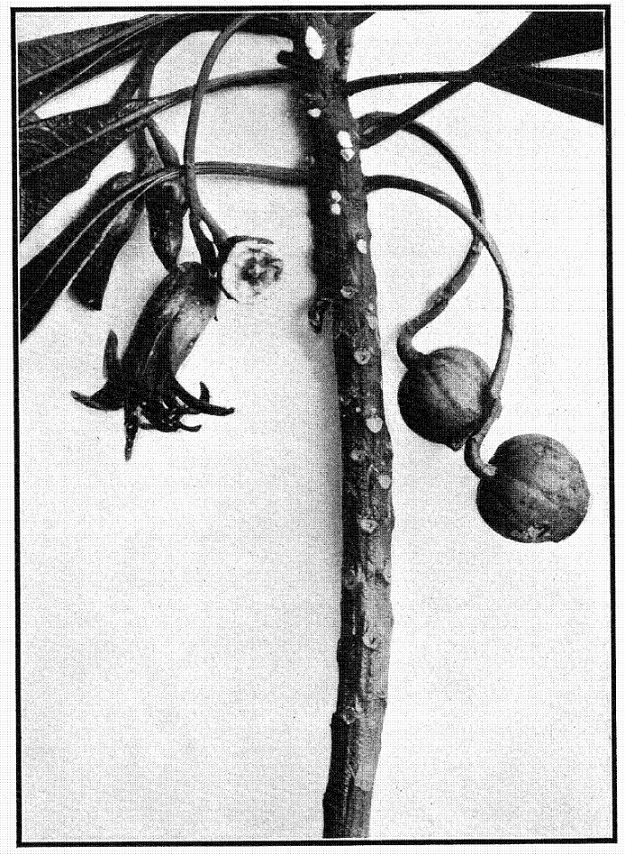
CLERMONTIA DREPANOMORPHA, Rock. About two-thirds natural size; showing flowers and fruits.
Page 471
The Hawaiian species present sometimes really grotesque and specialized forms, while others again (new forms) run into each other to such an extent that it is difficult to recognize specific distinction. While most of them are shrubs or small trees, only those are included here which reach a height of about 18 to 40 feet. Delissea undulata, which attains a height of over 30 feet on Mauna Loa, Hawaii (see plate XVII), is here omitted, as its stem is rarely thicker than two inches.
The genus Lobelia, which is represented by five very handsome species, some reaching a height of 18 feet (L. macrostachys in Kau, Hawaii), possesses about 200 species, which are distributed over Africa and South America, while very few are to be found in Central America. They usually inhabit high mountains, like Abyssinia, Ruwenzori, Kenia, etc., in company with arborescent Compositae.
In the Hawaiian Islands the genus Lobelia is confined to the middle forest zone, but does occasionally ascend into the upper forest zone to an elevation of 6500. (L. hypoleuca, Puunianiau crater, Haleakala.)
KEY TO THE GENERA.
| Milky shrubs or trees with axillary inflorescences. | |
| Berry large yellow, an inch or more in diameter: Corolla deeply slit to the base; flowers 2-6 in simple cymes. | Clermontia |
| Berry small, occasionally large, but then purple: Corolla slit beyond the middle, flowers in racemes. | Cyanea |
CLERMONTIA Gaud.
Calycine lobes either as long as the corolla and then bilabiate and deciduous or shorter than the corolla, bluntly lobed or acute, free and persistent; corolla nearly unilabiate, staminal column free from the corolla; the two lower anthers penicillate, the upper ones naked; fruit a globose or pear-shaped berry with a broad epigynous disc; seeds brown shining. Shrubs or trees (with thick latex) branching candelabra like. Inflorescence a two to many flowered cyme.
Page 472
Plate 197.
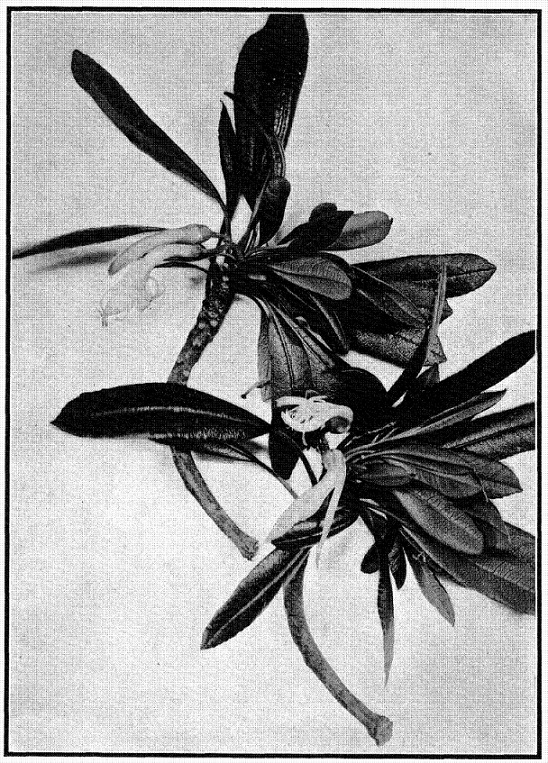
CLERMONTIA PERSICAEFOLIA Gaud. Less than half natural size.
Page 473
KEY TO THE SPECIES.
| I. CLERMONTIA GENUINAE. | |
| Calyx lobes connate, as long as the corolla; at maturity the entire tube falls with the corolla. | |
| Peduncle two flowered. | |
| Peduncle long filiform pendulous. | C. grandiflora |
| Peduncle arched, drooping, 1-10 cm long; fleshy, corolla dark purple. | C. drepanomorpha |
| Peduncle short, erect. | |
| Corolla and calyx not or little curved when open, slender, whitish. | C. persicaefolia |
| Corolla and calyx strongly arched, green. | C. oblongifolia |
| Peduncle 20-25 mm, drooping. | |
| Corolla long, slender, dark, purplish-black. | C. kohalae |
| Peduncle two to four flowered. | |
| Corolla smaller, dark, purplish; calyx green;branches slender; leaves with a purplish black tinge. | C. leptoclada |
| Corolla large, green, purplish or white, ovarian portion strongly ribbed. | C. Hawaiiensis |
| II. CLERMONTIOIDEAE. | |
| Calyx lobes free, shorter than the corolla, persistent. | |
| Peduncle short 15 mm or less. | |
| Calyx five toothed; corolla puberulous. | C. Gaudichaudii |
| Calyx with minute acute teeth; corolla dark purplish-red. | C. Peleana |
| Calyx five lobed; corolla glabrous, thick, fleshy. | C. arborescens |
| Calyx with five short obtuse lobes; corolla and calyx covered with tubercles. | C. tuberculata |
| Peduncle 2 cm or more in length; two to three flowered. | |
| Corolla bluish-white or purplish-green. | C. coerulea |
| Peduncle two-six flowered; flowers whitish-green. | C. Haleakalensis |
Clermontia grandiflora Gaud.
CLERMONTIA GRANDIFLORA Gaud. Bot. Voy. Uranie (1826) 459; pl. 73; Presl Monogr. Lobel. (1836) 48. — DC. Prodr. VII (1839) 352; — A. Gray Proc. Am. Acad. V. (1862) 150; — H. Mann Proc. Am. Acad. VII (1866) 184; — Hbd. Fl. Haw. Isl. (1888) 240; — Del Cast. Ill. Fl. Ins. Mar. Pacif. VII. (1892) 221. — Delissea filigera Wawra in Flora (1873) 31; — Not Kauai, but Maui; — Wälder over Waihee.
Leaves obovate to oblong 7 to 10 cm x 2.5 to 3 cm on petioles of 1 to 4 cm, shortly acuminate, bluntly serrulate or dentate, chartaceous glabrous dull; peduncle filiform, pendulous 2 to 8 cm long bracteate at the middle, two flowered, pedicels slender bracteolate about the middle, sometimes cymosely 4 to 5 flowered by dichtomy of pedicels; calyx glabrous greenish or purplish, thin, the lobes tubular, strongly curved before expansion 5 to 6 c long; corolla purplish somewhat longer than the calyx, berry pear-shaped about 2 cm orange yellow.
This quite distinct species occurs on the Islands of Molokai, Lanai, and Maui, where it inhabits the rain forest from an elevtion of 2000 to 5000 feet, or a little higher. It is very common on West Maui, but especially at the summit of Puu Kukui (578 feet), at the edge of Iao valley, in company with Lobelia Gaudichaudii, Labordea, Wilkesia Grayana, etc. On Molokai it can be found in the forest above Mapulehu and along a stream back of Kamoku. It is quite conspcuous by its green, purplish-streaked corolla, which is pendulous on long filiform peduncles, which characterizes it from all the other species. It is most plentiful at 4000 feet elevation on windward slope of Haleakala, East Maui, in the dense mossy rain forest along Waikamoi, Puohaokamoa and Honomanu gulch. On Lanai it grows in the more open dry districts at the ridge of Kaiholena valley, where it is a shrub, while in the other more shaded localities it becomes a small tree 15 to 18 feet in height.
The specific name grandiflora is rather misleading, as it is by no means the largest flowering Clermontia, being exceeded by C. drepanomorpha and C. arborescens.
Page 474
Plate 198.
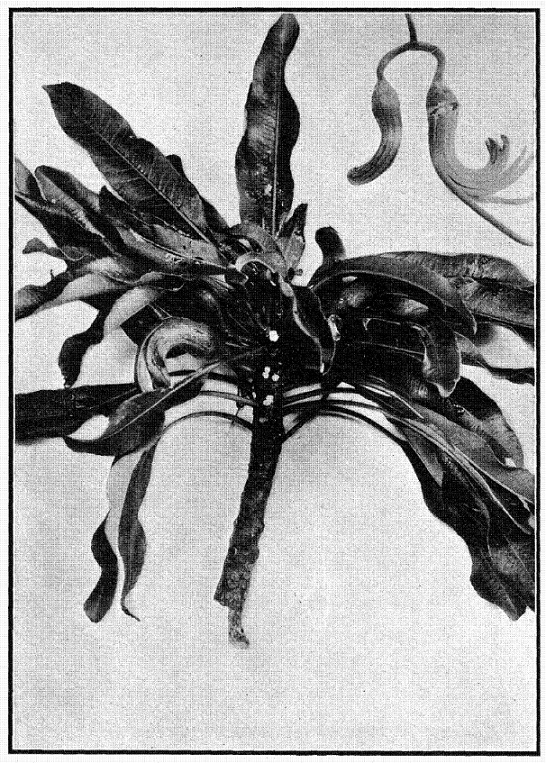
CLERMONTIA OBLONGIFOLIA Gaud. Less than one-half natural size; showing flowers and flower buds.
Page 475
Clermontia drepanomorpha Rock sp. nov.
(Plate 196.)
Leaves oblong or obovate, lanceolate 10 to 18 cm x 1.5 to 4 cm glabrous above or sparsely hispid underneath along the prominent reddish midrib, dark green above, lighter underneath, on petioles of 3 to 5 cm, denticulate in the upper two-thirds with callous teeth, entire in the lower; peduncle glabrous 6 to 8 cm long with flowers, 10 cm long with fruit, pedicels 2 cm, two flowered; bracts and bractlets triangular; calyx dark purplish, the ovarian portion 1.5 to 2 cm triangular to globose, the lobes as long as the corolla, the peduncles drooping, but the flowers erect; corolla purple, curved 4 to 6 cm long by 1.5 to 2 cm wide, fleshy; staminal column glabrous purplish; anthers bluish-lilac, hirsute along the sutures, the lower anthers penicillate; berry large globose yellow 3 cm in diameter; seeds yellowish-brown, smooth.
This remarkable species was discovered by the writer on the open swamp lands in the mountains of Kohala, Hawaii; also along Alakahi and Kawainui gorges at an elevation of 4000 to 5000 feet. It is a small tree 12 to 20 feet in height, and is peculiar to the boggy regions of West Hawaii, where the rainfall is enormous. It was collected flowering and fruiting in July, 1909, and again the following year during the same month on the high plateau, summit of Kohala; the type is No. 4745 in the Herbarium of the College of Hawaii.
It grows in company with several species of Pelea, Cheirodendron, Tetraplasandra, and a number of other species of Clermontia. It is remarkable for its handsome flowers, which are even larger than those of C. arborescens.
The birds are very fond of its very large, bright-yellow fruits, which they hollow out until only the skin remains on the stalks. This, however, is the case with most of our Lobelioideae. The trunks of this species are thickly covered with moss up to the ultimate branchlets. The wood is soft and whitish.
Clermontia persicaefolia Gaud.
(Plate 197.)
CLERMONTIA PERSICAEFOLIA Gaud. Bot. Voy. Uranie (1826) ; pl. 72; — DC. Prodr. VII (1839) 352; — Hbd. Fl. Haw. Isl. (1888) 241; — Del. Cast. Ill. Fl. Ins. Mar. Pacif. VII (189) 222; — Heller Pl. Haw. Isl. (1897) 907. — Clermontia persicifolia Presl Monogr. Lob. (1836) 48. — Clermontia grandiflora var. β oblongifolia Gray, in part, Proc. Am. Acad. V. (1862) 150; — H. Mann l. c. p 184 in part. — Lobelia persicifolia Endl. Fl. Suds. (1836) no. 1061. — Clermontia parviflora Wawra Flora (1873) 47.
Leaves lanceolate or oblong 8 to 10 cm x 1 to 2 cm acuminate or obtuse, coarsely crenate or serrulate, the base gradually contracting into a long petiole of 4 to 6 cm subcoriaceous, glossy above, glabrous and glaucous underneath; peduncles 10 to 14 mm, two flowered, with a pair of bracts below the middle; pedicels 12 to 15 mm long, bibracteolate at or near the base; calyx and corolla slender almost white, with purplish tinge, greenish when young, smaller than C. macrocarpa; the ovarian portion is turbinate.
A handsome shrub or small tree 15 to 18 feet in height, sometimes growing on other trees. It is peculiar to the Island of Oahu, where it can be found in the rain forests of the main range, and not uncommon on the mountain Waiolani, and also near the crater in Palolo valley at an elevation of from 1300 to 2000 feet. It is much branching and has a beatiful, round, symmetrical crown; flowers in spring. It also occurs on Mt. Kaala of the Waianae range.
Wawra's Clermontia parviflora No. 2206 in the Herb. Museum Caes. Palat Vindob., which the writer had occasion to examine, is really Gaudichaud's Cl. persicaefolia.
Page 476
Clermontia oblongifolia Gaud.
(Plate 198.)
CLERMONTIA OBLONGIFOLIA Gaud. Bot. Voy. Bonite (1838) 459 pl. 71; — Presl Monogr. Lob. (1836) 48. — DC. Prodr. VII (1839) 342; — Wawra Flora (1873) 47; — Hbd. Fl. Haw. Isl. (1897) 908. — Lobelia oblongifolia Endl. Fl. Suds. (1836) no. 1061. — Clermontia grandiflora var. β oblongifolia Gray Proc. Am. Acad. V. (1862) 150 pro parte; — H. Mann l. c. p 184 pro parte.
Leaves oblong 8 to 12 cm x 3 cm obtuse or rounded, crenate or bluntly serrulate towards the apex, contracting into a long petioles of 4 to 8 cm, chartaceous pale, whitish underneath; peduncle 10 to 16 mm long, two rarely three flowered, with one or two pairs of dentiform bracts; pedicels of the same length as peduncle, with two bractlets near the base; calyx pale greenish, the lobes as long as the corolla, strongly arcuate, circa 6 cm long by 12 mm wide; berry globose not furrowed, seeds dark brown.
It is a small and handsome tree, reaching a height of about 15 to 25 feet, but is often found as a shrub in the more open country or swampy flat lands, as at the head of Pauoa valley on Oahu, to which island it was thought to be peculiar. It has since been found by the writer on Maui in Honomanu gulch, and on Molokai at Maunahui, as on the ridges of Manoa, Palolo, Niu and Waipio valleys, Oahu. Its large, very arched, green flowers are not particularly handsome.
All Clermontiae are known to the natives as Ohawai or Haha. The milky, viscous sap was employed as bird lime in the olden days by the native bird-hunter.
Var. Mauiensis Rock var. nov.
Leaves acuminate 15 to 19 cm long, 3.5 to 4.5 cm wide, glabrous, pale green, on shorter petioles (4 cm); peduncle 1.5 cm long 2-3 flowered, pedicels somewhat longer, bracts 4 mm, bracteoles 2 mm; calyx green; corolla purplish; staminal column and anthers dark purple, the former glabrous, the latter hirsute along the sutures.
A small tree 15 to 18 feet high, resembling very much the species on Oahu. This tree is not at all common, but can be found on the Island of Maui on the windward slopes of Mt. Haleakala along the Kailua ditch trail in the valley of Honomanu at an elevation of 2800 to 3000 feet in the rain forest. The type specimen is No. 8804 in the College of Hawaii Herbarium. Collected flowering April, 1911. The tree grows in company with Cl. macrocarpa, which is the most common species in that locality, and Cl. arborescens.
Clermontia Kohalae Rock sp. nov.
Leaves linear oblong bluntly acuminate or obtuse 7 to 16 cm long, 2 to 3 cm wide, gradually narrowing into a petiole of 2 to 4 cm, glabrous, dull, pale underneath, with impressed veins chartaceous denticulate or serrate in the upper two-thirds, entire at the base; peduncle 15 to 35 mm, two flowered, hispid or even scabrous, with two triangular bracts above the middle; pedicels as long as the peduncles bibracteolate; the ovarian portion of the calyx turbinate, green, the lobes as long as the corolla, dark blackish purple, slender, not fleshy, suberect or slightly arcuate, glabrous; corolla of the same color as the calycine lobes, glabrous; staminal column glabrous; anthers pale, hirsute along the sutures, the two lower anthers only penicillate; berry subglobose circa 2 cm in diameter; seeds pale brown smooth shining.
Page 477
This species, new to science, is a small tree 15 to 18 feet in height with a trunk of a few inches in diameter, branching candelabra-like a few feet above the ground. It was discovered by the writer in July, 1910, in the lower forests of Kohala, Hawaii, and in the gulches on the windward side, along the streams at an elevation of 1500 to 2500 feet, where it is not uncommon. It is exceedingly handsome when in flower; the numerous dark-purple corollae in the axils of the leaves give it a pleasing appearance. It flowers during the summer months. The type is No. 8810 in the Herbarium of the College of Hawaii.
This very interesting and handsome Lobelia is peculiar to Kohala, Hawaii, after which district it is named. It was also observed along the lower Kohala ditch trail when in company with Mr Bluett.
Clermontia leptoclada Rock sp. nov.
Branches slender loosely foliose; leaves oblong acuminate at both ends 12 to 18 cm long by 2.5 to 4 cm wide, denticulate with callous teeth, dark green above, with a dark purple-bluish tinge at the margins and apex, glabrous above, coriaceous, with impressed veins, pale underneath and sparingly hispid along the veins and midrib, on petioles of 4 to 6 cm; flowers all along the slender stem on cymosely branching hirsute peduncles of 2.5 to 4 cm, which are bracteate in the upper third; pedicels two usually three to four 1.5 to 3.5 cm long, bibracteolate at the middle, the bractlets linear subulate 5 mm long; calyx, ovarian portion subglobose, the tube as long as the corolla, purplish with prominent hispid nerves; corolla slightly arcuate 4.5 cm long, lobes linear lanceolate, dark purple, hispid with white hair; staminal column purplish puberulous, the anthers hirsute along the sutures, bluish purple, the lower ones penicillate; fruit globose 2.5 cm in diameter; seeds brown smooth shining.
This species, which becomes a tree of 18 to 20 feet in height, was discovered by the writer near the summit of the Kohala mountains on Hawaii, along the Alakahi and Kawainui ditch trail at an elevation of 4200 feet, during the month of July, 1909, at which time it was found in flower and fruit. It is one of the many remarkable Lobelioideae which inhabits our high swampy plateaus. The type is No. 4760 in the Herbarium of the College of Hawaii.
Clermontia Hawaiiensis (Hbd.) Rock.
(Plate 199.)
CLERMONTIA HAWAIIENSIS (Hbd.) Rock. — Clermontia macrocarpa var. Hawaiiensis Hbd. Fl. Haw. Isl. (1897) 241.
Leaves ovate-obovate, oblong, undulate dark green, glossy above, glabrous, lighter underneath, pubescent along the veins and midrib; the veins impressed; 15 to 22 cm long, 3 to 6 cm wide on petioles of 2.5 to 3 cm reddish; peduncles 2 to 4 flowered, 3 to 6 cm long, pedicels 2 to 4 cm long; peduncle bibracteate in the upper fourth, bracts foliaceous 2 to 3.5 cm long, linear oblong denticulate, pedicels bibracteolate at the middle and at their common base, puberulous, calyx subglobose, the ovarian portion pronouncedly 10 ridged, the dorsal one almost wing-like, the tube green or purplish 6 to 6.5 cm long, as long or even longer than the corolla; the dorsal slit extending to the base, the lateral slits beyond the middle, each lobe strongly nerved, each nerve being a continuation of a ridge of the ovarian portion of the calyx; corolla slightly arched thickened toward the apex in the bud; staminal column glabrous, green or purple, anthers pale purple or dark hirsute along the sutures or glabrous, the two lower only penicillate, berry large 3 cm in diameter, 10 ridges, orange yellow.
This shrub or small tree reaches a height of 20 or more feet. It is a very variable species; the leaves are sometimes oblong or ovate, the peduncle either very long and then twice as long as the pedicels and two-flowered, or as long as the pedicels or little longer and then four-flowered; the two inner pedicels shorter and thicker (almost four-cornered) than the two outer pedicels. In the four-flowered specimens the corolla is purple, while in the long peduncled, two-flowered specimens the corolla is either whitish or green.
Page 478
Plate 199.
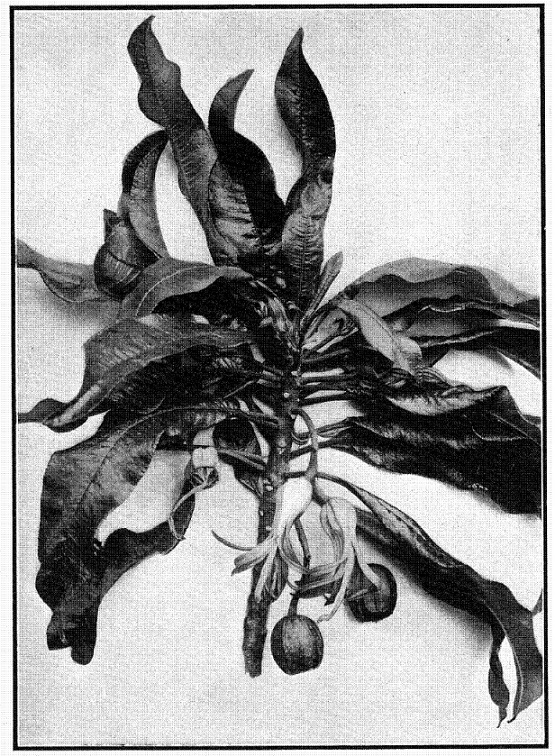
CLERMONTIA HAWAIIENSIS (Hbd.) Rock. Ohawai. Flowering and fruiting specimen from near the Volcano of Kilauea, Hawaii; elevation 4000 feet. One-half natural size.
Page 479
This species occurs in the semi-wet forest on the land of Keauhou about three miles from the Volcano House. It becomes exceedingly plentiful as one penetrates into the interior. It usually grows on the trunks of Cibotium tree ferns or is also occasionally terrestrial. It is associated with Acacia Koa, Metrosideros polymorpha, Perrottetia sandwicensis, Straussia sp., Myoporum sandwicense, etc.
The specimens found lower down along the government road comes nearer to Cl. macrocarpa; while the plants found back of Hilo are Clermontia macrocarpa. The plants found below the Volcano House and those beyond Shipman's paddock on Keauhou, cannot be very well separated, and therefore the writer found it advisable to make it a species, as the plants from the type locality can certainly not be called a variety of C. macrocarpa.
Collected April, 1911, July, 1911, and July 9, 1912, in company with Mr. W. M. Giffard. The type is No. 8803 in the College of Hawaii Herbarium.
Clermontia gaudichaudii (Gaud.)Hbd.
Haha or Hahaaiakamanu.
CLERMONTIA GAUDICHAUDII (Gaud.) Hbd. Fl. Haw. Isl. (1888) 243; — Del. Cast. Ill. Fl. Ins. Mar. Pacif. VII (1892) 211. — Delissea clermontioides Gaud. Voy. Bon. (1838) pl. 47, (1866) p. 64; — Gray Proc. Am. Acad. V (1862) 147; — H. Mann. l. c. p. 178; — Wawra in Flora (1873) 8. — Clermontia clermontioides Heller Pl. Haw. Isl. (1897) 906. Clermontia Clermontioides (Gaud.) Heller, would really be correct but owing to the silliness of the combination, Hillebrand's name is here retained.
Leaves elliptico oblong to lanceolate 8 to 12 cm x 1.5 to 4 cm on petioles of 2 to 3 cm, acute at both ends, crenulate, glabrous, pale and dull, chartaceous; peduncle short about 1 cm; pedicels 12 to 15 mm, bracts 1 mm; calyx broad campanulate about 15 mm high with 5 short acute teeth; corolla arched as much as in C. oblongifolia, about 4 cm long and 1 m wide, greenish purple, anthers pale, glabrous; berry globose, furrowed, 22 to 25 mm in diameter.
This species, which is peculiar to the middle forest region of the Island of Kauai, is either a shrub or small tree, with many candelabra-like braches forming a beautiful round or flatish crown. It grows mainly along stream beds, and is plentiful along Waialae gulch (4000 feet). It also grows in the swampy high plateau in gray, muddy soil, or can often be found on other trees between their main branches in accumulated humus.
It ascends even as high as to the foot of Mt. Waialeale (4600 feet), where it grows in company with the curious Gunnera petaloidea, or Apeape, along Kaluiti and Kailiili streams.
The natives, as well as the birds, are very fond of the large, sweet, yellow berries, from which the tree receives it name, Haha or Oha being the native generic name for all Clermontiae, while ai a ka manu is the specific one, meaning "eaten by the birds."
Page 480
Plate 200.
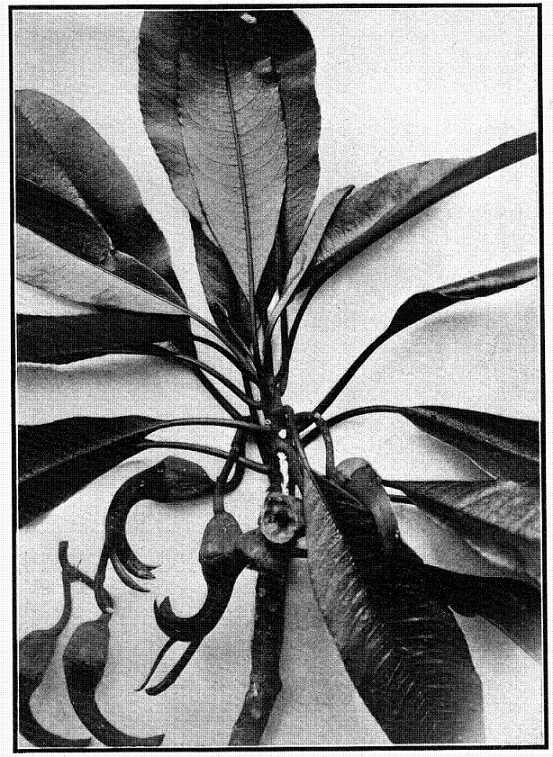
CLERMONTIA PELEANA Rock sp. nov. Flowering specimen from near Kilauea, Hawaii. More than one-half natural size.
Page 481
Plate 201.
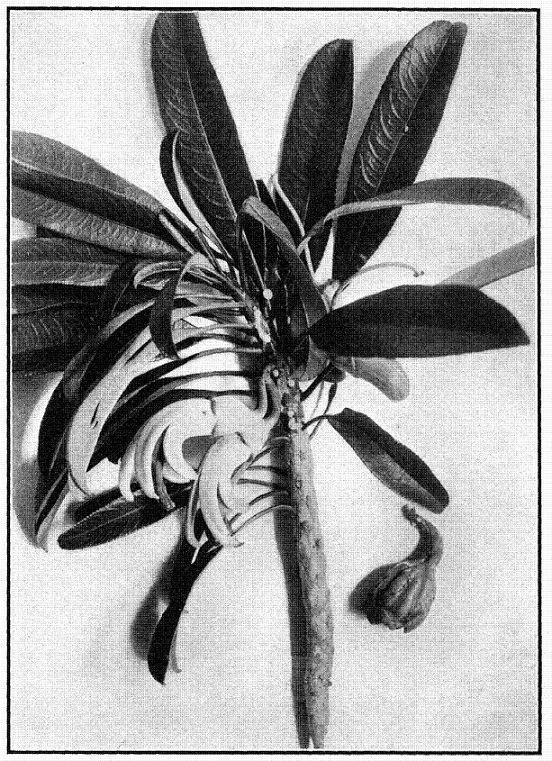
CLERMONTIA ARBORESCENS (Mann) Hbd. Less than half natural size; showing flowering branch and fruit.
Page 482
Plate 202.
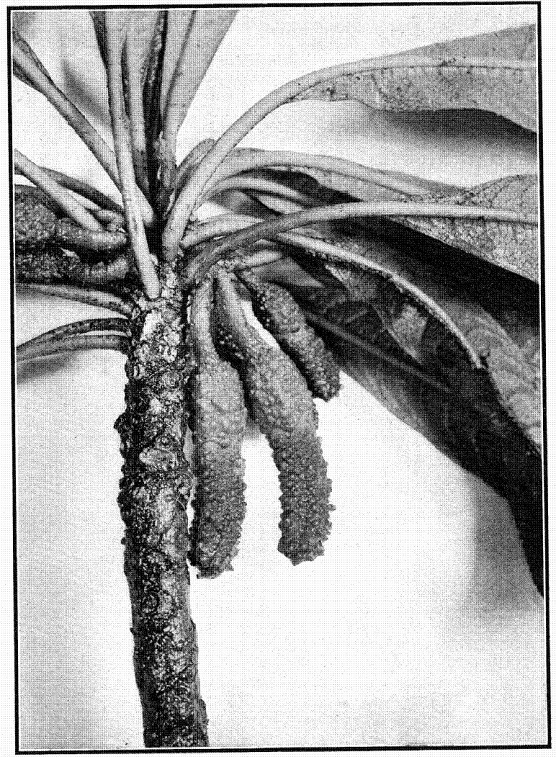
CLERMONTIA TUBERCULATA Forbes Natural size, showing flowerbuds. Note tubercles on the inflorescence.
Page 483
Clermontia Peleana Rock.
(Plate 200.)
Leaves oblong acuminate 18 to 20 cm long by 3.5 to 4.5 cm wide, dark green above, glossy somewhat lighter underneath, with dark purple veins and midrib, irregularly crenate to nearly the base of the leaf, which is on a petiole of 4 to 6 cm; flowers axillary usually two on a short peduncle of 1.5 cm with two small linear bracts at the middle; pedicles 3 to 4 cm with two bracteoles at their common base; calyx dark green, the ovarian portion turbinate 1.5 to 2 cm in diameter, with minute teeth; corolla strongly arched when open, 4 to 5 cm, dark blackish purple, thin not fleshy, silky, the apex almost returning to the level of the base; staminal column glabrous dark purple, as are the anthers of which the two lower are penicillate; style glabrous with a bluntly two-lobed stigma; fruit unknown.
This species, which is a small, glabrous tree 20 feet in height, has long, more or less rambling branches. It was discovered by the writer on the Island of Hawaii, in the middle rain forest zone, at an elevation of 3800 feet, four or five miles below Kilauea volcano, along the government road. Only three plants were observed, one of which had never flowered. It is a very handsome species, and is associated with Clermontia Hawaiiensis, Cheirodendron Gaudichaudii, Cyrtandra, Cibotium tree ferns, Ilex, etc.
It is named after the Hawaiian goddess Pele, whose abode is in the fires of Kilauea, in the vicinity of which this tree grows.
The type is in the Herbarium of the College of Hawaii, No. 8800, collected flowering in July, 1911, and July 10, 1912.
Clermontia arborescens (Mann) Hbd.
Oha wai.
(Plate 201.)
CLERMONTIA ARBORESCENS (Mann.) Hbd. Fl. Haw. Isl. (1888) 242; — Del. Cast. Ill. Fl. Ins. Mar. Pacif. VII (1892) 221. — Cyanea arborescens Mann. Proc. Am. Acad. VII (1866) 183. — Delissea Waihiae Wawra in Flora (1873) 8.
Leaves obovate oblong 12 to 16 cm x 4 to 5 cm, on petioles of 3 to 6 cm, shortly acuminate or rounded, narrowing at the base, crenate or serrulate, coriaceous, dark green, glossy above, paler underneath; peduncle very short fleshy, two flowered only, the pedicels about 25 mm or also 35 cm, bracts small, bractlets at the base of the pedicels; calyx green with a campanulate tube of about 20 mm and thick obtuse or deltoid lobes of very variable length, separated by sinuses when small and partly connate when large; corolla exceedingly thick and fleshy, strongly arched about 6 cm long of an even width, greenish white or sometimes cream colored with a tinge of reddish purple; anthers glabrous; berry yellow very deeply furrowed and crowned by the calycine lobes; seeds pale yellow shining.
It is one of the most common Clermontia, next to the Oahuan C. macrocarpa, but unlike the latter inhabits the middle forest zone between 2000 and 4000 feet. It occurs on the three central islands, but is absent on Oahu, Kauai, and Hawaii. It is peculiar to the wet forests, where it is a small tree 15 to 25 feet in height. The yellow berries, which reach the size of alittle lime, are eaten by birds and the natives. It is conspicuous by its monstrous fleshy inflorescence, which is, next to that of C. drepanomorpha, the largest in the genus. The Oha wai can be found along the Kula pipe line trail, East Maui, where it is extremely common. Also on West Maui (Kaanapali), Molokai (Pelekunu), Lanai (Haalelepakai), usually in company with species of Cyanea and Clermontia grandiflora.
Page 484
Plate 203.
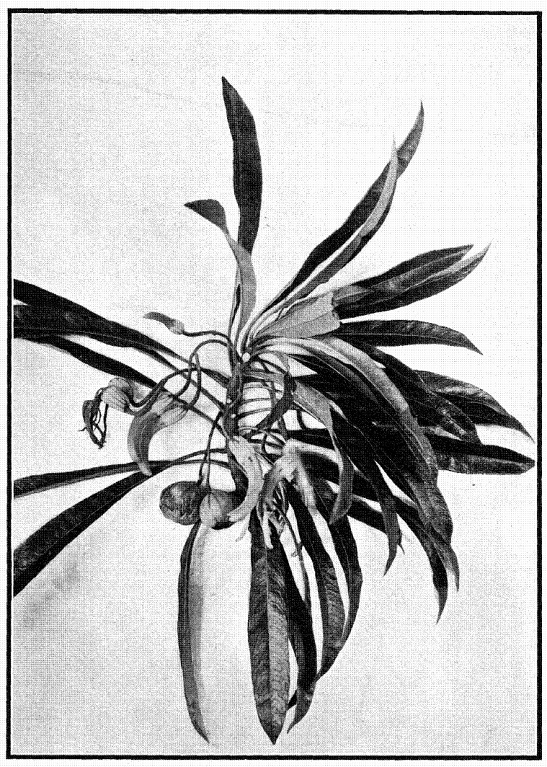
CLERMONTIA COERULEA Hbd. One-third natural size, showing flowers and fruits.
Page 485
Clermontia tuberculata Forbes.
(Plate 202.)
CLERMONTIA TUBERCULATA Forbes Occas. Papers B. P. Bish. Mus. V. (1912) 8, pl. 3.
Leaves obovate to oblong, serrulate, glabrous, coriaceous, the veins of the underside minutely tuberculate 19.5 cm to 4 cm, with petioles 2 to 3 cm long; peduncle two-flowered 5 mm long pedicels 3 cm, both covered with small tubercles; calyx tube campanulate with short obtuse lobes, which together with the thick fleshy corolla is covered with pronounced tubercles; anthers dark red, glabrous; berry globose, strongly tuberculate on the outside 1.3 cm in diameter; seeds smooth, yellow, shiny, ovoid.
This small tree, which reaches a height of about 12 to 15 feet, was discovered by Mr. C. N. Forbes of the Bishop Museum, who collected it on the Island of Maui on the slopes of Haleakala, in the wet forests near Ukulele (5000 feet).
The writer collected specimens of this species a year later from the identical tree from which Mr. Forbes derived his material. One other tree was seen along a stream bed, its branches touching the rushing waters, between Puukakai hill and the Kula pipe line trail, when in company with Dr. P. Ceresole.
It comes nearest to Clermontia arborescens Hbd., but does not grow to such a size. It is very distinct species, differing from all other Clermontiae in its tuberculate inflorescence, a character which, however, occurs in certain species of Cyanea new to science.
Clermontia coerulea Hbd.
(Plate 203.)
CLERMONTIA COERULEA Hbd. Fl. Haw. Isl. (1888) 243; — Del. Cast. Ill. Fl. Ins. Mar. Pacif. VII (1892) 211.
Leaves oblong 12 to 15 cm long 2 to 4 cm wide on petioles of 3 to 5 cm shortly acuminate, contracting at the base, minutely denticulate, glabrous above, membraneous, with a scattered pubescence along the mdirib underneath; peduncle slender 2.5 to 4 cm long, with a pair of short bracts considerably above the middle, pedicels of the same length or longer (in Hillebrand's specimen the pedicels are shorter) than the peduncle, bracteolate below the middle; (Hillebrand's statement that the bracteoles are at the middle is incorrect; his specimen of C. coerulea which I examined has the bracteoles also below the middle) calyx colored, the tube about 15 mm, turbinate, the lobes either large 15 to 17 cm or minutely denticulate; corolla moderately curved about 4 cm long greenish in Kau specimens, purplish in Kona specimens, of a thin texture; berry globose yellow about 2 cm in diameter somewhat furrowed.
What Clermontia macrocarpa is to Oahu, Clermontia coerulea is to Hawaii, especially on the southern end. It is the most common Clermontia on the slopes of Mauna Loa in Kau, from where it ranges way over to North Kona. It can be found at an elevation of 2000 feet above Naalehu, Kau, in wet rain forests up to an elevation of 4000 feet. It also occurs in the wet forest back of Kapua, where it extends up into the Koa belt. It is not uncommon in the forests above Kealakekua and on the slopes of Hualalai back of Huehue. In Kau it is a tree 15 to 20 feet in height with a trunk of about 4 to 5 inches in diameter, and is freely branches. In the specimens from Kau, the calycine lobes are minutely denticulate, while in the Kona specimens the lobes are broad deltoid. In the latter locality it is a shrub.
Page 486
Plate 204.
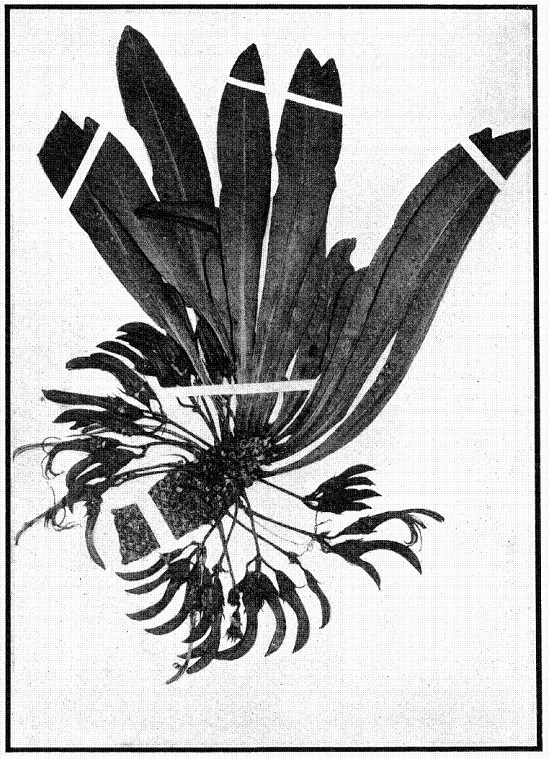
CLERMONTIA HALEAKALENSIS Rock. Less than half natural size.
Page 487
Plate 205.
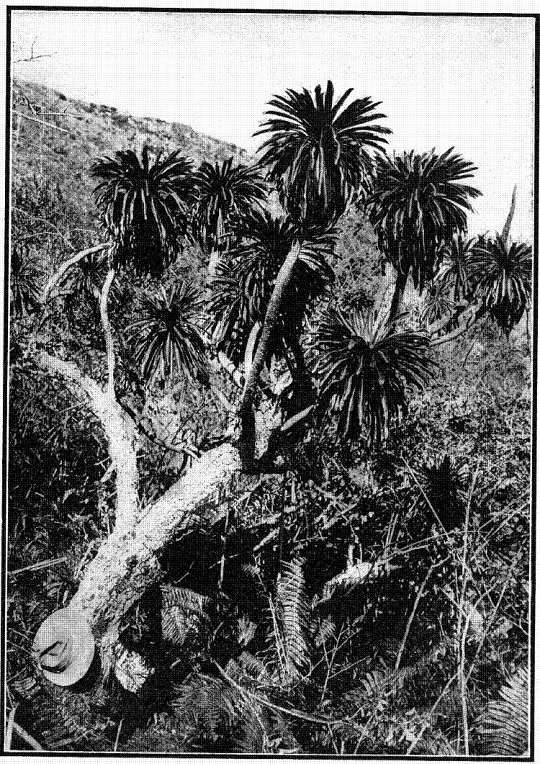
CLERMONTIA HALEAKALENSIS Rock. Growing on the inner crater wall of Puunianiau, slopes of Mt. Maleakala; elevation 7000 feet. Island of Maui.
Page 488
Plate 206.
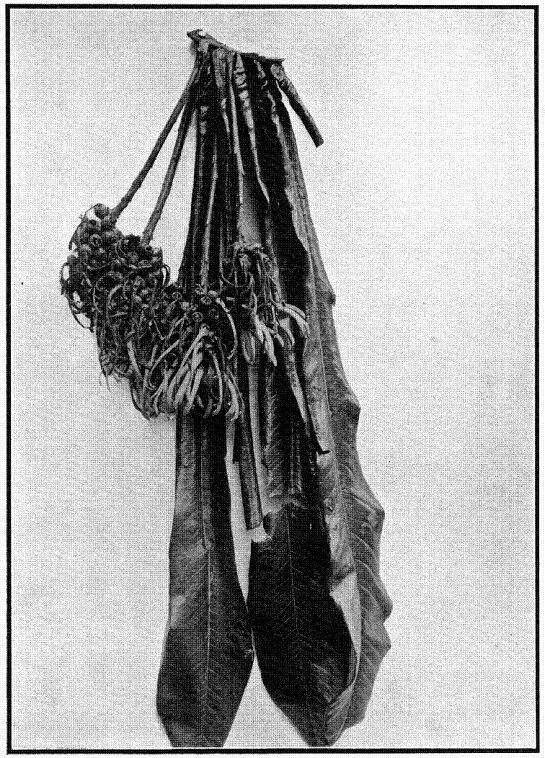
CYANEA ARBOREA (Gray) Hbd. Portion of crown of leaves with inflorescence; less than one-third natural size.
Page 489
Clermontia Haleakalensis Rock, sp. nov.
Leaves 20 to 30 cm long including the short margined petioles, fleshy, 1.5 to 4 cm wide, obtuse, oblong lanceolate, dark green above, pale underneath, midrib thick prominent, veins impressed, pellucid, the upper half crenate, lower half entire, glabrous, gradually tapering into a short margined petiole; cymes in the axils of the leaves, peduncle 2 to 5 cm long, bearing usually 6 flowers on pedicels of 1 to 1.5 cm, the bracts linear subulate about 7 mm, the pedicels bibracteolate below the middle; calyx tube oblong turbinate 1.5 cm slightly pubescent, the lobes linear subulate 5 mm long, corolla whitish green 3.5 to 4 cm long, curved, the dorsal slit not always extending to the base, sometimes only to the middle, lobes linear lanceolate glabrous; staminal column white pubescent at the base, as is the disc, glabrous in the upper part, the two lower anthers penicillate; style slightly pubescent, inner side of the staminal column hispid with white hair in the lower half, berry oblong, seeds smooth whitish.
A small tree 10 to 20 feet tall, with few very robust branches, having at first glance the aspect of a Dracaena. It is soft-wooded, and glabrous. This very curious tree, which has almost an antediluvian appearance, comes nearly between Clermontia and Cyanea. Its decidedly cymose inflorescence places it with the former genus, while the dorsal slit of the corolla does not always extend to the base, but the middle. It also has a characteristic of the genus Delissea, and that is the thickened portion or knob in the flower bud about the middle, indicating the termination of the dorsal slit; though the seeds, which in Delissea are deeply wrinkled, are smooth and shining in the species in question.
This remarkable tree is undoubtedly one of the oldest forms of our Hawaiian Lobelioideae, as it is so strikingly different from all the rest of the Lobelioideae inhabiting these islands.
This particular species was discovered by the writer October 11, 1910, on the Island of Maui, on the western slopes of Mt. Haleakala, on the crater of Puunianiau, at an elevation of 7000 feet, in a locality where no one would expect to find a member of this wonderful tribe. It grows in open, dry scrub in company with plants belonging to the upper forest zone, such as Raillardia platyphylla, Argyroxiphium virescens, Sophora chrysophylla, Santalum Haleakalae, etc. Unfortunately, only three trees are in existence, and as they are peculiar to the above locality, it will not be long before they will have shared the fate of so many of our native trees, becoming extinct, as cattle have free access and browse on the lower branches within their reach. The writer appealed to the manager of Haleakala ranch to protect these trees from the ravages of cattle, which he kindly promised to do.
The type specimen is No. 8595 in the Herbarium of the College of Hawaii.
CYANEA Gaud.
(Kittelia Reichb., Marcrochilus Presl.)
Calycine lobes of variable length, from dentate to foliaceous; the dorsal slit of the corolla extending to the middle. The two lower small anthers or all penicillate; seeds crustaceous shining smooth. Shrubs or small trees with erect simple stem or branches, occasionally covered with thorns. Leaves entire, lobed, or pinnate. Flowers bluish or purple or white in axillary racemes.
Page 490
Plate 207.
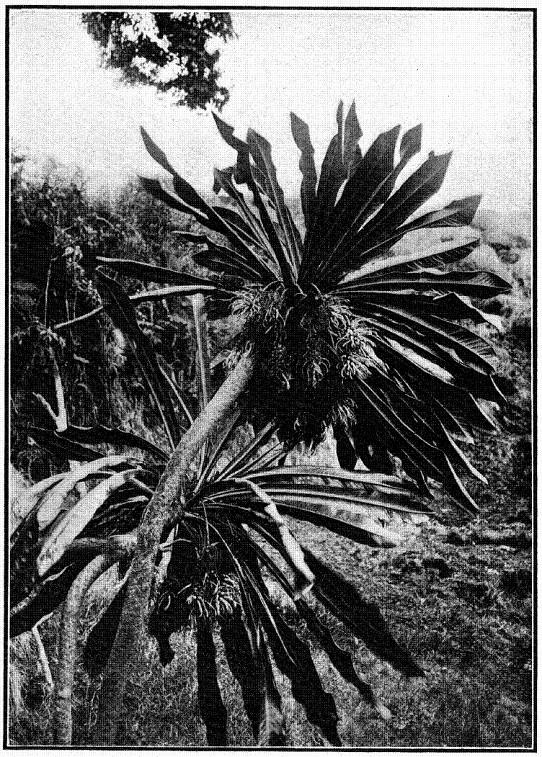
CYANEA ARBOREA (Gray) Hbd. Side view. At Ulupalakua, Maui. Note the dense inflorescence.
Page 491
Plate 208.
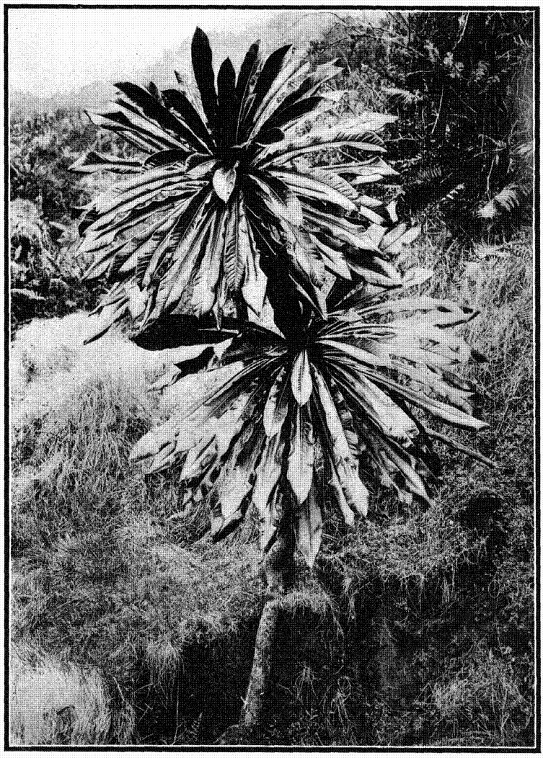
CYANEA ARBOREA (Gray) Hbd. Front view. Growing in a small gulch at Ulupalakua, Maui; elevation 5500 feet.
Page 492
Plate 209.
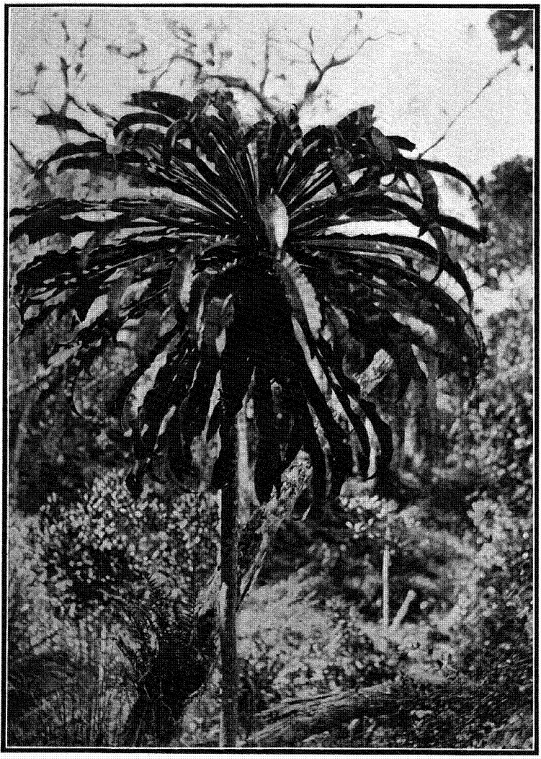
CYANEA LEPTOSTEGIA A. Gray. Hahalua. Plant reaches a height of forty feet. Growing in the forest of Kaholuamano on Kauai..
Page 493
The genus Cyanea is endemic in the Hawaiian Islands and possesses more species than either Clermontia or Delissea. All the species are shrubby, with three exceptions. One species, C. leptostegia, reaches 40 feet in height, and is the tallest of any of our Lobelioideae. The genus consists of many species, 31 having been so far described, while many more have been discovered by the writer which will be published in a monograph on this tribe, bringing the number of species of Cyanea probably up to 45, or even more.
The genus Cyanea consists of milky shrubs or trees with a single erect or branching stem, which includes a medullary cavity. Flowers are arranged in racemes.
KEY TO THE SPECIES.
| Calycine lobes shorter than the tube. | |
| Flowers grayish white or cream colored. | C. arborea |
| Calycine lobes longer than the tube. | |
| Flowers dark purple. | C. leptostegia |
Cyanea arborea (Gray) Hbd.
CYANEA ARBOREA (Gray) Hbd. Fl. Haw. Isl. (1888) 261; — Del. Cast. Ill. Fl. Ins. Mar. Pacif. VII (1892) 219. — Delissea coriacea var. β A. Gray l. c. p. 148; — H. Mann l. c. p. 178. — Delissea arborea H. Mann l. c. p. 180. — Cyanea longifolia Heller l. c. p. 909.
Leaves sessile oblanceolate 40-65 cm x 7-12.5 cm, shortly acuminate or rounded and apiculate, gradually narrowing toward the base, faintly dentate, but almost entire and wavy towards the base, glabrous or pubescent along the rib, glossy, chartaceous to coriaceous; peduncle slender but stiff 15-30 cm long, almost naked above, closely many flowered in the last fourth, pedicels short 3.8 mm; bracts 2-4 mm; bractlets 1 mm; calyx subglobose, glabrous, shortly toothed, the tube 6 mm; corolla slender moderately curved, suberect 5 cm long, 5 mm wide, glabrous grayish white, rather thin, with a deep dorsal slit and connivent lobes; staminal column glabrous; berry globose, faintly ribbed, 10-12 mm in diameter.
A tree 12 to 24 feet tall of palm-like habit with a crown of leaves at the apex of the stem, the latter measuring about 4 inches in diameter or more.
This is one of the most handsome Lobelias which the islands possess. Unfortunately it is exceedingly scarce, and the writer fears that it has become extinct.
Where there was once a forest at Ulupalakula there is now only grassland with planted Eucalypti. The writer met with only one single plant in a small gulch which was inaccessible to cattle. For three days the writer searched for this beautiful Lobelia, and he had nearly abandoned all hope when he saw this handsome plant hidden in a small and very narrow gulch. It evidently is the last of its race. In the whole district of Ulupalakua there is now no forest at all, only here and there stands a tree of the araliaceous species Pterotropia dipyrena.
Cyanea comata, another beautiful lobeliaceous plant once common in this district, has vanished forever.
The plant is peculiar to Haleakala, Ulupalakua, Maui, and was once plentiful at an elevation of 4000 to 5000 feet. It flowers in the early spring.
Cyanea leptostegia A. Gray.
Hahalua.
(Plate 209.)
CYANEA LEPTOSTEGIA A. Gray Proc. Am. Acad. V. (1862) 149; — Mann Proc. Am. Acad. VII (1866) 184. — Wawra in Flora (1873) 47; — Hbd. Fl. Haw. Isl. (1888) 261; — Del. Cast. Ill. Fl. Ins. Mar. Pacif. VII (1892) 219. — Heller Pl. Haw. Isl. (1897) 908.
Leaves sessile narrow lanceolate, 40 to 48 cm x 4 to 5 cm denticulate or subentire, glabrous shining chartaceous, the midrib of the leaves hollow, leaves of young plants lobed, the lobes extending sometimes to the midrib; peduncle (with flower) 2 to 3 cm slender, naked below, many-flowered at the apex, 10 to 20 flowers in a crowded cluster on pedicels of about 8 mm, bracts linear, twice as long as the bractlets; calyx glabrous, the tube cylindrical, lobes linear or filiform, sometimes 4 cm long; corolla dark purplish red, glabrous, semierect and slender about 4 cm long and 4 mm broad, anthers glabrous; berry ovoid, yellow, crowned by the filiform calycine lobes.
The Hahalua, which reaches a height of sometimes 40 feet, or about 13 m, has a pronounced palm-like habit, possessing a single erect trunk which is densely covered in its upper portion with rhomboid leaf-scars, bearing at the end a crown of sessile leaves.
The Hahalua is peculiar to the Island of Kauai, where it inhabits the middle forest zone on the leeward side in the driver and more open districts. It is associated with Antidesma platyphyllum var. β., Xylosma Hawaiiense, Maa sandwicensis var., Pisonia sandwicensis, Cyanea spathulata, and Cyanea hirtella. It flowers in the summer months.
Numerous species of caterpillars feed on the fruits and withered flowers.
The leaves of the young plants are always lobed, a characteristic found quite often in young plants of Cyaneae, especially in those of Section III Palmaeformes. The milky juice of this species is yellow.
:::
Page 508
ADDENDA.
Descriptions of New Species other than Trees.
Lobelioideae.
Cyanea pilosa Gray.
Var. densiflora Rock var. nov.
Leaves oblong-obovate, same as in the species; somewhat fleshy, white or silvery underneath, dark green above; the hirsute 10-16 flowered peduncle very short, pedicels hirsute; flowers white or with purplish tinge; staminal column white glabrous; anthers white, hirsute, the lower ones penicillate only; berry dark orange colored, 10-ribbed, crowned by the small linear calycine lobes, sparingly hispid.
Hawaii: — Southern slopes of Mauna Loa in the forest back of Naalehu, Kau, in swampy jungle, terrestrial, elevation 4000 feet; flowering and fruiting January 9, 1912; Rock no. 10001 in the Herbarium of the College of Hawaii.
Var. glabrifolia Rock var. nov.
Herbaceous, terrestrial, about 9-10 dm high, the stem strigosely hispid; leaves elliptical oblong, acuminate at both ends, thin chartaceous, pale green above, paler underneath, 18-28 cm x 5-8 cm, on hirsute petioles of 2 1/2-3 cm, young leaves densely hispid underneath, old ones glabrous above, hispid along the midrib and veins; flowers several on a hirsute peduncle of about 7 cm, bracteate above the middle; pedicels 6-10 mm long, filiform, sparingly hispid and bibracteolate at the base; bracteoles linear lanceolate, about 4 mm long; calyx greenish, the ovarian portion 5 mm, the lobes of nearly the same length (4 mm); corolla greenish white, sparingly hispid, 2 cm long; staminal column glabrous, whitish, the anthers densely hirsute; berry glabrous, oblong, dark orange, crowned by the calycine teeth; seeds light yellow.
Hawaii: — In dense swampy forest near Kilauea, elev. 3700 ft., but especially numerous in Mr. W. M. Giffard's mountain lot, Kalanilehua; outside the fenced portion in the forest it is scarce owing to cattle which are allowed to graze in portions of the forest. The plant is usually small and can easily be overlooked, as it grows in dense shaded places, hidden under the numerous ferns and other foliage. Rock no. 8805, flowering and fruiting July, 1911; Type in College of Hawaii Herbarium.
Var. Bondiana Rock var. nov.
Plant about 8 dm high, terrestrial, stem hirsute; leaves short petiolate, coriaceous, ovate oblong, glabrous above, covered with a soft light brown tomentum underneath, acuminate at both ends, 10-14 cm x 3.5-5.5 cm; peduncles vey short 3 mm, few flowered, hirsute, as are the pedicels and calyx, the lobes of the latter of the same length as the ovarian portion, linear; (flower buds only) corolla purple, sparingly hispid; berry glabrous yellow, globose.
Hawaii: — Mountains of Kohala, about 7 miles above Awini, near summit in exceedingly dense swampy forest, altitude about 5000 feet; flowerbuds and fruiting June, 1910. Rock, no. 8727 in the herbarium College of Hawaii, T. H.
Named in honor of Dr. B. D. Bond of Kohala for many courtesies rreceived from him by the author.
Page 509
Var. megacarpa Rock var. nov.
Plant erect, terrestrial, stem hirsute, leaves large, obovate oblong, blunt at the apex, narrowing suddenly into a fleshy petioles of 5 cm, with few scattered single hairs above, sparingly hispid underneath, 20-22 cm x 9.5-10.5 cm; berries large, 22 mm in diameter, globose, crowned by the broadly triangular 8 mm long calyx lobes (flowers unknown).
Hawaii: — Mts. of Kohala in swampy forest back of Waimea, along the Alakahi gorge, elev. 4200 ft. Only one plant observed; fruiting June, 1910, Rock no. 8728, in the herbaium, College of Hawaii, T. H.
Cyanea Bishopii Rock sp. n.
Cyanea Kunthiana? Hillebr. Fl. Haw. Isl. (1888) 264; — Drake Del Cast. Ill. Fl. Ins. Mar. Pac. VII. (1892) 219.
Plant subherbaceous, woody only at the base 10-14 dm high, rarely branching leaves crowded at the top, obovate oblong, bluntly acuminate at the apex, gradually tapering into a margined petiole of ca 3 cm; leaves 20-30 cm long, 4-7 cm wide (measured at their widest portion) sparingly hispid with scattered whitish hairlets above, pubescent underneath especially along the veins and midrib; inflorescence densely clustered along the stem, immediately under the leaves, extending down for about 12-15 cm; flowers numerous on a short hirsute many bracteate peduncle, ca 8 mm in length; pedicels 5-6 mm when with flowers, 12 mm when with fruit, bibacteolate above the middle, bracteoles linear subulate ca 3 mm; calyx hirsute the subglobose ovarian portion 6 mm, calycine lobes as long as the tube or longer; corolla slender, somewhat curved, 3 cm long, 4 mm wide, hirsute, pale purple or lilac with whitish streaks, lobes very short, 3-4 mm, retrorsely dentate above, the dorsal slit extending one-third the length of the tube; staminal column sparingly hispid, anthers densely covered with strigose pale purplish hair, the lower ones only penicillate; berry subglobose, deep orange ca 8 mm in diam., crowned by the calycine lobes.
Maui: — Back of Lahaina, West Maui, 4000 ft. on the ridge overlooking Wailuku, coll. by E. F. Bishop, Jan., 1871. Slopes of Haleakala, wet forest between Waikamoi and Honomanu gulch, along Kula pipe line trail in dense swampy jungle, elev. 4200 ft., west of Olinda, East Maui; fruiting October, 1910; Rock no. 8572; flowering May, 1911; Rock no. 8806, Herbarium, College of Hawaii.
Cyanea stictophylla Rock sp. n.
Plant 2 m high, erect, not branching; leaves 20-30 cm long, 4-4.5 cm wide, linear lanceolate, bluntly acuminate at both ends, narrowing into a petiole of 2.5-3 cm, glabrous above and evenly punctate with glandular points, hirsute underneath especially along the midrib and veins, with an undulate or irregularly notched margin, peduncles axillary 1-2.5 cm long, hirtellous, bracteate at the apex, usually 5-flowered, pedicels hirtellous 7-15 mm long, bibracteolate below the middle; calyx green puberulous, ovarian portion ovoid, calycine lobes triangular about 2 mm (flowers unknown).
Hawaii: — Mts of Kaiholena, in rain forest southern slopes of Mauna Loa, Kau, elevation 6000 ft. Jan., 1912; Rock no. 10055, shortly after flowering with immature fruits. Type in Herbarium, College of Hawaii. The plant belongs to the group to which Cyanea pilosa belongs, to which it is related.
Page 510
Cyanea aculeatiflora Rock sp. n.
Plant 3-7 m tall single stemmed or occasionally branching not far above the ground, covered with leaf-scars especially in the upper half; leaves at the ends of erect stems, large 40-60 cm x 10-20 cm, thick and stiff, dark green above, lighter underneath, the midrib as well as the 15 cm long fleshy petiole muricate; the upper side muricate at the angles of the veins, densely hispid underneath; inflorescence muricate throughout with aculeate tubercules; arranged in cymes in the axils of the leaves, on a common peduncle of about 8 cm with large foliaceous bracts of 3-4 cm, the ultimate pedicels 1 to 1.5 cm; calyx oblong, 2 cm long the oblong liner muricate lobes 2.5 cm x 0.5 cm; corolla dark purple, curved, muricate with yellow spines, the lobes bluish white, spreading, muricate on the outside; staminal column glabrous, purple, longer than the 5 cm long tube, of the corolla, anthers dark purple, glabrous, the two lower penicillate; style thickening towards the shortly two-lobed hirsute stigma; fruit unknown.
Maui: — Northwestern slopes of Haleakala in dense rain forest along streams or swampy ground, terrestrial, from Waikamoi to Honomunu gorge, elev. 4000 ft.; flowering Sept., 1910, Rock. no. 7513, type Herb., Board of Agriculture & Forestry, T. H. It grows in company with Clermontia arborescens, Cyanea hamatiflora, Tetraplasandra, etc.. The young plants are covered with spines throughout while the trunk of old ones is prickly only at the base.
Cyanea hamatiflora Rock sp. n.
Plant 3-4 m high, unarmed, glabrous, erect not branching; leaves broadly lanceolate, somehwat acute, broadly sessile at the base 60-70 cm long, 10-14 cm wide, puberulous above, pubescent underneath, midrib thick fleshy red, irregularly serrate with callous teeth; flowers on short peduncles in the axils of the leaves under which they are hidden; bracts lanceolate acuminate with a prominent median nerve, pedicels 5-6 mm with linear lanceolate bracteoles at their base; calyx ovate, green, 1.5 cm x 6-7 mm, lobes of irregular length, the lower two usually much shorter than the remaining three, lanceolate, obtuse the lower 12-14 mm, the upper 15-18mm x 4 mm; corolla purplish red, unilabiate, the dorsal slit extending more than one-third of its length, lobes sharply curved at the apex only, thick in texture and somewhat hirsute, staminal column glabrous, anthers sparingly hispid along the sutures, the two lower ones long penicillate. The whole inflorescence exudes a very viscid resinous substance especially when with young flowerbuds, which adhere to the paper in the Herbarium.
Fruit obovate-oblong dark purplish-red 10-12 ribbed, crowned by the long calycine lobes, 4-cm long, 2.5 cm wide, purple inside, seeds dark brown, shining.
Maui: — Slopes of Mt. Haleakala, elev. 4000 ft. in dense rain forest, between Waikamoi and Honomanu. The plant is conspicuous by its broad sessile light green leaves, which stand out horizontally. It grows in company with Cyanea aculeatiflora, Clermontia arborescens, Cyrtandra sp., Phyllostegia, Stenogyne, etc.
Rock n. 8514 flowering Sept., 1910; type in Herbarium, Board of Agriculture & Forestry, T. H.
Cyanea Gayana Rock sp. nov.
Trunk 1.5-3 m high, hardly woody, erect, stem smooth, not branching, (only when broken) foliose at the apex, leaves thick fleshy, lanceolate oblong, bluntly acuminate, denticulate, gradually narrowing into a margined petiole of 1 cm, making it appear subsessile, the lower portion entire, dark green above glabrous or puberulous, veins and midrib bright red thick fleshy, lighter underneath, and covered with grayish pubescence; peduncles thick fleshy, multi-bracteate from the base, hispid strigose, bearing flowers from half its length to the apex; pedicels densely hirsute 1-1.5 cm long, bracteate at the base; calyx dark, hirsute as is the corolla, tube ovate-obconical, 6-8 mm, the lobes triangular dentiform, 4 mm; corolla, suberect magenta-red with darker streaks, 3-4 cm long by 4 mm wide, the dorsal slit extending to the base; staminal column glabrous as well as the anthers, of the latter the two lower only penicillate; fruit ovoid of a glaucous color about 2-1.5 (?) cm long, crowned by the calycine teeth.
Kauai: — Mountains back of Waimea, woods of Kaholuamano, elev. 4000 ft., along streams only, near Waialae and Waiakealoha on the high plateau in company with numerous other Lobelioideae, Kadua, Cyrtandra, Hillebrandia, Clermontia gaudichaudii, etc. Rock n. 2463, flowering Marching 10, 1909, and n. Sept., 1909, fruiting, (but fruits were lost, description of fruit from notes), Rock, 1905, flowerbuds Oct. 20, 1911. Named in honor of Mr. Francis Gay of Kauai to whom the writer is greatly indebted for extended hospitality on Kauai, and without whose aid the writer would have been unable to make such a thorough botanical survey of that part of Kauai.
Type in Herbarium, Board of Agriculture and Forestry, T. H.
Page 511
Cyanea rivularis Rock sp. n.
A shrub 4-5 m (cm?) high, stem simple or branching at the base, leaf whorls at the end of the tomentose branches; leaves linear oblong bluntly acuminate at both ends, crenate or serrate with callous teeth; 20-30 cm long by 3-8 cm wide; pubescent above, densely velvety tomentose underneath, and pale; on tomentose petioles of 4-8 inches; whole inflorescence tomentose including the blue corolla; peduncle 4-8 cm long, naked two-thirds of its length, many flowered, the pedicels 1-1.5 cm, bracts linear subulate; calyx dark purplish green, its teeth sharply triangular, corolla 3 cm long, light pale to whitish with dark ultramarine blue streaks, velvety tomentose with short white hairlets, the dorsal slit extending one-third its length, curved with a knob in the bud showing the termination of the dorsal slit, lobes short; staminal column glabrous, white, anthers bright blue, slightly pubescent at the base, only the two lower ones penicillate, stigmatic lobes pubescent outside; berry dark bluish-black, globose 1-1.5 cm in diameter, crowned by the calycine teeth, seeds whitish large, and somewhat minutely wrinkled.
Kauai: — Mts. above Waimea along streambeds at the high plateau only, elev. 4200 ft. or more. The banks near the head of Waialae stream are covered with this species their palm-like stems gracefully waving in the wind. Also near Waiakealoha waterfalls (Rock no. 5365, Waiakealoha, Sept., 1909, flowering, and Waialea stream; Rock no. 9010 flowering and fruiting Oct 15, 1911). Abundant in company with Lobelia hypoleuca, Cyanea Gayana, etc.
Cyanea atra Hbd. var. lobata Rock v. n.
Erect single stemmed with subentire and lobed leaves, petiole muricate, 6-7 cm, leaves coriaceous, when not lobed the margin is almost fringed; or lobed iregularly deeply but not to the rhachis; tuberculate above, covered with an olivaceous tomentum underneath; peduncle longer than in the species, 3-4 cm, many flowered bracts and bractlets as in species; pedicels 15-18 mm; calyx and corolla as in the species, the staminal column and anthers glabrous.
Maui: — Upper ditch trail leading from Ukulele, elevation 5000 ft. to Waikamoi gulch in dense rain forest. Only few plants observed, when in company with Mr. L. v. Tempsky of Makawao, (Rock no. 8337, flowering October, 1910).
Clermontia multiflora var. micrantha Hbd. forma montana Rock f. n.
A shrub 2-3 m high, many branched; leaves smaller than in the variety, thick coriaceous, veins and denticulate margins pink as is the petiole; flowers somewhat larger, pinkish-purple, calyx lobes glabrous, corolla slightly hirtellous, peduncle usually 2-flowered, berry 1.5 cm or more long, not subglobose, but ovoid oblong.
Maui: — On the highest ridge leading to Puukukui, West Maui Mountains, in swampy forest at an elevation of 4600 ft. Rock and Hammond, flowering and fruiting, August, 1910, no. 8179, in Herbarium, College of Hawaii. Differs from var. micrantha in the two-flowered peduncle and in the larger ovoid-oblong fruits.
Page 512
Clermontia parviflora Gaud. var. calycina Rock v. n.
A shrub; leaves as in the species on somewhat longer petioles; flowers usually three on a peduncle, calyx lobes subulate 5 mm long, corolla larger than in the species, bluish gray, pubescent.
Hawaii: — High plateau of Kohala Mts., back of Waimea along Alakahi ditch trail, elevation 4000 ft. (Rock no. 4793, flowering July 12, 1909).
The plant has decidedly the aspect of C. parviflora, but differs from it in its larger flowers and short calycine lobes.
Clermontia Gaudichaudii Hbd. var. γ singuliflora Rock v. n.
A shrub 1.5-2 m high, glabrous throughout, leaves coriaceous, coarser dentate, veins dark prominent, flowers somewhat larger single on long pedicels; calyx-lobes dentate, anthers glabrous, the lower ones penicillate.
Hawaii: — Not uncommon on the northern slope of Mauna Kea, Hamakua, on trees, usually Cheirodendron or Cibotium, upper forest of Paauhau No 1, (Rock no. 3252, flowering June 1909).
Differs from the species in its single flowers and long pedicels.