BULLETIN
OF THE
TORREY BOTANICAL CLUB
VOL. 45
FOUNDED BY WILLIAM HENRY LEGGETT, 1870
EDITOR
ALEXANDER WILLIAM EVANS
ASSOCIATE EDITORS
| JEAN BROADHURST | MICHAEL LEVINE |
| JAMES ARTHUR HARRIS | WILLIAM GEORGE MARQUETTE |
| MARSHALL AVERY HOWE | ARLOW BURDETTE STOUT |
| NORMAN TAYLOR | |
NEW YORK
1918 PUBLISHED FOR THE CLUB THE NEW ERA PRINTING COMPANY LANCASTER, PENNSYLVANIA
Page 133
Vol. 45 No. 4.
BULLETIN
OF THE
TORREY BOTANICAL CLUB
_____________
APRIL, 1918
_____________
New species of Hawaiian plants
JOSEPH F. ROCK
(WITH PLATE 6)
1. Cyanea giffardii sp. nov.
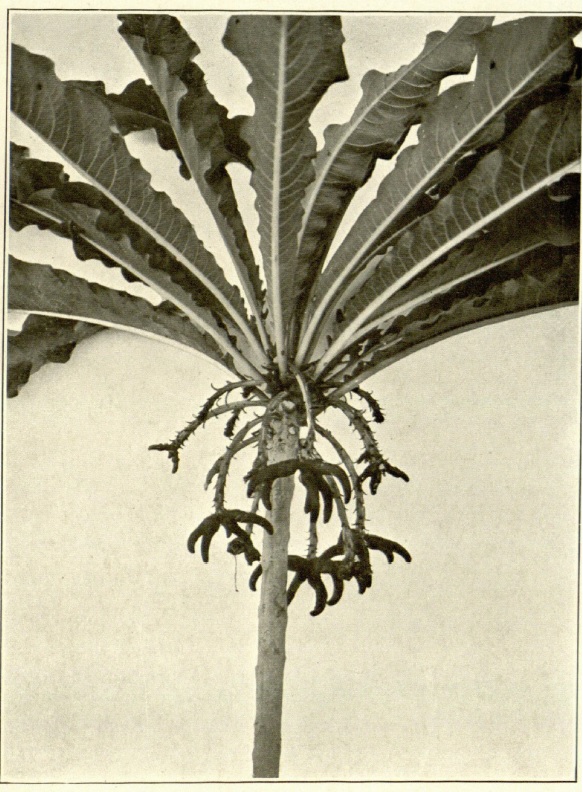
A tree 5-10 m. tall with a single trunk 15 cm. in diameter near the base, gradually tapering towards the apex, bark smooth, grayish green, with scattered leaf-scars, woody zone thin near the apex of the trunk, the medullary cavity septate by chartaceous diaphragms; leaves obovate-oblong, about 50 cm. long and 12-15 cm. wide, broadest portion in the upper third, margins strongly undulate and minutely denticulate, appearing sinuate, due to strong undulation, subentire with exception of the base, which is unevenly lobed, acuminate at the apex, mucronate, gradually tapering at the base into a stout petiole 3.5-6.5 cm. long, thin, subchartaceous, dark green and shining above, pale and dull underneath, midrib stout and prominent as are the lateral veins, the latter arcuate and united with other arcuate veins near the margin, the whole surface of the leaf covered with a pellucid reticulate net work, glabrous above, pubescent underneath, especially on the midrib and veins; peduncles axillary, drooping, stout, terete, glabrous, 10-16 cm. long or slightly longer, about 1 cm. thick, distantly bracteate the entire length, the upper bracts linear, 15-30 mm. long, 3-5 mm. wide, rounded and mucronate at the apex, bracts less distant towards the apex and also smaller; flowers on pedicels 2-3 mm. long with three small, acute bractlets at the base and dorsal side of the flower; calyx glabrous, dark purplish black, tube obconical, usually seven-ribbed, with two tubercles at the base, 18 mm. long, 15 mm. wide; calycine lobes broadly triangular, acute, 5 mm. each way, with broad sinuses intervening; corolla strongly arcuate, 7-8 cm. long, glossy, glabrous, dark purplish outside, slit at the back three fourths its length only when fully mature, the five lobes of the corolla entirely connate; staminal column protruding, perfectly glabrous, pale, anthers glaucous, glabrous, the two lower only penicillate; style black, the stigmatic hairs encircling the stigma, the latter yellowish tinged with purple; flowers usually ten on a peduncle, crowded at the apex; fruits globose, nearly 25 mm. each way, dark purplish black, locules small, each containing from six to twelve rather large whitish seeds; milky juice of the plant yellowish. [PLATE 6.]
Page 134
HAWAII: in the forest on the windward slope of Mauna Loa, near Glenwood at 22 miles, along the Homestead Road at an elevation of 2,200 feet, August 27, 1917, W. M. Giffard 12802, (flower buds) in the herbarium of the College of Hawaii; along the Volcano Road at 23 miles, in wet forest, September 1, 1917, Rock & Holm 12802b, (flowering and fruiting specimens), TYPE, in the herbarium of the College of Hawaii.
This very remarkable plant, which is closely related to Cyanea superba (Cham.) Gray, differs from it in the pubescent, deeply undulate leaves, which are lobed at the base instead of being entire; in the glabrous, much shorter peduncle, and in the glabrous deep purplish black flowers and fruits. Cyanea superba occurs on the island of Oahu in the gulches of Makaleha and Mt. Kaala, while Cyanea Giffardii occurs on the southernmost island of the group. It is also much statelier than Cyanea superba, as it reaches a height of thirty feet, with a single crown of leaves at the apex. It grows in company with Antidesma platyphyllum Mann, Labordia, Cyrtandra, Straussia hawaiiensis Gray, Strongylodon lucidum Seem., Clermontia parviflora Gaud., Cibotium Menziesii Hook. and C. Chamissoi Kaulf., the last two being the common tree ferns of the region.
When the species was first discovered by Mr. W. M. Giffard, in whose honor it is named, only two plants were observed, one with large flower buds and the other without flowers, the latter plant divided into three branches at the apex, on account of an injury. The mature type specimens, with flowers and fruit, were collected on the road to Glenwood and the Volcano, at an elevation of 2,400 feet. The largest plant seen was thirty feet in height. The plants are difficult to see in the forest as the trunk, which is usually covered partly with moss, does not branch and the crown of leaves is hidden amongst the foliage of other trees.
Page 135
Cyanea Giffardii may be Hillebrand's β var. of his Cyanea arborea from the woods of Hilo, Hawaii. The writer is well acquainted with Cyanea arborea and can only state that the new species is exceedingly different from the latter, and that it comes much closer to Cyanea superba. Cyanea arborea has a much larger and denser crown of leaves, which are sessile, and linear-oblong; the peduncles are much longer and the flowers are very thin, narrow and slender, suberect and whitish to gray.2. Cyanea rollandioides sp. nov.
Plant 1-1.5 m. high, stem simple, fleshy towards the apex, woody towards the base, stem muricate to spinose in the upper portion; leaves obovate-oblong, acute, fleshy when fresh, papery when dry, dark green above, paler underneath, but with dark purple midrib and veins and a prominent dark purple reticulate network, puberulous or glabrous on both surfaces, but more or less covered with spines on both sides, those of the upper surface yellow, those of the lower surface deep purple, margins eroso-dentate to irregularly notched, and somewhat uneven-sided at the base, 30-50 cm. long, 8-15 cm. wide in the widest portion, which is in the upper third, on fleshy stout spinose or muricate petioles, 8-15 cm. long; racemes glabrous, peduncle 3-6 cm. long, naked three fourths its lower length, but ddistantly covered with scars of fallen flowers, bearing in its upper fourth about fifteen flowers; bracts subulate, 3 mm. long, supporting each pedicel, the latter filiform, 10-25 mm. long, bibracteolate, the bracteoles alternate, one at about the middle of the pedicel the other near the apex, 0.25 mm. long; calyx tube turbinate to obovate-oblong, 7-10 mm. high, the linear calycine lobes as long as the tube; corolla deep purpish red or purple to pale yellowish white with dark purplish streaks, moderately arcuate, broadest at the middle, 5-8 mm., about 4.5 cm. long, thin and glabrous, dorsal slit very shallow, extending only one fourth of the length of the tube or a little beyond the two upper linear subulate lobes, the three lower lobes a little shorter; staminal column glabrous, as are the pale greenish anthers, the lower ones only penicillate; fruit unknown.
Page 136
HAWAII: Forest of Puna in dense woods along the Kalapana Road, not far from Pahoa, September 3, 1917, Rock & Newell 12831 (flowering specimens), TYPE, in the herbarium of the College of Hawaii.
This rather variable species is remarkably like a Rollandia. The plant varies considerably in the spinosity of the leaves, petioles and stems; some of the specimens almost approach Cyanea noli-me-tangere Rock in spinosity, while others are only muricate. The color of flowers is also variable, ranging from pale yellowish white with deep purplish streaks to entire dark purple. It is difficult to state to what known species the plant is closest related; in habit it approaches Rolland lanceolata Gaud., but actually seems to come close to Cyanea noli-me-tangere; from the latter it differs in the long-petioled leaves, which are much larger, and in the longer naked peduncles which are not spinose. The plant as a whole is much larger in every way, the flowers are purple as are the veins and midrib of the leaves; the whole inflorescence is glabrous. C. noli-me-tangere is very loosely foliate, while C. rollandioides is simple-stemmed and has at its apex a dense crown of leaves, this feature bringing it under the section Palmaeformes.
The plants grow in the wet forests of Puna on Hawaii, a little explored district and one of the most primitive regions on the island of Hawaii. A stalwart Hawaiian gave the writer the native name Aku-aku for the species in question, of which he said that the leaves were cooked with meat and eaten like cabbage. The name Aku along is applied to Cyanea tritomantha Gray, to which our plant has no resemblance. The species was collected in company with Brother Matthias Newell, of Hilo,, an ardent naturalist.
3. Rollandia angustifolia (Hillbrd.) sp. nov.
Rollandia longiflora β var. angusifolia Hillbrd. Fl. Hawaiian Isl. 246. 1888.
Stem smooth, 1-1.5 m. high, leaves linear-lanceolate, 18-35 cm. long, 2.5-3.75 cm. wide, thick, fleshy, dark green, glossy above, pale whitish underneath, with dark purplish midrib and veins, acuminate, mucronate at the apex, gradually narrowing at the base into a fleshy petiole 2-4.5 cm. long, glabrous on both sides; racemes slender, 3-4 cm. long, four-to five-flowered; pedicels thin, about 14 mm. long, bracteate at the base, bi-bracteolate about the middle; calyx turbinate, 1 cm. long, the apex truncate-dentate, or oftener lobed, the calycine lobes acute, of irregularly length, usually 3 mm. long, with a median nerve; corolla deep purplish red, 7-8.5 cm. long, 1 cm. wide, the lobes 1.5 cm., the dorsal slit extending one fifth the length of the tube; staminal column glabrous adherent up to about the middle of the corolla, the anthers glabrous, the lower only bearded; fruits globose, crowned by the tubular limb of the calyx, which disappears at the maturity of the fruit.
Page 137
OAHU: Mt. Konahuanui trail, Palolo Valley, Mt. Olympus, and Manoa Valley, Kalihi Valley, January, 1870, W. F. Hillebrand, without number, in Berlin Herbarium; June 14, 1908, H. L. Lyon 8816 in the herbarium of the College of Hawaii; September, 1912 and 1914, J. F. Rock 10250a, 10250b, in the herbarium of the College of Hawaii.
The plant in question is certainly worthy of specific rank. Young plants which the writer observed were of the same habit as mature ones, both having linear-lanceolate leaves, while the true Rollandia longiflora Wawra has sinuate leaves when young and also when in a mature state. R. angustifolia differs mainly in the linear, entire, minutely denticulate leaves, which give the plant an entirely different appearance from that of R. longiflora.
4. Lobelia oahuensis sp. nov.
Plant rather stout, stem short and thick, solid and not hollow; rosette of leaves very dense and about 1 m. in diameter; leaves densely packed around the apex of the stem, linear-oblong, acuminate at both ends, merging at the base into a winged fleshy petiole about 2.5 c. in length, 50 cm. long, 4.5-5 cm. wide, thick, coriaceous, dark green, glabrous above and covered with a strongly impressed, very close, reticular net work, young leaves densely hirsute underneath, especially along the very prominent projecting midrib and veins, of a dirty grey or fawn color on the older leaves, the margins revolute, denticulate with thick callous teeth; flowers not seen, a single dead terminal flower stalk was seen on one of the plants, which was about 1 m. long.
OAHU: at the very top of the main crest of the island, over-looking the cliffs of Waimanalo at an elevation approaching 3,000 feet, September 14, 1917, J. F. Rock 12836, TYPE, in the herbarium of the College of Hawaii. Several plants were seen growing together, the lower ones of which could not be reached owing to the vertical cliffs on which they grew, immediately below the knife-edge crest of the backbone of the island of Oahu. The plant forms a large rosette with the leaves densely packed at the apex in an almost horizontal position, that is, at right angles to the stem. It grows in company with Trematolobelia macrostachys (Hook. & Arn.), Zahlbr. Dubautia laxa Hook. & Arn., Metrosideros rugosa Gray, and other species. Notwithstanding that the flowers of this new species are unknown, the plant is so distinct from all of our other lobelias that it can well be described at present.
Page 138
The plant is evidently related to Lobelia hypoleuca Hillbrd., from which it differs in the solid stem, thick, coriaceous, closely reticulate leaves, not silvery underneath but hirsute, being covered with fawn-colored or dirty gray hair. In Lobelia hypoleuca, which is a branching species, the leaves are few and more or less scattered, thin and chartaceous; it does not ascend to such high elevation, but remains more at the lower levels, from 1,000 to 1,500 feet, in very sheltered situation, especially deep ravines.
5. Straussia glomerata sp. nov.
A medium-sized tree, 10 m. or more in height, trunk straight, crown round and of rather small dimension; stipules cup-shaped, not triangular, sheathing and of even height, 3 mm. high, soon deciduous; leaves obovate, coriaceous, glossy and smooth above, dull and pubescent beneath, especially along the midrib and veins, pubescent glands present in the axils of veins and midrib, 5-10 cm. long, 4.5-6.5 cm. wide, on petioles 15 mm. long, rounded at the apex, cuneate at the base; panicle erect, not drooping save when in full fruit, 2-4 cm. long, distinctly angular, hirsute with dirty yellowish hair, whorls two or three, of very short rays 2-6 mm. long; flowers sessile; calyx minute, 0.5-0.75 mm. long, densely hirsute, truncate; corolla greenish white, minute, tube 0.5 mm. long, lobes 1.5 mm. long, glabrous, stamens minute, filaments 0.25 mm. long; the convex disk densely hirsute; fruits numerous, densely agglomerate, forming a densely packed globose head, hiding all whorls and rays, fruits yellow, pubescent to hirsute, obovate, 9 mm. long, 6-6.5 mm. wide, crowned by a rounded, dome-shaped, projecting disk.
HAWAII: North Kona, in the forest of Waihou and on the lava flowers of Puuwaawaa, at an elevation of 3,700 feet, August 24, 1917, J. F. Rock 12829 (flowering and fruiting specimens), TYPE, in the herbarium of the College of Hawaii.
Page 139
This interesting species is very distinct from the other species in the genus, and is remarkable for the minute flowers, hirsute panicles and fruits which are densely glomerate, forming a densely packed, globose head, nearly as long as broad. It is related to Straussia hawaiiensis which deffers however in the loose and open-whorled drooping, glabrous panicle.
COLLEGE OF HAWAII,
HONOLULU, TERRITORY OF HAWAII.
Explanation of plate 6
Cyanea Giffardii Rock. Photograph of the type specimen, showing the crown of a flowering tree, twenty-four feet in height.
BULL. TORREY CLUB VOLUME 45, PLATE 6
CYANEA GIFFARDII Rock