OCCASIONAL PAPERS
BERNICE P. BISHOP MUSEUM OF
POLYNESIAN ETHNOLOGY AND
NATURAL HISTORY.
VOL. XI
HONOLULU, HAWAII
PUBLISHED BY THE MUSEUM.
1935-1936
HAWAIIAN PANICUM, METROSIDEROS, SANICULA, LOBELIA, AND ROLLANDIA
By
HAROLD ST. JOHN AND EDWARD Y. HOSAKA
BERNICE P. BISHOP MUSEUM
OCCASIONAL PAPERS
VOLUME XI, NUMBER 13.
HONOLULU, HAWAII
PUBLISHED BY THE MUSEUM.
NOVEMBER 12, 1935
Page 3
HAWAIIAN PANICUM, METROSIDEROS, SANICULA, LOBELIA, AND ROLLANDIA
By
HAROLD ST. JOHN AND EDWARD Y. HOSAKA
_______________
INTRODUCTION
In 1931 floristic and ecological studies of Kipapa Gulch, Oahu, were undertaken by E. Y. Hosaka under the direction of Professor Harold St. John. During the period of investigation (1931-34) about ninety field trips were made into the native forests of Kipapa Gulch and the plants of the region collected. Several new species of plants were found and some of them are described here. Sanicula Kauaiensis and Metrosideros macropus forma ruber are from other localities.
:::
Page 11
:::
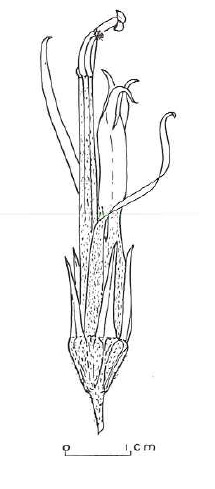 FIGURE 4. — Lobelia oahuensis.
FAMILY CAMPANULACEAE
Lobelia oahuensis Rock (fig. 4). Description amplified by Hosaka.
Plant 1-2 meters tall, with solid stem 4-7 cm in diameter, covered with leaf-scars, the upper part rusty tomentose; leaves 40-60 cm long, 4-6 cm wide, lanceolate, acuminate at both ends, the base tapering into fleshy petioles, which are 1-2.5 cm long, crowded at the apex, upper leaves smaller, glabrous and dark green above, below light green and white-hirsute; veins of lower surface prominent, midvein hispidulous above, margin revolute, with callous teeth; flowering stalks 3-7, the central flowering stalk 50-100 cm long, the axillary ones shorter, raceme 40-70 cm long, gray, wooly, hollow; pedicels 1-2 cm long, covered with grayish-white woolly hairs; bracts 2-4 cm long, 3-4 mm wide at base, acuminate at apex and broadly sessile at base, margin minutely serrate at middle portion, midvein prominent, purple, lower surface hispidulous to glabrous toward the base, upper surface villous toward the base, glabrous toward the tip; corolla 4-5.5 cm long, the outer surface covered with whitish villous hairs toward the base, glabrous toward the tip, inner surface glabrous, corolla splitting into 5 unequal linear lobes at maturity, two lobes spitting half the length of the corolla, the other three splitting only about 1-1.5 cm down from the tip, corolla pale blue, becoming paler at maturity; buds green; calyx 2-2.5 cm long, the ellipsoid tube 5-9 mm long, 8-10 mm wide at top, covered with grayish-white woolly hairs, the prominent veins purple, calycine teeth 1-2 cm long, 3-4 mm wide at base, tapering into an acute point, glabrous, with only a midvein; staminal column 4.5-6 cm long, about 3-6 mm longer than the corolla, upper portion pale blue, villous, anthers 7-10 mm long, light blue, glabrous, lower beak bearded, upper one glabrous; pistils protruding about 5 mm beyond the anthers at maturity, stigma green, bilobed, folding slightly backward; capsules 9-14 mm long, 7-10 mm wide, ellipsoid, tomentose with short grayish-brown hairs, 10-ribbed, the tip above the attachment of the long calycine lobes conic, tapering to a point; seeds 0.4 mm long, 0.3 mm wide, ovoid.
Page 12
Oahu, Koolau Range, Waipio, Kipapa gulch: along the crest, altitude 2,800 feet, September 18, 1932, E. Y. Hosaka no. 685 in fruit; August 6, 1933, E. Y. Hosaka no. 1156 in flower.
Rock 5, who collected this species at the top of the Koolau Range, Oahu, overlooking the cliffs of Waiamanalo at an elevation of about 3,000 feet on September 14, 1917, described the species from fruits and young buds. He says, "Flowers unknown but reported to be pale blue."
Rollandia lanceolata Gaudichaud, variety grandifolia De Candolle. Rollandia lanceolata Gaudichaud, variety grandifolia De Candolle, Prodr., vol. 7, p. 344. 1838. Rollandia lanceolata Gaudichaud, Bot. Voy. Uranie, p. 458, tab. 74 (as R. montana), 1826. Rollandia lanceolata Gaudichaud, variety typica Rock, in part, B. P. Bishop Mus., Mem., vol. 7, no. 2, pp. 371, 373, 1919.
Rollandia lanceolata has numerous varieties, hence it is convenient to use the aggregate concept for the species and to have variety alpha to represent the plant first described. The variety grandifolia is a synonym, as treated by Rock. The type specimen is Macrae, from "Woahoo" (or Oahu) in the Geneva Herbarium. Professor B.P.G. Hochreutiner has kindly examined this for us. He reports that the corolla "is quite glabrous outside and not puberulous." there is a duplicate of this in the Gray Herbarium, and Dr. L.B. Smith reports that is has the "corolla perfectly glabrous." Then there is no need to coin a new name for this, and the original plant of Gaudichaud can be called (instead of variety typica) variety grandifolia De Candolle.
___________________
5Rock, F. .J., Torrey Bot. Club, Bull., vol. 45, p. 137, 1918.
Page 13
Rollandia lanceolata Gaudichaud, variety Rockii St. John and Hosaka, new name. R. lanceolata Gaudichaud, variety typica Rock, in part, B.P.Bishop Mus. Mem. vol 7, no. 2. pp. 371, 373 1919.
The variety typica as described by Rock is based upon a curious confusion. The natural inference would be that it represented the original variety, that collected by Gaudichaud and described as R. lanceolata Gaudicaud. The Gaudichaud collection is not included in the list of representative specimens. However, it is dubiously mentioned in the next paragraph, as follows, "This is apparently Gaudichaud's R. lanceolata so far as can be determined from the fragmentary specimen in the Paris Museum." On the previous page it was stated that R. lanceolata was to be distinguished by its glabrous corolla, and here the Gaudichaud specimen is definitely listed. Mr. F. Pellegrin has kindly examined the type specimen of R. lanceolata Gaudichaud in the Paris Museum for us. He reports that the corolla is glabrous outside. On the contrary Rock in his description of his new variety typica states that it has a puberulous corolla, and the specimens which he definitely cites have the corolla puberulous outside. Then the situation is that his description and his specimens represent one variety, while his dubious reference to the Gaudichaud specimen and the impliation of his new name, variety typica, suggest another. In disentangling this confusion we assign the name, variety grandifolia De Candolle, to represent the original plant of Gaudichaud, and a new name, variety Rockii, for the plant positively described by Rock (as variety typica) and for the specimens he cites. there are numerous duplicates of each of his cited numbers in Bernice P. Bishop Museum. None is marked type, nor was any indicated in the publication. We therefore designate J. F. Rock, no. 10254, Pauoa Valley, Oahu, Hawaiian islands, April 20, 1912 (in Bishop Museum) as the type of variety Rockii.
Page 14
Rollandia lanceolata Gaudichaud, variety kipapaensis Hosaka, new variety (fig. 5).
An unbranched plant, 0.7-1.5 meters tall; corolla hirtellous, more so towards the tip, light purplish-gray to pale-ashy outside, staminal column glabrous; anther body glabrous, lower anthers penicilate at tip, the upper anthers glabrous.
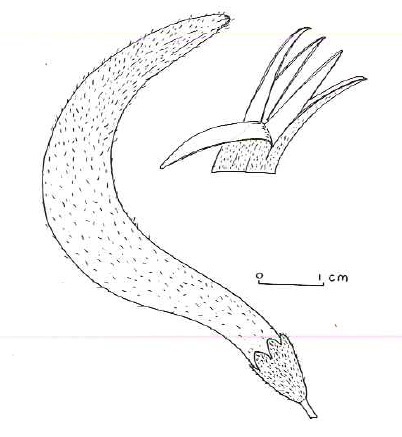 FIGURE 5. — Rollandia lanceolata var. kipapaensis.
This new variety comes close to Rollandia lanceolata Gaudichaud and R. lanceolata Gaudichaud, variety Rockii St. John and Hosaka, but closest to R. lanceolata, variety tomentosa Hillebrand. It may be distinguished from the related species and varieties as follows:
R. lanceolata has glabrous corolla, which is purple on outer and inner surfaces, staminal column puberulous near the base of the anther, anther body pilose at base, lower anthers penicillate, upper anthers glabrous. R. lanceolata, variety Rockii, has hirtellous corolla, which is purple on outer and inner surfaces, staminal column ciliate with whitish hairs, anther body pilose throughout, lower anthers penicillate, upper anther glabrous. R. lanceolata, variety tomentosa, has hirsute corolla, purplish-gray to pale-ashy, staminal column pilose, anther body pilose throughout, the lower and upper penicillate.
Oahu, Koolau Range, Waipio, Kipapa Gulch: in moist wooded gully, altitude 1,100 feet, May 14, 1933, E. Y. Hosaka no. 1027 (type in Bishop Museum).
R. lanceolata variety kipapaensis is judged to be a new variety because it differs in two or more important characters that are used in separating the varieties of the genus Rollandia.
Page 15
Rollandia St.-Johnii Hosaka, new species (fig. 6).
Plantae 30-60 cm altae, foliis 6-13 cm longis 1.5-22 cm latis lanceolatis marginibus revolutis, pedunculis 1-1.5 cm longis hispidis bractiis 4-7 mm longis lanceolatis-acuminatis, pediculis 0.5-1 cm longis, tubuos calyus 4-7 mm longo, labis calycis 3-10 mm longis lanceolatis-acuminatis subhispidulis, corolla 3-6 cm longa alba glabra.
An unbranched upright plant, 30-60 cm tall; the stem terete, rough at the naked lower portion, 1.5-2 cm in diameter at base; leaves in terminal clusters, leaves 6-13 cm long, 1.5-2 cm wide, lanceolate, obtusely acuminate at tip, base tapering into fleshy, margined petiole, upper surface dark green, glabrous, veins depressed, veins of under surface rusty, muricate-hispidulous, midrib prominent, margin with callous teeth, edges revolute; petioles 1-1.5 cm long, muricate-hispidulous; racemes 15-20-flowered; peduncles 1-1.5 cm long, hispid, thick; peduncle bracts 4-7 mm long, lanceolate-acuminate, hispidulous; flowers clustered near the apex; pedicels 0.5-1 cm long, hispidulous, with two lanceolate-acuminate, glabrous bracts 0.5 mm long at the lower third; corolla 3-6 cm long, 0.5-1 mm wide at the broadest part which is 1/2 to 2/3 of the length, white, curved, glabrous on the outer and inner surfaces, back grooved to the middle, tip splitting into 5 narrow lobes 8-12 mm long at maturity, inner surface of lobes tinted with light purple color; calyx 14-17 mm long, sparsely hispidulous, the obconical tube 4-7 mm long, 4-5 mm wide at top, the calycine lobes 3-10 mm long, 2-3 mm wide at base, lanceolate-acuminate; staminal column 5-8 mm shorter than the corolla, adnate to the corolla (1/3 to 1/2 the length), glabrous; anthers 4-7 mm long, purple, glabrous, tip of lower anther bearded, tip of upper anther glabrous; pistil protruding about 2-2.5 mm; stigma two-lobed; fruit a capsule.
This new species comes closest to Rollandia crispa Gaudichaud and Rollandia Humboldtiana Gaudichaud, both of which have glabrous staminal column and the underside of the leaf pubescent. This new species may be distinguished from these two as follows:
Rollandia crispa is 0.3-1.3 meters tall; with leaves 30-75 cm long, 10-16 cm wide, obovate-oblong; peduncles 2-3 cm long, puberulous; bracts 8-18 mm long, broad-oblong, obtuse; pedicels 1-2 cm long; calyx tube 8-12 mm long, the calycine lobes 9-14 mm long, broad-oblong, obtuse-apiculate, puberulous; corolla 5-7.5 cm long, pale purplish-red, puberulous.
Rollandia Humboldtiana is 1-2 meters tall; with leaves 26-40 cm long, 8-15 cm wide, obovate-oblong; peduncles 4-40 cm long, puberulous; bracts 8-11 mm long, lanceolate-acuminate; pedicels 1.5-22 cm long; calyx tube 9-11 mm long, calycine lobes 3-12 mm long, narrow-oblong, puberulous; corolla 7-7.5 cm long, white or pule, puberulous.
Rollandia St.-Johnii is 30-60 cm tall; with leaves 6-13 cm long, 1.5-2 cm wide, lanceolate, edges revolute; peduncles 1-1.5 cm long, hispid; bracts 4-7 mm long, lanceolate-acuminate; pedicels 0.5-1 cm long; calyx tube 4-7 mm long, the calycine lobes 3-10 mm long, lanceolate-acuminate, sparsely hispidulous; corolla 3-6 cm long, white, glabrous.
Page 16
Oahu, Koolau Range, Waipio, Kipapa Gulch; on wet windswept main divide, altitude 2,800 feet, August 6, 1933, E. Y. Hosaka no. 1159 (type in Bishop Museum); wet ravine, 900 meters, September 18, 1932, F. R. Fosberg no. 8715; wet ridge, 2,800 feet, August 7, 11934, E. Y. Hosaka no. 1256; wet main divide, 2,800 feet, September 18, 1932, E. Y. Hosaka no. 743.
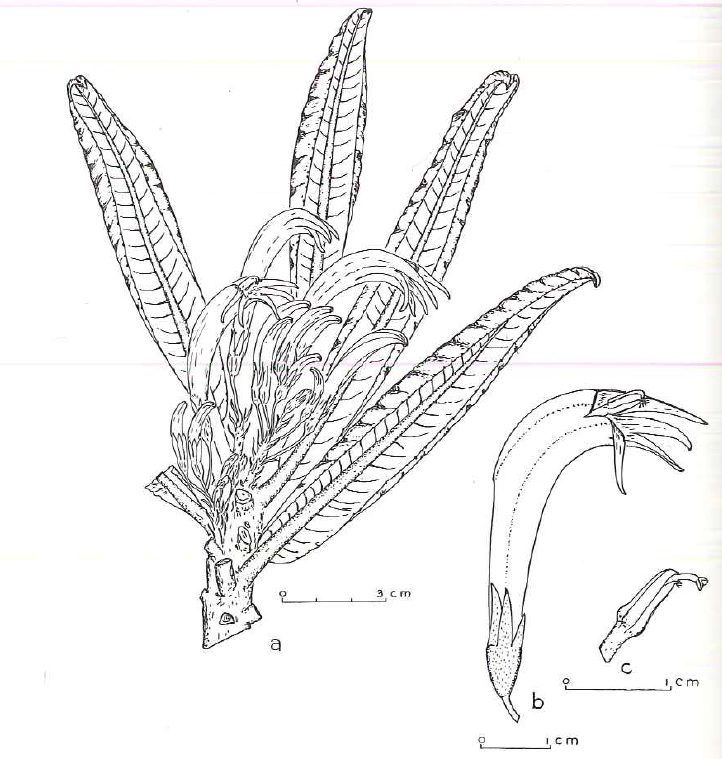 FIGURE 6. — Rollandia St.-Johnii: a, habit; b, flower; c, end of stamen with style.
This species is named after Dr. Harold St. John, Professor of Botany at the University of Hawaii and Botanist at Bernice P. Bishop Museum.
Rollandia St.-Johnii is found growing along the main divide of Koolau Range on leeward side at the head of the Kipapa Gulch and just over the divide on the windward side.
:::