Page I
A Monographic Study of the Hawaiian
Species of the Tribe Lobelioideae
Family Campanulaceae
By JOSEPH F. ROCK
Botanist, College of Hawaii, Consulting Botanist, Board of Commissioners of Agriculture and Forestry, Honolulu. Author of The Indigenous Trees of the Hawaiian Islands," and "The Ornamental Trees of Hawaii."___________
Memoirs of the Bernice Pauahi Bishop Museum
Volume VII., Number 2.___________
HONOLULU, H. I.
BISHOP MUSEUM PRESS 1919Page II
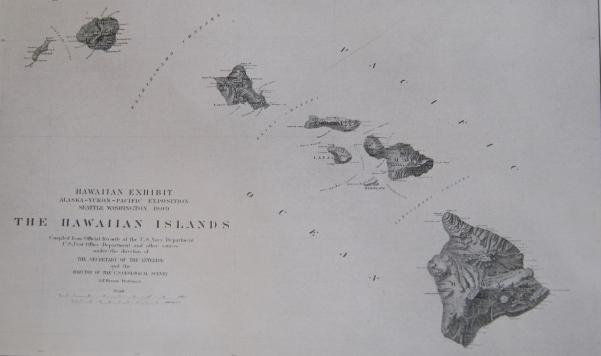
Page III
PUBLICATIONS OF THE BERNICE PAUAHI BISHOP MUSEUM OF POLYNESIAN ETHNOLOGY AND NATURAL HISTORY
___________
A Monographic Study of the Hawaiian
Species of the Tribe Lobelioideae
Family Campanulaceae
By JOSEPH F. ROCK
Botanist, College of Hawaii, Consulting Botanist, Board of Commissioners of Agriculture and Forestry, Honolulu. Author of The Indigenous Trees of the Hawaiian Islands," and "The Ornamental Trees of Hawaii."WITH FRONTISPIECE AND TWO HUNDRED AND SEVENTEEN PLATES
ISSUED FEBRUARY 20, 1919
___________
PUBLISHED BY AUTHORITY OF THE TRUSTEES
HONOLULU, H. I.:
1919
Page IV
Page V
To the Memory of the Celebrated Botanist, Charles Gaudichaud-Beaupré, who discovered and established the Hawaiian Genera of Lobelioideae, this Monographic Study is respectfully dedicated.
Page VI
Page VII
TABLE OF CONTENTS
| Page | |
| Dedication | V |
| Table of Contents | VII |
| List of Illustrations | VIII |
| Preface | 5 |
| Introduction | 13 |
| The Lobelioideae | 13 |
| Origin of the Hawaiian Lobelioideae | 16 |
| The Baccate Genera of the Hawaiian Lobelioideae | 19 |
| Avifauna of the Hawaiian Islands Partial to the Lobelioideae | 29 |
| The Capsular Lobelioideae of the Hawaiian Islands and Their Outside Affinities | 35 |
| The Genus Trematolobelia | 41 |
| The Genus Brighamia | 43 |
| Distribution of the Hawaiian Lobelioideae in the Hawaiian Archipelago | 47 |
| The Genus Clermontia | 47 |
| The Genus Cyanea | 51 |
| The Genus Delissea | 68 |
| The Genus Rollandia | 71 |
| Vertical Range of Lobelioideae in the Hawaiian Archipelago. | 73 |
| Tables Showing the Distribution of the Hawaiian Genera of the Tribe Lobelioideae | 79 |
| Distribution of the Genus Cyanea | 79 |
| Distribution of the Genus Clermontia | 81 |
| Distribution of the Genus Delissea | 81 |
| Distribution of the Genus Rollandia | 82 |
| Distribution of the Species of the Genus Lobelia in Hawaii | 82 |
| Distribution of the Genus Trematolobelia | 82 |
| Distribution of the Genus Brighamia | 84 |
| Flowering Season of the Hawaiian Lobelioideae | 84 |
| Root System of the Hawaiian Lobelioideae | 84 |
| Systematic Position of the Genus Cyanea | 87 |
| Sections Delisseoideae, Hirtellae and Pilosae | 88 |
| Section Cyanea Genuinae | 91 |
| The Section Palmaeformes | 94 |
| The Native Names of Hawaiian Lobelioideae | 97 |
| Insects Occurring on Plants of the Lobelioideae in the Hawaiian Islands | 98 |
| Bibliography of the Hawaiian Lobelioideae | 100 |
| Icones | 101 |
| Key to the Genera and Species | 102 |
| Key to the Species of Lobelia | 102 |
| Key to the Species of Cyanea | 103 |
| Key to the Species of Clermontia | 107 |
| Key to the Species of Delissea | 108 |
| Key to the Species of Rollandia | 108 |
| Systematic Part | 109 |
| LOBELIA | 111 |
| TREMATOLOBELIA | 139 |
| BRIGHAMIA | 149 |
| CYANEA | 153 |
| Sect. I. Palmaeformes | 157 |
| Sect. II. Delisseoideae | 195 |
| Sect. III. Hirtellae | 213 |
| Sect. IV. Genuinae | 231 |
| Sect. V. Pilosae | 269 |
| CLERMONTIA | 283 |
| Sect. Clermontioideae | 287 |
| Sect. Clermontiae Genuinae | 308 |
| Doubtful Species | 340 |
| DELISSEA | 341 |
| ROLLANDIA | 361 |
| Doubtful Species | 383 |
| Species Excludenda | 383 |
| Doubtful Species of Hawaiian Lobelioideae | 384 |
| Species of Lobelioideae Cultivated in the Hawaiian Islands | 385 |
Page VIII
LIST OF ILLUSTRATIONS
| Plate | Page | |
| 1 | THE ISLAND OF KAUAIThe center of the island is an extensive open bog known as Waialeale. | 8 |
| 2 | THE ISLAND OF OAHUIt is on the summits of the two main mountain ridges that the true Lobelias may be found. Rollandia, Cyanea, and Clermontia inhabit the middle forest zone in the deep valleys and ravines. | 9 |
| 3 | THE ISLAND OF MOLOKAIThe Lobelioideae are restricted to the eastern end of the island, especially to the deep ravines. | 10 |
| 3 | THE ISLAND OF LANAIThis island possesses only a few species of Lobelioideae. They occur mainly near the central ridge and in a few valleys. | 10 |
| 4 | THE ISLAND OF MAUIThe Lobelioideae inhabit the wet forests of West Maui, and the middle forest zone on the windward side of Haleakala and occur also in restricted areas of the leeward side at higher elevations. True Lobelia occur also in the southern gap of the huge crater. | 11 |
| 5 | THE ISLAND OF HAWAIIThe largest island of the group with its three lofty volcanoes, Mauna Kea, Mauna Loa and Hualalai; the Lobelioideae inhabit mostly the windward side of the island, especially the dense forests of the Kohala regions. They do, however, extend into the wet forests of the lee side. | 12 |
| 6 | CLERMONTIA PERSICIFOLIA Gaud.Mature tree. Growing epiphytically on Metrosideros, Ohia Lehua, in Palolo Valley, Oahu. | 14 |
| 7 | CLERMONTIA PERSICIFOLIA Gaud.A young tree growing terrestrially on Palolo crater-ridge, Oahu. | 15 |
| 8 | CLERMONTIA HALEAKALENSIS RockGrowing on the slopes of Puunianiau crater, Mt. Haleakala, Maui; elevation about 7000 feet. | 17 |
| 9 | CLERMONTIA PELEANA RockGrowing epiphytically on a tall Metrosideros (Ohia lehua) tree below Glenwood, Hawaii; elevation 2100 feet. | 18 |
| 10 | CYANEA LEPTOSTEGIA A. GrayThe tall plant to the right near the Ohia lehua tree. Forests of Kauai; elevation 4000 feet. Photo by A. Gartley. | 20 |
| 11 | DELISSEA UNDULATA Gaud.Growing in the Koa and Mamani forest (Acacia Koa and Sophora chrysophylla) on the slopes of Mauna Loa, Hawaii; 5000-6000 feet elevation; the plant to the left is 35 feet tall. | 22 |
| 12 | CYANEA ARBOREA (Mann) Hillebr.Growing above Ulupalakua, Kula, Haleakala, Maui; elevation about 5000 feet; plant approximately fifteen feet in height. | 24 |
| 13 | DELISSEA UNDULATA Gaud.Growing in the upper forest on the slopes of Mauna Loa, Hawaii; elevation 5500 feet. | 26 |
| 14 | DREPANIS FUNEREAA drepanid nectar-feeding bird partial to Lobelia. (From Wilson and Evans, Birds of the Hawaiian Islands, 1890-1899.) | 28 |
| 15 | LOBELIA GAUDICHAUDII A. DC.Fruiting specimen. To left Trematolobelia macrostachys (Hook. et. Arn.) Zahlbr. sterile, growing on the cliffs of Pelekunu, Molokai. | 30 |
| 16 | LOBELIA KAUAENSIS (A. Gray) HellerGrowing on a moss-covered tree near the swamp of Kauluwehi, Kauai; 4200 feet elevation. | 32 |
| 16 | LOBELIA KAUAENSIS (A. Gray) HellerFlowering at the summit bog of Mt. Waialeale, Kauai; elevation 5000 feet. | 32 |
| 17 | LOBELIA GLORIA-MONTIS RockA fine flowering specimen about five feet tall, growing near the summit of Mauna Eeke, in open bog, West Maui; elevation 3500 feet. | 33 |
| 18 | Group of Lobelia gloria-montis, showing sterile plant and plants in different stages of flowering, near the summit of Mauna Eeke, West Maui; 4000 feet elevation. | 34 |
Page IX
| Plate | Page | |
| 19 | LOBELIA HYPOLEUCA Hillebr.Growing at Waiakealoha Valley, Kauai; elevation 4000 feet. A mature flowering specimen | 36 |
| 20 | LOBELIA YUCCOIDES Hillebr.Growing on the edge of a ravine of Waimea canyon, Kauai; to the right an old inflorescence of Wilkesia gymnoxiphium A. Gray. | 37 |
| 21 | TREMATOLOBELIA MACROSTACHYS (Hook. et Arn.) Zahlbr.Growing in the swamp back of Waikolu ridge, Molokai. | 38 |
| 22 | BRIGHAMIA INSIGNIS A. GrayGrowing on the cliffs of Kalaupapa, Molokai. The plants are all in flower. (Photo by Nevin.) | 40 |
| 23 | BRIGHAMIA INSIGNIS A. GrayGrowing on th ecliffs of Halawa, Molokai. | 42 |
| 24 | CLERMONTIA PARVIFLORA Gaud.Growing epiphytically on Cibotium tree fern (C. Chamissoi) in the rainforest at 29 miles, Volcano of Kilauea, Hawaii; elevation 3500 feet. | 44 |
| 25 | CLERMONTIA KOHALAE Rock.(Left-hand upper corner.) A small tree, growing on rock walls in the Kohala Mountains, Hawaii, below Awini. | 46 |
| 26 | CLERMONTIA HALEAKALENSIS Rock.One of the most curious Lobelioids, growing on the slopes of Haleakala, Maui; elevation 7000 feet. | 48 |
| 27 | CYANEA FAURIEI Lévl.Growing in Olokele canyon, Kauai. The plant is about 15 feet tall. | 49 |
| 28 | CYANEA LEPTOSTEGIA A. GrayMature specimen in the woods above Waimea, Kauai. | 50 |
| 29 | CYANEA LEPTOSTEGIA A. GrayGrowing in Kaholuamano forest, Kauai. | 52 |
| 29 | CYANEA FAURIEI Lévl.Growing in Olokele canyon, Kauai. | 52 |
| 30 | CYANEA GAYANA RockMature plant growing in the forest of Kaholuamano, Kauai. | 53 |
| 31 | CYANEA LEPTOSTEGIA A. GrayThe palm-like plants all through the gulch; to the extreme right Cyanea spathulata (Hillebr.) Heller, growing in the forests of Kaholuamano, Kauai. The trees are Metrosidero collina polymorpha. | 54 |
| 32 | Several plants of Cyanea leptostegia A. Gray growing along the walls of a small streambed at Kaholuamano, Kauai. The small-leaved plant to the right is Cyanea spathulata (Hillebr.) Heller. | 55 |
| 33 | CYANEA SPATHULATA (HIllebr.) HellerGrowing in the forests of Kaholuamano, Kauai. | 56 |
| 34 | In the upper margin, Cyanea aculeatiflora Rock in company with Gunnera petaloidea, growing on the rock walls of Waikamoi gulch, East Maui; elevation 4000 feet. (Photo and copyright by R. K. Bonine.) | 58 |
| 35 | CYANEA ACULEATIFLORA RockMature plants growing in the rainforests on the northwestern slope of Mt. Haleakala, Maui, at an elevation of 4000 feet. | 59 |
| 36 | CYANEA HAMATIFLORA RockA group of these remarkable Lobelioids, growing in a deep gulch, below Puukakai, northwest slope of Mt. Haleakala, Maui; elevation 4000 feet. The tall flowering specimen in the background is about 20 feet in height. | 60 |
| 37 | CYANEA ARBOREA (Mann) Hillebr.Growing above Ulupalakua Kula, Haleakala, Maui; elevation about 5000 feet; plant approximately 15 feet in height. | 62 |
| 38 | CYANEA GIFFARDII RockThis rare and curious Lobelioid was photographed in the rainforests near 23 miles, along the Volcano of Kilauea road, Hawaii; elevation 2500 feet. | 63 |
| 39 | CYANEA TRITOMANTHA A. GrayGrowing in the dense tree-fern forest near Kulani, slopes of Mauna Loa, Hawaii; elevation 5000 feet. | 65 |
| 40 | CYANEA PILOSA Gray var. GLABRIFOLIA RockGrowing in fern forest near Kilauea Volcano, Hawaii; elevation 4000 feet. | 66 |
Page X
| Plate | Page | |
| 41 | CYANEA PILOSA Gray var. GLABRIFOLA RockGrowing on top of trunk of Cibotium Chamissoi (tree fern), forests of Kilauea, Hawaii; elevation 4000 feet. | 67 |
| 42 | LOBELIA KAUAENSIS (Gray) HellerFlowering plant about four feet high, growing at the summit of Mt Waialeale, Kauai; elevation 5000 feet. | 69 |
| 42 | LOBELIA HYPOLEUCA Hillebr.Growing in the upper ravines of Oahu, Manoa Valley; elevation 2000 feet. | 69 |
| 43 | LOBELIA KAUAENSIS VILLOSA RockA flowering and sterile specimen on the summit of Mt. Waialeale, Kauai; elevation 5000 feet. | 70 |
| 44 | CLERMONTIA HAWAIIENSIS (Hillebr.) RockTree 20 feet tall, growing terrestrially in the forest of the Kipuka Puaulu, Hawaii, slopes of Mauna Loa; elevation 4200 feet. | 72 |
| 45 | CLERMONTIA HAWAIIENSIS (Hillebr.) RockGrowing epiphyticallly on Metrosideros (Ohio lehua) trees in the Kipuka Puaulu, near the Volcano of Kilauea, Hawaii; elevation 4200 feet. | 74 |
| 46 | CYANEA SCABRA Hillebr.Low subherbaceous plants, about two to three feet tall, growing in the dense shade of Urticaceae, near the streambed in the Waihee Valley, West Maui; elevation 1500 feet. | 76 |
| 47 | CYANEA ASPLENIFOLIA (Mann) Hillebr.Growing near the streambed in Waihee Valley, West Maui; elevation 1800 feet. The plant is about six feet tall. | 78 |
| 48 | Root system of Clermontia hawaiiensis, growing epiphytically on Acacia Koa (Koa) in the forests near the Volcano of Kilauea, Puu Oo trail, Hawaii; 4300 feet elevation. Note the twenty-foot-long taproot, which descended through the center of the giant Koa trunk; the root was 15 inches thick where it entered the ground. | 83 |
| 49 | CYANEA MACROSTEGIA Hillebr.A fruiting specimen (September) growing in the dense sphagnum forests of Puohaokamoa, northern slope of Mt. Haleakala, Maui; elevation 4200 feet. | 85 |
| 50 | CYANEA PILOSA A. GrayPlant about 5 feet tall, growing epiphytically in the dense rainforests near Kulani, slopes of Mauna Loa., Hawaii; elevation 4500 feet. Note the downward-bent peduncles, along the stem. | 86 |
| 51 | CYANEA COPELANDII RockGrowing epiphytically on a fern-covered tree trunk in the forest near Glenwood, Hawaii; elevation 2400 feet. | 89 |
| 52 | CYANEA BISHOPII RockPlants in full fruit (September) growing in the dense rainforests near Puohaokamoa, northern slopes of Mt. Haleakala, Maui; elevation 4000 feet. The tallest plant is only about 5 feet high. | 90 |
| 53 | CYANEA TRITOMANTHA A. GrayGrowing in the forest of Naalehu, Kau, Hawaii; plants 10-15 feet tall. Vine in the background Freycinetia arborea Gaud. | 92 |
| 54 | CYANEA NOLI-ME-TANGERE RockOne of the most spiny Lobelioids, growing always terrestrially in the dense rainforets in deep shade, near 23 miles, Volcano Road, Hawaii. | 93 |
| 55 | CYANEA ACULEATIFLORA RockA giant Lobelioid growing along a small streambed neaar the Waikamoi trail, Haleakala, Maui; 4000 feet elevation. | 95 |
| 56 | LOBELIA GAUDICHAUDII De Cand.Specimen from the summit of Kanohuanui, Oahu (in the herbarium of the College of Hawaii). | 113 |
| 57 | LOBELIA GAUDICHAUDII De Cand.The typical plant from the summit of Konahuanui, Oahu. | 114 |
| 58 | LOBELIA GLORIA-MONTIS Rock sp. n.Type in the herbarium of the College of Hawaii. | 116 |
| 59 | Type of Lobelia gloria-montis longibracteata Rock in herbarium College of Hawaii. | 118 |
| 60 | LOBELIA KAUAENSIS (A. Gray) HellerFrom a specimen in the Gray Herbarium, ex coll. A. A. Heller. | 120 |
| 61 | Type (no. 12741) of Lobelia Kauaensis villosa Rock in the herbarium of the College of Hawaii. | 121 |
| 62 | Single branches of Lobelia hypoleuca Hillebr. | 123 |
Page XI
| Plate | Page | |
| 63 | LOBELIA HYPOLEUCA Hillebr.Specimen ex coll. Hillebrand in the Gray Herbarium | 124 |
| 64 | To the left Lobelia oahuensis Rock; to the right Lobelia hypoleuca Hillebr. Note the difference in the undersurface of the leaves. In L. Oahuensis the leaves are green; in L. hypoleuca the leaves are white beneath. | 126 |
| 65 | LOBELIA YUCCOIDES Hillebr.Co-type specimen collected by V. Knudsen in the Hillebrand collection in the Gray Herbarium. | 128 |
| 66 | LOBELIA YUCCOIDES Hillebr.Specimen in the College of Hawaii Herbarium, Rock no. 5779. | 129 |
| 67 | LOBELIA NERIIFOLIA A. GraySpecimen from Mt. Haleakala, East Maui, in the herbarium of the College of Hawaii. | 131 |
| 68 | LOBELIA TORTUOSA HellerFrom the specimen in the Gray Herbarium, ex coll. A. A. Heller. | 134 |
| 69 | Type of Lobelia Remyi Rock in the Paris Herbarium. | 136 |
| 70 | TREMATOLOBELIA MACROSTACHYS Zahlbr.Showing portions of fruiting racemes perfectly mature. | 140 |
| 71 | TREMATOLOBELIA MACROSTACHYS Zahlbr.Flowering specimen. | 142 |
| 72 | Part of the inflorescence of the type of Trematolobelia macrostachys Kauaiensis Rock in herbarium, College of Hawaii. | 144 |
| 73 | Type of Trematolobelia macrostachys grandifolia Rock in herbarium, College of Hawaii. | 146 |
| 74 | Flowering specimen of Brighamia insignis A. Gray in the herbarium, College of Hawaii. | 150 |
| 75 | CYANEA SUPERBA (Cham.) GraySpecimen in Herbarium Berolinense ex coll. Hillebrand. | 154 |
| 76 | CYANEA SUPERBA VEULTINA RockType in Herbarium Berlin. | 155 |
| 77 | CYANEA REGINA (Hillebr.) RockType in Herbarium Vienna,, ex coll. Wawra, ex herb. Hillebr. | 156 |
| 78 | CYANEA REGINA (Hillebr.) RockSpecimen ex coll. Hillebr. in Herbarium Berolinense. | 158 |
| 79 | CYANEA GIFFARDII RockFlowering specimen from the forests above Glenwood, Hawaii. The plant was 30 feet in height. | 160 |
| 80 | CYANEA GIFFARDII RockType no. 12802-b in the herbarium of the College of Hawaii. | 161 |
| 81 | CYANEA LEPTOSTEGIA GraySpecimen in Herbarium Berolinense, ex coll. Hillebr. | 163 |
| 82 | CYANEA LEPTOSTEGIA A. GrayLeaves of young plant. Specimen in the College of Hawaii Herbarium, Rock no. 9016. | 164 |
| 83 | CYANEA ARBOREA (Mann) Hillebr.Specimen in Herbarium Berolinense, ex coll. Hillebrand. | 166 |
| 84 | CYANEA ARBOREA (Mann) Hillebr.Portion of crown of leaves with inforescence; less than one-third natural size. | 167 |
| 85 | CYANEA SOLENOCALYX Hillebr.Type in the Herbarium Berolinense, ex coll. Hillebr. | 169 |
| 86 | CYANEA SOLENOCALYX Hillebr.(Young plant.) Specimen in Herbarium Berolinense, ex coll. Hillebr. | 170 |
| 87 | CYANEA WAILAUENSIS RockType no 8812 in the herbarium of the College of Hawaii. | 172 |
| 88 | CYANEA PROCERA Hillebr.Type in Herbarium Berolinense, ex coll. Hillebr. | 174 |
| 89 | CYANEA GIBSONII Hillebr.Type in Herbarium Berolinense, ex coll. Hillebr. | 175 |
| 90 | CYANEA ATRA Hillebr.Specimen ex coll. Rock no. 8204 in herbarium of the College of Hawaii. | 176 |
| 91 | CYANEA ATRA LOBATA RockType (no. 8637) in the College of Hawaiii Herbarium. | 178 |
Page XII
| Plate | Page | |
| 92 | CYANEA MACROSTEGIA Hillebr.Type in Herbarium Berolinense, ex coll. Hillebrand. | 180 |
| 93 | CYANEA MACROSTEGIA Hillebr.Specimen (Rock no. 10264) in the College of Hawaii Herbarium. | 181 |
| 94 | CYANEA MACROSTEGIA VISCOSA RockType (no. 8791) in the College of Hawaii Herbarium. | 182 |
| 95 | CYANEA MACROSTEGIA PARVIBRACTEATA RockOne-half natural size.Type no. 10057 in the herbarium of the College of Hawaii. | 184 |
| 96 | CYANEA HAMATIFLORA RockType in the herbarium of the College of Hawaii. | 185 |
| 97 | CYANEA HAMATIFLORA RockMature fruits. | 186 |
| 98 | CYANEA ACULEATIFLORA RockType in the College of Hawaii Herbarium, Rock no. 8513. | 188 |
| 99 | CYANEA TRITOMANTHA GraySpecimen in the Herbarium Berolinense, ex coll. Hillebr. | 190 |
| 100 | CYANEA TRITOMANTHA GrayFrom a living specimen collected in the forests of Hilea, Kau, Hawaii. | 191 |
| 101 | CYANEA TRUNCATA RockType no 8840 in the herbarium of the College of Hawaii. | 192 |
| 102 | CYANEA ANGUSTIFOLIA (Cham.) Hillebr.Typical specimen from the mountains behind Honolulu. | 196 |
| 103 | CYANEA ANGUSTIFOLIA LANAIENSIS RockType in Herbarium Berolinense, ex coll. Hillebr. | 197 |
| 104 | CYANEA ANGUSTIFOLIA LANAIENSIS RockSpecimen in herbarium Museum Paris, ex coll. Remy, no 304. | 198 |
| 105 | CYANEA ANGUSTIFOLIA RACEMOSA Hillebr.Type in Herbarium Berlin. | 200 |
| 106 | CYANEA ANGUSTIFOLIA TOMENTELLA Hillebr.Type in Berlin Herbarium. | 201 |
| 107 | CYANEA MANNII (Brigham) Hillebr.Specimen in Berlin Herbarium, ex coll. Hillebr. | 202 |
| 108 | CYANEA OBTUSA (Gray) Hillebr.Specimen in Herbarium Berolinense, ex coll. Hillebr. | 204 |
| 109 | CYANEA CORIACEA (A. Gray) RockType in Gray Herbarium, ex coll. J. Remy no 302. | 205 |
| 110 | CYANEA FAURIEI Lévl.Specimen in the College of Hawaii Herbarium (Rock no. 5826-a). | 206 |
| 111 | CYANEA HARDYI RockType no 12767 in the College of Hawaii Herbarium. | 208 |
| 112 | CYANEA SPATHULATA (Hillebr.) HellerSpecimen in Herbarium Berolinense, ex coll. Hillebr. | 210 |
| 113 | CYANEA COMATA Hillebr.Type in Herbarium Berolinense, ex coll. Hillebr. | 212 |
| 114 | CYANEA KNUDSENII RockType in the Herbarium Berolinense, ex coll. Hillebrand. | 214 |
| 115 | CYANEA HIRTELLA (Mann) RockSpecimen in Gray Herbarium, Mann & Brigham no. 574. | 215 |
| 116 | CYANEA HIRTELLA (H.Mann) RockFlowering specimen in the College of Hawaii Herbarium, Rock no. 5942. | 216 |
| 117 | CYANEA HIRTELLA (H.Mann) RockFruiting specimen in the College of Hawaii Herbarium, Rock no. 8865. | 217 |
| 118 | CYANEA RIVULARIS RockType no. 5365 in the College of Hawaii Herbarium. | 218 |
| 119 | CYANEA RIVULARIS RockA narrow-leaved form of the species; the plants with narrow leaves are taller than those with broad leaves. | 220 |
| 120 | CYANEA FISSA (Mann) Hillebr.Specimen in theh Gray Herbarium, ex cell. Mann & Brigham no. 577. | 222 |
| 121 | CYANEA FISSA (Mann) Hillebr.Specimen in Herbarium Vienna, ex coll. Wawra no. 2187 (as Cyanea humilis Wawra). | 223 |
Page XIII
| Plate | Page | |
| 122 | CYANEA GAYANA RockType (no. 2463) in the College of Hawaii Herbarium. | 224 |
| 123 | CYANEA RECTA (Wawra)Hellebr.Type in Herbarium Vienna, ex coll. Wawra no. 2062 (as Delissea recta Wawra). | 226 |
| 124 | CYANEA LARRISONII Rock.Type no. 10342 in the College of Hawaii Herbarium. | 228 |
| 125 | CYANEA SYLVESTRIS HellerSpecimen in Gray Herbarium, ex coll. A. A. Heller no. 2691. | 229 |
| 126 | CYANEA NOLI-ME-TANGERE RockType in herbarium of the College of Hawaii. | 230 |
| 127 | CYANEA PLATYPHYLLA (Gray) Hellebr.Specimen ex coll. Hillebrand in Berlin Herbarium. | 232 |
| 128 | CYANEA FERNALDII RockCo-type in herbarium Museum Paris. | 234 |
| 129 | CYANEA PROFUGA ForbesCo-type in the College of Hawaii Herbarium, ex coll.. C. N. Forbes no. 313 Mo. | 236 |
| 130 | CYANEA ROLLANDIOIDES RockType in the herbarium of the College of Hawaii. | 238 |
| 131 | CYANEA FEROX Hillebr.Type in Herbarium Berolinense, ex coll. Hillebr. | 240 |
| 132 | CYANEA FEROX? Hillebr.Specimen in Herbarium Berolinense, ex coll. Hillebr. A young plant, but if belonging to C. ferox is not certain. | 241 |
| 133 | CYANEA FEROX HORRIDA RockSpecimen in Herbarium Berolinense, ex coll. Hillebr. (Cyanea ferox β var.). | 242 |
| 134 | CYANEA FEROX HORRIDA RockSpecimen in Herbarium Berolinense, ex coll. Hillebrand (Cyanea ferox β var.). Young plant; if belong to C. ferox horrida, is not certain. | 243 |
| 135 | CYANEA FEROX HORRIDA RockSpecimen no. 10056 in the College of Hawaii Herbarium. | 244 |
| 136 | CYANEA LOBATA H. MannType in Cornell Herbarium, ex coll. Mann & Brigham no. 467. | 246 |
| 137 | CYANEA GRIMESIANA Gaud.Type ? in herbarium Museum Paris, ex coll. Gaudichaud no. 143. | 248 |
| 138 | CYANEA GRIMESIANA Gaud.Specimen in Herbarium Berolinense, ex coll. Hillebrand. | 249 |
| 139 | CYANEA GRIMESIANA MAUIENSIS RockType in Berlin Herbarium. | 250 |
| 140 | CYANEA GRIMESIANA LYDGATEI RockType in the Herbarium Berolinense, ex coll. Hillebrand. | 252 |
| 141 | CYANEA GRIMESIANA CYLINDROCALYX RockType in the herbarium of the College of Hawaii. | 253 |
| 142 | CYANEA SCABRA Hillebr.Type in Herbarium Berolinense, ex coll. Hillebrand. | 254 |
| 143 | CYANEA SCABRA VARIABILIS Rock var. nov.Type in herbarium College of Hawaii, ex coll. H. L. Lyon no. 10259. | 256 |
| 144 | CYANEA SCABRA LONGISSIMA Rock var. nov.Type in herbarium College of Hawaii, Rock no. 8790. | 257 |
| 145 | CYANEA SCABRA SINUATA RockType in Herbarium Berolinense, ex coll. Hillebrand. | 258 |
| 146 | CYANEA HOLOPHYLLA Hillebr.Type in Herbarium Berolinense, ex coll. Hillebrand. | 260 |
| 147 | CYANEA SOLANACEA Hillebr.Type, showing young spinose plant and portion of a mature plant with flowers. | 261 |
| 148 | CYANEA SOLANACEA Hillebr.Specimen of mature plant in Herbarium Berolinense, ex coll. Hillebrand. | 262 |
| 149 | CYANEA SOLANACEA QUERCIFOLIA Hillebr.Type in Herbarium Berolinense, ex coll. Hillebrand. | 264 |
Page XIV
| Plate | Page | |
| 150 | CYANEA ASPLENIFOLIA (H. Mann) Hillebr.Type in Cornell Herbarium, ex coll. Mann & Brigham no. 464. | 266 |
| 151 | CYANEA MULTISPICATA Lévl.Co-type in herbarium College of Hawaii, ex coll. U. Faurie no. 576. | 268 |
| 152 | CYANEA ACUMINATA (Gaud.) Hillebr.Specimen in herbarium College of Hawaii, Rock no. 8845. | 270 |
| 153 | CYANEA PILOSA A. GrayType in the Gray Herbarium, ex coll. U. S. Exploring Expedition. | 272 |
| 154 | CYANEA PILOSA DENSIFLORA RockFlowering and fruiting specimen from the Mountains of Naalehu, Kau, Hawaii. | 274 |
| 155 | CYANEA BISHOPII RockType in the Berlin Herbarium. | 276 |
| 156 | CYANEA COPELANDII RockType in the herbarium of the College of Hawaii. | 278 |
| 157 | CYANEA STYCTOPHYLLA RockType in the herbarium of the College of Hawaii. | 280 |
| 158 | CYANEA REMYI RockType in herbarium Museum Paris, ex coll. J. Remy. | 281 |
| 159 | CLERMONTIA ARBORESCENS (Mann) Hillebr.Specimen in Herbarium Berolinense ex coll. Hillebrand. | 286 |
| 160 | CLERMONTIA ARBORESCENS (Mann) Hillebr.Ohawai. Less than half natural size; showing flowering branch and fruit. | 288 |
| 161 | CLERMONTIA TUBERCULATA ForbesNatural size, showing flowerbuds. Note tubercules on the inflorescence. | 289 |
| 162 | CLERMONTIA GAUDICHAUDII BARBATA RockType in Herbarium Berolinense, ex coll. Hillebrand no. 56. | 290 |
| 163 | Type of Clermontia singuliforia Rock in the herbarium of the College of Hawaii. | 292 |
| 164 | CLERMONTIA PELEANA RockFlowering specimen, reduced. | 294 |
| 165 | Type of Clermontia coerulea Hillebr. in Herbarium Berolinense. | 295 |
| 166 | CLERMONTIA COERULEA Hillebr.One-third natural size; showing flowers and fruits. | 296 |
| 167 | CLERMONTIA WAIMEAE RockType in the herbarium of the College of Hawaii. | 298 |
| 168 | CLERMONTIA PYRULARIA Hillebr.Type in Herbarium Berolinense ex coll. Hillebrand. | 300 |
| 169 | CLERMONTIA HALEAKALENSIS RockLess than half natural size. Type in the herbarium of the College of Hawaii. | 301 |
| 170 | CLERMONTIA FULVA Lévl.Sketch of the type in Léveilé Herbarium, La Mans, France. | 302 |
| 171 | CLERMONTIA KAKEANA MeyenSpecimen ex coll. Hillebrand in Herbarium Berolinense. | 305 |
| 172 | CLERMONTIA PERSICIFOLIA Gaud.Specimen collected during Gaudichaud's second visit (1836-37), in the herbarium Museum Paris. | 306 |
| 173 | CLERMONTIA PERSICIFOLIA Gaud.Flowering specimen, reduced. | 307 |
| 174 | Left-hand upper corner, Cl. persicifolia Gaud., ex coll. Gaud. visit 1836-37, Bonité; left-hand lower corner, Cl. Gaudichaudii, ex coll. U. S. Expl. Exp., Kauai; right upper three leaves, Cl. oblongifolia Gaud., ex coll. Gaud., visit 1836-37, Bonité; single leaf extreme right, middle of plate, Cl. Kakeana, ex coll. U. S. Expl. Expl., Oahu. | 309 |
| 175 | CLERMONTIA OBLONGIFOLIA Gaud.Specimen ex coll. Gaudichaud in Herbarium Paris. | 310 |
| 176 | CLERMONTIA OBLONGIFOLIA Gaud.Specimen ex coll. Hillebrand in Herbarium Berolinense. | 311 |
| 177 | CLERMONTIA OBLONGIFOLIA Gaud.Flowering specimen. | 312 |
Page XV
| Plate | Page | |
| 178 | CLERMONTIA HAWAIIENSIS (Hillebr.) RockSpecimen of Cl. macrocarpa Hawaiiensis Hillebr. in Herbarium Berolinense. | 314 |
| 179 | CLERMONTIA HAWAIIENSIS (Hillebr.) RockFlowering and fruiting specimen. | 316 |
| 180 | Type of Clermontia pallida Hillebr. in Herbarium Berolinense. | 318 |
| 181 | CLERMONTIA KOHALAE RockType in the herbarium of the College of Hawaii. | 320 |
| 182 | CLERMONTIA KOHALAE ROBUSTA RockType in the herbarium of the College of Hawaii. | 321 |
| 183 | CLERMONTIA LEPTOCLADA RockType in the herbarium of the College of Hawaii. | 322 |
| 184 | CLERMONTIA DREPANOMORPHA RockType in the herbarium of the College of Hawaii. | 324 |
| 185 | CLERMONTIA DREPANOMORPHA RockFlowering and fruiting specimen, about one-half natural size. | 325 |
| 186 | Type of Clermontia grandiflora Gaud. in herbarium Museum Paris. | 326 |
| 187 | CLERMONTIA GRANDIFLORA Gaud.Specimen ex Herbarium Hillebrand in Herbarium Berolinense. | 328 |
| 188 | CLERMONTIA MULTIFLORA Hillebr.Type in Herbarium Berolinense. | 329 |
| 189 | Type of Clermontia micrantha (Hillebr.) Rock in Herbarium Berolinense. | 330 |
| 190 | CLERMONTIA MONTIS LOA RockType (no. 10002) in the College of Hawaii Herbarium. | 332 |
| 191 | Type of Clermontia montis-Loa Rock in the herbarium of the College of Hawaii. | 333 |
| 192 | Type of Clermontia parviflora Gaud. in the herbarium Museum Paris. | 335 |
| 193 | CLERMONTIA PARVIFLORA Gaud.(Type of Hillebrand's Cl. parviflora pleiantha in the Herbarium Berolinense.) | 336 |
| 194 | Type of Clermontia parviflora calycina Rock in the herbarium of the College of Hawaii. | 338 |
| 195 | DELISSEA SUBCORDATA Gaud.Specimen in the Herbarium Berolinense, ex coll. Hillebrand. | 344 |
| 196 | DELISSEA SUBCORDATA OBTUSIFOLIA WawraType in the Herbarium Berolinense, ex coll. Hillebrand. | 346 |
| 197 | Type of Delissea laciniata Hillebr. in Herbarium Berlin. | 347 |
| 198 | Type of Delissea laciniata parvifolia Rock in Herbarium Berolinense. | 348 |
| 199 | Type of Delissea sinuata Hillebr. in Herbarium Berlin. | 350 |
| 200 | Type of Delissea sinuata lanaiensis Rock in Herbarium Berlin. | 351 |
| 201 | Type of Delissea undulata Gaud. in herbarium Museum Paris. | 352 |
| 202 | DELISSEA RHYTIDOSPERMA H. MannSpecimen in Gray Herbarium, ex coll. Mann & Brigham. | 354 |
| 203 | DELISSEA RHYTIDOSPERMA H. MannSpecimen ex coll. Wawra (Delissea Kealiae) in Herbarium Vienna. | 355 |
| 204 | Type of Delissea fallax Hillebr. in Herbarium Berolinense. | 356 |
| 205 | DELISSEA PARVIFLORA Hillebr.Type in Herbarium Berolinense, ex coll. Hillebrand. | 358 |
| 206 | ROLLANDIA ANGUSTIFOLIA (Hillebr.) RockSpecimen (Rock no. 10250) in the College of Hawaii Herbarium. | 364 |
| 207 | ROLLANDIA PURPURELLIFOLIA RockIn the herbarium of the College of Hawaii. | 366 |
| 208 | ROLLANDIA LONGIFLORA WawraCo-type in the Gray Herbarium, ex coll. Hillebrand. | 367 |
| 209 | ROLLANDIA LANCEOLATA Gaud.Typical specimen (Rock no. 10254), in the College of Hawaii Herbarium. | 368 |
| 210 | ROLLANDIA LANCEOLATA VIRIDIFLORA RockFlowering plant, much reduced. | 370 |
| 211 | ROLLANDIA KAALAE WawraType in Herbarium Vienna, ex coll. Wawra. | 372 |
Page XVI
| Plate | Page | |
| 212 | ROLLANDIA KAALAE WawraSpec ex Herbar. Hillebrand in Herbarium Berolinense. | 374 |
| 213 | ROLLANDIA CRISPA Gaud.Specimen collected by H. Mann, in the Gray Herbarium. | 375 |
| 214 | ROLLANDIA CRISPA Gaud.From a living specimen (much reduced) collected in the mountains behind Honolulu. | 376 |
| 215 | ROLLANDIA CALYCINA G. DonSpecimen in herbarium Museum Paris, ex coll. Gaudichaud no. 41. | 378 |
| 216 | ROLLANDIA CALYCINA G. DonSpecimen (ock no. 8844) in the College of Hawaii Herbarium. | 379 |
| 217 | ROLLANDIA HUMBOLDTIANA Gaud.Showing inflorescence (flowers white), about two-thirds natural size; from living specimen collected on Mt. Olympus, Oahu. | 380 |
page 5
PREFACE
The present paper represents a monographic study of all the known Hawaiian Lobelioideae comprising the genera Lobelia, Trematolobelia, Brighamia, Cyanea, Clermontia, Delissea and Rollandia. Six of the seven genera are peculiar to the Hawaiian Islands, while the seventh (Lobelia) is of world-wide distribution. The largest number of species occur in the genus Cyanea fifty-two, in Clermontia there are twenty-three, in Rollandia nine, in Delissea seven, in Lobelia eleven, and one in each of the two remaining genera (Trematolobelia and Brighamia). This makes a total number of one hundred and four species of Lobelioideae which are all peculiar to the Hawaiian Islands. Besides these species, there occur five varieties and one form in Clermontia, twenty-five varieties in Cyanea, three varieties in Delissea, three varieties in Rollandia, four varieties and one form in Lobelia, two varieties in Trematolobelia, and one form in Brighamia, making a total of one hundred and forty-nine species, varieties, and forms. Hillebrand in his Flora of the Hawaiian Islands enumerates fifty-eight species of Lobelioideae in all. While the number of species and varieties has been more than doubled, it is the writer's opinion that many more species will be brought to light especially in the genus Cyanea. Strange to say, Delissea has brought forth no new species; on the contrary, the old known species have become extremely rare and several of the species have not been re-collected since the days of Hillebrand. Delissea is in all probability a decadent genus. A few new species may be expected in Clermontia, Rollandia and perhaps Lobelia, but the greater number of new species must be expected in Cyanea
The writer has labored for nearly ten years on the Hawaiian Lobelioideae. As Botanist of the Hawaiian Board of Agriculture and Forestry and of the College of Hawaii, he made a botanical survey of all the islands of this group, and from the beginning of his work here in Hawaii he felt especially interested in these strange and highly interesting plants. Thus he became acquainted with nearly all the Hawaiian Lobelioideae growing in their natural habitat, which is so essential to the proper understanding of this difficult group of plants. It is next to impossible to arrange these plants systematically without having seen them in their native haunts. In the preparation of this monograph, the writer had at his disposal for study the Hillebrand Collection in the Berlin Herbarium, The Wawra Collection in the Vienna Herbarium, Gaudichaud's and J. Remy's Collection in the Paris Museum, Asa Gray's species in the Gray Herbarium, H. Mann's Collection from the Cornell Herbarium and Bishop Museum Herbarium; he saw A. A. Heller's species and C. N. Forbes' new species in the Bishop Museum, and the A. S. Hitchcock Collection which the writer determined for the U.S.National Museum.
In the year 1913-1914 the writer made a journey around the world and for three months studied the collections in Europe. He examined Adalbert de Chamisso's species in Berlin, and saw specimens collected by Lay and Coolie, Bennett, Wawra, Remy, Gaudichaud and Hillebrand. In America he studied the collections in the Gray Herbarium at Cambridge.
In most instances the types of the early authors have been photographed by the writer, whose own types have also been photographically reproduced. Only
page 6
in few instances the types were not seen and consequently not photographed. Some of the types are in such a miserable state or so fragmentary that a photograph of the same would be of no help whatsoever.
Unfortunately Hillebrand neither numbered his specimens nor did he designate his types; consequently his species are all electotypes and as such are here reproduced. Many of his new species bear an entirely different name on the herbarium sheet from that of the one published in his Flora, and his species had to be rediscovered in his collection to a greater or lesser extent. It was most unfortunate that Hillebrand's collection was not kept intact, as only a very comprehensive collection of such polymorphic species as occur in the Hawaiian Islands can give a clear idea of the limits of a species and its relationship. As it is, his collection was divided and distributed among many herbaria, to such an extent that the main collection is in many instances quite fragmentary; rarely is a species represented in the collection from more than one island; Hillebrand records specimens of a species from different localities on one island and often from another island. In nearly every instance only one herbarium sheet is present, while the others can be found at Harvard and elsewhere.
Shortly before the completion of this monograph, the writer was enabled to examine a collection of plants made jointly by Hillebrand and Lydgate. The collection was in the possession of Mr. Lydgate of Kauai and was sold by him to the Bishop Museum. The collection brought forth nothing new, but contained a specimen of Cyanea tritomantha β. var. Hillebrand, which was labeled Cyanea Lydgatei sp. n. This is evidently the only plant extant, as the writer did not meet with it in any of the European or American Herbaria, nor has it again been re-collected.
Co-types of the writer's own species have been deposited in the Bishop Museum together with duplicate photographs of types of early authors, as far as available. The monograph was prepared at the College of Hawaii, partly during College of Hawaii time and partly during the writer's own time, when he labored during the hours of the night or early morning. The photographs were nearly all taken by the writer; only in few instances were they taken by others and are thus marked on the individual plate. The actual specimens were all photographed by him.
The writer wishes to express his sincere thanks and gratitude to the Directors of the various herbaria in which he was privileged to work, especially to Prof. A. Engler, Drs. I. Urban, Diels, Zahlbruckner, Dr. Le Comte, Drs. Robinson, Fernald, Prof. Hosmer, Prof. N. L. Britton, Dr. Rowlee and Monseign. Léveillé. To the Hon Albert F. Judd, President of the Trustees of the Bernice P. Bishop Museum, the writer is grateful for the kind interest shown in the present work, as it is to his desire to further scientific knowledge in the Pacific that the publication of this monograph owes its existence. To Mr. Henry Holmes, of the publication committee of the Bishop Museum, the writer is indebted for many valuable suggestions and coöperation in the reading of proof.
To Mr. O. H. Swezey the writer is grateful for information regarding the insect fauna partial to Lobelioideae. A list of the insects found on Lobelioideae, compiled by Mr. Swezey, can be found at the end of the introduction.
In conclusion, the writer wishes to remark that while undoubtedly new species of Lobelias will reward the labors of future explorers, the old and most
page 7
interesting species are fast disappearing and some of them have already become extinct: he needs only mention the magnificent species of Cyanea arborea, C. Giffardii, C. superba and others; and if the publication of this paper should, besides giving a full and explicit account of every known species, be the means of arousing interest in the preservation of these rare and curious plants, the writer's aims will indeed have been attained.
JOSEPH F. ROCK.
Honolulu, May 17, 1918.
page 8
| PLATE 1. |
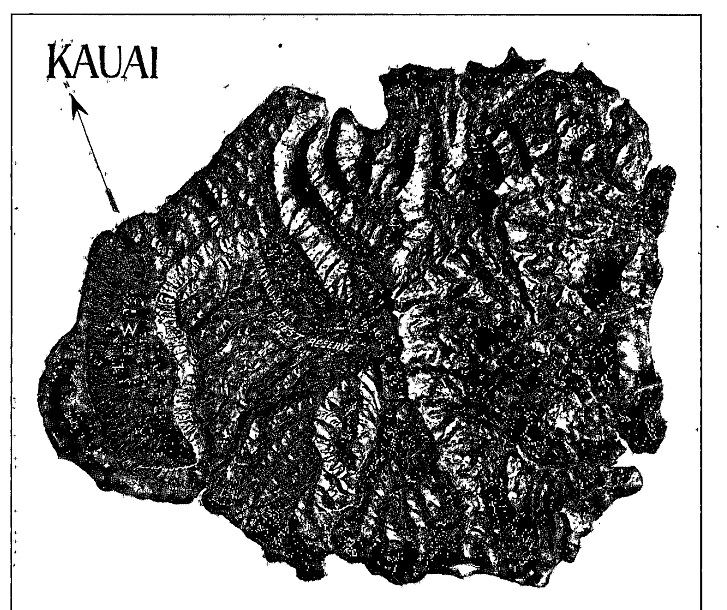 |
| THE ISLAND OF KAUAI |
| The center of the island is an extensive open bog known as Waialeale. |
page 9
| PLATE 2. |
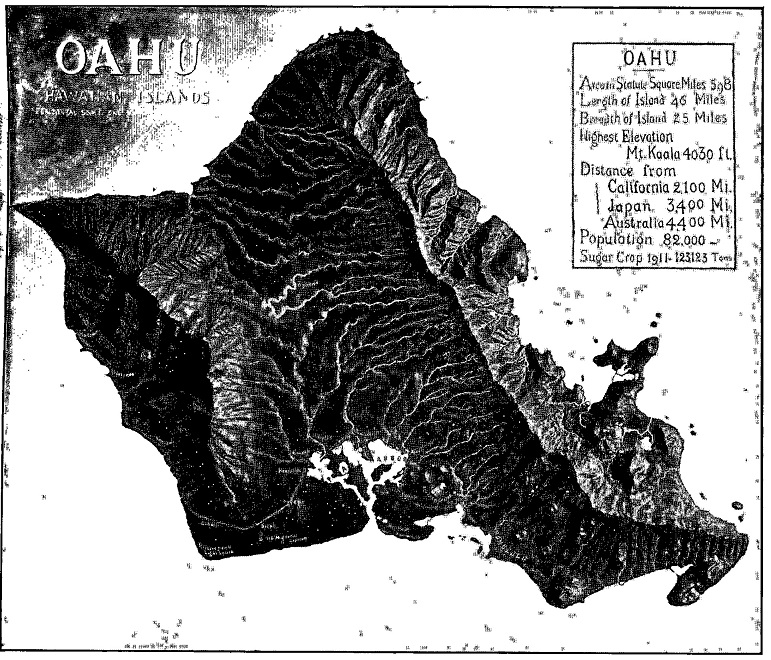 |
| THE ISLAND OF OAHU |
| It is on the summits of the two main mountain ridges that the true Lobelias may be found. Rollandia, Cyanea, and Clermontia inhabit the middle forest zone in the deep valleys and ravines. |
page 10
| PLATE 3. |
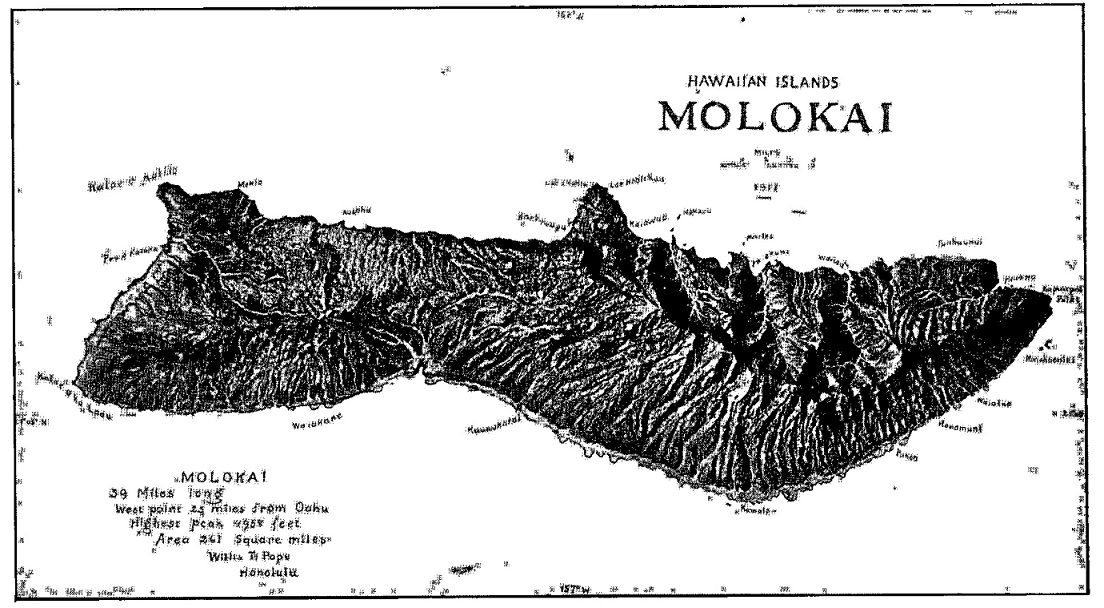 |
| THE ISLAND OF MOLOKAI |
| The Lobelioideae are restricted to the eastern end of the island, especially to the deep ravines. |
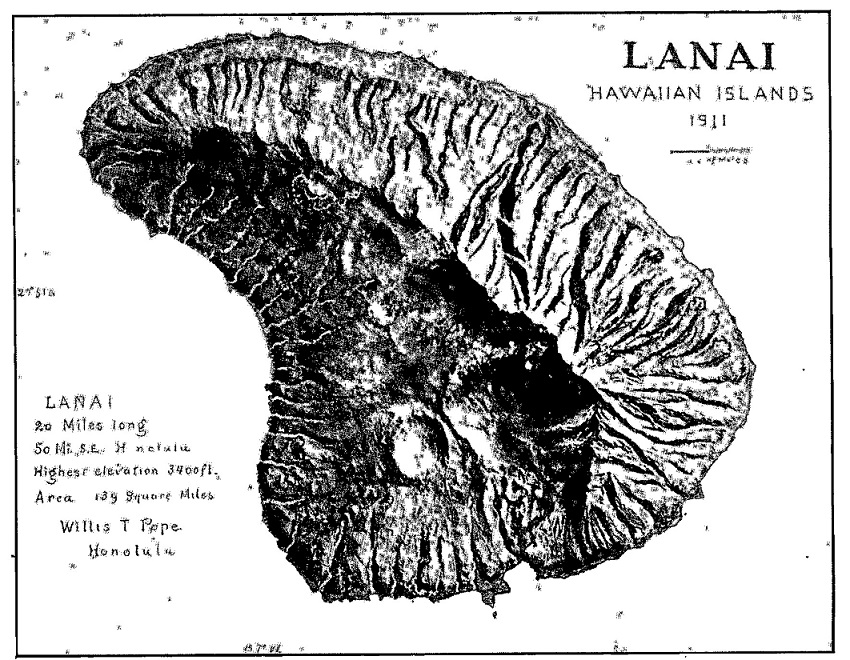 |
| THE ISLAND OF LANAI |
| This island possesses only a few species of Lobelioideae. They occur mainly near the central ridge and in a few valleys. |
page 11
| PLATE 4. |
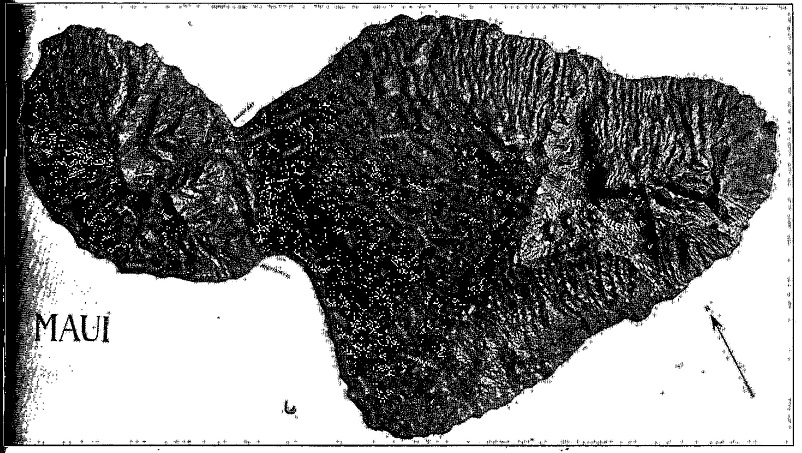 |
| THE ISLAND OF MAUI |
| The Lobelioideae inhabit the wet forests of West Maui, and the middle forest zone on the windward side of Haleakala and occur also in the restricted areas of the leeward size at higher elevations. True Lobelia occur also in the southern gap of the huge crater. |
page 12
| PLATE 5. |
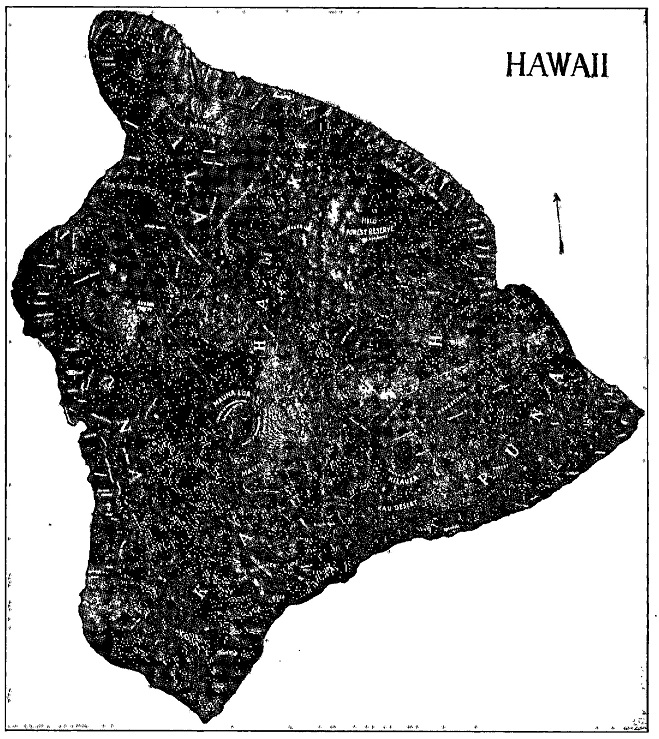 |
| THE ISLAND OF HAWAII |
| The largest island of the group with its three lofty volcanoes, Mauna Kea, Mauna Loa and Hualalai; the Lobelioideae inhabit mostly the windward size of the island, expecially the dense forests of the Kohala regions. They do however extend into the wet forests of the lee side. |
page 13
INTRODUCTION
The Hawaiian Archipelago is composed of eight islands and several small ones which may better be termed islets. The material of Lobelioideae on which this monograph is based was collected on seven of the larger islands which may here be given in their order beginning with the westernmost: Niihau, Kauai, Oahu, Molokai, Maui, Lanai, and Hawaii. The Island of Kahoolawe does not concern us here as no specimens of Lobelioideae have ever been collected there. This does not mean, howeber, that there never were Lobelioideae on that particular island. The smaller islands were nearly always neglected in the days of the early navigators. Their stay was usually limited and they confined their collecting activities to those islands which promised the greater harvest. Thus practically nothing is known of the flora of Kahoolawe, or rather of the flora which once upon a time occurred on that island, for today the island is denuded not only of its plants but also of its soil especially on the uplands of the island. On a windy day the island is not visible as it is enshrouded in a cloud of red dust representing the still available soil which is being flown out to sea. In all probability it is safe to say that genera like Cyanea and Clermontia, which inhabit the moist regions or rainforests, were never present on Kahoolawe, but Brighamia insignis and perhaps one or two species of Delissea did occur on it. The writer believes this to be plausible for he has found Brighamia insignis in the dry and barren gulch Mauna Lei on the Island of Lanai, from which island it had previously not been recorded.
Niihau the westernmost island of this group was visited by Jules Remy a French collector in the years of 1851-1853, and he seems to have been the only one who collected extensively on that island. He collected two Lobelioideae on Niihau viz. Brighamia insignis and Delissea undulata. Dr. Wm. T. Brigham re-collected the latter on the same island.
Kauai, Oahu, Molokai, Maui, Lanai and Hawaii are then the remaining islands, on which the Lobelioideae form a more or less striking part of the vegetative covering. Before going into detail as regards the distribution of the various genera and species of Lobelioideae on each of the above mentioned islands of the group, it is advisable to consider the tribe Lobelioideae of the family Campanulaceae as a whole, and then the Hawaiian endemic genera and species of this remarkable tribe of plants.
THE LOBELIOIDEAE
The tribe Lobelioideae, formerly recognized as a distinct family "Lobeliaceae," is composed of twenty-three genera, of which six are peculiar to the Hawaiian Islands, Clermontia, Rollandia, Delissea, Cyanea, Brighamia and Trematolobelia; one to the island of Raiatea and Tahiti, Apetahia; one to Tahiti and Rarotonga, Sclerotheca; these comprise the genera which are found in the eastern Pacific. Next in interest are the two genera Centropogon and Siphocampylus each possessing about a hundred species distributed over tropical South America, Central America and the West Indies.
Madagascar possesses the monotypic genus Dialypetalum, and Mexico the
page 14
| PLATE 6. |
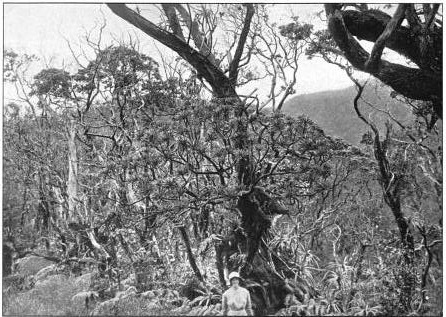 |
| CLERMONTIA PERSICIFOLIA Gaud. |
| Mature tree. Growing epiphytically on Metrosideros Ohia lehua, in Palolo Valley, Oahu. |
page 15
| PLATE 7. |
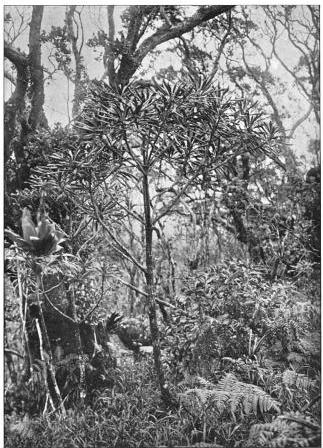 |
| CLERMONTIA PERSICIFOLIA Guad. |
| A young tree growing terrestrially on Palolo crater-ridge, Oahu. |
page 16
genus Heterotoma; Grammatotheca occurs both in South Africa and Australia with two species, one in each continent.
The herbaceous genus Pratia is found in South America and the neighboring islands down to the Magellan Strait, New Zealand, Australia and tropical Asia (one species only in India and Java).
Isotoma to which our Hawaiian genus Brighamia is very closely related is composed of eight species of which six are peculiar to Australia, one to the West Indies and one to the Society Islands.
The genus Lobelia proper which possesses about two hundred species has the widest distribution. It occurs in the tropical as well as temperate regions of the world with the exception of Central and Eastern Europe and Westen Asia. The remaining genera are more or less dwarfed herbs, usually annuals, to which category belong also the genera Pratia, Heterotoma, and Isotoma. Of the remaining genera three inhabit North America and one the Mediterranean region, besides occurring in North America and South Africa.
The Lobelioideae may be conveniently divided into two main groups, one with baccate and the other with capsular fruits. It is remarkable to find that of the Hawaiian genera four have true baccate fruits. Outside of these islands there remain only the genera Centropogon in South America and Pratia, with most of its species South American with true baccate fruits. All the rest of the genera belonging to the Lobelioideae have capsular fruits. Of these we possess three, Trematolobelia and Brighamia, which are peculiar to these Islands, and the genus Lobelia proper, Brighamia with fruits of semi-baccate nature or rather fruits with a somewhat fleshy thin exocarp. From this we may infer that the bulk of the Hawaiian Lobelioideae the four genera with baccate fruits, are related to South American species especially to the genus Centropogon, but of that later.
The remarkable fact remains that the extensive island groups of the Western Pacific as for example Fiji and Samoa are void of Lobelioideae and this is also true of the Malayan region, the Philippines and New Guinea. The only Pacific islands which do possess Lobelioideae are Tahiti, Raiatea, and Rarotonga, but each island possesses only one or two species, while the Hawaiian Islands, so far as they have been explored, have yielded one hundred forty-nine species, varieties and forms, belonging to seven genera, six of which are endemic.
ORIGIN OF THE HAWAIIAN LOBELIOIDEAE
To the seven genera of Lobelioideae existing in these islands, we must attribute at least three different ancestors, which again had their origin in as many different and remote regions. We will divide the Hawaiian genera therefore into three groups and discuss their relationship with existing foreign species. The most interesting of these three groups are without doubt those with baccate fruits so numerous in the Hawaiian Islands. As has been pointed out in the last part of the previous chapter, the Hawaiian genera Cyanea, Clermontia, Rollandia and Delissea are unquestionably of American affinity and find their present cloest relative in the genus Centropogon. That their age is enormous and that they form with the Compositae the oldest element in our flora may be judged from their numerous species and their distribution over the whole
page 17
| PLATE 8. |
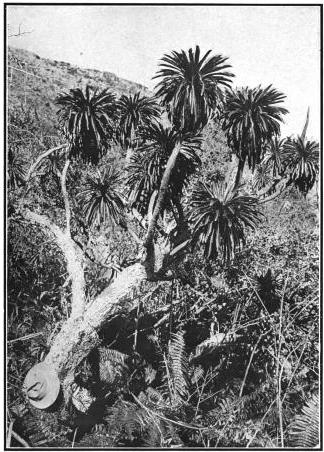 |
| CLERMONTIA HALEAKALENSIS Rock |
| Growing on the slopes of Puunianiau crater, Mt. Haleakala, Maui; elevation about 7000 ft. |
| From: J. F. Rock, The Indigenous Trees of the Hawaiian Islands. |
page 18
| PLATE 9. |
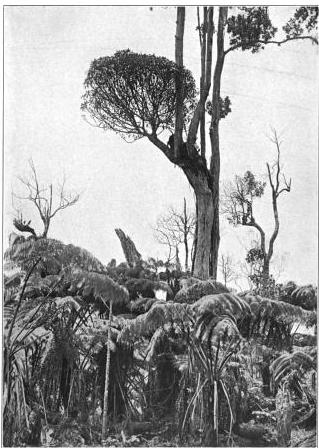 |
| CLERMONTIA PELEANA Rock |
| Growing epiphytically on a tall Metrosideros (Ohia lehua) tree below Glenwood, Hawaii; elevation, 2100 feet. |
page 19
group, but especially from their fauna. Their structural peculiarities and the large number of species would certainly indicate a very ancient occupation of this group of islands by their immigrant ancestors. These four genera are in reality so closely related to each other that botanists have been unable to set exact specific limits, and it is true that some species, as for example Clermontia Waimeae, puzzle the botanist as regards their generic value. This was however brought about by the basing of these genera, by Ch. Gaudichaud on irrevelant characters, which, as new species were discovered, became untenable. It was due to the following of Gaudichaud's classification by later botanists that heterogenous species were brought together and closely related ones were separated. Hillebrand, who has been by far the best connoisseur of our flora has arranged them in what must be considered the best possible classification.
THE BACCATE GENERA OF THE HAWAIIAN LOBELIOIDEAE
To this group belong the already mentioned genera Clermontia, Cyanea, Delissea, and Rollandia. Of these, the genus Cyanea possesses by far the most species, and is with Clermontia, still in the process of evolution, while the genus Delissea is to be considered in a decadent stage. The characters of these four genera are not very well defined and as Hillebrand pointed out were not quite satisfactorily arranged. Gaudichaud established these genera mainly on the length of the calycine lobes, a character not at all reliable as is well illustrated by certain species of Clermontia still in the process of evolution. Hillebrand's classification was based on more extensive material, and though a great many new species have been discovered since Hillebrand, his classification need not be altered; on the contrary the newly discovered species confirm his classification. The genus Clermontia is at once recognized by its cymose inflorescence, and also by its peculiar branching habit, which to some extent occurs in a few species of Cyanea. The three remaining genera have all a racemose inflorescence. Clermontiae are usually trees or shrubs of which the latter type is quite commonly epiphytic. The type of branching is candelabra-like as can be seen by the accompanying illustrations. The crowns are either dense and rounded, or open and loosely branched, in one instance (Clermontia Haleakalensis) the branches are stout and ascending. (See Plate VIII.) Their corollas are rather large and fleshy (Cl. arborescens, Cl. drepanomorpha, etc.) or thin and slender as well as small, to this category belong Clermontia parviflora, Cl. micrantha and Cl. multiflora the latter in some respects forming with Cl. persicifolia the intermediate of the fleshy and large flowering species. Their foliage is usually thick leathery and shiny above, with two exceptions (Clermontia parviflora and Clermontia Kakeana). All species have a tendency to become, or indeed are, more or less epiphytic. The large orange-colored berries are a source of food for the birds which deposit the seeds with their droppings in the forks of trees, or on thick mossy branches, or in the fribrous masses of the stout trunks of the tree ferns Cibotium Menziesii and C. Chamissoi. Clermontia Peleana has been observed by the writer in the uppermost branches of Ohia lehua trees (Metrosideros collina polymorpha) on Hawaii, some sixty to eithy feet up in the tree. (Pl. IX.)
Clermontia Haleakalensis which is the largest of all species of Clermontia is terrestrial only, as least so far as has been observed. They are never single
page 20
| PLATE 10. |
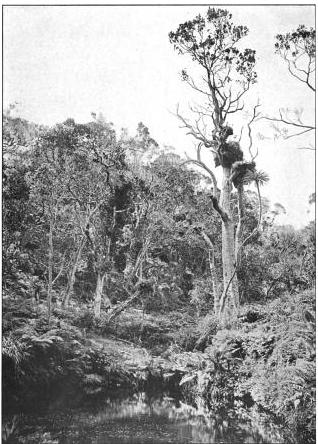 |
| CYANEA LEPTOSTEGIA A. Gray |
| The tall plant to the right near the Ohia lehua tree. Forests of Kauai; elevation 4000 feet. Photo by A. Gartley. |
page 21
stemmed plants as ocur in Cyanea, Rollandia and Delissea but are always more or less many branched trees or shrubs with trunks varying from a few inches or even less, to one foot in diameter. The flowers as in the other genera of this group are axillary. The calycine lobes are either connate with the corolla, enclosing the latter completely and dropping off with it after anthesis, or they are short obtuse lobes or minute teeth. The main characteristic is however the cymose inflorescence. Only in a single instance has the writer observed a tendency to a raceme; this was in the polymorphic species Cl. Waimeae, where two flowers issued from the apex of the peduncle and third one about a half an inch lower down the peduncle. Clermontia Waimeae occurs in the wet forest of Kohala Hawaii, with other polymorphic species of both Clermontia and Cyanea. No such racemose tendencies occur in the species on the older islands. The seeds of Clermontia are perfectly smooth and shiny and of a brown color; this same characteristic is common to the seeds of Cyanea. In Cyanea however we have very different types of plants. While we have observed a typical candelabra-like branching habit in Clermontia, Cyanea is far from exhibiting such a constant character. We find it necessary to divide Cyanea into several sections, of which the section palmaeformes is the most remarkable. It is characterized by a single stem which never branches, save when it is broken, and then only will it divide into two or threee branches. It is Cyanea which produces the tallest Lobelioideae of the Hawaiian Islands; the tallest species being Cyanea leptostegia (see Plate X), often reaching a height of forty feet, Cyanea Giffardii reaches thirty feet and C. arborea a similar height. They form stately trees of palm-like habit with a dense crown of long, usually sessile leaves, and long drooping or closely packed flowers. They certainly are a striking feature of the landscape. The group Delisseoideae exhibits a similar branching habit as Clermontia only their branches are longer, that is they rarely branch again, and are more or less straight ascending. This type of Cyaneae has usually long racemes and small flowers of a whitish to cream color with a purplish tinge. It is not apt to grow at as high an elevation as the section palmaeformes. Its species are rarely taller than fifteen feet. Another group with also possesses small flowers is the section pilosae which is subherbaceous, especially in the upper two thirds. The plants are rarely higher than three to four feet and grow in dense shade in the mossy rain forests, especially well developed on Hawaii.
Cyanea acuminata of Oahu and Cyanea multispicata of Kauai, the latter perhaps only a form of the former represent this group in the oldest islands which C. Bishopii is its representative on Maui.
It must be remarked that there is a tendency to lobed leaves in the young state of most of Cyaneae while such tendency is not at all present in Clermontia. Lobed leaves occur especially in the section palmaeformes and so different to the young plants look that it is indeed difficult to place them with their respective species. Thus Cyanea leptostegia has deeply lobed leaves when young; so have Cyanea solenocalyx, C. solanacea and others, and while the leaves become entire in the old plants they are usually undulated to such an extent as to appear lobed. Certain species keep the lobed-leaf-character but all gradations exist till we find the perfect pinnate leaf in C. Grimesiana which character remains always constant. In the branching species, like Cyanea angustifolia, C. coriacea, C. Hardyi, and C. Fauriei, lobed leaves never make their appearance at any stage, and thus
page 22
| PLATE 11. |
 |
| DELISSEA UNDULATA Gaud. |
| Growing in the Koa and Mamani forest (Acacia Koa, and Sophora chrysophylla) on the slopes of Mauna Loa, Hawaii; 5000-6000 feet elevation; the plant to the left is 35 feet tall. From: J. F. Rock "The Indigenous Trees of the Hawaiian Islands." |
page 23
they are again brought nearer to Clermontia of which they may be a satellite.
Similar to the tendency of lobed leaves in young plants is the tendency to produce spines or murications sometimes retained in certain species. An extreme case is Cyanea nolimetangere which has not only densely spiny stems but leaves bristling with spines on both sides. In the section palmaeformes we find sometimes spines in young plants especially in Cyanea tritomantha, C. solenocalyx and C. aculeatiflora which disappear entirely in old plants or remain in the shape of a slight murication. In the species of the section Delisseoideae no tendency to spines occurs, and thus they are again brought nearer to Clermontia which has not a single species with spines. Clermontia tuberculata however, possesses tubercles on the inflorescence only.
Cyanea is differentiated from Clermontia in the racemose inflorescence mainly. Delissea has also a racemose inflorescence but the corolla, which is smooth in Cyanea has in Delissea from one to three distinct knobs, one on the dorsal side, or when three, two additional ones on the lateral sides of the corolla. The main distinction between Cyanea and Delissea is to be found in the seeds. In Delissea the seeds are a pale yellow or whitish and are deeply wrinkled, which character is visible even with the naked eye; the seeds are also a trifle larger than in Cyanea. The same branching characters are exhibited in Delissea as are to be found in Cyanea. Two types occur, tall simple stemmed plants (Delissea undulata), and branching shrubs (Delissea subcordata). Delissea undulata is the only one in the genus which reaches a height of thirty-five feet (see Plate XI) and thus brings the genus close to the section palmaeformes of Cyanea, which Delissea subcordata connects it with Cyanea through the section Delisseoideae of the latter.
There is again a tendency to lobed leaves as is exhibited in the species D. laciniata, D. sinuata, and D. parviflora, while D. undulata as the name implies has very strong undulate leaves giving it the appearance of being lobed. The wrinkled seeds and knobbed corolla distinguish this genus at once from the other three, though the inflorescence is racemose. It may be however, that what now constitutes the species of the genus Delissea, is nothing but a single very polymorphic species. The peculiarity of wrinkled seeds however belongs to Delissea alone.
We come now to the last genus of the baccate Hawaiian Lobelioideae, "Rollandia." The genus Rollandia, while at once recognized even in sterile specimens, by the botanist familiar with the Hawaiian flora, is mainly distinguished from the other genera in the staminal tube which is adnate to the tube of the corolla, usually in its lower third, or lower half. This is a never failing character. The flowers are arranged in long or short racemes, and are of course again axillary. The corolla is usually purplish-red, red, or purple. Rollandia is a genus of a few species only and does not exhibit the wonderful variety of types as Cyanea, but is remarkably uniform in habit. Rollandia rarely branches, its stem is fleshy or woody at the base; it is confined to the very humid rainforest with a high precipitation. It is rarely found on exposed ridges, but always in dense shade in deep ravines, and in that respect has the habit of Cyrtandra. It is the farthest removed from Clermontia, phylogenetically speaking. Like the rest of the baccate Hawaiian genera of Lobelioideae it has also a species which still shows the process of evolution; this is Rollandia lanceolata
page 24
| PLATE 12. |
 |
| CYANEA ARBOREA (Mann) Hillebr. |
| Growing above Ulupalakua, Kula, Haleakala, Maui; elevation about 5000 feet; plant approximately fifteen feet in height. |
page 25
which possesses a number of varieties. What Cyanea scabra is in Cyanea, Delissea laciniata in Delissea, Clermontia parviflora and [sic] Cl. Waimeae are in Clermontia, Rollandia lanceolata is in Rollandia as far as plymorphism of species is concerned. These species are all in their prime, while others are on the point of extinction (palmaeformes of Cyanea). The distribution of the genus Rollandia in the islands, (being confined to Oahu, except a single species "Rollandia parvifolia" which occurs on Kauai), would indicate that its ancestor was a different one from that of the other genera and that it did not arrive conteporaneously with the other original immigrant or immigrants.
The occurrence of the large number of allied species of Lobelioideae would indicate a very ancient occupation of this island group by their ancestor or ancestors, and we come to believe that these closely allied genera and numerous species were evolved here in these islands, becoming modified to such an extent that their ancestors cannot now be recognized, rather than that they existed or originated elsewhere, whence they arrived in Hawaii, becoming extinct in their country of origin. That their ancestor or ancestors was or were American there remains no doubt whatever. The possibility exists however that the bacccate genera of Lobelioideae were once of wider distribution, that is to say, that they existed on possible intermediate islands, between this archipelago and the coast of South America, which islands became submerged at a later age. The writer does not entertain the theory of a direct land connection with either Asia or America; the theory of other volcanic islands having existed in the early age of the Pacific, forming stepping stones between this island group and the continent of America and Asia seems to him more plausible. In fact such a chain of islands is still in evidence between Japan and Hawaii, while the Galopagos Islands are a remnant of the chain of islands which probably existed between Hawaiii and Central or South America. The chain extended probably down to the island of Juan Fernandez, the flora of which has much in common with that of Hawaii. Extraordinary however is the fact that neither Juan Fernandez nor the Galopagos Islands, so close to the American continent, possess Lobelioideae. Hallier* seems to think that Indonesia, Australia and Polynesia must have once formed a mighty Australian peninsula which was bordered by concentric mountain ranges and whose eastern boundary or margin was formed by the Hawaiian Islands and the Paumoto archipelago. This peninsula he gradually permits to sink, partly through periodic earthquakes, so that the lowlands between these mountain ranges disappeared from the surface of the sea. This still permitted an exchange of plants between the mountains off Tasmania, New Caledonia, New Guinea, the Moluccas, Celebes, Philippines and Formosa. He also says that in still earlier times this Australian peninsula was united with America by means of a broad isthmus.
The depths in the neighborhood of Hawaii are so enorous that such a connection does not seem plausible; it is probable that other volcanic islands existed near the American Continent which brought the Hawaiian Islands closer to America.
The development of the Hawaiian species of Lobelioideae and their great
____________
* Mededeelingen's Rijiks Herbarium Leiden. No. 8-14, 1912. Hans Hallier, Über frühere Landbrücken, Pflanzen and Völkerwanderungen zwischen Australasien aund America.
page 26
| PLATE 13. |
 |
| DELISSEA UNDULATA Gaud. |
| Growing on the upper forest on the slopes of Mauna Loa, Hawaii; elevation 5500 feet. |
page 27
number are undoubtedly due to extremely varied conditions in these islands, produced by the enormous range of altitude, and consequent variable climatic conditions, which proved favorable and remained so, to the development of distinct forms from an early ancestor. Such widely ranging conditions were not available in the islands of the eastern Pacific as Tahiti and Rarotonga, which probably accounts for the very small number of Lobelioideae:— in each island one or two species at most. That the genera Sclerotheca and Apetahiia were derived from Australian species there is probably no doubt. In judging the length of time that the Lobelioideae have existed in Hawaii it is only necessary to look, next to their wonderful development, at the fauna to which they are host. Some of the birds which are dependent on the Lobelioideae are quite as remarkable as the plants themselves, and like them are not known in any other part of the world.
The early species of the Hawaiian baccate genera of Lobelioideae or their ancestors must have belonged to a type that was able to subsist in the less humid forests or even preferred the more open localities on the higher mountains of this group. The first immigrants probably have settled at high elevations whence they descended into the humid forests below, where they found conditions favorable to the remarkable development which they have now attained. Such old remnants of high mountain forms we find in Clermontia Haleakalensis, which grows on the upper slopes of Mt. Haleakala at an elevation of 7,000 feet whence one would never expect a baccate Lobelioid. The fact is that Clermontia Haleaklensis is the most distinct and curious of all species beonging to that genus, and represents probably the oldest type of Clermontia.
Another high mountain form is Delissea undulata which the writer found on the slopes of Mauna Loa at an elevation of about 5,000-6,000 feet in the dreary forests of Myoporum sandwicense, Acacia Koa and Sophora chrysophylla. Clermontia Haleakalensis which has the aspect of a Dracaena grows in company of a similar vegetation, as Delissea undulata, the plants growing nearest to it were Rubus, Stenogyne rugosa, Santalum Haleakalae, Sophora, etc. It is to be regretted that the uplands of these high mountains were given over to cattle grazing. Many more such types as Clermontia Haleakalensis occurred no doubt at the higher levels, but have now become extinct; these could have given us a clue as to the origin or evolution of the Hawaiian genera. Cl. Haleakalensis owed its survival to the few deep lava gulches on the slopes of the crater Puunianiau between which it grew, and which were more or less inaccessible to roaming cattle. Thousands of people have ascended Mt. Haleakala, among them a number of naturalists, but it was left to the writer to discover this rare and curious species of which only three trees are, or were then in existence. How many of these curious plants have disappeared from the uplands from where they descended to the more humid forest belts below we can not even guess, for the present number of survivors of such types is too small. It is quite possible that the baccate Hawaiian Lobelioideae have originated from two ancestral immigrants, of which that of the genus Cyanea antedated that of Rollandia. The very fact that Cyanea possesses so many species, almost as many as the other baccate genera together and the remarkable types of the section palmaeformes, as Cyanea leptostegia, C. arborea, and C. Giffardii, point to the great antiquity of that genus, which undoubtedly antedates the other baccate genera. The peculiar distribution of Rollandia with several species on Oahu, and only one on
page 28
| PLATE 14. |
 |
| DREPANIS FUNEREA. |
| A drepanid nectar-feeding bird partial to Lobelias. |
| From Wilson and Evans, Birds of the Hawaiian Islands, 1890-1899 |
page 29
Kauai would show that it came perhaps in a later age than Cyanea and from another ancestor, the agent which was responsible for the inter-island dispersal of the genus Cyanea was perhaps at that time extinct or on the verge of being so, which would account for the fact that Rollandia is practically restricted to one island. It is more probable that the single species found on Kauai by Mr. Forbes is an accidental immigrant, than that the genus is a decadent one and has nearly disappeared from Kauai; if that were the case we would undoubtedly find old ones on the other islands like Molokai. Some may claim that the other islands are perhaps much younger than Kauai and Oahu. There is little doubt that Kauai is the oldest island and that the western mountain range known as the Waianae Mountains of Oahu, is of the same age as Kauai, while the main mountain range known as the Koolau range is probably of the same age as Molokai and West Maui. That inter-island dispersal has stopped is certainly undeniable and in all probability it stopped at about the time of arrival of the ancestor of Rollandia. In Rollandia we do not find such remarkable contrasts in species as in Cyanea, in fact the species of Rollandia are very close to each other both structurally and in their habits; one need only compare the small subherbaceous forms of Cyanea and the palm-like giants of forty feet in height. Even the species of Rollandia found on Kauai comes close to Rollandia angustifolia from Oahu. Were Rollandia of a greater age we undoubtedly would find similar gaps as exist in the appearance or stature of the species of Cyanea. This would expeically be the case with a species found on Kauai.
AVIFAUNA OF THE HAWAIIAN ISLANDS PARTIAL TO LOBELIOIDEAE
Dr. R. C. L. Perkins in his introductory remarks to section Vertebrata of the "Fauna Hawaiiensis" states: "Remarkable as are some other members of the Hawaiian Avifauna, yet it is upon the Drepanid birds that the interest of the ornithologist will always be centered. The Drepanideae include thirty-five species belonging to no less than seventeen genera." It may be remarked that the Drepanideae are a family of birds peculiar to the Hawaiian Islands and that, as Dr. Perkins states, they are of unknown origin, owing to their dubious relationships with outside forms. "Dr. Gadow has suggested, however, that they are related to the Coerebidae, which fact, if certain, would leave little doubt as to their American origin." A large number of the Drepanideae are nectar feeders but Dr. Perkins also notes that nectar is never the sole food, though a most important source of nutriment, he says: "Nectar is undoubtedly absolutely necessary to the existence of Himatione, Chlorodrepanis, Vestiaria, Hemignanthus and Drepanis as they are constituted; small moths, caterpillars, and spiders — their other food — would certainly fail them in sufficient quantity as certain seasons." A number of the Drepanideae have developed long curved beaks "which make one wonder for what purpose such an extraordinary development can have taken place."
"Practically all the plants visited by birds for food had bell-shaped or tubular flowers, in which the nectar was more or less hard to reach; most striking of all are the arborescent Lobelioideae, and the multiplicity of these peculiar plants and their isolation from foreign forms bears a striking resemblance to that of
page 30
| PLATE 15. |
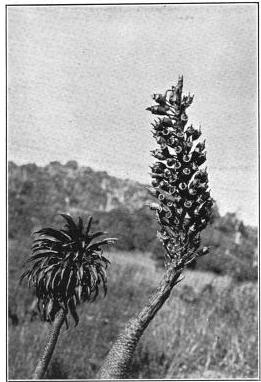 |
| LOBELIA GAUDICHAUDII A. DC. |
| Fruiting specimen. To left Trematolobelia macrostachys (Hook. et Arn.) Zahlbr. sterile, growing on the cliffs of Pelekunu, Molokai. |
page 31
the Drepanid birds themselves, indicating likewise an extremely ancient occupation of the islands, and as the Drepanid birds are the pride of the Hawaiian ornithologist, so are the Lobelioideae of the Hawaiian botanist." Perkins again says: "the development of the extreme forms of these birds is not comprehensible without a knowledge of the island flora."
"A series of observations made on one of the most superb of the Lobelioideae showed that it could only be fertilized by these highly specialized birds. In this species the pollen is mature before the stigma is exserted, by which time the pollen has vanished. The latter cannot be wind-borne because it is shed in a viscid mass on contact and so is constantly deposited on the bird's forehead, from which it is difficult to remove it." To this the writer would remark that birds are not essential to the pollination of Hawaiian Lobelioideae though no doubt they are important factors in pollination. In the Lobelioideae especially in the Hawaiian species, we find at the apex of the style immediately below the stigmatic lobes and usually on the lower surface of the stigmatic lobes, rows of hair, which are on a level with the base of the tube of the anthers at the time of the pollen-discharge. The pollen remains in the tube of the anthers as the anthers are united and thus the pollen cannot be disseminated. At the time of the pollen discharge within the tube, the style has usually not reached its full length, but it continues to grow and as it pushed through the anther-tube it brushes the pollen with its rows of hair out of the tube, and there the pollen remains adhering to the bristles or bunches of hair, with which usually the two lower, or in some cases all five anthers are fitted out at their apices. It can be seen that dichogamy is not so pronounced that autogamy is not possible. The proterandrous anthers are often eaten by insects or birds (?) and the pollen is thus prematurely discharged.
The base of the corolla tubes, especially those of the large flowering species, is usually filled with great numbers of Brachypeplus (small insects with short wings) and the Drepanid birds may find in them a source of insect food. Dr. Perkins seems not to have mentioned that fact, though he has often, on being invited, picked off specimens of Brachypeplus from dried herbarium specimens of the rarer and new Hawaiian Lobelioideae. When one breaks flowering branches of Cyaneae or Clermontiae especially those with large flowers, the inflorescences become alive with Brachypeplus as well as small Carabidae.
We can judge from these remarks that the Lobelioideae must certainly belong to one of the oldest groups of plants inhabiting this archipelago. Long before there were any Drepanid birds the Lobelioideae must have occurred in these islands, to be sure not in such numbers, but perhaps in isolated individuals with structural characters probably different from those which are now existing. Since the Drepanid birds themselves show a relationship to American birds, we must look to the ancestor of the Drepanideae of today as the possible agent of dispersal of the baccate Lobelioideae. That the Drepanid birds and Lobelioideae had a more or less simultaneous development can again be surmised by the fact that, in some of the Drepanid birds we still find individual variation as regards the length of the bill.
page 32
| PLATE 16. | |
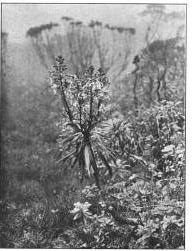 | 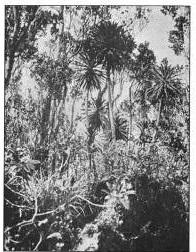 |
| LOBELIA KAUAENSIS (A. Gray) HellerFlowering at the summit bog of Mt. Waialeale, Kauai; elevation 5000 feet. | LOBELIA KAUAENSIS (A. Gray) HellerGrowing on a moss-covered tree near the swamp of Kauluwehi, Kauai; 4200 feet elevation. |
page 33
| PLATE 17. |
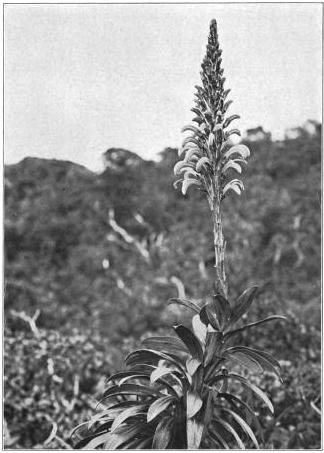 |
| LOBELIA GLORIA-MONTIS Rock |
| A find flowering specimen about five feet tall, growing near the summit of Mauna Eeke, in open bog, West Maui; elevation, 3500 feet. |
page 34
| PLATE 18. |
 |
| Group of Lobelia gloria-montis, showing sterile plant and plants in different stages of flowering, near the summit of Mauna Eeke, West Maui; 4000 feet elevation. |
page 35
THE CAPSULAR LOBELIOIDEAE OF THE HAWAIIAN ISLANDS, AND THEIR OUTSIDE AFFINITIES.
To this group of Lobelioideae belong the three remaining genera as Lobelia, Trematolobelia, and Brighamia. The two first mentioned genera possess true capsular fruits while in Brighamia the capsule is at first somewhat fleshy, but opens at maturity by two slits on each side. Of all our Lobelioideae the true Lobelias have unquestionably the more beautiful flowers. The Hawaiian species may be divided into two groups, comprising ten species and four varieties. What is now considered the genus Trematolobelia was formerly included in the genus Lobelia.
The most beautiful of our true Lobelias inhabit the summits of the mountains that harbor more or less extensive bogs with an entirely different vegetation than one would expect in the tropics. The finest of our Lobelias is Lobelia gloria-montis, a truly royal and superb plant. It occurs on the summit of Puukukui on West Maui, also on Mauna Eeke of the same range. There it forms stately plants with single stems several feet in height, and when in flower is really a gorgeous sight; the individual flowers are large, cream colored with purple streaks and are arranged in a terminal panicle, sometimes three feet in length and bearing as many as eighty to a hundred flowers. On the edge of the bog overlooking the cliffs of the famous Iao Valley there occurs a variety longibracteata, which has a stem of about 10 feet, after which it divides into four or five ascending branches or flowering spikes with still larger flowers; it differs from the species also in the long acuminate bracts. The species does not occur on the muntains of Oahu and Molokai, but on Oahu it is represented by another species Lobelia Gaudichaudii with red flowers, and smaller spikes. This species inhabits the very summit of Konahuanui, Oahu, overlooking the precipices on the windward side of the island. On the island of Kauai we meet with another species less robust than the Maui plants from the swamps of Puukukui. The summit of Kauai is an extensive bog harboring a wonderful vegetation of which Lobelias form a striking part. Lobelia Kauaensis inhabits the wind-swept cold boggy summit in company with a variety villosa and another Lobelioid Trematolobelia macrostachys var. Kauaiensis with purple to red flowers. Lobelia Kauaensis is nearly always branching, bearing two, three or four spikes of gorgeous, large and delicate flowers. The flora with which these Lobelias are associated is of an entirely temperate type, as Plantago which forms large rosettes, Sanicula, Drosera, Styphelia, Geranium, Oreobolus, and Acaena, also wonderful Compositae as ancient as the Lobelias themselves.
All of the Hawaiian true Lobelias are monocarpic, a character which we find in certain species of Lobelia occurring in the Abyssinian highlands, on Mt. Kenya, Ruwenzori and Kilimanjaro in Africa. According to Hillebrand, Lobelia Gaudichaudii is closely related to a species from Loo Choo Islands, specimens of this, a supposedly undescribed species, were said to be in the Gray Herbarium, but according to Dr. B. L. Robinson no such specimen could be found.
Lobelia Gaudichaudii, Lobelia gloria-montis, and Lobelia Kauaensis are probably of Asiatic origin, and their closest relatives will probably be found in species occurring in the islands south of Japan as Liu Kiu and the Bonine Islands. This type of Lobelia extends into Asia or rather northern India,
page 36
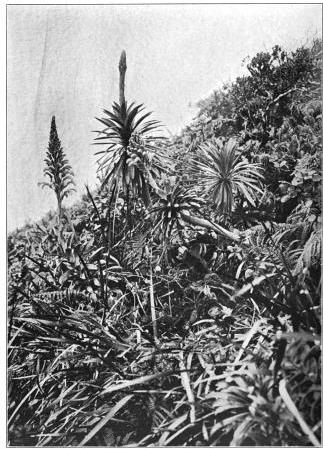
| PLATE 19. |
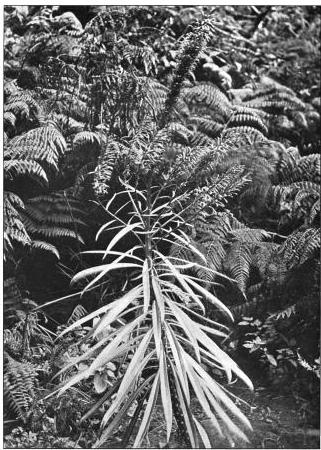 |
| LOBELIA HYPOLEUCA Hillebr.Growing at Waiakealoha Valley, Kauai; elevation 4000 feet. A mature flowering specimen. |
page 37
| PLATE 20. |
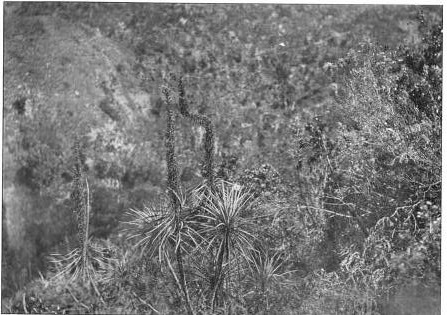 |
| LOBELIA YUCCOIDES Hillebr.Growing on the edge of a ravine of Waimea canyon, Kauai; to the right an old inflorescence of Wilkesia gymnoxiphium A. Gray. |
page 38
| PLATE 21. |
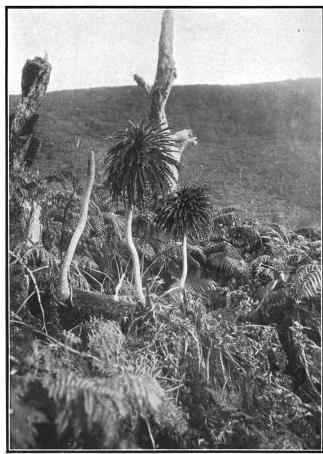 |
| TREMATOLOBELIA MACROSTACHYS (Hook. et Arn.) Zahlbr.Growing in the swamp back of Waikolu rudge, Molokai.From: J. F. Rock "The Indigenous Trees of the Hawaiian Islands." |
page 39
whence about seven of the tall species are recorded in Hooker's Flora of British India. C. B. Clarke classes them in the section Rhyncopetalum of which the tallest species is about twelve feet in height. Nearly all of these species have branching stems as occur in Lobelia gloria-montis longibracteata and Lobelia Kauaensis. The Indian species inhabit the Himalaysas up to an elevation of from three thousand to twelve thousand feet. The Hawaiian true Lobelias of the type to which L. Gaudichaudii belongs, inhabit the highest available altitudes which harbor extensive bogs. If Mauna Kea and Haleakala had boggy summits we would probably find species of Lobelia as high up as 13,000 feet and 10,000 feet respectively.
The other group of Lobelia inhabiting Hawaii have blue flowers and are as a
whole quite different in character from Lobelia Gaudichaudii. The most
remarkable of the blue flowered type is Lobelia yuccoides (see Plate XX), which
reminds one more of the Lobelias of the Abyssinian highland, like Lobelia rhyncopetalum.
The latter grows in the province of Semien up to an altitude of nearly
14,000 feet in boggy meadows. It reaches a height of fourteen feet and has an
inflorescence of an additional ten feet in length. This inflorescence bears over a
thousand blue flowers of a finger's length. Lobelia yuccoides as the specific
name inplies has the appearance of a yucca and is peculiar to Kauai and Oahu
where it grows at lower elevations from 3,000 feet upward but does not ascend to
the high swampy plateau; it loves canyons and flourishes best near waterfalls
and on the edge of cliffs usually in company with the extraordinary and peculiar
composite Wilkesia gymnoxiphium. The stem of Lobelia yuccoides is often over
six feet in length and bears a single flowering spike three feet in length with up
to four hundred blue flowers. Its habit is decidedly different from that of
Lobelia Gaudichaudii and is thus closer related to the African species than to
the North Indian ones. With Lobelia yuccoides we must class Lobelia oahuensis,
with a large dense crown of thick woolly leathery leaves. As the name implies it
is peculiar to Oahu, to the summit ridge of the Koolau Mountains where it
grows on the exposed, wind-swept cliffs with
Judging from the relationship of the Hawaiian Lobelias with species occurring in such vastly different geographical regions, we must come to the conclusion
page 40
| PLATE 22. |
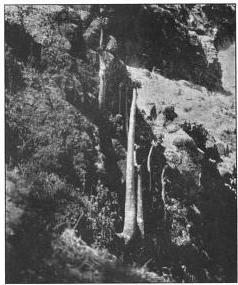 |
| BRIGHAMIA INSIGNIS A. GrayGrowing on the cliffs of Kalaupapa, Molokai. The plants are all in flower. Photo by Nevin. |
page 41
that they originated from two different immigrant ancestors. The agents responsible must again have been birds or perhaps wind currents. The seeds of Lobelia are so minute that they could easily be taken up in the upper air currents and thus carried across great areas. Their stations as we have seen are exposed, and swept by strong gales and as they are already at considerable elevations their find seeds could easily be carried by high winds which blow almost continuously over these boggy summits with such force that the writer found it most difficult to walk. To the writer it seems much more feasible to attribute the presence of Lobelia proper to wind currents rather than to bird agency. The fruits of the true Lobelias being capsular they would not attract birds to such an extent as baccate fruits would, though there is the possibility of the seed having arrived in dried mud on the feet of migratory birds. The genus Lobelia proper forms the crowning stage of the plant-stocking of this island group. Probably long after the present endemic genera, there arrived species of the widely distributed genus Lobelia, which in the course of millenniums produced the endemic species of today. We see the same case repeated in the Compositae. The oldest denizens of that family are undoubtedly the Silversword Argyroxiphium, Hesperomannia, and Wilkesia, while Coreopsis (Campylotheca) and Lipochaeta are the youngest, and it with these that the genus Lobelia may be compared as far as length of residence is concerned.
THE GENUS TREMATOLOBELIA.
In the year 1891, A. Zahlbruckner established the genus Trematocarpus on what was then known as Lobelia macrostachys Hooker et Arnott; the specimen was collected by Wawra on Kauai, which represents however a variety of the species occurring on Oahu and Molokai. Owing to the name of Trematocarpus being preoccupied Dr. Zahlbruckner suggested the name Trematolobelia which was published by the writer in a College of Hawaii publication.* The genus Trematolobelia differs from the true Lobelia in the capsule, which, instead of dehiscing at the top into loculicidal valves, does not dehisce at all like a Lobelia but disseminates its seeds through oval or round holes in the capsular wall which become larger towards the base of the capsule; the depressed umbonate vertex remains however intact.
The genus Trematolobelia possesses only one species T. macrostachys which occurs on Oahu, Molokai and Lanai, on the crests of high mountain ridges but below the habitat of Lobelia Gaudichaudii. It is usually epiphytic but also terrestrial. It is a remarkably handsome species and besides differing from Lobelia in the characters above mentioned differs also in the horizontally branching inflorescence. The flowers are slender and pinkish in color. On Kauai it is represented by a very distinct variety (var. Kauaiensis), occurring on the high plateau in swampy forests, along stream beds, and at the summit bog Waialeale in company with Lobelia Kauaensis, and its var. villosa, besides Drosera, Sanicula, Plantago, Compositae, Geranium, etc. In the mountains of Kohala on Hawaii it is represented by another variety much more robust and with large obovate leaves, larger white flowers and long racemes. This var. grandifolia grows along the edge of Waipio, Alakahi and Kawainui gorges where there is an enormous precipitation, at an elevation of about 4,000 feet.
____________
* College of Hawaii Bulletin No. 2:45. plates 11 & 12. 1913.
page 42
| PLATE 23. |
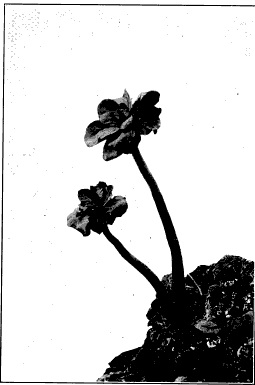 |
| BRIGHAMIA INSIGNIS A. GrayGrowing on the cliffs of Halawa, Molokai. |
page 43
There is no doubt that Trematolobelia is of Asiatic origin, in fact the genus is closely relted to Lobelia rosea Wall., in the subtropical Himalayas. Lobelia rosea has a stem from four to twelve feet in height; its branches are horizontal as in Trematolobelia. The flowers are rose to white in color and crowded. The capsule is subglobose as is the case in Trematolobelia. Unfortunately nothing is said in regard to the dehiscence of the capsules of this spcies; it would certainly be remarkable if the structure of the capsule of Lobelia rosea proved to be the same as that of Trematolobelia. Unfortunately the writer has not been able to examine a specimen of that species.
The stem of the Hawaiian Trematolobelia is sometimes eight feet in height, and dies after flowering. Sterile specimens possess a dense crown of narrow lanceolate, undulate leaves, which gradually drop when the plant begins to flower. The species proper is also not uncommon on Hawaii especially in boggy forests near the Volcano of Kilauea and in the forests of Kau, Hawaii, as well as on the northern slopes of Mt. Haleakala, Maui, along the Waikamoi trail, as an elevation of four thousand feet. As has been remarked above, its ancestor has reached these islands from the Asiatic Continent, as its closest living relative is found in Lobelia rosea of the subtropical Himalayas. The seeds of Trematolobelia are much smaller than in Lobelia, ovate in outline and smooth and not margined; in the Himalayan Lobelia rosea the seeds are ellipsoidal, compressed and also not margined. The seed is obviously fitted out for wind-dispersal, though birds may not be excluded as possible agents.
THE GENUS BRIGHAMIA.
Certainly one of the most curious Hawaiian Lobelioideae, though not one of the handsome ones if Brighamia insignis. It was named in honor of Dr. Wm. T. Brigham, the director of the Bishop Museum, by Dr. Asa Gray. Botanists thought at first to unite it with the genus Isotoma with which it is closely related. Unlike the other genera of Hawaiian Lobelioideae, Brighamia insignis the Aula or Puaala of the natives, does not inhabit the high mountains or mossy rainforests, but the steep cliffs on the windward side of Niihau, Kauai, Molokai, and Lanai. The writer has observed it on the cliffs of Kalaupapa and on almost bare rockwalls between Kalawao and Waikolu, within the spray of the sea, only a few feet above the mightly breakers of the Pacific. In Halawa Valley on the same island Brighamia grows in the dry rocky gorges at the broad entrance to the valley. It certainly is a most grotesque plant and has aptly been compared by Hillebrand with a cabbage put on a fence post. The stem is thick clubshaped and fleshy throughout, bearing a crown of broad fleshy leaves at the apex. The flowers appear in the axils of the leaves and instead of drooping as in other genera, stand erect; they are white and have a strong fragrance reminiscent of a violet. It is the only species in the genus but is represented on Kauai by a form described by Charles N. Forbes as forma citrina on account of its orange yellow flowers. Like the other Hawaiian Lobelioideae it is not known from any other part of the world but its ancestor was undoubtedly Australian. As has already been remarked it is related to the genus Isotoma which consists of about eight species of which six are peculiar to Australia, one to the West Indies and one to the Society Islands. Isotoma longiflora is one of
page 44
| PLATE 24. |
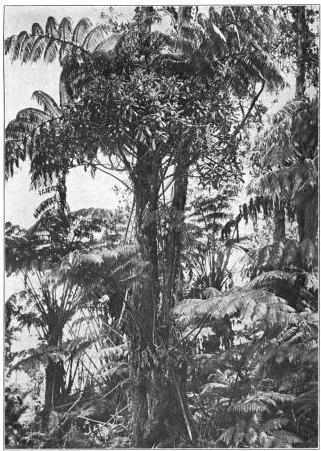 |
| CLERMONTIA PARVIFLORA Gaud.Growing epiphytically on Cibotium tree fern (C. Chamissoi) in the rainforest at 29 miles, Volcano of Kilauea, Hawaii; elevation, 3500 feet. |
page 45
the most poisonous West Indian plants. While the species of Isotoma are small herbs, Brighamia attains a height of twelve feet, but is fleshy throughout. Brighamia is in all probability a much more recent immigrant that has established itself in these islands, but not sufficient time has elapsed for it to expand and to produce varieties and species. Only a single form differing from the species in the organge yellow flowers has been reported so far. It probably was next to Lobelia the last of the Lobelioideous immigrants to arrive in Hawaii; it is safer to assume this than to say that the genus is a decadent one and that Brighamia is the last survival of the Isotoma-Brighamia tribe. Undoubtedly Brighamia was handicapped by the restricted area which it found suitable for its existence and development.
Intermediate between Brighamia and Isotoma is Apetahia Raiateensis, a remarkable arborescent species peculiar to the island of Raiatea; the generic name being derived from the native name Apetahi. It is remarkable on account of its unilocular ovary and parietal placentas. The long floral tube is split to the base as in Isotoma, and the flowers are also single, while in Brighamia the corolla is salvershaped, and the flowers are arranged racemosely.
In viewing the Hawaiian Lobelioideae, and their possible country of origin we find that they must have been derived from four continents. The baccate genera, Cyanea, Clermontia, Delissea and Rollandia show a strong relationship to Centropogon of Central and South America, Lobelia proper, to species occurring in equatorial Africa as the highlands of Abyssinia, Mr. Kenya, and Kilimanjaro, as well as to species found in the islands south of Japan, as Liu Kiu and the Bonine Islands: Trematolobelia to a species of Lobelia from the subtropical Himalayas, and finally Brighamia to Isotoma of Australia and Apetahia of Raiatea.
Guppy in his valuable work "Observations of a Naturalist in the Pacific" claims an age of Compositae an age of Lobelioideae as well as an age of Coniferae in the Pacific. He tried to explain the absence of Lobelioideae from the islands of the western Pacific, by stating that during the age of the Lobelioideae, that is to say during the age of their distribution, the western Pacific islandds were submerged and that after their emergence from the ocean, the agent responsible for the distribution of the Lobelioideae had become extinct. It is more probable that there were other islands between Hawaii and the American continent which facilitated plant migration, while the western Pacific Islands were more or less isolated from the area whence the distribution of Lobelioideae took place. The mountains of the western Pacific islands do not reach such altitudes as in Hawaii, and besides their location in more tropical latitudes would perhaps account for the absence of true Lobelias, which seem to be more favorable to cooler latitudes and altitudes. However the floras of the islands of the south Pacific are far too little known to permit anything but theorizing. While the facts and theories set forth in the previous chapters are not conclusive by any means we must regard them as based on such evidence as is at hand today. More intensive explorations in the islands of the south Pacific may reveal to us the presence of Lobelioideae which would throw new light on the question of their origin and distribution. Suffice it to say that it is doubtful that they will be found in such large numbers as to constitute as striking a feature in the floras as they are in Hawaii.
page 46
| PLATE 25. |
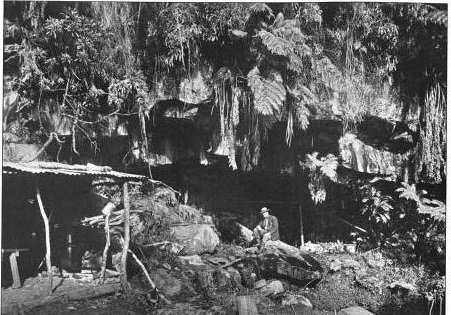 |
| CLERMONTIA KOHALAE Rock(Left-hand upper corner.) A small tree growing on rock walls in the Kohala Mountains, Hawaii, below Awini. |
page 47
DISTRIBUTION OF THE HAWAIIAN LOBELIOIDEAE IN THE HAWAIIAN ARCHIPELAGO.
In glancing over the appended charts we are at once struck by the peculiar distribution of the species of these various endemic genera, and in order to examine them more carefully it is best to look at each genus separately.
THE GENUS CLERMONTIA.
The genus Clermontia possesses twenty-three species and five varieties so far as we know today. Dr. Wm. Hillebrand in his Flora of the Hawaiian Islands describes eleven species and five varieties. All his species have been retained, while two of his varieties have been raised to specific rank, and one var. rosea of Cl. macrocarpa = Cl. Kakeana has been united with that species as not sufficiently distinct to warrant its separation as a variety. To these there were added eight new species by the writer, one new species by C. N. Forbes and one by H. Leveille; besides these new species the writer described three new varieites. This brings the total to twenty-eight species and varieties of Clermontia; of these, three species, Cl. arborescens, grandiflora, and oblongifolia, occur each on two islands, while one species, Cl. Kakeana, occurs on three islands. The remaining species and varieties are each confined to one island with the exception of var. robusta, which occurs on the same island as the species to which it belongs. By far the largest number of species (eleven) occur on the island of Hawaii, also two varieties. Kauai posseses only two species Cl. Gaudichaudii and Cl. fulva. The latter is somewhat doubtful. Of the eleven species found on Hawaii seven were discovered by the writer. Oahu harbors three species, Molokai, four; Maui, eight; and Lanai, one, while Niihau and Kahoolawe possess none. The highest elevation attained by Clermontia (Halekalensis) is 7,000 feet on the crater slopes of Puunianiau, a cone crater on the north-western slope of Mt. Haleakala on Maui, while Cl. Kakeana and Cl. Kohalae grow at an elevation as low as from 500 to 1,000 feet. The others inhabit the middle forest zone from an elevation of two thousand to nearly six thousand feet. Clermontia drepanomorpha a tall arborescent species inhabits the wettest regions, as the swampy plateau of the summit of Kohala, back of the gorges of Alakahi and Kawainui. They are rarely epiphytic but grow in the thick sphagnum moss which covers the ground. On this plateau the forest is rather open, and it is here that they abound in great numbers and in many different forms. The leaf variation is enormous, while the floral characters are unchanged. With the exceptions of Cl. drepanomorpha and Cl. Haleakalensis, the species are both terrestrial and epiphytic but more often the latter. They do however enjoy the more open forest of high swapy plateaus with a low tree formation. We find them associated with tree ferns on which they are quite often epiphytic, especially Cl. parviflora which loves the dense fern forests. Cl. Hawaiiensis is mainly associated with tree ferns, Metrosideros, Myoporum, Suttonia, and Acacia Koa. Cl. coerulea enjoys a similar plant company with the addition of Santalum Pilgeri, Pittosporum. and a predominance of Acacia Koa. The Clermontia drepanomorpha associates are of a different type, we find it with Clermontia Waimeae, Cl. leptoclada.
page 48
| PLATE 26. |
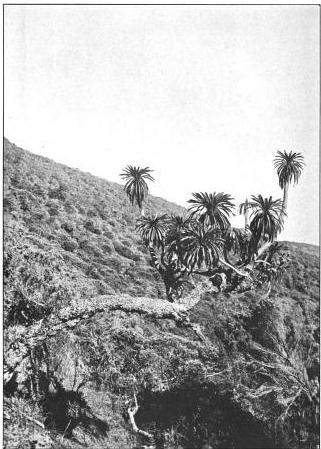 |
| CLERMONTIA HALEAKALENSIS RockOne of the most curious Lobelioids, growing on the slopes of Haleakala, Maui; elevation 7000 feet. |
page 49
| PLATE 27. |
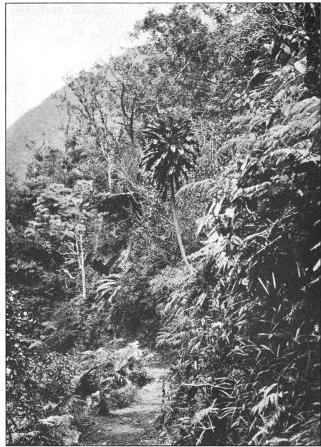 |
| CYANEA FAURIEI Lévl.Growing in Olokele canyon, Kauai. The plant is about 15 feet tall. Photo by R. S. Hosmer. |
page 50
| PLATE 28. |
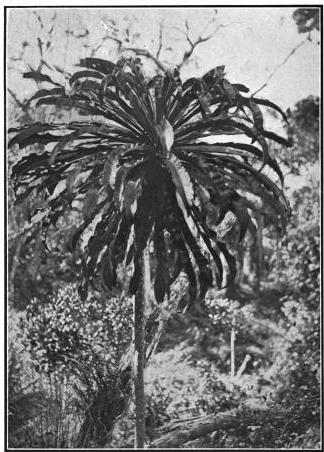 |
| CYANEA LEPTOSTEGIA A. GrayMature specimen in the woods above Waimea, Kauai. From J. F. Rock "The Indigenous Trees of the Hawaiian Islands." |
page 51
Cl. parviflora
, Plantago, Schiedea, Cyrtandra, Viola, Pelea pseudoanisata, Labordea, Tetraplasandra and the curious Gunnera petaloidea.The Oahu species Cl. Kakeana, Cl. persicifolia and Cl. oblongifolia inhabit the rain forest proper. Cl. oblongifolia ranges to the summit ridge but usually all three species can be observed together. Cl. arborescens inhabits the 4,000 foot level both on Molokai and Maui in the rain forest, with Pelea, Tetraplasandra, Platydesma, Cyrtandra, etc. Cl. grandiflora loves forested ridges on Molokai, and the swampy plateaus of West Maui. Clermontia singuliflora is on the verge of extinction; it occurs epiphytically on dead trees in the dead forest of Paauhau on the northern sloopes of Mauna Kea; there the forest was once burned over and since then has been used for grazing purposes. There is no doubt that it would revive were it not for the cattle which are very fond of the fleshy leaves of all Lobelioideae. That the Clermontia species love or can thrive abundantly in the open wet forest lands is demonstrated by almost pure stands of Clermontia Kakeana on the northern slope of Mt. Haleakala where the old forest has completely died. Thousands of Clermontia trees have since then come up even in the grass land of Paspalum conjugatum.
THE GENUS CYANEA
The genus Cyanea comprises today fifty-two species and twenty-five varieties. It is true that some of these species and varieties have become extinct, and one, Cyanea Kunthiana, has only been found by Gaudichaud and has not been recollected since. As no type or plant is extant in any European or American Herbarium, and as a description has never been published, but only a plate it is best that the species be dropped altogether. It was figured by Gaudichaud as Delissea Kunthiana and identified by Hillebrand with an entirely different plant of which Hillebrand had at that time only fragmentary specimens. From the excellent plate it is evident that the plant in question is a Cyanea and not a Delissea and the name Kunthiana being now a synonym should be discarded. The writer would suggest the name Cyanea Bonita; the specific name Bonita referring to the voyage Bonité on which Gaudichaud was botanist. As no material is available for study the plant is however not included in this monograph. One variety of Schizocalyx of Cyanea solenocalyx Hbd. is also omitted. No material is outstanding of this variety in the Hillebrand Herbarium. Hillebrand himself was doubtful as to the identity of his plant as his specimens were without flowers or fruit. There is the possibility that it is related to the writer's Cyanea aculeatiflora but nothing can be said as there are no specimens of Hillebrand's variety in any herbarium. Of the fifty species of Cyanea, fifteen are peculiar to Kauai with no varieties. Not a single species of the fifteen has been found outside of Kauai. Oahu possesses six species and three varieties. Of these species only one Cyanea angustifolia, occurs outside of Oahu, on Molokai and Lanai. Molokai, harbors eight species and one variety. Maui twelve species and eleven varieties, Lanai one species and two varieties, and Hawai nine species and seven varieties. Cyanea obtusa is the only other species outside of Cyanea angustifolia, which occurs on more than one island, Maui and Hawaii. The variety racemosa of C. angustifolia occurs on two islands, Oahu and Lanai. This is the only instance where a variety occurs on more than one island. We
page 52
| PLATE 29. | |
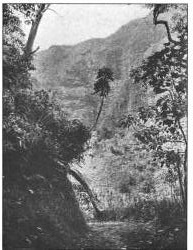 | 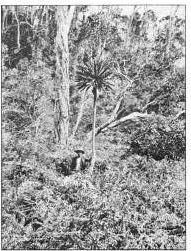 |
| CYANEA FAURIEI Lévl.Growing in Olokele canyon, Kauai. | CYANEA LEPTOSTEGIA A. Gray.Growing in Kaholuamano forest, Kauai. |
page 53
| PLATE 30. |
 |
| CYANEA GAYANA RockMature plant growing in the forests of Kaholuamano, Kauai. |
page 54
| PLATE 31. |
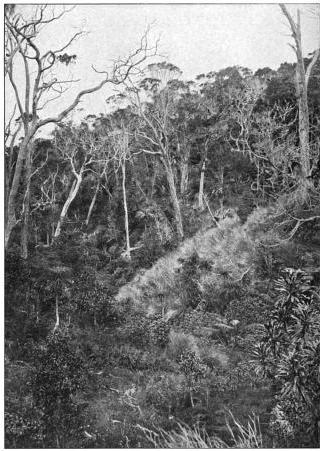 |
| CYANEA LEPTOSTEGIA A. GrayThe palm-like plants all through the gulch; to the extreme right Cyanea spathulata (Hillebr.) Heller, growing in the forests of Kaholuamano, Kauai. The trees are Metrosideros collina polymorpha. |
page 55
| PLATE 32. |
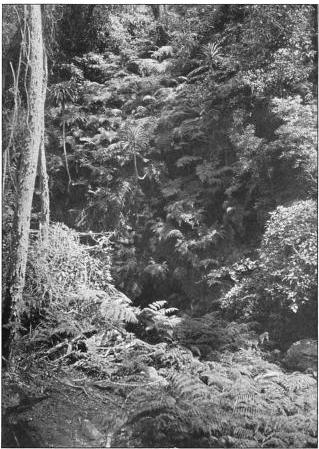 |
| Several plants of Cyanea leptostegia A. Gray growing along the walls of a small stream-bed at Kaholuamano, Kauai. The small leaved plant to the right is Cyanea spathulata (Hillebr.) Heller. |
page 56
| PLATE 33. |
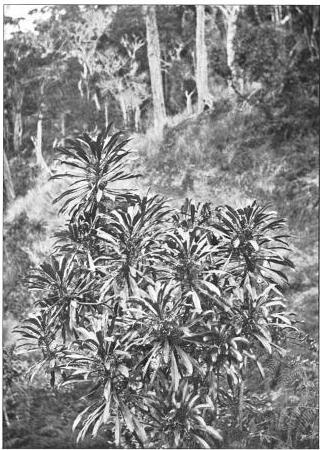 |
| CYANEA SPATHULATA (Hillebr.) HellerGrowing in the forests of Kaholuamano, Kauai. |
page 57
can see from this distribution that the species are decidely local, and that isolation has produced, or was responsible for these numerous forms.
Hillebrand describes in his Flora twenty-eight species and eighteen varieties, of these, two had been raised to specific rank, one by A. A. Heller, Cyanea spathulata, and one by the writer, C. regina, once a species described by Wawra and reduced by Hillebrand. Two of Hillebrand's varieties have been dropped or rather one has been doubtfully identified with the writer's C. Giffardii, and should this contention prove to be correct the name Cyanea Giffardii would have to stand as Hillebrand had not named the doubtful variety, but had simply given it a Greek letter; for further discussion see under Cyanea Giffardii. One species as already stated has been dropped as no material is in existence, and Hillebrand's specimen which he doubtfully referred to Gaudichaud's plant (Delissea (Cyanea) Kunthiana) had been described as a new species. The species of Cyanea similar to those of Clermontia inhabit the rainforests, ranging from 1200 feet ot 5000 feet elevation. Some species grow in the more open forests along ravines and gulches, waterfalls, etc. If we take the species of Cyanea on Kauai we find C. leptostegia the most common one as well as the most stately and tallest of all Lobelioideae. (See Plate XXIX.) While it occupies the open forests, and edges of dry ravines with Lobelia yuccoides, Wilkesia gynoxiphium, Styphelia, Metrosideros, Pelea, Xanthoxylum, Coreopsis cosmoides and others, it loves watercourses and can then be found on densely fern-covered walls together with Cyanea spathulata, Asplenius, Sadleria squarrosa, Cladium Meyenii, Schiedea stellarioides, etc. (See Plate XXXII.) As we approach the interior of the island we find Cyanea leptostegia absent and its place is taken by Cyanea Gayana, and Cyanea rivularis, the latter is an exceedingly handsome species with beautiful blue flowers; it reaches its finest development in the gorge of Waialae especially near the head of this broad valley. There the steep walls are one mass of this species growing fifteen to twenty feet tall and occasionally branching from near the base. There they grow with species of Dubautia, Cyrtandra, Cyanea Gayana, and the begoniaceous Hillebrandia sandwicensis, while Lobelia hypoleuca grows near the high water mark of the stream bed. On penetrating further into the interior of the island near the swampy summit we find practically an absense of Cyanea. C. hirtella is the only one which can be found near the high swampy plateau, especially along the streams of Kaluiti and Kailiili. There they grow in company with a new species of Gunnera, Trematolobelia , Tetraplasandra Waialealae, Lobelia Kauaensis, Cheirodendron platyphyllum, Suttonia, Schiedea lychnoides, and others.
Cyanea coriacea, C. Hardyi and Cyanea Fauriei, three closely related species, occur on the lower levels of from about one thousand to two thousand feet elevation. Cyanea Fauriei is practically confined to Olokele canyon, but a few specimens of C. Hardyi may be seen with it. The latter species reaches the border of the habitat of C. leptostegia but does not ascend higher. It grows in company with Rockia sandwicensis, Boehmeria stipularis, Perrottetia sandwicensis. Viola chamissoniona var. pubescens, Sida, etc. Cyanea coriacea is found on the windward side of the island and so is Cyanea fissa, and Cyanea Larrisonii. Cyanea Knudsenii is a shrub with a few ascending branches; it is confined to the forests of Halemanu and can be found in the mixed woods of Kopiwai together with Alphitonia excelsa, Santalum pyrularium, Platydesma rostratum,
page 58
| PLATE 34. |
 |
| In the upper margin, Cyanea aculeatiflora Rock in company with Gunnera petaloidea, growing on the rock walls of Waikamoi gulch, East Maui; elevation 4000 feet. (Photo and copyright by R. K. Bonine.) |
page 59
| PLATE 35. |
 |
| CYANEA ACULEATIFLORA RockMature plants growing in the rainforests on the northwestern slope of Mt. Haleakal, Maui, at an elevation of 4000 feet. |
page 60
| PLATE 36. |
 |
| CYANEA HAMATIFLORA RockA group of these remarkable Lobelioids, growing in a deep gulch, below Puukakai, northwest slope of Mt. Haleakala, Maui; elevation, 4000 feet. The tall flowering specimen in the background is about 20 feet in height. |
page 61
Xanthoxylum dipetalum Kauaiense, Elaeocarpus bifidus, and others of the drier regions. Cyanea recta inhabits the interior of the island with C. Gayana and C. rivulis, but is rather rare.
While Kauai is rich in species Oahu is comparatively poor, but this is compensated by the number of species of Rollandia of which genus only a single species is found outside of Oahu.
Cyanea angustifolia is by far the most common species occurring on the lower slopes of the mountains all over the island. C. acuminata with white flowers is subherbaceous but still five to six feet in height and inhabits the denser rainforest. Intermediate between the two stations we find Cyanea Grimesiana. The palm-like type of Cyaneas with loose-leaved crowns as we find in the rainforests of both west and east Maui and Hawaii are absent on Oahu, but their place is taken by Cyanea superba and Cyanea regina both stately plants and resembling greatly Cyanea Giffardii of Hawaii and C. arborea of Maui.
Cyanea truncata is found on the lower mountain spurs in dense jungle; it seems to be confined to the Koolau range from Waiahole to Punaluu valleys.
Molokai has produced the smaller palm-like species which have open loose-leaved crowns resembling those of Cyanea aculeatiflora on Maui and Cyanea tritomantha on Hawaii. Their representatives on the island of Molokai are Cyanea solenocalyx, C. wailauensis, C. solanacea and C. ferox, as well as C. procera, they all inhabit the dense rainforests, and may be found on the ridges on the leeward sides as well as in the deep ravines of Wailau and Pelekunu on the windward sides. In the drier leeward gulches we find C. angustifolia, while C. profuga is found in the valley of Mapulehu at a comparatively low evevation. Lanai possesses only one species C. Gibsonii, of Cyanea atra-type, while two varieties of Cyanea angustifolia (var. lanaiensis and var. racemosa), occur in the gulches of Mahana and Kaiholena.
The island of Maui, owing to its topographical diversity, altitude, and rainfall has produced a goodly number of very interesting species. The most noteworthy being Cyanea aculeatiflora and C. hamatiflora two very distinct species inhabiting the dense rainforests of the northern and north-western slopes of Mt. Haleakala at an elevation of from five thousand to six thousand feet. The former species extends into the deep ravines of Waikamoi and Puohaokamoa (see Plate XXXIV), where it grows fifteen to twenty feet in height or even more, in company with masses of Gunnera petaloidea, Labordea, Pelea, etc. Cyanea hamatiflora extends from Olinda to Waikamoi but is especially partial to Puukakai an ancient densely wooded volcanic cone in the rain belt above Makawao. Cyanea atra is found both on West and East Maui. In the former locality it is not uncommon in the upper portion of Honokawai gulch and in the latter is found along the Ukulele pipe line trail, a thousand feet higher than Cyanea aculeatiflora. C. asplenifolia, C. holophylla and C. lobata are found on West Maui in the gulches of Wailuku and back of Kaanapali in deep ravines. The latter species occurs also along the Nahiku-Keanae trail. One of the finest and most interesting species however is Cyanea arborea. Unfortunately the plant is practically extinct. It occurred on the slopes of Haleakala between Kula and Ulupalakua. Anyone familiar with the forest region, or rather region, as the forest has gone, can see why C. arborea one of the finest of Lobelioideae of the Hawaiian Islands had to succumb. Where there was once fine forest
page 62
| PLATE 37. |
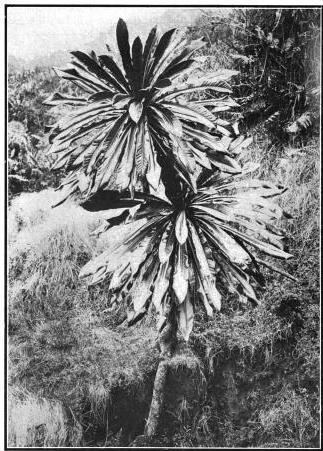 |
| CYANEA ARBOREA (Mann) Hillebr.Growing above Ulupalakua-Kula, Haleakala, Maui; elevation about 5000 feet; plant approximately 15 feet in height.From: J. F. Rock "The Indigenous Trees of the Hawaiian islands." |
page 63
| PLATE 38. |
 |
| CYANEA GIFFARDII RockThis rare and curious Lobelioid was photographed in the rainforests near 23 miles, along the Volcano of Kilauea road, Hawaii; elevation, 2500 feet. |
page 64
stalked with beautiful arborescent Lobelias there we find Hilo grass (Paspalum conjungatum) and herds of cattle the arch enemy of Hawaiian forests. The illustration here shown represents the last of this Lobelioid. Cyanea comata another beautiful species which has been recorded by Hillebrand from that region has already vanished, unless it may be found somewhere in the forests of Kaupo. We have seen however how extremely local these plants are, and how they are often confined to a very small area.
Cyanea Bishopii a small species akin to C. pilosa of Hawaii occurs both in the wet forests of Olinda and West Maui
The island of Hawaii the largest of the group, offers the greatest range in altitude, and combines all the topographical features from newly vomited lava flows to high swampy plateaus (Kohala), deep ravines and forests, the fastnesses of which have as yet not been trodden by man. In comparison with Maui, Hawaii, notwithstanding its wonderful and various topographic features, is not rich in Cyanea. Two types stand out clearly Cyanea Giffardii a very ancient species and Cyanea tritomantha. The former is the tallest Cyanea on Hawaii. The writer measured a specimen exactly thirty feet in lenght. It inhabits a strip of land near Glenwood which was once upon a time covered by dense forest. Today these forests are being cut down, and stocked with cattle and here and there on this narrow strip of land a few of these tall Lobelioids have survived only to be destroyed in the nearest future. The land about Glenwood is intersected by many lava flows which are covered with various types of vegetation. The strip of land on which Cyanea Giffardii occurs is very narrow, no trace of lava is visible but deep rich humus, while the adjoining strips are scoria (aa lava) disintegrated to be sure, to some extent, and covered with dense forest. The ground is however still full of holes and is therefore quite dangerous. The type of vegetation found on such flows is of course derived from the adjacent regions, but is uniform, and Lobelioideae are decidedly absent. Therefore in exploring a region with so many varied topographical features as is the case with the region about Glenwood it is necessary to make a thorough exploration and not to select a certain parcel of land and judge the rest of the land even the most adjacent one and its plant covering, by it. What will prove to be uniform vegetation in the first hundred feet may become very rich and ancient in the next hundred feet alternating again with a poorer type of forest. All these type are luxuriant to be sure, on account of the incessant rains in this region, but their flora may be entirely different. It is on one of these ancient strips of lands surrounded by lava flows which are covered with jungle, that Cyanea Giffardii has survived.
Lower down, below Glenwood and back of Hilo we find Cyanea tritomantha together with Cyanea platyphylla, and a variety cylindrocalyx of C. Grimesiana.
The Kohala mountains are rather poor in Cyanea but rich in Clermontia. Cyanea pilosa and its four varieties occur in the more uniform fern forests either growing terrestrially or on fern trunks (see Plant XLI); with it we find the spiny C. nolimetangere and Cyanea Copelandii. The latter has the tendency to recline against moss-covered tree trunks, which it ascends, sending out roots all along its stem. In the Kohala mountains proper Hillebrand records as growing C. arborea var. pycnocarpa, unfortunately the writer has not met with this plant. From the distribution of the species of Cyanea we learn that
page 65
| PLATE 39. |
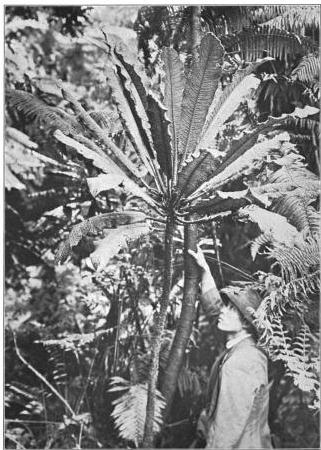 |
| CYANEA TRITOMANTHA A. GrayGrowing in the dense tree-fern forest near Kulani, slopes of Mauna Loa, Hawaii; elevation, 5000 feet. |
page 66
| PLATE 40. |
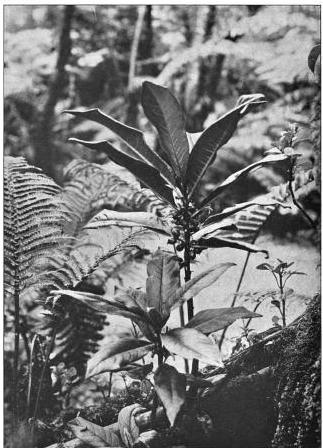 |
| CYANEA PILOSA Gray var. GLABRIFOLIA RockGrowing in fern forest near Kilauea Volcano, Hawaii; elevation 4000 feet. |
page 67
| PLATE 41. |
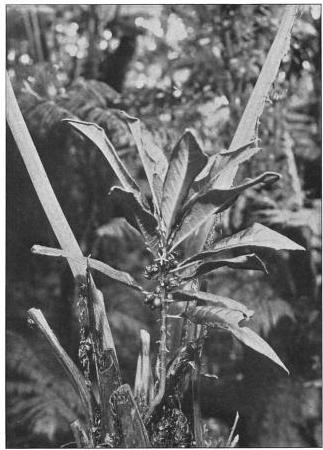 |
| CYANEA PILOSA Gray var. GLABRIFOLIA RockGrowing on top of trunk of Cibotium Chamissoi (tree fern), forests of Kilauea, Hawaii; elevation 4000 feet. |
page 68
species of the section palmaeformes, as Cyanea leptostegia, C. superba, C. arborea, and C. Giffardii are the oldest denizens and that they are on the verge of extinction, while others are to be considered in their prime and still in the process of evolution.
THE GENUS DELISSEA.
Unfortunately the species of Delissea are not so well known as the species of Cyanea and Clermontia and consequently only little can be added to the information furnished by previous authors. It is greatly astonishing that no new species have come to light and that even some of the old ones, discovered by Hillebrand could not again be located. The most common species of Delissea are D. subcordata and D undulata. The former has however become rare; this is due mainly to the fact that it grows at the lower elevation at the outskirts of forests, which have become invaded by foreign plants, especially the Hilo grass (Paspalum conjugatum) so destructive to Hawaiian vegetation. D. undulata has been recorded from all of the islands of the group with the exception of Oahu, Lanai and Kahoolawe. On Hawaii it attains its best development especially on the high central plateau in the forests of Mauna Loa and Hualalai. At Pulehua, South Kona, the writer met with large numbers of this species some reaching a height of thirty-five feet. It ranges from three thousand feet at Puuwaawa to six thousand feet elevation on the slopes of Mauna Loa. The beautiful little crowns on stems perfectly straight, are often hidden in the foliage f the Koa (Acacia Koa) so that only the gray straight stems covered with leaf sears can be seen. They are especially numerous at the bottoms of craters and volcanic cones. Looking down into one of these cones, one sees the tops of this curious plant, like cabbage heads protruding over the rim of the cone. It is also found throughout the forest on the border of the great plain, but is especially common in the volcanic cones described above, for the single reason that they are not accessible to cattle. Asa Gray seems to have confused the two plants more or less, for he considered D. undulata merely as a form of D. subcordata. The latter is a small branching shrub, while the former has an entirely different habit as can be seen from the illustration. Delissea rhytidosperma is only found on Kauai, especially in the drier woods of Waimea, Kealia and elsewhere. Heller records it from the east side of Hanapepe river in wet woods near the sources of the Wahiawa. Delissea parviflora was discovered by Hillebrand on the Kohala range and in the woods of Mauna Kea on Hawaii, the plant has not been re-collected and nothing is known regarding its habit. The same must be said of D. fallax from the woods of Hamakua and Hilo
The remaining species D. laciniata and D. sinuata occur on Oahu in the drier regions, the former from Wailupe Valley on the eastern end of the island and the latter from the dry valley of Makaleha on the western range. A variety of D. sinuata has been found on Lanai. There is no doubt that all these species are closely related, but they are unquestionably decadent. They are dying out fast as are the forests which they once inhabited. The few species may be looked upon as the remnant of what was once probably an extensive tribe. But as they seem not to be partial to the humid rainforesta and as the forests of
page 69
| PLATE 42. | |
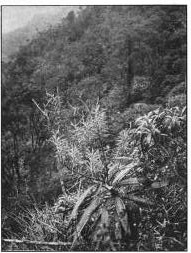 | 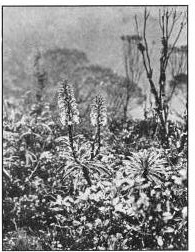 |
| LOBELIA HYPOLEUCA Hillebr.Growing in the upper ravines of Oahu, Manoa Valley; elevation 2000 feet. | LOBELIA KAUAENSIS (Gray) HellerFlowering plant about four feet high, growing at the summit of Mt. Waialeale, Kauai; elevation 5000 feet. |
page 70
| PLATE 43. |
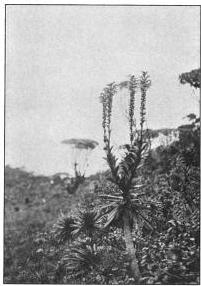 |
| LOBELIA KAUAENSIS VILLOSA RockA flowering and sterile specimen on the summit of Mt. Waialeale, Kauai; elevation 5000 feet. |
page 71
their choice have since decades been in a state of extermination, they have also succumbed to the ravages of goats and cattle
THE GENUS ROLLANDIA.
It has already been stated that the genus Rollandia is practically confined to the island of Oahu. A remarkable instance was the discovery by C. N. Forbes, of a Rollandia, which he named parvifolia, on the island of Kauai. No new species save one, R. purpurellifolia, were discovered by the writer on the island of Oahu. It is confined to the dense forest of the Koolau range on the windward side of the island along the Punaluu stream and on the ridge leading to Hauula. Rollandia Humboldtiana a remarkable species with either pure white or purple flowers is partial to higher levels on the Koolau range especially Manoa Valley and Palolo.
All Rollandiae are terrestrial. R. Humboldtiana is rarely taller than two feet and fleshy throughout, while Rollandia crispa which occurs in the same locality reaches a height of five feet or even more. It does however descend into the valleys at an elevation of about 800-1000 feet. The Punaluu mountains are a veritable paradise for Rollandia; in the interior ravines, perfectly protected from the wind, at an altitude of about 1200 feet, and an enormous rainfall, Rollandia calycina and R. crispa develop a wonderful crown of leaves, several feet in diameter; they grow in large numbers forming a society by themselves, but often in company with, Platydesma cornutum, Lysimachia Forbesi, Viola oahuensis, Musa, Labordia, Anoechtochilus sandwicensis, Phyllostegia, Kadua, etc.
Like Delissea, Rollandia has been rather disappointing as no new species have been discovered save the two mentioned. The discovery of the Kauai species is however extraordinary. On the eastern end of Oahu, especially in Palolo Valley, there occurs a very narrow-leaved species, which Hillebrand referred to Rollandia longiflora. To the writer's mind it certainly is sufficiently distinct to be a species. Rollandia longiflora has lobed leaves in the young state, while Rollandia angustifolia has entire leaves even in the perfectly young state.
Sufficient has been said about Lobelia, Trematolobelia and Brighamia in the general discussion which need not be reiterated here. The writer only wishes he were gifted to express himself in such a way as to enable him to give a word picture of the regions which Lobelia Kauaensis and Lobelia gloria-montis inhabit. These vast summit bogs are uncomfortable to visit at any time of the year, as torrential downpours, high winds and low temperature are apt to make collecting if not difficult at least highly uncomfortable. The writer ascended the summit of Mt. Waialeale on Kauai three times, the last time with Prof. A. S. Hitchock of Washington, D. C., who confessed that it was about the hardest trip he had ever undertaken. The annual rainfall on that mountain is over six hundred inches; the vegetation is of course stunted. Cyperaceae occur, like the tussock formation of Oreobulus furcatus, also Panicum monticola; in these we find Drosera, Acaena, Sanicula, Vaccinium, creeping Metrosideros, Carex montis Eeka, and rosette-like Plantago with many varieties; of trees Pelea Waialealae, Suttonia lanceolata, Pelea orbicularis, and Tetraplasandra Waialealae. Together with these wonderful Lobelias we find curious compositae such as Dubautia
page 72
| PLATE 44. |
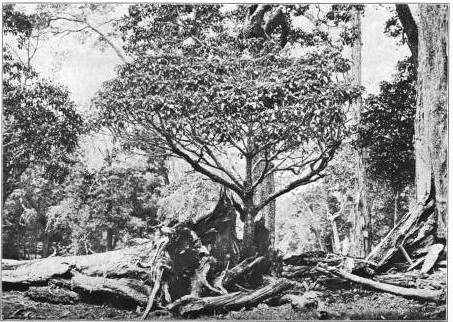 |
| CLERMONTIA HAWAIIENSIS (Hillebr.) RockTree 20 feet tall, growing terrestrially in the forest of the Kipuka Puaulu, Hawaii, slopes of Mauna Lea; elevation 4200 feet. |
page 73
Waialealae, and even a Pittosporum (P. Gayanum var. Waialealae). There are however similar, if not so extensive bogs here and there in the forests of the high plateau of Waimea, Kauai, it is on the borders of these bogs as Kauluwehi that we meet again with Lobelia Kauaensis, growing on trunks of trees, but with Trematolobelia macrostachys var. Kauaiensis, which is confined to near the summit and the summit proper. It is fortunate that these mountain summits are difficult of access, and it is this that will insure the perpetuity of the various species, at least on Kauai. Some ruthless people have drained the bog of Puukukui on West Maui, by the method known as "Louisiana drain" which will change the entire vegetation of that mountain summit and will dradually denude its slopes of the existing tree growth, through rapid erosion which must ensure sooner or later, as the water which under normal condition was absorbed by the vegetation at the summit, is carried off at once in torrents. Such actions on the part of ruthless ignoramuses should be curbed at all events.
VERTICAL RANGE OF LOBELIOIDEAE IN THE HAWAIIAN ISLANDS.
In regard to the question of altitude at which the Hawaiian Lobelioideae occur in the Hawaiian Islands, it may be said that they range from sea level to seven thousand feet elevation.
Their best development is, however, reached at an elevation of four thousand feet, usually on the windward side of the larger islands. The statement "from sea level to seven thousand feet elevation" is a rather broad one when we consider that not a single speciies of Cyanea, the genus with the largest number of species, is represented at either of these points of altitude. The only species of Lobelioideae which descends to sea level is Brighamia insignis, of Australian ancestry, while Clermontia Haleakalensis is found at the highest mentioned altitude, seven thousand feet.
The genus Cyanea ranges from one thousand feet elevation to the five thousand feet, but not higher, with the largest number of species occurrring at the four-thousand-foot level. Clermontia descends lower than Cyanea and may be found at 500 feet elevation, but also higher than Cyanea, at seven thousand feet elevation, the limit of altitude for Lobelioideae in the Hawaiian archipelago. The genus Delissea with its few species ranges from less than one thousand feet to nearly six thousand feet elevatioin; both limits are, however, reached by a single species (Delissea undulata), which has been found on the low island of Niihau, and at nearly six thousand feet elevation on the largest and southernmost island, Hawaii.
The Lobelioideae are partial to the rainforests and are practically absent from the dry or mixed forest on the leeward side of the islands usually so rich in species of trees. The only species which can be considered as belonging to that region is Delissea undulata, which is found in North Kona in the forests of Puuwaawaa and in the dry forest on the slopes of Mauna Loa in South Kona.
Not a single species of Cyanea has so far been discovered in the actual dry forest. The nearest approach to such a locality may be found on Kauai, where we meet with the tallest species of Cyanea (C. leptostegia) on the lee side above
page 74
| PLATE 45. |
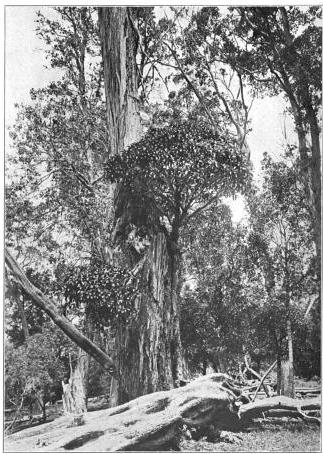 |
| CLERMONTIA HAWAIIENSIS (Hillebr.) RockGrowing epiphytically on Metrosideros (Ohia leha) trees in the Kipuka Puaulu, near the Volcano of Kilauea, Hawaii; elevation, 4200 feet. |
page 75
Waimea, at the outskirts of the rainforest, at an elevation of from 3000 to 400 feet. Cyanea Hardyi must be considered as belonging to that locality also.
The genus Rollandia which occurs practically on Oahu alone (save a single species on Kauai), is confined to the rainforests of both mountain ranges, the Koolau and the Waianae ranges, from a hundred feet elevation to practically the summit of the ridges. A particular species of Lobelioideae may, however, be confined to a certain elevation, above or below which it does not occur. This is true of the majority of the spcies in all genera with the exception of one or two species of Delissea. Besides the restriction of the numerous species of Lobelioideae to specific altitudes, they are also restricted to certain circumscribed localities ofen comprising only an acre or even less, outside of which area they are not found. This is at least true today. Previously, of course, when forests remained undisturbed, conditions may have been different, but still it must be considered that they were always more or less local. Today certain species have survived in a particular locality, from which they cannot spread, as they are surrounded by grazing animals which devour eagerly any germinating plant, thus precluding the establishing of a progeny, and they are thus doomed to extinction. Clermontia Haleakalensis, for example, has already disappeared. A few years ago three healthy trees existed of this species. It is true they were surrounded by their enemies, the cattle, which browsed on their lowest branches and trampled under foot or devoured any seedling which might have dared show its cotyledons above ground even in what must now be considered unnatural surroundings and among foreign plant associates. Today the specis has become extinct; not even a vestige of the trunks of these giants of Lobelioides remains to bear testimony to their previous existence. Fortunately, the writer photographed these trees when he discovered them, the only record besides herbarium specimens.
Numerous may have been the species which lived in remote places and became extinct before they were discovered.
The species occurring in dense rainforests are more secure from extinction than those which grow in the drier regions, as cattle are usually not found there save where the forests have been turned over to the rancher for grazing purposes.
Most of the species of Clermontia are epiphytic, and they are thus saved from immediate destruction. However, the large tree ferns and Metrosideros trees on which they grow stand sometimes isolated in fields of Paspalum conjugatum, commonly known here as Hilo grass, either in a dying condition or already dead and ready to fall, but with the Clermontia tree still alive in the uppermost branches. Clermontia Peleana and Clermontia singuliflora, both species occurring on Hawaii, find themselves in the above described predicament and ready for extinction, as there are no other healthy trees in the neighborhood on which birds may be permitted to deposit the minute seeds. In such localities native birds usually responsible for the distribution of Lobelioids have also vanished, and the work of dissemination could now only be carried on by the pernicious and introduced Mynah bird, which may now be found all over the islands from sea level to more than 10,000 feet elevation.
The deep ravines and gorges of the various islands are inhabited each by their particular species of Lobelioids, and it is not often that the same species is found in more than two or three valleys, but oftener a particuular species would
page 76
| PLATE 46. |
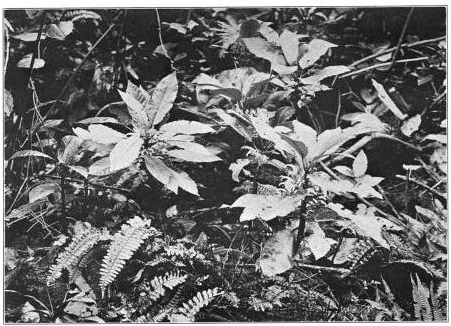 |
| CYANEA SCABRA Hillebr.Low subherbaceous plants about two to three feet tall, growing in the dense shade of Urticaceae, near the streambed in the Waihee Valley, West Maui; elevation 1500 feet. |
page 77
be confined to a single valley. These valleys can often only be explored by following the streambed, usually a dangerous undertaking, as heavy downpours in the heart of the mountains are apt to make egress or further ingress impossible. It is in such localities and in fenced-in forest reserved that the native vegetation or at least the Lobelioideae are safe from destruction.
Interesting and rich in Lobelioideae are the valleys of West Maui, like Waihee, Waiehu, Honokawai and Honokahau. In the first mentioned valley we find Cyanea scabra and Cyanea holophylla growing in dense shade of urticaeae and ferns near the streambed, while Cyanea asplenifolia, a striking species with pinnatifid leaves, grows on the small ridges and little ravines leading into the main streambed from the mighty vertical walls of the main valley, On the sheer cliffs overhanging the streambed we find Clermontia Kakeana and Clermontia mutiflora, shunning the darkness and striving for light as the rest of the species of Clermontia, unlike Cyanea, with most of its species shade-loving and hiding in dark ravines and under broad-leaves plants. The species of Cyanea are nearly all terrestrial; only a very few, like C. Copelandii, are epiphytic and festoon the moss-covered trees and tree ferns (Plate LI.)
Of Cyanea the following may be found in the neighborhood of the 4000-foot level and beyond: Cyanea leptostegia, C. rivularis, C. Gayana, C. recta, C. hirtella, C. Knudsenii and Cyanea spathulata, on Kauai; Cyanea hamatiflora, C. aculeatiflora. C. Bishopii, C. macrostegia and C. atra on Maui, especially East Maui; a few species are found slightly lower than 3500 feet down to the 3000 foot level, as C. ferox horrida and C. atra. On Hawaii we find C. tritomantha, C. pilosa and C. stictophylla at four thousand feet and higher, while at three thousand we find C. nolimetangere, C. Giffardii, C. tritomantha and C. Copelandii. While still lower we meet with C. platyphylla, C. Fernaldii, C. Grimesiana cylindrocalyx and others.
Nearly all the species of Clermontia, with very few exceptions, belong to the middle forest region at elevations from 2500 to 4500 feet on various islands.
The bogs at the summits of Kauai and West Maui harbor true Lobelias only; neither Clermontia nor Cyanea dare approach but the margins. These flat, extensive boggy meadows are windswept and receive a rainfall of from sixty to one hundred inches or more per month, and it is here that the most beautiful Lobelias can be found.
page 78
| PLATE 47. |
 |
| CYANEA ASPLENIFOLIA (Mann)Hillebr.Growing near the streambed in Waihee Valley, West Maui; elevation, 1800 feet. The plant is about six feet tall. |
page 79
DISTRIBUTION OF THE HAWAIIAN GENERA OF THE TRIBE LOBELIOIDEAE.
DISTRIBUTION OF THE GENUS CYANEA.
| Species | Niihau | Kauai | Oahu | Molokai | Maui | Lanai | Kahoolawe | Hawaii |
| aculeatiflora | * | |||||||
| acuminata | * | |||||||
| angustifolia | * | * | * | |||||
| var. racemosa | * | * | ||||||
| var. lanaiensis | * | |||||||
| var. tomentella | * | |||||||
| var. Hillebrandii | * | |||||||
| arborea | * | |||||||
| var. pycnocarpa | * | |||||||
| asplenifolia | * | |||||||
| atra | * | |||||||
| var. lobata | * | |||||||
| Bishopii | * | |||||||
| comata | * | |||||||
| Copelandii | * | |||||||
| coriacea | * | |||||||
| Dunbarii | * | |||||||
| Fauriei | * | |||||||
| Fernaldii | * | |||||||
| ferox | * | |||||||
| var. horrida | * | |||||||
| fissa | * | |||||||
| Gayana | * | |||||||
| Gibsonii | * | |||||||
| Giffardii | * | |||||||
| Grimesiana | * | |||||||
| var. Mauiensis | * | |||||||
| var. Lydgatei | * | |||||||
| var. cylindrocalyx | * | |||||||
| hamatiflora | * | |||||||
| Hardyi | * | |||||||
| hirtella | * | |||||||
| holophylla | * | |||||||
| var. obovata | * | |||||||
| Knudsenii | * | |||||||
| Larrisonii | * |
page 80
| Species | Niihau | Kauai | Oahu | Molokai | Maui | Lanai | Kahoolawe | Hawaii |
| leptostegia | * | |||||||
| lobata | * | |||||||
| var. hamakuae | * | |||||||
| macrostegia | * | |||||||
| var. parvibracteata | * | |||||||
| var. viscosa | * | |||||||
| Mannii | * | |||||||
| multispicata | * | |||||||
| nolimetangere | * | * | ||||||
| obtusa | * | * | ||||||
| pilosa | * | |||||||
| var. Bondiana | * | |||||||
| var. densiflora | * | |||||||
| var. glabrifolia | * | |||||||
| var. megacarpa | * | |||||||
| platyphylla | * | |||||||
| procera | * | |||||||
| profuga | * | |||||||
| recta | * | |||||||
| regina | * | |||||||
| Remyi | *? | *? | ||||||
| rivularis | * | |||||||
| rollandioides | * | |||||||
| scabra | * | |||||||
| var. longissima | * | |||||||
| var. sinuata | * | |||||||
| var. variabilis | * | |||||||
| solanacea | * | |||||||
| var. quercifolia | * | |||||||
| solenocalyx | * | |||||||
| var. glabrata | * | |||||||
| spathulata | * | |||||||
| stictophylla | * | |||||||
| superba | * | |||||||
| var. velutina | * | |||||||
| sylvestris | * | |||||||
| tritomantha | * | |||||||
| var. Lydgatei | * | |||||||
| truncata | * | |||||||
| undulata | * | |||||||
| Wailauensis | * |
page 81
DISTRIBUTION OF THE GENUS CLERMONTIA.
| Species | Niihau | Kauai | Oahu | Molokai | Maui | Lanai | Kahoolawe | Hawaii |
| arborescens | * | * | ||||||
| coerulea | * | |||||||
| drepanomorpha | * | |||||||
| fulva | * | |||||||
| Gaudichaudii | * | |||||||
| var. barbata | * | |||||||
| grandiflora | * | * | ||||||
| Haleakalensis | * | |||||||
| Hawaiiensis | * | |||||||
| Kakeana | * | * | * | |||||
| Kohalae | * | |||||||
| var. robusta | * | |||||||
| leptoclada | * | |||||||
| micrantha | * | |||||||
| montis Loa | * | |||||||
| forma globosa | * | |||||||
| multiflora | * | |||||||
| oblongifolia | * | * | * | |||||
| pallida | * | |||||||
| var. ramosissima | * | |||||||
| parviflora | * | |||||||
| var. calycina | * | |||||||
| var. grandis | * | |||||||
| Peleana | * | |||||||
| persicifolia | * | |||||||
| pyrularia | * | |||||||
| singuliflora | * | |||||||
| tuberculata | * | |||||||
| Waimeae | * |
DISTRIBUTION OF THE GENUS DELISSEA.
| Species | Niihau | Kauai | Oahu | Molokai | Maui | Lanai | Kahoolawe | Hawaii |
| fallax | * | |||||||
| laciniata | * | |||||||
| var. parvifolia | * | |||||||
| parviflora | * | |||||||
| rhytidosperma | * | |||||||
| sinuata | * | |||||||
| var. lanaiensis | * | |||||||
| subcordata | * | |||||||
| var. obtusifolia | * | |||||||
| undulata | * | * | * | * |
page 82
DISTRIBUTION OF THE GENUS ROLLANDIA.
| Species | Niihau | Kauai | Oahu | Molokai | Maui | Lanai | Kahoolawe | Hawaii |
| calycina | * | |||||||
| crispa | * | |||||||
| var. muricata | * | |||||||
| lanceolata | * | |||||||
| var. tomentosa | * | |||||||
| var. viridiflora | * | |||||||
| angustifolia | * | |||||||
| Humboldtiana | * | |||||||
| purpurellifolia | * | |||||||
| parvifolia | * | |||||||
| Kaalae | * | |||||||
| longiflora | * |
DISTRIBUTION OF THE GENUS LOBELIA IN HAWAII.
| Species | Niihau | Kauai | Oahu | Molokai | Maui | Lanai | Kahoolawe | Hawaii |
| Gaudichaudii | * | * | ||||||
| gloria-montis | * | |||||||
| var. longibracteata | * | |||||||
| Kauensis | * | |||||||
| var. villosa | * | |||||||
| hypoleuca | * | * | * | * | * | |||
| var. macrophyta | * | |||||||
| neriifolia | * | * | ||||||
| oahuensis | * | |||||||
| Remyi | * | |||||||
| tortuosa | * | |||||||
| Hillebrandii | * | |||||||
| var. paniculata | * | |||||||
| var. monostachya | * | |||||||
| Dunbarii | * | |||||||
| yuccoides | * | * |
DISTRIBUTION OF THE GENUS TREMATOLOBELIA.
| Species | Niihau | Kauai | Oahu | Molokai | Maui | Lanai | Kahoolawe | Hawaii |
| macrostachys | * | * | * | * | * | |||
| var. Kauaiensis | * | |||||||
| var. grandifolia | * |
page 83
| PLATE 48. |
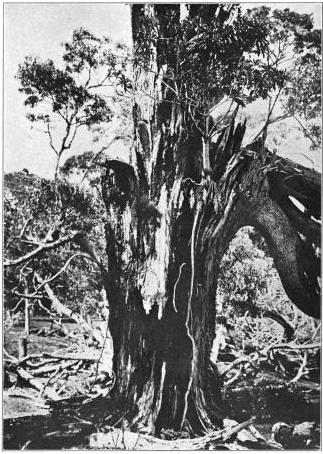 |
| Root system of Clermontia Hawaiiensis, growing epiphytically on Acacia Koa (Koa) in the forests near the Volcano of Kilauea, Puu Oo trail, Hawaii; 4300 feet elevation. Note the twenty-foot-long taproot, which descended through the center of the giant Koa trunk; the root was 1.5 inches thick where it entered teh ground. |
page 84
DISTRIBUTION OF THE GENUS BRIGHAMIA.
| Species | Niihau | Kauai | Oahu | Molokai | Maui | Lanai | Kahoolawe | Hawaii |
| insignis | * | *? | * | * | ||||
| forma citrina | * |
FLOWERING SEASON OF THE HAWAIIAN LOBELIOIDEAE.
The genus Cyanea has two distinct flowering seasons. Certain species as C. Giffardii, C. arborea, C. leptostegia, C. coriacea, C. Fauriei, C. atra, C. aculeatiflora, C. hamatiflora, etc., flower during the (late) summer months, while others like C. Bishopii, C. macrostegia, C. asplenifolia, C. pilosa and its varieties begin flowering in the early winter months and are usually in full mature fruit in the months of July and August. Of the genus Delissea little is known as to the flowering periods save that D. undulata is usually in full flower during the month of January. Of course, elevation plays a grreat part in the period of flowering as well as a rainy summer, which delay the flowering period considerably.
The species of Clermontia flower nearly all during the summer months with the exception of Clermontia Gaudichaudii of Kauai, and Clermontia coerulea of Hawaii, which flower in the late winter or early spring.
Brighamia flowers in the summer only. The true Lobelias are monocarpic; that is, they flower only once in their life, and that usually in the summer.
Of the species of Rollandia, a few flower in the late summer, while the others, like R. purpurellifolia, R. lanceolata, R. crispa and R. longiflora, flower during the winter months till May.
ROOT SYSTEM OF THE HAWAIIAN LOBELIOIDEAE.
Very little is known about the root system of the Hawaiian Lobelioideae, as hardly any observations have been made in that regard.
It may be said, however, that the root system of the species of Cyanea, especially those of the section palmaeformes, is rather weak. Species like Cyanea Giffardii seem to have a tap root but very few lateral foots; how deep the roots extend into the ground has not been ascertained. The plants are readily pulled up even when thirty feet in height, or rather the tap root breaks a few inches below the ground being, like the stem, very brittle.
The subherbaceous species of Cyanea have a very weak root system, especially species like C. holophylla, C. scabra, C. Copelandii and others; the stem of these plants is often trailing, and roots are exposed several inches before they enter the ground.
The species of the genus Clermontia seem to have a stronger root system; this is required on account of the candelabra-like branching habit of most of the species.
Those growing epitphytically on trees or ferns send their tap root through the decayed part of the respective tree or fern on which they grow. The accompanying illustration shows the twenty-foot-long tap root of Clermontia Hawaiiensis growing on Acacia Koa in the forests near the Volcano of Kilauea, Hawaii,
page 85
| PLATE 49. |
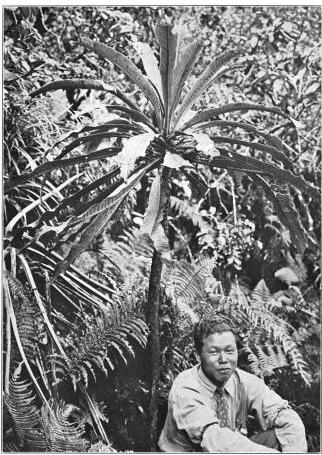 |
| CYANEA MACROSTEGIA Hillebr.A fruiting specimen (September) growing in the dense sphagnum forests of Puohaokamoa, northern slope of Mt. Haleakala, Maui; elevation, 4200 feet. |
page 86
| PLATE 50. |
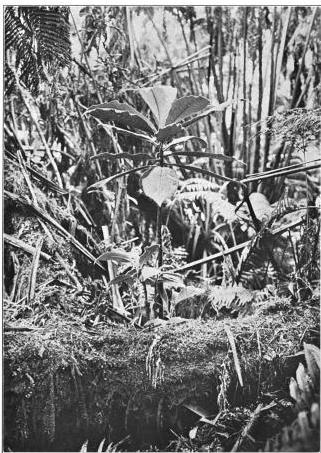 |
| CYANEA PILOSA A. GrayPlant about 5 feet tall, growing epiphytically in dense rainforest near Kulani, slopes of Mauna Loa, Hawaii; elevation 4500 feet.. Note the downward-bent peduncles, along the stem. |
page 87
at an elevation of 4000 feet. The Koa tree, split by the force of the wind, exposed the twenty-foot-long tap root, which made its way right through the center of the big trunk. The tap root was over an inch in diameter where it entered the ground. Only one single lateral root was observed, which was however, dead.
Nothing is known of the root system of the other lobelioideous genera occurring in these islands save that they must be weak, as the plants are readily pulled up.
SYSTEMATIC POSITION OF THE GENUS CYANEA
The genus Cyanea was first established by Gaudichaud in 1826 on the single species C. Grimesiana. The large foliaceous calyx lobes peculiar to that species served as the generic character. On the species with dentiform calyx lobes he established the genus Delissea, such as D. subcordata, D. undulata, and D. acuminata. Succeeding collectors such as Pickering, Wawra, Hillebrand, and Mann brought to light many more new species, especially Hillebrand, who quite succesfully arranged his large material into the order adhered to in this paper. The calycine lobes were found to be the most variable character, and the second factor, the five anthers which were all bearded in C. Grimesiana, proved to occur in other species which did not have foliaceous calyx lobes, while plants with foliaceous calyx lobes had again only the lower anthers bearded, and as Hillebrand remarks:- "were very unsatisfactorily defined by irrelevant technical characters which separated in different genera closely related species and brought together quite heterogenous ones."
The main generic character in Cyanea, as adopted by Hillebrand, and adhered to by this writer, is the racemose inflorescence, a corolla without knobs, and smooth, shining, crustaceous seeds.
The genus Cyanea, of which C. Grimesiana is the type, is the largest of all the seven genera of the tribe or subfamily Lobelioideae represented in the Hawaiian Islands. The larger Cyaneae, that is the arborescent ones belonging to the section palmaeformes, are more distinct and show no such proneness to the variation as is the case with the herbaceous or subherbaceous species. To the writer's mind the group of Cyanea forming the section palmaeformes appears to be the oldest of that genus, while those of section delisseoideae would follow, with section hirtellae next, and last those more or less subherbaceous ones of the section Cyanea genuineae, which show extreme variation. While there are several species in the section palmaeformes which are decidedly distinct, there are others of the same section which seem to be more closely connected, such as Cyanea atra and Cyanea Gibsonii; the next closest allied is C. macrostegia, followed by C. aculeatiflora and C. hamatiflora. The most interesting species of that section appear to be C. leptostegia, C. superba, C. arborea and Cyanea Giffardii. These four species are decidedly distinct and probably extremely old, while the others are closely connected and range more or less into each other, not only the species from one and the same island district, but others of that section occurring on Molokai and Hawaii. They form as it were a common group by themselves, pointing back to a common ancestor. The four species above mentioned may however be the remnant of a distinct group, the intermediates
page 88
of which have become extinct, leaving one or two species of that particular type on some of the islands. It is quite possible and probably true that a good many others species of that type existed, which, if we had any knowledge of their characters would link them together with those of other sections.
SECTIONS DELISSEOIDEAE, HIRTELLAE, AND PILOSAE.
The first section was established by Hillebrand and is characterized by the minute calycine teeth. It maybe argued, and it is true, that the calycine lobes of the Hawaiian Lobelioideae are the most variable character, though in this case, especially in this section, while the calycine teeth are minute, the corollas are so much alike, of the same shape and color, as well as being arranged on more or less drooping racemes, that it would be unnatural not to group these together.
The first section numbers now six species, against ten in Hillebrand's arrangement; three have been classed with section hirtellae, and one very little known in Hillebrand's time, with section pilosae. The three former belong to a section which the writer was justified in establishing by the discovery of a number of new species, (four in number, to which were added two by other authors) all of which occur on the island of Kauai. They are quite distinct in habit of growth and in corolla, whose general character runs through all nine species.
The species of the section hirtellae, have quite a different habit of growth from the species of the other sections, are usually single-stemmed plants and only in one or two instances occasionally branching from the base. This brings the species of this section closer to the section palmaeformes, and the writer would look upon them as miniature forms of the latter. The leafy crowns, which are of course terminal, are much smaller than in those of section palmaeformes.
It may also be remarked that the species of section delisseoideae occur in the outskirts of the forests on the leeward side and at lower altitudes, 1000-3000 feet, not in the swampy forests, while those of the section hirtellae occur in the wet forests from 3000 feet up to 5000 feet, in the humid rainforests, save a few exceptions, occurring in lower altitudes, but still in the rain forests on the windward side.
Anyone knowing them from field experience cannot help but arrange them in a section by themselves; this would perhaps not be done by a person only acquainted with them from herbarium specimens. Of course it would simplify matters very much indeed would one adopt the method set forth by H. Baillon in his Histoire des plants where he throws all our Hawaiian endemic lobelioideous genera together into one genus (Delissea), dividing the latter into as many sections as there existed genera. That is one way out of the difficulty but to the writer's mind, does not lead to a better understanding of this striking element of our Flora. The deeper we go into the study of these plants, dividing them according to their natural affinities, the more we will learn in regard to their ancestry, evolution, age, etc more than by simply throwing them all together into one genus, without further thought. These plants must be studied in the field; only then can one come to proper conclusions.
page 89
| PLATE 51. |
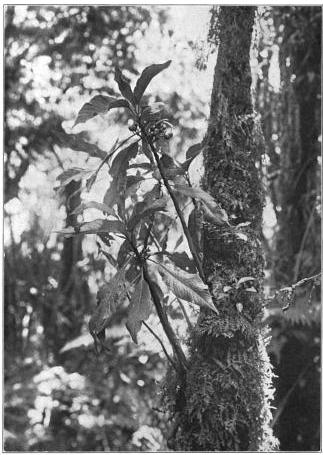 |
| CYANEA COPELANDII RockGrowing epiphytically on a fern-covered tree trunk in the forest near Glenwood, Hawaii; elevation, 2400 feet. |
page 90
| PLATE 52. |
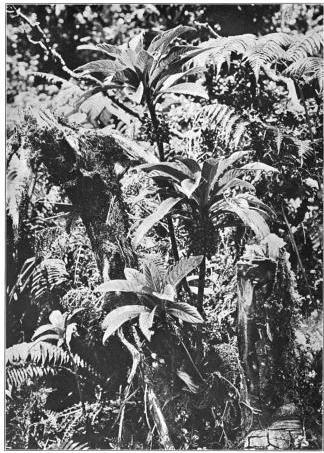 |
| CYANEA BISHOPII RockPlants in full fruit (September) growing in the dense rainforests near Puohaokamoa, northern slopes of Mt. Haleakala, Maui; elevation, 4000 feet. The tallest plant is only about 5 feet high. |
page 91
Of the first section, C. angustifolia, with its many varieties, has spread from Oahu as far as Maui and Lanai, but not to Kauai, which island is separated from Oahu by a channel of 60 miles width; its var. racemosa from the Koolau mountain range, Oahu, and Lanai, links together three species occurring on Kauai, C. coriacea, C. Fauriei and C. Hardyi. All three in turn are related to a Maui species, C. comata. It may be suggested that there is a possibility of C. angustifolia, C. Mannii, and C. obtusa, especially the first, with its many varieties being the outcome of the two extremer species C. coriacea and C. comata, the former from Kauai, the latter from Maui.
In regard to the species of section two, it has already been stated that they are all peculiar to Kauai, and may be grouped as to their affinities, showing their scala of evolution, or better, range of satellitic offsprings as follows: Cyanea fissa, C. Knudsenii, C. sylvetris, all three broad-leaved plants, Cyanea Gayana, C. hirtella, C. rivularis with more oblong lanceolate leaves to C. recta, C. undulata, C Larrisonii with from broadly lanceolate to linear lanceolate leaves.
Of the six species which form the section pilosae, one, C. Copelandii, is included with some doubt, while in other respects belonging to this section it lacks more or less the general characteristic, as the dense clustering of the floral racemes around the fleshy stem below the leaf-whorls. This is however less striking in a variety of C. pilosa, the type of this section, var glabrifolia from Hawaii.
This section is distributed over four islands and find in C. multispicata, with no known varieties at present, its sole representative on the most distant island Kauai. Its closest congener can be found in Cyanea acuminata on Oahu. On Molokai, the intermediate island between the former and Maui, there is so far no representative known, while on the latter island the section is represented by C. Bishopii which is closest related to C. pilosa, and its many varieties, found on Hawaii. The latter species may be looked upon as the youngest and still in the process of evolution. This may be accounted for by the various regions of Hawaii in which this plants grows, as for example, the extreme southern forests of Naalehu, Kau, with moderate rainfall, the forests of Kilauea, with a more constant rainfall, and the swampy moss-covered rainforests of the oldest portion of the island of Hawaii, the Kohala mountains. Quite different is it with C. Copelandii. All the other species are terrestrial, while C. Copelandii is semi-epiphytic, its semi-fleshy stem is often found ascending the moss-covered trunks of trees and attaching itself by means of roots which extend the whole length of its prostrate stem.
All species of this section are unbranched and subherbaceous. The only exception being C. Copelandii, which sometimes branches from the common rootstock and sends out long rambling or scandent branches. They approach the species of the next following section, C. genuinae.
SECTION CYANEA GENUINAE.
This section, the writer found it convenient to divide into two subsections:- scabrae, and glabriflorae. The former possesses four species, the latter five. The writer considers that this section represents the youngest group of Hawaiian Cyaneae. With the exception of Cyanea solanacea, which occurs on Molokai,
page 92
| PLATE 53. |
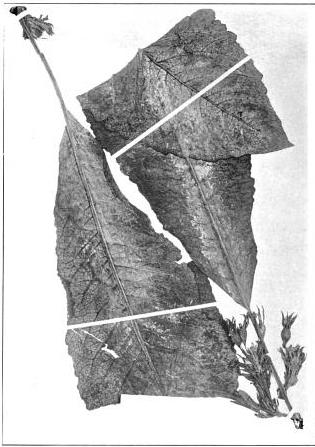 |
| CYANEA TRITOMANTHA A. GrayGrowing in the forest of Naalehu, Kau, Hawaii; plants 10-15 feet tall. Vine in background Freycinetia arborea Gaud. From: J. F. Rock "The Indigenous Trees of the Hawaiian Islands." |
page 93
| PLATE 54. |
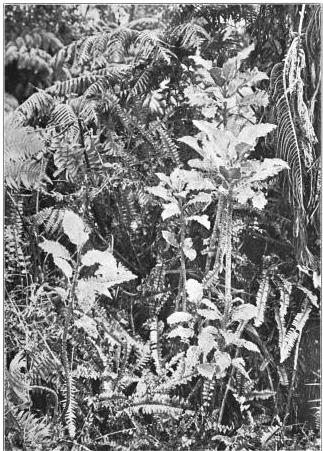 |
| CYANEA NOLI-ME-TANGERE RockOne of the most spiny Lobelioids, growing always terrestrially in the dense rainforests in deep shade, near 23 miles, Volcano Road, Hawaii. |
page 94
represented only by a rather doubtful variety on Maui, all of the remaining species occur either on Maui or Hawaii or on both islands; one species C. Grimesiana even ranging from Oahu, and Molokai, to Maui, with a variety on Hawaii. All the species of this section have a proneness to lobed leaves, in fact are lobed in their young state; gradually after becoming more mature, their leaves are notched. In Cyanea Grimesiana, the widest distributed species over this island group, is represented the extreme type with perfectly pinnate leaves. The tendency of lobed or sinuate or even pinnate leaves occurs in both subsections, though the corolla in one subsection is muricate, and in the other perfectly glabrous. All species are more or less spiny along the stem, or at least muricate, a character found again in a few species of the section, palmaeformes. Of the first subsection the species Cyanea scabra is the most variable; all gradations exist from entire to deeply pinnatisect leaves, from smooth petioles and stems to densely muricate ones, while the corolla remains unchanged.
C. holophylla and C. solanaceae are next closely allied, with C. asplenifolia following. It seems, however, curious that the latter species, which is nearer to C. Grimesiana than to any other in this section, should have muricate corolla-lobes, while those of the latter are smooth; in aspect and general habit they are alike, differing however in the corolla, which in C. asplenifolia is narrower, with muricate lobes, and also in the linear lanceolate acute calycine lobes, while those of C. Grimesiana are broader, with smooth lobes, and in the calycine lobes, which are large foliaceous.
Cyanea platyphylla is very close to C. scabra, differing in the glabrous corolla. C. ferox, with deeply lobed leaves, is an exceedingly spiny species and must be classed as the next closest relative to C. Grimesiana, though somewhat different in habit, it being a tall branching shrub with ascending, prickly, brittle branches.
C. nolimetangere is an exaggeration of C. platyphylla, the former being spiny all over both leaf surfaces, as well as stem and petioles, to such an extent that it is impossible to touch them with bare hands; the flowers are white-greenish and perfectly smooth.
On Hawaii and Maui this section seems to have reached its best development, but is still in the process of evolution, which is well illustrated by C. scabra, while C. Grimesiana seems to be a rather settled type occurring farthest away (Oahu) from its congeners, with a few varieties on Maui and Hawaii.
THE SECTION PALMAEFORMES.
The section palmaeformes possesses the most interesting species of the genus Cyanea and, as has been remarked, represents the oldest type of Cyanea. A very unique plant is Cyanea leptostegia, which reaches a height of forty feet, with a single stem about three inches in diameter and a large crown of leaves at the apex, the leafy crown having a diameter of often five feet or even more.
Here again, we find the most settled species on old islands such as Kauai, Oahu, and Maui, while on Hawaii two species occur C. tritomatha and C. Giffardii, the former is however very closely related to C. macrostegia, or Maui, while the latter represents an exceedingly old type related to C. superba of Oahu.
page 95
| PLATE 55. |
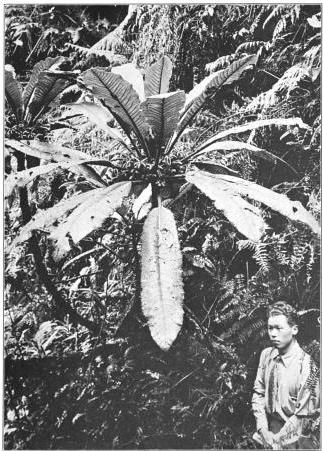 |
| CYANEA ACULEATIFLORA RockA giant Lobelioid growing along a small streambed near the Waikamoi trail, Haleakala, Maui; 4000 feet elevation. |
page 96
In this section nearly all the species have a decidedly different aspect when young as compared to mature plants, a fact which has prompted even such a careful worker as Asa Gray to describe the younger flowerless plant of C. leptostegia, his own species, as a variety pinnatiloba of C. coriacea (?? Gray's article says Delissea delessertiana = Rollandia lanceolata, not Cyanea coriacea??) an entirely different plant. The young plants of C. aculeatiflora and C. tritomantha have deeply bipinnatisect leaves, usually prickly but otherwise resembling a deeply divided fern-frond; old plants however have usually entire leaves.
As has been remarked, the writer believes this section to be the oldest; first, because it is found on all the islands of the group with the exception of Niihau and Kahoolawe; their nonexistence there is due to the smallness of the islands in question and consequently do not offer the range of conditions found on the larger islands, so essential to their development.
While in Berlin the writer had occasion to examine species of both genera, Centropogon and Siphocampylus, as far as represented in the Royal Botanical Museum, and by studying them came to the above conclusion based on the following facts:
Outside of some of our Hawaiian genera of Lobelioideae, Centropogon is the only genus with true baccate fruits; the species of Centropogon, like Cyanea, are nearly all shrubby; only a few are herbaceous. The fruits of the genus Pratia have a fleshy pericarp; the species are however in neary every instance prostrate herbs and have no resemblance to our arborescent Hawaiian forms. Siphocampylus, a South American genus with over 100 species has capsular fruits opening at the apex into two values.
The only important difference between Centropogon and Cyanea is the corolla, which is very shortly slit at the back, in the former, while the Hawaiian species of Cyanea are deeply slit to beyond the middle. The calycine lobes are also a very variable character in Centropogon, ranging from linear-subulate, elongate to linear lanceolate, or are reduced to teeth; the flowers are arranged singly in the axils of the leaves, a character never occurring in Cyanea, or are racemose or in terminal corymbs. The genus Apetahia, with its single species (A. raiateensis) from the islands of Raiatea and Tahiti, seems to be an intermediate between the strictly capsular and baccate genera. Apetahia possesses an indehiscent (?) rather dry fruit which is unilocular, and possesses an undivided stigma. Sclerotheca with two species in the Society Island (Tahiti), and one in Rarotonga, is of great integerst. The fruits of this genus are capsular and the seeds are dispersed by two pores at the apex of the capsule.
page 97
THE NATIVE NAMES OF HAWAIIAN LOBELIOIDEAE.
We find that the Hawaiians of by-gone days were quite familiar with the Flora of these islands and had adopted a system of naming plants. They named not only those that were of especial use to them, either medicinally or otherwise, but even plants occurring in very remote places in the islands, difficult of access.
The Hawaiians gave these plants names, corresponding to the generic names in botany and designated the different species of a genus by a special name which had either reference to the size of the leaf or the resemblance of a leaf, or the plant itself, to another plant. Some of the names are of mythological origin or are connected with Kahunaism (native witchcraft).
The most common Hawaiian names for Cyaneas and Clermontias are Haha or Oha. To these they have added so-called specific names. The name Haha is usually applied to all Lobelioideae with the exception of Lobelia proper and Brighamia.
The name Oha seldom occurs alone but is used in conjunction with the word wai, like Oha-wai for species of Clermontias and Cyanenas but especially for the former.
| Haha | — | for species of Clermontia and Cyanea in general. |
| Haha-lua | — | for Cyanea leptostegia. |
| Haha-ai-a-ka-manu | — | for Clermontia Gaudichaudii; the meaning of the word is "The Haha eaten by the birds". |
| Haha-nui | — | for Cyanea ferox - meaning of Haha-nui: "The large Haha." |
| Aku | — | for Cyanea tritomantha. |
| Aku aku | — | for Cyanea rollandioides. |
| Kolii | — | for Trematolobelia macrostachys var. Kauaiensis. |
| Kuhiaika-moo-wahie | — | Lobelia hypoleuca. |
| Liua | — | Lobelia hypoleuca. |
| Ohawai | — | Clermontia spp.. |
| Panaunau | — | Lobelia yuccoides. |
| Popolo | — | Cyanea solancea; the name popolo is also applied to species of Solanum, the leaves of Cyanea solanacea resemble those of Solanum incompletum. |
| Puaala | — | Brighamia insignis on Molokai. |
| Alula | — | Brighamia insignis on Kauai. |
| Puakala | — | Cyanea solenocalyx. |
| Pu'e | — | Lobelia Kauaensis. |
| Kue-nui | — | Cyanea Grimesiana. |
It may also be remarked that the milky juice of some of the species of Clermontia was employed by the natives as bird lime, while the leaves of Cyanea angustifolia, Cyanea tritomantha and Cyanea rollandioides were cooked and eaten like cabbage.
The fruits of some of the Clermontia species, especially those of the Kauai species Clermontia Gaudichaudii, were eaten by the natives.
page 98
Out of seventeen names given above, only five occur in Hillebrand's Flora, besides the common name Oha-wai; for the remaining names the writer is indebted to Mr. Francis Gay of Kauai, who knows the Kauai plants by their respective native names. The writer had the pleasure of camping with Mr. Gay in the mountains of Kauai and this enabled him to associate the native names with the plants to which they belonged.
INSECTS OCCURRING ON PLANTS OF THE LOBELIOIDEAE IN THE HAWAIIAN ISLANDS.
By Otto H. Swezey.
The species of this family are not much attacked by insects. Those which do attack them are not particularly injurious to the plants. The fact that so few insects attack the Lobeliaceae accounts for there having been less special attention given to collecting insects from these plants than to many others which yield insects in greater numbers.
Some of the insects mentioned below may be specially attached to their respective plants, not having been reared from others; but the records are altogether too meager to state with certainty until more observations are made. The following list is made up from the records of several entomologists: Dr. Perkins, Messrs. Giffard, Swezey, Timberlake and Bridwell. These records are almost entirely from collecting on the island of Oahu. If special collecting should be done on the Lobeliaceae on the other islands no doubt many more species could be added to the list.
LEPIDOPTERA.
Family Carposinidae.
Heterocrossa olivaceonitens. This moth has often been reared from larvae in the fruit and flower buds of Clermontia Kakeana. It has been reared also from various other kinds of fruits.
Heterocrossa gemmata. This moth has been reared from the flowers and fruit of Rollandia, and from the fruit of Clermontia.
Heterocrossa crinifera. This species occurs as a leaf-miner in Rollandia Humboldtiana.
Heterocrossa sp. An undetermined species reared on one occasion from a larva boring in stem of Cyanea.
Family Hyponomeutidae.
Hyperdasys cryptogamiellus. This moth was reared from a larva in the dead stem of Clermontia. It has been found in dead wood of other kinds as well.
DIPTERA.
Family Agromyzidae.
Agromyza sp. On a few occasions the leaves of Clermontia persicifolia have been found mined with the larvae of a fly, but none were reared to maturity.
page 99
HEMIPTERA.
Family Delphacidae.
Nesosydne blackburni. This leaf-hopper has been taken on Clermontia parviflora on Hawaii, but it usually occurs on other plants.
Nesosydne pseudorubescens. This species has also been taken on Clermontia parviflora, though it usually occurs on koa.
Nesosydne lobeliae and N. montis-tantalus occur on Lobelia hypoleuca.
Nesosydne timberlakei has been taken on Cyanea truncata.
Neososydne wailupensis has been collected on Rollandia crispa.
Nesodryas giffardi has been collected in abundance on Rollandia crispa.
Family Tettigoniidae.
Nesophrosyne spp. Several species of this family of leaf-hoppers have been collected from different Lobeliaceae, but they are as yet undetermined.
Family Miridae.
Several species of plant bugs have been collected from Lobelioidea, but they are as yet undetermined.
Family Anthocoridae.
A bug of this family has been taken in hollow dead stems, where in search of prey.
COLEOPTERA.
Family Carabidae.
A few species of this family are sometimes found hiding, or in search of prey, in hollow dead stems of Clermontia.
Family Nitidulidae.
Orthostolus robustus, and other beetles of this familly are often found very numerous in the flowers and decaying fruits of many if not all species of Lobelioideae.
Family Proterhinidae.
An undetermined species of this family has been reared from larvae in dead Clermontia stems. There may be other species also.
Family Scolytidae.
A species of this family has been taken in dead Clermontia stems.
Family Curculionidae.
Dryophthorus crassus. This large Cossonid has been taken in abundance in dead Clermontia stems.
Oodemas sp. has been taken in similar situations as the above.
ORTHOPTERA.
Family Gryllidae.
Prognathogryllus alatus and P. stridulans. These peculiar crickets and other allied species are often found hiding in hollow dead stems of Clermontia and other Lobelioideae.
page 100
BIBLIOGRAPHY OF THE HAWAIIAN LOBELIOIDEAE.
CH. GAUDICHAUD, Botany Voyage Uranie 457-459 inclus. 1826.
H. G. L. REICHENBACH, Conspectus regni vegetabilis, page 114 nos. 2786 et 2788. 1828. (Delissea genus Goodenoviarum?, Clermontia.)
F. B. BARTLING, Ordines naturales plantarum page. 148-151. 1830 (Delissea-Clermontia.)
ADALBERT DE CHAMISSO, in Linnaea VIII:218-233. 1833.
G. DON, A general System of Gardening III:698. 1834 (Clermontia, Rollandia.)
K. B. PRESL, Prodromus Monographia Lobeliacearum 47 et 48. 1836. (Clermontia, Cyanea, Delissea, Rollandia.)
STEPHAN ENDLICHER, Flora der Suedsee Iseln, in Annalen des Wiener Museum I:170. 1836.
H. G. L. REICHENBACH, Handbuch des natuerlichen Pflanzen-systems, 186. 1837 (Clermontia, Rollandia, Kittelia, Macrochilus.) Nom. page 102, no. 3998. genus Delisseacearum, et no. 4001.
STEPHAN ENDLICHER, Genera Plantarum 512-513, et 1392. 1838.
K. F. MEISNER, Plantarum vascularium genera secundum ordinis, 241 (148). 1839.
AUG PYRAMO DE CANDOLLE, Prodromus systematis Natural. regni veget. VII:2. 341-344. 1839.
E. SPACH, Histoire naturelle des vegetaux Phanerog. IX:572. 1840.
STEPH. ENDLICHER, Enchiridion botan. exhib. class. et ordin. plant. 264. 1841
HOOKER ET ARNOTT, Botany Capt Beechey's Voyage, 88 1841. (Lobelia.)
MEYEN, BEITR. BOTANIK GES., Reise um die Erde. 358. 1843. (Clermontia.)
MEYEN, in Walper's Repert. Botan. System. II:708. 1843. (Clermontia.)
TH. NUTTALL, in Transact. Amer. Philos. Soc. II:8,251. 1843. (Clermontia.)
J. LINDLEY, The Vegetable Kingdom 693. 1847.
ASA GRAY, Proceedings Amer. Acad. Sciences. V:146-151. 1862.
HORACE MANN, Proceedings Amer. Acad. VII:177-187. 1868.
H. MANN, Notes on Brighamia in Memoir. Bost. Soc. Nat. Hist., Vol. I, art IV: 531-532, 1869.
H. WAWRA, Flora od. Allgem. Bot. Zeit. XXX:568, 1872, Vol. XXXI:7-58. 1873.
BENTHAM ET HOOKER, Genera Plantarum II. 2:546. 1876.
H. M. BAILLON, Histoire des plantes VIII:364. 1886.
H. M. BAILLON, Dictionnaire Botanique II:96, 310. 1886.
W. HILLEBRAND, Flora Hawaiian Isl. 234-264. 1888.
SCHOENLAND, in Engler et Prantl, Natürl. Pflanzenf. IV. 5:64. 1889.
A. ZAHLBRUCKNER, in Annalen des Wiener Museums VI:430-432. 1891. (Trematocarpus.)
W. B. HEMSLEY AND A. ZAHLBRUCKNER, Annales of Botany, Vol. VI:154. 1892. Vol VII, 289-290. 1893. (Trematocarpus.)
DRAKE DEL CASTILLO, Illustrat. Flor. Insul. Maris Pacif. VII:217-221. 1892.
O. STAPF, in Annales of Botany, Vol. VII:396-399. 1893. (Trematocarpus.)
JACKSON, in Index Kewensis Vol. I:339, 560, 675, 725. 1895; Vol. II:102, 728. 1895; Supl. I. 101, 1901-1906; Supl. II. 43, 1904.
A. A. HELLER, in Minnesota Botanical Studies IX: 906-912. 1897.
DALLA TORRE ET HARMS, Genera Siphonogamarum 520, nos. 8685, 8688. 1900-1907.
CHARLES N. FORBES, Occasional Papers Bernice Pauahi Bishop Museum, Vol. V: pages 8, 12, 1912; Vol. VI. no. 3. pages 68-73, 1916. Vol. VI: no. 4, page 11, foot note, 1917.
JOSEPH F. ROCK, Bot. Bull. No. 2, Hawaii Board of Agric. & Forestry. 1913.
page 101
JOSEPH F. ROCK, Indigenous Trees Hawaiian Islands, 469-494 et 508-512. 1913.
JOSEPH F. ROCK, College of Hawaii Publications, Bulletin 2, pages 4-48 inclus. 1913.
JOSEPH F. ROCK, in Fedde Repertorium Specierum novar. XIII:354. 1914.
JOSEPH F. ROCK, in Torrey Botanical Club Bulletin, Vol. 42:77-78, 1915; Vol. 44:229-239, 1917; Vol. 45:133-138, 1918.
GENERAL.
A. R. WALLACE, Island Life page 306, 1880.
A. ENGLER, Versuch einer Entwicklungsgeschichte der Pflanzenwelt, part II:122, 131. 1882.
H. B. GUPPY, Observations of a Naturalist in the Pacific, Vol. II: 253-260. 1906.
ICONES.
GAUDICHAUD, Botany, Voyage Uranie, plates 71, 72, 73, 74, 75, 76, 77, 78. 1826.
GAUDICHAUD, Botany. Voyage Bonite, plates 45-47, 49, 75-77. 1839-1852.
H. MANN, Notes on Alsinidendron, Platydesma and Brighamia in Memoirs Boston Soc. Nat. Hist., Vol. I, part IV, plate 23. 1869.
CH N. FORBES, Occasional papers B. P. Bishop Museum, Vol. V, no. 1 (three plates, not numbered), 1912; Vol. VI, no. 3 (three plates, not numbered), 1916.
J. F. ROCK. Indigenous Trees of the Hawaiian Islands, plates 6, 17, 24, 196, 197, 198, 199, 200, 201, 202, 203, 204, 205, 206, 207, 208 209. 1913.
J. F. ROCK, in Torrey Botanical Club Bull., Vol. XLII, plate 8, 1915; Vol. XLIV, plates 9, 10, 11, 12, 13, 14, 15, 16, 1917; Vol. XLV, plate (6), 1918.
J. F. ROCK, College of Hawaii Publication Bull. no. 2, plates 9, 10, 11, 12. 1913.
J. F. ROCK, Report Board of Commiss. Agricul. and Forestry for the period 190-1910, plates 14, 15, 16. 1911.
A. A. HELLER, in Minnesota Botanical Studies, Vol. IX, plates 64, 65, 66, 67. 1897.
A. S. HITCHCOCK, Smithsonian Miscell. Collect., Vol. 66, no. 17, plate 76. 1917.
A. ZAHLBRUCKNER, in Annalen des Wiener Museums, Vol. VI, figures (one). 1891.
A. S. HITCHCOCK, in "The Scientific Monthly," figures 31, 41 and 42 (representing Trematolobelia macrostachys, Cyanea Fauriei, and Lobelia Kauaensis, erroneously labeled Cyanea sp.).
page 102
KEY TO THE GENERA AND SPECIES.
KEY TO THE GENERA.
| Corolla salvershaped, the straight tube entire; fruit capsular, at first fleshy, later dehiscing by two lateral slits. | Brighamia |
| Corolla tubular, curved, deeply slit at the back. Inflorescence a terminal raceme or racemes. Fruit a capsule dehiscing at the top into loculicidal valves. | Lobelia |
| Capsule subglobose with an indehiscent depressed umbonate vertex, opening by round pores in the wall of the capsule. | Trematolobelia |
| Inflorescence axillary. Fruit a berry. Seeds smooth, crustaceous, brown, shiny. Inflorescence a cyme, flowers two to thirteen. | Clermontia |
| Inflorescence a strict raceme. Staminal column free from the corolla. | Cyanea |
| Staminal column adnate to the corolla, the latter laterally compressed. | Rollandia |
| Seeds greyish-white, dull, wrinkled, flowers with one dorsal or two additional lateral knobs. | Delissea |
KEY TO THE SPECIES OF LOBELIA
| Corolla curved, with converging upper lobes, cream colored to purple. All anthers penicillate, seeds marginate. Stem simple, flowering spike large pyramidal, bracts broad foliaceous. Flowers cream colored, 8 cm long, 1.5 cm wide. | Lobelia gloria-montis |
| Flowers deep wine colored, raceme and flowers smaller, the latter 6 cm long, less than 1 cm wide. | Lobelia Gaudichaudii |
| Stem branching candelabra like, flowering spikes two to four. Flowers cream colored as in L. gloriamontis, but bracts and calycine lobes linear-lanceolate. | L. gloria-montis longibracteata |
| Flowers purplish to pink, or greenish-white with deep purplish streaks. Racemes slender, deep purple glabrous or puberulous, leaves linear acute as are the bracts. | L. kauaensis |
| Racemes stout, villous throughout, greenish, leaves broad oblong, bracts broadly ovoid, the upper ones cordate. | L. kauaensis villosa |
| Corolla suberect, the upper lobes spreading, lower anthers penicillate, seeds marginate. Calycine lobes and bracts subulate. Stem solid, ending in a single raceme, flowers bluish, leaves linear with revolute margins. | Lobelia yuccoides |
| Stems hollow, flowers blue. Stem erect, spikes large, single or several. Capsule cylindrical, leaves broadly lanceolate, 30-40 cm long, white beneath | Lobelia hypoleuca |
| Capsule ovoid or obovate-turbinate. Leaves elongate-linear 10-20 cm long canescent beneath | Lobelia neriifolia |
| Leaves linear oblong 50 cm long, 5 cm wide, hirsute with greenish gray hair beneath. | Lobelia oahuensis |
| Stem prostrate or clustered from a thick mass of roots. Flowering branches virgate, single or with one or more distant small ones; corolla 18-20 mm long, lilac colored. | Lobelia Hillebrandii |
| Flowering branches arising from a woody base, the former angled; corolla 25-336 mm long, garnet colored. | Lobelia tortuosa |
| Calycine lobes and bracts green, foliaceous, flowers as in Lobelia Hillebrandii | Lobelia Dunbarii |
________________
NOTE: – L. Remyi is not sufficiently known and is therefore not included in this key.
page 103
KEY TO THE SPECIES OF CYANEA
PALMAEFORMES Hillebrand
Corolla usually large fleshy, peduncles long drooping or short and densely clustered around the stem; calycine lobes of variable length, leaves large, undivided (or lobed but then only in the young state); berries large ovoid-oblong, yellowing or purple. — Stem or trunk usually undivided, straight, unarmed, or muricate, foliose at the apex, of palm-like habit. The plants reach a height of from 1 m to 14 m.
Palmaeformes.
| Peduncles long drooping, up to 32 cm long. Calycine lobes oblong, coriaceous, as long or longer than the tube. Peduncles longer than the leaves, bracts foliaceous. | Cyanea superba |
| Peduncles shorter than the leaves, but longer than the petioles, corolla grayish, velvety tomentose. | Cyanea regina |
| Calycine lobes short, triangular or minute tooth-like. Corolla broad arcuate, purplish black, grabrous; leaves broadly oblong, acuminate, sinuately lobed at the base. | Cyanea Giffardii |
| Corolla white, slender, suberect; leaves oblong, sessile. | Cyanea arborea |
| Peduncles short, up to 5 cm. Leaves sessile. Calycine lobes 6 cm long, filiform, corolla semierect slender, reddish. | Cyanea leptostegia |
| Calycine lobes as long as the tube, 2 cm, broadly obtuse, corolla fleshy suberect, hamatiform at the apex, magenta red. | Cyanea hamatiflora |
| Leaves petiolate. Calycine lobes short triangular, 4 mm long. Corolla glabrous, bluish below, greenish yellow above, thick fleshy. | Cyanea procera |
| Calycine lobes foliaceous. Calycine lobes smooth. Calycine lobes one nerved. Calyx and corolla deep purplish-black erect. Staminal column hispid. | Cyanea atra |
| Staminal column glabrous. | Cyanea Gibsonii |
| Calyx thin, green, hispid, peduncle multibracteate from the base. Calyx and corolla hispid, the latter 6 cm long, staminal column hispid. | Cyanea tritomantha |
| Calyx puberulous, corolla smaller, glabrou,s pale wine colored; staminal column glabrous. | Cyanea truncata |
| Calycine lobes several nerved. Calycine lobes broad foliaceous, connate, corolla scabrous hispid, dark purple. | Cyanea solenocalyx |
| Calycine lobes not connate, green. Calycine lobes acute, 15-18 mm , corolla a dirty white hirsute, and hidden. | Cyanea Wailauensis. |
| Calycine lobes 4 cm long emarginate, corolla dark purple, hirsute, leaves narrowing into a short petiole. | Cyanea macrostegia. |
| Calycine lobes densely muricate, corolla 6-6.5 cm long, strongly muricate outside. | Cyanea aculeatiflora. |
DELISSEOIDEAE Hillebrand
Calycine lobes mostly minute tooth-like (Cyanea angustifolia, C. Hardyi, C. Fauriei, C. coriacea, C. comata, and C. spathulata), or the triangular lobes one-third to one-half the length of the tube (Cyanea obtusa, C. Mannii); tube of corolla suberect and slender, pale lilac, or arcuate (as in Cyanea comata), not exceeding three mm in width; berry globose. — Unarmed shrubs, branching or single stemmed, or sparingly branching, the branches ascending, leaves entire, not lobed, but dentate to serrate or crenate; young plants generally with a simple stem.
Of the eight species belonging to this section, one (Cyanea angustifolia) occurs on Oahu with two varieties, while a third variety occurs on Lanai, and a
page 104
fourth on Maui. Four species (Cyanea coriacea, C. Hardyi, C. Fauriei and C. spathulata) occur on Kauai; one, very close to C. angustifolia (Cyanea Mannii) occurs on Molokai, while C. comata and C. obtusa occur on Maui, the latter species has been doubtfully recorded from Hawaii.
Delisseoideae.
| Calycine teeth minute shorter than the tube. Leaves entire, dentate, serrate or crenulate. Corolla suberect slender, glabrous. Racemes longer than the petioles. Petioles 7-11 cm long. Leaves oblong, serrulate, membranous, 16-20 cm long. | Cyanea angustifolia |
| Leaves obovate-oblong, acute or subtruncate at the base, 22-32 cm long, racemes 22-26 cm long. | Cyanea Fauriei |
| Petioles margined 4-7 cm long. Leaves linear spathulate, 20-35 cm long, decurrent, racemes long slender about 20 cm , corolla dark purple. | Cyanea Hardyi |
| Racemes shorter than the petioles. Leaves obovate-oblong, coriaceous, 30 cm long, 8 cm broad, racemes 2.5 cm. | Cyanea coriacea |
| Leaves linear-spathulate, 10-22 cm long, 1.5-2.5 cm wide. | Cyanea spathulata |
| Corolla slender strongly arched, larger than in the other species. | Cyanea comata |
| Calycine teeth one-third as long or longer than the tube. Leaves glabrous, calycine lobes one nerved, corolla glabrous. | Cyanea Mannii |
| Leaves with a gray tomentum, calycine lobes one-half as long as the tube or shorter, corolla pubescent. | Cyanea obtusa |
HIRTELLAE Rock
Calycine lobes dentiform (C. Larrisonii), to triangular, acute, and subulate, as long as or longer than the tube; corolla tomentose, erect, suberect, or curved, slender or broad; berry larger than in Delisseoideae, purple or yellow, pyriform, obovoid, ovoid, or globose. — Unarmed shrubs, either branching (C. fissa, C. Knudsenii), or simple stemmed and only in one instance occasionally branching from the base (Cyanea rivularis). All eight species of this section, of which C. hirtella is the type, occur on the island of Kauai; they have all the tomentose corolla in common.
Hirtellae.
| Calycine lobes shorter than the tube. Racemes long, 6-10 cm. Corolla blue with pale streaks, broad, fleshy. | Cyanea rivularis |
| Racemes shorter. Leaves hirtellous. Petioles 4-10 cm in length. Leaves broadly obovate, obtuse at the apex, corolla slender, curved, bluish | Cyanea Knudsenii |
| Leaves lanceolate, acute at both ends, corolla purple | Cyanea hirtella |
| Petioles 1.5-3 cm in length. Peduncles stout multi-bracteate from the base, corolla suberect. Leaves oblong, bluntly acuminate | Cyanea Gayana |
| Peduncles slender, with small subulate bracts, corolla straight Leaves linear-lanceolate, acuminate at both ends | Cyanea recta |
| Leaves glabrous. Leaves linear, dark green above, pale-whitish underneath, 23 cm long, 12-20 mm wide. Peduncle 1 cm, corolla dark bluish-black | Cyanea Larrisonii |
| Leaves broadly obovate oblong, pale green on both sides, crenulate, peduncle many flowered | Cyanea sylvestris |
| Calycine lobes longer than the tube. Racemes up to 6 cm long, corolla suberect, purple. | Cyanea fissa |
page 105
CYANEAE GENUINAE Hillebrand
Calycine lobes as long as the tube or longer, linear, subulate to foliaceous; corolla lobes smooth or muricate; leaves lobed, sinuate, notched, pinnate or entire.
Branching shrubs, generally muricate or aculeate with thick conical spines, or simple stemmed and somewhat fleshy, with prickly or muricate petioles, stem, and leaves (Cyanea nolimetangere and Cyanea rollandioides), or unarmed (Cyanea profuga, Cyanea Fernaldii and Cyanea Dunbarii).
Cyaneae genuinae.
| Calycine lobes as long as the tube or longer. Leaves lobed or sinuately notched or pinnate to the rhachis. Leaves lobed or sinuately notched. Calycine lobes nearly three times the length of the tube, 5 to 9-nerved, denticulate above. Corolla glabrous, purplish, curved, the lobes smooth. | Cyanea lobata |
| Calycine lobes thick, one-nerved, 8-12 mm long. Calycine lobes muricate. Corolla coarsely hairy. | Cyanea ferox |
| Calycine lobes green, glabrous. Corolla sparsely hispid or glabrous, staminal column pubescent, plant armed. | Cyanea solanacea |
| Corolla glabrous, white, staminal column glabrous, plant unarmed. | Cyanea Dunbarii |
| Leaves pinnate to the rhachis. Calycine lobes large foliaceous, many-nerved and net veined. Corolla falciform, the lobes glabrous, upper anthers tufted. | Cyanea Grimesiana |
| Calycine lobes as long as the tube or shorter, acute.. Corolla suberect, the lobes muricate, upper anthers naked. | Cyanea asplenifolia |
| Leaves entire. Stem and petioles spiny. Corolla lobes muricate. | Cyanea scabra |
| Corolla lobes smooth. Leaves glabrous, on petioles of about 10 cm. Calycine lobes several nerved, linear oblong. | Cyanea holophylla |
| Calycine lobes sharp dentiform, acute, corolla white, whin and glabrous. | Cyanea platyphylla |
| Leaves spiny on both sides. Plant densely foliate, forming a close crown. Calycine lobes linear acute, as long as the tube corolla purple or with pale streaks. | Cyanea rollandioides |
| Plant loosely foliate, plale, leaves covered with pale spines. Calycine lobes shorter, triangular; corolla pure white. | Cyanea nolimetangere |
| Stem, petioles and leaves smooth. Peduncles short, 2.5 cm , glabrous. Corolla white, slender, glabrous, leaves elliptical. | Cyanea profuga |
| Peduncles long, 8-10 cm , pubescent. Corolla white pubescent, leaves lanceolate oblong. | Cyanea Fernaldii |
page 106
PILOSAE Rock
Calycine lobes triangular dentate or linear and as long as the tube (only in C. Bishopii), corolla pubescent or glabrate (C. pilosa, teste Gray), whitish with purple tinge or greenish white, small, on short racemes which are clustered all along the stem below the leaves, berry yellow, ribbed, globose or ovoid; leaves obovate, oblong, pubescent or hirsute. — Unarmed subherbaceous simple stemmed plants of 0.3-1.5 m in height, woody only at the base, terrestrial and epiphytic.
Of the six species which form this distinct section, three occur on Hawaii, one on Maui (C. Bishopii), one on Oahu (C. acuminata), and one (C. multispicata) on Kauai; while they differ appareently in several respects their habit of growth is the same; all species are unbranched and subherbaceous.
Pilosae.
| Calycine lobes as long as the tube or longer. Leaves entire. Leaves obovate to ovate-elliptical, hairy, eroso-dentate. Corolla greenish-white, lobes glabrous. | Cyanea pilosa |
| Leaves obovate-oblong, pubescent underneath. Corolla purple, lobes short, retrorsely scabrous. | Cyanea Bishopii |
| Calycine lobes shorter than the tube, acute. Leaves entire. Corolla white, suberect, puberulous. Peduncles short, 1.5 cm. Leaves obovate-oblong, rounded at the base. | Cyanea multispicata |
| Peduncles short, 2.5-6 cm. Leaves oblong acuminate at both ends, pale underneath, staminal column pubescent. | Cyanea acuminata |
| Corolla yellowish with purple pubescence. Leaves oblong acuminate, green on both sides, staminal column glabrous. | Cyanea Copelandii |
| Leaves sinuately notched, lanceolate oblong, hirsute unerneath. Corolla yellowish white, sparesely puberulent. | Cyanea stictophylla |
page 107
KEY TO THE SPECIES OF CLERMONTIA
| Calyx lobes shorter than the corolla, persistent. Cyme two flowered, rarely single (Cl. singuliflora). Common peduncle 5-8 mm. Bracts and breactoles small. Flowers smooth. Flowers thick fleshy, strongly curved, calycine lobes thick, obtuse or deltoid, fruit deeply furrowed. | Cl. arborescens |
| Flowers slender calycine lobes minute dentiform. Pedicels 3-4.5 cm long, stout usually one, bibracteolate near the base, corolla glabrous. | Cl. singuliflora |
| Flowers tuberculate. Calyx and corolla covered with tubercles, fleshy, fruit globose, strongly tuberculate. | Cl. tuberculata |
| Bracts subfoliaceous. Flowers yellowish pubescent, suberect | Cl. fulva |
| Common peduncle 1.5-6.5 cm. Pedicels 3-4.5 cm long, berry globose. Peduncle 1.5 cm, calycine lobes minute, ovarian portion broadly globose, purplish-black as is the strongly curved corolla. | Cl. Peleana |
| Peduncle 2.5-4 cm, slender, calycine lobes broadly deltoid to dentiform, ovarian portion tubinate, bluish to greenish white, corolla moderately curved. | Cl. coerulea |
| Pedicels 1.5 cm or less, berry pyriform. Peduncle 5-6.5 cm, deflected, drooping, pedicels resupinate. | Cl. pyrularia |
| Peduncle about 1 cm, corolla arcuate, greenish, puberulous. | Cl. Gaudichaudii |
| Cyme four to more flowered. Branches slender, leaves linear-lanceolate, loose-open, on petioles of 2-3 cm, corolla pale purple, calycine lobes twisted or reflexed, up to 20 mm long. | Cl. Waimeae |
| Branches thick, stout leaves oblong-spathulate, fleshy, subsessile or on a short-winged petiole, corolla white. | Cl. Haleakalensis |
| Calycine lobes connate as long as or little shorter than the corolla, not persistent. Peduncle two flowered. Peduncle much longer than the pedicels, arched. Peduncle 8-11 cm long (rarely 3 cm), filiform, pendulous, flowers greenish to purple, thin, not fleshy. | Cl. grandiflora |
| Peduncle not filiform, 6-10 cm long (rarely 2.5cm), stout drooping. Flowers greenish-white long tubular, acuminate in the bud, ovary turbinate strongly ribbed, fruit ovoid to oblong, ribbed. | Cl. Hawaiiensis |
| Flowers deep purple, thick fleshy, tube short, with a curved beak in the bud, ovary smooth, fruit globose smooth. | Cl. drepanomorpha |
| Peduncle short, erect, as long as the pedicels or shorter. Calyx and corolla little curved when open. Leaves dull green, broadly oblong, pubescent underneath, calyx and corolla green. | Cl. Kakeana |
| Leaves shining above. Leaves glabrous, ovarian portion turbinate. Flowers whitish, 5.5-6 cm long, slender, peduncles 1 cm, leaves whitish underneath. | Cl. persicifolia |
| Flowers dark purplish-black broadly tubular, peduncles 2-3 cm, leaves green underneath. | Cl. Kohalae |
| Leaves pubescent underneath, ovarian portion narrow, oblong. Flowers 4.5-5 cm, purplish green, peduncle and pedicels 1 cm, fruit ovate-oblong. | Cl. montis Loa |
| Calyx and corolla strongly arched when open, leaves pale and glabrous underneath. | Cl. oblongifolia |
| Peduncle three to eleven-flowered. Flowers large 6 cm. Peduncle 3-4 cm long, flowers two to four, calyx and corolla fleshy, dark purple, suberect. | Cl. leptoclada |
| Peduncle about 1 cm long, 2-7 flowered, calyx and corolla thin, green with purplish tinge, leaves on petioles of 7-10 cm. | Cl. pallida |
| Flowers small 3-4.5 cm, suberect even in the bud. Peduncle 1.5-2 cm, 7-10-flowered. Leaves lanceolate, pale, calyx and corolla pinkish red. | Cl. multiflora |
| Leaves broadly oblong, dark green, calyx and corolla bluish-purple, the lobes reflexed. | Cl. parviflora |
| Peduncle 5 mm, 2-5-flowered, flowers pink, 3 cm, leaves small, 8 cm long, 1.5-2 cm wide. | Cl. micrantha |
page 108
KEY TO THE SPECIES OF DELISSEA
| Flowers over 3.75 cm long, curved, white. Branching shrubs 1.5-3 m high. Leaves laciniately lobed. | D. laciniata |
| Leaves broadly cordate or ovate oblong subentire, serrulate-dentate. | D. subcordata |
| Stem simple erect up to 2 m high. Leaves oblanceolate or spathulate with sinuate margin. | D. sinuata |
| Flowers less than 2.5 cm long, suberect, greenish white. Stem simple erect up to 10 m high (D. undulata). Leaves ovate oblong, corolla with three knobs. | D. undulata |
| Leaves elongate-oblong on petioles more than one-half their length, corolla with a single dorsal knob. | D. fallax |
| Branching shrubs. Leaves lanceolate or oblong dentate or serrulate on petioles of less than or one-third their length. | D. rhytidosperma |
| Leaves laciniate, on petioles of one-fourth their length or less. | D. parviflora |
KEY TO THE SPECIES OF ROLLANDIA
| Leaves slightly pubescent, or densely tomentose underneath. Leaves somewhat pubescent, especially along the nerves. Staminal column hairy, leaves lanceolate, corolla glabrous. | Rollandia lanceolata |
| Staminal column glabrous, leaves broad obovate, very shortly petiolate, corolla pale reddish, pubescent. | Rollandia crispa |
| Leaves tomentose underneath. Racemes long drooping (8-40 cm), corolla white or purplish, staminal column glabrous. | Rollandia Humboldtiana |
| Racemes shorter and erect. Leaves papilose hispid above, petioles and stems muricate, anthers hairy along the base. | Rollandia calycina |
| Leaves glabrous above. Staminal column glabrate, leaves large, 62 cm long, 10 cm broad. | Rollandia Kaalae |
| Staminal column hairy, leaves elongate narrow. | Rollandia lanceolata tomentosa |
| Leaves glabrous on both sides. Leaves pale whitish underneath. Calyx truncate, at the apex dentate. Leaves linear elongate, entire. | Rollandia angustifolia |
| Leaves sinuately lobed to laciniate or subentire, lanceolate. | Rollandia longiflora |
| Calyx cylindrical, the lobes oblong, thin, 1 cm long, leaves lanceoalte acuminate, 18-22 cm long, on petioles 2.8 cm, with small lenticels. | Rollandia parvifolia |
| Leaves dark purple underneath shining, oblanceolate, very shortly acute, on short margined petiole; inflorescence glabrous. | R. purpurellifolia |
page 109
SYSTEMATIC PART
page 110
page 111
LOBELIA Linn.
page 112
page 113
| PLATE 56. |
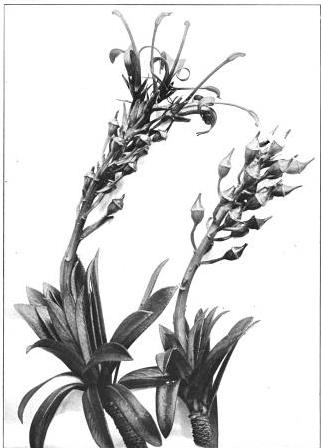 |
| LOBELIA GAUDICHAUDII De Cand.Specimen from the summit of Konahuanui, Oahu (in the Herbarium of the College of Hawaii). |
page 114
| PLATE 57. |
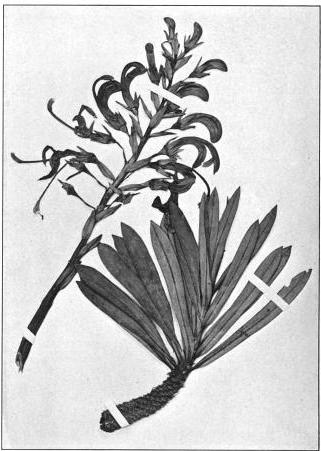 |
| LOBELIA GAUDICHAUDII De Cand.The typical plant from the summit of Konahuanui, Oahu. |
page 115
LOBELIA Linn.
Calyx five-toothed or lobed. Corolla slit open on the upper side to near the base, five-lobed, the two upper lobes half the length of the corolla, forming an upper lip, the three lower united into a tridentate or trifid lower lip. Staminal tube free from the corolla, the two lower anthers or all bearded at the top with a tuft of short stiff hairs. Style shortly two-lobed, with two patches or a ringlet of short hairs below the lobes. Capsule two-celled opening at the top into two loculicidal valves. Seeds numerous, small, with a thin smooth testa. — Shrubs or arborescent plants or mostly herbs. All the Hawaiian species are shrubby. Peduncules one-flowered, arranged in terminal bracteate racemes or spikes.
The genus Lobelia consists of over two hundred species distributed in the tropical and temperate regions of all continents, with the exception of Central and Eastern Europe and Western Asia. Of the Hawaiian species, which number eleven. Lobelia gloria-montis, L. Gaudichaudii, and Lobelia Kauaensis are the most beautiful of all our Lobelioideae. They inhabit the summit of mountains like Konahuanui on Oahu, Waialeale on Kauai, and Puukukui on West Maui. Lobelia hypoleuca and Lobelia neriifolia are of second rank. Originally the genus included five Hawaiian species of which one species L. macrostachys had been separted from Lobelia and a special genus had been erected for it owing to the peculiar dehiscence of the capsule (see Trematolobelia). Lobelia gloria-montis and Lobelia Remyi are here described for the first time. The former was included by Hillebrand with Lobelia Gaudichaudii, and the latter represented an undescribed species in the Paris Herbarium. It is here named after its discoverer the celebrated July Remy, who botanized in these islands during the years 1851-1855. All in all there are here described eleven species, four varieties and one form.
Lobelia Gaudichaudii De Cand. in Prodr. VII:384. 1838. Lobelia Gaudichaudii coccinea Rock in Torrey Bot. Club. Bull. 44:238. 1917. (Plates 15, 56, 57.)
Stem 3-7 dm long or longer, glabrous, closely covered with rhomboidal leaf-scars, leaves oblong-lanceolate, entire, the margin thickened or revolute with callous teeth, acute at the apex, narrowing at the base, sessile, 15 - 18cm long. 1.5 - 2.5 cm wide, the strong midrib pubescent beneath with white hair; the single spike up to 60 cm long, raceme open-flowered, glabrous throughout, pedicels bracteate at the base, compressed equalling the bracts in length; calyx tube hemisphaerical-turbinate, the lobes lanceolate twice as long as the tube; corolla arcuate, deep red-purple, glabrous, 5 cm long, 7 mm broad, widening at the apex, bilabiate, the lower lobe tri-dentate at the apex; staminal column purple, glabrous, anthers glabrous, all five penicillate; capsule ovoid, the apex conical, dehiscing loculicidally; seeds compressed, ovate-reniform, margined.
OAHU: Wo-ahu, 1837. Gaudichaud no. 149 in herbarium Mus. Paris; — Konahuanui, Hillebrand; — Punaluu Mts. summit ridge, fruiting December 3-4, 1908, Rock no. 65 in herbarium College of Hawaii; — summit of Mt. Konahuanui 3030 feet, flowering September 1912, Glen. W. Shaw no 12742 in herbarium College of Hawaii; — Konahuanui summit, flowering-fruiting September 1914, Nelson & Stone no. 10003 in the herbarium College of Hawaii.
Gaudichaud's specimen came from the summit of the Oahu range, (ad acumen montis O-Wahu Sandwicensium) and is the type of Lobelia Gaudichaudii DC.
page 116
| PLATE 58. |
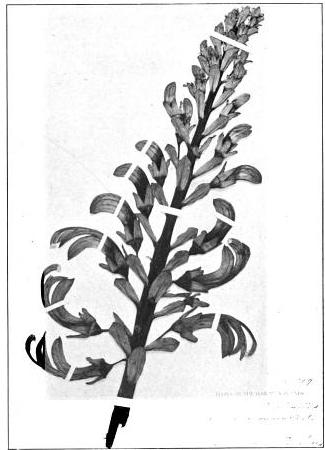 |
| LOBELIA GLORIA-MONTIS Rock sp. n.Type in herbarium College of Hawaii. |
page 117
De Candolle states plainly "corolla basi rosea, supernea rubro-violacea." Hillebrand incorporated the Kauai and West Maui plants with the typical Lobelia Gaudichaudii DC., but they are quite different from the typical species. Hillebrand's description of the flowers was evidently drawn from the West Maui plant, about which he says: "Corolla 3 - 3.5 inches long, 1.5 inches broad, at the base, etc. of thick texture, cream-colored." The flowers of the Oahu specimens are much smaller and of a dark red-carmine-purple. The aspect of the plant as a whole is quite different and so are the leaves. It was Hillebrand's description which caused the writer to err and describe the true Lobelia Gaudichaudii DC. as a variety coccinea. The West Maui plant must be considered an undescribed species.
Lobelia gloria-montis Rock sp. nov. Lobelia Gaudichaudii Hillebr. Flora Haw. Isl. 236. 1888. not De Candolle (in part). (Plates 17, 18, 58.)
Stem 1 - 1.5 m high, thick near the base; leaves oblong, spathulate, acute at the apex, broadly sessile at the base, 12 - 13 cm long, 3 - 4 cm wide, thick coriaceous, pale green, glabrous on both sides, ciliate at the margins near the base, upper margin revolute, with thickened, dark, minute teeth; raceme 50 - 60 cm or more long, glabrous, bracts broadly spathulate, 3 - 4 cm long, 1.5 cm wide, denticulate in the upper margin, ciliate in the lower; pedicels as long as the bracts; calyx tube turbinate, 2 cm broad, the lobes lanceolate, 1.5 - 2 cm long, pale with purplish tinge; corolla large, 8 cm long, 1.5 cm broad at the base, broader at the apex, beautiful cream-colored with faint purplish streaks; staminal column glabrous cream-colored; the anthers grayish blue, glabrous, all five penicillate; capsule not seen.
MAUI: West Maui, Mauna Eeke Hillebrand Herbarium Berlin and Gray Herbarium; — top of Mt. West Maui, Mann et Brigham no. 462 in Gray Herbarium; — Puukukui elevation 5000 feet in bog with Wilkesia Grayana, Acaena exigua, Argyroxiphium sp? etc., flowering August 1910, Rock no 8209 in herbarium College of Hawaii; — Puukukui, flowering, September 24-26 1916, A. S. Hitchcock no. 14861 in U. S. National Herbarium; — Mauna Eeke, flowering September 3, 1918, Rock & Hashimoto, no. 13130 in Herbarium Rock.
This glorious species has been mistaken for the Oahu Lobelia Gaudichaudii to which it does come very close. It differs from it in the very large pyramidal racemes with large cream-colored flowers which are nearly twice the size of the Oahu species; the leaves are oblong to broadly spathulate instead of oblong lanceolate. To see this species growing is one of the delights of the botanist. During the summer months the big bogs of the West Maui mountain summits are resplendent with the huge racemes of large cream-colored flowers. The writer has not seem this species on any of the mountains save on West Maui. The Kauai species which Hillebrand also included with Lobelia Gaudichaudii is quite different in aspect.
The young plants of Lobelia gloria-montis are pubescent on both sides with long white hair.
page 118
| PLATE 59. |
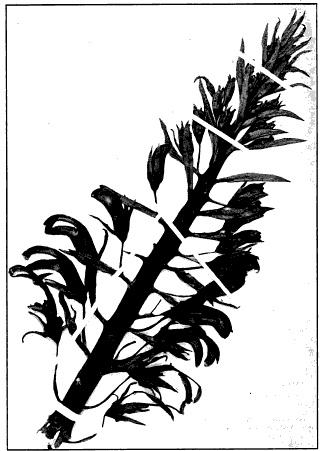 |
| Type of Lobelia gloria-montis longibracteata Rock in herbarium College of Hawaii. |
page 119
Lobelia gloria-montis longibracteata Rock Lobelia Gaudichaudii longibracteata Rock in Coll. Hawaii Publ. Bull. 2:47. 1913 (Plate 59.)
Plant 3 - 5 m high branching candelabra like into five to seven erect, ascending branches; leaves oblong-lanceolate, nearly of even width, 18 - 20 cm long, 3 - 3.5 cm wide, glabrous, and not ciliate at the base; racemes larger than in the species 50 - 60 cm or more, five to seven forming one inflorescence; pedicels 5 - 6 cm long; bracts linear lanceolate, exceeding the length of the pedicels 6 - 8 cm or more long, 8 - 10 mm wide; calyx tube turbinate 1 cm high, the lobes three and one half times the length of calyx tube; corolla as in the species.
MAUI: summit of Puukukui on the edge of Iao Valley in forests with Clermontia grandiflora, Pelea, etc.; — flowering August 1910, Rock type no. 8818 in herbarium College of Hawaii.
This variety is at once distinguished from the species in its branching habit, and larger size, but mainly in the long racemes with their long, linear-lanceolate, acuminate bracts, and long calycine lobes. One of the handsomest Hawaiian Lobelias.
Lobelia Kauaensis (Gray) Heller in Minnes. Bot. Stud. IX:911. 1897. Lobelia Gaudichaudii var. Kauaensis A. Gray in Proceed. Am. Acad. V:150. 1862. Lobelia Gaudichaudii Hillebr. Flora Haw. Isl. 236. 1888 (not De Candolle) in part. (Plates 16, 42, 60.)
Stem 1 - 2 m high, closely covered with leaf scars, about 3 cm in diameter; leaves linear lanceolate glabrous even in very young plants, subsessile or on short petioles 3 - 5 mm long, acuminate or acute at both ends, mucronulate at the apex, coriaceous, 12 - 15 cm long, 15 - 20 mm wide, purplish beneath as are the somewhat revolute margin, midrib and minute callous teeth; inflorescence branching into two or usually four racemes 35 - 40 cm long or more, the rhachis deep purple, glabrous or puberulous; pedicels 1.5 - 3 cm, bracteate at the base, the bracts narrow linear lanceolate, purple, finely mucronate, glabrous or puberulous on the margin, sharter than the pedicels, or of equal length; calyx tube broadly obconical, the lobes twice as long (little longer than the calyx tube teste Gray), corolla creamy-white with deep purplish streaks, 4 -5 cm long, 1 cm wide at the middle, the two lateral lobes linear, deeply cut 3 - 3.5 cm , 4 - 5 mm wide, the lower lip shortly trifid; staminal column glabrous, as are the anthers, all bearded at the apex; capsule black, pyriform, with a long acuminate conical vertex 12 - 14 mm high, seeds linear-reniform, glossy, of a reddish brown, the margins thickened, shining.
KAUAI: U. S. Explor. Exped. in Gray Herbarium; — Pohakupili, Wawra no. 2044 in Herbarium Vienna; — bog at the head of the Wahiawa river, October 19, 1895, A. A. Heller no. 2888 in the Gray Herbarium; — summit of Kauai, Mt. Waialeale in the bog, flowering September 1909, Rock nos. 5109, 5823, in the herbarium of the College of Hawaii; — same locality October, 1911, Rock in herbarium College of Hawaii; — Hanapepe, 800m, Abbe Faurie no. 552 in herbarium Léveillé and herbarium College of Hawaii; — Mt. Waialeale, flowering, fruiting October 21, 1916, Rock no. 12845 in herbarium College of Hawaii; — same locality, A. S. Hitchcock no. 15499 in U. S. National Herbarium.
This species, while quite distinct, comes closer to the typical L. Gaudichaudii from Oahu; the main difference being the branching inflorescence, dark purple stems, purplish leaves which are perfectly glabrous and very handsome creamy- white flowers with deep purple streaks.
page 120
| PLATE 60. |
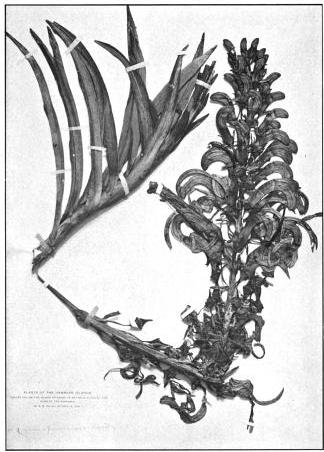 |
| Lobelia Kauaensis (A. Gray) HellerFrom a specimen in the Gray Herbarium, ex coll. A. A. Heller. |
page 121
| PLATE 61. |
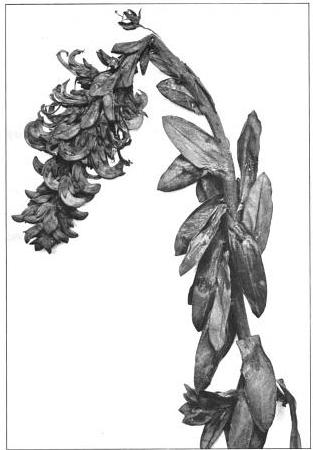 |
| Type (no. 12741) of Lobelia Kauaensis villosa Rock in the herbarium of the College of Hawaii. |
page 122
Asa Gray states calyx viscous, the lobes little longer than the tube; in all the specimens collected the calycine lobes are twice as long as the tube.
The plant does not only occur on the summit of Kauai as for example on Mt. Waialeale, but also on the outskirts of the bogs in the forests at a lower elevation. When found in the latter locality the stems are stouter and taller; they then grow usually on the trunks of moss-covered trees.
Specimens were observed in the forests on the border of Kauluwehi swamp at an elevation of 4000 feet. Lobelia Kauaensis is a very handsome species worthy of cultivation, as are the other species of Lobelia occurring in Hawaii.
When growing on the extensive bogs at the summit of Kauai (Mt. Waialeale, 5200 feet elevation) it is assocated with Pelea Waialealae, Panicum monticola, Panicum isachnoides, Oreobulus furcatus, Sanicula, Acaena exigua, Viola Kauaensis, Dubautia Waialealae and others.
The type of Asa Gray's Lobelia Gaudichaudii var. Kauaensis in the Gray Herbarium consists of a few fragments of flowers, and the outline drawing of a leaf, which must have been made after a leaf taken from a sterile specimen; the drawing of the leaf is exceptionally large and leaves of that size occur only on plants which have not as yet reached the flowering stage. When the plants begin to flower the leaves drop off gradually.
Heller's specimen is in excellent condition, and is identical with the glabrous specimens collected by the writer on Mt. Waialeale, Kauai.
Lobelia Kauaensis villosa Rock in Torrey Bot. Club Bull. 44:237. 1917. (Plates 43, 61.)
Stem 6 - 10 dm high, covered with leaf-scars as in the typical form of the species, inflorescence branching candelabra-like, or a single spike aout 55 cm long and 1 cm or more in diameter, villous-hairy throughout, light green in color; lower leaves oblong, sessile with a broad base, 9 - 14 cm long, 3.5 cm wide, with thick prominent midrib and obscure venation, bluntly acute at the apex, glabrous below with the exception of the midrib and the entire margin, pubescent above, upper leaves gradually reduced to foliaceous, broadly ovate bracts; raceme more densely flowered than in the typical form, villous, the flowers arranged along the uppper third of the spike, pedicels and calycine tube villous with whitish gray hairs, the calycine lobes green, but ciliate at the margin; corolla shorter than in the typical form but broader, whitish green, the veins very indistinct, only visible in the buds, slightly purplish tinged.
KAUAI: Mt. Waialeale at an elevation of 5000 feet, flowering September 23, 1909, Rock no. 5823 in herbarium College of Hawaii; — Mt. Waialeale, flowering October 22, 1916, Rock and Hitchcock no. 12741 in herbarium College of Hawaii; — same locality flowering October 22, 1916, Hitchock nos. 15432, 15450, 15484 in U. S. National Herbarium.
A much stouter plant than the typical form of the species, differing in the broad, fleshy, oblong leaves, and broad, ovate bracts. The whole aspect of the plant is different; the typical form is glabrous and has dark purple, slender glabrous racemes, while the racemes in the variety, which is almost worthy of specific rank, are thick, stout, bright green and villous throughout. The villosity and compact character of the plant are not due to location, for both the typical form and the variety grow side by side in the open bog of Mt. Waialeale on the island of Kauai, at an elevation of 5000 feet, in company with Compositae, Drosera longifolia L., several species of Plantago, Panicum monticola Hook. f., P. isachnoides Munro, P. imbricatum Hillbrd. and Oreobolus furcatus H. Mann.
page 123
| PLATE 62. |
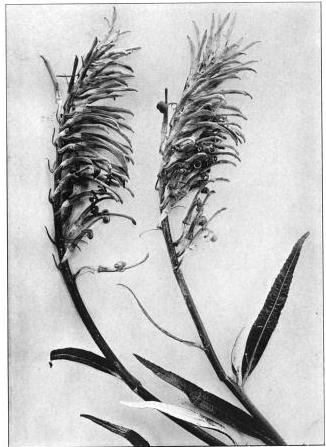 |
| Single branches of Lobelia hypoleuca Hillebr. |
page 124
| PLATE 63. |
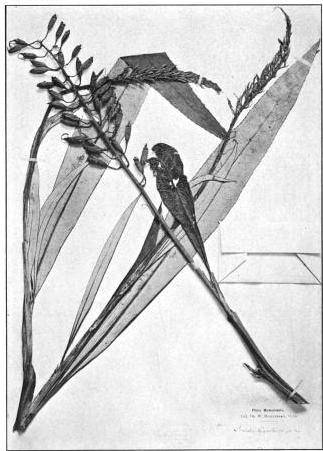 |
| LOBELIA HYPOLEUCA Hillebr.Specimen ex coll. Hillebrand in the Gray Herbarium. |
page 125
Lobelia hypoleuca Hillebr. Flora Hawaii Isl. 238. 1888. (Plates 19, 42, 62, 63, 64.)
Erect subherbaceous, the hollow stem 1.5 - 2 m high, with few distant leaves, branching above, the long branches bearing one to four distant leaves and ending in a rather loose raceme 15 - 25 cm long; leaves broadly lanceolate 30 - 45 cm long, 2.5 - 7.5 cm wide, acute, gradually narrowing into a petiole up to 2.5 cm in length, sharply dentate or serrulate with callous teeth, soft chartaceous, white beneath with a thick layer of matted, cobwebby wool; bracts linear or filiform, as long as the pedicels or longer, the latter 12 mm long, bibracteolate near the base; calyx tomentose white, with an elongate tube 6 mm long, the lobes of about the same length, subulate from a broad base; corolla bluish, puberulous, very slender, erect, 30 - 36 mm long, with revolute lobes; filaments puberulous, anthers glabrous, bluish only the lower ones penicillate; capsule whitish, cylindrical 16 - 18 mm long, the free conical vertex less than one-fourth of the length, with ten warty ridges; the calycine covering being very thin, the capsule is apt to split laterally before the vertex; seeds very minute, smooth, ovoid, light brown.
OAHU: Waialua and Helemano Hillebrand in Herbarium Berlin and Gray Herbarium; — Remy 1851-1855, in herbarium Museum Paris; — Punaluu Mts., 2000 feet, fruiting, November 14-21, 1908, Rock nos. 807, 808, in herbarium College of Hawaii; — Konahuanui, Mt. Olympus trail, flowering 1911, 1912, May 1918, Rock no. 13114 in herbarium College of Hawaii.
KAUAI: Waiakealoha waterfall, elevation 3600 feet, flowering August 1909, Rock; — Waialae Valley, flowering Octoer 1911, Rock no. 12842 in herbarium College of Hawaii.
MOLOKAI: Pali of Pelekunu, Hillerand. Pali of Waihanau, 3000 feet elevation, May 27, 1918, Rock no. 14035 in herbarium College of Hawaii.
MAUI: Gulches of Lahaina and Wailuku, Hillebrand.
LANAI: Upper part of mountains September 21, 1916, A. S. Hitchcock nos. 15603, 14675, 14665, in U. S. National Herbarium.
HAWAII: Woods of Kohala, Hillebrand; — woods of Waimea, flowering October 1909, R. S. Hosmer no. 6096 in herbarium College of Hawaii.
Lobelia hypoleuca was first collected by Jules Remy. It seems to be a very variable species if the plants from the other islands belong to it. The Oahu specimens seem to have the typical cylindrical capsule, while those from Hawaii and Kauai seem to be more ovate. It is doubtful indeed if some of the Kauai plants should be referred to this species; they appear to belong to Lobelia neriifolia A. Gray, to which Wawra referred his specimen from Halemanu, Kauai, no. 2108, though the typical Lobelia hypoleuca does occur on Kauai.
On Hawaii the writer collected a specimen which was unfortunately not in flower. It was over ten feet in height, had a single erect trunk about 10 cm thick at the base, at the apex there was a dense crown of large leaves 60 - 65 cm long, about 10 cm wide, on thick fleshy petioles of 3 cm; the plant is so different in habit from the true Lobelia hypoleuca that it deserves to e regarded at least as a new form, form macrophyta Rock form nova.
Lobelia hypoleuca forma macrophyta Rock f. n.
Plant 3 m or more high, stem erect 10 cm in diameter at the base, crown of leaves dense at the apex; leaves 60 - 65 cm long, 10 cm wide, acute at the apex, thin chartaceous, irregularly denticulate to subentire, dark green above, white cobwebby woolly beneath; petioles 3 cm long thick fleshy; flowers and fruit unknown.
page 126
| PLATE 64. |
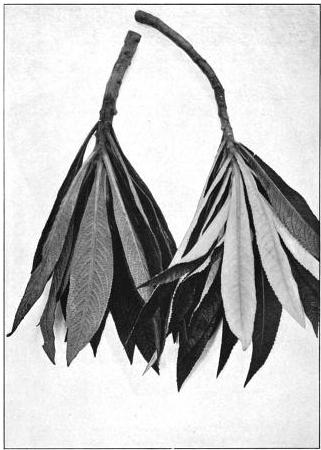 |
| To the left Lobelia oahuensis Rock, to the right Lobelia hypoleuca Hillebr. Note the different in the undersurface of the leaves. In L. oahuensis the leaves are green; in L. hypoleuca the leaves are white beneath. |
page 127
HAWAII: Holokaiea gulch, back of Waimea, elevation 3000 feet, July 9, 1909, Rock no. 4767 in herbarium College of Hawaii.
Lobelia oahuensis Rock in Torrey Bot. Cl. Bull. Vol. 45:137. 1918. (Plate 64.)
Plant rather stout, stem short and thick, solid and not hollow; rosette of leaves very dense and about 1 m in diameter; leaves densely packed around the apex of the stem, linear-oblong, acuminate at both ends, merging at the base into a winged fleshy petiole about 2.5 cm in length, 50 cm long, 4.5 - 5 cm wide, thick, coriaceous, dark green, glabrous above and covered with a strongly impressed, very close, reticular net work, young leaves densely hirsute underneath, especially along the very prominent projecting midrib and veins, of a dirty grey or fawn color on the older leaves, the margins revolute, denticulate with thick callous teeth; flowers not seen, a single dead terminal flower stalk was seen on one of the plants, which was about 1 m long; inflorescence composed of several hollow, ascending spikes, 1 - 1.5 m high; spikes hollow gray woolly as is the underside of the leaves, and densely covered with linear bracts, bracts acuminate at the apex, broadly sessile at the base, 20 - 25 mm long, about 3 mm wide, irregularly denticulate with reddish, thickened teeth, median nerve prominent, covered on both sides with a grayish pubescence; flowers unknown, but reported to be pale blue; flowerbuds green; calycine teeth about 15 mm long, acuminate, with a prominent median nerve, ovarian portion ovate to obovate, densely covered with grayish-white hair, as are the pedicels, the latter 2 cm when with fruit, and stout, staminal column puberulous, the two lower anthers bearded only; capsule (not mature) densely pubescent with dirty grayish-brown hair, 10-ribbed, obovate-turbinate, 10 - 14 mm long, 8 - 10 mm wide, crowned by the long calycine lobes; seeds ovate, not margined.
OAHU: At the very top of the main crest of the island overlooking the cliffs of Waimanalo at an elevation approaching 3000 feet, September 14, 1917, Rock no. 1236 type in the herbarium of the College of Hawaii; — same locality, May 12, 1918, Rock & Tasartez no. 13113 in herbarium College of Hawaii; — same locality, flowerbuds and fruiting, October 1918, Swezey & Timberlake in herbarium College of Hawaii.
Several plants were seen growing together, the lower ones of which could not be reached owing to the vertical cliffs on which they grew immediately below the knife-edge crest of the backbone of the island of Oahu. The plant forms a large rosette with the leaves densely packed at the apex in an almost horizontal position, that is at right angles to the stem. It grows in company with Trematolobelia macrostachys (Hook. et Arn.) Zahlbr., Dubautia laxa, Metrosideros rugosa, etc.
The plant is evidently related to Lobelia hypoleuca Hillebr., from which it differs in the thick coriaceous, closely reticulate veins of the leaves, not silvery beneath but hirsute, being covered with fawn-colored or dirty gray hair.
In Lobelia hypoleuca which is a branching species, the leaves are few and more or less scattered, thin and chartaceous; it does not ascend to such high elevations, but remains more at the lower levels from 1000-1500 feet in very sheltered situations, especially deep ravines.
The stem, though solid, has very little woody tissue; the central part of the stem is filled with a fleshy pith which is surrounded by a very narrow woody tissue.
The old rootstock produces small plants or offshoots which probably never reach the flowering stage.
page 128
| PLATE 65. |
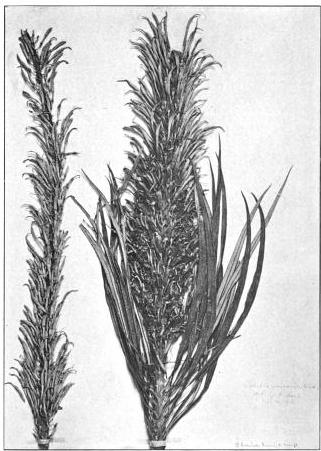 |
| LOBELIA YUCCOIDES Hillebr.Co-type specimen collected by V. Knudsen in the Hillebrand collection in the Gray Herbarium. |
page 129
| PLATE 66. |
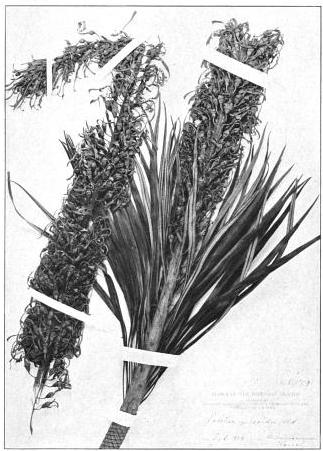 |
| LOBELIA YUCCOIDES Hillebr.Specimen in the College of Hawaii herbarium, Rock no. 5779. |
page 130
The writer is indebted to Mr. O. H. Swezey and Mr. P. H. Timberlake, both entomologists, for fruiting specimens, one of which possessed a few flowerbuds at the apex.
The writer was justified, as stated before, in establishing this new species; his viewpoint has been verified by the material collected by Swezey and Timberlake. They reported a number of specimens growing on the cliffs overhanging Waimanalo, one specimen of which was in flower (said to be of a pale blue) but grew at an inaccessible place and could not be collected. The species is closely related to L. hypoleuca, but differs in the densely dirty gray pubescent racemes, the long numerous bracts, the densely-packed racemes, and gray woolly, obovate to turbinate capsules; the leaves are of an entirely different texture, as can be seen by the illustration.
Lobelia yuccoides Hillebr. Flora Hawaii. Isl. 237. 1888. (Plates 20, 65, 66.)
Trunk simple erect with a thin woody zone and compact medulla, 1.5 - 2 m high, 2.5 - 3.25 cm thick, closely covered with spires of rhomboidal leaf-scars and bearing a crown of leaves at the end, and passing at once into a thick terminal raceme of 6 - 10 dm in length, which is closely covered with two hundred to four hundred flowers; leaves linear, 24 - 37.5 cm long, 7 - 15 mm wide, acuminate or acute at both ends, with revolute margins, entire or minutely denticulate, whitish gray beneath, dark green above, chartaceous, with almost horizontal nerves; pedicels 8 - 12 mm, with setiform bracts and bractlets; calyx whitish pubescent as are the pedicels, the obconical striate tube 5 mm, the subulate lobes of the same length or shorter (somewhat longer teste Hillebrand); corolla puberulous, bluish, very slender, suberect, 36 - 40 mm long, the upper lip spreading, the lower deeply trifid; filaments puberulous, a small patch of pubescence at the base of each anther, only the two lower anthers penicillate; capsule ovoid or almost cylindrical, 10 - 12 mm high, semi-inferior, with a conical apex, loculicidal in the free portion and at last down to the base.
KAUAI: Waimea, elevation 2000-3000 feet, Knudsen in Herbarium Berlin and Gray Herbarium; — on the edge of dry canyons below Kaholuamano, elevation 300 feet, in company with Wilkesia gymnoxiphium, Coreopsis cosmoides, etc. flowering-fruiting, September 1909, Rock no. 5779 in herbarium College of Hawaii; — Waimea, March 1910, U. Faurie no. 553 in herbarium Léveillé and herbarium College of Hawaii; — same locality October 1916, Rock no. 12836 in herb. Coll. Hawaii; — Kaholuamano, fruiting, October 21, 1916, A. S. Hitchcock no. 15432 in U. S. National Herbarium.
OAHU: Ridge of Waianae, mountains above Lihue, Hillebrand, anno 1869, in Gray Herbarium.
A tall and handsome true Lobelia well named yuccoides, for the plant truly resembles a small yucca in habit. It inhabits the dry ridges and canyons of the Waianae Mountains of Oahu and the leeward side of Kauai. It differs from L. hypoleuca in the solid woody stem, long simple racemes and narrow linear leaves. The racemes are, however, hollow.
Lobelia yuccoides Hillebr. is exceedingly close to Lobelia neriifolia A. Gray, but differs from it in the tall stem, long raceme, and the very slender much longer flowers, which are a grayish blue. There is an excellent flowering specimen in the Gray Herbarium, collected by V. Knudsen. The leaves are less canescent beneath than in L. neriifolia Gray.
page 131
| PLATE 67. |
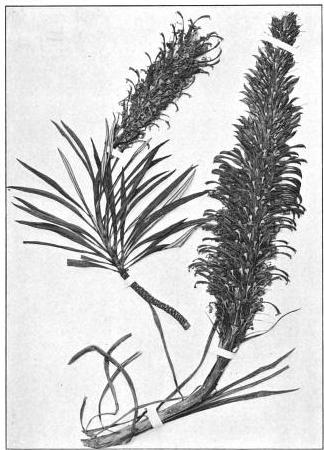 |
| LOBELIA NERIIFOLIA A. GraySpecimen from Mt. Haleakala, East Maui, in the herbarium of the College of Hawaii. |
page 132
Hillebrand's specimen, in the Gray Herbarium, from the Waianae Mountains, Oahu, is quite fragmentary and is labelled "Lobelia neriifolia var. yuccaeformis same as comm. by V. Knudsen." Hillebrand himself was not quite sure if his plant was not, after all, referable to Gray's L. neriifolia, since the Oahu specimen consists of the upper portion of a raceme only, it cannot be determined whether it belongs to L. neriifolia or L. yuccoides.
Lobelia neriifolia A. Gray in Proceed. Am. Acad. V: 150. 1862. (Plate 67.)
Stem fruticose stout, the medula solid; leaves crowded, elongate-linear, narrowing at both ends, atenuating into a marginate petiole about 5 mm long, coriaceous, transversely veined, margin entire revolute, glabrous above, whitish below, 10-20 cm long, 5-14 mm wide, raceme virgate, densely flowered, 15-40 cm long; bracts and calycine lobes subulate-setaceous, the former 3.5-4 cm long, the latter about 10 mm long, calyx tube whitish, turbinate; corolla blue, subect, puberulous; staminal column pubescent; anthers glabrous, only the lower penicillate; capsule dehiscent through the short and obtusely conical vertex.
MAUI: East Maui, U. S. Exploring Expedition, type in Herbarium Gray; — Haleakala, 8000 feet, Maui, Wm. Windte in Gray Herbarium; — Puunianiau crater, elevation 6500 feet, along watercourses or gulch ending north of Puunianiau, Mt. Haleakala, flowering October 22, 1910, Rock no. 8612 in the herbarium of the College of Hawaii; — Kaupo gap in Haleakala crater, flowering-fruiting September 1910, Rock no. 8612-a in herbarium College of Hawaii; — Koolau gap, crater of Haleakala, flowering October 1910, Rock no. 8640 in herbarium College of Hawaii; — Haleakala crater, 6000 feet, flowering October 2-5, 1916, A. S. Hitchcock no. 14947 in U. S. National Herbarium.
KAUAI: Waialae Valley along banks, stream bed, and rock walls, flowering September 6, 1909, Rock no. 5959 in herbarium College of Hawaii.
Hillebrand absolutely ignored the original description of A. Gray's Lobelia neriifolia and drew up a description from an entirely different plant; his description is exactly the opposite of that given by A. Gray. The original specimen was collected on East Maui evidently on Haleakala, where the writer collected his material. The species is rather abundant at an elevation of from 5000-7000 feet on the northwestern slope of the crater as well as in both the Koolau and Kaupo gaps in the crater The species resembles somewhat Lobelia hypoleuca but differs from it in the short and narrow leaves with revolute margins, the densely flowered raceme, and ovate, obtuse capsule. The racemes are usually single; only occasionally two or three small ones appear at the base of the main raceme (no. 8640). The Kauai plant no. 5959 is here referred to this species on account of the ovoid obtuse capsule and the leaves, which are like those of Lobelia neriifolia from Haleakala; the plant does not exactly agree with the typical species, though comes much closer to it than to Lobelia hypoleuca. The latter does, however, occur on Kauai, where it reaches a height of six feet or more.
The type of Lobelia neriifolia A. Gray in the Gray Herbarium is exceedingly fragmentary, consisting of three single leaves and a few very old capsules; the leaves are about 31 cm long and 8-10 mm wide, and belong unquestionably to plants found on Mt. Haleakala on Maui. The question arises if Lobelia neriifolia is not identical with Hillebrand's Lobelia yuccoides. The fragmentary type of
page 133
Lobelia neriifolia does not permit a definite statement to that effect; it may however be remarked, that while the species of Lobelia found on Mt. Haleakala, and in the crater proper, comes exceedingly close to Lobelia yuccoides, it is sufficiently distinct to warrant its retention as a separate species, and as it agrees well with the type and the description of Lobelia neriifolia Gray it is referred to it. Hillebrand's Lobelia neriifolia has nothing in common with Asa Gray's species of that name, and is here described as Lobelia Hillebrandii. The species found on Kauai along the streambed of Waialae Valley belong for the most part to Lobelia neriifolia A. Gray.
Lobelia Dunbarii Rock sp. n.
Stem woody at the base, green, solid with fleshy pith; leaves linear lanceolate, sessile, acute or acuminate at the apex, thin membraneous when fresh, green and glabrous on both sides, 14-15 cm long, 1.5-2 cm wide, serrate to dentate; raceme single or with two smaller ones arising from the base?, the leaves becoming reduced to foliaceous bracts the whole length of the raceme, the most terminal one still measuring 3 cm in length; flowers single in the axils of the large foliaceous bracts, on pedicels of 3 cm; calyx green the ovarian portion turbinate, 5-ribbed, each rib projecting into a narrow wing which extends the length of the pedicels, 6-10 mm high, the calycine lobes bright green, broad foliaceous 15 mm long, 3-4 mm wide, acute and apiculate at the apex, glabrous inside and outside; corolla a bright ultramarine blue, 2.5 cm long 2.5-3 mm wide, glabrous, the lips revolute; staminal column pale blue puberulous, anthers greyish blue, glabrous; capsule unknown.
MOLOKAI: Along the streambed of Waihanau on rock walls, in company with Hillebrandia sandwicensis, etc., flowering August 13, 1918, L. M. Dunbar type no. 13125 in herbarium College of Hawaii; — Maunahui in a deep ravine on a clay bank, March 21, 1910, Rock no. 6134 in herbarium College of Hawaii.
This very distinct species, which is here named for Mrs. L. M. Dunbar, who collected the type material, is evidently related to L. Hillebrandii, but differs from it in the large foliaceous bracteate raceme, the large green calyx and long foliaceous calyx lobes, which give this species an entirely different aspect from any of our other known Hawaiian true Lobelias.
Lobelia Hillebrandii (Gray) Rock sp. n. Lobelia neriifolia Hillebr. Flora Hawaii. Isl. 238. 1888. not A. Gray.
Low prostrate, the woody trailing stem about 6 mm thick and studded below with knobby leaf-scars, distantly foliose above and ending in a long raceme, with generally one or more distant smaller ones in the axils of the upper leaves; leaves chartaceous, linear lanceolate 10-22 cm long, 8-14 mm wide, acute at both ends, glandular dentate to serrulate, or with revolute margins, subentire especially near the base, pale green, paler beneath and whitish gray pubescent; raceme 8-22 cm long, loosely flowered; bracts linear, calyx tube short obconical about 3 mm high, the subulate lobes about 5 mm; corolla lilac, slender, suberect 18-20 mm long, the lips revolute; filaments pubescent; anthers glabrous, only the lower penicillate; capsule ovoid 6 mm high, the free conical portion loculicidal and septicidal; seeds minute ovoid.
MAUI: West Maui rdiges of Wailuku (in Gray Herbarium ex coll. Hillebrand) and Waikapu; — Haleakala 2000-3000 feet, Hillebrand; — Lahaina, West Maui, fruiting September 29, 1916, A. S. Hitchock no. 14881 in U. S. National Herbarium and part in herbarium of the College of Hawaii.
ILES SANDWICH: Gaudichaud in herbarium Museum Paris.
page 134
| PLATE 68. |
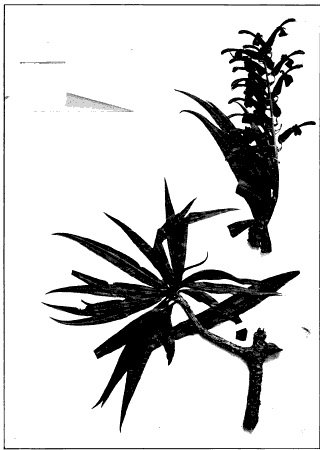 |
| LOBELIA TORTUOSA HellerFrom a specimen in the Gray Herarium, ex coll. A. A. Heller. |
page 135
This species was first collected by Gaudichaud. Hillebrand misinterpreted Asa Gray's species of L. neriifolia and referred this species to the former, drawing up a description of his own and ignoring Asa Gray's description altogether.
Lobelia Hillebrandii is a small species in comparison to the magnificent, tall Lobelias of the high mountains of these islands.
A fragmentary specimen of Hillebrand's Lobelia neriifolia = L. Hillebrandii Rock ex coll. Hillebrand in the Gray Herbarium possesses a single leaf glabrous on both sides; only a small secondary raceme is attached to the sheet. The specimen is labeled as the "typical form of L. neriifolia," which is, however, not the case.
Lobelia Hillebrandii paniculata Rock Lobelia neriifolia Hillebr. β var. Flora Hawaii. Isl. 238. 1888.
Trailing as in the species; leaves elongate-linear, serrulate, acute at the apex, long attenuate at the base subsessile or on a short margined petiole, green underneath, glabrous; inflorescence paniculate, five to six secondary racemes besides the terminal one (teste Hillebrand).
MOLOKAI: Maunahui trailing among Lycopodium fastigiatum, Hillebrand; — Kamolo, 1000 feet, June 1910, U. Faurie in herbarium Léveillé, and U. Faurie no. 557 in herbarium College of Hawaii; — Waialeia ridge, August 9, 1918, Mrs. L. M. Dunbar no. 13124 in Herbarium Rock.
This variety comes very close to the species and differs from it mainly in the green leaves, and according to Hillebrand in the paniculate inflorescence. U. Faurie's specimen is without flower or fruit.
Lobelia Hillebrandii monostachya Rock v. n. Lobelia neriifolia Hillebr. γ var. Flora Hawaii. Isl. 238. 1888.
Leaves narrow linear 4-8 mm wide, green underneath, membranaceous, crenulate; a single raceme 12.5-15 cm long; capsule 6 mm high, the free portion more than half its length.
OAHU: Niu Valley, on a dry exposed slope, Hillebrand, in herbarium Bishop Museum.
This variety is not known to the writer save from Hillebrand's specimen. Hillebrand states in his Flora that the stems are only one foot long, and exhibit the growth of several seasons; the remnants of old racemes stand at the base of the latest growth.
Lobelia tortuosa Heller in Minnes. Bot. Stud. Vol. IX:912, pl. 57. 1897. (Plate 68.)
"Woody; stems clustered from a thick mass of roots, the older ones almost 2.5 cm in diameter at the base, gnarled and twisted, the young flowering and leaf-bearing ends ascending and sparingly branching, closely studded with leaf-scars; leaves narrowly lanceolate-oblong, slightly cyathiform, acuminate at the apex, tapering at the base into a short winged petiole, 15 cm long, 18 mm wide, light green and somewhat pubescent above, pale and densely soft pubescent beneath, with prominate midveins; flowering branch angled; pedicels 12 mm long, horizontal for half their length, then twisted and curved upwards; bracts subulate tomentose; calyx shallow cup-shaped, truncate, shortly pubescent, the lobes linear, almost as long as the tube; corolla 3.6 cm long, garnet colored, somewhat contracted near the middle, pubescent, the lobes revolute; stamens glabrous, or
page 136
| PLATE 69. |
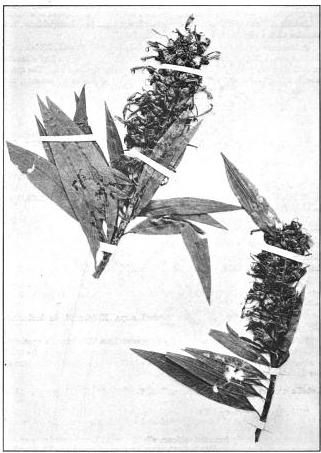 |
| Type of Lobelia Remyi Rock in the Paris Herbarium. |
page 137
occasionally with a few scattered hairs; lower anthers penicillate only; style with a pubescent ring at the base of the stigma."
KAUAI: On perpendicular cliffs along the Hanapepe river, flowering, June 24-26, 1895, A. A. Heller no. 2443 in herbarium Bishop Museum; — Gray Herbarium, and herbarium Bronx Park, New York.
Lobelia tortuosa is an excellent species and remarkable for its branching stem which is quite stout, and the garnet-colored flowers which are urceolate in shape. In the other branching Hawaiian Lobelias, the stem branches usually at the apex into several flowering racemes, or at the very base from rootstock as in L. Hillebrandii
Heller states that the thick knotted mass of roots protrude from crevices of the rocks, and from them spring the first declined and twisted, finally ascending, sparingly branched stems. It is probably closely related to Lobelia Remyi Rock.
The description is quoted almost entirely from Heller; only the measurements have been changed into the metric system, and a few superfluous phrases have been omitted.
Lobelia Remyi Rock sp. n. (Plate 69.)
Leaves linear lanceolate, acuminate at the apex, acute at the base, thick chartaceous, 12-16 cm long, 14-26 mm wide, on petioles 5-8 mm long, glabrous above, graying tomentose or woolly beneath; racemes short 12-15 cm long; pedicels 12-14 mm long; ovarian portion of calyx broad cup-shaped about 5 mm high, the teeth triangular acute to acuminate (anthers glabrous); capsule whitish, the conical vertex higher than the lower portion.
OAHU: J. Remy no. 298 type in herbarium Museum Paris.
This species, which has not been re-collected, is described from a specimen, collected by Jules Remy on Oahu, in the herbarium in Paris. It is at once distinguished from the other Hawaiian Lobelias in the compact short raceme and the small graying woolly leaves. It comes evidently close to Lobelia tortuosa Heller, with which it has the tomentose leaves in common. The specimen possesses old flowers, and is already in the fruiting stage.
page 138
page 139
TREMATOLOBELIA Zahlbruckner.
page 140
| PLATE 70. |
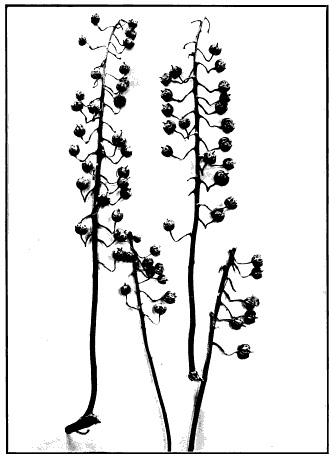 |
| TREMATOLOBELIA MACROSTACHYS Zahlbr.Showing portions of fruiting racemes perfectly mature. |
page 141
TREMATOLOBELIA Zahlbruckner.
Trematolobelia* Zahbruck. in (Rock descript. new spec. Hawaii. Plants) Coll. Hawaii Publ. Bull. no. 2:45. 1913. Trematocarpus Zahbruck. in Annal. Mus. Vindob. VI. 3-4, 430, fig. 1. 1891.
"Calycis tubus subanthesi adnatus, subglobosus, limbus 5-partibus. Corolla arcuata, decidua, tubo dorso a basi fisso, limbi lobis incurvis inaequalibus, 2 majoribus altius solutis, 3 minoribus connatis solum apice breviter trifidis. Staminum tubus a corolla liber, rectus, tubo corollae multi longior; antherae 2 minores vertice penicillatae, 3 majores glabrae. Ovarium inferum, 2-loculare, placentis-ovolatis. Capsula infera, lignosa vertice clausa et umbonata, lateraliter inter costas praesertim versus basim foraminibus ovalibus aut rotundatis dehiscens. Semina parva pressione mutua marginata. Embryo rectus, radicula juxta hilum, lobis rotundatis planis.
"Frutex foliis alternantibus. Inflorescentia racemosa, pedunculis ad axillae bractearum solitariis, bibracteolatis et articulatis."
A single species with two distinct varieties inhabiting nearly all the islands of the Hawaiian group. Of the varieties one occurs on Kauai, the other on Hawaii. In regard to the validity of Zahlbruckner's genus (Trematocarpus) there seems to have been a lengthy discussion by Hemsley and Stapf, both of whom did not think it justifiable to erect a new genus on the mode of seed dispersal of (Lobelia) Trematolobelia macrostachys (Hook. et Arn.) Zahlbr. which does not take place through a loculicidal dehiscence of the conical vertex, but through peculiar holes in the wall of hte capsule, which are very numerous and of different sizes and shapes, becoming larger at the base of the capsule.
Hemsley suggested that the holes may have been the work of insects in the herbarium and that Zahlbruckner had monstrous capsules. This the writer can absolutely prove to be not true, as he has studied the plants in the field in all stages of growth; plants from the slopes of Mauna Loa, Hawaii, forests of Naalehu were devoid of all foliage and flowers; even the epicarp had decayed and only the skeleton of the fruits had remained; the capsules were, however, not dehiscent and even after pressure had been applied did not open, nevertheless the capsules were empty and only very few seeds could be found at the very base of the capsule; the rest were dispersed through th enumerous holes in the wall of the ligneous capsule.
In regard to Trematocarpus, which is now a synonym of Trematolobelia, A. Zahlbruckner wrote the following in the Annales of the Vienna Museum of Natural History, Vol. VI:430,1891 (translated by the writer):
I established this genus (Trematocarpus) on a plant which was collected by Wawra in the Sandwich Islands and which he identified and published as Lobelia macrostachys Hook. et Arn. I do not doubt that the plant is indeed identical with that described species, though the descriptions as well as the plate by Gaudichaud differ from the actual facts. Neither Hooker and Arnott nor Hillebrand saw mature fruits of this species, and Gaudichaud prepared his plate (figure) from a specimen still in an immature flowering stage. The mode of dihiscence, I considered sufficient to separate the genus Trematocarpus. The
____________ * Formed of το τρημα = The hole and Lobelia.
page 142
| PLATE 71. |
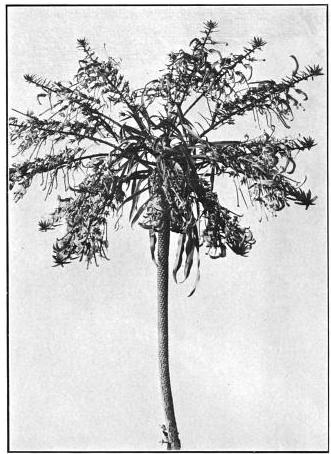 |
| TREMATOLOBELIA MACROSTACHYS Zahlbr.Flowering specimen. |
page 143
abundant material of fruiting specimens in all stages of development in the Wawra collection, permitted me to study most thoroughly the structure and the development of the capsule. I shall describe the actual facts more thoroughly, first because it necessitates the generical separation of Lobelia macrostachys Hook. et Arn. and second because this mode of dehiscence of this plant is the only one known within the family Campanulaceae as understood by Bentham and Hooker.
"Immediately after anthesis the corolla drops off and the staminal tube with the basal part of the enclosed style breaks somewhat above the conical insertion. The calyx remains however on the receptacle. The capsule assumes gradually a woody consistence through a thick zone of sclerenchym fibres which form beneath the parenchymes of the receptacular wall. It appears that Hillebrand considered this stage as the mature capsule. When the development of the sclerenchymal zone has reached a certain point, then the epidermis of the receptacular wall becomes separated from the woody part of the latter and with the epidermis also the parenchymal layers beneath it. At the same time occurs the dropping off of the calycine teeth. During the process of separation there are formed in the lateral woody part of the capsular wall, between the strongly protruding ten ribs, oval or circular holes, which find their origin in the even accumulation of sclerenchym fibers. The number of holes is variable, and becomes greater at the base of the capsule, also the presence of the same is more constant at that place, between each two ribs. In all other Lobelioideae the receptacular wall remains adnate or united with the carpids even at maturity of the fruit; different, however, is the case in Trematocarpus. Within each cell of the capsule, the carpids separate from the woody capsular wall by means of shrivelling and finally become torn. The small seeds, which in the meantime became fully mature, reach the vacant space between the capsular wall and the carpids, and are dispersed from the capsules through the mvoement of the plant; dispersal is facilitated through the downward bent position of the capsule.
"Occasionally there appear during the drying of the capsule, on the equally ligneous vertex, fine slits or furrows; these very rarely extend the entire thickness of the vertex wall, and are even then much too small to permit the passing of seed. These slits or furrows evidently caused Hillebrand to assume that the capsule does occasionally open with fine slits at the apex ('indehiscent or opening by small pores at the vertex').
"The seed is small, about 1 mm long, usually ovoid, or weak pyramidal, reddish brown and smooth; laterally the seed is surrounded by a lighter-colored duplicature of the testa which is almost square in shape; this margin is formed through the mutual pressure of the numerous ovules. The testa is composed of a single layer of cells; these are elongate to polygonal, are arranged in longitudinal rows, and their walls are minutely perforated. The albumen consists of relatively large polygonal cells, in cross section arranged in four to five rows; their contents are rich in fat. The embryo is straight, the radicle thick spindle-shaped, constricted below the semicircular lobes of the seed. The pollen is globose and exactly as in Lobelia."
For the criticism and replies by Botting Hemsley, Stapf and Zahlbruckner, see Annales of Botany, Vol. VI:154 (1892), Vol. VII:289, 396 (1893).
page 144
| PLATE 72. |
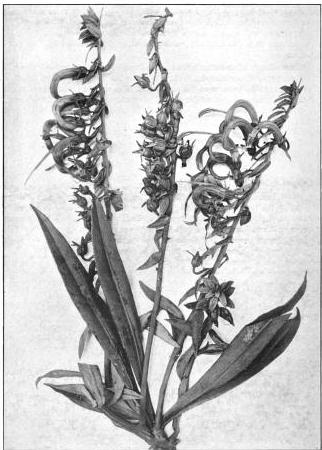 |
| Part of the inflorescence of the type of Trematolobelia macrostachys Kauaiensis Rock in herbarium, College of Hawaii. |
page 145
Trematolobelia macrostachys Zahlbruck. in Coll. Hawaii Publ. Bull. no. 2:45, pl. XI, XII. 1913. Trematocarpus macrostachys Zahlbrk. in Annal. Mus. Vindob. VI. 3-4, 432. 1891 Lobelia macrostachys Hook. et Arn. Bot. Beech. Voy. 88. 1832. Delissea (?) macrostachys Presl. Prodr. Monogr. Lobel. 47. 1836. (Plates 21, 70, 71.)
Plant 1.5-4 m high, the woody stem erect 2.5-3.5 cm thick, dividing at the apex (only when flowering) candelabra-like into five to sixteen or more horizontal branches (the young branches densely pubescent) each 4 dm or rarely 1 m long and terminating in a many flowered raceme, the leaves rather abruptly falling off to bracts; leaves glabrous, membranous, lanceolate 25-30 cm long, 2-2.5 cm wide, acuminate, gradually narrowing into a margined petiole, faintly crenate in its upper portion, with a small gland under each crenature; racemes about 3 dm or more long, the pedicels horizontal, 2.5-3 cm long, bibracteolate in the lower third, the bracts as long as the pedicels and longer, usually 3.5 cm, 2 mm wide; calyx glabrous, its tube globose, about 6 mm, the lobes lanceolate, of nearly the same length; corolla glabrous, pale rose or pink, slender, 5-6 cm long, about 5 mm wide, suberect before expansion, more or less arcuate when open, the two upper lobes spreading, the lower lip shortly trifid; staminal column glabrous, excepting a small hairy patch at the base of each anther; only the two lower penicillate; stigmatic hairs in a ringlet; capsule coriaceous-ligneous, subglobose 8x22 mm, with prominent lines and a broad umbonate indehiscent vertex, the walls of the capsule pierced by numerous holes of various size, larger towards the base, the periphery of the holes with a thickened ring; seeds minute, ovoid.
OAHU: Lay et Collie, type in Herbarium Kew; — U. S. Explor. Exped. in Gray Herbarium; — Gaudichaud no. 150 (flower buds only) in Herbarium Mus. Paris; — Remy no. 297 in Herbarium Mus. Paris; — Mann and Brigham no. 643 in herbarium Cornell Univers. and Gray Herbarium; — On high ridges at elevations of 2000-3000 feet, on both ranges, Hillebrand in Herbarium Berolinense and flowering and fruiting July 1865, Hillebrand no. 71 in Gray Herbarium; — Punaluu Mountains, fruiting December 24-29, 1908, Rock no. 468 in herbarium College of Hawaii;— ridge leading to Hauula from main range, fruiting December 23, 1908, Rock no. 471 in herbarium College of Hawaii; — Konahuanui, on ridge, fruiting (young) January 8, 1910, Rock no. 6083 in herbarium College of Hawaii; — Konahuanui ridge, flowering May 1912, P. Ceresole no. 12841 in herbarium College of Hawaii.
MOLOKAI: U. S. Explor. Exped.; — Hillebrand; — Waikolu ridge and open flat swamps above Waikolu, flowerbuds, April 1910, Rock no. 8819 in herbarium College of Hawaii; — Pukoo, flowering Ocober 8, 1916, A. S. Hitchcock no. 15068 in U. S. National Herbarium.
MAUI: West Maui, Puukukui, September 24-26, 1916, A. S. Hitchcock no. 14187 in U. S. National Herbarium; — East Maui, Olinda-Waikamoi pipe line trail, Waikamoi gulch, observed only, Rock, Sept. 1910, March 1911.
LANAI: Upper parts of mountains, September 21, 1916, A. S. Hitchcock no. 14684 in U. S. National Herbar.
HAWAII: U. S. Exploring Exped., one single leaf in Gray Herbarium; — Hillebrand; — forests of Naalehu, Kau south slopes of Mauna Loa, fruiting January 1913, Rock no. 10360 in Herbarium College of Hawaii; — Volcano of Kilauea, fern forest open places, flowerbuds, May 1911, observed only (Rock) and along automobile road to Kilauea crater proper, fruiting August 1917, Rock in Herbarium College of Hawaii.
page 146
| PLATE 73. |
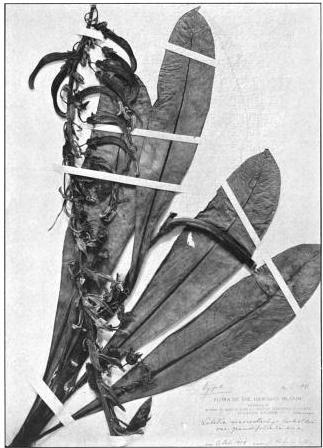 |
| Type of Trematolobelia macrostachys grandifolia Rock in herbarium, College of Hawaii. |
page 147
An exceedingly handsome species when in full bloom; the flowers are usually pink. The species is a monocarp, as well as some of our true Lobelias. Prof. A. S. Hitchcock collected it for the first time on the island of Lanai. It is not uncommon in the mountains of Oahu, especially on the upper slopes of the ranges back of Honolulu.
The flowering habit of this species is quite different from that of the Hawaiian true Lobelias; the flowering spikes number usually nine and are arranged horizontally like the spokes of a wheel; in this is resembles Lobelia rosea from India, which has a similar inflorescence. As the spikes reach maturity the cluster of leaves at the apex of the stem drops off and when fully mature the spikes alone remain without any leaves at all.
Trematolobelia macrostachys Kauaiensis Rock in Coll. Hawaii Publ. Bull. no. 2:46. 1913 Lobelia macrostachys Kauaiensis Rock in Indig Trees Hawaii. Isl. 77. 1913. nom. nud. (Plate 72.)
Plant 1.5 m high, stems black, leaves linear-lanceolate to oblong, acuminate at both ends dark green, glossy above, paler beneath, with red veins, midrib and callous glands, 16 cm long, 3 cm wide; racemes fewer than in the species, not all horizontally arranged, one or two always considerably below the others, shorter, 24-34 cm long, flowers strongly arched, returning to the level of the base and beyond, in the bud and when mature, scarlet to deep purplish red, smaller, otherwise as in the species.
KAUAI: Pohakupili, Wawra no. 2190 in herbarium Vienna; — summit of Mt. Waialeale in open bog, elevation 5200 feet, flowering October 20, 1911, Rock no. 8877 type in herbarium College of Hawaii; — same locality, flowering and fruiting October 20, 1912, Rock no. 8031 in the herbarium of the College of Hawaii; — Kaluiti and Kailiili streams of Waialeale, flowering October 1916, Rock no. 12843 in herbarium College of Hawaii; — Waialeale, near summit, flowering October 1916, A. S. Hitchock no. 15496 in U. S. National Herbarium.
This variety is quite smaller than the species and differs from it in the strongly arched scarlet-purple smaller corollas, the fewer racemes, short leaves with red venation, and black stems. The branching of the inflorescence is somewhat different from that of the species; the branches are fewer, semi-erect, and widely separated.
Wawra's specimen no. 2190 served Dr. Zahlbruckner as the type of his Trematocarpus = Trematolobelia and not the species from Oahu or the other islands; the species does not occur on Kauai. It is associated with Lobelia Kauaensis, Tetraplasandra Waialealae, Geranium humile Kauaense, Dubauti Waialealae, Pelea Waialealae, Gunnera, Suttonia lanceolata, etc.
Trematolobelia macrostachys grandifolia Rock in Coll. Hawaii Publ. Bull. no. 2:46. 1913 (Plate 73.)
Plant erect, branching as in the species; stem dark reddish, leaves large, obovate-oblong, subentire or faintly crenulate with callous glands, pale green, midrib dark, blackish, acute or obtuse at the apex, gradually narrowing at the base into broad, margined petioles of 2-5 cm in length, 26-30 cm long, 5-7 cm broad; racemes longer than in the species, robust 50-60 cm long, bracts broad, foliaceous, calyx twice as large as in the species, corolla not of even width, somewhat sigmoid, pure white, broader and longer than in the species.
page 148
HAWAII: Mountains of Kohala along the edge of Kawainui gorge, elevation 4400 feet, flowering October 1909, R. S. Hosmer type no. 6090 in the herbarium of the College of Hawaii.
This variety differs from the species in the large, obovate-oblong leaves, the long stout racemes and large white flowers; the plant is quite robust in comparison to the other variety and the species proper.
In the Gray Herbarium is a single broad leaf collected by the U. S. Exploring Expedition on Hawaii. It is mounted with a narrow-leafed young flowering specimen collected on Oahu. The single leaf may be referrable to the writer's var. grandifolia, but it differs in the subsessile base.
On the same sheet are fragments belonging to Trematolobelia macrostachys, collected by Gaudichaud during the visit of the Bonité
page 149
BRIGHAMIA A. Gray
page 150
| PLATE 74. |
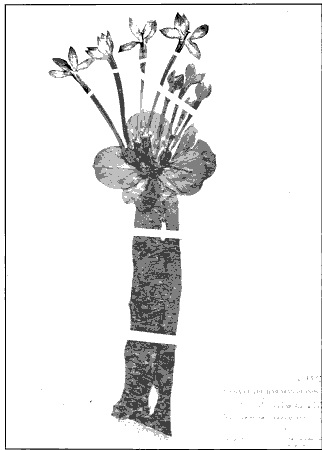 |
| Flowering specimen of Brighamia insignis A. Gray in the herbarium, College of Hawaii. |
page 151
BRIGHAMIA A. Gray
Calyx tube oblong-cylindrical, ten-ribbed, with short lobes; corolla salver-shaped, tube long, straight, entire, the lobes spreading, valvate in the bud, the tips and margins inflected, nearly equal, two separated by deeper slits; staminal column adnate to the corolla below the middle, highest at the back; all anthers subenclosed, and bearded at the apex; ovary bilocular, with peltate placentas; stigma shortly two-lobed, the rounded flat lobes faintly pubescent externally; capsule at first fleshy, later opening by two slits on each side; seeds ovoid, numerous, testa thin, smooth and pale; embryo straight, shorter than oleose albumen. — A perennial plant with a thick fleshy simple stem conically enlarging at the base and densely foliose at the apex; leaves entire; flowers white or yellow on erect axillary racemes, with small deciduous bracts and straight pedicels.
The genus Brighamia was dedicated to Dr. W. T. Brigham, Director of the B. P. Bishop Museum of Honolulu, by Dr. A. Gray. It consists of a single species and a recently described form. It is related to the Australian genus Isotoma, which has a representative in the Society Islands.
Our Brighamia as has been discussed in the introduction to this monograph is undoubtedly of Australian origin. The question whether it is a declining species, and represents the last remnant of an ancient genus, or an accidental immigrant from Australia, with its peculiar characters devloped here, is a difficult one to settle, though the latter assumption seems to the writer the more plausible
Halophytes usually develop fleshy stems and flesy leaves, and Brighamia can well be classed with halophytic plants, as it is always found in more or less close proximity to the sea. It even occurs within the spray of the breakers, a little above the high surf on the windward side of Molokai, on steep cliffs where it must occasionally get drenched with sea-water on stormy days. It does, however, grow on steep rocky cliffs in the valleys of Molokai and Lanai, quite a distance from the sea.
Brighamia insignis A. Gray in Mann Enum. Hawaii. Plants, in Proceed. Am. Acad. VII:185. 1868. (Plates 22, 23, 74.)
Stem simple 1.5-5 m high, naked and smooth, fleshy throughout, thickest at the base, leaf-scars mostly obliterated at the base; leaves simple, obovate more or less cup-shaped, contacting at the base, subsessile, thick fleshy, glossy, subentire to sinuate crenate, light green, 20-30 cm long, 12-15 cm wide; peduncle stout, fleshy 1.5-12.5 cm long, naked below, bearing five to fifteen flowers in its upper half on naked pedicels 5-25 mm long; bracts small dentiform; calyx tube 12-14 mm long, the lobes triangular or lanceolate, 2-8 mm long; corolla white to cream-colored; corolla tube 7.5-12.5 cm long, the lobes ovate acuminate, contracting at the base, sometimes subbilabiate, the two anterior lobes separated from each other and from the lateral ones by sinuses forming narrow claws of nearly the length of the lobe; staminal column glabrous, almost white, the anthers scarcely projecting beyond the cleft of the corolla, all bearded; fruit capsule, ovoid to cylindrical 16-18 mm long crowned with the calycine lobes.
KAUAI or NIIHAU: Remy no. 309 ter. in Herbarium Mus. Paris.
MOLOKAI: Steep rocky cliffs near Halawa, W. T. Brigham; — on steep palis of the northern coast, Kalaupapa to Halawa, Hillebrand in herbarium Berolinense; — steep slopes of Halawa valley, April 1910, Rock no. 8817 in herbarium College of Hawaii; — Kalaupapa-Kalawao-Waikolu, April 1910, Rock
page 152
no. 8817-a in herbar. Coll. Hawaii; — Kalaupapa pali, flowering August 1911, N. B. Nevin no. 8817-b in herbar. College of Hawaii; — Halawa, June 1910, U. Faurie no. 74 in herb. Léveillé (La Mans, France) and in herb. Coll. Hawaii.
LANAI: At the head of Maunalei Valley on steep rocky cliffs, July 1910 Rock, observed only.
The plant had not been previously recorded from Lanai; it grew on the vertical walls of Maunalei gorge and could not be collected.
The natives call this species Alulu on Kauai, and Puaala on Molokai; the plants has been compared by Hillebrand and that aptly to a cabbaged-head stuck on a naked pole. The flowers are sweet-scented with an odor like that of violets. The natives of Wailau Valley on the windward side of Molokai cultivate this species in their front yards within the spray of the sea.
The writer brought about ten large individuals of this species to Honolullu, for the purpose of growing them; they all died, however, after a short time.
The juice of the stem is watery and not glutinous and milky as in the other Hawaiian Lobelioideae.
Brighamia insignis forma citrina Forbes & Lydgate in Occas. Pap. B. P. Bish. Mus. Vol. VI, no. 4:11 anot. 1917.
Leaves as in the species; calyx teeth shorter, corolla lemon yellow, brighter yellow on the inner side of the expanded lobes, the latter acute.
KAUAI: Haupu range near Nawiliwili Bay, flowering, October 31, 1916. Forbes no. 706-k in herbarium Bishop Museum, Honolulu.
Whether the plants from Kalalau, Kauai, are referable to this form or belong to the species proper cannot be determined in absence of specimens from Kalalau, where the plant has apparently been only observed by J. M. Lydgate and Forbes.
page 153
CYANEA Gaudichaud
SYNONYMY.
Cyanea Gaudichaud Bot. Voy. Uranie 457. 1826. Macrochilus Presl Prodr. Monogr. Lobel. 47. 1836. Kittelia Reichenb. Handb. 186. 1837. Delissea (sect. Cyanea) Baill. Hist. del Pl. VIII:364; 1886. Post et Kuntze Lex. Gen. Phan. 166, n. 273; 1904. Uphof, Die Pflzengatt. 24 n. 17; 1910.
page 154
| PLATE 75. |
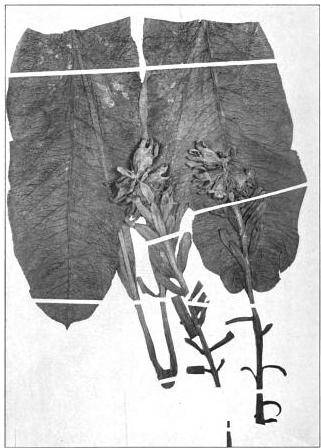 |
| CYANEA SUPERBA (Cham.) A. GraySpecimen in Herbarium Berolinense, ex coll. Hillebrand. |
page 155
| PLATE 76. |
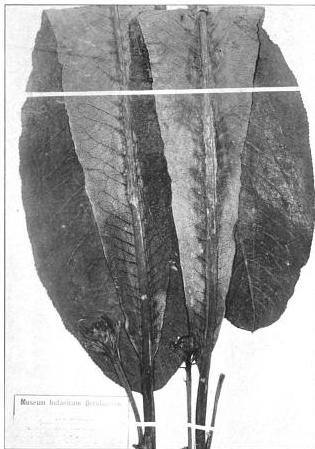 |
| CYANEA SUPERBA VELUTINA RockType in Herbarium Berlin, ex coll. Hillebrand. |
page 156
| PLATE 77. |
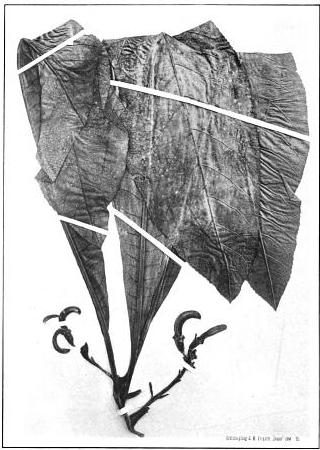 |
| CYANEA REGINA (Hillebr.) RockType in Herbarium Vienna, ex coll. Wawra, ex herb. Hillebrand. |
page 157
CYANEA Gaudichaud
Calyx-tube adnate, globose to cylindrical, the lobes of variable length, short tooth-like to several times the length of the tube, often foliaceous, valvate rarely connate, often separated by broad sinuses, persistent; corolla tubular, more or less curved, occasionally arched, 5-cleft, sub-bilabiate, the dorsal slit extending beyond the middle; staminal column free from the corolla, the two lower anthers, rarely all tufted or bearded with whitish hair at the apex; stigma 2-lobed, hairy at the back or base of the short fleshy lobes; berry 2-celled, orange yellow to purplish red, or dark purple, globose to ovoid, with fleshy placentas; seeds small, ovoid, with a crustaceous smooth, shining brown testa; milky shrubs or small trees with only a few subherbaceous species, including a medullary cavity, armed or unarmed; leaves entire or sinuately lobed or pinnate; flowers in axillary racemes, of various sizes, whitish-green, with purplish tinge, to white and bluish, and blue to dark purplish-red, to almost black. The pedicels bibracteolate about the middle. An endemic Hawaiian genus with 52 species and 25 varieties, for convenience's sake divided into five sections as follows:
Cyanea
| I. | Palmaeformes. | II. | Delisseoideae. | III. | Hirtellae. | IV. | Genuinae. | V. | Pilosae. |
SECT. I. PALMAEFORMES Hillebr.
Cyanea superba (Cham.) A. Gray in Proc. Am. Acad. V:149. 1862. Lobelia superba Chamisso in Linnaea VIII:223 1833. Macrochilus superbus Presl Prodr. Monogr. Loel. 47. 1836. (Plate 75.)
Trunk smooth 4-5.5 m high and 7.5-12.5 cm thick at the base, with a thin woody zone, the large medullary cavity septate by closely set chartaceous diaphragms; leaves obovate-oblong, 6-10 dm long, 15-20 cm wide, obtuse or rounded, but shortly acuminate, narrowing at the base, on distinct petioles of 5-7.5 cm crenate, but almost entire below, coriaceous, glabrate; peduncle (with ripe fruit) 30-35 cm long, tomentose, drooping, with the numerous subsessile berries crowded in a cluster near the apex, for the rest distantly bracteate, the bracts tomentose, broad-oblong or lanceolate, obtuse, 24-40 mm long, besides two bracteoles of 12 mm in length at the base of each flower; calyx velvety tomentose, the tube obconical, 10-14 mm, the oblong coriaceous lobes 10-16 mm long; corolla arcuate, tubular, with short connivent lobes and a long dorsal slit, 3.75 cm long, coriaceous, whitish or cream-colored; staminal column glabrous; berry obconical, 16-20 mm long, 12-16 mm wide, yellow or orange, ribbed, crowned by the calycine lobes which are separated by conspicuous sinuses; seeds rather large, 2 mm, dark brown, smooth and shining.
OAHU: Gulches of Mt. Kaala, Makaleha, Hillebrand in Herbarium Berlin.
The writer is not familiar with this species, as he has not seen it growing in the field; he has, however, examined Hillebrand's material in the Berlin Herbarium.
Cyanea superba velutina Rock. Cyanea superba β var. Hillebr. Flora Haw. Isl. 261. 1888/. (Plate 76.)
Plant as in the species; leaves larger on stouter petioles, and with a brownish tomentum underneath.
page 158
| PLATE 78. |
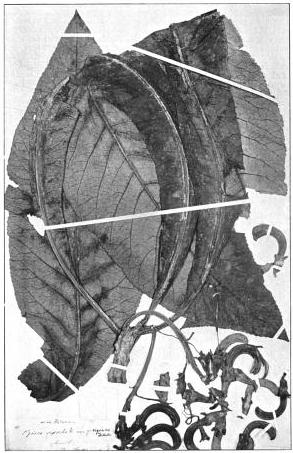 |
| CYANEA REGINA (Hillebr.) RockSpecimen ex coll. Hillebr. in Herbarium Berolinense. |
page 159
OAHU: Gulches on the eastern slope of Mt. Kaala, Hillebrand March 1870, type in Herbarium Berlin.
Hillebrand's specimen has young flowerbuds only.
Cyanea regina (Hillebr.) Rock Delissea regina Wawra in Flora od. Allgem. Bot. Zeit. XXX:9.1873. Cyanea superba γ var. reginae Hillebr. Flora Haw. Isl. 261. 1888. (Plates 77, 78.)
Leaves chartaceous, tomentulose underneath when young, but glabrate with age, 50-75 cm long, 10-17.5 cm broad, commonly acuminate but sometimes rounded, the base gradually narrowing into a petiole of 5-7.5 cm; peduncle about 20 cm long, drooping, naked below, distantly bracteate above, bearing near the apex 5-10 flowers on short resupinate pedicels of 6 mm, bracts 12-36 mm; bractlets 4-6 mm; calyx velvety-tomentose, bluish, as are also the upper bracts, the tube 16 mm, the oblong obtuse lobes 6-10 mm, separated by intervals; corolla coriaceous, velvety-tomentose, cream-colored, with purplish nerves (not "rosea"), arcuate, the apex returning to the level of the base, 5.75-7.5 cm in length and of even width 9 mm throughout, the lobes short connivent, the dorsal slit extending to the middle; staminal column glabrous; anthers white, with purplish stripes, the upper ones beardless; stigmatic hairs in two patches; berry obconical, ribbed, 16-20 mm long, 10-12 mm wide.
OAHU: Niu and Wailupe Valley, elevation 1500-2000 feet, Hillebrand jun. and Lydgate in Herbarium Berlin; — Wawra, ex Herbarium Hillebrand, no. 2239 (not Kaala, Oahu) in Herbarium Vienna.
According to Hillebrand and Wawra a truly superb and royal plant. The writer has not met with this species; the lower slopes of Niu and Wailupe, the region where this plant once flourished, is now grazing land, and otherwise more or less barren. The writer fears that this magnificent plant has, like other Hawaiian Lobelioideae of the lower elevations, succumbed to the ravages of cattle.
Cyanea regina differs from Cyanea superba in acute or acuminate leaves, the much shorter peduncles, which are somewhat longer than the petiole, and the shorter linear-spathulate bracts.
Cyanea Giffardii Rock in Torrey Bot. Cl. Bull. 45:133, pl. 6, 1918. (Plates 38, 79, 80.)
A tree 5-10 m tall with a single trunk 15 cm in diameter near the base, gradually tapering towards the apex, bark smooth graying green, with scattered leaf-scars, woody zone thin near the apex of the trunk, the medullary cavity septate by chartaceous diaphragms; leaves obovate-oblong, about 50 cm long and 12-15 cm wide, broadest portion in the upper third, margins strongly undulate and minutely denticulate, appearing sinuate, due to strong undulation, subentire with exception of the base, which is unevenly lobed, acuminate at the apex, mucronate, gradually tapering at the base into a stout petiole 3.5-6.5 cm long, thin, subchartaceous, dark green and shining above, pale and dull underneath, midrib stout and prominent as are the lateral veins, the latter arcuate and united with other arcuate veins near the margin, the whole surface of the leaf covered with a pellucid reticulate network, glabrous above, pubescent underneath especially on the midrib and veins; peduncles axillary, drooping, stout, terete, glabrous, 10-16 cm long or slightly longer, about 1 cm thick, distantly bracteate the entire length, the upper bracts linear, 15-30 mm long, 3-5 mm wide, rounded and mucronate at the apex, bracts less distant towards the apex and also smaller; flowers on pedicels 2-3 mm long with three small, acute bractlets at the base and dorsal side of the flowers; calyx glabrous, dark purplish black, tube obconical, usually seven-ribbed, with two tubercles at the base, 18 mm long, 15 mm wide; calycine lobes broadly triangular, acute 5 mm each way, with broad sinuses
page 160
| PLATE 79. |
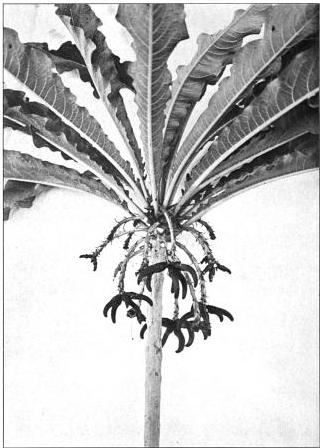 |
| CYANEA GIFFARDII RockFlowering specimen from the forests above Glenwood, Hawaii. The plant was 30 feet in height. |
page 161
| PLATE 80. |
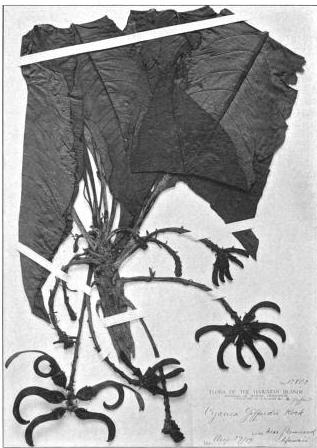 |
| CYANEA GIFFARDII RockType no 12802-b in the herbarium of the College of Hawaii. |
page 162
intervening, corolla strongly arcuate, 7-8 cm long, glossy, glabrous, dark purplish outside, slit at the back, only when fully mature, three fourths its length, the five lobes of the corolla entirely connate; staminal column protruding, perfectly glabrous, pale, anthers glacous, glabrous, the two lower only penicillate; style black, the stigmatic hair encircling the stigma, the latter yellowish tinged with purple; flowers usually ten on a peduncle, crowded at the apex; fruits globose nearly 25 mm each way, dark purplish black, locules small, each containing from six to twelve rather large whitish seeds; milky juice of the plant yellowish.
HAWAII: In the forest on the windward slope of Kilauea-Mauna Loa, near Glenwood at 22 miles, along the homestead road, elevation 2000 feet, flower buds, August 27, 1917. W. Giffard no. 12802 in the herbarium of the College of Hawaii; — along the Volcano Road at 23 miles in wet forests, flowering and fruiting (specimens) September 1st, 1917, Rock and Holm type no. 12802-b in the herbarium of the College of Hawaii.
This very remarkable plant, which is closely related to Cyanea superba (Cham.) Gray, differs from it in the pubescent, deeply undulate leaves, which are lobed at the base instead of being entire; in the glabrous, much shorter peduncle, and in the glabrous deep purplish black flowers and fruits. Cyanea superba occurs on the island of Oahu in the gulches of Makaleha and Mt. Kaala, while Cyanea Giffardii occurs on the southernmost island of the group. It is also much statelier than Cyanea superba, as it reaches a height of thirty feet, with a single crown of leaves at the apex. It grows in company with Antidesma platyphyllum Mann, Labordia, Cyrtandra, Straussia hawaiiensis Gray, Strongylodon lucidum Seem., Clermontia parviflora Gaud., Cibotium Menziesii Hook. and C. Chamissoi Kaulf. the last two being the common tree ferns of the region.
When the species was first discovered by Mr. W. M. Giffard, in whose honor it is named, only two plants were observed, one with large flower buds and the other without flowers, the latter plant divided into three branches at the apex on account of an injury.
Mature ones (type specimen) with flowers and fruits were collected on the road to the Volcano of Kilauea — Glenwood — at an elevation of 2400 feet. The largest plant seen was thirty feet in height.
The plants are difficult to see in the forest, as the trunk, which is usually covered partly with moss, does not branch and the crown of leaves is hidden amongst the foliage of other trees.
Cyanea Giffardii may be Hillebrand's var. β of his Cyanea arborea (Mann) Hillebr., from the woods of Hilo, Hawaii. The writer is well acquainted with Cyanea arborea and can only state that the new species is quite different from the latter and that it comes much closer to Cyanea superba. Cyanea arborea has a much larger and denser crown of leaves, which are sessile and linear-oblong; the peduncles are much longer and the flowers are very thin, narrow and slender, suberect and whitish to gray.
page 163
| PLATE 81. |
 |
| CYANEA LEPTOSTEGIA A. GraySpecimen in Herbarium Berolinense, ex coll. Hillebr.. |
page 164
| PLATE 82. |
 |
| CYANEA LEPTOSTEGIA A. GrayLeaves of young plant.Specimen in the College of Hawaii herbarium, Rock no. 9016. |
page 165
Cyanea leptostegia A. Gray Proc. Am. Acad. V: 149. 1862. Delissea Delessertiana var. pinnatiloba A. Gray Proc. Am. Acad. V:147. 1862. Delissea coriacea Gray var.? pinnatiloba A. Gray Bot. U. S. Exp. Exped. ined. (Plates 10, 28, 29, 31, 32, 81, 82.)
Trunk smooth 10-14 m high, densely covered in its upper portion with rhomboidal leaf-scars; leaves of young plants sinuately lobed in the lower half, deeply lobed in the upper, narrow lanceolate, sessile, with undulate margins in mature plants, 75-100 cm long, 6.5-8.5 cm wide; denticulate or subentire, glabrous on both surfaces, shining above, chartaceous, the prominent midrib hollow; peduncle 4-6 cm, slender, naked below, many flowered at the apex, 12-25 flowers in a crowded cluster, on pedicels of 1-1.5 cm; bracts linear, 24 mm; bractlet 12 mm; calyx glabrous, the tube cylindrical, somewhat produced beyond the ovary, 15-18 mm, the filiform-linear erect lobes 5-5.5 cm long, 1 mm or less broad; corolla reddish to dark purple, glabrous, semi-erect and slender, 5 cm long, 3 mm wide, thin, with a long dorsal slit; staminal column and anthers glabrous; berry ovoid, 20-35 mm long, 8-12 mm wide, crowned by the long calycine lobes.
KAUAI: Upper edge of the forest near the tabular summit of Kauai, U. S. Expl. Exped. in Gray Herbarium; — Mann and Brigham no. 575; — Wälder von Halemanu, Wawra no. 2116 in Herbarium Vienna; — Waimea leg. Knudsen in Herbarium Hillebrand, Herbarium Berlin; — type locality, September 9, Heller no. 2793; — forests of Halemanu and Kaholuamano flowering and fruiting, September, Rock no. 5818 in herbarium College of Hawaii and Gray Herbarium; — same locality fruiting October 24, 1911, Rock no. 10256 and 9016 (the latter young leaves) in the herbarium of the College of Hawaii; — Kaholuamano, A. S. Hitchcock, October 20, 1916, no. 15359 in U. S. National Herbarium.
One of the most remarkable of Cyaneas. It is the only species that reaches a height of forty feet. The writer observed a specimen at Opaiwela, near Kaholuamano, of fully that height. The young plants, like a good many of the species of the section palmaeformes, have deeply lobed leaves. Asa Gray's Delissea coriacea var. pinnatiloba, which the writer examined, is none other than a young plant of C. leptostegia. The species is more or less peculiar to the outskirts of the forest and is not found in the interior of the island. It grows in company with Antidesma platyphyllum var., Xylosma hawaiiense, Maba sandwicensis var., Rockia sandwicensis, Cyanea spathulata and Cyanea hirtella. Numerous species of caterpillars (probably Heterocrossa) feed on the fruits and withered flowers. The native name of the species is Hahalua. The milky sap is of a canary yellow.
Cyanea arborea (H. Mann) Hillebr. Flora Haw. Isl. 261. 1888. Delissea arborea H. Mann Proc. Am. Acad. VII:180, no. 263. 1868. Delissea coriacea Gray var. β Gray in Proc. Am. Acad. V:148. 1862. Cyanea longifolia Heller in Minnes. Bot. Stud. IX:909. 1897. (Plates 12, 37, 83, 84.)
Trunk 4-8 m high, smooth, leaves sessile, oblanceolate, 66-88 cm long, 6-12 cm wide, shortly acuminate, apiculate, gradually narrowing toward the base, faintly dentate, subentire and wavy towards the base, glabrous and shining above, slightly pubescent underneath, especially along the very prominent midrib, chartaceous to coriaceous, midrib impressed above, reddish; peduncle slender, but stiff, 15-32 cm long, almost naked below, closely many-flowered in the upper fourth; the pedicels short, 4-8 mm; bracts 3-5 mm, bractlets 1 mm; calyx subglobose, glabrous, shortly toothed, the tube 1 cm, the calycine teeth 1 mm; corolla slender moderately curved or suberect 4-5 cm long, 4 mm wide, glabrous, cream-colored to bluish gray, rather thin with a deep dorsal slit and connivent lobes; staminal column glabrous, anthers glabrous, the two lower bearded: stigmatic lobes tufted with whitish hair underneath; berry globose, faintly ribbed, 10-12 mm in diameter.
page 166
| PLATE 83. |
 |
| CYANEA ARBOREA (Mann) Hillebr.Specimen in Herbarium Berolinense ex coll. Hillebrand. |
page 167
| PLATE 84. |
 |
| CYANEA ARBOREA (Mann) Hillebr.Portion of crown of leaves with inflorescence; less than one-third natural size.From J. F. Rock "The Indigenous Trees of the Hawaiian Islands." |
page 168
MAUI: Ulupalakua, Mann & Brigham no. 461; — crater of East Maui, U. S. Explor. Exp. in Gray Herbarium; — Ulupalakua, South Haleakala, Hillebrand in Herbarium Berlin and herbarium Bishop Museum, Honolulu, Gray Herbarium; — above Kula, southern slopes of Haleakala, elevation 5000 feet, flowering March 1913, Rock no. 10354 in the herbarium of the College of Hawaii, Gray Herbarium, New York Botanical Museum, herbar. Calif. Ac. of Sc.
This is one of the handsomest species of Cyanea; it is of palm-like habit and reaches a height of 24 feet (8m). Unfortunately it is exceedingly scarce and the writer fears that it has become extinct. Where there was once a forest at Ulupalakua there is now only grass land with planted Eucalypti. The writer met with but a single plant in a very narrow ravine which was inaccessible to cattle.
Horace Mann's description of the inflorescence is wrong; the peduncles are long and many-flowered and not "pedunculis axillaribus brevibus paucifloris."
The trunk is simple erect or (as in the case of the writer's specimen) branching near the base.
In the Gray Herbarium is a drawing of a Cyanea from Makawao, Maui, marked Delissia arborea? in Asa Gray's handwriting. It was drawn from a specimen collected by F. L. Clarke in 1877, and bears the following legend: "From 20-40 feet in height. Leaf entire-sessile, veins anastomozing, coriaceous, slightly downy on the upper surface; veins distinct." The specimen itself is missing; only a section of the stem is preserved in an envelope.
The plant, as can be judged from the drawing, is not closely related to C. arborea, still less identical with it. It would come closer to Cyanea Giffardii, which has the flowers arranged in a similar way at the apex of the peduncle. It is probably intermediate between C. superba and C. Giffardii. Hillebrand's var. β of Cyanea arborea from the woods of Hilo, is not to be found in Hillebrand's Herbarium; judging from the short description it is probably identical with the writer's C. Giffardii, but besides the arborescent stature it is very different from C. arborea and could not be classed as a variety of the latter.
Cyanea arborea picnocarpa Hillebr. Flora Hawaii. Isl. 261. 1888.
Leaves smaller, membranous, running out into a distinct petiole of 3.75 cm, pubescent underneath; peduncle slender naked,7.5-10 cm long, bearing at its end a cluster of sessile subglobose, truncate berries 12 mm in diameter, the acute triangular calyx-lobes 4 mm.
HAWAII: Kohala range, Hillebrand.
This variety has never been re-collected, nor is there a specimen to be found in Hillebrand's collection in the Berlin herbarium.
Cyanea solenocalyx Hillebr. Flora Hawaii. Isl. 258. 1888. (Plates 85, 86.)
A stout and tall shrub, 2-4 m high, the stem hollow, the thick and stiff branches muricate below, aculeate above with pale yellow conical spines; leaves dimorphous, those of the young plant broadly ovate or cordate, shortly lobed,
page 169
| PLATE 85. |
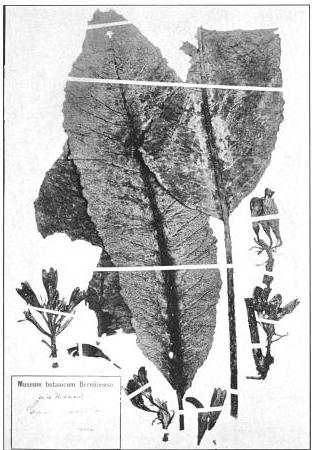 |
| CYANEA SOLENOCALYX Hillebr.Type in the Herbarium Berolinense, ex coll. Hillebr. |
page 170
| PLATE 86. |
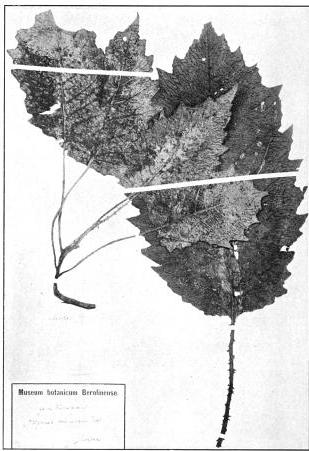 |
| CYANEA SOLENOCALYX Hillebr.(Young plant.)Specimen in the Herbarium Berolinense, ex coll. Hillebr. |
page 171
prickly on both faces; those of the adult plant obovate-oblong, 37.5-60 cm long, 12.5-22.5 cm wide, on fleshy muricate petioles of 12.5-25 cm; shortly acuminate or obtuse at either end, sinuate or entire, thin chartaceous, coarsely hispidulous underneath, the rib muricate; raceme fleshy 3.75-5 cm bracteate from near the base, the pedicels 12-24 mm, the bracts linear-lanceolate, 18-35 mm; the bractlets l8-12 mm, calyx scabrous and hirsute or hispid, but almost glabrous with age, the adnate portion 12 mm, the broad foliaceous several nerved lobes 20-24 mm long and connate enirely or in part in a broad cylindrical or funnel-shaped sheath; corolla semierect but ampliate, 30-40 mm long, 8-10 mm wide, slit beyond the middle, scabro-hispid, dark purple; staminal column glabrous, anthers purple, the upper ones beardless; berry ovoid 16 mm, seeds pale yellow.
MOLOKAI: In deep gulches of Kalae, Mapulehu and elsewhere, Hillebrand type in Herbarium Berlin; — Molokai, no. 2 leg. Lydgate, J. F., young plant with lobed leaf; — forests of Mapulehu, flowering April 1910, Rock no. 6112 in herbarium College of Hawaii; — ridge leading to Pelekunu, fruiting April 1910, Rock no. 8813 in herbarium College of Hawaii; — Mapulehu, May 6, 1915, Rock no. 12521 in herbarium College of Hawaii; — Pukoo, October 8, 1916, A. S. Hitchcock no. 15009 in U. S. National Herbarium, and part in College of Hawaii Herbarium.
According to Hillebrand the native name of this species is Puakala. The species is very distinct, but does not branch and should therefore come under section palmaeformes; the mere fact that the stem is armed and the petioles and peduncles muricate is no reason to include it with C. scabra and the other species belonging to that section. The writer's C. aculeatiflora is decidedly armed, but not branching, and has the outward appearance of C. tritomantha, which Hillebrand includes in section palmaeformes. Hillebrand's variety schizocalyx evidently does not belong here; there is no specimen in Hillebrand's collection of this variety. It may, however, be related to the writer's C. aculeatiflora from the same region (Hamakua, E. Maui), where Lydgate collected the material of that variety.
Cyanea solenocalyx glabrata Rock var. nov.
Habit as in the species, stem smooth, spineless, as are the leaves, petioles slightly muricate only; leaves oblong, glabrous above, hispidulous underneath; peduncle thick fleshy, muricate, about 3 cm long, bracteate at the apex, the bracts linear-lanceolate hispid, calyx green, glabrous, ovarian portion turbinate 12 mm high, the funnel-shaped connate calycine lobes 2 cm long, and irregularly slit at the apex, the nerves indistinct, corolla short, fleshy, 4 cm long, 10 mm wide, glabrate, waxy white with purplish streaks, the dorsal slit not quite extending to the middle; staminal column glabrous, anthers purple.
MOLOKAI: Gulch of Waihanau in rainforest along streambed, flowering August 13, 1918, L. M. Dunbar type no. 13118 in herbarium College of Hawaii.
This variety differs from the species in the smooth stem and spineless leaves and glabrate calyx and flowers; the bracts are apparently at the apex of the peduncle instead of extending down to the stem.
The variety was discovered by Mrs. L. M. Dunbar of Molokai, who has shown great interest in this group of plants.
page 172
| PLATE 87. |
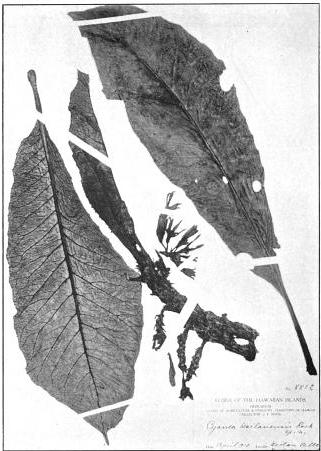 |
| CYANEA WAILAUENSIS RockType no. 8812 in the herbarium of the College of Hawaii. |
page 173
Cyanea Wailauensis Rock Coll. Haw. Publ. Bull. 2:43. 1913. (Plate 87.)
The plant erect, 1.5 m high, not branching, stem fleshy, but woody at the base, unarmed and covered in its upper portion with leaf-scars, with a crown of leaves at the apex; leaves chartaceous when dry, somewhat fleshy when fresh, pale green, dull and glabrous above, with prominent veins and impressed midrib, obovate-oblong, cuspidate to acute at the apex, gradually narrowing at the base, somewhat wavy and eroso-dentate at the margin, puberulous underneath, 30-40 cm long, 10-18 cm wide on petioles of 4-8 cm, young leaves hispid; racemes arranged along the upper portion of the stem, somewhat similar to Cyanea acuminata, peduncle thick about 4 cm long, densely studded almost from the base with large close knobby scars of a pale color, 6-8 flowered at the apex, peduncle hirsute as are the linear bracts; pedicels 1 cm long, hispid; calyx hispidulous to hirsute, the ovarian portion 10 mm, the linear oblong lobes 15-18 mm, free to the base; corolla of a dirty white, the tube 22-25 mm, hirsute as are the unequal lobes, the dorsal slit extending 2/5 its length; staminal column dark purple, glabrous, the lower anthers bearded, stigma surrounded at its base by a tuft of small, white hairs; fruit unkonwn; but calyx-lobes persistent with fruit as is evidenced from very young fruits.
MOLOKAI: Valley of Wailau, elevation 1000 feet, along streambed at the head of the valley in company with Cyanea Grimesiana, flowering April 1910, Rock no. 8812 type in the herbarium of the College of Hawaii and cotype in Gray Herbarium; — Mapulehu, May 1915, Rock in herbarium College of Hawaii; — Pukoo, Mr. Conradt's place, rain forest flowering October 8, 1916, A. S. Hitchcock no. 15008 in U. S. National Herbarium and part in herbarium College of Hawaii; — perhaps also a plant from the same locality, A. S. Hitchcock no. 15073 in U. S. National Herbarium.
This plant differs from Cyanea solenocalyx, to which it is closely related, mainly in the thick peduncle with closely set knobby scars, the very short white flowers which are almost hidden in the calyx. The species is single-stemmed and unarmed.
Hitchcock's specimens have not the knobby peduncles as in the type; perhaps it is only a very variable species and identical with Cyanea solenocalyx.
Cyanea procera Hillebr. Flora Haw. Isl. 262. 1888. (Plate 88.)
Trunk and leaves as in Cyanea arborea, the leaves broader 10-15 cm, closely denticulate, pubescent underneath; peduncle short, thick and fleshy, 2.5-3.75 cm long with many (10-20) flowers near the apex, the pedicles 6-10 mm, bracteolate at the base; bracts 10 mm, bracteoles 4 mm; calycine tube glabrous, cylindrical, 10-14 mm in length, with triangular lobes of 3-4 mm; corolla (undeveloped) glabrous, over 6 mm broad, bluish below, greenish-yellow above, thick fleshy.
MOLOKAI: Kamolo, 2000 feet elevation, Hillebrand; type in Herbarium Berlin, and co-type in the Gray Herbarium.
Nearly related to Cyanea arborea Mann (Hillebr.) In both the trunk has a thick woody zone which includes a narrow cavity septate by numerous papery diaphragms.
To the writer the species is only known from the material in the Berlin Herbarium; co-type in Gray Herbarium, labeled Delissea procera sp. n. Molokai, Kamolo.
page 174
| PLATE 88. |
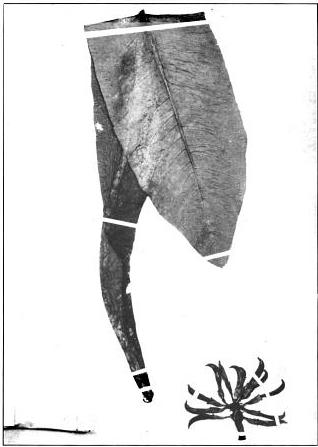 |
| CYANEA PROCERA Hillebr.Type in Herbarium Berolinense, ex coll. Hillebr. |
page 175
| PLATE 89. |
 |
| CYANEA GIBSONII Hillebr.Type in Herbarium Berolinense, ex coll. Hillbr. |
page 176
| PLATE 90. |
 |
| CYANEA ATRA Hillebr.Specimen ex coll. Rock no. 8204 in herbarium College of Hawaii. |
page 177
Cyanea Gibsonii Hillebr. Flora Hawaii. Isl. 263. 1888. (Plate 89.)
Trunk 1-1.60 m high, smooth; leaves broad elliptical or obovate-oblong, acute, generally rounded at the base, wavy, crenate or denticulate, membraneous, pubescent but green underneath, 30-20 cm long, 10-15 cm wide, on petioles of 7.5-12.5 cm; peduncle dark purple, thick fleshy, 2.5-3.75 cm, many flowered, the pedicels 6-20 mm, bracteolate above the base, the bracts narrow linear, 12-18 mm; calyx dark purple, pubescent, the conical tube 12 mm, the lobes 16-20 mm, oblong, somewhat acute, thin, herbaceous, one-nerved; corolla hirsute as in Cyanea atra, dark purple, staminal column glabrous.
LANAI: On the highest wooded ridge, flowering July 1870, Hillebrand, type in Herbarium Berlin; — at the head of Mahana Valley at the bottom of a rock-wall, near the waterfall, and at the summit of Lanaihale, young plants only, July 23, 1910, Rock no. 8051 in the College of Hawaii herbarium.
This species is very closely related to C. atra and may be only a form of the latter. The writer is not acquainted with the mature plants, having only collected and observed two young specimens. The type in the Berlin Herbarium has flower buds only.
Cyanea atra Hillebr. Flora Hawaii. Isl. 263. 1888. (Plate 90.)
Trunk 1.3-2 m high; tuberculate in the upper portion; leaves broadly lanceolate to obovate-oblong, acute at the apex, gradually tapering into a thick muricate petiole of 5-8 cm, crenulate, coriaceous, with prominent nerves 40.5-50.5 cm long, 7.5-14 cm wide, pubescent underneath, papillose above; peduncle short, 1.5-2 cm, thick, 4-10 flowered, the pedicels 1-2.5 cm; bracts 6-15 mm long, 2 mm wide, bractlets at the middle of the pedicel, 3 mm long; calyx dark purplish of the same color as the corolla (hirsute teste Hbd.), pubescent, the cylindrical tube 15 mm, the thick, oblong, obtuse, mucronate, or emarginate lobes one-nerved, of variable length, usually 2 cm; corolla suberect 5-6 cm long, 6-8 mm wide, dark purple almost black, hirsute with reddish brown, coarse hair, the lobes linear; staminal column dark purple, glabrous, the two lower anthers bearded; berry ovoid 2-2.5 cm, orange colored, with grayish tomentum; seeds pale yellow.
MAUI: West Maui, back of Lahaina, Wailuku, 3000-4000 feet, Hillebrand, no specimen extant; — in dense forests along Honokawai gulch, back of Kaanapali, elevation 4000-4300 feet, flowering and fruiting August 24, 1910, Rock no. 8204 in the herbarium College of Hawaii and Gray Herbarium; — Puu Kukui, 4000-5000 feet, fruiting September 24-26, 1916, A. S. Hitchcock no. 14749 and 14847 in U. S. National Herbarium; — Honokahau Valley, flowering September 3, 1918, Rock & Hashimoto no. 13126 in Herbarium Rock.
There is no specimen of this species in Hillebrand's collection in the Berlin Herbarium. One sheet marked Cyanea atra in the above herbarium is Cyanea macrostegia Hillebrand, and not C. atra. The leaves of that specimen are larger than in C. atra and the calycine lobes are many nerved.
The original label was marked in Hillebrand's handwriting Cyanea only; the specific name atra was written by someone else, and as the color of the ink is much fresher it would indicate that the plant was erroneously identified by somone of the Berlin Herbarium staff, and the original C. atra was given away in exchange to some herbarium; the writer has, however, been unable to find it.
The species is related to Cyanea macrostegia but differs from it in the dark purple calyx and calycine lobes and corolla, the former being one-nerved instead
page 178
| PLATE 91. |
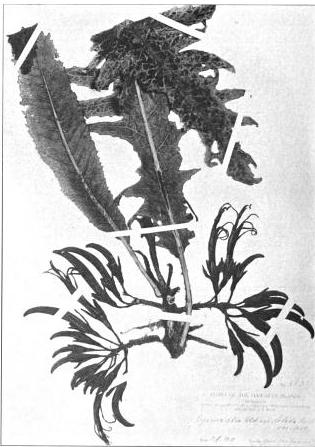 |
| CYANEA ATRA LOBATA RockType (no. 8637) in the College of Hawaii Herbarium. |
page 179
of many-nerved as in Cyanea macrostegia; the flowers and calyx are almost black, hence the name atra; the fruits are densely gray tomentose; the species is usually single stemmed, but is occasionally found branching once or twice near the base.
Cyanea atra lobata Rock The Indigenous Trees Haw. Isl. Add. 511. 1913. (Plate 91.)
Erect single stemmed with subentire and lobed leaves, petiole muricate, 6-7 cm, leaves coriaceous, when not lobed the margin is almost fringed, or lobed irregularly, deeply, but not to the rhachis, tuberculate above, covered with an olivaceous tomentum underneath; peduncle longer than in the species, 3-4 cm, many-flowered, bracts and bractlets as in species; pedicels 15-18 mm; calyx and corolla as in the species, the staminal column and anthers glabrous.
MAUI: Upper ditch trail leading from Ukulele to Waikamoi gulch in dense rain forest, 5000 feet, flowering October 1910, Rock no. 8637 in the herbarium College of Hawaii, and Gray Herbarium.
Only few plants were observed when in company with Mr. L. von Tempsky of Makawao.
Cyanea macrostegia Hillebr. Flora Haw. Isl. 263. 1888. (Plates 49, 92, 93.)
Plant 2-4 m high, rather rough but unarmed, leaves as large as in Cyanea tritomantha or smaller, 45-62 cm long, 7.5-11 cm wide, gradually narrowing into a petiole of (2.5 cm. teste Hbd.) 1 cm in length, pubescent underneath, papillosa above, eroso-dentate; peduncle short 1.5-3 cm, thick fleshy, racemose from the base, densely hirsute in the writer's material, pedicels 1.5-2 cm, bracts broad, oblong of various length from 20-40 mm long, about 6 mm wide, green, hispid, bractlets 10-12 mm; calyx (smooth glabrate teste Hbd.) hirtellous in the writer's specimens, the tube obconical glabrate or hirsute with coarse whitish gray hair, 2 cm long, 1 cm wide, the calycine lobes 2.5-5 cm long, 8 mm broad, obtuse, or emarginate, many-nerved, the nerves anastomosing, green; corolla suberect 5-6 cm long, 10 mm wide, fleshy, dark purplish (at first pubescent along the linear lobes, but soon glabrate (teste Hbd.), densely hirsute or strigosely hispid with yellowish coarse hair, especially in its upper half and on the lobes, deeply slit at the back; staminal column and anthers glabrous, dark purple; berry large ovoid 20 mm long, 16 mm wide, yellow, crowned by the large 50 mm long calycine lobes; seeds shining.
MAUI: West Maui, Kaanapali, Honokahau, Waihee in deep wooded ravines, Hillebrand, gulch at Kaanapali, August 1870, in Herbarium Berlin, and Gray Herbarium as Cyanea tritomantha Gray; East Maui, Hamakua, Waikamoi-Olinda trail, elevation 4000 feet, in dense rain forest, fruiting September 1910, Rock no. 8524 in herbarium College of Hawaii and Gray Herbarium; — Honomanu, flowering April 1911, Rock no. 8524-a in herbarium College of Hawaii; — forest of Nahiku, flowering May 1911, Rock no. 10264 in herbarium College of Hawaii.
Cyanea macrostegia Hillebrand is one of tall-stemmed species peculiar to the rainforests of both West and East Maui; in the latter locality it grows in company with Cyanea aculeatiflora, Cyanea hamatiflora, Clermontia arborescens, Tetraplasandra meiandra, Rubus, Cyrtandra mauiensis, Stenogyne, Phyllostegia, Acacia Koa, Dubautia, etc.
The specimen in Hillebrand's collection (Berlin Herbarium) is labeled C. atra Hbd., but is in reality C. macrostegia Hbd. As Hillebrand did not number
page 180
| PLATE 92. |
 |
| CYANEA MACROSTEGIA Hillebr.Type in herbarium Berolinense ex coll. Hillebrand. |
page 181
| PLATE 93. |
 |
| CYANEA MACROSTEGIA Hillebr.Specimen (Rock no. 10264) in the College of Hawaii Herbarium. |
page 182
| PLATE 94. |
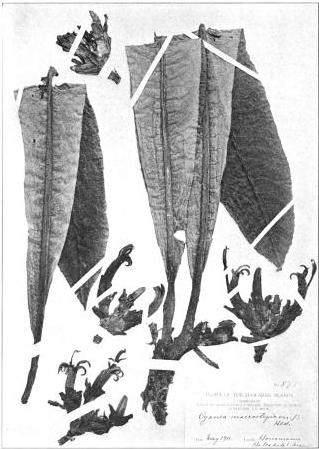 |
| CYANEA MACROSTEGIA VISCOSA RockType (no. 8791) in the College of Hawaii Herbarium. |
page 183
his plants nor mark his types it is now very difficult to locate them. A great many duplicates were given away by the Berlin authorities, and as some of them were only scantily labeled, some of his plants where were undoubtedly his types were given away. This accounts for the number of species not represented in his herbarium. In a great many instances Hillebrand's original labels have not been mounted with the respective plants. While the writer's material does not exactly agree with Hillebrand's description of that species, it nevertheless cannot be separated from it, as it agrees with the above species in the specific characters, as for example many-nerved oblong calycine lobes, and in the very long and numerous bracts. The East Maui material is very strongly hispid, that is the inflorescence, while Hillebrand's plants from West Maui are more or less glabrate. It is a very variable species whose forms cannot well be separated, while the specific characters remain constant.
In the Gray Herbarium is a sheet ex coll. Hillebrand marked C. tritomantha which is Cyanea macrostegia.
Cyanea macrostegia viscosa Rock Cyanea macrostegia β var. Hillebr. Flora Haw. Isl. 163. 1888. (Plate 94.)
Habit as in the species; leaves about 50 cm long, 6.5-8 cm wide, on thick fleshy petioles of 6-7 cm, the latter muricate, leaves glabrate or puberulous above, with an olivaceous pubescence underneath, lanceolate or oblong, acute to acuminate at the apex, gradually tapering below; inflorescence viscous, the bracts broad foliaceous 3 cm long, 1 cm wide, pubescent; calycine lobes broad and much shorter than in the species, nearly 2 cm long, 8 mm broad; corolla densely strigosely hispid with yellowish gray hair; staminal column and anthers glabrous.
MAUI: West Maui, John Lydgate no. 50 in Herbarium Hillebrand in Herbarium Berlin; — Honomanu, East Maui, flowering May 1911, Rock no. 8791 in herbarium College of Hawaii.
The variety differs from the species mainly in the viscous inflorescence, broad and shorter calycine lobes and bracts, as well as lanceolate tomentose leaves.
Cyanea macrostegia parvibracteata Rock Coll. Hawaii Public. Bull. 2:43, pl. X. 1913. (Plate 95.)
Leaves large, 45-65 cm by 7-14 cm, coriaceous, scabrous above, dull pubescent underneath, margin irregularly notched or laciniform, broadly oblong in outline; peduncle 4-6 cm, fleshy, bracteate at the apex, bracts linear-subulate 5 by 1 mm; pedicels 15 mm, apparrently naked; calyx pubescent, the ovarian portion obconical, the lobes 20-30 mm long, 4-5 mm broad, green; corolla dark purple, as in the species, 6-7 cm long, slightly curved, pubescent with reddish brown hair; berry ovoid, dark yellowish, 25-30 mm long, 18-27 mm thick, crowned by the calycine lobes.
MAUI: Northwest slope of Mt. Haleakala, along the Waikamoi-Olinda trail, elevation 5000 feet, flowering March 1912, Rock and Ceresole no. 10057 in the herbarium of the College of Hawaii; — northern slopes of Haleakala along a stream back of Nahiku, elevation 3000 feet, fruiting May 1911, Rock no. 8792 in the herbarium of the College of Hawaii, and Gray Herbarium.
This variety is apparently an intermediate between Cyanea atra and C. macrostegia.
page 184
| PLATE 95. |
 |
| CYANEA MACROSTEGIA PARVIBRACTEATA RockOne-half natural size.Type no. 10057 in the herbarium of the College of Hawaii.From: College of Hawaii Publication, Bulletin No. 2, 1913. |
page 185
| PLATE 96. |
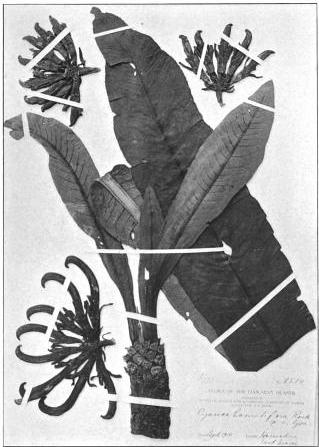 |
| CYANEA HAMATIFLORA RockType in the herbarium of the College of Hawaii. |
page 186
| PLATE 97. |
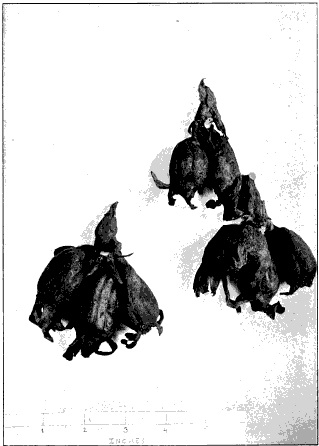 |
| CYANEA HAMATIFLORA RockMature fruits. |
page 187
Cyanea hamatiflora Rock The Indig. Trees Hawaii. Isl. Add. 510. 1913. (Plate 36, 96, 97.)
Plant 3-8 m high, unarmed, glabrous, erect not branching; leaves broadly lanceolate, somewhat acute, broadly sessile at the base, 60-70 cm long, 10-14 cm wide, puberulous above, pubescent underneath, irregularly dentate with callous teeth; midrib thick fleshy, red; inflorescence axillary hidden by the leaves which stand at right angles to the stem, peduncle 1.5-2 cm, bracteate at the apex and at the middle of peduncle; bracts lanceolate acuminate pubescent, with a prominent median nerve, pedicels 5-6 mm with linear-lanceolate bracteoles at their base; calyx ovate, green, 1.5 cm high, 6-7 mm wide; lobes of irregular length, two usually shorter, lanceolate, obtuse 12-18 mm long, 4 mm wide; corolla purplish to magenta red, the dorsal slit extending more than one third of its length, lobes sharply curved at the apex only, thick fleshy in texture and somewhat hirsute, staminal column glabrous, with a patch of purplish hair at the base; anthers sparingly hispid along the sutures, the two lower only bearded; berry obovate, dark purplish-red, 10-12 ribbed, crowned by the long calycine lobes, 4 cm long, 2.5 cm wide, fruit flesh purple, seeds dark brown shining.
MAUI: Slopes of Mt. Haleakala in dense rainforest between Waikamoi and Honomanu, also common on the crater of Puukakai in the same region, elevation 4000-5000 feet, flowering September 1910, Rock (type) no. 8514 in herbarium College of Hawaii, co-types in Herbarium Berlin, and Vienna and Gray Herbarium; — same locality, fruiting March 1912, Rock; — type locality, flowering August 1918, Rock & Hashimoto no. 13132 in Herbarium Rock.
The plant is easily distinguished from the other Cyaneas by the broad sessile, light green leaves which stand out horizontally. The whole inflorescence of this species exudes a very viscous substance, especially the young flowerbuds, which adhere to the paper in the herbarium.
The species is peculiar to the rainforests of Hamakua district, East Maui, where it grows in company with Cyanea aculeatiflora, Cyanea ferox horrida, Clermontia tuberculata, Clermontia arborescens, Cyanea macrostegia, Rubus, Stenogyne, Phyllostegia, Dubautia, Pelea, Cyrtandra mauiensis, Tetraplasandra meiandra var., etc. It is one of the most robust species, reaching a height of about twenty-five feet, with a trunk of five inches or more in diameter.
Cyanea aculeatiflora Rock The Indig. Trees Hawaii. Isl. Add. 509. 1913. (Plate 34, 55, 98.)
Plant 3-7 m tall, single stemmed or occasionally branching not far above the ground, covered with leaf-scars, especially in the upper portion; leaves large, 40-60 cm long, 10-20 cm wide, thick and stiff, dark green above, lighter underneath, the midrib as well as the 15 cm long fleshy petiole muricate; the upper surface muricate at the angles of the veins, densely tomentose-hispid underneath; inflorescence muricate throughout with aculeate tubercles; inflorescence racemose in the axils of the leaves; peduncle 6-10 cm with large foliaceous bracts of 3-4 cm, scattered along its entire length, the pedicels 1-1.5 cm; calyx tube oblong 2 cm, the oblong, obtuse, linear, muricate lobes 2.5 cm long, 0.5 cm wide; corolla dark purple, curved, covered with yellowish spines, the inner side of the lobes smooth, bluish-white, spreading, densely muricate on the outside; staminal column glabrous, purple, longer than the 5 cm long tube of the corolla; anthers dark purple, glabrous, the two lower bearded only; style thickening towards the shortly two-lobed hirsute stigma; fruit unknown.
page 188
| PLATE 98. |
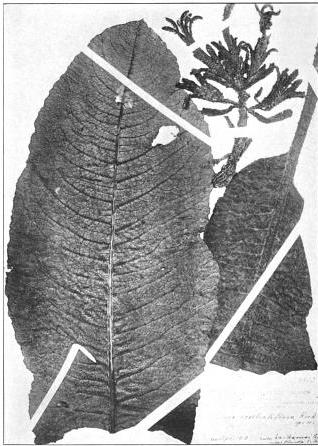 |
| CYANEA ACULEATIFLORA RockType in the College of Hawaii Herbarium, Rock no. 8513. |
page 189
MAUI: Northwestern slopes of Mt. Haleakala, in dense rainforest, and along streams, Waikamoi to Honomanu, elevation 4000 feet, flowering September 1910, Rock no. 8513, type, in herbarium College of Hawaii, co-type in Herbarium Berlin, Vienna and Gray Herbarium; — Olinda, flowering October 1, 1916, A. S. Hitchcock nos. 14904 and 14905, the latter (young leaves) in the U. S. National Herbarium; — type locality, flowering August 1918, Rock & Hashimoto no. 13133 in Herbarium Rock.
Cyanea aculeatiflora is found in company with Clermontia arborescens, Cyanea hamatiflora, Tetraplasandra, etc. The young plants of this species are covered with spines throughout, while the trunk of old ones is prickly only at the base.
Hillebrand's var. β schizocalyx of C. solenocalyx collected by Lydgate in Hamakua, E. Maui, may be related to this species, though his plant has only peduncles of 2.5 cm. However, there is no material of Hillebrand's variety extant in the European herbaria.
Cyanea aculeatiflora belongs to the section palmaeformes notwithstanding that it branches occasionally at the base, which fact seems to appear only when the plant has been broken.
Cyanea tritomantha A. Gray Proceed. Am. Acad. V:149. 1862. (Plates 39, 53, 99, 100.)
Trunk 18-30 dm high, rough, tuberculate; leaves broadly oblong-lanceolate or obovate, 37.5-70 cm long, 12.5-20 c wide, on muricate petioles of 12.5-20 cm, acuminate sinuate-dentate, suddenly contracting at the base, thick chartaceous, pubescent underneath along the prominent nerves; peduncle 2.5-6.25 cm long, thick fleshy, closely bracteate from near the base, somewhat muricate, bracts linear oblong 14-42 mm, the lower ones almost foliaceous, flowers 5-20 near the apex of the peduncle on pedicels of 20-30 mm, bi-bracteate either immediately under the calyx (as in Gray's specimen) or about, or below the middle; calyx green, scabro-hispid or subglabrous, the lobes green, linear lanceolate one-nerved, acute as long as the tube or longer 16-25 mm; corolla either dark purple or greenish white with the apex dark purple, pubescent, falciform, 6-7.5 cm long, 6 mm wide, bluish grey inside, the lobes narrow linear, staminal column glabrous; anthers dark purple, glabrous, the lower only penicillate; mature fruits unknown.
HAWAII: Windward side of Mauna Kea, U. S. Exploring Exped. in Gray Herbarium; — Hilo, Lydgate in Herbarium Berlin, and herbarium Bishop Museum, Honolulu; — Kohala Mountains, April 1871, in Herbarium Berlin; — southern slopes of Mauna Loa, forest region of Hilea, Kau, elevation 1500-3000 feet, flowering January 1912, Rock nos. 10013 and 10013-a in herbarium College of Hawaii, Gray Herbarium, Herbarium Botanic Garden New York, Nation. Herbarium Sydney N .S. W., Calif. Acad. Science Herbarium; — Hilo, flowering December 1912, Bro. Matthias Newell no. 10261 in herbarium College of Hawaii; — in dense forest from 29 miles near Volcano Kilauea to Kulani, Rock and Hashimoto, flowering August 15, 1918, no. 13135 in herbarium College of Hawaii.
Cyanea tritomantha, which the natives cal Aku, is a very variable species. The specimen in the Gray Herbarium consists of a single flower; the leaf is drawn on the sheet. Hillebrand's specimen in the Berlin Herbarium possesses flowerbuds and immature fruits; the bracteoles which are present immediately under
page 190
| PLATE 99. |
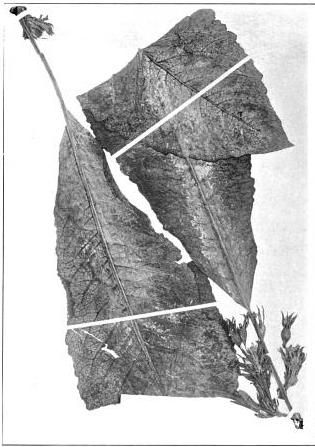 |
| CYANEA TRITOMANTHA A. GraySpecimen in the Herbarium Berolinense, ex coll. Hillebr. |
page 191
| PLATE 100. |
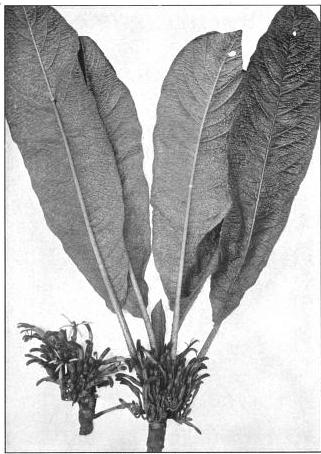 |
| CYANEA TRITOMANTHA A. GrayFrom a living specimen collected in the forests of Hilea, Kau, Hawaii. |
page 192
| PLATE 101. |
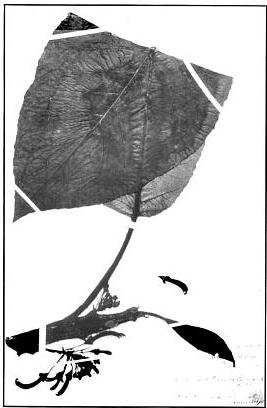 |
| CYANEA TRUNCATA RockType no. 8840 in the herbarium of the College of Hawaii. |
page 193
the calyx in Asa Gray's specimen, are wanting in the Hillebrand and the writer's material. In the Gray Herbarium is another sheet ex coll. Hillebrand, marked C. tritomantha from West Maui, collected in 1870; this plant is not C. tritomantha but C. macrostegia Hillebrd.
Cyanea tritomantha grow in company with Clermontia coerulea, Clermontia parviflora, Antidesma platyphyllum. Freycinetia arborea, Straussia, etc. The young leaves of this species resemble greatly those of Cyanea nolimetangere; in fact, the young plants of the former may easily be mistaken for mature ones of the latter when not in flower.
Cyanea tritomantha Lydgatei (Hillebr.) Rock. Cyanea tritomantha β var. Hillebr. Flora Haw. Isl. 262. 1888. Cyanea Lydgatei sp. n. Hillebr. MSS.
Leaves thick coriaceous, oblanceolate-oblong, acute at the apex, decurrent at the base, acute, 31 cm long, 8 cm wide, with stout midrib and veins, glabrate above, but with small pustules scattered over the surface, pubescent below with brownish hair especially on the veins, margin subentire to unevenly denticulate, petioles 4 cm long, stout, sparingly muricate its entire length, and villous pubescent; inflorescence as in Cyanea tritomantha, bracts 10 cm long, 1-1.5 mm wide, villous-pubescent; pedicels 1-2 cm, bibracteolate about the middle, bracteoles 2-2.5 mm; calyx obconical-oblong, 12 mm, the calycine lobes linear, 8 mm long, 2 mm wide, acute, with a median nerve; corolla narrow, 8 cm long, 5-6 mm wide, of even width, dark reddish-purple, with a grayish-brown pubescence, the lobes thickly muricate, the dorsal slit extending to the lower third, staminal column glabrate to puberulous; anthers puberulous, hirsute along the sutures, the lower ones bearded only; fruit unknown.
HAWAII: Kona, flowering January 1873, J. Lydgate ex coll. J. Lydgate in the herbarium of Bishop Museum.
The writer did not find this variety in the Berlin Herbarium nor in the Gray Herbarium. Recently the Bishop Museum acquired by purchase from Mr. J. Lydgate a collection made by Dr. W. Hillebrand; the Lobelioideae of the collection were carefully examined by the writer and among the plants there was found this rare variety. It was first named Cyanea Lydgatei sp. n. by Hillebrand, but later in his Flora referred to Cyanea tritomantha as a variety β. It differs from the species in the smaller leaves and muricate corolla lobes.
Cyanea truncata Rock in Torrey Bot. Cl. Bull. XLIV:234, plate 15. 1917. Rollandia truncata Rock in Coll. Hawaii Publ. Bull. 2:44. 1913. Cyanea Juddii Forbes in Occas. Pap. B. P. Bishop Mus. Vol. VI, no. 3, 68, plate, 1916. (Plate 101.)
A low plant 3-4 dm high with fleshy muricate stem; leaves large, chartaceous, broadly obovate-oblong, acute at the apex, decidedly truncate at the base with perhaps a slight indication of becoming subcordate, pale green, glabrous above, with here and there, especially on the veins, a few minute conical spines, 40-42 cm long, 18-20 cm wide, puberulous underneath, on muricate petioles of 14 cm; racemes axillary, slender, 5.5 cm long, bracteate from the base, hispidulous, the number of bracts increasing towards the apex, whole inflorescence rather broadly contracted, the lower flowers mature, while the apical ones occur as minute buds; pedicels single in the axils of each bract, long, slender, 22-26 mm long, bibracteolate at or below the middle, pubescent; calyx 10 mm long, the ovarian portion obconical, the lobes as long as the tube, 5 mm, broadly obtuse;
page 194
corolla pale, purplish-pink, slender, very thin puberulous in the bud, glabrous when open, slightly curved, or almost straight, the dorsal slit extending to the middle, 32 mm long, 5 mm wide, almost of even width, puberulous, the three lower lobes very short, 5-7 mm; staminal column glabrous, free, pale, anthers bluish, glabrous, the two lower bearded.
OAHU: Mountains of Punaluu, valley trail, elevation 1000 feet, flowering August 1911, Rock (type) no. 8840 in the herbarium College of Hawaii, and Gray Herbarium; — Waiahole Pali, flowering February 6, 1912, C. N. Forbes no. 1477-o in herbarium Bishop Museum (as C. Judii); — Waiahole, flowering August 26, 1917, Dr. H. L. Lyon no. 12830 in herbarium College of Hawaii.
The outward aspect of this species resembles that of a Rollandia, to which genus it comes very close, but is differentiated from it in the free staminal column. It inhabits the windward side of Oahu from Waiahole to Punaluu Valley, at an elevation of about one thousand feet; in Punaluu it grows in company with Cyrtandra, Scaevola, Chamissoniana, Acacia Koa, etc.
It is, as Mr. Forbes points out, related to Cyanea tritomantha A. Gray of Hawaii, but differs from it in the much smaller stature, smaller leaves, and smaller glabrous flowers. The only character it has in common with the Hawaii species is the bracteate peduncle.
page 195
SECT. II. DELISSEOIDEAE Hillebr.
Cyanea angustifolia (Cham.) Hillebr. Flora Hawaii. Isl. 253. 1888. Lobelia (Delissea) angustifolia Chamisso in Linnaea VIII:219 1833. Delissea angustifolia Presl Monogr. Lobel. 47. 1836. Delissea acuminata var. angustifolia A. Gray in Proceed. Am. Acad. V:148. 1862. Delissea Honolulensis Wawra in Flora od. Allgem. Bot. Zeit. XXXI:11. 1873. (Plate 102.)
A shrub 2.5-5 m high, stem simple or sparingly branched or (in the broad-leaved forms) a much branching shrub or small tree; branches erect to suberect densely foliose at the ends, glabrous, the cavity of the stem septate by closely-set chartaceous diaphragms; leaves lanceolate or elongate-oblong, 15-25 cm long, 2-5 cm wide, equally acuminate at both ends, or acute and minutely mucronate, often with undulate margins and irregular serrature, entire in the lower portion, glabrous on both surfaces, but pubescent along the midrib, membranous, the transparent veinlets minutely reticulate, on petioles of 8-10 cm; peduncles as long as the petioles, slender, densely-flowered near the apex, naked below, glabrous; pedicels filiform 1.5-2 cm; bracts subulate 1.5 mm; bractlets minute or wanting; calyx turbinate, 5 mm, minutely toothed; corolla slender, moderately curved, pale violet, glabrous, the dorsal slit extending to near the base, 3-4 cm long, 2.5 mm wide; anthers and staminal column glabrous; berry 6-8 mm, globse, bluish; seeds dark yellow.
OAHU: Gaudichaud anno 1817 in Herbarium Paris; — U. S. Exploring Exped. (two leaves) in Gray Herbarium; — Jules Remy, flowering, coll. 1851-1855, no. 299 in Herbarium Paris and Gray Herbarium; — main range, Mann and Brigham no. 231 in herbarium Bishop Museum; — fruiting, Wawra no. 1975 (as Delissea Honolulensis) in Herbarium Vienna; — Niu Valley, Hillebrand in Herbarium Berlin, Kalihi, Hillebrand in Herbarium Berlin and herbarium of the College of Hawaii; — spec. ex coll. Hillebrand in Bishop Museum herbarium (flowerbuds); — Palolo Valley, flowering, Rock no. 107 in herbarium of the College of Hawaii; — Palolo Valley, flowering, Rock no. 107 in herbarium of the College of Hawaii; — Pauoa Valley, flowering January 7, 1909, Rock no. 1032; — Wahiawa, fruiting August 1908, Rock no. 35; Pauoa Valley, flowering November 4, 1908, Rock no. 10272; Manoa Valley, flowering September 1912, Rock no. 10256; Punaluu trail, flowering November 1914, Rock no. 10357; Maunawili, flowering 1914, O. H. Swezey no. 13107 in the herbarium College of Hawaii; — ex coll. Rock nos. 8799, 1060 and two sheets without number in Gray Herbarium; — Palolo Valley, August 7, 1916, A. S. Hitchcock no. 14132 in U. S. National Herbarium; — Kalihi Valley, August 2, 1916, A. S. Hitchcock no. 14094 in U. S. National Herbarium.
LANAI: Mahana Valley, flowering August 3, 1910, Rock and Hammond no. 8105 in the herbarium of the College of Hawaii.
MOLOKAI: Valley back of Kaluaaha, Rock, observed only.
A very common species at the lower levels back of Honolulu and the main range. The plants found in the valleys back of Honolulu are all alike, forming shrubs with few erect branches, while those of the Koolau range beyond Kahana Valley are small trees or much branching shrubs, with denser crown and much broader leaves. Hillebrand classes with this species plants found on West and East Maui, which differ decidedly from those of Oahu; Cyanea angustifolia is very variable and ranges into Cyanea Hardyi, C. Fauriei and Cyanea coriacea; these three species are, however, very much larger plants.
page 196
| PLATE 102. |
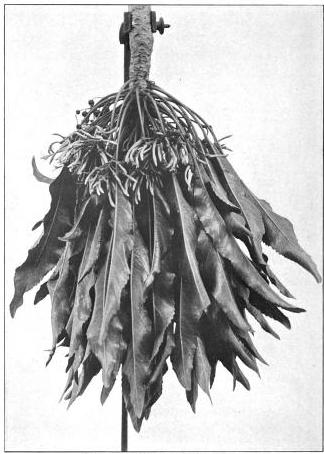 |
| CYANEA ANGUSTIFOLIA (Cham.) Hillebr.Typical specimen from the mountains behind Honolulu |
page 197
| PLATE 103. |
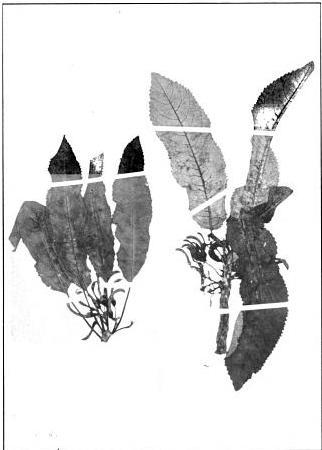 |
| CYANEA ANGUSTIFOLIA LANAIENSIS RockType in Herarium Berolinense, ex coll. Hillebr. |
page 198
| PLATE 104. |
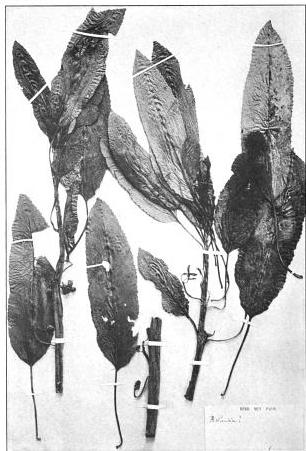 |
| CYANEA ANGUSTIFOLIA LANAIENSIS RockSpecimen in herbarium Museum Paris, ex coll. Remy, no. 304. |
page 199
Cyanea angustifolia Hillebrandii Rock in Torrey Bot Cl. Bull. 44:234. 1917. Cyanea angustifolia (Cham.) Hillebr. Flora Hawaii. Isl. 253. 1888 (in part).
A small, sparingly branching shrub 2 m high, branches slender, glabrous; leaves ovate to ovate-oblong, 8-14 cm long, 3-4 cm wide, on petioles 2.5-3.5 cm long, glabrous above, puberulous underneath, serrulate to crenulate, acute at both ends, peduncle very short, 1-1.5 cm long; pedicels 5-10 mm long, flowers as in the typical form of the species, only very small, 15 mm long, 1.5 mm wide.
MAUI: Northern slopes of Mt. Haleakala, Keanae Valley elevation 1000 feet, flowering April 1911, Rock no. 8799 in the herbarium of the College of Hawaii; — West Maui, Lydgate no. 140 in Herbarium Berlin.
The leaves in var. Hillebrandii are smaller than in the species; the flowers are also much smaller, and on very short peduncles (1.5 cm). It grows along the lower ditch trail and in Keanae Valley, on the windward slope of Mt. Haleakala.
Cyanea angustifolia lanaiensis Rock in Torrey Bot. Cl. Bull. 44:235. 1917. Cyanea angustifolia β var. Hillebr. Flora Hawaii. Isl. 253. 1888. (Plates 103, 104.)
Plant 3-4 m high, branching a few decimeters above ground, the branches erect and densely foliose at the apex; leaves dark green, membranous, glabrous on both sides, elongate-oblong, bluntly acute at the apex, rounded at the base, or slightly unevensided, coarsely serrate with uncinate teeth, 10-18 cm long, 4-5 cm wide, on petioles 4.5-6 cm long; racemes much shorter than in the typical form of the species, about 3.5 cm long, few-flowered, flowers smaller, whitish.
LANAI: Without definite locality, Voyage de M. J. Remy 1851-1855, no. 304 in Herbarium Paris (marked Rollandia); — July 1870, Hillebrand in Herbarium Berlin; — Mahana Valley, flowering July 1910, Rock no. 10257 in the herbarium of the College of Hawaii; — Kaiholena Valley, flowering July 23, 1910, Rock no. 8053 in the herbarium of the College of Hawaii, and the Gray Herbarium; — ravine, moist woods, September 22, 1916, A. S. Hitchcock no. 14705 in the U. S. National Herbarium.
The variety lanaiensis differs from the typical form of the species in the broader leaves, which are rounded at the base and coarsely serrate with uncinate teeth; also in the short and few-flowered racemes.
Hillebrand's specimen is labeled Delissea inter angustifoliam et obtusam, with Remy's specimen in the Paris Museum is labeled Rollandia?
Cyanea angustifolia racemosa Hillebr. Flora Hawaii. Isl. 253. 1888. (Plate 105.)
Leaves chartaceous, longer than in the species, 21-22 cm long, 4-6.5 cm wide, crenate, on petioles of 10-10.5 cm; peduncle much elongate 12.5-25 cm long, drooping, naked in the lower third or half, racemosely flowered above, pedicels up to 2.5 cm long; flowers pale, as in the species.
OAHU: Kaala mountains, Hillebrand in Herbarium Berlin.
LANAI: Waiopaa, G. C. Munro, September 18, 1916, flowering, A. S. Hitchcock no. 15572 in the U. S. National Herbarium, part in the herbarium of the College of Hawaii.
Variety racemosa is intermediate between C. angustifolia and C. Fauriei and C. Hardyi; it was previously only recorded from Mt. Kaala, Oahu, the mountain range nearest Kauai, on which island the two latter species occur. G. C. Munro collected variety racemosa on the island of Lanai.
page 200
| PLATE 105. |
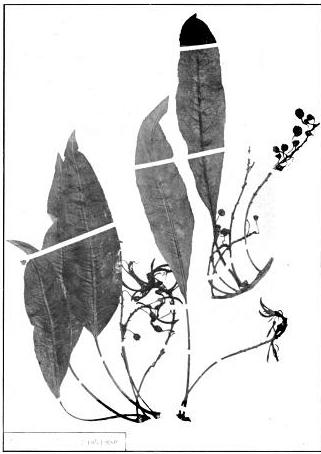 |
| CYANEA ANGUSTIFOLIA RACEMOSA Hillebr.Type in Herbarium Berlin. |
page 201
| PLATE 106. |
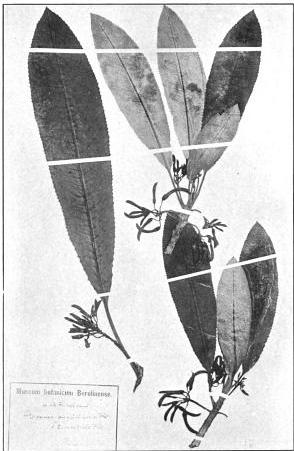 |
| CYANEA ANGUSTIFOLIA TOMENTELLA Hillebr.Type in Herbarium Berlin. |
page 202
| PLATE 107. |
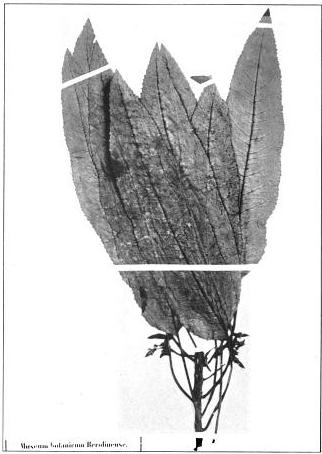 |
| CYANEA MANNII (Brigham) Hillebr.Specimen in Berlin Herbarium, ex coll. Hillebr. |
page 203
Cyanea angustifolia tomentella Hillebr. Flora. Hawaii. Isl. 253. 1888. (Plate 106.)
Traces of pubescence on leaves, calyx and corolla; leaves oblanceolate, 30 cm by 6.8 cm, on petioles of 7.5 cm; peduncles thicker, 7.5 cm long; calycine teeth one-fourth the length of the tube.
OAHU: Helemano (Halemanu Hillebrand), flowering specimen, Hillebrand in Herbarium Berlin.
The writer has not collected this variety and nothing is known of its habit. It is very close to Cyanea obtusa and together with that species, Cyanea Manii and the other varieties of Cyanea angustifolia may form one very variable species, which might all be included with Cyanea angustifolia. One would then have to include Cyanea Fauriei, Cyanea Hardyi, C. coriacea and also C. spathulata, all from Kauai.
Cyanea Mannii (Brigham) Hillebr. Flora Hawaii. Isl. 253. 1888. Delissea Mannii Brigham in Mann, Enum. Haw. Plants in Proceed. Am. Acad. VII:182. 1868. (Plate 107.)
Habit and size of Cyanea angustifolia; leaves elongate-oblong, base rounded, 15-20 cm long, 4.5-5 cm wide, on petioles of 3.8-6.3 cm long, glabrous or puberulous along the midrib below; peduncle (with advanced buds) 5-7.5 cm, naked in the lower half, puberulous; pedicels 8-12 mm, bacteolate below the middle; bracts linear, 6 mm, but often foliaceous; bractlets 2-3 mm; calyx puberulous, the adnate tube 6 mm, the lanceolate mostly three-nerved lobes as long or longer; corolla almost straight, and probably of the same size as C. angustifolia, glabrous, purplish blue; staminal column glabrous.
MOLOKAI: W. T. Brigham in Herbarium Bishop Museum?; — Kalae, 1870 (flowerbuds), Hillebrand in Herbarium Berlin, herbarium College of Hawaii, and Gray Herbarium.
The writer has not collected this species; it is only known to him from the Hillebrand material.
The species is undoubtedly very closely related to Cyanea angustifolia and may be only a variety of it. It differs from it in the pubescent inflorescence and the longer calycine lobes; the leaves are like those of C. angustifolia.
Cyanea obtusa (Gray) Hillebr. Flora Hawaii. Isl. 254. 1888. Delissea obtusa A. Gray in Proceed. Am. Acad. V:148. 1862 (inclusive var. mollis A. Gray l.c.) (Plate 108.)
A much branching shrub 23-50 dm high, the stem of a compact wood, with narrow cavity, the branches spreading, tomentose; leaves elongate-oblong, 15-30 cm long, 3.8-9 cm wide, on petioles of 3.8-10 cm, obtuse or shortly acuminate, contracting below, serrulate with patent teeth, membranous, the ribs and veins puberulous on both faces; peduncle 5 cm, naked in the lower half or two thirds; pedicels 16-24 mm, bracts 2 mm; calyx tomentose, bluish, the cylindrical tube 6 mm, the acute triangular teeth one-third to one-half of its length; corolla tomentose, graying blue, suberect, 30-36 mm long; staminal column glabrous.
MAUI: Mountains of Maui, U. S. Exploring Exped., not in Gray Herbarium; — Mann and Brigham no. 466 in herbarium Cornell University; — Honuaulu, Hamakua, Waikapu, Lahaina, Haleakala south, East Maui, flowering September 1870, Hillebrand in Herbarium Berlin.
HAWAII: Mauna Kea, U. S. Explor. Exped. (not in Gray Herbarium).
page 204
| PLATE 108. |
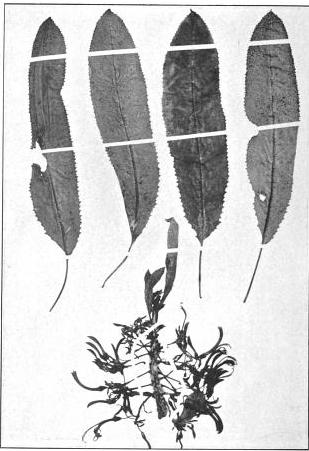 |
| CYANEA OBTUSA (A. Gray) Hillebr.Specimen in Herbarium Berolinense, ex coll. Hillebr. |
page 205
| PLATE 109. |
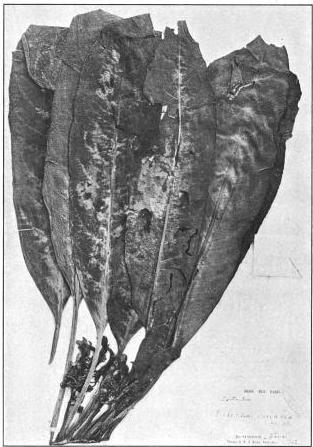 |
| CYANEA CORIACEA (A. Gray) RockType in Gray Herbarium ex coll. J. Remy no. 302. |
page 206
| PLATE 110. |
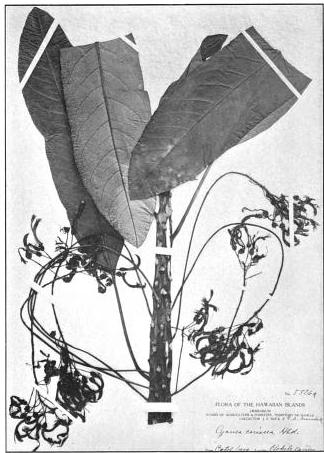 |
| CYANEA FAURIEI Lévl.Specimen in the College of Hawaii Herbarium (Rock no. 5826-a). |
page 207
There are no specimens of either the species or the supposed variety in the Gray Herbarium. The plant is only known to the writer from Hillebrand's and Mann's specimens.
The writer collected in September, 1910, a Cyanea above Makawao, East Maui (no. 8517), which may be referrable to Cyanea obtusa. Hillebrand remarks about the stem of this species as having a compact wood with narrow cavity; the writer's material has the stem hollow, but divided into narrow chambers by horizontal chartaceous diaphragms.
Cyanea coriacea (A. Gray) Rock in Torrey Bot. Cl. Bull. 44:237. 1917. Delissea coriacea A. Gray in Proceed. Am. acad. V:147. 1862. (Plate 109.)
Leaves thick coriaceous, repandly serrulate, oblong lanceolate, acute at the base, obtuse or rounded at the apex, 32 cm long, 8 cm broad, on petioles of 8 - 12 cm. veinlets conspicuously reticulate, light green above, pale underneath, perfectly glabrous on both sides: racemes many-flowered, never exceeding the petioles, 2 - 5 cm long; limb of calyx obsoletely or minutely dentate; corolla 2.5 cm long, glabrous purplish.
KAUAI: Voyage of M. J. Remy 1851-1855, type no. 302 in Gray Herbarium; — co-type in Herbarium Paris; — Waioli river basin, 500-700 feet, flowering November 1915, V. W. Hardy no 12713 in herbarium of the College of Hawaii.
This species is characterized by the thick leathery leaves, long petioles and short, stout racemes. It was confused by Hillebrand and other writers with a different species from Olokele canyon, which was recently described by H. Léveillé as Cyanea Fauriei.
Cyanea coriacea has only been re-collected once since Jules Remy's time, by V. W. Hardy in the Waioli river basin on Kauai at an elevation of between 500 and 700 feet, and not 5000-7000 feet as misprinted in the Torrey Bot. Club Bull. 44:237. 1917.
Cyanea Fauriei Lévl. in Fedde Repert. Spec. Nov. X:10/14, 156. 1911. Cyanea coriacea Hillebr. Flora Hawaii. Isl. 254. 1888. (Plates 27, 29, 110.)
Branching or simple, more often branching, 2.5 - 4 m high, the medullary cavity of the stem septate y chartaceous diaphragms, the leaves crowded at the ends of the branches; leaves obovate-oblong to oblong-lanceolate, 24 - 30 cm long, 6 - 8 cm wide, on petioles of 6 - 10 cm or more, shortly acuminate, moderately contracting at the base, chartaceous, dark green above, pale underneath, glabrous on both surfaces, with midrib and veins prominent underneath, crenate to denticulate, more or less entire at the lower portion of the leaf; peduncle in full matured inflorescences exceedingly long, 16 - 26 cm, slender, naked four-fifths of its length; pedicels filiform, about 2 cm long, the minute bracts and bractlets evanescent; calyx greenish, the tube obovate, about 5 mm, with minute teeth; corolla purplish to pale violet, somewhat larger than in C. angustifolia, glabrous, slender, moderately curved, 2.5 - 3 cm long, 3 mm wide, the dorsal slit extending to near the base; staminal column and anthers glabrous, berry globose, as in C. angustifolia.
KAUAI: Waimea, 1500-2000 feet, Knudsen in herb. Hillebrand in Herbarium Berlin; — banks of Hanapepe and Wahiawa rivers, July 22, 1895, A. A. Heller no. 2597 in Herbarium Paris; — Olokele canyon, flowering September 30,
page 208
| PLATE 111. |
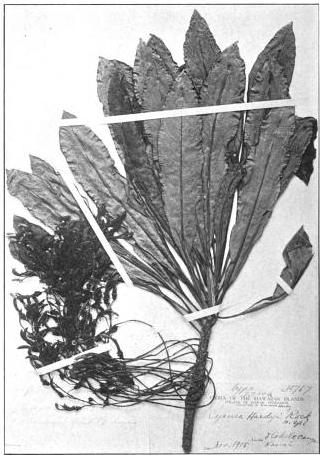 |
| CYANEA HARDYI RockType no. 12767 in the College of Hawaii Herbarium. |
page 209
1909. Rock no. 5826, Olokele, flowering October 1909, Rock and Marshall no. 8526-b in the herbarium of the College of Hawaii; — Koloa, fruiting 1909, Abbé Faurie no. 565 in Herarium Léveillé and in the herbarium of the College of Hawaii; — Olokele canyon, October 1916, Rock no. 13108 in the herbarium of the College of Hawaii; — same locality, flowering October 18, 1916, A. S. Hitchcock no. 15243 in the U. S. National Herbarium.
This species is distinguished from Cyanea coriacea in the long flowering raceme, sometimes more than twice the length of the petioles, while the racemes of C. coriacea never exceed the petioles. The leaves instead of being coriaceous are chartaceous. Hillerand misinterpreted Asa Gray's species, and unfortunately nearly all other authors followed Hillebrand.
Cyanea Hardyii Rock in Torrey Bot. Cl. Bull. 44:236. 1917. (Plate 111.)
A small tree 5 - 7 m in height, with several straight ascending branches bearing large crowns of leaves at the apices; branchlets covered with leaf-scars; leaves narrow, linear-oblong, chartaceous, the margins crenulate to denticulate; denticulations close in the upper portion, coarser and wider apart in the second third, lacking at the base, midrib prominent underneath, the veins purplish, closely reticulate, dark green above, light underneath, 20 - 30 cm long, 2.5 - 5 cm wide, acuminate to acute at the apex gradually tapering into a margined petiole 2.5 - 8 cm in length; racemes very slender, axillary, in the axils of the leaves and below the crown of leaves in the axils of the scars of fallen leaves, 20 - 25 cm long, naked in the lower three fourths, minutely bracteate; the filiform pedicels bibracteolate at the middle; flowers deep purplish black, the calyx turbinate, strongly ribbed when dry, minutely toothed; corolla semi-curved, the dorsal slit extending to the middle, glabrous, anthers and staminal column glabrous, the lower anthers bearded; fruit unknown.
KAUAI: Olokele canyon, elevation 1400 feet, flowering November 1915, V. W. Hardy no. 12767 type in the herbarium of the College of Hawaii; — Olokele canyon one mile from intake, October 1916, Rock no. 12765 (sterile specimens) in the herbarium of the College of Hawaii; — below Kaholuamano, elevation 2600 feet, October 1916, Rock no. 12766 (with undeveloped racemes) in the herbarium of the College of Hawaii; — Olokele, October 18, 1916, A. S. Hitchock in the U. S. National Herbarium.
In certain respects C. Hardyi is intermediate between C. Fauriei and C. coriacea. It differs mainly in its leaves, which are linear-oblong and acuminate, tapering gradually into a margined petiole. It is further characterized by its habit and by its dark purplish black inflorescence. In C. Fauriei the leaves are obovate-oblong, with longer petioles and abruptly cuneate at the base, the petioles not being margined; the inflorescence is pale lilac and more robust.
The following species, given in their natural order, range into each other and are consequently very closely related: C. coriacea, C. Fauriei, C. Hardyi, C. spathulata, C. angustifolia, C. comata and perhaps C. Mannii and C. obtusifolia.
The species was named in honor of Mr. V. W. Hardy, Assistant Engineer in the United States Hydrographic Survey.
Cyanea Hardyi has a later flowering period than C. Fauriei. The former flowers in the winter months, while the latter is usually over flowering in October. When the writer collected the last material of this species in October,
page 210
| PLATE 112. |
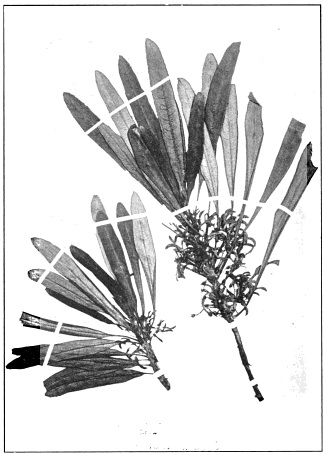 |
| CYANEA SPATHULATA (Hillebr.) HellerSpecimen in Herbarium Berolinense, ex coll. Hillebr. |
page 211
1916, Cyanea Fauriei was in full bloom and was also beginning to fruit, while Cyanea Hardyi just began to send out the peduncles; the latter were only about 5 cm or less long and showed only a few bractlets but no flowerbuds.
Cyanea spathulata (Hillebr.) Heller in Minnes. Bot. Stud. IX:909, pl. 65. 1897. Cyanea coriacea Hillebr. var. spathulata Hillebr. Flora Hawaii. Isl. 254. 1888. Rollandia Fauriei Lévl. in Fedde Repert. Spec. Nov. XII:506. 1913. (Plates 33,112.)
A much branching shrub 2-3 m high, often branching from near the base, with the aspect of Clermontia, glabrous; leaves linear spathulate, dark green above, lighter underneath, with prominent reddish midrib, veins impressed above, the upper leaf surface covered with a dense areolar network, crenate to dentate, bluntly acute or obtuse and mucronulate at the apex, 10-24 cm long, 1.5-2.5 cm wide, gradually narrowing into an almost winged petiole of 1.5-6 cm, somewhat pubescent as is the midrib and veins on the underside of the leaf; racemes axillary, peduncles 2-6 cm long, naked, the racemes often developing into a small branch, the filiform pedicels 1-2.5 c in length; flowers and berry as in Cyanea angustifolia.
KAUAI: Waimea, 4000 feet, Knudsen no. 11 (two specimens, one labeled Delissea micrantha var. δ coriacea) in Herbarium Berlin; — west side of the Waimea river, 4000 feet, August 30, 1895, A. A. Heller no. 2768 in Herbarium Paris; — W. Brigham, without date or locality (Delissea coriacea var.), in Gray Herbarium; — forests and outskirts of forests of Kaholuamano-Opaiwela, elevation 3600-4000 feet, flowering March 3-10, 1909, Rock no. 2425; — same locality, September 1909, Rock no. 5664; — Kaholuamano, fruiting October 1911, Rock no. 9008 in herbarium of the College of Hawaii; — Waimea, Abbé U. Faurie, March 1910, no. 568 (Rollandia Fauriei Lévl.) in Herbarium Léveillé and in the herbarium of the College of Hawaii; — Kaholuamano, October 20, 1916, A. S. Hitchcock no. 15369 in the U. S. National Herbarium; — Kaholuamano, fruiting October 1916, Rock no. 13109 in the herbarium of the College of Hawaii.
Cyanea spathulata (Hillebr.) Heller certainly is worthy of specific rank; it is quite different in aspect from Cyanea coriacea, as it is a very much branching shrub of much smaller stature; it is, however, related to Cyanea coriacea, as well as to Cyanea angustifolia, C. obtusa, C. comata, and C. Mannii.
Cyanea comata Hillebr. Flora Hawaii. Isl. 256. 1888. (Plate 113.)
An unarmed shrub 1.6-2.6 m high, with few ascending, distantly foliose branches; leaves obovate-oblong, 15.2-20.3 cm long, 7.6-9 cm wide, on petioles of 2.5-3.8 cm, obtuse or shortly pointed, somewhat contracted at the base, closely and sharply dentate, puberulous underneath, chartaceous, the veins minutely areolate; peduncles much longer than the leaves, often exceeding 30 cm, slender and drooping, naked, bearing from 6-12 resupinate flowers toward the end, the pedicels 16-20 mm, curved upward, with minute bractlets above the middle; bracts 3 mm; calyx glabrous, broader than high, 6 by 8 mm, the short triangular teeth about one-third the length of the tube; corolla strongly arched, 5 cm long, 4-5 mm wide, with the dorsal slit very deep, glabrous, grayish or pale lilac; anthers glabrous, much exserted, 5-6 mm long; berry subglobose, truncate, 8 by 14 mm, broadest at the base; seeds complanate, smooth and shining.
page 212
| PLATE 113. |
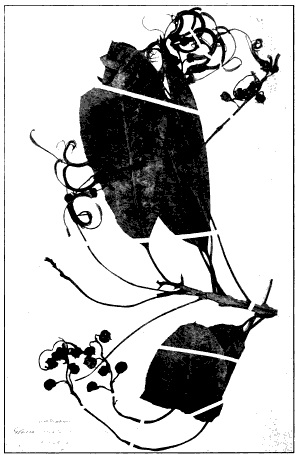 |
| CYANEA COMATA Hillebr.Type in Herbarium Berolinense, ex coll. Hillebr. |
page 213
MAUI: Southern slope of Mt. Haleakala, 3000-4000 feet elevation, August 1870, Hillebrand type in Herbarium Berlin, clastotype in herbarium of the College of Hawaii, and co-type in Gray Herbarium.
Cyanea comata is related to Cyanea Fauriei but differs from it in the larger and arcuate flowers and in the shorter obovate-oblong leaves. The writer is only acquainted with this species from material in the Berlin and Gray Herbaria ex herbarium Hillebrand.
It probably occurs in the forests of Kaupo, Maui, or did occur back of Ulupalakua, which is, strictly speaking, on the southern slope of Haleakala; however, all native vegetation has disappeared from that region, which is now covered with Paspalum conjugatum and planted Eucalypti.
SECT. III. HIRTELLAE Rock
Cyanea Knudsenii Rock sp. nov. Cyanea hirtella Hillebr. Flora Hawaii. Isl. 255. 1888. (Plate 114.)
A tall branching shrub 4-6.5 m high, the young shoots hirsute with short rusty hairs; leaves broadly obovate-oblong, 22-27.5 cm long, 7-10 cm wide near the apex, on petioles of 5-8 cm, obtuse or shortly acute, cuneately contracting at the base, sinuate-dentate or serrulate, the ribs and veins shortly pubescent underneath; peduncle 2-5 cm long, naked below, ten to twelve-flowered, in the upper third or half; pedicels about 12 mm; bracts and bractlets deciduous; calyx rusty tomentose, cylindrical 8-10 mm long, the narrow triangular or subulate lobes half as long or as long; corolla moderately curved 4 cm long, 4 mm wide, slit beyond the middle at the back, purplish-blue, tomentose; anthers glabrous; berry pyriform, seeds pale brown.
KAUAI: Waimea, V. Knudsen in collect. Hillebrand, Herbarium Berlin, and Gray Herbarium; — Kopiwai forest below Halemanu, flowering February 14, 1909, Rock no. 2418 in the herbarium of the College of Hawaii, and Gray Herbarium (as Cyanea hirtella).
Dr. W. Hillebrand misinterpreted Horace Mann's Delissea hirtella == Cyanea hirtella, and referred a different plant collected by Valdemar Knudsen to H. Mann's species. The writer followed Hillebrand, as the specimens of H. Mann, Delissea hirtella, were in a deplorable condition and could not well be recognized. The writer collected the same species which Hillebrand referred to Cyanea hirtella, in the type locality where Knudsen gathered his specimen. When visiting the forests on the other side of Waimea canyon, he found another species, which he considered new and which he described as Cyanea communis, on account of its being so very common in the region; it was, however, not observed at Halemanu, Knudsen's collecting ground. This latter species is in reality Horace Mann's Delissea hirtella, now Cyanea hirtella (H. Mann) Rock, while the plant referred to Cyanea hirtella by Hillebrand was an undescribed species and is here named in honor of Mr. V. Knudsen, who collected the species for the first time. It is quite a distinct species with a short trunk and three to four ascending branches; it differs from Cyanea hirtella in the tall habit, the broadly obovate-oblong leaves, and in the slender corollas.
Heller was right in stating that "Hillebrand probably had an entirely different plant" from Cyanea (Delissea) hirtella.
page 214
| PLATE 114. |
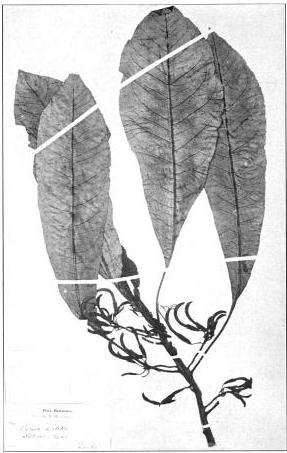 |
| CYANEA KNUDSENII RockType in Herbarium Berolinense, ex coll. Hillebrand. |
page 215
| PLATE 115. |
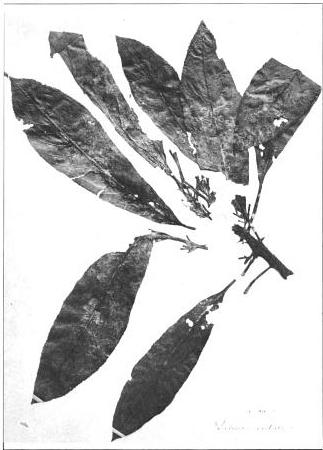 |
| CYANEA HIRTELLA (Mann) RockSpecimen in Gray Herbarium, Mann & Brigham no. 574. |
page 216
| PLATE 116. |
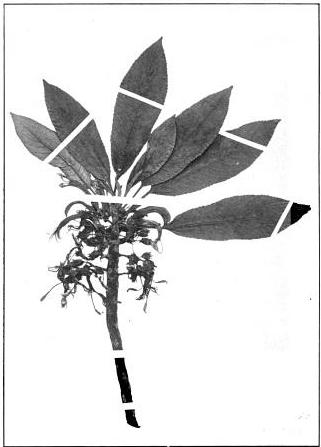 |
| CYANEA HIRTELLA (Mann) RockFlowering specimen in the College of Hawaii Herbarium, Rock no. 5942. |
page 217
| PLATE 117. |
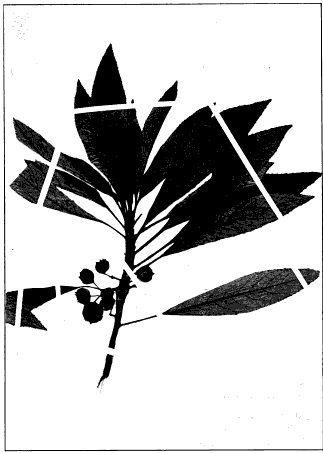 |
| CYANEA HIRTELLA (Mann) RockFruiting specimen in the College of Hawaii Herbarium, Rock no. 8865. |
page 218
| PLATE 118. |
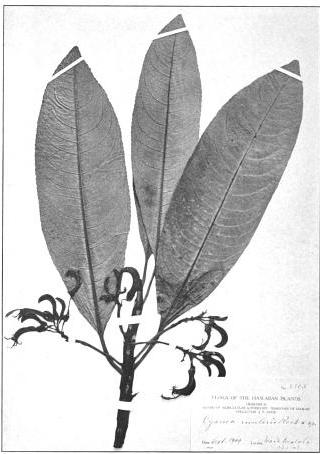 |
| CYANEA RIVULARIS RockType no. 5365 in the College of Hawaii Herbarium. |
page 219
Cyanea hirtella (Mann) Rock Delissea hirtella H. Mann Enum. Haw. Plants in Proc. Am. Acad. VII:179, n. 258. 1868. Cyanea communis Rock Coll. Hawaii Publ. Bull. 2:41. 1913. (Plates 115, 116, 117.)
Plant single-stemmed, erect, not branching, fleshy, but woody towards the base, hirsute in the upper portion, 4-30 dm high, leaves pale green, ovate-oblong, acuminate at both ends, chartaceous, irregularly serrate to dentate with the exception of the base proper, glabrous or slightly hispidulous above, pubescent underneath or only along the prominent veins and midrib, young leaves hirsute on both faces, 10-20 cm long, 3-5 cm wide, on hirsute petioles of 2.5-6 cm; racemes arranged all along the naked stem and in the axils of the leaves; peduncle 1.5-3 cm, hirsute, occasionally with foliaceous bracts, or naked, or with a few knobby scars at the end, 3-7-flowered, pedicels slender, hirsute, 6-12 mm; calyx ovoid, puberulous, the lobes one third its length or less, acute, triangular; corolla pale purple to pink, slightly curved, tomentulose, 30 mm long, 4 mm wide, very thin, the dorsal slit extending only one third its length, or even less, the lobes unequal, linear; staminal column glabrous as are the bluish anthers; fruit ovoid to globose, dark orange colored 10-16 mm in diameter, crowned by the calycine lobes; seeds smooth, shining, reddish brown.
KAUAI: Mountains above Waimea, Mann and Brigham no. 574 in the herbarium of the Bishop Museum, and Gray Herbarium; — Waimea, August 30, 1895, A. A. Heller no. 2769 in Gray Herbarium, and herbarium of the Bishop Museum; — Lehua Makanoe-Kaholuamano, September 1909, Rock no. 4885 in the herbarium of the College of Hawaii; — Waialae Valley, September 1909, Rock no. 5942, Kaholuamano, August 1909, Rock no. 5359, September 1909, Rock no. 5658, October 1911, Rock no. 8865, October 1916, Rock nos. 12784 and 13103 in the herbarium of the College of Hawaii, and nos. 5359, 5658 in Gray Herbarium; — Kaholuamano, fruiting October 20, 1916, A. S. Hitchcock nos. 15353 and 15371 in the U. S. National Herbarium; — Waialeale, October 22, 1916, A. S. Hitchcock no. 15843 in the U. S. National Herbarium.
Horace Mann records this species as a branching shrub twenty feet in height; like Heller, the writer saw only plants about 10 feet in height.
Cyanea hirtella is a very variable plant; as has already been remarked under C. Knudsenii, the writer's C. communis is identical with Mann's Cyanea hirtella, although the former includes specimens with calycine lobes much longer than those in the typical C. hirtella. The latter occurs along streambeds together with Cyanea leptostegia and Cyanea spathulata, while those with longer calycine lobes, shorter and pale leaves, and pale midribs occur at the high plateau and up to Waialeale in the dense swampy forests. The specimens from the latter locality may represent a variety of Cyanea hirtella. It is the only Cyanea that occurs on Mt. Waialeale proper.
Cyanea rivularis Rock The Indig. Trees Hawaii. Isl. add. 511. 1913. (Plate 118, 119.)
A shrub 4-5 m high, stem stimple or branching at the base, leaf whorls at the end of the tomentose branches; leaves linear-oblong, bluntly acuminate at both ends, crenate or serrate with callous teeth, 20-30 cm long by 3-8 cm wide, pubescent above, densely velvety tomentose underneath, and pale, on tomentose petioles of 4-8 cm long, whole inflorescence tomentose including the blue corolla, peduncle 4-8 cm long, naked two thirds of its length, many flowered, the pedicels 1-1.5 cm, bracts linear subulate; calyx dark purplish green, its teeth sharply
page 220
| PLATE 119. |
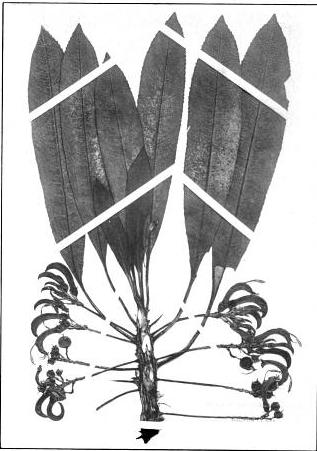 |
| CYANEA RIVULARIS RockA narrow-leaved form of the species; the plants with narrow leaves are taller than those with broad leaves. |
page 221
triangular; corolla 3-4 cm long, light pale to whitish with dark ultramarine blue streaks, velvety tomentose with short white hairlets, the dorsal slit extending one third its length, curved, with a knob in the bud showing the termination of the dorsal slit, lobes short; staminal column glabrous, white, anthers bright blue, slightly pubescent at the base, only the two lower ones penicillate, stigmatic lobes pubescent outside; berry dark bluish-black, globose 1-1.5 cm in diameter, crowned by the calycine teeth, seeds whitish, large, and somewhat minutely wrinkled.
KAUAI: Mountains above Waimea along streambeds at the high plateau only, elevation 4200 feet, Waiakealoha waterfall, flowering Septermber 1909, Rock type no. 6365 in the herbarium of the College of Hawaii, and co-type in Gray Herbarium; — Waialae Valley, flowering and fruiting October 15, 1911, Rock no. 9010 in the herbarium of the College of Hawaii, and in the Gray Herbarium; — Kaholuamano, flowering October 20, 1916, A. S. Hitchcock in the U. S. National Herbarium; — same locality, flowering October 1916, Rock no. 13104 in the herbarium of the College of Hawaii.
The only Cyanea with bright blue flowers; a very handsome species, distantly related to Cyanea hirtella, but of quite different aspect.
The steep walls at the head of Waialae Valley, in the heart of the island of Kauai, are covered with the tall graceful plants of this beautiful species. At Waiakealoha it is a much smaller plant; the leaves are rather variable, linear-lanceolate and broadly oblong acute forms can be found.
Cyanea undulata Forbes Occas. Pap. B. P. Bishop Mus. V:I, 12, 1912.
Single stem, 18-36 dm high; leaves lanceolate, entire, acuminate, undulating near the edges, or the edges sometimes irregularly turned over, the apex sometimes spirulate, coriaceous, hispidulous on the under side, the veins rusty tomentose underneath, 36 cm long, 4 cm wide, on rusty tomentose petioles, 5 cm long; flowers 5-6 in racemes, peduncle 3-4 cm long, pedicels 1 cm long, both rusty tomentose, flowers in the bud; calyx hirsute, cylindrical, the lobes triangular, acute, 4 mm long; corolla hirsute on the outside and inside, slightly curved, yellowish; staminal column hispidulous, 22 mm long; anthers elongate, glabrous, 7 mm long; berry obovate, yellow, 17 mm long, 11 mm thick; seeds obovoid, smooth, dark reddish-brown.
KAUAI: Damp woods surrounding the Wahiawa swamp, flowerbuds May 1908, J. M. Lydgate; — fruiting August 1909, C. N. Forbes no. 292-k in herbarium Bishop Museum.
The writer examined the type no. 292-k in the Bishop Museum, but the specimen is so badly eaten and in other ways so fragmentary that nothing can be done but to quote C. N. Forbes' description. J. M. Lydgate's specimen with flowerbuds is not in the Bishop Museum herbarium.
It probably belongs to this section with Cyanea recta and C. fissa from the same island.
page 222
| PLATE 120. |
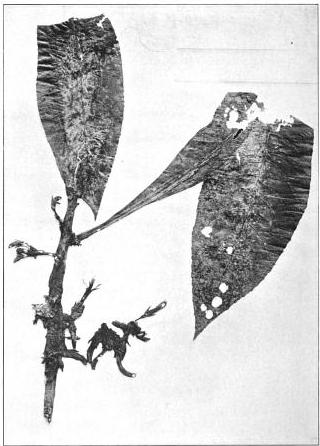 |
| CYANEA FISSA (Mann) Hillebr.Specimen in the Gray Herbarium, ex coll. Mann & Brigham no. 577. |
page 223
| PLATE 121. |
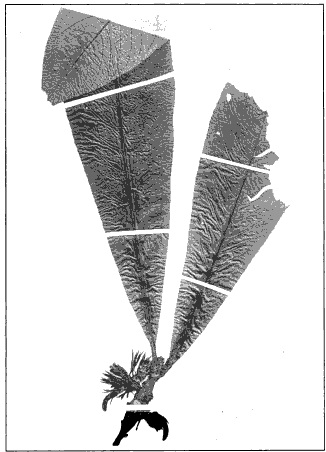 |
| CYANEA FISSA (Mann) Hillebr.Specimen in Herbarium Vienna, ex coll. Wawra no. 2187 (as Cyanea humilis Wawra). |
page 224
| PLATE 122. |
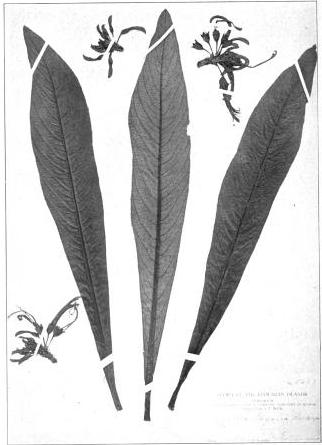 |
| CYANEA GAYANA RockType (no. 2463) in the College of Hawaii Herbarium. |
page 225
Cyanea fissa (H. Mann) Hillebr. Flora Hawaii. Isl. 255. 1888. Delissea fissa H. Mann, Enum Haw. Pl. in Proc. Am. Acad. VII:182, n. 271. 1868. Cyanea humilis Wawra in Flora od. Allgem. Bot. Zeit. XXXI:47. 1873. (Plates 120, 121.)
A branching shrub 3-4 m high; leaves obovate-lanceolate, 40.5 cm long, 9 cm wide, including the petiole in which they gradually merge, acuminate, crenate, glabrous above, sparsely hairy underneath, particularly along the rib and veins; peduncle covered with coarse glandular hairs as are the calyx and corolla, 2.5-5 cm long, 8-12-flowered; pedicels 12 mm, bracteolate; bracts 6-8 mm; calyx tube 6-8 mm, the acute narrow-lanceolate lobes as long or considerably longer; corolla pale purple, slightly curved or erect, slender, the lobes linear, the dorsal slit extending to the base; anthers glabrous.
KAUAI: Valleys of Kealia and Hanalei, flowering, Mann and Brigham no. 577 in the Gray Herbarium, and herbarium of the Bishop Museum; — Hanalei, Wawra nos. 2186 and 2187 (the latter as C. humilis) in Herbarium Vienna; — forests of Kealia to Hanalei, flowering, V. W. Hardy no. 13105 in the herbarium of the College of Hawaii.
Wawra's Cyanea humilis is identical with Cyanea fissa. The difference in the length of the calycine lobes and peduncle is not sufficient to warrant its separation, even as variety, from C. fissa.
The plant collected by Abbe Faurie and described by Léveillé as Cyanea Feddei was by mistake referred to Cyanea fissa by the writer; it is, however, identical with Cyanea sylvstris Heller.
Cyanea Gayana Rock in The Indig. Trees Hawaii, Isl. add. 510. 1913. (Plates 30, 122.)
Trunk 1-1.5 m high, hardly woody, erect, stem smooth, not branching (only when broken), foliose at the apex; leaves growing at almost right angles to the stem, thick fleshy, lanceolate oblong, bluntly acute, denticulate 28-35 cm long, 5-8 cm wide, gradually narrowing into a margined petiole of 1 cm, making it appear subsessile, the lower portion entire, dark green above, glabrous, veins and midrib bright red, thick fleshy, lighter underneath, and covered with a grayish pubescence; peduncles thick fleshy, multi-bracteate from the base, hispid-strigose, bearing flowers from half its length to the apex; pedicels densely hirsute, 1-1.5 cm long, bracteate at the base; calyx dark, hirsute as in the corolla, tube ovate-obconical, 6-8 mm, the lobes triangular dentiform, 4 mm; corolla, suberect magenta red with darker streaks, 3-4 cm long by 4 mm wide, the dorsal slit extending to the base; staminal column glabrous as well as the anthers, of the latter the two lower only penicillate; fruit ovoid, of a glaucous color, about 2-1.5 (?) cm long, crowned by the calycine teeth.
KAUAI: Mountains back of Waimea, woods of Kaholuamano, 4000 feet, along streams only, near Waialae and Waiakealoha, flowering March 10, 1909, Rock no. 2463 in herbarium College of Hawaii; — September 1909, fruiting, Rock & Forbes; — Waiakealoha, October 20, 1911, Rock no. 9015 (flowerbuds) in the herbarium of the College of Hawaii; — Waialae Valley, flowering September 1909, Rock no. 4893 in the herbarium of the College of Hawaii; — Kaholuamano, October 20, 1916, A. S. Hitchcock no. 15302 in U. S. National Herbarium.
This specimen was named in honor of Mr. Francis Gay of Kauai. It grows in company with Cyanea recta, Cyanea spathulata, Hillebrandia, Clermontia Gaudichaudii, Cyrtandra and others.
page 226
| PLATE 123. |
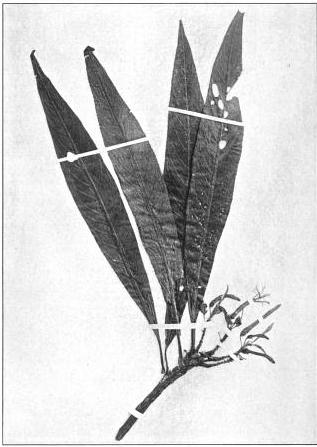 |
| CYANEA RECTA (Wawra) Hillebr.Type in Herarium Vienna, ex coll. Wawra no. 2062 (as Delissea recta Wawra). |
page 227
Cyanea Gayana is closely related to Cyanea fissa, from which species it differs in the much shorter calycine teeth, shorter, multi-bracteate peduncles, and peculiar habit of growth, being single stemmed, while Cyanea fissa s a much branching shrub of often more than 4 m in height.
Cyanea recta (Wawra) Hillebr. Flora Hawaii. Isl. 255. 1888. Delissea recta Wawra in Flora od. Allgem. Bot. Zeit. XXXI:30. 1873. (Plate 123.)
Stem short, simple; leaves broadly lanceolate, bluntly acuminate, entire, denticulate, gradually narrowing into a petiole of 2.5-3.5 cm, glabrous above, pubescent below especially along the veins and midrib, about 25 cm long, 3-5 cm wide, peduncle twice as long or of same length or even shorter than the petiole, squamose; pedicels 1.75 cm, filiform, slightly pubescent, calyx globose, the size of a pea, five-toothed with short acute patent teeth; corolla slender, pubescent as is the calyx, 3.5-4 cm long, purplish with lighter stripes, erect, or curved in the bud, the dorsal slit extending beyond the middle; staminal column glabrous, the lower anthers bearded; stigmatic lobes orbicular, ciliate; berry subglobose, larger than a pea; seeds brown smooth shining.
KAUAI: Forests of Kealia, flowering, Wawra no. 2062 in Herbarium Vienna; — near Waiakealoha, central plateau of Kauai, elevation 4600 feet, flowering October 1911, Rock no. 10355 in the herbarium of the College of Hawaii.
A distinct species closely related to Cyanea Gayana, Cyanea fissa and Cyanea hirtella.
It is very distinct from Heller's Cyanea sylvestris and has nothing in common with Cyanea angustifolia var. δ as Hillebrand suggested.
Cyanea Larrisonii Rock in Torrey Bot. Cl. Bull. XLII:77, pl. VIII. 1915. (Plate 124.)
Stems fleshy, apparently not branching, foliose at the apex, puberulous; leaves linear-lanceolate, acuminate at both ends, minutely mucronate, pale whitish underneath, light greeen above, glabrous on both surfaes, midrib and veins prominent below, chartaceous, 20-23 cm long (including a puberulous petiole of 15-18 mm), 12-20 mm wide, entire or minutely denticulate in the upper third; raceme 1 cm long, 4-6-flowered, bibracteate at the middle; bracts 12 mm by 1 mm; pedicels 5-6 mm long; calyx subglobose, dark purplish-black, 5 mm, minutely toothed, tomentulose; corolla slender, 3 cm long, 3.5-4 mm wide, dark bluish-black, slightly curved, the dorsal slit extending beyond the middle, tomentose, especially near the apex; staminal column dark purple, glabrous, with a patch of purplish hairs at the base, anthers glabrous, pale, with purplish streaks, the two lower only tufted at the apex; stigma minutely two-lobed scarcely protruding; berry (immature) globose, purplish-black.
KAUAI: Upper Hanalei Valley, on ridge between Hanalei and Kalihinui, elevation 1800 feet, flowering October 17, 1914. G. K. Larrison no. 10342 type in the herbarium of the College of Hawaii.
A striking species somwhat related to Cyanea recta. The corolla is only slightly curved and almost black. It was named in honor of Mr. G. K. Larrison, who discovered it while making a water survey of Hanalei stream.
page 228
| PLATE 124. |
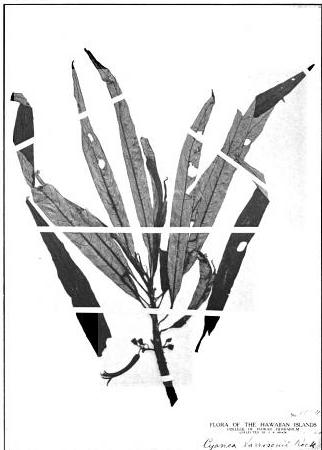 |
| CYANEA LARRISONII RockType no. 10342 in the College of Hawaii Herbarium. |
page 229
| PLATE 125. |
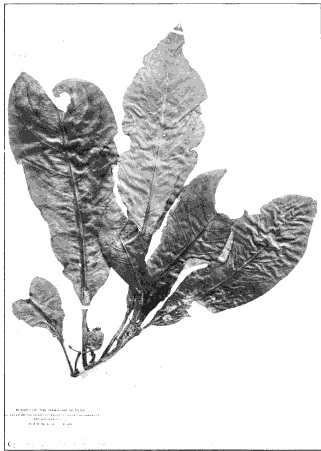 |
| CYANEA SYLVESTRIS HellerSpecimen in Gray Herbarium, ex coll. A. A. Heller no. 2691. |
page 230
| PLATE 126. |
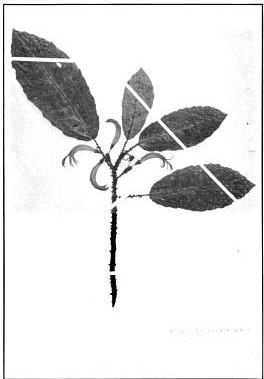 |
| CYANEA NOLI-ME-TANGERE RockType in herbarium College of Hawaii. |
page 231
Cyanea sylvestris A. A. Heller in Minnes. Bot. Stud. IX:909. 1897. Cyanea Feddei Lévl. in Fedde Repert. Spec. Nov. X:10/13, 156. 1911. (Plate 125.)
An unbranched shrub 1.3-2.6 m high, with a trunk 2.5-5 cm in diameter, leaves large, disposed at the summit of the erect stem, lanceolate or ovate lanceolate, 30-35 cm long, 7.5-10 cm wide, thick, glabrous, light green and shining above, paler beneath, serrulate, acute, narrowing below into a stout petiole, veins prominent on both sides, the midrib raised on the upper side, flat and broad on the lower side; petioles 2.5-5 cm long; inflorescence somewhat pubescent with short, brownish hair, flowers mostly in the axils of the upper leaves; peduncles shorter than the petioles, several flowered; calyx subcampanulate, the lobes narrowly lanceolate, much shorter than the tube; corolla nearly 5 cm in length, slender, curved, purple; staminal column glabrous; berry yellow, obovate, 4.37 cm in length, with a diameter of about 1.25 cm, crowned by the persistent style; seeds brown, very glossy.
KAUAI: Wet woods near the Wahiawa river, at elevations of 2500-3000 feet, always found back in the forest, never in open places, fruiting (flowerbuds) August 8, 1895, A. A. Heller no. 2691 in Gray Herbarium; — ridge west of Hanapepe river (undeveloped flowerbuds), August 1895, Heller no. 2494; — Hanapepe Valley, fruiting July 23, 1895, A. A. Heller no. 2607 in Gray Herbarium; — Kauai, fruiting March 1910, U. Faurie no. 567 in Herbarium Léveillé and herbarium of the College of Hawaii (as Cyanea Feddei Lévl.); — Olokele canyon, flowerbuds, October 18, 1916, Rock no. 13106 in herbarium of the College of Hawaii; — same locality, A. S. Hitchcock, October 18, 1916, no. 15232 in U. S. National Herbarium and part in herbarium College of Hawaii.
This is a very distinct species, and while the leaves are perfectly glabrous on both sides, the flowers are of the same type as C. hirtella and the other species of the section Hirtellae.
SECT. IV. CYANEAE GENUINAE Hillebr.
SUBSECTION GLABRIFLORAE
Cyanea noli-me-tangere Rock in Torrey Bot. Cl. Bull. 44:229, plage 9. 1917. (Plates 54, 126.)
Plant subherbaceous, 3-20 dm high, terrestrial, branching only when broken, spinescent throughout, with the exception of the fruit and corolla; stem green, somewhat flesy, entirely covered with strong, pale yellow, hollow spines; leaves bright green, ovate-oblong, somewhat acute at the apex, rounded at the base, thin in texture, irregularly and sinuately notched, with minute, mucronulate teeth along the margin, covered with yellow spines at more or less regular intervals of 7-10 mm on both surfaces, 9-21 cm long, 4-7.5 cm wide, on spinescent petioles 1.5-4 cm in length, glabrous or slightly pubescent; inflorescence axillary, the spinescent peduncle 2-2.5 cm long, multribracteate two thirds of its length; pedicels 6-10 mm long when in flower, 20 mm when in fruit, pubescent with whitish hairlets; calyx similarly pubescent, calycine lobes triangular, acuminate, 3 mm long corolla greenish white, slightly pubescent, strongly curved, 4 cm long, of unequal width, broadest portion (7 mm) beyond the dorsal slit, the latter extending one third the length of the corolla, upper corolla lobes 12 mm long, the three lower 8 mm long; staminal column green, glabrous, as are the anthers, only the two lower being penicillate; stigma pubescent; fruit orange-colored, pubescent, ovoid, 1 cm long; seeds dark brown, shining.
page 232
| PLATE 127. |
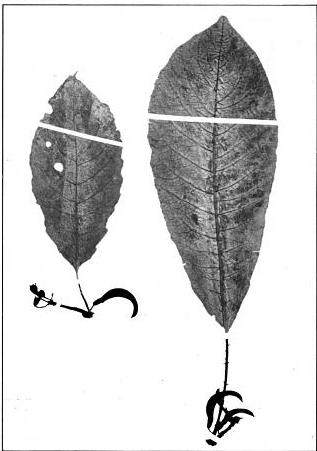 |
| CYANEA PLATYPHYLLA (Gray) Hillebr.Specimen ex coll. Hillebrand in Berlin Herbarium. |
page 233
HAWAII: Terrestrial, in the forests of Glenwood, usually in the more or less uniform fern forest at an elevation of 3500 feet, fruiting March 20, 1908, H. L. Lyon no. 8847 in the herbarium of the College of Hawaii; — same locality, flowering December 23, 1914, Rock & Copeland (type) no. 10351 in herbarium College of Hawaii; — near Kalanilehua, elevation 3000 feet, (flowerbuds) August 27, 1917, Rock n. 12834 in the herbarium of the College of Hawaii; — east of Honaunau Mountains, 2000-3000 feet, September 4, 1916, A. S. Hitchcock no. 14569 in the U. S. National Herbarium.
MAUI: In the rainforest on the northwestern slope of Mt. Haleakala, along the Honomanu trail, April 1911, Rock no. 8796-a in the herbarium of the College of Hawaii.
Cyanea noli-me-tangere differs from Cyanea scabra in the spinescent leaves and in the corolla lobes, which are smooth instead of scabrous. The corolla lobes are usually smooth; only in one plant, no. 12834, could the writer detect a murication of the corolla lobes in the bud. Muricate corolla lobes are evidently not a very reliable character, similar to the variability of the length of the calycine lobes.
Cyanea platyphylla (Gray) Hillebr. Flora Hawaii. Isl. 164. 1888. Delissea ? platyphylla A. Gray Proceed. Am. Acad. V:148. 1862. (Plate 127.)
Stem slender, 1-1.6 m high, fleshy or somewhat woody at the base, often only 60 cm tall, covered in its upper portion with short and sharp pale spines; leaves obovate-oblong 20-45 cm long, 8-20 cm wide, on prickly or muricate petioles of 5-10 cm, obtuse to acute at the apex, contracted at the base, midrib and veins prominent underneath, wavy or sinuate, denticulate, glabrous above, puberulous underneath, rather fleshy; peduncle muricate or unarmed, naked, or distantly bracteate below, or covered with leaf-scars, many flowered at the apex, 2.5-3 cm long; the slender pedicels 12-25 mm, bracts 4-8 mm, often foliaceous; calyx glabrous, the tube cylindrical 6-8 mm, the lobes dentiform or subulate 3-4 mm; corolla white, thin glabrous or pubescent along the nerves and apex, falciform or often semierect, 5 cm long, 6-8 mm wide; staminal column pale, glabrous; berry ovoid 8 mm; seeds crustaceous, reddish, smooth.
HAWAII: District of Puna, U. S. Exploring Exped., not in Gray Herbarium; — Puna and lower woods of Hilo, April 1870, Hillebrand in Herbarium Berlin; — Hilo? (Delissea Hawaiiensis) Hillebrand no. 168 in Herbarium Berlin; — Hilo, April 1871, Hillebrand in herbarium Bishop Museum; — woods of Hilo, flowering July 1912, Rock no. 10260 in the herbarium of the College of Hawaii; — above Hilo, flowering December 1912, Bro. Math. Newell no. 10259 in the herbarium of the College of Hawaii; — Puna, Kalapana road, flowering September 3, 1917, Rock no. 12832 in the herbarium of the College of Hawaii.
C. platyphylla belongs to the group of C. scabra and C. noli-me-tangere, but is quite distinct from either. It is only found in the lower forest region on the windward side just a few hundred feet above sea level.
Hillebrand's no. 168 bears the remark: — Determined at Kew as Rollandia Humboldtiana. A. Gray's remark that it resembles Gaudichaud's Rollandia crispa is certainly erroneous; they can be distinguished at a glance. The murication on the peduncle and petioles as well as on the stem varies as in C. scabra.
page 234
| PLATE 128. |
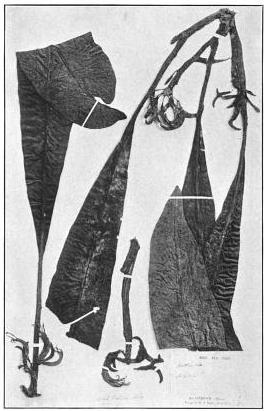 |
| CYANEA FERNALDII RockCo-type in herbarium Museum Paris. |
page 235
The presence of scabrosity on the corolla lobes in Puna specimens of this species, make C. platyphylla little remote from Cyanea scabra.
Cyanea Fernaldii, C. platyphylla, C. noli-me-tangere, Cyanea profusa, C. scabra and C. rollandioides are so closely related to each other that they may be looked upon as one very polymorphic species. Their habit of growth is, however, quite different, in some instances at least, which permit us to recognize them as distinct species. One could trace a species through a number of others even to species belonging to other sections. What Cyanea platyphylla is on Hawaii or Cyanea scabra, for instance, on Maui, Cyanea angustifolia is on Oahu, with its many relatives on Maui, Lanai, and its main relatives or, better said, ancestors in Cyanea coriacea, C. spathulata, C. Fauriei and C. Hardyi on Kaui. They all form a continuous chain, but leaves isolated the older species of the section palmaeformes as Cyanea leptostegia, C. arborea, C. Giffardii, etc., probably the oldest Lobelioideae of the Hawaiian Islands.
The lobed forms of C. scabra unite that species with C. holophylla, C. solanacea, C. lobata to C. ferox, and again from C. ferox to C. asplenifolia to C. Grimesiana, the true pinnate type of Cyanea. The varieties of the latter species, especially C. Grimesiana cylindrocalyx, make this circle perfectly complete.
Cyanea Fernaldii Rock in Torrey Bot. Cl. Bull. 44:231, pl. 11. 1917. (Plate 128.)
Leaves lanceolate-oblong, thin in texture when dry (chartaceous), dark green above, paler underneath, with prominent midrib, subentire with somewhat wavy margin, minutely and closely denticulate, bluntly acuminate at the apex, 34-40 cm long, puberulous on both sides, the apparently fleshy petioles 12-19 cm or more in length, near the blade of the leaf showing signs of murication; peduncle fleshy (apparently), nearly as long as the petioles, 8-10 cm long or a little more, naked its entire length, pubescent with round scars near the apex; bracts foliaceous, 3.5 cm long, dentate, only present at the apex of peduncle; pedicels short, filiform, 12-15 mm long, pubescent; calycine lobes triangular, 2.5 mm long, the ovarian portion of calyx 7 mm long, oblong, nearly cylindrical, pubescent; corolla evidently white, pubescent outside, slightly curved, 4 cm long, 6 mm wide, glabrous inside, the lobes not muricate; staminal column glabrous, as well as anthers, the lower only penicillate; fruit unknown.
HAWAII: Without definite locality, 1851-1855, J. Remy no. 301, type in the Gray Herbarium, and co-type in Herbarium Museum Paris; — Waipio Valley, flowering July 1909, Rock no. 4663 in the herbarium of the College of Hawaii.
The specimen in the Paris Museum, a photograph of which is here reproduced, is labeled Rollandia and Delissea; the duplicate in the Gray Herbarium is marked Rollandia Humboldtiana Gaud. That the species is not a Rollandia is evident by the free staminal column, while the absence of dorsal knobs would separate it from Delissea. The species belongs, in fact,, to the section Cyaneae genuinae and comes exceedingly close to Cyanea platyphylla Hillebr., differing in the long, narrowly oblong leaves and in the exceedingly long peduncles; otherwise the two species correspond closely.
The plant is named for Professor Fernald of the Gray Herbarium, to whom the writer is indebted for many favors received and especially for the loan of this particular species. The type is in the Gray Herbarium, Remy no. 301. The
page 236
| PLATE 129. |
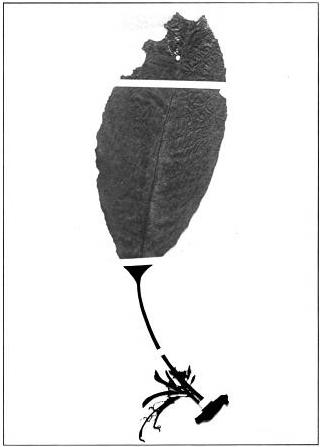 |
| CYANEA PROFUGA ForbesCo-type in the College of Hawaii Herbarium, ex coll. C. N. Forbes no. 313 Mo. |
page 237
writer had at first drawn up a description from the specimen in the Paris Museum, which is much better than the type specimen. Unfortunately the description was in some way lost after the specimen had been returned to Paris. Professor Fernald then sent him again the one in the Gray Herbarium, from which the description is drawn. The illustration represents the much more complete specimen in the Paris Museum.
The writer's specimens from Waipio Valley, no. 4663, are doubtfully referred to this species; they come very close to it and are perhaps intermediate between Cyanea platyphylla and C. Fernaldii. Asa Gray states in his description of C. platyphylla, peduncles short; those of Cyanea Fernaldii and in the writer's no. 4663 are long (10 cm). The petioles are also very long (12-19 cm).
Cyanea profuga Forbes in Occas. Pap. B. P. Bishop Museum VI, no. 3. 70, with plate. 1916. (Plate 129.)
Stem simple, 18-24 dm high; leaves broadly elliptical, acuminate, acute at the base, undulate, somewhat irregularly so, glabrous, pale whitish below, chartaceous, 23.4 cm long, 9.8 cm wide, on petioles of 12.2 cm in length; peduncle naked below, glabrous, 9-12 flowered, 2.8-4.1 cm long, the pedicles 9-10 mm long; calyx cylindrical to obconical, glabrous, the tube 7 mm long, the lobes oblong with rounded apex, 5 mm long; corolla white, slender, suberect, glabrous, with dorsasl slit nearly to the base, 3.4 cm long; staminal column and anthers glabrous; berry not seen.
MOLOKAI: Mapulehu Valley, flowering July 1912, C. N. Forbes (type) no. 313 Mo. in the herbarium of the Bishop Museum and co-type in the herbarium of the College of Hawaii.
The species is quite distinct, but seems to be more closely related to Cyanea platyphylla than to C. acuminata, as suggested by Mr. Forbes; the corolla is more slender than in the former species, but the leaves and the aspect of the plant would show a relationship with that species.
Cyanea rollandioides Rock in Torrey Bot. Cl. Bull. 45:135. 1918. (Plate 130.)
Plant 1-1.5 m high, stem simple, fleshy towards the apex, woody towards the base, stem muricate to spinose in the upper portion; leaves obovate-oblong, acute, fleshy when fresh, papery when dry, dark green above, paler underneath, but with dark purple midrib and veins and a prominent dark purple reticulate network, puberulous or glabrous on both surfaces, but more or less covered with spines on both sides, those of the upper surface yellow, those of the lower surface deep purple, margins eroso-dentate to irregularly notched, and somewhat uneven-sided at the base, 30-50 cm long, 8-15 cm wide in the widest portion, which is in the upper third, on fleshy stout spinose or muricate petioles, 8-15 cm long; racemes glabrous, peduncle 3-6 cm long, naked three fourths its lower length, but distantly covered with scars of fallen flowers, bearing in its upper fourth about fifteen flowers; bracts subulate, 3 mm long, supporting each pedicel, the latter filiform, 10-25 mm long, bibracteolate, the bracteoles alternate, one at about the middle of the pedicel, the other near the apex, 0.25 mm long; calyx tube turbinate to obovate-oblong, 7-10 mm high, the linear calycine lobes as long as the tube; corolla deep purplish red or purple to pale yellowish white with dark purplish streaks, moderately arcuate, broadest at the middle, 5-8 mm, about 4.5 cm long, thin and glabrous, dorsal slit very shallow, extending only one fourth the length of the tube or a little beyond the two upper linear subulate lobes, the three lower lobes a little shorter; staminal column glabrous, as are the pale greenish anthers, the lower ones only penicillate; fruit unknown.
page 238
| PLATE 130. |
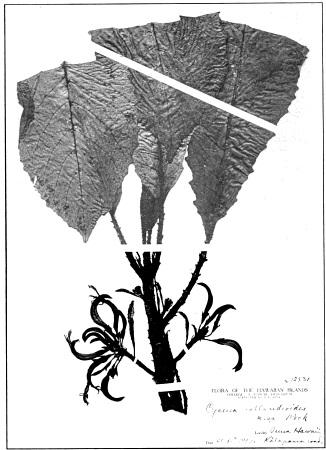 |
| CYANEA ROLLANDIOIDES RockType in the herbarium of the College of Hawaii. |
page 239
HAWAII: Forests of Puna in dense woods along the Kalapana road not far from Pahoa, flowering Setember 3, 1917, Rock & Newell (type) no. 12831 in the herbarium of the College of Hawaii.
This rather variable species is remarkably like a Rollandia. The plant varies considerably in the spinosity of the leaves, petioles and stems; some of the specimens almost approach Cyanea noli-me-tangere Rock in spinosity, while others are only muricate. The color of flowers is also variable, ranging from pale yellowish white with deep purplish streaks to entire dark purple. In habit it approaches Rollandia lanceolata, but actually seems to come close to Cyanea noli-me-tangere; from the latter it differs in the long-petioled leaves, which are much larger, and in the longer naked peduncles which are not spinose. The plant as a whole is much larger in every way, the flowers are purple, as are the veins and midrib of the leaves; the whole inflorescence is glabrous. Cyanea noli-me-tangere is very loosely foliate, while C. rollandioides is simple-stemmed and has at its apex a dense crown of leaves. It seems that its closest congener may be looked for in Cyanea platyphylla, and it is on that account that it is placed into this section, rather than in section palmaeformes.
The plants grow in the wet forests of Puna, on Hawaii, a little explored district and one of the most primitive regions on the island of Hawaii. A stalwart Hawaiian gave the writer the native name Aku-aku for the species in question, of which he said the leaves were cooked with meat and eaten like cabbage. The name Aku alone is applied to Cyanea tritomantha, to which our plant has no resemblance. The species was collected in company with Brother Matthias Newell of Hilo, an ardent naturalist.
Cyanea ferox Hillebr. Flora Hawaii. Isl. 259. 1888. Cyanea armata sp. n var. pinnatifida Hillebr. MSS. in Herb. Berlin. (Plates 131, 132.)
"Size and habit of Cyanea solonacea Hillebr., the branches bristling with thorns; leaves of young plants bipinnatisect, to the rhachis in the lower portion, and covered with spines; those of the adult plant oblanceolate in outline 25-30 cm by 7.5-10 cm, deeply cut into patent oblong sinuate segments of 2.5-5 cm in depth which shorten to auricles at the base, on petioles of 3.75-5 cm, papilloso-hispid on the upper, scabro-hispid on the lower face, thick chartaceous, with prominent nerves, not aculeate; peduncle (with buds) 2.5 cm long, floriferous at the end; calyx muricato-hispid, the lobes one-nerved, oblong, obtuse, apiculate, longer than the tube, 12 mm, corolla coarsely hairy."
MOLOKAI: Mountains back of Kamolo, anno 1870, Hillebrand in Herbarium Berlin; — leaves only ex coll. Hillebrand in herbarium Bishop Museum; — heights of Waikolu near the type locality, March 1910, Rock no. 8794 in the herbarium of the College of Hawaii; — heights of Kamole, flowering August 9, 1918, Mrs. L. M. Dunbar, no. 13117 in herbarium College of Hawaii.
Hillebrand evidently did not label his specimens with the final name under which he published his species, or the authorities of the Berlin Herbarium were not at all careful in the distribution of the duplicates of his Hawaiian plants. Hillebrand's material should have been kept together, but as it is, his collection is now scattered to the four winds; even types are missing, and Hillebrand's original labels have been discarded and replaced by Berlin Herbarium labels;
page 240
| PLATE 131. |
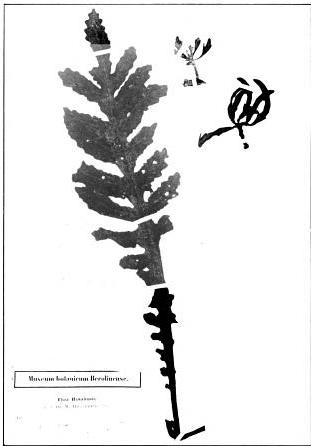 |
| CYANEA FEROX Hillebr.Type in Herbarium Berolinense, ex coll. Hillebr. |
page 241
| PLATE 132. |
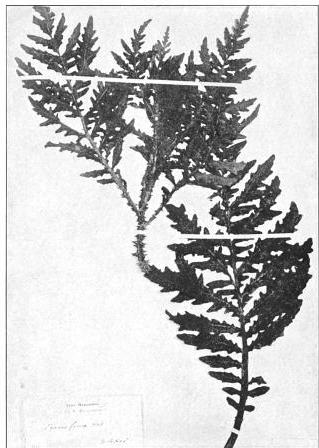 |
| CYANEA FEROX? Hillebr.Specimen in Herbarium Berolinense, ex coll. Hillebr. A young plant, but if belonging to C. ferox is not certain. |
page 242
| PLATE 133. |
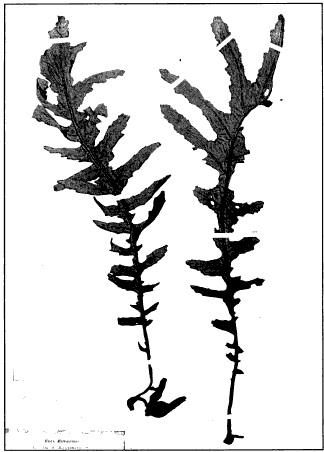 |
| CYANEA FEROX HORRIDA RockSpecimen in Herbarium Berolinense, ex coll. Hillebr. (Cyanea ferox β var.). |
page 243
| PLATE 134. |
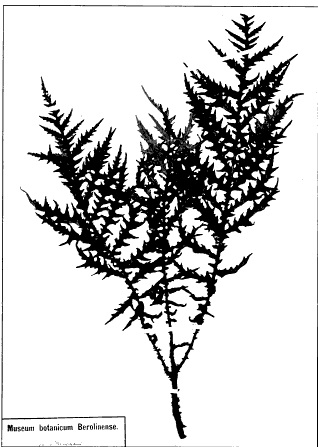 |
| CYANEA FEROX? HORRIDA RockSpecimen in Herbarium Berolinense, ex coll. Hillebrand (C. ferox β var.).Young plant; if belonging to C. ferox horrida, is not certain. |
page 244
| PLATE 135. |
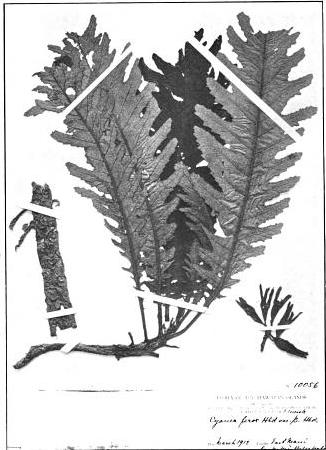 |
| CYANEA FEROX HORRIDA RockSpecimen no. 10056 in the College of Hawaii Herbarium. |
page 245
plants have been misidentified by inexperienced botanists, and thus Hillebrand's collection is not half as valuable as it was. Specimens of one species, coming from different localities, have been separated and only one retained, instead of keeping them together for comparison, a thing so necessary with Hawaiian plants on account of their polymorphism. We find what is to be regarded as the type of Cyanea ferox, labeled Cyanea armata var. pinnatifida from Kamolo, Molokai. The description of Cyanea ferox fits this specimen only; besides, there is no specimen labeled Cyanea ferox in the Hillebrand Herbarium. From his description of that species we learn that he had flowerbuds only and the specimen here figured corroborates this fact. There is another sheet in the Hillebrand Herbarium containing young leaves of Cyanea ferox and labeled as such.
The writer collected this species at the heights of Waikolu, but it was neither in flower nor in fruit. Mrs. L. M. Dunbar collected this species recently with flowerbuds; it evidently flowers in the late summer or autumn.
There seems to be some doubt as to the validity of the varieties of Cyanea solanacea, and of the species Cyanea ferox and its variety from East Maui. Further exploration will have to decide the question. The straightening out of Hillebrand's own material will serve as a good basis to build upon intelligently. The thinner leaves labeled Cyanea ferox ex coll. Hillebrand-Lydgate in the Bishop Museum are probably referable to the var. β of that species from East Maui. The leaves of the Molokai specimen are of thick texture.
Cyanea ferox horrida Rock in Torrey Bot. Club. Bull. 44:235. 1917. Cyanea ferox β var. Hillebr. Flora Hawaii. Isl. 259. 1888. (Plates 133, 134, 135.)
"Leaves thinner, pinnatisect to near the rib; berry glabrate and smooth, ovoid 7 lin. (14 mm) long, the linear-oblong lobes 14-18 mm; pinnae or segments of the leaves in young plants separated by small lobules or auricles."
MAUI: Ulupalakua, Makawao, Hamakua, Hillebrand no. 55 in Herbarium Berlin, and herbarium Bishop Museum; — Haleakala south, February 1862, sine flor. v. fruct., Hillebrand in Herbarium Berlin; — crater of Puukakai, elevation 4500 feet, along watercourses, quite abundant in company with Cyanea hamatiflora, Rubus Hawaiiensis, etc. fruiting March 1912, Rock & Ceresole no. 10056 in the herbarium of the College of Hawaii.
The writer collected this variety in the type locality, on the western slopes of Mt. Haleakala in the wet forest, on the crater of Puukakai. The following is a description of the writer's material from Puukakai:
A branching shrub 18-22 dm high, branching usually at the base, trunk and branches covered with thorns; leaves all pinnatisect, crowded at the apex of the branches; peduncles arranged all along the branches for about 25 cm, four to five-flowered, bracteate at the apex, bracts 5 mm; pedicels 10 mm, bracteolate at the middle; flowers unknown; berry ovoid to oblong 20-25 mm, bright yellow, crowned by the calycine lobes.
It is very doubtful, however, if the Maui plant is a variety of Cyanea ferox from Molokai; it would rather appear from the habit of the two plants that the latter represents a distinct species (Cyanea horrida Rock), but as no mature flowers are known of either at present, the varietal rank may be adhered to.
page 246
| PLATE 136. |
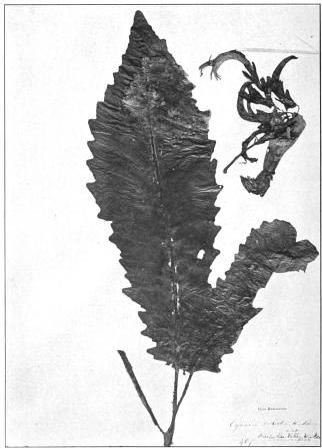 |
| CYANEA LOBATA H. MannType in Cornell Herbarium, ex coll. Mann & Brigham no. 467. |
page 247
Cyanea lobata H. Mann Proceed. Am. Acad. VII:183, no. 276. (Plate 136.)
"A branching shrub 1.3-2.3 m high, sparsely muricate or aculeate, or unarmed; leaves obovate or elliptical oblong, 45-50 cm long, 15-17.5 cm wide, irregularly cut into broad triangular lobes, acuminate, narrowing at the base, glabrous, membranous, on petioles of 10-17.5 cm long, these and the midrib generally with some scattering conical spines, peduncle 6.25-7.5 cm long, bracteate from the base, many flowered, the pedicels 2.5-3.75 cm long, the bracts linear, 8-12 mm, often foliaceous; calyx tube obconical 12 mm, its lobes 18-24 mm foliaceous, 5-9-nerved, net-veined and denticulate, oblong obtuse, mucronate; corolla 5-6.25 cm long, 3.5 lin. (7 mm) wide, glabrous and smooth, white below, purplish above; stamens glabrous; anthers purplish, the upper ones ciliate at the apex; berry yellow, globose; seeds yellowish."
MAUI: West Maui, valley of Waihee, Mann and Brigham no. 467 in the herbarium of Cornell University, and Gray Herbarium; — Kaanapali, Honokahau, Wailuku and elsewhere. (Kaanapali) August 1870, Hillebrand in Herbarium Berlin and part in the herbarium of the College of Hawaii.
Hillebrand's specimen bears in his handwriting the name Cyanea (armata) and in fresher ink, lobata Mann. It agrees exactly with Mann's plant in the Cornell Herbarium, only the leaves seem to be narrower and on longer petioles. It is undoubtedly very close to Cyanea Grimesiana, as it has also the upper anthers ciliate, as is the case in C. Grimesiana.
Cyanea lobata hamakuae Rock Cyanea lobata β var. Hillebr. Flora Hawaii. Isl. 257. 1888.
"Stem quite prickly, leaves 30 cm long, 15 cm wide, more deeply lobed; tubes of calyx 6 mm, its lobes 10-12 mm; lobes of corolla muricate."
MAUI: East Maui, Hamakua, Lydgate, no specimen is extant; — Nahiku, September 1909, U. Faurie no. 670 in Herbarium Léveillé and the herbarium of the College of Hawaii.
No specimen of this variety is to be found in any of the herbaria. Abbé Faurie's specimen is very fragmentary, but seems to belong here; the calycine lobes are shorter than in the species, and the leaves are deeper lobed, but the corolla lobes are smooth. The writer's no. 10350 may belong here; it was collected near Keanae, East Maui, in May, 1911; it was without flower or fruit.
Cyanea Grimesiana Gaud. Bot. Voyage Uranie, 457, t. 75. 1826. (Plate 137, 138.)
A stout, branching shrub or often also single-stemmed and not branching, 1-3.3 m high, aculeate at the base, the stem hollow; leaves broadly oblong in outline, 30-45 cm long, 20-30 cm wide, on muricate or prickly petioles of 7.5-20 cm, pinnate below, pinnatisect toward the apex, the pinnae 9-12 on each side, broadly sessile, often separated by small lobules, lanceolate, entire or sinuate, 12-30 cm broad, the lowest diminishing to mere auricles, membranous, glabrous; raceme 5-7.5 cm long, bracteate from near the base, 6-10 flowered in the upper half; pedicels 2.5-3.75 cm; bracts lanceolate 12 mm; ;calyx glabrous, the tube obconical, 12-16 mm long, the lobes broad foliaceous, crisp and brittle, 20-36 mm long, 8-12 mm wide, many nerved and net-veined, acute; corolla falciform, nearly 7.5 cm long and 1.25 cm wide, whitish or light purple or lilac, with deeper stripes, glabrous, but the lobes sometimes warty; staminal column glabrous, of the same color, the upper anthers tufted at the apex with long and stiff hairs; berry large, obconical 2.5-3.75 cm, orange colored, crowned with calycine lobes.
page 248
| PLATE 137. |
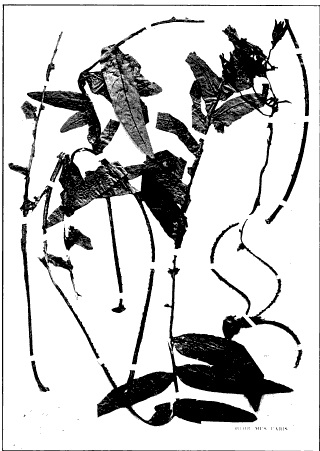 |
| CYANEA GRIMESIANA Gaud.Type ? in herbarium Museum Paris, ex coll. Gaudichaud no. 143. |
page 249
| PLATE 138. |
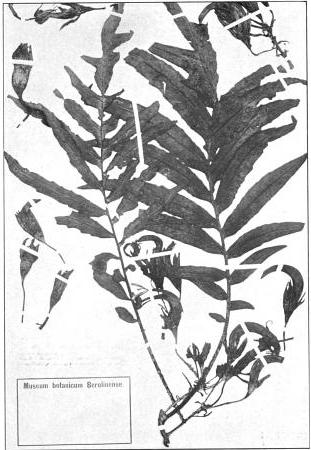 |
| CYANEA GRIMESIANA Gaud.Specimen in Herbarium Berolinense, ex coll. Hillebrand. |
page 250
| PLATE 139. |
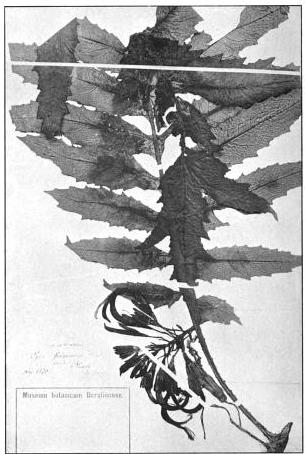 |
| CYANEA GRIMESIANA MAUIENSIS RockType in Berlin Herbarium. |
page 251
OAHU: Iles Sandwich, Gaudichaud no. 143 in herbarium Museum Paris; — Mann and Brigham no. 201 in herbarium University Cornell; — U. S. Exploring Expedition in Gray Herbarium; — on both ranges, Hillebrand in Herbarium Berlin and herbarium Bishop Museum; — Konahuanui, Wawra nos. 1719 and 2354 in Herbarium Vienna; — Pauoa Valley, flowering January 7, 1909, Rock no. 1061 in the herbarium of the College of Hawaii; — Pauoa Valley, fruiting April 20, 1912, Rock no. 10255 in the herbarium of the College of Hawaii; — Manoa cliff trail, flowering October 10, 1914, Rock no. 10349 in the herbarium of the College of Hawaii.
MOLOKAI
Wailau Valley, observed without flower or fruit, March 1910, Rock.Cyanea Grimesiana, the type of the genus Cyanea, is not uncommon on the lower valley slopes of Oahu at an elevation of 1200-1500 feet, but owing to the approach of foreign vegetation, especially Paspalum conjugatum, into the regions of its habitat it has of late become very scarce.
Asa Gray's var? citrullifolia from Mauna Loa and Mauna Kea, Hawaii, is nothing but a young plant of Cyanea tritomantha Gray, which is very common in these regions. The writer has observed hundreds of young plants of that species identical with Gray's var. citrullifolia in the forest of Naalehu, southern slopes of Mauna Loa, under adult plants of Cyanea tritomantha.
Cyanea Grimesiana mauiensis Rock Cyanea Grimesiana β var. Hillebr. Flora Hawaii. Isl. 257. 1888. (Plate 139.)
Pinnae larger and broader, laciniate, decurrent along the rhachis; calyx tube cylindrical, the lobes twice as long, 24-36 mm; corolla almost white.
MAUI: West Maui, Olowalu, flowering August 1870, Hillebrand in Herbarium Berlin; — Waikapu Valley, without flower or fruit, April 1910, Rock no. 10265 in the herbarium of the College of Hawaii.
LANAI: Ravine in mountains, moist woods flowering September 22, 1916, A. S. Hitchcock no. 14703 in the U. S. National Herbarium and (fragment) in the herbarium of the College of Hawaii.
This variety was previously not reported from Lanai.
Cyanea Grimesiana Lydgatei Rock Cyanea Grimesiana γ var. Hillebr. Flora Hawaii. Isl. 257. 1888. (Plate 140.)
"Pinnae sinuately notched, contracted at the base; calyx tube short cylindrical, 8 mm long, the lobes 12-16 mm long."
MAUI: Makawao, Hamakua, flowering, Lydgate no. 62 in Herbarium Berlin.
Not known to the writer save from the type in the Berlin Herbarium.
Cyanea Grimesiana cylindrocalyx Rock in Torrey Bot. Cl. Bull. 44:235, pl. 16, 1917. (Plate 141.)
Leaves pinnate at the base, pinnatisect towards the apex, the pinnae sinuately notched or lobed, the lobes denticulate; calyx tube long, cylindrical, 2.5-3.5 cm, including the ovarian portion, irregularly lobed, the lobes of uneven length from 4-10 mm; corolla more or less hidden in the calyx tube, dark purple; the upper anthers not bearded.
page 252
| PLATE 140. |
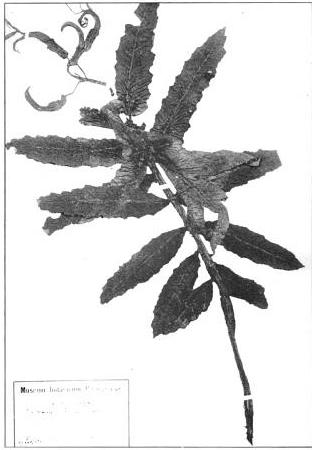 |
| CYANEA GRIMESIANA LYDGATEI RockType in Herbarium Berolinense ex coll. Hillebrand. |
page 253
| PLATE 141. |
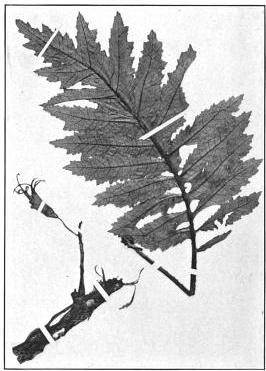 |
| CYANEA GRIMESIANA CYLINDROCALYX RockType in herbarium of the College of Hawaii. |
page 254
| PLATE 142. |
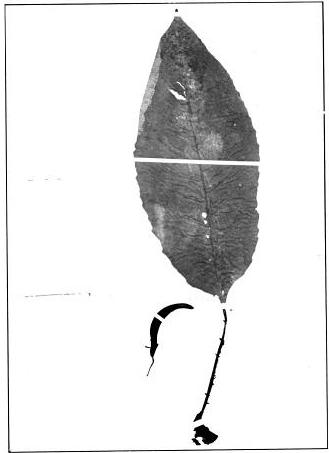 |
| CYANEA SCABRA Hillebr.Type in Herbarium Berolinense, ex coll. Hillebrand. |
page 255
HAWAII: Waipio Bay, December 1851, without flower or fruit, J. Remy no. 309 in herbarium Museum Paris; — Waipio Valley, Waima branch, flowering July 16, 1909, Rock no. 4629 in the herbarium of the College of Hawaii.
SUBSECTION SCABRAE
Cyanea scabra Hillebr. Flora Hawaii. Isl. 256. 1888. Cyanea armata Hillebr. sp. n. MSS. (Plates 46, 142.)
Original description: "A small shrub, 1.3 m high, the erect branches prickly towards the ends; leaves broad, obovato or elliptical-oblong, 25-35 cm by 8.75-12.5 cm, on petioles of 6.25-10 cm, shortly acuminate at both ends or obtuse at the base, the undulating margin denticulate, ribs and veins faintly hispid underneath and sparsely covered, as well as the petiole, with short conical spines or tubercles, membranous; peduncle 5-7.5 cm hispid and muricate many flowered from the base, pedicels slender, 12-16 mm; bracts linear-oblong 8 mm, occasionally foliaceous; calyx sparsely hispid, the tube obconical 5-6 mm, the lobes of the same length or a little longer, obtuse, 1-3-nerved; corolla curved 5 cm long, 5 mm wide, with the dorsal slit extending less than half its length, hispid, the lobes muricate, whitish, with lilac streaks; stamens glabrous, the upper anthers recurved (and scantily ciliate at the apex?)."
MAUI: West Maui, Kaanapali, 1500-2000 feet, August 1870, Hillebrand in Herbarium Berlin; — Valley of Waihee in dense shade near streambed, flowering September 5, 1918, Rock and Hashimoto no. 13129 in herbarium College of Hawaii.
Cyanea scabra is a very variable species, which extends from West to East Maui mainly on the windward side. The writer has collected this species in the Valley of Waihee near the riverbed, where it grew in company with Cyanea holophylla, from which it seems only to differ in the glabrous corolla and spine-less stem and leaves; the flowers of Cyanea scabra are pure white and strongly hispid.
In the Hillebrand Herbarium there is a specimen from Maui labeled Cyanea scabra sp. n. var. inermis; the corolla lobes are, however, not muricate, which fact brings this plant closer to Cyanea platyphylla than to Cyanea scabra.
The various forms of Cyean scabra occurring on East Maui may be described under the variety name variabilis.
Cyanea scabra variabilis Rock var. nov. (Plate 143.)
Leaves obovate or oblong, entire or sinuate, or deeply lobed, obtuse or acuminate at the apex rounded, truncate or decurrent at the base, 20-36 cm long, 8-14 cm wide, on petioles of 5-12 cm, with sparingly scattered conical spines; flowers white not hispid, lobes muricate; fruit ovoid, truncate at the apex orange-yellow, on pedicels 1.5-2.5 cm, crowned by the narrow, acute calycine lobes.
MAUI: Upper ditch trail, East Maui, Kailua, flowering November 18, 1908, H. L. Lyon no. 10259 in the herbarium of the College of Hawaii; — Honomanu Valley, May 1911, Rock no. 8789-a, and Keanae Valley, fruiting May 1911, Rock no. 8798 in the herbarium of the College of Hawaii; — Honomanu Valley, fruiting
page 256
| PLATE 143. |
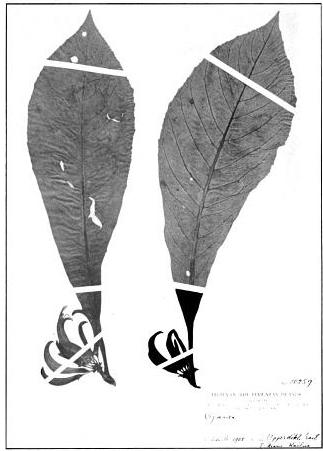 |
| CYANEA SCABRA VARIABILIS Rock var. nov.Type in herbarium College of Hawaii, ex coll. H. L. Lyon no. 10259. |
page 257
| PLATE 144. |
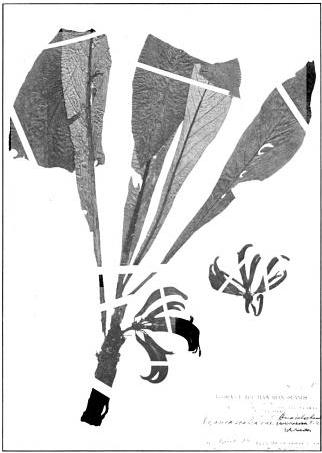 |
| CYANEA SCABRA LONGISSIMA Rock var. nov.Type in herbarium College of Hawaii, Rock no. 8790. |
page 258
| PLATE 145. |
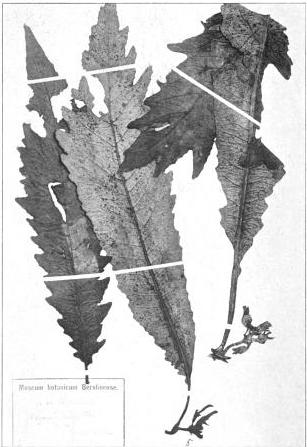 |
| CYANEA SCABRA SINUATA RockType in herbarium Berolinense, ex coll. Hillebrand. |
page 259
May 1911, Rock no. 8797-a (deeply lobed leaves) in herbarium College of Hawaii; — Keanae Valley, May 1911, Rock no. 8797 in herbarium College of Hawaii.
To this variety may also be referred no. 8796 a specimen without flower or fruit; its position is, however, doubtful.
Cyanea scabra longissima Rock var. nov. (Plate 144.)
Plant subherbaceous, unarmed throughout; leaves lanceolate-oblong, gradually narrowing into a short margined petiole, 30-50 cm long including the petiole, 5-10 cm wide, somewhat fleshy, light green; peduncle short 1.5 cm, many-flowered, corolla curved, 5-6 cm long, 5-8 mm wide, glabrous, waxy white, with pale lilac streaks, the lobes muricate; fruit subglobose to ovoid, 10-12 mm long, orange colored, seeds dark smooth shining.
MAUI: Honomanu ditch trail along watercourses in dense swampy shaded woods, northern slopes of Mt. Haleakala, April-May 1911, Rock no. 8790 (flowering and fruiting specimen) in the herbarium of the College of Hawaii.
A rather distinct variety differeing from the species in the long lanceolate leaves on short margined petioles and in being unarmed. It loves the deep and shaded ravines, as well as the banks of streambeds, where it grows in the dense shade of the urticaceous Touchardia latifolia.
Cyanea scabra sinuata Rock var. nov. Cyanea scabra β var. Hillebr. Flora Hawaii. Isl. 257. 1888. (Plate 145.)
"Leaves drawn out at the base into a shorter petiole, sinuately lobate with numerous triangular somewhat obtuse lobes about 12 mm deep; corolla sparsely hispid, sometimes glabrate, but muricate on the lobes; peduncle 2.5-3.5 cm long; berry ovoid, 10-12 mm.
MAUI: West Maui, Lahaina, Wailua, Waihee, Hillebrand no. 5 in Herbarium Berlin.
The writer has not collected this variety, but it comes very close to some of the sinuately-lobed specimens of variety variabilis, but differs again in the short petioles and short pedicels.
Cyanea holophylla Hillebr. Flora Hawaii. Isl. 257. 1888. (Plate 146.)
"An unarmed shrub, 1.3 m high; leaves ovate or obovate-oblong, 25-35 cm long, 7.5-12.5 cm wide, on petioles of 10 cm, shortly acuminate, rounded or subcordate at the base, sinuate or entire, glabrous, flaccid; raceme 1.87-3.12 cm; pedicels 12 mm; calyx-lobes nearly twice as long as the tube, 12-14 mm; corolla quite glabrous and smooth, otherwise as in C. scabra (upper anthers ciliate at the apex.)"
MAUI: West Maui, Valley of Waiehu, Waihee August 1870, Hillebrand in Herbarium Berlin; — Valley of Honokahau, flowering September 3, 1918, Rock & Hashimoto, no. 13128 in herbarium College of Hawaii; — Valley of Waihee near streambed, flowering August 5, 1918, Rock & Hashimoto, no. 14079 in herbarium College of Hawaii.
The following legend appears on an accompanying label: "Cyanea sp. n. habitu Delissea acuminata. Frutex 4-pedalis inermis glaber; fol. membranceis glabris, subtus pallidioribus, longe petiolatis, oblongis infra rotundatis, supra acuminats. Pedunculi petiolo dimidio vel plus breviores, multiflores."
page 260
| PLATE 146. |
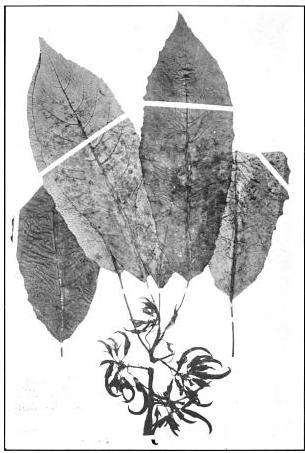 |
| CYANEA HOLOPHYLLA Hillebr.Specimen in Herbarium Berolinense, ex coll. Hillebr. |
page 261
| PLATE 147. |
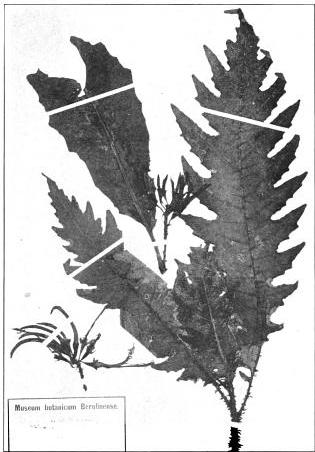 |
| CYANEA SOLANACEA Hillebr.Type, showing young spinose plant and portion of a maure plant with flowers. |
page 262
| PLATE 148. |
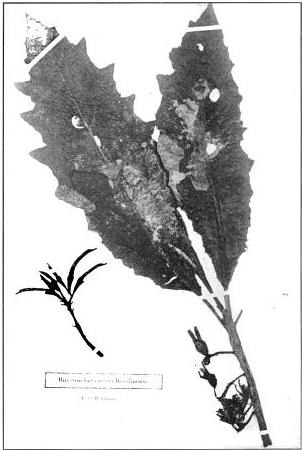 |
| CYANEA SOLANACEA Hillebr.Specimen of mature plant in Herbarium Berolinense, ex coll Hillebrand. |
page 263
This species, which resembles a form of Cyanea scabra variabilis (no. 8789 from Honomanu, East Maui), is closely related to Cyanea scabra and belongs to the section of which the latter is the type.
Hillebrand's statement in regard to the upper anthers being ciliate at the apex is incorrect; the writer examined Hillebrand's type and could not corroborate his findings; neither is it to be found in his variety β.
Cyanea holophylla obovata Rock Cyanea holophylla β var. Hillebr. Flora Hawaii. Isl. 257. 1888.
Leaves 19-41 cm long, about 15 cm broad, obovate, acute at the apex, narrowing at the base into a petioles 6-10 cm long, peduncle 1.5 cm long, bracteate at the apex; calyx oblong 8 mm long, the lobes 10-11 mm long, with a strong median nerve and two obscure lateral ones, acute; corolla curved, muricate on the ventral side only, in the bud, puberulous.
MAUI: West Maui, type in Herbarium Berlin, part of type (flowers) in the herbarium of the College of Hawaii.
The large obovate leaves distinguish this variety at once from the species.
Cyanea solanacea Hillebr. Flora Hawaii. Isl. 259. 1888. Cyanea armata Hillebr. MSS. (Plates 147, 148.)
"A stout freely-branching shrub, 20-27 dm high, the stiff ascending branches aculeate with slender straw-colored thorns; leaves of young plants deeply cut into sharp sinuate segments, the stem, petioles, ribs and nerves bristling on both faces with thorns, which resemble those of Solanum aculeatissimum; leaves of adult plants obovate-oblong, 25-32.5 cm long, 7.5-12.5 cm wide on petioles of 2.5-4 cm, shortly acuminate, contracting at the base, sinuate or lobed, the blunt lobes seldom exceeding 12 mm in depth, hispidulous underneath, unarmed, thick chartaceous, with prominent veins; peduncle fleshy, 2.5-5 cm, bracteate from the base, but bearing flowers only near the apex; pedicels 8-12 mm; bracts 2-4 mm; calyx green, glabrous, the tube obconical 8 mm, the lobes oblong, truncate, 4-8 mm, thick fleshy, 1-nerved, apiculate, with intervening sinuses; corolla white, with a lilac tinge, semierect, slender 5 cm long, 4 mm broad, sparsely hispid or glabrous, with lobes warty (rather scabrous as in C. scabra Hbd. (J. F. Rock), the dorsal slit deep; staminal column pubescent; the upper anthers beardless; stigmatic hairs in a ring; style lilac; berry obovoid 16 mm long, orange-colored; seeds reddish, smooth.
MOLOKAI: Kalae, Mapulehu, 1000-2000 feet, anno 1870 Hillebrand in Herbarium Berlin; — Kamolo, fruiting June 1910, U. Faurie no. 668 in Herbarium Léveillé and the herbarium of the College of Hawaii.
The writer has not collected this species, but has examined Hillebrand's type in the Berlin Herbarium; his original label is lost, and the Berlin Herbarium label reads: "Cyanea solanacea Hbd. var. quercifolia Hbd. Kalae auf Molokai." Hbd.'s var. quercifolia comes from Ulupalakua, Maui, and not Kalae, Molokai, and as there is no plant in his collection answering his description of the variety, and as there is no other plant in the herbarium labeled as C. solanacea, the one from Molokai must be the type of the species, the description of which it ansers perfectly; both plants, the species and the variety, are here reproduced.
There is another specimen in Hillebrand's herbarium marked in his handwriting "Cyanea armata sp. n. Molokai"; this is identical with Cyanea solanacea Hillebr. Hillebrand never adopted his older name armata, but published his
page 264
| PLATE 149. |
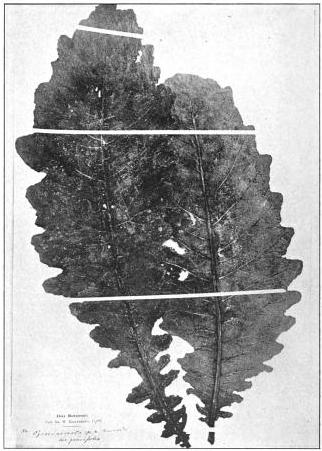 |
| CYANEA SOLANACEA QUERCIFOLIA Hillebr.Type in Herbarium Berolinense. |
page 265
species as Cyanea solanacea. The variety quercifolia still bears in his handwriting the name Cyanea armata sp. n. var. quercifolia. It is the variety quercifolia of Cyanea solanacea from Ulupalakua, Maui. All four specimens are here published; the first is considered as the type, the second is a mature form of the species. The type shows a young plant and a portion of a mature plant and an inflorescence. Young plants of this species are densely spinose when young but lose them when they become mature; the leaves in old plants also become less lobed than in young plants. This accounts for the specimen represented on the second plate being without spines and having sinuate leaves only.
There is another specimen in Hillebrand's herbarium in Berlin, consisting of three different types of leaves: one very young one, almost bipinnate; a large pinnate one representing a leaf of a young plant and a subentire or notched smaller leaf from a mature plant. These three leaves belong to Cyanea solanacea. They are labeled in a heavy handwriting, "Molokai, ins. sandvic. W. Hillebrand, 1870."
Cyanea solanacea quercifolia Hillebr. Flora Hawaii. Isl. 259. 1888. (Plate 149.)
Leaves larger 27.5-50 cm long, 7.75-15 cm wide, thicker scabrous on the upper, hispid on the lower face, with prominent nerves, the lobes deeper and rounded, cut to the rhachis at the narrow base; calyx glabrous, the lobes 4 mm; corolla as above, but glabrous; the staminal column and anthers pubescent; berry 16 mm.
MAUI: East Maui, Ulupalakua, 3000-4000 feet, anno 1870 Hillebrand in Herbarium Berlin; — Hamakua, Hillebrand, not in Herbarium Berlin.
According to Hillebrand this variety attains the size of a small tree fifteen feet (five meters) high. The writer has not collected this variety and knows it only from Hillebrand's material in the Berlin Herbarium. At Ulupalakua the plant has become extinct; there is not a vestige of forest left in that district. The only remaining sign of a forest is here and there a tree of Pterotropia dipyrena; the rest is grazing land and planted Eucalypti.
From the description it would appear that his supposed variety is a distinct species referable to the section palmaeformes, but owing to the scanty material the writer thought it best to follow Hillebrand.
Cyanea Dunbarii Rock sp. nov.
Plant 1.5-2 m high with several straight ascending branches, perfectly unarmed, stems woody at the base, fleshy above, with a loose crown of leaves; leaves ovate-elliptical, thin, sinuately notched or lobed, the lobes 1.5-2.5 cm, triangular ovate-elliptical, thin, sinuately notched or lobed, the lobes 1.5-2.5 cm, triangular and denticulate, dark green above, paler underneath, perfectly glabrous on both sides, midrib and veins prominent, especially underneath, the midrib continuing into a fleshy petiole of 8-12 cm; racemes axillary, 4-7 cm long, floriferous near the apex, bracteate from the base, the bracts linear subulate, 5 mm; pedicels 12-15 mm, bibracteolate at the middle, the bractlets 0.5 mm; calyx green, ovate 6-7 mm high, the teeth linear, acute 2-3 mm long, 1 mm wide, with broad sinuses intervening; corolla white 3-4 cm long, 4-5 mm wide, slightly curved, glabrous, ridged at the apex in the bud, the dorsal slit not extending to the middle; staminal column whitish glabrous, anthers green, glabrous, the two lower penicillate; style green, glabrous; berry unknown.
page 266
| PLATE 150. |
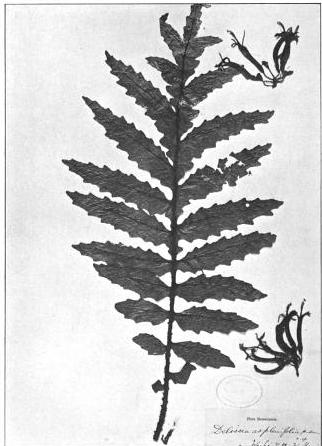 |
| CYANEA ASPLENIFOLIA (H. Mann) Hillebr.Type in Cornell Herbarium, ex coll. Mann & Brigham no. 464. |
page 267
MOLOKAI: in the deep ravine of Waihanau, in shade along streambed, elevation 3000 feet, flowering August 13, 1918, L. M. Dunbar type no. 13119 in herbarium of the College of Hawaii.
This interesting species comes close to Cyanea solanacea Hillebr., but differs from it in the smaller thinner leaves and the spineless character of the plant; the pedicels are longer, and the staminal column glabrous.
The species is somewhat variable, especially the color of the flower, which is sometimes not pure white but has lilac to bluish stripes; the apex of the corolla is then warty instead of ridged. The species is named in honor of Mrs. L. M. Dunbar, who collected the type material. The writer collected sterile specimens of this species during the month of May in the type locality.
Cyanea asplenifolia (H. Mann) Hillebr. Flora Hawaii. Isl. 260. 1888. Delissea asplenifolia H. Mann in Proceed. Am. Acad. VII:182, n. 273. 1868. (Plates 47, 150.)
A branching shrub 1.3-2 m high, sparsely aculeate; leaves obovate-oblong in outline, 32-42 cm long, 10-25 cm wide, on prickly petioles of 7.5-10 cm, deeply cut into connected segments or pinnatisect to the rhachis with or without intervening lobules, or pinnate, the segments contracted at the base, almost stipitate, gradually or suddenly decreasing in size toward the base, all bluntly acuminate, entire or sinuate, membranous, glabrate sparsely muricate on ribs and nerves; peduncles 5 cm long, slender, naked or distantly bracteate below, 10-15-flowered near the apex; pedicels 8-12 mm; bracts setaceous, 3 mm, but sometimes foliaceous; calyx glabrous, the tube obconical, 4-6 mm, its lobes as long or shorter, linear lanceolate, acute; corolla semierect, 38 mm or more in length, sparingly hispid, the lobes muricate; staminal column glabrous; upper anthers naked.
MAUI: Waihee Valley, Mann and Brigham no. 464 in herbarium Cornell University and Gray Herbarium; — Kaanapali, August 1870 (flowering specimen), Hillebrand in Herbarium Berlin, and Gray Herbarium; — Waihee Valley, flowerbuds, September 5, 1918, Rock & Hashimoto, no. 13134 in herbarium College of Hawaii.
According to Hillebrand the leaves in specimens from Kaanapali are pinnatisect, and those from Waihee and Waiehu pinnate. The plant resembles greatly C. Grimesiana outwardly, but is related to C. solanacea and belongs to the group of C. scabra Hillebr.
The writer has collected this species in the type locality and has examined Mann's type no. 464 in the herbarium of Cornell University. Hillebrand's specimen in the Gray Herbarium has much larger leaves and longer pinnae than those in the Berlin Herbarium.
The murication of the corolla is better visible when the flowers are not yet open. In H. Mann's type the murication of the corolla is less pronounced than in Hillebrand's plant, on account of the open, mature flowers.
page 268
| PLATE 151. |
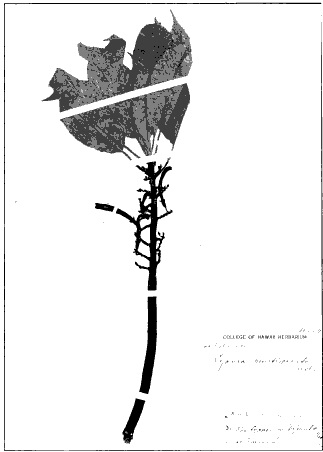 |
| CYANEA MULTISPICATA Lévl.Co-type in herbarium College of Hawaii, ex coll. U. Faurie no. 576. |
page 269
SECT. V. PILOSAE Rock
Cyanea multispicata Lévl. in Fedde Repert. Spec. Nov. X:10/11, 157. 1911. (Plate 151.)
Stem densely pubescent, with 12-20 thick racemes below the leaf whorl, exending down the stem for about 10 cm; leaves 30-40 cm long, 5-9 cm wide (teste Lévl.), only 10-12 cm by 4 cm in the specimen obtained from U. Faurie, on petioles of 3-3.5 cm, ovate to obovate-oblong, acuminate at the apex, rounded or attenuate at the base, thin chartaceous, pubescent on both sides, young leaves 1.5 cm long, rather thick, with knobby scars, pubescent; calyx cylindrical, 6 mm wide, the calycine teeth triangular, 2 mm long, acute; corolla 3-3.5 cm long, 3 mm wide, color apparently whitish?, puberulous, almost straight or slightly curved, with obtuse lobes, staminal column and anthers glabrous.
KAUAI: Waimea, 3000 feet, flowering March 1910, U. Faurie no. 576 and 594 in Herbarium Léveillé, no. 576 in herbarium of the College of Hawaii.
Abbé Faurie's specimens are very badly preserved, and the fact that his cited localities are not reliable makes it very difficult to check up his plants. For example, his specimen no. 576 are merely labeled "Insulis Sandwich," while in the publication it is cited as coming from Waimea, Kauai. Adding to this the very meagre description by Léveillé, it is indeed difficult to make out the affinity of the plant. The species in question is either identical with Cyanea acuminata or it is at least very closely related to it. It seems to differ from the latter in the shorter peduncles, thick coriaceous flowers, cylindrical calyx tube, and glabrous anthers, otherwise identical with Cyanea acuminata. Till more material is at hand, or the plant is re-collected, it will have to remain an obscure species. A co-type is in the College of Hawaii herbarium.
Cyanea acuminata (Gaud.) Hillebr. Flora Hawaii. Isl. 254. 1888. Delissea acuminata Gaud. Bot. Voy. Uranie 457, pl. 76. 1826. (Plate 152.)
Stem simple and erect, or sparingly branched 1.3-1.6 m high, leaves broad-oblong, acuminate at both ends, dark green above, pale whitish underneath, puberulous on both surfaces, especially along the mdirib and veins underneath, flaccid, thin, chartaceous, entire or faintly denticulate, 14-30 cm long, 4-7 cm wide, on petioles of 2-6 cm; inflorescence numerous along the stem for about 18 cm, in the axils of fallen leaves, peduncle 2.5-6 cm in length, puberulous, either naked or covered with knobby scars from the base, bearing from 6-20 flowers near the apex; pedicels slender, filiform, puberulous, 1 cm long, bracts linear, 8-12 mm, bractlets minute, deciduous; calyx faintly pubescent, greenish, the tube 4-5 mm; the narrow sharp lobes 2 mm; corolla white with a slight bluish tinge, puberulous, suberect, about 3 cm long, 4 mm wide, the dorsal slit extending to near the base, staminal column pubescent; anthers blue, hirsute with whitish hair, the two lower bearded only, the bluntly lobed stigma glabrous; berry globose, yellow, 4-6 mm; seeds pale.
OAHU: Gaudichaud in herbarium Museum Paris; — Lay and Collie; — Mann and Brigham no. 233 in herbarium Cornell University; — Manoa, Moanalua and Nuuanu Valley. Hillebrand in Herbarium Berlin, Gray Herbarium and herbarium Bishop Museum ex coll. Lydgate-Hillebrand; — Wawra no. (1793), 2286 in Herbarium Vienna; —; Pauoa Valley, elevation 1000 feet, flowering October 24, 1908, Rock no. 712 in the herbarium of the College of Hawaii; — Punaluu Mts.,
page 270
| PLATE 152. |
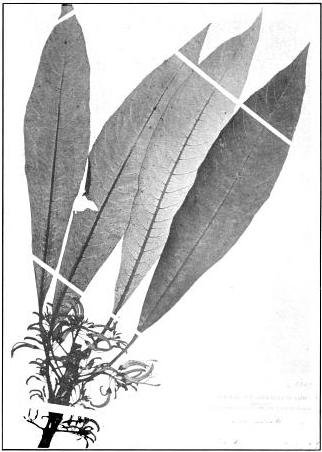 |
| CYANEA ACUMINATA (Gaud.) Hillebr. |
page 271
August 1908, Rock no. 450 (flowering) in the herbarium of the College of Hawaii and Gray Herbarium; — same locality, December 24, 1908, Rock no. 456 (fruiting) in the herbarium of the College of Hawaii; — Koolau Mts., flowering August 1911, Rock no. 8845 in the herbarium of the College of Hawaii.
The specimen in the Paris Herbarium, collected by Gaudichaud, is labeled Delissea acuminata var. There is no question of its identity, though only a few leaf fragments and a portion of a peduncle are left. On the label is written: "fleurs blanch antheres violaces, cal. overt flavescent, fruits jaune-orange arondis lobez overte flavescent * * * (a part is not legible) plant sont lactescentes, etc."
This species is very distinct, and quite common in the mountains back of Honolulu; it is conspicuous in the forest on account of its mass of white flowers clustering along the stem in the axils of fallen leaves for often more than 18 cm. In the writer's opinion Cyanea acuminata is much closer affiliated with Cyanea Bishopii, and the many varieties of Cyanea pilosa, than with Cyanea angustifolia. It has the habit of the first mentioned species, being somewhat subherbaceous and only woody at the base, while Cyanea angustifolia is a much-branched robust shrub, or even small tree. It is therefore included in the section with Cyanea pilosa. Wawra records a variety latifolia from Mt. Kaala, Oahu, no. 2251; it is, however, doutful if that plant has anything in common with this species, he having collected leaves only.
Cyanea pilosa A. Gray in Proceed. Am. Acad. V:149. 1862. Delissea pilosa Mann in Proceed. Am. Acad. VII:182. 1868. (Plates 50, 153.)
Plant low subherbaceous, 8 dm to 1 m tall, hirsute, leaves broadly obovate to obovate-oblong, 14-30 cm long, 7-12 cm wide, long acuminate at the apex, acute or rounded at the base, erosodentate, flaccid, densely hirsute on both surfaces, more so on the lower, with soft yellowish-golden hair, especially along the midrib, the hirsute petioles 3-5 cm in length; inflorescence a short and few-flowered raceme; peduncle hirsute 1.5-2 cm (when with fruit), the hirsute slender pedicels 8-10 mm; calyx glabrous, the lobes linear, of the same length as the oblong tube (teste Gray) (shorter in the writer's specimen); corolla small grayish-blue, glabrous; berry small, globose, 8 mm in diameter; seeds smooth light brown.
HAWAII: Mauna Key, U. S. Exploring Exped., type in the Gray Herbarium; — Holokaiea gulch, Waimea, fruiting July 9, 1909, Rock no. 4769 in the herbarium of the College of Hawaii; — Alakahi ditch trail, fruiting July 13, 1909, Rock no. 4753 in the herbarium of the College of Hawaii; — Kohala Mts., near summit, fruiting June 23, 1910, Rock no. 8726-a in the herbarium of the College of Hawaii; — Kohala, seven miles above Awini near summit, in swampy forest, 5000 feet elevation, fruiting June 1910, Rock no. 8726 in the herbarium of the College of Hawaii; — in the forest beyond Kalanilehua, at the Volcano Kilauea, August 26, 1917, Rock no. 12833 in the herbarium of the College of Hawaii; — forest between 29 miles and Kulani, August 1918, Rock & Hashimoto (not flowering but developed peduncles) no. 13137 in herbarium College of Hawaii.
Dr. Gray suggests that this species is doubtless related to Chamisso's Lobelia calycina, ambigua, etc.; these two latter species are true Rollandias and have
page 272
| PLATE 153. |
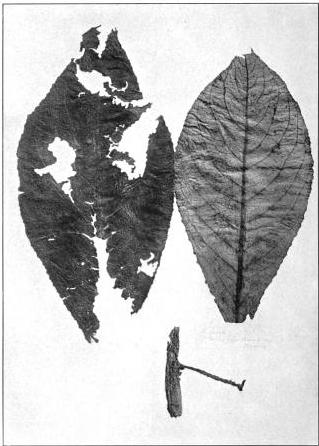 |
| CYANEA PILOSA A. GrayType in the Gray Herbarium, ex coll. U. S. Exploring Expedition. |
page 273
nothing in common with Cyanea pilosa, though the leaves do resemble Rollandia calycina in outline only. Dr Gray's material was too scanty, which accounts for his great many mistakes.
Cyanea pilosa Gray is certainly a very distinct species and is represented in the forests of Hawaii by several varieties. The species occurs on the windward side of Mauna Kea at the lower margin of the forests, where it was collected by the U. S. Exploring Expedition, and in the west forests back of Waimea, facing the big Waimea plain which is part of the slope of Mauan Kea, and also near the summit of the Kohala Mountains. The writer recognizes four distinct varieties, which occur all on the same island; two on the slopes of Mauna Loa (that is, one on the southern slope, in the forests of Naalehu; the other on the windward side of Mauna Loa, in the vicinity of the Volcano of Kilauea). The other two, var. Bondiana and var. megacarpa, occur in the swampy forests of the Kohala Mountains at an elevation of 4200 feet, in company with herbaceous species of Cyrtandra and Labordia. The specimen collected by Macrae, Ins. Owhyhee, ad montem Kaah June 1825, belongs to variety densiflora. Though there are only single fruits remaining on the peduncle, the plant agrees in all other respect with that variety, the fruits having evidently been lost; in its natural habitat the plant, which is here figured, has a densely-flowering inflorescence, which, in order to preserve the plant, has to be thinned out.; var. glabrifolia was first collected by J. Remy on Hawaii, no. 303 in herb. Museum Paris, and labelled Rollandia.
Cyanea pilosa is represented on Maui by Cyanea Bishopii, to which it is closely related, but differs in the smooth corolla lobes, which are retrorsely dentate or scabrous in the latter species. Cyanea pilosa forms a distinct section in the genus with the following relatives: Cyanea Bishopii, Cyanea Copelandii, Cyanea stictophylla, and vaguely Cyanea hirtella which forms the transition type to another section which includes Cyanea recta, Cyanea fissa, Cyanea Gayana and others.
Cyanea pilosa densiflora Rock The Indig. Trees Hawaii. Isl, add. 508. 1913. (Plate 154.)
Leaves oblong-obovate, same as in the species; somewhat fleshy, white or silvery underneath, dark green above; the hirsute 10-16-flowered peduncle very short, pedicels hirsute; flowers white or with purplish tinge; staminal column white, glabrous; anthers white, hirsute, the lower ones penicillate only; berry dark orange colored, 10-ribbed, crowned by the small linear calycine lobes, sparingly hispid.
HAWAII: Southern slopes of Mauna Loa, in the forest of Naalehu, Kau, in swampy jungle (terrestrial), elevation 4000 feet, flowering and fruiting January 9, 1912, Rock, type no. 10001 in the herbarium of the College of Hawaii; — Owhyhee ad montem Kaah, fruiting June 1825, Macrae ex herbarium Soc. Hort. Lond. in the Gray Herbarium.
Cyanea pilosa glabrifolia Rock The Indig. Trees Hawaii. Isl, add. 508. 1913. (Plates 40, 41.)
Herbaceous, terrestrial, about 9-10 dm high, the stem strigosely hispid; leaves elliptical-oblong, acuminate at both ends, thin chartaceous, pale green above, paler undernenath, 18-28 cm by 5-8 cm, on hirsute petioles of 2.5-3 cm, young leaves densely hispid underneath, old ones glabrous above, hispid along the
page 274
| PLATE 154. |
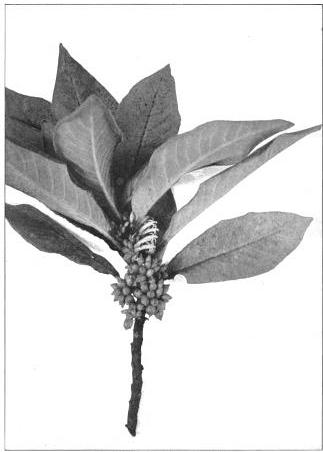 |
| CYANEA PILOSA DENSIFLORA RockFlowering and fruiting specimen from the mountains of Naalehu, Kau, Hawaii. |
page 275
midrib and veins; flowers several on a hirsute peduncle of about 7 cm, bracteate above the middle; pedicels 6-10 mm long, filiform, sparingly hispid and bibracteolate at the base bracteoles linear lanceolate, about 4 mm long; calyx greenish, the ovarian portion 5 mm, the lobes of nearly the same length (4 mm); corolla greenish white, sparingly hispid, 2 cm long; staminal column glabrous, whitish, the anthers densely hirsute; berry glabrous, oblong, dark orange, crowned by the calycine teeth; seeds light yellow.
HAWAII: In the dense swampy forest near Kilauea, elevation 3700 feet, flowering and fruiting July 1911, Rock type no. 8805 in the herbarium of the College of Hawaii; — Kalanilehua, January 1918, W. M. Giffard in herbarium of the College of Hawaii; — Iles Sandwich, 1851-1855, J. Remy no. 303 in herbarium Museum Paris.
The variety glabrifolia is especially numerous in Mr. W. M. Giffard's mountain home, Kalanilehua; outside the fenced portion in the forest it is scarce, owing to cattle which are allowed to graze in portions of the forest. The plant is usually small and can easily be overlooked, as it grows in dense shaded places, hidden under the numerous ferns and other foliage.
Cyanea pilosa Bondiana Rock The Indig. Trees Hawaii. Isl, add. 508. 1913.
Plant about 8 dm high, terrestrial, stem hirsute; leaves short petiolate, coriaceous, obovate oblong, glabrous above, covered with a soft light-brown tomentum underneath, acuminate at both ends, 10-14 cm by 3.5-5.5 cm; peduncles very short, 3 mm, few-flowered, hirsute, as are the pedicels and calyx, the lobes of the latter of the same length as the ovarian portion, linear; (flowerbuds only) corolla purple, sparingly hispid; berry glabrous yellow, globose.
HAWAII: Mountains of Kohala, about 7 miles above Awini near summit, 5000 feet elevation, in dense swampy forest, flowerbuds and fruiting June 1910, Rock no. 8727 in the herbarium of the College of Hawaii.
Named in honor of Dr. B. D. Bond of Kohala for many courtesies received from him by the author. Only one single specimen was observed; it grew in company with Cyanea pilosa proper.
Cyanea pilosa megacarpa Rock The Indig. Trees Hawaii. Isl, add. 508. 1913.
Plant erect, terrestrial, stem hirsute, leaves large, obovate-oblong, blunt at the apex, narrowing suddenly into a fleshy petioles of 5 cm, with few scattered single hairs above, sparingly hispid underneath, 20-22 cm by 9.5-10.5 cm; berries large, 22 mm in diameter, globose, crowned by the broadly triangular 8 mm long calyx lobes (flowers unknown).
HAWAII: Mountains of Kohala in swampy forest back of Waimea along the Alakahi gorge, elevation 4200 feet, fruiting June 1910, Rock no. 8728 in the herbarium of the College of Hawaii.
Only a single plant was observed; it is doubtfully referred to Cyanea pilosa. The plant looks quite different, at least the leaves are not of the C. pilosa type, but the habit of the plant is the same. The fruits are very large and globose.
page 276
| PLATE 155. |
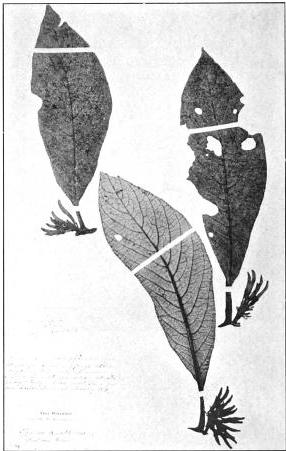 |
| CYANEA BISHOPII RockType in the Berlin Herbarium. |
page 277
Cyanea Bishopii Rock The Indig. Trees Hawaii Isl., add. 509, 1913, and Torrey Bot. Cl. Bull. 44:233, pl. 13, 14, 1917. Cyanea Kunthiana? Hillebr. Flora Hawaii. Isl. 264. 1888. (Plates 52, 155.)
Plant subherbaceous woody only at the base 10-14 dm high, rarely branching, leaves crowded at the top, obovate-oblong, bluntly acuminate at the apex, gradually tapering into a margined petiole of 3 cm; leaves 20-30 cm long, 4-7 cm wide (measured at their widest portion), sparingly hispid with scattered whitish hairlets above, pubescent underneath, especially along the veins and midrib; inflorescence densely clustered along the stem, immediately under the leaves, extending down for about 12-15 cm; flowers numerous on a short, hirsute, many bracteate peduncle, 6 mm in length; pedicels 5-6 mm when with flowers, 12 mm when with fruit, bibracteolate above the middle, bracteoles linear subulate 3 mm; calyx hirsute the subglobose ovarian portion 6 mm, calycine lobes as long as the tube or longer; corolla slender, somewhat curved, 3 cm long, 4 mm wide, hirsute, pale or lilac with whitish streaks, lobes very short, 3-4 mm, retrorsely dentate above, the dorsal slit extending one-third the length of the tube; staminal column sparingly hispid, anthers densely covered with strigose pale purplish hair, the lower ones only penicillate; berry subglobose, deep orange 8 mm in diam., crowned by the calycine lobes.
MAUI: On ridge overlooking Wailuku, and back of Lahaina, January 1871 (with flowerbuds), E. F. Bishop co-type in Gray Herbarium, type no. 47 in Herbarium Berlin; — slopes of Haleakala, wet forest between Waikamoi and Honomanu gulch, along Kula pipeline trail, elevation 4000 feet, flowering May 1911, Rock no. 8806 in the herbarium of the College of Hawaii; — same locality, fruiting October 1910, Rock no. 8572 in the herbarium of the College of Hawaii; — upper forest of Puu Kukui, West Maui, 3000-5000 feet elevation, fruiting September 24-26, 1916, A. S. Hitchcock no. 14846 in the U. S. National Herbarium and the herbarium of the College of Hawaii; — valley of Honokahau along the trail to Mt. Eeke, 3000 feet elevation, Rock & Hashimoto, August 3, 1918 (observed only).
Half of the specimen collected by Mr. Bishop was sent to Hillebrand so in reality both can be considered the type. With the specimen in the Gray Herbarium is a letter addressed to Professor Asa Gray by Mr. Bishop, who writes as follows:
I have recently come to East Hampton, June 15, 1872, from the Hawaiian Islands and have brought a few plants which I have collected. While there I had communication with Dr. Hillebrand, who has made large collections. But he left for Germany, where he intends publishing a work on the Island Flora. I have therefore some plants which are entirely new. All my collections have been made on West Maui.
I enclose two plants herewith: a Cyanea found at an elevation of 4000 feet. It was unfortunately not quite open, but the buds are large and apparently of full size. The plant has a simple upright stem about 2 to 4 feet high. There are probably 10 to 15 full-sized leaves closely ranged at the apex of the plant. The specimen is full sized. Found January, 1871.
He then refers to the other plant, a Hesperomannia; at the foot of the letter is a note, probably written by Professor Gray, as follows: "Write and send the Cyanea to Hillebrand."
Hillebrand referred to this plant doubtfully as Cyanea Kunthiana (Gaud.), a
page 278
| PLATE 156. |
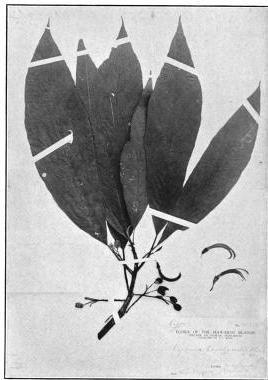 |
| CYANEA COPELANDII RockType in the Herbarium College of Hawaii. |
page 279
species figured but not described by its author* under the name Delissea Kunthiana. That it is not this species is evident by the fact that the lobes of the mature corolla are exceedingly short and retrorsely dentate or scabrous; the whole aspect, moreover, is different from the plant figured.
Cyanea Copelandii Rock in Torrey Bot. Cl. Bull. 44:231, pl. 10, 1917. (Plates 51, 156.)
Plant herbaceous, epiphytic, 30-40 cm tall, not branching, stem fleshy throughout, green, with distant leaf-scars; leaves dark green, oblong, acuminate at the apex, gradually narrowing and slightly rounded below, 22.5-27 cm long, 5-8 cm wide, on petioles 4.5-5.5 cm long, midrib prominent underneath as are the veins, the latter slightly impressed above, margin of leaf unevenly wavy, minutely and closely denticulate, denticulation mucronulate, glabrate above, slightly pubescent below, especially the veins and midrib, pubescence consisting of minute reddish brown hairlets; inflorescence axillary, peduncles 4-5 cm long when in flower, 5.5 cm long when in fruit, with a rusty-colored pubescence; pedicels three or four, 11-16 mm long, 2 mm thick, calyx greenish with purplish tinge, pubescent, ovarian portion ovoid-oblong, 1 cm high, 6 mm in diameter, ten-ribbed, the calycine lobes triangular-dentiform, the tips dark purplish, 2 mm long; corolla yellowish flesh-colored, slightly curved when open, of equal width throughout, 4 cm long, 6 mm wide, the dorsal slit extending not quite to the middle, the two upper lobes 2 cm long, the three lower 1 cm long, with a purplish pubescence mainly along the nerves, the tips of the lobes mucronulate; staminal column green, pale, perfectly glabrous, shorter than the corolla, the tube glabrous inside, with the exception of the base, which is tufted with whitish hairlets; style green, glabrous, stigma slightly two-lobed; anthers glabrous, the lower only penicillate; fruit dark orange, oblong, 15 mm long, 10 mm wide, slightly ribbed, crowned by the calycine teeth.
HAWAII: On trunks of trees and tree ferns, in the rainforest of Glenwood, elevation 2400 feet, flowering and fruiting December 23, 1914, J. F. Rock & M. L. Copeland no. 10350 type in the herbarium of the College of Hawaii; — Glenwood, flowering September 1917, Rock no. 12848 in herbarium of the College of Hawaii; — same locality, flowering and fruiting January 1918, W. M. Giffard no. 13087 in the herbarium of the College of Hawaii; — at 23 miles in dense fern forest plentiful on trees and tree ferns, flowering and fruiting August 1918, Rock & Hashimoto, no. 13138 in Herbarium Rock.
This species is related to Cyanea acuminata, Cyanea stictophylla, to Cyanea multispicata and Cyanea hirtella.
It is usually an epiphyte, but occasionally it roots in the ground at the base of a tree, against which it reclines and ascends, the stem rooting practically all along its whole length on the moss-covered trunk.
It was named for the writer's friend, M. L. Copeland, who accompanied him on botanical excursions on Hawaii.
Cyanea stictophylla Rock The Indig. Trees Hawaii Isl., add. 509, 1913. Cyanea palakea Forbes in Occas. Pap. B. P. Bishop Museum VI:3, 72, plate. (Plate 157.)
Plant 2 m high, erect, not branching; leaves 20-30 cm wide, linear lanceolate, bluntly acuminate at both ends, narrowing into a petiole of 2.5-3 cm, glabrous above and evenly punctate with glandular points, hirsute underneath especially along the midrib and veins, with an undulate or irregularly notched margin, peduncles axillary 1-2.5 cm long, hirtellous, bracteate at the apex, usually 5-flowered, pedicels hirtellous 7-15 mm long, bibracteolate below the middle; calyx green puberulous, ovarian portion ovoid, calycine lobes triangular about 2 mm (flowers unknown).
____________
* Voyage, Bonité, pl. 77. 1839-52.
page 280
| PLATE 157. |
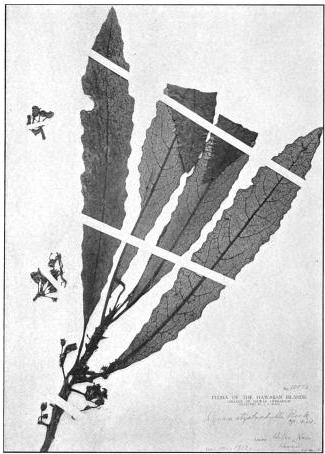 |
| CYANEA STYCTOPHYLLA RockType in the herbarium of the College of Hawaii. |
page 281
| PLATE 158. |
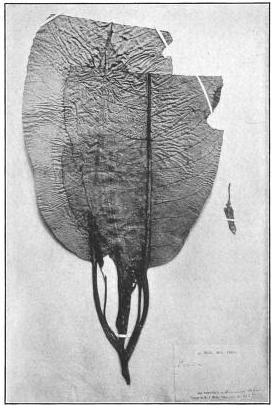 |
| CYANEA REMYI RockType in herbarium Museum Paris, ex coll. J. Remy. |
page 282
HAWAII: Mountains of Kaiholena in rainforest, southern slopes of Mauna Loa, Kau, elevation 6000 feet, January 1912, Rock type no. 10055 in the herbarium of the College of Hawaii; — dense forest east of Palakea, about 10 miles north of Kilauea, Hawaii, June 29, 1915, C. N. Forbes no. 1003-H in the herbarium Bishop Museum.
The native who was with the writer when he collected this species assured him that he had seen it before in the same locality, and stated that the flowers are yellowish. This species is related to C. Copelandii Rock, and probably also to C. pilosa Gray.
Forbes gives the stem as spiny. The stem in the writer's was not spiny with the exception of some murication at the base. Spinyness is a variable character and cannot very well be depended upon; for example, Cyanea platyphylla is sometimes very spiny, and then again we meet with perfectly glabrous specimens.
The single corolla which adhered to the specimen was lost, but the writer remembers it to have been yellowish-white. Forbes describes the flowers and fruits as follows:
"Calyx obconical, glabrous, the tube 5-6 mm long, the teeth narrow acute, 3-3.5 mm long; corolla white nearly glabrous, sparsely puberulent under a lens, falciform 3.6 cm long; staminal column and anthers glabrous; berry globose, orange-colored, rather flat-topped, seeds crustaceous, smooth reddish."
The writer examined Forbes' type of Cyanea palakea and found it identical with the writer's C. stictophylla.
Cyanea Remyi Rock in Torrey Bot. Cl. Bull. 44:233, pl. 12. 1917. (Plate 158.)
Plant glabrous throughout; leaves thick, chartaceous, mostly 38-40 cm long and 15 cm wide, on petioles 10-12 cm long; peduncle 7-8 cm long, pedicels filiform, 2 cm long; flowers (only a single flowerbud remaining) purplish pink, glabrous, and of very thin texture.
KAUAI or NIIHAU: Without definite locality, 1851-1855, J. Remy 302 bis, type, in the herbarium of the Natural History Museum at Paris. The specimen is labelled Delissea, but represents a typical Cyanea. The species has not again been collected and is very distinct. Nothing is known in regard to height or habit of growth.
Species MINUS COGNITA.
Cyanea Remyi Rock Cyanea undulata Forbes
Species EXCLUDENDA.
Cyanea Blinii Lévl. in Fedde Repert. X. 10/14 (1911) 156 == Clermontia parviflora Gaud. (var. β pleiantha Hbd.).
page 283
CLERMONTIA Gaudichaud
page 284
page 285
CLERMONTIA Gaudichaud
Calyx lobes either as long as the corolla and then connate bilabiate, colored, caducous, or shorter than the corolla and free, persistent; the ovarian portion globose or tubinate; corolla tubular of even width throughout, arched, or sub-erect, almost unilabiate, the dorsal slit extending to the base, the lateral slits to the middle, and the anterior ones falling little short of the latter; staminal column free from the corolla, generally glabrous; only the two lower anthers penicillate; stigma two-lobed, hairy below the lobes; fruit a globose to oblong, or pyriform berry with a broad epigynous disk, two-celled, fleshy placentas which fill the entire cells; seeds numerous crustaceous, ovoid, smooth. — Unarmed glabrous or tuberculate shrubs or trees with a thick tenacious milk sap, branching horizontally or candelabra-like from the base upwards; flowers in simple or irregularly compound cymes (two to ten-flowered), flowers green to pinkish purple, or white, or deep purplish black.
The type of the genus is Clermontia oblongifolia Gaud. The genus was dedicated by Gaudichaud to M. le Marquis de Clermont-Tomere, who was Minister of the French Navy (Marine). Originally the genus consisted of five species, three described by Gaudichaud and one figured by that author but not described. One was described by Asa Gray from a specimen collected by Gaudichaud. The genus Clermontia comprised originally only such species as had a connate calycine tube as long as the corolla. That character, as has been shown, is not tenable for generic distinctions, as the greatest variability occurs, to such an extent that it is sometimes not even permissible to be used in specific distinctions (see Clermontia parviflora and compare with its variety calycina). Hillebrand added four new species and transferred one species of Cyanea described by Mann and one species of Delissea described by Gaudichaud to Clermontia.
The writer added eight new species, and raised two of Hillebrand's varieties to specific rank — Clermontia micrantha (Hillebr.) Rock, and Cl. Hawaiiensis (Hillebr.) Rock. C. N. Forbes described one new species (Cl. tuberculata) and H. Léveillé one valid one (Cl. fulva); the status of this species is, however, still somewhat doubtful.
Three of Hillebrand's varieties were reduced to their respective species; three varieties were described as new by the writer. This brings the number of Clermontia up to twenty-three species, five varieties and one form.
Hillebrand divided the genus into two sections, viz: Clermontia genuinae and Clermontioideae. Of the first, Cl. oblongifolia must remain the type, and of the second Clermontia Gaudichaudii (Delissea clermontioides Gaud.).
To Clermontia genuinae with a connate calycine tube as long as the corolla belong the following species: Cl. oblongifolia, Cl. Kakeana, Cl. persicifolia, Cl. Kohalae, Cl leptoclada, Cl. drepanomorpha, Cl. pallida, Cl. Hawaiiensis, Cl. montis-Loa, Cl. multiflora, Cl. micrantha, Cl. grandiflora, Cl. parviflora, exclusive variety calycina.
To Clermotioideae with short persistent calycine lobes belong the following: Cl. Gaudichaudii, Cl. singuliflora, Cl. arborescens, Cl. tuberculata, Cl. fulva, Cl. coerulea, Cl. pyrularia, Cl. Haleakalensis, Cl. Waimeae and Cl. Peleana, also Clermontia parviflora calycina.
page 286
| PLATE 159. |
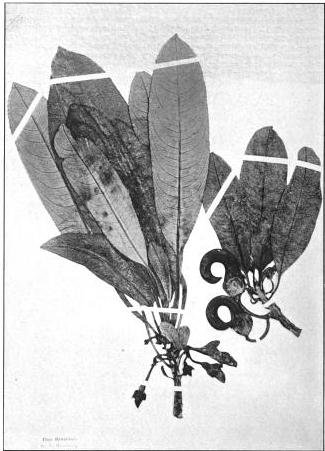 |
| CLERMONTIA ARBORESCENS (Mann) Hillebr.Specimen in Herbarium Berolinense, ex coll. Hillebrand. |
page 287
Section CLERMONTIOIDEAE Hillebr. Hillebr. Flora Hawaiian Isl. 240. 1888.
Clermontia arborescens (Mann) Hillebr. Flora Hawaii. Isl. 242 1888. Cyanea arborescens Mann in Proceed. Amer. Acad. VII:183. 1868. Delissea Waihiae Wawra in Flora XXXI:8. 1873. (Plates 159, 160.)
A small tree 5-8 m in height; leaves obovate oblong, 12-16 cm long, 4-5 cm wide, on petioles of 3-6 cm, shortly acuminate, acute, or rounded at the apex, acute to acuminate at the base, crenate to serrulate, coriaceous, dark green and glossy above, paler beneath, glabrous on both sides; peduncle very short, 5-8 mm long, thick fleshy, two-flowered; bracts small; pedicels about 25 mm long; braceteoles minute, at the base of the pedicels, calyx green, ovarian portion campanulate about 20 mm high, the lobes usually deltoid, fleshy about 5 mm high, separated by sinuses, or connate and each lobe deeply emarginate, or dentiform; corolla thick fleshy, strongly arched, about 6 cm long, of even width, greenish white or sometimes cream-colored with a tinge of reddish purple; staminal column glabrous, anthers thick, glabrous or hirsute along the sutures; berry subglobose to obovate, orange yellow, deeply furrowed and crowned by the calycine lobes or truncate; seeds pale yellow, shining.
MAUI: West Maui, Mann et Brigham in Herbarium ?; — West Maui, elevation 2000-3000 feet, Hillebrand; — Waihee Valley (not Kauai), Wawra no. 1956 in Herbarium Vienna; — Honokawai gulch, West Maui, flowering August 22, 1910, Rock no. 8202 in the herbarium of the College of Hawaii; — Waikamoi trail, Olinda, northwestern slopes of Mt. Haleakala, flowering September 1910, Rock no. 8515 in the herbarium of the College of Hawaii; — Olinda along pipeline trail, October 1, 1916, A. S. Hitchcock no. 14923 in U. S. National Herbarium; — Puukukui, October 26, 1916, A. S. Hitchcock nos. 14754, 14794 in U. S. National Herbarium.
MOLOKAI: Hillebrand in Herbarium Berlin; — heights of Pelekunu flowering March 17, 1910, Rock no. 6109 in herbarium of the College of Hawaii; — Maunahui-Waikolu, fruiting March 21, 1910, Rock no. 6137 in the herbarium of the College of Hawaii; — Pukoo, October 8, 1916, A. S. Hitchcock no. 15074 in U. S. National Herbarium; — north of Kamolo, 4000 feet, October 10, 1916, A. S. Hitchcock no. 150880 in U. S. National Herbarium.
LANAI: Summit ridge Lanai Hale and Haalelepakai, elevation 3000 feet, July-August 1910, Rock, observed only; — (Hillebrand in Herbarium ?); — upper part of mountains, September 21, 1916, A. S. Hitchcock no. 14648 in U. S. National Herbarium.
The Molokai specimens come close to Clermontia Gaudichaudii in the very short dentiform calycine lobes; the flowers are also less fleshy than in the Maui specimens, which have broad fleshy deltoid calycine lobes and corolla lobes 5 mm thick; the leaves are, however, all dark green glossy above and paler beneath. The species is otherwise much more robust than Cl. Gaudichaudii; its closest relationship is, however, with the latter species.
It is very common throughout the wet forests of West and East Maui and Molokai, but is less common on Lanai. With Cl. drepanomorpha it possesses the largest flowers of the genus Clermontia.
page 288
| PLATE 160. |
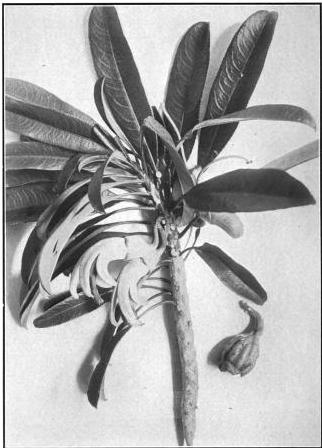 |
| CLERMONTIA ARBORESCENS (Mann) Hillebr.Ohawai.Less than half natural size; showing flowering branch and fruit.From: J. F. Rock "The Indigenous Trees of the Hawaiian Islands." |
page 289
| PLATE 161. |
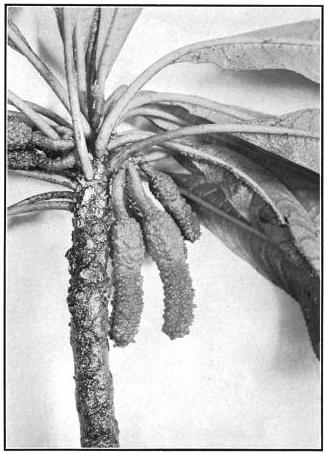 |
| CLERMONTIA TUBERCULATA ForbesNatural size, showing flowerbuds. Note tubercles on the inflorescence.From: J. F. Rock "The Indigenous Trees of the Hawaiian Islands." |
page 290
| PLATE 162. |
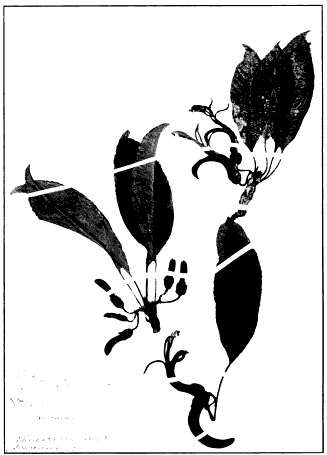 |
| CLERMONTIA GAUDICHAUDII BARBATA RockType in Herbarium Berolinense ex coll. Hillebrand no. 56. |
page 291
Clermontia tuberculata Forbes Occas. Pap. B. P. Bishop Museum V:8, pl. 1912. (Plate 161.)
A small tree 4-5 m high, many branched; leaves obovate to spathulate oblong, denticulate to serrulate, 15-20 cm long, 3-4.5 cm wide, on petioles of 2-5.5 cm, coriaceous, dark green above, paler and minutely pubescent along the veins underneath; peduncle two-flowered, 5 mm long pedicels 2-3 cm, both covered with tubercles; calyx tube campanulate with short obtuse lobes and covered with tubercles throughout; corolla somewhat curved, 3.5-4 cm long, fleshy and covered with tubercles; anthers dark red, glabrous; berry globose, strongly tuberculate, 1.3 cm in diameter (teste Forbes); seeds smooth, yellow, shiny ovoid.
MAUI: East Maui, western slopes of Mt. Haleakala, to the east of and betwen Olinda and Ukulele, flowering July 1910, C. N. Forbes no. 201-m in the herbarium of the Bishop Museum; — along the Ukulele-Waikamoi trail, elevation 5000 feet, flowering March 1912, Rock & Ceresole no. 12837 in the herbarium of the College of Hawaii.
This species is not at all common; one tree was observed along the Ukulele-Waikamoi trail, and a second one along a stream between Puukakai hill and the Kua pipeline trail.
It comes close to Clermontia arborescens (Mann) Hillebr., but does not develop such a size. It is a very distinct species and can be at once recognized by the strongly tuberculate inflorescence, a character which occurs, however, in Cyanea aculeatiflora Rock of the section palmaeformes and from the same locality.
Clermontia Gaudichaudii (Gaud.) Hillebr. Flora Hawaii. Isl. 243. 1888. Delissea Clermontioides Gaud. Bot. Voy. Bonité, t. 47. 1839-1852. Clermontia Clermontioides (Gaud.) Heller in Minnes. Bot. stud. IX:906. 1897. Clermontia Fauriei Lévl. in Fedde Repert. Spec. nov. X:156. 1911.
A shrub or small tree, branching candelabra-like, and forming a somewhat flat crown; leaves elliptical-oblong, to lanceolate, 8-14 cm long, 1.5-4.5 cm wide, subcoriaceous to chartaceous, glabrous on both sides, glossy shining above with a close reticulate impressed network, dull and paler beneath, with well-marked darker venation, acute at both ends, margin crenulate, on petioles of 2-4 cm; peduncle short, 1-3 cm, bibracteate at the apex; pedicels as long or slightly longer, bibracteolate at or below the middle; calyx broad campanulate, 15 mm high, with five short, acute teeth, 1.5 mm long; corolla arcuate, about 5 cm long, 6-8 mm wide, greenish purple, glabrous; anthers pale glabrous; berry subglobose, furrowed, 3 cm high, 2.5 cm wide, truncate at the apex.
ILES SANDWICH: Gaudichaud.
KAUAI: Waialeale and Pohakupili, Wawra nos. 2043, 2198 in Herbarium Vienna; — Waimea, Knudsen not in Herbarium Berolinense; — U. S. Exploring Exped. (leaves only) in Gray Herbarium; — woods near the source of the Wahiawa river, August 12, 1895, A. A. Heller no. 2704; — Kaholuamano, flowering March 10, 1909, Rock no. 2499 in the herbarium of the College of Hawaii; —; near Mr. Waialeale, Kaluiti stream, fruiting and flowering September 1909, Rock no. 5062; — Waimea, March 1910, Urban Faurie no. 578 in Herbarium Léveillé and herbarium of the College of Hawaii; — Kaholuamano forest, October 1916, Rock no. 12793 in the herbarium of the College of Hawaii; — Kaholuamano, October 21, 1916, A. S. Hitchcock no. 15428, and on Mt. Waialeale, October 22, 1916, A. S. Hitchcock no. 15482 in the U. S. National Herbarium.
page 292
| PLATE 163. |
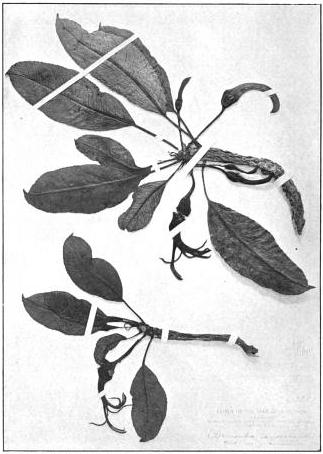 |
| Type of CLERMONTIA SINGULIFLORA Rock in Herbarium College of Hawaii. |
page 293
This species is peculiar to the middle forest region of the island of Kauai. It occurs as a shrub and as a small tree, sometimes epiphytically on Metrosideros collina polymorpha or on Cheirodendron platyphyllum. It ascends as high as to the foot of Mt. Waialeale at an elevation of 4600 feet along Kaluiti and Kailiili streams. It is associated with Gunnera, Trematolobelia macrostachys Kauaiensis, Tetraplasandra Waialealae, and others.
Horace Mann has apparently not collected this species, and the description he published was drawn up from a fragment collected by the U. S. Exploring Expedition. The specimen consists of a small twig with leaves only and is mounted on a sheet with other fragments of Clermontia oblongifolia ?, Cl. persicifolia, and perhaps also Cl. Kakeana. Léveillé's Clermontia Fauriei is a young twig of this species.
The natives as well as the birds are very fond of the large, sweet yellow berries. The native name of the species is Haha-ai-a-ka-manu == the Haha which is eaten by the birds.
Clermontia Gaudichaudii barbata Rock. Clermontia gaudichaudii β var. Hillebr. Flora Hawaii. Isl. 243. 1888. (Plate 162.)
Calyx and corollas as in the species; upper anthers pubescent along the sutures and at the apex; leaves broader oblong, glossy, as if varnished on the upper face.
MAUI: East Maui, Hamakua, Lydgate no. 56 in Herbarium Berolinense.
The writer is not familiar with this variety; according to Hillebrand the upper anthers are bearded. There is a specimen in the Berlin Herbarium collected by Lydgate.
Clermontia singuliflora Rock. Clermontia Gaudichaudii var. singuliflora Rock in Indig. Trees Hawaii. Isl. 512. 1913. (Plate 163.)
An epiphitic shrub, 1.5-2 m high, glabrous throughout, leaves elliptical, ovate-oblong, acute at both ends, coriaceous, 8-15 cm long, 3.5-5 cm wide; glabrous on both sides, shining above, dull underneath, with fine reticular network impressed above, projecting below, margin irregular, serrulate to denticulate, petioles 2.5-5 cm; peduncle short, about 8 mm, bibracteate at the middle and bibracteolate at the apex; pedicels 3-4.5 cm long, bibracteolate about 4 mm above the base; calyx tube turbinate about 15 mm long, and about as broad at the apex, the lobes triangular dentiform about 2 mm high; corolla glabrous, greenish white, arcuate, 5-6 cm long; staminal column glabrous, pale, as are the anthers; fruit unknown.
HAWAII: Paauhau no. 1, northwestern slopes of Maunakea, elevation 3500-4000 feet, flowering June 1909, Rock no. 3252 type in the herbarium of the College of Hawaii.
Clermontia singuliflora, as the specific name implies, has usually single flowers in the axils of the upper leaves, but occasionally two may be observed. The species is closely related to Clermontia Peleana, but differs from it in the very short peduncles, long pedicels, and smaller elliptical leaves; the flowers are whitish green, while those of Cl. Peleana are purplish black. It is also epiphytic and grows usually on Cheirodendron Gaudichaudii and Cibotium tree ferns. The forest in which this species occurs was in a dying condition nearly ten years ago, and in all probabilty it has disappeared by now.
page 294
| PLATE 164. |
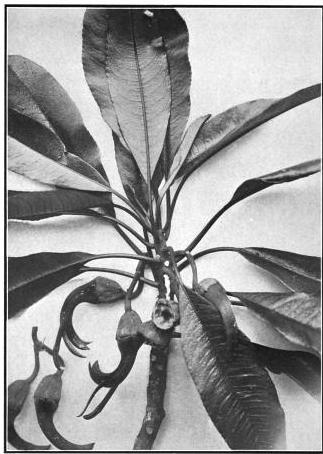 |
| CLERMONTIA PELEANA RockFlowering specimen, reduced.From: J. F. Rock "The Indigenous Trees of the Hawaiian Islands.". |
page 295
| PLATE 165. |
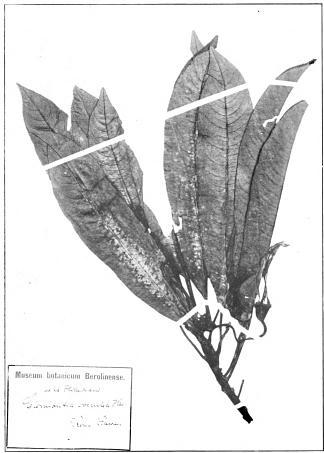 |
| Type of CLERMONTIA COERULEA Hillebr. in the Herbarium Berolinense. |
page 296
| PLATE 166. |
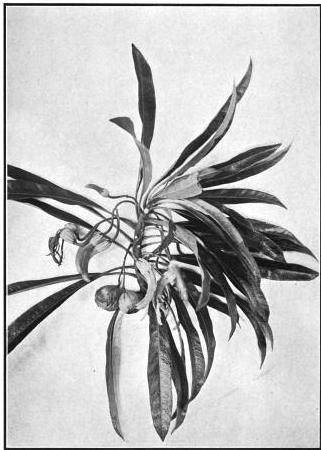 |
| CLERMONTIA COERULEA Hillebr.One-third natural size; showing flowers and fruits.From: J. F. Rock "The Indigenous Trees of the Hawaiian Islands.". |
page 297
Clermontia Peleana Rock Indig. Trees Hawaii. Isl. 483, pl. 200. 1913. (Plates 9, 164.)
A small tree or shrub 6 m or more high, usually epiphytic, glabrous throughout; leaves oblong acuminate 18 to 20 cm long by 3.5 to 4.5 cm wide, dark green above, glossy somewhat lighter underneath, with dark purple veins and midrib, irregularly crenate to near the bae of the leaf, which is on a petiole of 4 to 6 cm; flowers axillary usually two on a short peduncle of 1.5 cm with two small linear bracts at the midde; pedicels 3 to 4 cm with two bracteoles at their common base; calyx dark green, the ovarian portion turbinate 1.5 to 2 cm in diameter, with minute teeth; corolla strongly arched when open, 4 to 5 cm, dark blackish purple, thin not fleshy, silky, the apex almost returning to the level of the base; staminal column glabrous dark purple, as are the anthers of which the two lower are penicillate; style glabrous with a bluntly two-lobed stigma; fruit globose, truncate at the apex, about 3 cm in diameter, orange yellow; seeds chestnut-brown shining, about 1 mm in diameter.
HAWAII: Near Glenwood along the road to the Volcano, epiphytic on Ohia lehua trees, flowering July 11, 1911, Rock no. 8800 type in the herbarium of the College of Hawaii; — same locality, July 12, 1912; and fruiting August 30, 1917, Rock no. 12846 in the herbarium of the College of Hawaii.
Clermontia Peleana is named after the Hawaiian goddess Pele, whole abode is in the fires of Kilauea, in the vicinity of which this species grows.
It is a tree about 20 feet in height, but much smaller plants were observed; the tallest ones were seen in the uppermost forks of giant Metrosideros collina (Ohia lehua) trees in the wet forest at an elevation of 2500 to 3000 feet; it is an exceedingly handsome species on account of its symmetrical growth, dark green glossy leaves with deep purple venation and dark purplish-black flowers. It grows in company with Clermontia Hawaiiensis, Cheirodendron Gaudichaudii, Cyrtandra platyphylla, Cibotium Chamissoi, C. Menziesii, Ilex anomala sandwicensis, Coprosma pubens and others. Like Cl. Haleakalensis, Cl. Peleana is soon to be a thing of the past. It inhabits the tallest Ohia lehua trees, which, deprived of their native undergrowth, are ready to fall to their death, and with them this interesting Clermontia.
Clermontia coerulea Hillebr. Flora Hawaii. Isl. 243. 1888. (Plates 165, 166.)
A small tree or shrub 4-6.5 m high; leaves oblong 12-20 cm long, 2-4.5 cm wide, shortly acuminate, mucronulate or bluntly acute, or obtuse at the apex, acuminate at the base and contracting into a petiole of 3-5 cm in length, minutely denticulate, membranaceous, glabrous above, with a scattered pubescence along the midrib beneath; peduncle slender 2.5-4 cm long, bracteate considerably above the middle pedicels as long or longer than the peduncle (in Hillebrand's specimen the pedicels are shorter than the peduncle), bracteolate below the middle; * calyx greenish white or purple, the tube oblong or turbinate, the lobes either large 15-17 mm, or minute dentiform; corolla moderately curved about 4 cm long, greenish in Kau specimens, purplish in Kona specimens, of a thin texture; berry globose yellow about 2 cm in diameter, somewhat furrowed.
_______________ * Hillebrand's statement that the bracteoles are at the middle is incorrect; his specimen, which the writer examined, has the bracteoles also below the middle.
page 298
| PLATE 167. |
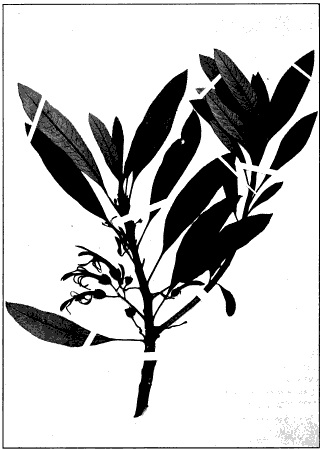 |
| CLERMONTIA WAIMEAE RockType in the herbarium of the College of Hawaii. |
page 299
HAWAII: Woods of Kona, Hillebrand type in Herbarium Berolin.; — Iles Sandwich, Hawaii, J. Remy, 1851-1855, no. 308 in herbarium Mus. Paris; — Moonuiahea, slopes of Mt. Hualalai, flowering June 10, 1909, Rock no. 3737 in herbarium of the College of Hawaii; — Hinakapauula, Hualalai, flowerbuds, June 10, 1909, Rock no. 3762 in herbarium College of Hawaii; — Naalehu forest, Kau 3000 feet elevation, flowering January 1912, Rock no. 10003 in herbarium College of Hawaii; — forest of Kealakekua, flowering February 10, 1912, Rock no. 10031 in herbarium College of Hawaii; — Pulehua, South Kona, flowering February 1912 Rock no. 10032 in herbarium College of Hawaii.
Clermontia coerulea is the most common Clermontia in the southern part of the island of Hawaii. It ranges from Kau to South Kona, extending over the slopes of Mauna Loa to North Kona over the slopes of Mt. Hualalai. It can be found at an elevation of 2000 feet above Naalehu, Kau, in wet rain forests up to an elevation of 4000 feet. It also occurs in the wet forest back of Kapua, where it extends up into the Koa belt. It is not uncommon in the forests above Kealakekua and on the slopes of Kualalai back of Huehue. In Kau it is a tree 15 to 20 feet in height with trunk of about 4 to 5 inches in diameter, and is freely branching. In the specimens from Kau, the calycine lobes are minute dentiform, while in the Kona specimens the lobes are broad deltoid. In the latter locality it is a shrub.
The species was first collected by Jules Remy, but was never described by him. His specimen no. 308 in the Paris Herbarium has long calycine lobes such as are found in the North Kona specimens.
Clermontia Waimeae Rock in Coll. Hawaii Publ. Bull. 2:40. 1913. (Plate 167.)
A shrub 3-5 m high, many branched, of the typical Clermontia type; branches slender, glabrous; leaves bright green, glossy, subcoriaceous to chartaceous, glabrous on both sides, only the young leaves puberulous underneath, elliptic-lanceolate, acute at both ends, mucronate at the apex, crenate to crenulate, callous, covered with a fine impressed areolar network, midrib reddish, 10-15 cm long, 2-3.5 cm wide, on petioles of 2.5-3.5 cm; cyme 3-5 flowered, puberulous, axillary, the common peduncle 2-3 cm, pedicels 10-15 mm, bibracteolate at or below the middle; ovarian portion of calyx subglobose, 6-8 mm in diameter, the lobes linear-lanceolate recurved, acute, 5-8 mm long, puberulous, corolla purple, slender, slightly curved, somewhat pubescent, 3-4 cm long, 3-4 mm wide, deeply lobed more than half the length of the corolla, the lobes linear-lanceolate, acute, the dorsal slit not always extending to the base, but often only beyond the middle; staminal column glabrous, anthers entirely glabrous, the lower ones bearded only; fruits dark orange yellow, globose with truncate apex and persistent calycine lobes.
HAWAII: Dense swampy forests above Waimea village, Parker Ranch, elevation 4000 feet, flowering July 12, 1909, Rock, type no. 4794 in the herbarium of the College of Hawaii; — Waimea forests, flowering July 1910, Rock nos. 4794-b, 4794-c, 4794-d, 4794-e; — Alakahi gorge, flowering July 13, 1909, Rock no. 4756; — Kohala reservoir mountains of Kohala, flowering July 1910, Rock no. 8847.
Clermontia Waimeae is a very variable species, the most variable part being the calycine lobes. This species shows well the impossibility of establishing genera on such a variable character as the length of calycine lobes.
page 300
| PLATE 168. |
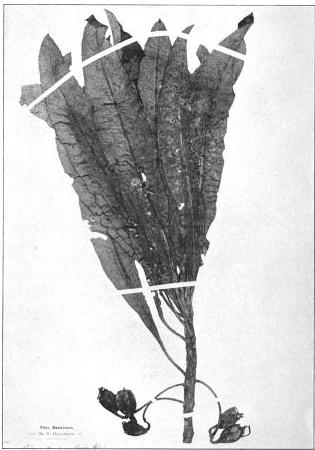 |
| CLERMONTIA PYRULARIA Hillebr.Type in Herbarium Berolinense, ex coll. Hillebrand. |
page 301
| PLATE 169. |
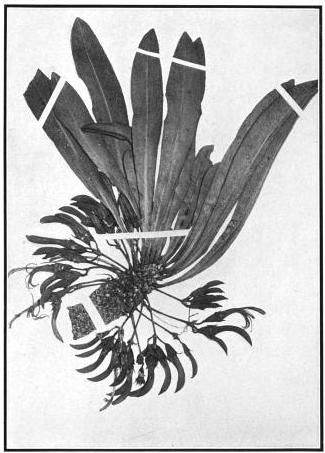 |
| CLERMONTIA HALEAKALENSIS RockLess than half natural size. Type in the herbarium of the College of Hawaii.From: J. F. Rock "The Indigenous Trees of the Hawaiian Islands." |
page 302
| PLATE 170. |
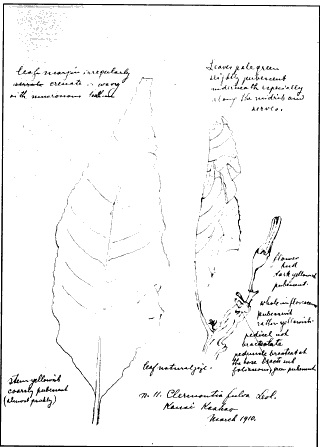 |
| CLERMONTIA FULVA Lévl.Sketch of the type in Léveillé Herbarium, La Mans, France. |
page 303
For example, we find in no. 4794-d, calycine lobes measuring 22 mm in length; they are, however, not connate, but free to the base. In no. 4794-b the calycine lobes measure 8 mm. There are other intermediates with calycine lobes of all lengths, but not as long as the corolla, and only in one instance (no. 4794-c) is there a tendency of the lobes becoming connate. The species is closely related to Clermontia montis-Loa, Cl. parviflora and Cl. parviflora calycina. There is also a tendency to develop a raceme instead of a true cyme, and thus the species probably establishes the link between Cyanea and Clermontia. The habit of the plant as well as the leaves is that of a typical Clermontia.
Clermontia pyrularia Hillebr. Flora Hawaii. Isl. 243. 1888. amend. (Plate 168.)
Leaves lanceolate acute or bluntly acuminate 20-28 cm long, up to 5 cm in width, chartaceous, dull, glabrous above, pale and whitish pubescent underneath, on petioles of 2.5-3 cm long, peduncle 5-6 cm long, deflected, nodding, quite naked, two to three-flowered, pedicels 8 mm to 2 cm long, resupinate, with short bracteoles near the base; calyx turbinate 12 mm long and broad, with short obtuse teeth, puberulous; corolla moderately curved, 6-8 mm wide, puberulous; berry large pear-shaped 2.5 cm long, about 2 cm wide; seeds dark brown, shining.
HAWAII: Woods of Hamakua, Hillebrand in Herbarium Berlin; — Mauna Kea, northeast slopes, elevation 7000 feet, fruiting August 23, 1916, A. S. Hitchcock no. 14305 in the U. S. National Herbarium and part in the herbarium of the College of Hawaii.
Prof A. S. Hitchcock was the first to re-collect this interesting species. It comes close to Cl. drepanomorpha, but differs from it in the short obtuse calycine teeth, while those in Clermontia drepanomorpha are as long as the corolla and enclose the same. It grows in the wet shady woods on the northeast slopes of Mauna Kea at an elevation of 7000 feet. Hillebrand simply gives as locality, woods of Hamakua, Hawaii. The Hamakua district is exceedingly large and ranges from sea level to 10,000 feet elevation or even more; without more definite locality it is certainly difficult to locate such precinctive species as belong to the Lobelioideae.
Clermontia Haleakalensis Rock Indig. Trees Hawaii. Isl. 489, pl. 204, 205. 1913. (Plates 8, 26, 169.)
A small tree 6.5 m high, with few robust branches, glabrous; leaves 20 to 30 cm long including the short margined petiole, fleshy, 1.5 to 4 cm wide, obtuse, oblong lanceolate, dark green above, pale underneath, midrib thick prominent, veins impressed, pellucid, the upper half crenate, lower half entire, glabrous, gradually tapering into a short margined petiole; cymes in the axils of the leaves, peduncle 2 to 5 cm long, bearing usually 6 flowers on pedicels of 1 to 1.5 cm, the bracts linear subulate about 7 mm, the pedicels bibracteolate below the middle; calyx tube oblong turbinate 1.5 cm slightly pubescent, the lobes linear subulate 5 mm long, corolla whitish green 3.5 to 4 cm long, curved, the dorsal slit not always extending to the base, sometimes only to the middle, lobes linear lanceolate glabrous; staminal column white pubescent at the base, as is the disc, glabrous in the upper part, the two lower anthers penicillate; style slightly pubescent, inner side of the staminal column hispid with white hair in the lower half, berry oblong, seeds smooth whitish.
page 304
MAUI: East Maui, western slopes of Mt. Haleakala, on the crater of Puunianiau, elevation 7000 feet, flowering October 11, 1910, Rock type no. 8595 in herbarium of the College of Hawaii, Gray Herbarium, herbarium New York Botanic Garden, herbarium Sydney Bot. Gard., Herbarium Berol., Herbarium Vienna.
A small tree 10 to 20 feet tall, with few very robust branches, having at first glance the aspect of a Dracaena. It is soft-wooded, and glabrous. This very curious tree, which has almost an antediluvian appearance, comes nearly between Clermontia and Cyanea. Its decidedly cymose inflorescence places it with the former genus, while the dorsal slit of the corolla does not always extend to the base, but to the middle. It also has a characteristic of the genus Delissea, and that is the thickened portion or knob in the flowerbud about the middle, indicating the termination of the dorsal slit; though the seeds, which in Delissea are deeply wrinkled, are smooth and shining in the species in question.
This remarkable tree is undoubtedly one of the oldest forms of our Hawaiian Lobelioideae, as it is so strikingly different from all the rest of the Lobelioideae inhabiting these islands.
This species was discovered by the writer October 11, 1910, on the island of Maui, on the western slopes of Mt. Haleakala, on the crater of Puunianiau, at an elevation of 7000 feet, in a locality where no one would expect to find a member of this wonderful tribe. It grows in open, dry scrub in company with plants belonging to the upper forest zone, such as Raillardia platyphylla, Argyroxiphium virescens, Sophora chrysophylla, Santalum Haleakalae, etc. Unfortunately, only three trees are in existence, and as they are peculiar to the above locality, it will not be long before they will have shared the fate of so many of our native trees, becoming extinct, as cattle have free access and browse on the lower branches within their reach.*
Clermontia fulva Lévl. in Fedde Repert. Spec. nov. XII:506. 1913. amend. (Plate 170.)
Leaves ovate-lanceolate, undulate, pale green, slightly pubescent underneath, especially along the midrib and nerves, the margins wavy, crenate and with numerous teeth, acute to acuminate? at the apex, acute at the base, 23 cm long, 8 cm wide, on petioles of 2.5 cm; peduncle 1 cm, bracteate at the base, the bracts subfoliaceous, green glabrous; pedicels not bracteolate, 1.5 cm pubescent, yellowish; calyx ovate, ovarian portion about 13 mm, the teeth triangular 3 mm long acute, distant; corolla suberect, (bud) 3 cm long, yellowish tomentose, fruit unknown.
KAUAI: Kaahao (in specimen), Kauhoa (in publication), flowerbuds, March 1910, Urban Faurie no. 11 in Herbarium Léveillé, La Mans, France.
No specimens are extant in other herbaria as far as the writer is aware; the description has been drawn up by the writer from the miserable specimen in Léveillé's herbarium.
The species is indeed an odd Clermontia; it has more the habit of a Cyanea. The inflorescence as far as can be made out is apparently a cyme.
____________
* The writer's fears in regard to the destruction of this rare species, were well founded; the species has become extinct. While on Maui for the purpose of taking photos of Lobelioideae, he made a special trip to Puunianiau to see this species once more, but to his great sorrow not a vestige of this interesting species could be found; it had succumbed to the ravages of cattle.
page 305
| PLATE 171. |
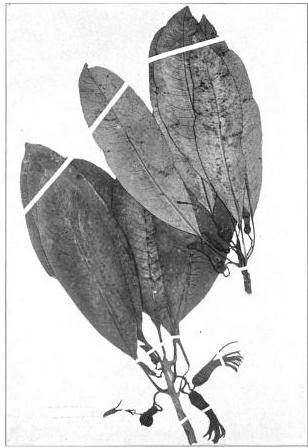 |
| CLERMONTIA KAKEANA MeyenSpecimen ex coll. Hillebrand in Herbarium Berolinense. |
page 306
| PLATE 172. |
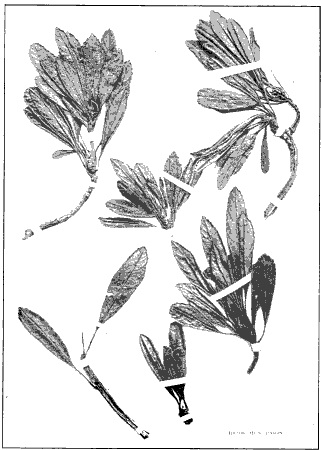 |
| CLERMONTIA PERSICIFOLIA Gaud.Specimen collected during Gaudichaud's second visit (1836-37), in the herbarium Museum Paris. |
page 37
| PLATE 173. |
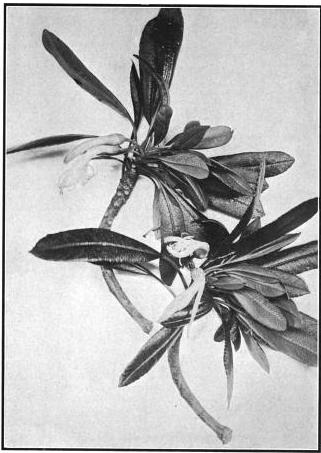 |
| CLERMONTIA PERSICIFOLIA Gaud.Flowering specimen, reduced.From J. F. Rock "The Indigenous Trees of the Hawaiian Islands.". |
page 308
Section CLERMONTIAE GENUINAE. Hillebr. Flora Hawaiian Isl. 239. 1888.
Clermontia Kakeana Meyen Reise um die Erde II:358. 1843. Clermontia macrocarpa Gaud. Bot. Voy. Bonité, t. 49. 1839-1852. Clermontia macrophylla Nutt. Transact. Amer. Philos. Soc. II, 8:251. 1843. Clermontia grandiflora γ longifolia A. Gray in Proceed. Am. Acad. V:150. 1862. (Plate 171.)
A tall shrub or small tree 3-6 m high, branching candelabra-like, young shoots tomentose; leaves obovate-oblong, 15-25 cm long 5-8 cm wide, on petioles of 3-6 cm, shortly acuminate or acute at the apex, acuminate at the base, closely denticulate with callous teeth, but entire along the base, membranous when dry, a dull green, not shining and glabrous above, fainly pubescent or puberulous beneath; peduncle pubescent, 2-3.5 cm long, two to five flowered; pedicels 15-20 mm long, bibracteolate below or above the middle, or the bracteoles accrete to the pedicels and therefore apparently at the baes of the calyx; calyx green, ovarian portion globose 10-13 mm in diameter, the tubular portion equalling the corolla, 5 cm long, about 8 mm wide, suberect green; corolla yellowish green to pale rose-colored; staminal column and anthers glabrous, the latter purplish; berry globose 20-30 mm in diameter, faintly ribbed; seeds pale.
OAHU: Gaudichaud in herbarium Museum Paris; — Meyen, Nuttal, in Herbarium?; — Mann et Brigham no. 22 in Herbarium Cornell; — Halemann gulch, March 1870, Hillebrand in Herbarium Berolinense; — Waiolani Mountain, Wawra no. 1658 in Herbarium Vindobonense; — Kaala Mts., Wawra no. 2246 in Herbarium Vindobonense; — Kaala, Hillebrand in Herbarium Berolinense; — along Tantalus, April 2, 1895, Heller no. 2059 in Herbarium Cornell, Gray Herbarium; — Pauoa Valley, flowering January 7, 1909, Rock no. 711 in herbarium College of Hawaii; — Wahiawa, flowering July 1908, Rock no. 8725 in herbarium College of Hawaii; — Kaukonahua gulch, flowering May 15, 1909, Rock no. 8723 in herbarium College of Hawaii; — Waikakalau gulch, flowering October 1912, G. W. Shaw no. 12839 in herbarium College of Hawaii; — Waianu Valley (Waiahole), Flowering January 22, 1909, Rock no. 1199 in herbarium College of Hawaii.
MOLOKAI: Hillebrand in Herbarium Berolinense; — Mapulehu, Molokai, flowering April 1910, in herbarium College of Hawaii; — Pukoo, October 8, 1916, A. S. Hitchcock no. 15032 in U. S. National Herbarium.
MAUI: West Maui, Puukukui, September 24-26, 1916, A. S. Hitchcock nos. 14793, 14795 in U. S. National Herbarium; — East Maui, Honomanu ditch trail, flowering May 1911, Rock no. 8815 in herbarium College of Hawaii; — Kahikinui, southern slopes of Mt. Haleakala, flowering November 1910, Rock no. 8688 in herbarium College of Hawaii; — Olinda pipeline trail, elevation 4000 feet, October 1, 1916, A. S. Hitchcock no. 14928 in U. S. National Herbarium.
Clermontia Kakeana while not so variable as other species of the genus Clermontia, is nevertheless one of the most common species. It occurs on Oahu, Molokai and Maui, growing at elevation of 1000-4000 feet. The plant was commonly known as Clermontia macrocarpa, but the specific name Kakeana given by Meyen is the older one. Meyen also published the first description, while Gaudichaud only published a plate, which is, however, excellent better than any description. Hillebrand records three varieties of this species in his Flora.
page 309
| PLATE 174. |
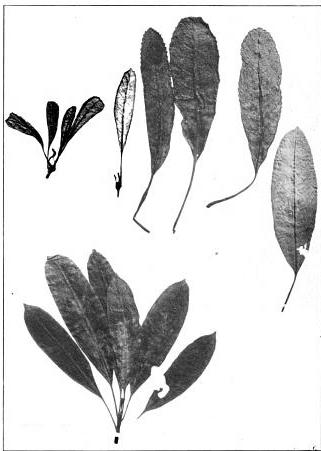 |
| Left-hand upper corner, Cl. persicifolia Gaud., ex coll. Gaud. visit 1836-37, Bonité left-hand lower corner, Cl. Gaudichaudii, ex coll. U. S. Expl. Exp., Kauai; right upper three leaves, Cl. oblongifolia Gaud., ex coll. Gaud., visit 1836-1837, Bonité; single leaf extreme right, middle of plate, Cl. Kakeana, ex coll. U. S. Expl. Exp. Oahu. |
page 310
| PLATE 175. |
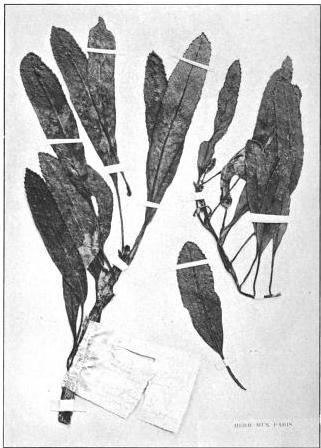 |
| CLERMONTIA OBLONGIFOLIA Gaud.Specimen ex coll. Gaudichaud in Herbarium Paris. |
page 311
| PLATE 176. |
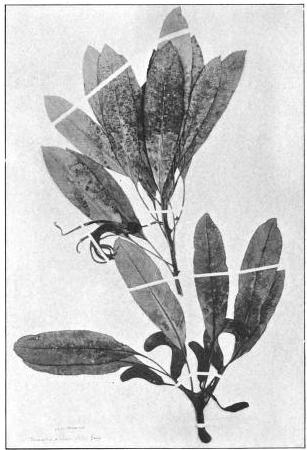 |
| CLERMONTIA OBLONGIFOLIA Gaud.Specimen ex coll. Hillebrand in Herbarium Berolinense. |
page 312
| PLATE 177. |
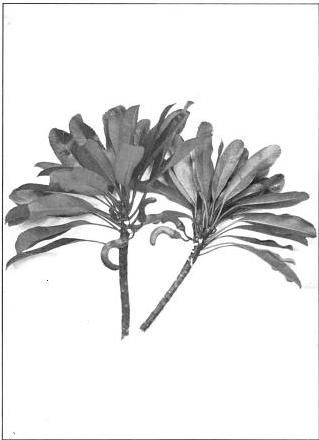 |
| CLERMONTIA OBLONGIFOLIA Gaud.Flowering specimen. |
page 313
The two first ones, var β cymosa and γ rosea, are not sufficiently distinct to separate them from the species; a five-flowered cyme occurs in specimens from Oahu and also from Molokai, while two-flowered ones occur on these same plants. His third variety, δ Hawaiiensis, is sufficiently distinct to be raised to specific rank see Rock, Indigenous Tree Hawaiian Isl., page 477, plate 199).
In the Paris Museum is a specimen ex coll. Gaudichaud no. 146, C. viridis, which may be referable to this species; to the writer's mind it seems to approach a larger-flowered form of Clermontia parviflora.
Clermontia persicifolia Gaud. Bot. Voyage Uranie 459, pl. 72. 1826. Clermontia grandiflora var. β oblongifolia A. Gray in part, Proceed. Amer. Acad. V:150. 1862. Clermontia parviflora Wawra in Flora XXXI:47. 1873. not Gaudichaud. Clermontia persicaefolia Hillebr. Flora Hawaii. Isl. 241. 1888. (Plates 6, 7, 172, 173, 174 in part.)
A shrub or small tree 5-6 m high with a broad, spreading crown; leaves lanceolate or oblong to spathulate, acute or rounded at the apex, acuminate at the base, subcoriaceous, dark green, glossy above, pale beneath, coarsely crenate or serrulate, 8-10 cm long, 1-2 cm wide, on petioles of 4-6 cm; peduncle 10-14 mm, usually two-flowered with a pair of bracts below the middle; pedicels 12-15 mm long, bibracteolate at or near the base; calyx and corolla slender, whitish to white with purplish tinge, greenish when young, 5.5 cm long, 7-8 mm wide, slightly curved; staminal column glabrous; anthers whitish glabrous, the lower three penicillate; berry subglobose orange yellow.
OAHU: Gaudichaud in herbarium Museum Paris; — ex collect. Gaudichaud no. 148 in Herbarium Paris; — Montagnos, Avril 1855, J. Remy no. 307 in Herbarium Paris; — Puahakea, Wawra no. 2206 in Herbarium Vindobonense; — Palolo Valley, Hillebrand in Herbarium Berolinense; — Waiolani, 2500 feet elevation, June 6, 1895, Heller no. 2391; — Punaluu, main ridge Koolau Mountains, December 3-14, 1908, Rock no. 698 in herbarium College of Hawaii; — Palolo Valley, near crater, 1912, Rock no. 12791 in herbarium College of Hawaii.
LANAI: Upper forests of the mountains, September 21, 1916, A. S. Hitchcock no. 14643 in the U. S. National Herbarium.
Clermontia persicifolia, hitherto thought peculiar to Oahu, has lately been found on Lanai by Prof. A. S. Hitchcock. It is evidently very rare, as the writer, who spent several weeks on that island, did not find it.
It is a handsome shrub or small tree, growing either terrestrially or epiphytically on Metrosideros trees. It is most common in Palolo Valley at an elevation of 1500 feet from the crater rim.
Remy's no. 307 is the typical Cl. persicifolia, and so is Wawra's no. 2206 (Cl. parviflora Wawra not Gaud.). Gaudichaud collected two specimens of this species, one on his first visit, the other on his second visit. One, the type without number, has a three-flowered cyme; the other consists of leaves only. It bears the number 148 and is labeled Cl. oblongifolia?? var. cuneata. It was evidently collected during his second visit on the Bonité in 1836-1837. Fragments of this plant are also in the Gray Herbarium on a sheet with specimens of Cl. oblongifolia. Cl. Gaudichaudii, and perhaps also Cl. Kakeana, it is marked var. cuneata, Bonité, Gaudichaud.
page 314
| PLATE 178. |
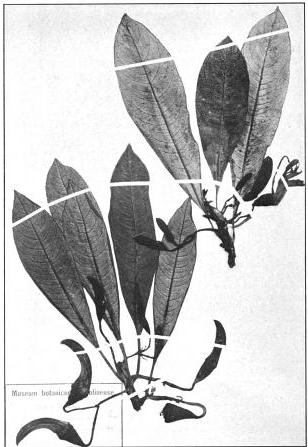 |
| CLERMONTIA HAWAIIENSIS (Hillebr.) RockSpecimen of Cl. macrocarpa Hawaiiensis Hillebr. in Herbarium Berolinense. |
page 315
Gaudichaud evidently did not recognize his own species established in 1826, which is not at all surprising, since the material at its best is fragmentary.
Clermontia oblongifolia Gaud. Bot. Voyage Uranie 459, pl. 71. 1826. Clermontia grandiflora var. β oblongifolia A. Gray in part, Proceed. Amer. Acad. V:150. 1862. pro parte. Clermontia oblongifolia Mauiensis Rock in Indig. Trees Hawaii. Isl. 476. 1913. (Plates 175, 176, 177.)
A small tree 5-7 m high or more often a shrub; leaves oblong to obovate oblong, or lanceolate oblong, bluntly acute, or obtuse or shortly acuminate at the apex, acute or acuminate at the base, coriaceous to subchartaceous, pale or deep green, lighter beneath, glossy shining above, 8-19 cm long, 3-4.5 cm wide, the margin crenulate, on petioles of 3-9 cm; peduncles two to three flowered, 1.5-4.5 cm long, with one or two pairs of dentiform bracts; pedicels 2-4.5 cm, bibracteolate near the base, calyx greenish, the lobes as long as the corolla, the latter strongly arcuate, 6 cm long, 12 mm wide, glabrous, greenish or purplish and dull, the apex returning to the level of the base; staminal column glabrous, the anthers glabrous or hirsute at the sutures; the berry globose not furrowed, seeds dark brown.
OAHU: Gaudichaud in Herbarium Paris; — U. S. Exploring Exped. in Herbarium Gray; — Mann et Brigham no. 232 (in part) in Herbarium Cornell; — Hillebrand in Herbarium Berolinense; — Wawra no. 2356 ex herb. Hillebrand in Herbarium Vienna; — Konahuanui, elevation 2500 feet, May 2, 1895, Heller no. 2239; — Pauoa Valley, flowering November 1908, Rock no. 106 in herbarium of the college of Hawaii; — Konahuanui, flowering January 7, 1909 Rock no. 983 in herbarium College of Hawaii; — Punaluu, Koolau, December 24-29, 1908, Rock in herbarium College of Hawaii; — Pauoa Valley, April 20, 1912, Nuuanu Valley 1912, Rock no. 12784; — Konahuanui, 1912, Rock no. 12783 in herbarium College of Hawaii; — Mt. Kaala, 2000-4000 feet, July 9, 1916, A. S. Hitchcock no. 13993 in U. S. National Herbarium.
LANAI: Mahana Valley flowering July 23, 1910, Rock no 8014-a; — Kaiholena Valley, flowering July 1910, Rock no. 8014-b in herbarium of the College of Hawaii.
MAUI: Honomanu, East Maui, elevation 3000 feet, flowering April 1911, Rock no 8804 in herbarium of the College of Hawaii.
Of Clermontia oblongifolia there is one sheet in the Herbarium Paris, collected by Gaudichaud, but it seems never to have been properly labeled. In pencil appears the following legend, translated: "Attenuata, Clermontia oblongifolia? violacea, a light purple, greenish, corolla green-yellowish, stamens whitish purple, style light green, stigma dark green." There is no question of its being Cl. oblongifolia.
In the Cornell Herbarium is one sheet of the Mann & Brigham collection, part of which is Cl. oblongifolia and the other part Cl. Kakeana.
The specimens from Lanai and Maui differ somewhat from the Oahu specimens, but they must be referred to Cl. oblongifolia. In the Maui specimens the anthers are a deep purple and are hirsute at the sutures; the leaves are also acuminate.
page 316
| PLATE 179. |
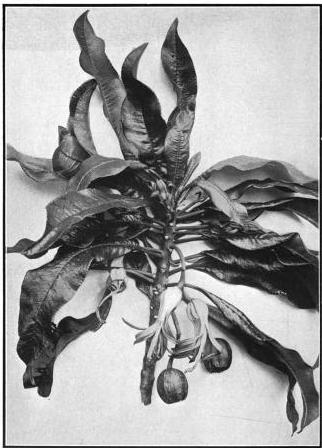 |
| CLERMONTIA HAWAIIENSIS (Hillebr.) RockFlowering and fruiting specimen.From J. F. Rock "The Indigenous Trees of the Hawaiian islands." |
page 317
Clermontia Hawaiiensis (Hillebr.) Rock in Indig. Trees Hawaii. Isl. 477, pl. 199. 1913. Clermontia macrocarpa var. Hawaiiensis Hillebr. Flora Hawaii. Isl. 241. 1888. (Plates 44, 45, 48, 178, 179.)
Leaves ovate-obovate, oblong, undulate, dark green, glossy above, glabrous, lighter beneath, pubescent along the veins and midrib, the veins impressed, 5-22 cm long, 3-6 cm wide on reddish petioles of 2.5-3 cm, chartaceous, acute or acuminate, obtuse or rounded at the apex, acuminate at the base; peduncles two to four-flowered, 3-6 cm long, bibracteate in the upper fourth, bracts foliaceous, 2-3.5 cm long linear-oblong, denticulate; pedicels 2-4 cm long, bibracteolate at the middle and at their common base, puberulous; ovarian portion of calyx subglobose to oblong, turbinate, pronouncedly ten-ridged, the dorsal ridge almost wing-like, the lobes green or purplish as long as the corolla and enclosing the same, 6-6.5 cm long, the dorsal slit extending to the base the lateral slits beyond the middle, each lobe strongly nerved, each nerve being a continuation of a ridge of the ovarian portion of the calyx; corolla slightly curved, especially before anthesis, and thickened toward the apex in the bud, white to greenish purple or purple; staminal column glabrous, green or purple, anthers pale purple, or dark and hirsute along the sutures or glabrous, ,the two lower penicillate only; berry large 3 cm in diameter, truncate at the apex, orange yellow, ten-ribbed.
HAWAII: From Hilo to Waiohino, flowering, Hillebrand in Herbarium Berolinense; — Volcano road, flowering July 1911, Rock no. 8801; — Mauna Loa, Kipuka Puaulu, flowering July 1911, Rock no. 8802; — Puaulu and Maunaloa, flowering July 1911, Rock no. 8803 type in herbarium of the College of Hawaii; — Puna, Hawaii, on road to Tree-moulds, flowering September 2, 1917, Rock no. 12847 in herbarium of the College of Hawaii.
Clermontia Hawaiiensis embraces quite a number of forms. Hillebrand's typical var. Hawaiiensis of Cl. macrocarpa was obtained evidently back of Hilo or Puna. It is true that the plants from these two mentioned localities come rather close to Cl. macrocarpa = Cl. Kakeana, but those found higher up the mountain on Mauna Loa, as, for example, in the famous Kipuka Puaulu and in the fern forest at 4200 feet elevation, look quite different; it is a compact tree up to twenty feet in height with a dense round crown. These different forms range more or less into each other, and it is desirable to recognize them all as a species. In Puna the species is exceedingly common; whole aa (=round) lava flows are taken up by this species, which forms a regular scrub forest to the exclusion of everything else.
The leaves are sometimes oblong or ovate, the peduncle either very long and then twice as long as the pedicels and two-flowered, or as long as the pedicels or little longer and then four-flowered; the two inner pedicels are shorter and thicker (almost quadrangular) than the two outer pedicels. In the four-flowered specimens the corolla is purple, while in the long-peduncled, two-flowered specimens the corolla is either whitish or greenish. In the forests of Keauhou, on Mauna Loa, about three miles from the Volcano House, it is exceedingly plentiful and grows usually on trunks of Cibotium tree ferns or it is also occasionally terrestrial. In the above-mentioned region it is associated with Acacia koa hawaiiensis, Metrosideros collina polymorpha, Myoporum sandwicense, Straussia hawaiiensis, etc. The plants found immediately back of Hilo may not be referable to this species, but to Clermontia Kakeana.
page 318
| PLATE 180. |
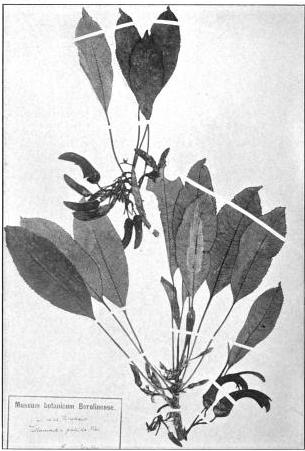 |
| Type of CLERMONTIA PALLIDA Hillebr. in Herbarium Berolinense. |
page 319
Clermontia pallida Hillebr. Flora Hawaii. Isl. 241. 1888. (Plate 180.)
A small tree 4 to 5 m high, quite glabrous leaves crowded at the ends of the branches, pale, chartaceous, dull, not shining, elliptico-oblong, 10-15 cm long, 3-4.5 cm wide, on petioles of 6.5-10 cm long, cuspidate at the apex, acute at the base, bluntly serrulate; peduncles 7.5-15 mm long, cymosely three to seven flowered, with a pair of empty bracts, pedicels up to 2 cm long, bibracteolate below the middle; bracts 14 mm, linear-oblong, bractlets 10 mm long; calyx green with a reddish tinge, the free tubular portion moderately arched, about 5 cm long, 10-12 mm wide, glabrous; corolla of the same color as the calyx or darker, glabrous; staminal column bluish purple, pruinose, puberulous, the anthers bluish glabrous; fruit (immature) globose, truncate.
MOLOKAI: Pali of Wailau, Hillebrand type in Herbarium Berolinense, part of type in herbarium of the College of Hawaii, co-type in Gray Herbarium; — Wailau Pali on ridge overlooking the valley, flowerbuds May 1915, Rock no. 12788 in herbarium of the College of Hawaii; — Wailau Pali, flowering and fruiting (immature) December 24, 1915, Rock no. 12790 in herbarium of the College of Hawaii; — Kamolo, north of, about 4000 feet elevation, flowering October 10, 1916. A. S. Hitchcock in the U. S. National Herbarium and part in herbarium of the College of Hawaii, no. 1276; — Central Molokai, wet forest, October 13, 1916, A. S. Hitchcock no. 15189 in the U. S. National Herbarium and part in herbarium of the College of Hawaii.
Clermontia pallida is evidently related to Cl. multiflora, but differs from it in the larger flowers, much larger leaves and long petioles; the name pallida refers to the very pale green leaves. the species is peculiar to Molokai. A co-type in the Gray Herbarium is labeled: "Clermontia sp. ? an oblongifolia Gaud ? Cl. longiper herb. mei. Molokai: pali of Wailau and Pelekunu."
On the cliffs of Waialeia and Waihanau a variety of the species is quite common; it presents a different aspect from the plants found at Wailau and Pelekunu; the leaves are much smaller and the flowers are larger and on very short peduncles and pedicels. Were it not for the two-flowered cyme the plant could be referred to Cl. multiflora. It is a very much branched, densely foliate shrub or small tree and may be recognized as a new variety of the species as var. ramosissima Rock, type no. 13116 in Herbarium Rock.
Clermontia Kohalae Rock in Indig. Trees Hawaii. Isl. 476. 1913. (Plates 25, 181.)
A small tree 5-6 m tall, loosely branched; leaves linear oblong, bluntly acute at the apex and slightly emarginate, acuminate at the base, 7-16 cm long, 2-3 cm wide, gradually narrowing into a petiole of 2 to 4 cm, glabrous, dull, pale underneath, with impressed veins, chartaceous to membranous, denticulate or serrate in the upper two thirds, entire at the base; peduncle 15-35 mm long, two-flowered, hispid or even scabrous, with two triangular bracts above the middle; pedicels as long as the peduncles, bibracteolate; ovarian portion of calyx turbinate, green, the lobes as long as the corolla, dark purplish black, thin, suberect or slightly arcuate, glabrous; corolla dark purplish black, glabrous, 5-6 cm long; staminal column glabrous; anthers pale, hirsute along the sutures, the two lower anthers only penicillate; berry subglobose, about 2 cm in diameter; seeds pale brown, smooth, shining.
page 320
| PLATE 181. |
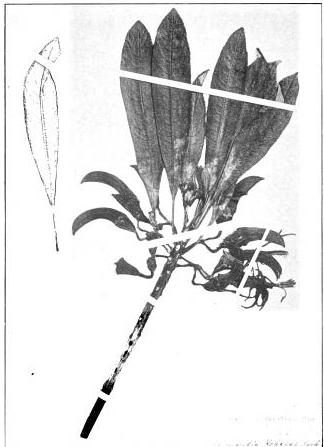 |
| CLERMONTIA KOHALAE Rock Type in the herbarium of the College of Hawaii. |
page 321
| PLATE 182. |
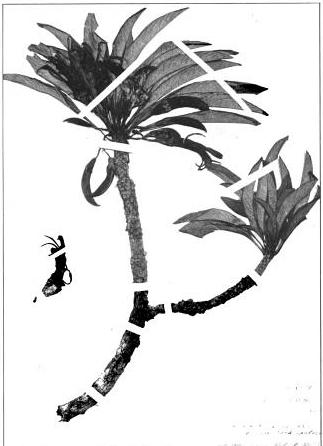 |
| CLERMONTIA KOHALAE ROBUSTA Rock Type in the herbarium of the College of Hawaii. |
page 322
| PLATE 183. |
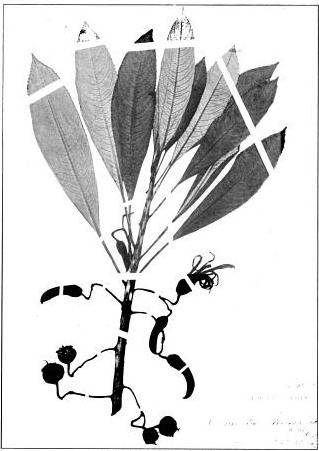 |
| CLERMONTIA LEPTOCLADA Rock Type in the herbarium of the College of Hawaii. |
page 323
HAWAII: Woods above Hiilawe, Waipio Valley, Kohala, flowering July 18, 1909, Rock no. 4573 in herbarium of the College of Hawaii; — gulches back of Kohala proper, lower forests along the streams at an elevation of 1500-2500 feet, flowering and fruiting July 1910, Rock, type no. 8810 in the herbarium of the College of Hawaii, co-type in Gray Herbarium, Herbarium Sydney, Calif. Academy of Science, Herbarium Berlin, and Herbarium Vienna.
A very handsome species. It flowers during the spring and summer months and is restricted to the windward side of Hawaii, district of Kohala. It is undoutedly related to Clermontia Hawaiiensis of the same island, but differs from it in the long, thin purplish black flowers and in many other respects also.
Clermontia Kohalae robusta Rock in Coll. Hawaii Publ. Bull. 2:41. 1913. (Plate 182.)
A small tree or shrub, branches exceedingly stout, woody to the last ramification, bark thick corky and covered with numerous thick knobby leaf-scars; leaves smaller than in the species and on much shorter petioles, densely crowded at the apex of each branchlet; inflorescence the same as in the species, flowers thicker and more fleshy, the cymes in the axils of the uppermost leaves and not all along the stem as in the species.
HAWAII: Mountains of Kohala, along stream beds and near waterfalls at an elevation of 1500 feet, back of Kohala proper, flowering July 1910, Rock, type no. 8811 in the herbarium of the College of Hawaii.
A very robust Clermontia perhaps only a form of the species.
Clermontia leptoclada Rock in Indig. Trees Hawaii. Isl. 477. 1913. (Plate 183.)
A tree 6-7 m tall, branching candelabra-like, branches slender, loosely foliose; leaves lanceolate-oblong, acuminate at both ends, 12-18 cm long, 2.5-4 cm wide, denticulate with callous teeth, dark green above, with a dark purplish tinge at the margins and apex, glabrous above, coriaceous, with impressed veins, pale underneath and sparingly hispid along the veins and midrib, on petioles of 4-6 cm; flowers all along the slender stem, on cymosely branching hirsute peduncles of 2.5-4 cm, bracteate in the upper third; pedicels two to four, 1.5-3.5 cm long, bibracteolate at the middle, the bracteoles linear-subulate, 5 mm long; ovarian portion of calyx subglobose, 14 mm in diameter, the tube as long as the corolla, purplish with prominent hispid nerves; corolla slightly arcuate 4.5 cm long, lobes linear-lanceolate, dark purple, hispid with white hair; staminal column purplish, puberulous, the anthers hirsute along the sutures, bluish purple, the lower only penicillate; fruit globose, 2.5 c in diameter; seeds brown, smooth, shining.
HAWAII: Forests above Waimea, along the Alakahi-Kawainui ditch trail, elevation 4200 feet, flowering and fruiting July 13, 1909, Rock type no. 4760 in herbarium of the College of Hawaii; — Alakahi trail, flowering June 1910, Rock no. 8814 in herbarium College of Hawaii.
This species is closely related to Cl. montis Loa, but differs from it in the larger flowers, long peduncles and pedicels; though no. 8814 comes very close to it. It inhabits the high swampy plateau of Kohala back of Waimea, and grows in company with Cl. drepanomorpha, Gunnera petaloidea, Labordia spp., Cyrtandra paludosa, Cheirodendron Gaudichaudii, etc.
page 324
| PLATE 184. |
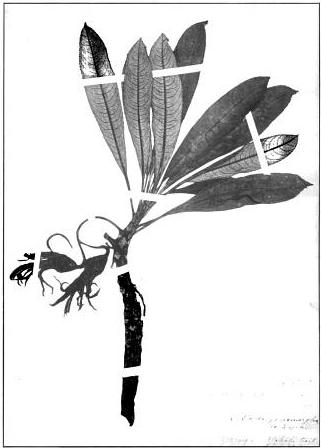 |
| CLERMONTIA DREPANOMORPHA RockType in the herbarium of the College of Hawaii. |
page 325
| PLATE 185. |
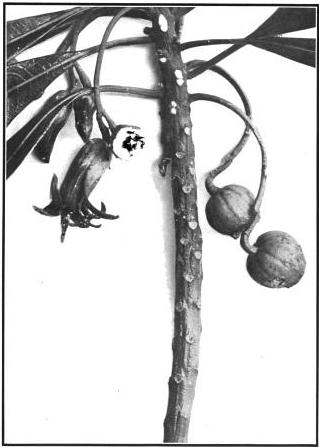 |
| CLERMONTIA DREPANOMORPHA RockFlowering and fruiting specimen, about one-half natural size.From: J. F. Rock "The Indigenous Trees of the Hawaiian Islands." |
page 326
| PLATE 186. |
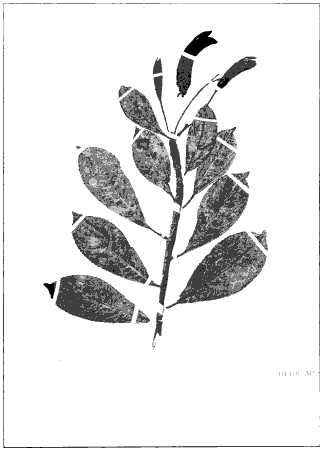 |
| Type of CLERMONTIA GRANDIFLORA Gaud. in herbarium Museum Paris. |
page 327
Clermontia drepanomorpha Rock in Indig. Trees Hawaii. Isl. 473, pl. 196. 1913. (Plates 184, 185.)
A small tree 4-6 m tall, much branching, leaves lanceolate-oblong, obovate, linear-elongate, 8-18 cm long, 1.5-4 cm wide, glabrous above, sparsely hispid underneath along the prominent reddish midrib, dark green above, lighter underneath, denticulate in the upper two thirds with callous teeth, entire in the lower, coriaceous acuminate-mucronate at the apex, acuminate at the base, the margin often revolute; petiole 2-5 cm; peduncle glabrous, two-flowered, 6-8 cm long with flowers, 10 cm with fruit, naked, deflected, nodding; the pedicels 2 cm, resupinate; bracts and bracteoles triangular; calyx dark purplish, the ovarian portion purple, fleshy, slightly curved, 4-6 cm long, 1.5-2 cm wide, puberulous; staminal column glabrous, purplish, anthers bluish-lilac, hirsute along the sutures on the inner side, glabrous outside, the lower only penicillate; berry large globose, orange yellow, 3 cm in diameter; seeds yellowish brown, smooth.
HAWAII: On the swampy high plateau of Kohala along the gorges of Alakahi and Kawainui and near the summit of Kohala in the more open swampy forest, growing terrestrially in Sphagnum moss, flowering July 12-13, 1909, Rock, type no 4751 in herbarium of the College of Hawaii; — same locality, no. 4745; — tabular summit, swampy forest of Kohala, flowering July 1910, Rock nos. 8807, 8808, 8809 in herbarium of the College of Hawaii; — Waimea, Hawaii, August 25, 1916, A. S. Hitchock in U. S. National Herbarium.
This remarkable species, with flowers as large as those of Cl. arborescens, if not larger, inhabits the summit swamp-sphagnum forests of Kohala, Hawaii; the species occurs in thousands of trees, but each seems to have a different aspect. It is a very variable species as far as the foliage is concerned, but the inflorescence does not vary at all, only perhaps in color. It is one of the finest Clermontias and at once recognizable by the long drooping inflorescence and large puruple flowers. The calyx is as long as the corolla; otherwise it would come exceedingly close to Clermontia pyrularia.
Clermontia grandiflora Gaud. Bot. Voy. Uranie 459, pl. 73. 1826. Clermontia grandiflora var. brevifolia A. Gray Proc. Am. Acad. V:150. 1862. Delissea filigera Wawra in Flora XXXI:31. 1873. (Plates 186, 187.)
A small tree 4-5 m high, glabrous; branches slender; leaves obovate to oblong, shortly acuminate, acute or cuspidate at the apex, bluntly serrulate or dentate, narrowing and acuminate at the base, 8-15 cm long, 2.5-4.5 cm wide, chartaceous, glabrous and dull; petioles 1-5 cm long; peduncle filiform and pendulous 2-11 cm long, bracteate at the apex and above the middle, two-flowered, the slender pedicels 3-6 cm long, bibracteolate near the middle (or sometimes three or by dichotomy of the pedicels cymosely four to five-flowered teste Hillebrand); calyx glabrous, rather thin, purplish or greenish, the ovarian portion low cup-shaped, 1 cm high, about 15 mm broad, the free portion tubular, strongly curved before expansion, much less so after, as long as or shorter than the corolla; corolla about 6-7.5 cm long, 8-10 mm wide, purplish or greenish, glabrous; staminal column glabrous, as are the anthers; berry obpyriform, deep orange yellow.
ILES SANDWICH: Gaudichaud, type in Herbarium Paris.
MOLOKAI: Voyage de M. J. Remy, 1851-1855, Remy no. 306 in Herbarium Paris and Gray Herbarium; ‐ heights back of Kamolo, July 1870, Hillebrand in
page 328
| PLATE 187. |
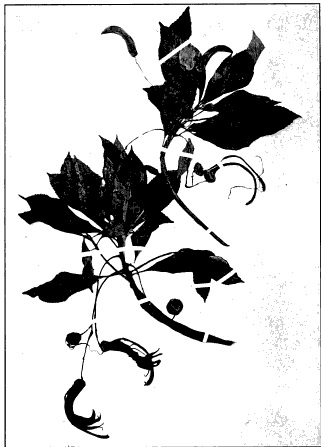 |
| CLERMONTIA GRANDIFLORA Gaud.Specimen ex Herbarium Hillebrand in Herbarium Berolinense. |
page 329
| PLATE 188. |
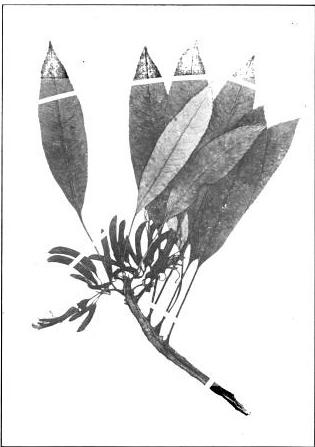 |
| CLERMONTIA MULTIFLORA Hillebr.Type in Herbarium Berolinense. |
page 330
| PLATE 189 |
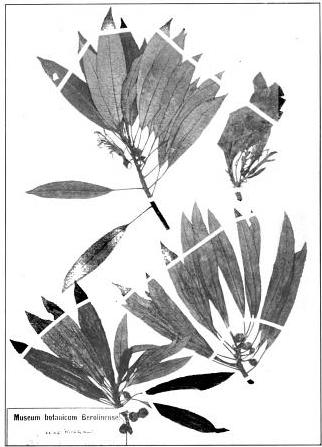 |
| Type of CLERMONTIA MICRANTHA (Hillebr.) Rock in Herbarium Berolinense. |
page 331
Herbarium Berolinense; — Kamoku camp above Kaunakakai, elevation 3500 feet, below a waterfall, flowerbuds, March 20, 1910, Rock no. 6117 in herbarium College of Hawaii; — woods above Mapulehu-Wailau Pali, April 1910, Rock no. 8069 in herbarium College of Hawaii; — Mapulehu, April 1910, Rock no. 7068 in herbarium College of Hawaii; Mapulehu, flowering May 1915, Rock no. 12781 in herbarium College of Hawaii; — Pukoo, October 8, 1916, A. S. Hitchcock no. 15013 in U. S. National Herbarium.
LANAI: Slopes of Mahana Valley and on the main ridge, flowering July 22, 1910, Rock no. 8018 in herbarium of the College of Hawaii; — upper forests, September 21, 1916, A. S. Hitchcock no. 14677 in U. S. National Herbarium.
MAUI: West Maui, U. S. Exploring Exped. in Herbarium Gray; — Waihee (not Kauai), Wawra, no. 1955 in Herbarium Vindobonense; — Puukukui, near summit, flowering August 1910, Rock no. 8193 in herbarium College of Hawaii; — Honokawai, flowering August 1910, Rock no. 8205 (intermediate between Cl. grandiflora and Cl. oblongifolia) in herbarium College of Hawaii; — Waikamoi gulch, elevation 4300 feet, flowering and fruiting September 1910, Rock no. 8503 in herbarium College of Hawaii; — Olinda, October 1, 1916, A. S. Hitchcock no. 14898 in U. S. National Herbarium; — Puukukui, young fruits, September 24-26, 1916, A. S. Hitchcock nos. 14762 and 14788 in U. S. National Herbarium.
This distinct species inhabits the rainforests of Molokai, Lanai, West and East Maui, from an elevation of 2000 to 5000 feet. The specimens from above Mapulehu or the Molokai specimens in general have the longest peduncles, while the Maui specimens have the shortest (2 cm). The Lanai specimens vary slightly and some have the aspect of Clermontia oblongifolia, with which the species is doubtless closely related. On Lanai it grows in the more dry district at the ridge of Kaiholena and Mahana valleys, where it is a shrub; in the more shaded localities it becomes a small tree 15-18 feet in height. It is very plentiful at 4000 feet elevation on the windward side of Haleakala, East Maui, in the dense mossy rainforest along Waikamoi, Puohaokamoa, and Honomanu gorges.
The specific name grandiflora is very misleading, as its flowers are exceeded in size by Cl. arborescens and Cl. drepanomorpha.
Clermontia multiflora Hillebr. Flora Hawaii. Isl. 242. 1888. (Plate 188.)
A glabrous shrub 2-4 m high, leaves lanceolate-oblong 11.25-12.5 cm long, 2.5-3.15 cm wide, on long petioles of 6.25 to 7.5 cm, equally acute at both ends, crenulate, pale, chartaceous to membranaceous; peduncle 1.75 cm long, slender, umbellately many (seven to ten) flowered, with empty bracts only when fewer flowered; pedicels as long, bracteolate at the base; the bracts 1-2 mm; calyx of thin texture, glossy pale green, the ovarian portion obconical, 8 mm long, the free tubular portion as long as the corolla, 24-32 mm long and 5 mm wide, suberect; corolla purple at the top as are the anthers.
MAUI: Gulches of Waihee and Lahaina, flowering August 1870, Hillebrand in Herbarium Berlin and part of type in herbarium of the College of Hawaii, and Gray Herbarium.
OAHU: Wailupe Valley, Hillebrand in Herbarium Berlin and part in herbarium of the College of Hawaii, no. 12782.
A very interesting and distinct species, which so far has not been re-collected. The specimen is the Gray Herbarium is labeled: "Clermontia multiflora sp. n.? affin. pygmea." The name pygmea refers to his Cl. multiflora var. micrantha.
page 332
| PLATE 190. |
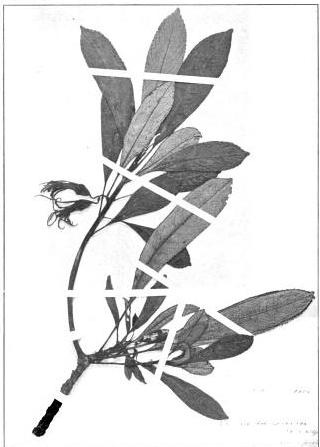 |
| CLERMONTIA MONTIS-LOA RockType (no. 10002) in the College of Hawaii Herbarium. |
page 333
| PLATE 191. |
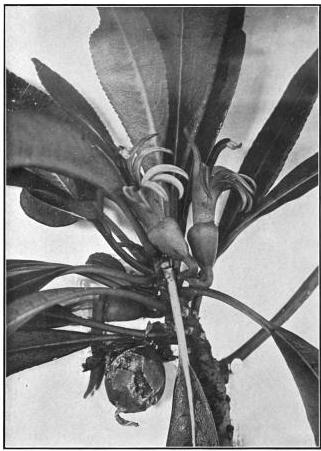 |
| Type of CLERMONTIA MONTIS-LOA Rock in the herbarium of the College of Hawaii.From: College of Hawaii Publ., Bull. no. 2. |
page 334
Clermontia micrantha (Hillebr.) Rock Clermontia multiflora micrantha Hillebr. Flora Hawaii. Isl. 242. 1888. Clermontia multiflora micrantha montana Rock Indig. Trees Hawaii. Isl. 511. 1913. (Plate 189.)
A shrub 1.5-2 m high; leaves small thick coriaceous when fresh, light green with pinkish veins and denticulate margins, linear-lanceolate acute to acuminate at both ends, glabrous on both sides, 5-10 cm long, 15-25 mm wide, on petioles of 2-3.5 cm long; peduncles usually two-flowered (three to five-flowered according to Hillebrand*); peduncle 5-6 mm long, pedicels about 12 mm; calyx greenish pink, as long as the corolla; corolla 2.5 cm long, pinkish purple, glabrous; staminal column and anthers pruinose-bluish; berry ovoid to subglobose, deep orange, 15 mm in diameter.
MAUI: Waihee Valley, flowering August 1870, Hillebrand in Herbarium Berolinense; — above Kaanapali, on Mt. Puukukui, elevation 4000 feet, flowering August 1910, Rock no. 8179 in herbarium of the College of Hawaii; — upper forest of Puukukui, West Maui, flowering and fruiting September 24-26, 1916, A. S. Hitchcock nos. 14821 and 14784 in the U. S. National Herbarium and part in the herbarium of the College of Hawaii; — near the summit of Mauna Eeke, flowering September 3, 1918, Rock & Hashimoto, in Herbarium Rock, no. 13131.
A very handsome plant worthy of specific rank; it is a small shrub with pinkish purple flowers and bright green leaves with a pinkish tinge. The peduncles are nearly always two-flowered and only rarely three to five-flowered, as stated by Hillebrand.
Clermontia montis-Loa Rock in Coll. Hawaii Publ. Bull. 2:40, pl. 9. 1913. (Plates 190, 191.)
A small tree or shrub, usually epiphytic; leaves coriaceous, oblong, obtuse or bluntly acute at the apex, acuminate at the base, glabrous above, covered with close reticulate network, dark green above pale whitish underneath, and pubescent with whitish hair, the margin crenate, 10-18 cm long, 2.5-3.5 cm wide, on petioles of 3-4.5 cm long; peduncle about 3-8 mm, two-flowered; pedicels of the same length, bracteate at the base, and minutely bi-bracteolate at about the middle; ovarian portion of calyx tube oblong to turbinate, green 12 mm long, the tube as long as the corolla 3.5 cm, glabrous, corolla light purplish green, the dorsal slit extending below the middle; staminal column glabrous dark purple, anthers darker, glabrous, only the two lower penicillate; berry ovoid-oblong, 25 mm long, 15 mm wide, dark orange; seeds elliptical, small, shining, dark brown.
HAWAII: Forests of Naalehu, Kau, southern slopes of Mauna Loa, elevation 4000 feet, in dense forest, flowering and fruiting January 9, 1912, Rock, type no. 10002 in herbarium of the College of Hawaii; — slopes of Kilauea-Mauna Loa, near 23 miles, in the neighborhood of Kalanilehua, flowering August 30, 1917, Rock no. 12833 in herbarium of the College of Hawaii; — forests of 29 miles, flowering and fruiting August 1918, Rock & Hashimoto no. 13121 in Herbarium Rock.
This species comes close to Clermontia parviflora and forms perhaps an intermediate between Cl. persicifolia and Cl. Kakeana on one side, and Cl. parviflora and Cl. leptoclada on the other. It is, however, quite distinct and easily
_________________ * Hillebrand's specimen is mostly two-flowered.
page 335
| PLATE 192. |
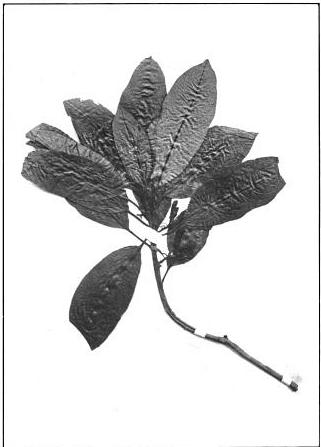 |
| Type of CLERMONTIA PARVIFLORA Gaud. in the herbarium Museum Paris. |
page 336
| PLATE 193. |
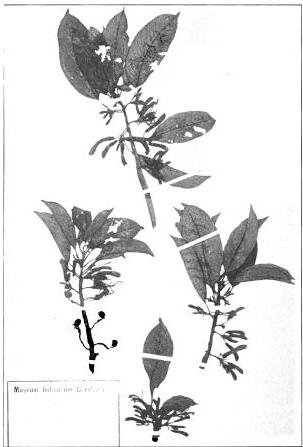 |
| CLERMONTIA PARVIFLORA Gaud.(Type of Hillebrand's Cl. parviflora pleiantha in the Herbarium Berolinense.) |
page 337
recognized in the short peduncles and pedicels, the former sometimes measuring only 3 mm.
The specimens from Kilauea differ slightly from the Kau specimens in the darker leaves and darker venation; otherwise they are exactly the same. The species is epiphytic, usually on Cibotium tree ferns.
Clermontia montis-Loa forma globosa Rock f.n.
A shrub as in the species; leaves smaller, shorter petioled, glossy shining above, glabrous on both sides; peduncle and pedicels as in the species; flowers a trifle larger; berry large globose, 3 cm in diameter, perfectly smooth, not ribbed.
HAWAII: Forests of Kilauea near Kalanilehua, flowering and fruiting August 30, 1917, Rock no. 12835 in herbarium of the College of Hawaii.
Forma globosa differs from the species mainly in the large globose, perfectly smooth fruits. It grows epiphytically on tree ferns, as does the species.
Clermontia parviflora Gaud. in Asa Gray in Proceed. Amer. Acad. V:150. 1862. Clermontia oblongifolia Hook. et Arn. not Gaud. teste A. Gray. Clermontia parviflora pleiantha Hillebr. Flora Hawaii. Isl. 242. 1888. Cyanea Blinii Lévl. in Fedde Repert. Spec. no. X:156. 1911. (Plates 24, 192, 193.)
A shrub 2-3 m high, many branched; leaves obovate-oblong to lanceolate-oblong 10-18 cm long, 3-5.5 cm wide, on petioles of 2-4.5cm, chartaceous, shortly acuminate and mucronulate at the apex, acuminate at the base, closely or irregularly denticulate, dull green, paler and faintly pubescent beneath; peduncle short, 10-12 mm, bibracteate above the middle, three to (six?) four-flowered; pedicels 8-10 mm; calyx suberect, the ovarian portion 5-8 mm high, oblong to turbinate, the free portion as long as the corolla or slightly longer, purplish blue, glabrate; corolla 2.5-4 cm long, purplish blue, the dorsal slit almost extending to the base; staminal column glabrate as are the bluish anthers; berry ovoid dark orange yellow.
HAWAII: Ins. Owhyhee, ad montem Kaah (Mauna Kea), flowering Junio 1825, Macrae in herbarium Societ. Hortic. London and in Gray Herbarium; — I. Sandwich, Owhyhee, Bai Byron, Gaudichaud in Herbarium Museum Paris; — 1851-1855, Remy no. 305 in herbarium Mus. Paris; — Mann and Brigham no. 296 in Herbarium Cornell; — Kohala range, Waimea mountains, flowering December 1872, Lydgate-Hillebrand in Herbarium Berolinense; — Holokaiea gulch, Waimea, flowering July 10, 1909, Rock nos. 4362, 4363, 4366 in herbarium College of Hawaii; — Kohala Mountains, flowering June 1910, Rock no. 4364 in herbarium College of Hawaii; — Paauhau no. three, Hamakua, flowering July 6, 1909, Rock no. 4360 in herbarium College of Hawaii; — Glenwood, Hawaii, flowering May, 1909, Urban Faurie no. 575 in Herbarium Léveillé and in herbarium of the College of Hawaii; — Waimea, August 26, 1916, A. S. Hitchcock nos. 14363, 14408 (fruiting) in U. S. National Herbarium; — common at 29 miles, Kilauea Volcano, flowering-fruiting August 1918, Rock & Hashimoto no. 13122 in Herbarium Rock.
OAHU: May 1825, Macrae in Herb. Soc. Hort. London, and Gray Herbarium.
page 338
| PLATE 194. |
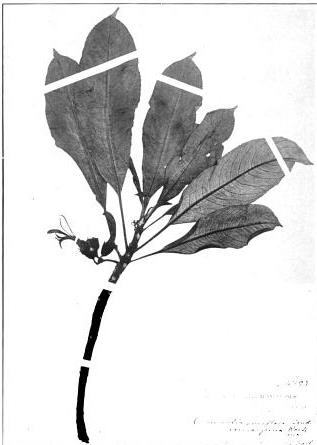 |
| Type of CLERMONTIA PARVIFLORA CALYCINA Rock in the herbarium of the College of Hawaii. |
page 339
Clermontia parviflora is a very variable species and may be found in the wet forests everywhere on the island of Hawaii. It grows at altitudes of 600 to 3000 feet elevation or even higher. The type is a specimen collected by Gaudichaud on Hawaii, in Byron Bay, now Hilo or Kuhio Bay. It was labeled by Gaudichaud "Clermontia Byronii pyrifolia??, parviflora," but never described. Macrae was the first to collect it on Hawaii; he also collected a specimen on Oahu (Woahoo), which must be referred to this species. It is labeled in pencil, "Rollandia lanceolata Hook. et Arn.," and on the label in A. Gray's handwriting, "Clermontia parviflora?" There is no doubt that it is the latter species. As it has not been re-collected on Oahu, and as it does not occur on the intermediate islands of Molokai and Maui, some doubt exists about the locality cited. Macrae or someone else might have mixed up the labels, especially as the labels did not bear any name, but simply the printed legend.
Hillebrand's variety pleiantha came from the type locality "Hilo" and does not differ considerably from the type. He remarks, "Peduncle six to ten-flowered"; and a footnote says: "here the median branch of the cyme often divides in place of the lateral ones and lengthens out, simulating a short raceme, but in the young inflorescence the lowest lateral branches generally bear two or three flowers." Near the Volcano of Kilauea there is a small form of this species, growing always epiphytically on trees or tree ferns; it is a small compact shrub with smaller leaves and perhaps smaller flowers. The writer is of the opinion that it is better to refer this plant to the species, as the latter is so extremely variable. Hybridisation is also not excluded. There are a number of forms in the herbarium of the College of Hawaii; they were collected by the writer in the wet forests of Waimea, Hawaii. All these plants must be referred to Clermontia parviflora, though they differ considerably more from the typical specimen than Hillebrand's variety pleiantha.
The writer's number 4788 has much larger flowers and large globose fruits; the flowers measure 4.5 cm in length, including the ovarian portion of the calyx; the fruits measure nearly 3 cm in diameter, but the leaves and aspect of the plant are those of Cl. parviflora; the varietal name grandis may be suggested for the specimen with no. 4788 in the herbarium of the College of Hawaii. Another specimen, no. 4780, has also large flowers but smaller fruits, and may be referred to variety grandis. While no. 12834 has flowers of the size of the typical Cl. parviflora, but fruits much larger, measuring about 2.5 cm in length, they are not globose but oblong-ovoid and about 15 mm wide; the leaves resemble more those of Clermontia montis-Loa, in which company it grows.
There is no doubt that Clermontia parviflora represents the youngest type of a Clermontia, as it is still in the process of evolution; this is exhibited by its many intermediate forms.
The following numbers must all be referred to this species: nos. 8764, 8736 and 13030, from Kilauea Volcano region. These specimens were first referred to Hillebrand's variety pleiantha, by the writer, and are all deposited in the herbarium of the College of Hawaii.
Léveillé's Cyanea Blinii belongs to this species.
Clermontia parviflora forms a natural link with Cl. montis-Loa, Cl. Waimeae, Cl. leptoclada, and even Cl. drepanomorpha, also with Cl. multiflora and Cl. micrantha.
page 340
Clermontia parviflora calycina Rock in Indig. Trees Hawaii. Isl. 512. 1913. (Plate 194.)
A shrub; leaves as in the species, of little thicker texture, cuspidate, and on petioles of 2.5-5 cm, the margins slightly undulate; peduncle 15 mm long, three-flowered; pedicels thick, 8-10 mm long; ovarian portion of calyx about 11 mm long, the subulate lobes 5 mm; corolla 3.5 cm long, about 5 mm wide, slightly pubescent; staminal column and anthers glabrous; berry globose 2.5 cm in diameter.
HAWAII: High plateau of the Kohala mountains, back of Waimea, along Alakahi ditch trail, elevation 4000 feet, flowering July 12, 1909, Rock, type no. 4793 in the herbarium of the College of Hawaii; — Waimea, June and July 1910, Rock in herbarium College of Hawaii.
The only difference is the subulate calycine lobes, which are much shorter than in the species; the flowers are much larger, of the size of those of the var. grandis, but otherwise has the aspect of Clermontia parviflora. Two sheets without number, from the Waimea mountains, belong here, though the calycine lobes while subulate are nearly 18 mm long; they are not at all connate, but divided to the base.
DOUBTFUL SPECIES.
Clermontia carinifera Lévl. in Fedde, Repert. Spec. Nov. XX:505. 1913.
page 341
DELISSEA Gaudichaud
page 342
page 343
DELISSEA* Gaudichaud
Calyx tube turbinate or oblong, its lobes dentiform or subulate; corolla more or less curved, tubular, widening from a narrow base, shortly bilabiate, the dorsal slit not extending beyond the middle, the termination of the dorsal and often also of the lateral slits indicated in the bud by a knob or gibbus; staminal column free from the corolla, white, glabrous, only the two lower anthers tufted at the apex; ;stigmatic lobes shortly pubescent outside; berry ovoid, orange or black, with narrow epigynous disk, two-celled; seeds dull white, the thin testa finely wrinkled in transverse wavy lines — Unarmed, glabrous, often subherbaceous shrubs, the stems branching or simple, more or less fleshy; leaves entire or laciniate, succulent when fresh, flaccid and transparent when dry, bright green, glossy; flowers in axillary racemes, with small deciduous bracts and naked pedicels, always white or greenish white with purplish tinge.
The genus Delissea* was first erected by Gaudichaud on three lobelioideous plants found in the Hawaiian Islands, D. subcordata (type of the genus), D. undulata and Delissea acuminata, the last now Cyanea acuminata. The genus was founded on quite an artificial character; it was mainly based on the 5-dentate calyx lobes and the two lower bearded anthers. Gaudichaud's genus Cyanea, of which only a single species (C. Grimesiana) was then known, was based on the long foliaceous calyx lobes of the above-mentioned species, which happened to possess anthers which were all bearded. The latter character is, however, not constant, as it appears in a number of species of Cyanea which have not foliaceous calyx lobes.
Hillebrand, who had much more material at hand and who was familiar with the plants, having seen them growing in the field, certainly was justified in rearranging the genera; the writer can only uphold Hillebrand's arrangement, which is an excellent one, as it brings together species which were previously separated in different genera by mere artificial and untenable characters.
The seven species of Delissea are well defined and can never be mistaken for Cyaneas. They all have the deeply wrinkled, dull white seeds in common, and the dorsal gibbus of the corolla is always present, characters absent in Cyanea.
All species of Delissea seem to have a tendency to at least sinuate leaves, even D. subcordata, whose leaves show signs of becoming sinuate to laciniate near the base of the leaf.
The fact, however, that the genus Delissea occurs on nearly all the islands of this group, from distant Kauai, the oldest island, to Hawaii, the presumably youngest, shows that they are not all one variable species, which may be classed with Cyanea, but are distinct enough specifically, possessing a common characteristic which separates them from Cyanea, forming thus the genus Delissea. While some of the specific differences may not be so readily recognized in dried material, no one who has seen them growing in their natural habitat can for a moment doubt their specific distinction. For example, the species Delissea undulata and D. subcordata; Gray unites these two species, not even recognizing the latter as a form of the former. Had he seen the plants growing he would
____________
* Dedicated to A. M. Delisse, pharmacist, naturalist of the French expedition, 1800 to 1804.
page 344
| PLATE 195. |
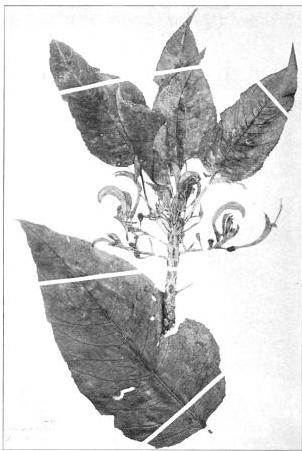 |
| DELISSEA SUBCORDATA Gaud.Specimen in the Herbarium Berolinense, ex coll. Hillebrand. |
page 345
never have come to such a conclusion. D. undulata is a simple-stemmed plant reaching a height of 35 feet, bearing at the top of the less than 5 cm thick stem a single crown of leaves; the flowers are small and have three dorsal knobs. D. subcordata is a small branching shrub for the most 10 feet high; the main stem rarely taller than 4 feet before branching; the flowers are twice the size of the former species and have only one dorsal knob.
The Hillebrandian arrangement is therefore the best and is here adopted as the most satisfactory.
Hillebrand divides the genus into two sections:
MACRANTHAE: Flowers over 3.75 cm long, curved and white.
MICRANTHAE: Flowers less than 2.5 cm long, suberect and greenish white.
These two sections are adopted in the present paper.
Delissea subcordata Gaud. Bot. Voy. Uranie 457, pl 77. 1826. Delissea undulata A. Gray in Proceed. Am. Acad. V:148. 1862. in part. (Plate 195.)
A branching shrub 1.5-3 m high, glabrous; leaves ovate thin, membranaceous, acuminate or acute at the apex, subcordate or subtruncate with unsymmetrical base, glossy above, paler, dull and glabrous beneath, 15-23 cm long, 7-12 cm wide, on petioles 7-18 cm long, the margins unequally serrate, with acute teeth, often laciniate at the base; racemes fleshy 7-10 cm many flowered, naked in the lower fourth; pedicels 16-18 mm; bracts 3 mm; calyx tube ovoid-obtuse at both ends, 5-dentate at the apex; corolla falciform, 4.5 cm long ampliate above, with a single dorsal knob above the middle, the short lobes connivent; berry ovoid-oblong 15 mm long, 8 mm wide; seeds whitish, deeply wrinkled.
ILES SANDWICH: Gaudichaud, type in herbarium Museum Paris.
OAHU: U. S. Exploring Exped. in Gray Herbarium; — Kaala Mts., Mann et Brigham no. 573 in Herbarium Cornell and Gray Herbarium; — Kaalagebirge, Wawra nos. 2224, 2229 in Herbarium Vienna; — Wailupe, Manoa, Nuuanu, Waialua, Kaala, Hillebrand 1870, without number in Herbar. Berolinense and Gray Herbarium; — Pauoa Valley, near Tantalus, flowering June 1908, Rock no. 4859 in herbarium College of Hawaii; — Niu Valley, flowering August 22, 1909, Rock no. 4859-b in herbarium College of Hawaii.
KAUAI: Hillebrand, not in his herbarium.
The species is quite distinct and can never be taken for D. undulata, of which A. Gray thinks it not even a form.
D. subcordata is a much branching shrub, while D. undulata is single stemmed and reaches a height of thirty feet or more, with a crown of leaves at the apex of a slender stem. It also differs in the larger flowers, which have a single dorsal knob instead of three, and in the much longer peduncle, the much larger leaves, and large oblong berries.
Gaudichaud's type specimen in the Herbarium Paris consists of a single leaf only.
Mann's no. 573 is a robust plant with very large leaves; the fruits are oblong and have a broad truncate apex. The specimen collected by the U. S. Exploring Expedition consists of two leaves only. These are mounted on the same sheet with a specimen of Delissea undulata collected by Remy, no. 300 bis, and presented by the Paris Museum to Dr. Gray's herbarium.
page 346
| PLATE 196. |
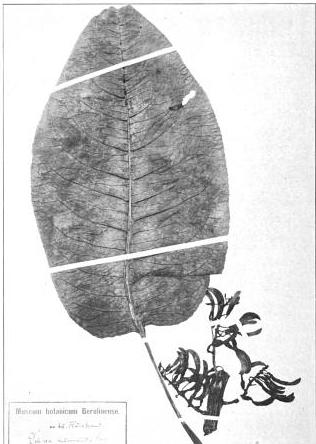 |
| DELISSEA SUBCORDATA OBTUSIFOLIA WawraType in the Herbarium Berolinense, ex coll. Hillebrand. |
page 347
| PLATE 197. |
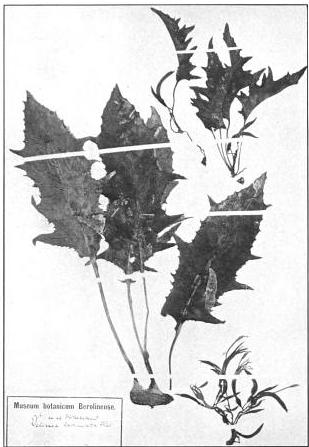 |
| Type of DELISSEA LACINIATA Hillebr. in the Herbarium Berlin. |
page 348
| PLATE 198. |
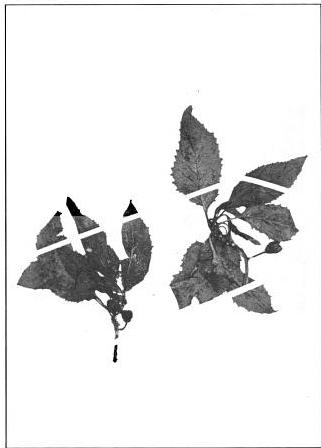 |
| Type of DELISSEA LACINIATA PARVIFOLIA Rock in Herbarium Berolinense. |
page 349
The specimen collected by the U. S. Exploring Expediction is so fragmentary that Dr. Gray evidently thought it to be the same as Delissea undulata, especially as the two fragmentary leaves were rather small and resembed those of D. undulata.
Delissea subcordata obtusifolia Wawra in Flora od. Allgem. Bot. Zeit. XXXI:7. 1873. (Plate 196.)
Leaves 22.5-30 cm long, 10-17.5 cm wide, broadly oblong, obtuse, even suborbicular; calycine teeth longer often almost equalling the tube; the dorsal knob of the corolla often wanting.
OAHU: Helemano, Waipio, Hillebrand in Herbarium Berolinense and Gray Herbarium; — no. 2355 (ex herb. Hillebrand) in Herbarium Vienna.
The first description was published by Wawra in Flora as follows: "foliis quam in praecedenti multo amplioiribus, rotundatis..
Delissea laciniata Hillebr. Flora Hawaii. Isl. 249. 1888. (Plate 197.)
"A branching shrub, leaves oblong in outline, 12.5-15 cm long, 9.25 cm wide, on petioles 7.5-12.5 cm long, irregularly cut into patent acute lobes, the lowest lobes 2.5-3.75 cm dep, with irregular serratures, somewhat decurrent along the petioles; raceme 3.75-5 cm, slender, naked in the lower half, 6-10-flowered, the pedicels 12 mm; bracts short linear; calyx obconical, its teeth sharp triangular or subulate, 2 mm or more; corolla 37 mm long, falcate, white, a dorsal knob below the middle and generally two lateral ones a little higher, the lobes rather long, their slits extending to the knobs; anthers faintly pubescent at the base; berry bluish, obovoid, about 12 mm long."
OAHU: Wailupe, Hillebrand in Herbarium Berlin (type), and Gray Herbarium; — specimens ex herb. Hillebrand in Bishop Museum herbarium.
This species has not been re-collected so far.
Delissea laciniata parvifolia Rock n. v. (Plate 198.)
Leaves much smaller 6-6.5 cm long, 2-3 cm wide, ovate, acuminate at both ends, irregularly serrate, membranaceous; flowers smaller, 2.5 cm long, 5 mm wide; berry about 7 mm long.
OAHU: Wailupe Valley, Hillebrand, type in Herbarium Berolinense.
Hillebrand mentions this form in a footnote as follows: "A variety of the same region has smaller leaves which are only irregularly serrate."
Delissea sinuata Hillebr. Flora Hawaii. Isl. 250. 1888. (Plate 199.)
"Stem simple, erect, 6-12 dm high, subherbaceous, leaves oblanceolate or spathulate, 25-27.5 cm x 5-7.5 cm, bluntly acuminate gradually contracting into long petioles of 7.5-12.5 cm, the margin sinuate and denticulate with appressed teeth; peduncle 37-50 mm, nearly naked, the numerous flowers crowded near the apex; pedicels 10 mm; bracts short linear; calyx tube cylindrical, 8-10 mm long, the sharp subulate teeth one quarter to one third of its length; corolla about 37 mm, curved, white, the dorsal gibbus generally wanted, but at the middle when present; anthers faintly puberulous at the base."
page 350
| PLATE 199. |
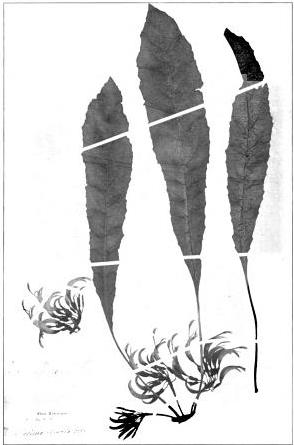 |
| DELISSEA SINUATA Hillebr.Type in Herbarium Berolinense. |
page 351
| PLATE 200. |
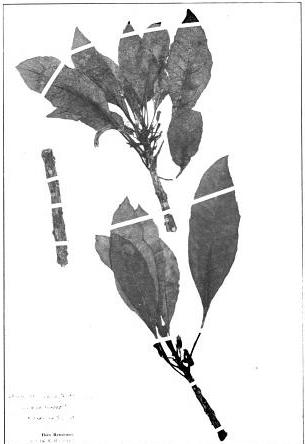 |
| DELISSEA SINUATA LANAIENSIS RockType in Herbarium Berolinense. |
page 352
| PLATE 201. |
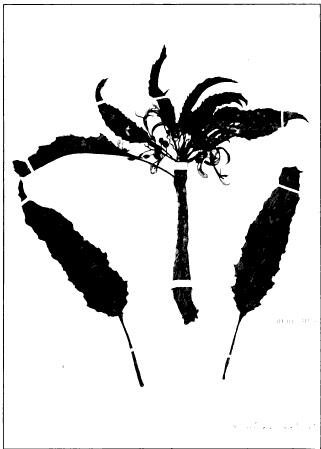 |
| DELISSEA UNDULATA Gaud.Type in herbarium Museum Paris. |
page 353
OAHU: Makaleha Valley, northern side of Kaala, March 1871, Hillebrand in Herbarium Berlin and Gray Herbarium; — Makaleha Valley, observed, flowering May 3, 1918, Rock.
A co-type in the Gray Herbarium is labeled, "Delissea laciniata var., Makaleha, Oahu, Kaala Mt." The single leaf of this latter specimen is almost laciniate toward the base Undoubtedly D. laciniata, D. sinuata and D. parviflora are very closely related.
Delissea sinuata lanaiensis Rock Delissea sinuata β var. Hillebr. Flora Hawaii. Isl. 250. 1888. (Plate 200.)
Leaves oblong or oblanceolate, 15-17 cm long, 5 cm wide, on petioles 2.5-5 cm long; peduncle 12 mm or less, few flowered; berry cylindrical 10 mm long.
LANAI: July 1870, Hillebrand in Herbarium Berolinense and Gray Herbarium.
This variety has not been collected by the writer. It comes very close to Delissea rhytidosperma Mann of Kauai, all of which seem to be extreme forms of D. laciniata, found on the various islands of the group. The variety differs from D. rhytidosperma mainly in the larger flowers and cylindrical berry.
Delissea undulata Gaud. Bot. Voy. Uranie 457, pl 78. 1826. Delissea undulata serrulata Wawra in Flora od. Allg. Bot. Zeit. 8. 1873. (Plates 11, 13, 201.)
Stem simple and straight 18-90 cm high (only branching when broken), gray, about 37 mm thick at the base, covered with rhomboidal leaf-scars down to the base, with the remnants of the peduncle in each axil of leaf-scars; densely foliose at the apex, leaves ovate-oblong subcordate, glabous on both sides, dark green above with reddish spots, margins undulate, irregularly sinuate, dentate or serrate, with sharp, reddish, protruding teeth, 14-16 cm x 4-8 cm, on petioles of 5.5-15 cm; inflorescence axillary, peduncles short 12 mm to 25 mm bracteate at the apex, pedicels 4-5, minutely bibracteolate at base, 5-8 mm; calyx green or reddish, the ovarian portion ovate oblong, minute five-toothed; corolla somewhat curved, wider at the apex, thickening below the middle, with three protuberances at the back, corolla reddish pink to yellow or green, the dorsal slit extending to the protuberances; staminal column glabrous, pale, anthers grayish brown, the lower two penicillate; stigma green, the lobes ovate; berry globose or ovoid, black when ripe, 10-12 mm long, juice purple; seeds white, deeply wrinkled.
ILES SANDWICH: Gaudichaud, type in herbarium Museum Paris.
KAUAI or Niihau: Remy no. 300 bis in Herbarium Paris and Gray Herbarium.
NIIHAU: Mann and Brigham in Herbarium Cornell.
MAUI: Gulches of Lahaina, Olowalu and Waikapu, on exposed cliffs, dry pali, August 1870, Hillebrand in Herbarium Berolinense; — Waihee Valley, Wawra no. 1943 in Herbarium Vindobonense.
HAWAII: Puuwaawaa hill, North Kona, elevation 3000 feet, flowering June 15, 1909, Rock no. 3950 in herbarium College of Hawaii; — Pulehua, South Kona, southern slopes of Mauna Loa, 5000 feet elevation above Kealakekua, flowering and fruiting February 14, 1912, Rock no. 10053 in herbarium College of Hawaii.
Delissea undulata had previously not been recorded from the big island Hawaii; it grows on the slopes of Mt. Hualalai, and also on the southern slopes
page 354
| PLATE 202. |
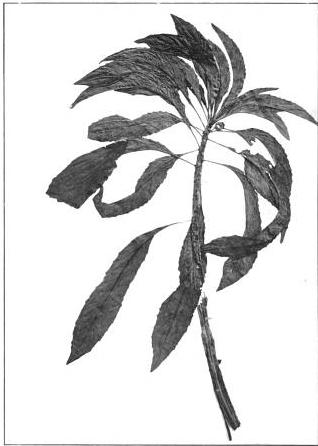 |
| DELISSEA RHYTIDOSPERMA H. MannSpecimen in Gray Herbarium, ex coll. Mann & Brigham. |
page 355
| PLATE 203. |
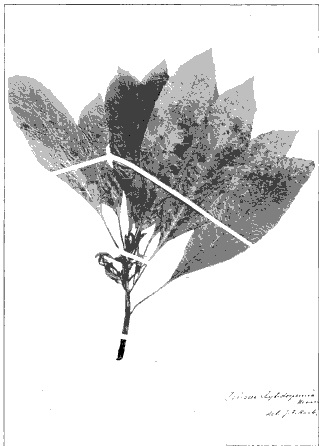 |
| DELISSEA RHYTIDOSPERMA H. MannIn Herbarium Vienna, ex coll. Wawra (as Delissea Kealiae Wawra). |
page 356
| PLATE 204. |
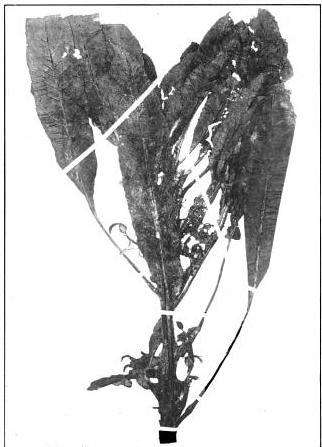 |
| DELISSEA FALLAX Hillebr.Type in Herbarium Berolinense. |
page 357
of Mauna Loa at elevation of 5000-5300 feet in company with Acacia koa, Myoporum sandwicense, Sophora chrysophylla, and Santalum Pilgeri.
Until now the plant had only been recorded from Niihau, Kauai and Maui, and that from a lower elevation.
It is really astonishing to find this curious plant on the slopes of Mauna Loa in the upper forest zone in company with Sophora and Acacia koa; it is here that the plant reaches a height of more than 30 feet, growing mainly on the many wooded extinct cinder cones and at the bottom of extinct craters as well as all through the forest where it is easy to overlook the plant on account of its leaf whorls beting hidden in the branches of Koa and Mamani trees.
At Puuwaawaa, but especially Waihou forest, the plants are numerous, but do not reach such a height as on Mauna Loa.
Asa Gray says in Proc. Am. Acad. that D. subcordata belongs to this species, but nothing can be more different in habit than these two species; D. subcordata is a small branching shrub of the habit of a Clermontia (as far as branching is concerned), while D. undulata is not branched and has a single straight slender stem of often more than 30 feet in height. The flowers of D. subcordata are also larger than in D. undulata. In the Gray Herbarium is a specimen collected by J. Remy on Kauai no. 300 marked Delissea undulata var. attenuata; the plant is identical with D. rhytidosperma Mann from the same island. The plants from Niihau collected by Remy are much more robust, the stems being nearly 5 cm in diameter. In the Paris Herbarium are two sheets, one no. 300 ter coll. Remy, leaves deeply serrate on long petioles, no locality given; the other Remy no. 300 bis — from Kauai or Niihau A duplicate of the latter is in the Gray Herbarium.
Delissea rhytidosperma H. Mann Proceed. Am. Acad. VII:180. 1868. Delissea Kealiae Wawra in Flora od. Allg. Bot. Zeit. XXXI:10. 1873. (Plates 202, 203.)
A branching shrub or small tree (according to Mann); leaves oblong lanceolate 12-19 cm long, 25-55 mm wide, bluntly acuminate, tapering at the base into a petiole 20-50 mm long, membranaceus, sinuate-dentate or serrulate, pale green; peduncle 10-20 mm long, naked below, bearing 4-12 flowers on pedicels of usually 10 mm long; bracts linear about 5 mm long; calyx tube obconical minutely toothed; corolla greenish-white, glabrous outside, farinose-puberulous inside; staminal column glabrous, the length of the corolla, anthers partly hirsute at the base, the two lower one penicillate; style filiform; stigma pilose; berry ovoid or globose, dark orange colored, 7-12 mm high; seeds white wrinkled.
KAUAI: Waimea, 2000-3000 feet elevation, Mann and Brigham no. 576 in Herbarium Cornell and Gray Herbarium; — Kauai or Niihau, Remy no. 299 in Herbarium Paris; — 1851-1855, Remy no. 300 in herbarium Mus. Paris and Gray Herbarium; — Waimea, Knudsen no. 102 in Herbarium Berolinense; — forest of Kealia, Wawra nos. 2026, 2050 in Herbarium Vienna; — along the Hanapepe river near the falls, July 2-8, 1895, A. A. Heller no. 2487 in Gray Herbarium and Herbarium Cornell.
Not collected by the writer.
The plant was first collected by J. Remy on Kauai, but had never been published by him. There is a specimen in the herbarium Mus. Paris, Remy no. 300 without name, which belongs there; a duplicate with the same number is in the Gray Herbarium, ex herb. Paris, labeled "Delissea undulata var. atenuata" and again marked with pencil, "D. acuminata".
page 358
| PLATE 205. |
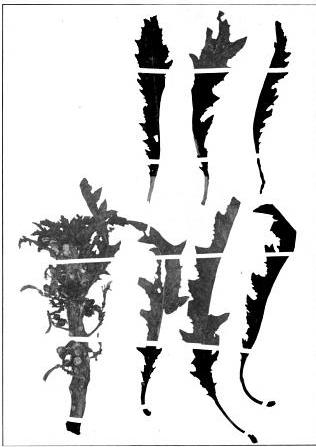 |
| DELISSEA PARVIFLORA Hillebr.Type in Herbarium Berolinense, ex coll. Hillebrand. |
page 359
Hillebrand's specimen in the Herbarium Berlin is very incomplete and consists only of a single leaf, with flowerbuds and young fruits; it was originally labeled as D. laciniata var. γ subintegra micrantha but then identified by him as D. rhytidosperma.
In Wawra's specimen (D. Kealiae) the leaves are larger and on longer petioles. He says in Flora: "Stands very close to D. rhytidosperma, but differs from it in being a shrub, in the larger leaves, the racemosely arranged flowers, and in the presence of bracts."
It seems that in Mann's specimens, which are rather imperfect, the bracts must have dropped, as Remy's specimens, which are identical with Mann's with the exception of longer petioles and peduncles, have linear bracts, as well as Hillebrand's specimen, and that of Heller in the Gray Herbarium; the latter's specimen is in fruit, which are larger than in all the other specimens of the various collectors.
Delissea fallax Hillebr. Flora Hawaii. Isl. 251. 1888. (Plate 204.)
"Stem simple (?), fleshy in the upper portion, distantly foliose; leaves lanceolate or elongate-oblong, 20-22.5 cm long, 5 cm wide, on long petioles 10-12.5 cm long, obtuse, sharpy denticulate, suddenly contracting at the base, dull, but translucent; peduncle with fruit 37-50 mm long, naked in the lower half; pedicels 10 mm long; bracts subulate, 3 mm long; calyx tube 4-7 mm long, the teeth about 3 mm long; corolla 18 mm long, suberect, with a dorsal gibbus at the middle; anthers glabrous; berry subglobose, 6-8 mm high; seeds white, wrinkled."
HAWAII: Woods of Hamakua and Hilo, Hillebrand, type in Herbarium Berolinense; — same locality, Hillebrand in Gray Herbarium.
Hillebrand in his Flora remarks of this rare species: "leaves in shape like those of Cyanea obtusa." The co-type in the Gray Herbarium is simply marked "Delissea sp?" and with pencil below the generic name, "obtusa? Gray, received July 1865, Dr. Hillebrand." The specimen in the Gray Herbarium is identical with, and is a co-type of Delissea fallax Hillebr.
Delissea parviflora Hillebr. Flora Hawaii. Isl. 251. 1888. (Plate 205.)
"Branching (?), the stem or branches fleshy and distantly foliose; leaves lanceolate or oblong in outline, 12.5-15 cm x 12-37 mm, sharply cut into irregularly dentate or serrulate lobes of 6-12 mm in depth, gradually tapering into a petioles of 25-37 mm, dull, not shining in the badly preserved specimens, but flaccid and pellucid; peduncle 18-24 mm, several flowered in the upper half; pedicels 6 mm; bracts dentiform; calyx 4-5 mm, shortly toothed; corolla suberect 18 mm, with a dorsal tubercle at the middle; berry subglobose 8 mm; anthers quite glabrous; seeds white, wrinkled."
HAWAII: Kohala range, and woods of Mauna Kea, elevation 4500 feet, Hillebrand (Parker) no. 84, type in Herbarium Berolinense; — Hamakua, Hillebrand in Gray Herbarium.
The plant comes very near to D. laciniata, from which it differs in the very small flowers and leaves, which are, however, almost laciniate.
The specimen in the Gray Herbarium (ex herb. Hbd.) is marked "Delissea laciniata var., Hawaii, Kamakua."
The description is quoted from Hillebrand's Flora.
page 360
page 361
ROLLANDIA Gaudichaud
page 362
page 363
ROLLANDIA* Gaudichaud
Calyx-tube adnate, ovoid-elongate, the limb five-toothed or lobed, the lobes imbricate in the bud, persistent; corolla tubular falciform or sigmoid, laterally compressed, gradually widening from the base and contracting towards the mouth, with lobes subequal and spreading, short, not exceeding one fourth of its length, the dorsal slit never extending to the base; staminal column glabrous or pubescent, adnate to the corolla; stigma two-lobed, the lobes thick ovoid, with a patch of hairs at their bases; berry rather dry, two-celled, obovoid; seeds small, ovoid crustaceous, smooth and shining. — Woody or subherbaceous plants with a simple stem, foliose at the apex; leaves in the young plant often lobed (save in R. angustifolia), those of the adult ones lanceolate, oblong or obovate or linear elongate, entire or dentate with patent, callous teeth; flowers alternate in axillary racemes, purplish red, or dark purple, the pedicels bibracteolate about the middle.
The genus Rollandia consists now of nine species and two varieties. Only one single species has so far been reported off the island of Oahu; the remaining ones are all peculiar to the latter island, where they inhabit the very wet or rain forest from an elevation of 600 to 3000 feet.
The genus is easily distinguished from the other genera in the adnate staminal column. Asa Gray unfortunately confused the Hawaiian Lobelioideae to a great extent; this was, however, due to the fragmentary and very poor herbarium material which he had as a basis for his paper. For example, he remarks that the adnate character of the staminal column in Rollandia is probably a mistake. It is evident from the fact of his placing a young plant of one of his own species Cyanea leptostegia, to Rollandia lanceolata (his Delissea Delessertiana) as a variety pinnatifida, what a conception he had of the Hawaiian Lobelioideae. This was, however, due to the miserable material with which he had to work; and, second, he had never seen these superb plants in their environment.
No Hawaiian Lobelioideae have been in such a state of confusion as those belonging to the genus Rollandia. This was due to the naming of species from miserable specimens — and some of the types of the old species consist of insect-eaten leaves only. The drawings in the atlas of the Uranie are very poor and do not allow the recognizing of species, while the drawings in the atlas of the Bonité are excellent. Unfortunately no descriptions were issued with these plates, which accounts for the mistakes made by other authors. Not all doubt as to the absolute identity of one or two species has been removed; this is due to the brief original descriptions and second to the miserable types extant, especially of Rollandia crispa and R. lanceolata. No type of R. Humboldtiana seems to occur in any of the European herbaria. Rollandia lanceolata is the type of the genus.
____________
* Dedicated by Ch. Gaudichaud to Mr. Rolland, quartermaster cannonier of the Expedition; he had rendered great services in the science of ornithology.
page 364
| PLATE 206. |
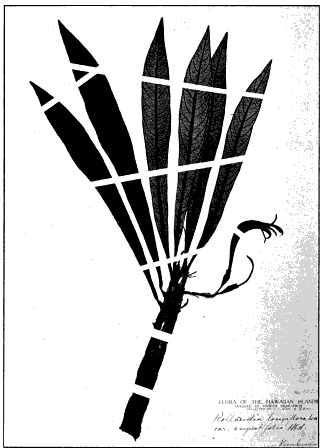 |
| ROLLANDIA ANGUSTIFOLIA (Hillebr.) RockSpecimen (Rock no. 10250) in the College of Hawaii Herbarium. |
page 365
Rollandia parvifolia Forbes Occas. Pap. B. P. Bishop Mus. V, no. 1:10, pl., 1912.
"Single stem 9 dm high; leaves lanceolate, acuminate with a minute mucro at the apex, gradually narrowing from the upper third to the petiole, entire, glabrous, coriaceous, pale whitish below, 18-22 cm long, 2.3-4 cm wide, with petioles 2.8 cm long, which are occasionally sparingly marked with small lenticels; flowers five to six in a raceme, the peduncles 3-4 cm long, bibracteate, the pedicels 1 cm long, bracteolate above the middle, glabrous; calyx tube cylindrical, glabrous, 8 mm long, with the lobes oblong, obtuse, minutely mucronate, thin 1 cm long; corolla purple, strongly sigmoid, 6.5 cm long, the lower lobes split less than one-half the distance of the tube 1.5-2 cm long; staminal column adherent to the corolla for about one-third its length, the upper half puberulent as long as the corolla; anthers puberulent; berry not seen."
KAUAI: Waioli Valley, flowering August 1, 1909, C. N. Forbes no. 103-k in the herbarium of the Bishop Museum.
This is the first Rollandia which has been reported off the island of Oahu. It is certainly interesting to find that Rollandia also occurs on Kauai; in all probability there may be other species to be found in the remote valleys of the island of Kauai.
Rollandia angustifolia (Hillebr.) Rock in Torrey Bot. Club. Bull. 45:136. 1918. Rollandia longiflora angustifolia Hillebr. Flora Hawaii. Isl. 246. 1888. (Plate 206.)
Stem smooth, 1-1.5 m high, leaves linear-lanceolate, 18-35 cm long, 2.5-3.75 cm wide, thick, fleshy, dark green, glossy above, pale whitish underneath, with dark purplish midrib and veins, acuminate, mucronate at the apex, gradually narrowing at the base into a fleshy petiole 2-4.5 cm long, glabrous on both sides; racemes slender, 3-4 cm long, four to five-flowered; pedicels thin, about 14 mm long, bracteate at the base, bibracteolate about the middle; calyx turbinate, 1 cm long, the apex truncate-dentate, or oftener lobed, the calycine lobes acute, of irregular length, usually 3 mm long, with a median nerve; corolla deep purplish red, 7-8.5 cm long, 1 cm wide, the lobes 1.5 cm, the dorsal slit extending one-fifth the length of the tube; staminal column glabrous adherent up to about the middle of the corolla, the anthers glabrous, the lower only bearded; fruits globose, crowned by the tubular limb of the calyx, which disappears at the maturity of the fruit.
OAHU: Mr. Konohuanui trail, Palolo Valley, Mt. Olympus and Manoa Valley; Kalihi Valley, fruiting January 1870, Hillebrand in Herbarium Berlin and one specimen ex coll. Hillebrand in herbarium Bishop Museum; — Palolo Valley, flowering June 14, 1908, H. L. Lyon no. 8816 in herbarium College of Hawaii; — Mt. Olympus trail, Manoa Valley, flowering September 2, 1912, and Konahuanui trail, flowering September 1914, Rock no. 10250 in herbarium College of Hawaii.
The plant in question is certainly worthy of specific rank. Young plants which the writer observed were of the same habit as mature ones, both having linear-lanceolate leaves, while the true Rollandia longiflora Wawra has sinuate leaves when young and also when in a mature state. R. angustifolia differs
page 366
| PLATE 207. |
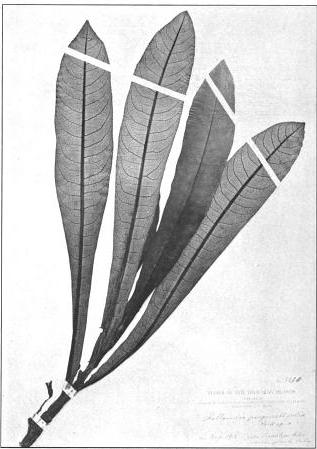 |
| ROLLANDIA PURPURELLIFOLIA RockIn the herbarium of the College of Hawaii. |
page 367
| PLATE 208. |
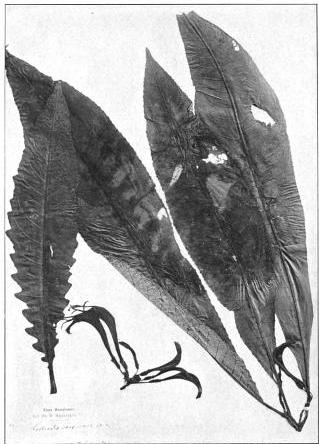 |
| ROLLANDIA LONGIFLORA WawraCo-type in the Gray Herbarium, ex coll. Hillebrand. |
page 368
| PLATE 209. |
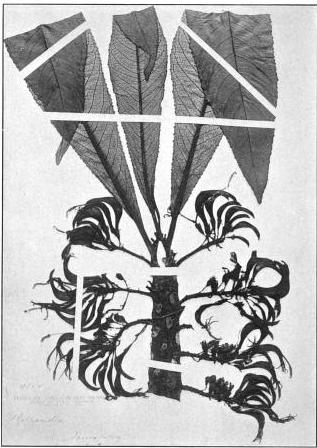 |
| ROLLANDIA LANCEOLATA Gaud.Typical specimen (Rock no. 10254) in the College of Hawaii Herbarium. |
page 369
mainly in the linear, entire, minutely denticulate leaves, which give the plant an entirely different appearance from that of Rollandia longiflora.
Rollandia purpurellifolia Rock in Coll. Hawaii Publ. Bull. 2:44. 1913. (Plate 207.)
Plant 3-5 dm high with fleshy stem, unbranched, unarmed and glabrous; leaves subsessile or on petioles of 5-8 mm, linear-oblong, shortly acute at the apex, decurrent at the base into asomewhat margined petiole, dull deep green above or graying green when dry, deep purple and shining underneath, glabrous above, but slightly hirtellous on the nerves but not midrib underneath, 16-35 cm long, 3.5-6.5 cm wide, the margin minutely denticulate, but entire in the lower fourth of third; inflorescence glabrous; peduncles slender, with few knobby scars, 15-25 mm long, bracteate at the apex; pedicels slender blackish purple, 12-20 mm long bibracteolate below the middle; flowers unknown; fruits dark purple to black, obovoid, 15-18 mm long, crowned by the 4-6 mm long, acute calycine lobes.
OAHU: Dense forests of Punaluu Mountains and on the summit ridge above Hauula in dense shade with Lysimachia Forbesii Rock, fruiting August 1911, Rock, type no. 8824 in the herbarium of the College of Hawaii.
No flowering specimens of this species have been secured so far and therefore the generic position of this species cannot positively be determined; the outward aspect, the leaves and fruits are, however, unmistakably those of a Rollandia.
The plant is close to Rollandia longiflora Wawra.
Rollandia longiflora Wawra in Flora od. Allgem. Bot. Zeit. XXXI:44. 1873. Rollandia sanguinea Hillebr. in herbar. (Plate 208.)
Stem smooth 1.3-3.3 m tall, leaves lanceolate 30-40 cm long, 6-8 cm wide, acute, gradually narrowing into a short petiole of 2.5 cm, entire or denticulate, sinuate particularly near the base, even faintly laciniate, glabrous on both sides, shining, thin chartaceous; raceme slender ca 3 cm bracteate from the base, 5-10-flowered, pedicels 10-15 mm, bracts 2-3 mm, bractlets dentiform or wart-like; calyx five-toothed; corolla dark red sigmoid 6-6.5 cm, gradually widening from a slender base to a width of 1 cm with a deep dorsal groove; staminal column adherent up to the middle of the corolla, dark red, glabrous, the upper anthers not tufted; berry pyriform 1 cm or little more. The young plant is prickly or muricate and has the leaves unevenly lobed or laciniate.
OAHU: Western division of the main ridge, from Waipio to Helemano, Hillebrand in Herbarium Berlin, the herbarium of the Bishop Museum, Honolulu, and the Gray Herbarium; — Wawra no. 2285, ex herbarium Hillebrand in Herbarium Vienna; — Schofield Barracks, east range, July 11, 1916, A. S. Hitchcock no. 14033 in the U. S. National Herbarium, Washington, D. C.; — right-hand branch of Makaleha Valley, at an elevation of 1000 feet, on steep forested slopes, flowering May 3, 1918, Rock no. 13110 in herbarium of the College of Hawaii.
This species is easily distinguished by the calyx, which is only sinuately five-toothed instead of lobed as in the other species of the genus. The species grows much taller than was recorded by Hillebrand; the writer met with plants ten feet in height. The flowering season is in the early spring, April to May.
page 370
| PLATE 210. |
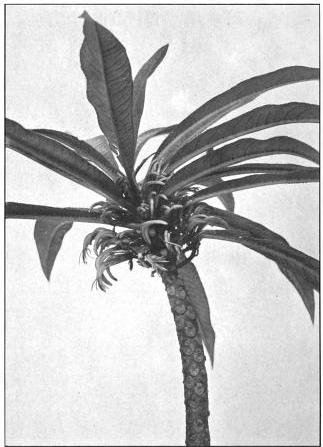 |
| ROLLANDIA LANCEOLATA VIRIDIFLORA RockFlowering plant, much reduced. |
page 371
Rollandia lanceolata Gaud. Bot. Voy. Uranie, table 74. (R. montana). 1826. Rollandia lanceolata var. grandifolia DC. in Prodr. VII:344. 1838. Rollandia Delessertiana Gaud. Bot. Voy. Bonité, table 75. 1839-1852. Delissea lanceolata A. Gray in Proceed. Am. Acad. V:147. 1862.
Trunk unarmed about 2 m high, leaves oblanceolate 24-60 cm long, 5.5-10.5 cm wide, gradually acuminate at both ends, on distinct petioles of 2.5-7.5 cm; denticulate often sinuate, chartaceous, the veins underneath with a short pubescence; peduncle many-flowered (8-16), 6-12.5 cm long, distantly bracteate from the base; pedicels 6-18 mm long; bracts 2-8 mm; bracteoles minute; corolla pale reddish to deep purplish, or pale greenish with purple streaks, sigmoid up to 7.5 cm long, very slender below; staminal column adherent to the middle, reddish, hirsute with purplish hair, especially at the base of the anthers; the upper anthers tufted or ciliate at the apex; berry pyriform 16-18 mm long; seeds smooth shining.
OAHU: Gaudichaud type in herbarium Museum Paris; — Woahoo, Maio 1825, Macrae ex Herb. Soc. Hort. London, in Gray Herbarium; — W. T. Brigham in Herbarium ?; — Moanalua, Halawa var. α; — Kalihi, Waipio var. β.; — Helemano (Halemanu), May, 1870, Willie, var. γ; — Wailupe, Nuuanu, leg. Lydgate, var δ crispa, Hillebrand in Herbarium Berline and Bishop Museum herbarium; — Wahiawa, var ε; — Helemano (Halemanu), var. ξ, Hillebrand in Herbarium Berlin; — Waialua, Hillerand var. ε in herbarium Bishop Museum; — Pauoa Valley, flowering April 20, 1912, Rock nos. 10252, 10253, 10254 in herbarium of the College of Hawaii; — Kalihi Valley, August 2, 1916, A. S. Hitchcock no. 14115 in U. S. National Herbarium.
Rollandia lanceolata is an exceedingly variable species; Hillebrand's varieties enumerated in his Flora are too vague to be upheld; they have all save var. ε and ξ been classed with the species proper. The largest leaved specimens come from Palolo Valley. The species is not uncommon at the lower levels on Oahu, where it occurs in nearly all the valleys. It is at once distinguished by the glabrous calyx and corolla and hirsute staminal column and anthers.
Rollandia lanceolata Gaud. typica Rock (Plate 209.)
A tall stout, single-stemmed plant 2-3 m high, leaves 35-50 cm long, dark green with purplish tinge along midrib, 7-12 cm wide, paler beneath, acuminate at the apex, strongly mucronate, bluntly acute at the base, or abruptly decurrent, on a petiole 5-5.5 cm long, thick fleshy, leaf margin serrate, undulate, midrib and nerves prominent underneath, with purplish, short spine-like protuberances which extend to the petiole; racemes extending along the stem from the upper leaf axils to below the crown of leaves not dense but loosely clustered; racemes deep purple throughout about 5 cm long or longer with fruit; bracts broad and strongly cuspidate at the apex, at the base of the pedicels, the latter about 8 mm; calyx deep purple, ovarian portion ovate, shining, the triangular teeth 1.5 mm long, mucronulate; corolla deep purple 6.5-7 cm long, narrow at the base, broadest at the middle about 13 mm, puberulous, the dorsal slit extending one-third its length, the narrow lobes of nearly equal length scabrous in the bud, with whitish pubescent margins when open; ;staminal column adnate more than half its length, ciliate with whitish hair; anthers whitish pubescent throughout, especially so at the base of the anthers, the lower strongly bearded, the upper ciliate; stigmatic lobes glabrous, but with a ring of purplish hair at the base.
page 372
| PLATE 211. |
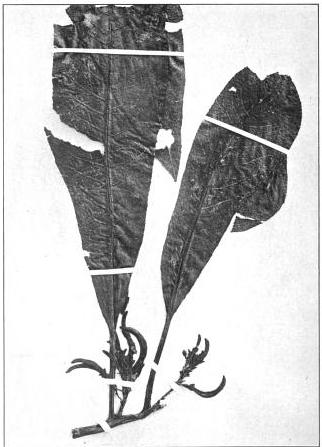 |
| ROLLANDIA KAALAE WawraType in Herbarium Vienna, ex coll. Wawra. |
page 373
OAHU: At lower elevations (1000 feet); Pauoa Valley, flowering April 20, 1912, Rock no. 10254 in herbarium College of Hawaii; — lower left-hand Valley of Palolo (Manoa ridge), 1200 feet elevation, flowering May 12, 1918, Rock no. 13111 in herbarium College of Hawaii.
This is apparently Gaudichaud's R. lanceolata so far as can be determined from the fragmentary specimen in the Paris Museum. It is the most striking of all the numerous forms; the flowers are a deep purple, the leaves are broader than in the other varieties.
Rollandia lanceolata viridiflora Rock n. v. (Plate 210.)
Stem 2 dm high or more with large crown of leaves at right angles, inflorescence densely clustered near the apex of the stem; leaves lanceolate, acuminate at the apex, acute at the base, about 40 cm long, 7 cm wide, dark green above and glossy, margin irregularly crenulate, midrib and veins prominent; petioles about 4 cm long; racemes about 3 cm long, closely bracteate, stout, deep purple; calyx purplish, the teeth triangular, minute; corolla greenish with purplish stripes, fleshy, smaller than in var. typica, less broad, staminal column as in var. typica.
OAHU: Eastern Manoa ridge dividing Manoa from Palolo Valley, at lower elevation (1000-1200 feet), flowering May 12, 1918, Rock & Tasartez no. 13112 in herbarium College of Hawaii.
Variety viridiflora is distinguished by the greenish pale flowers and the thick closely bracteate racemes; the leaves stand almost at right angles to the stem, while those of var. typica are re-curved, forming a globose crown; the racemes are closely packed in the upper part of the stem, while those of var. typica extend along the stem below the crown of leaves. This variety begins flowering very young and the young plants have the leaves narrower lanceolate and purplish beneath; the racemes are fewer flowered and naked.
Rollandia lanceolata tomentosa Hillebr. Rollandia lanceolata var ε et ζ Hillebr. Flora Hawaii. Isl. 248. 1888.
Calyx 2-5 mm, corolla ashy pale, faint purple at the back, dark inside, pubescent along the lobes or hairy throughout; anthers pubescent at the base only or almost glabrate, with a few cilia at the upper anthers; leaves elongate, narrow lanceolate tomentose underneath.
OAHU: Ewa, Wahiawa and Helemano (Halemanu), Hillebrand in Herbarium Berlin; — Waialua, Hillebrand in herbarium Bishop Museum.
The variety tomentosa is distinguished from the species in the brown tomentose leaves and pubescent corolla.
Rollandia Kaalae Wawra in Flora od. Allgem. Bot. Zeit. XXXI:45. 1873. Rollandia Humboldtiana Hillebr. not Gaudich. Flora Hawaii. Isl. 248. 1888. (Plates 211, 212.)
Stem 1 m tall, simple, fleshy; leaves nearly 62 cm long, 10 cm broad, subcoriaceous, lanceolate, acute, merging into a hirtellous petiole of 7.5-10 cm in length, dark green, glabrate, and papilose above, pale yellowish tomentose below, the nerves dark tomentose; peduncles axillary half as long or as long as the petioles; pedicels about 12 mm, hirto-tomentellous as is also the calyx; calycine tube 12 mm long, the lobes half or a third as long as the tube, rounded at the
page 374
| PLATE 212. |
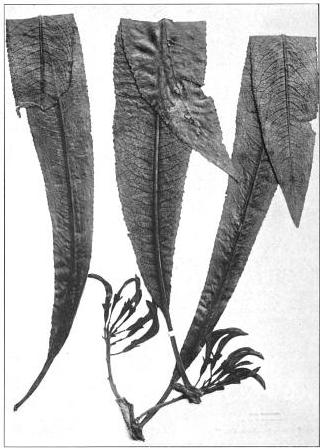 |
| ROLLANDIA KAALAE WawraSpec. ex Herbar. Hillebrand in Herbarium Berolinense. |
page 375
| PLATE 213. |
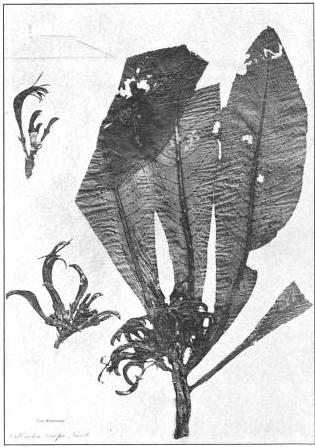 |
| ROLLANDIA CRISPA Gaud.Specimen ex coll. Mann & Brigham in the Gray Herbarium. |
page 376
| PLATE 214. |
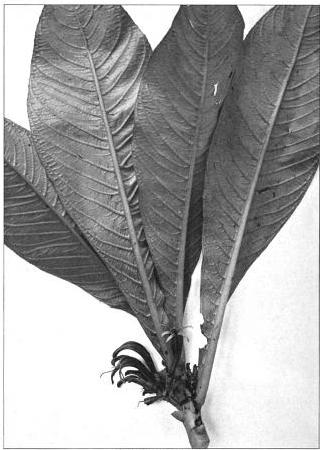 |
| ROLLANDIA CRISPA Gaud.From a living specimen (much reduced) collected in the mountains behind Honolulu. |
page 377
apex, or subemarginate, very shortly mucronulate; corolla 5 cm or more, slightly sigmoid, rose-colored or light purple with reddish streaks; staminal tube glabrous, anthers puberulous, all tufted at the apex.
OAHU: Kaala, Wawra, no. 2241 in Herbarium Vienna; — slopes of Kaala and Moanalua, Hillebrand in Herbarium Berolin, and Gray Herbarium.
That this species has nothing in common with the Rollandia Humboldtiana figured by Gaudichaud is evident on examining his plate (76) in the Atlas Voyage Bonité. For further discussion see Rollandia Humboldtiana.
Wawra's variety tomentella of his Rollandia Humboldtiana is in all probability a variety of R. lanceolata. The writer has not seen material of this variety, nor does Hillebrand mention it in his Flora.
Rollandia crispa Gaud. Bot. Voy. Uranie 459. 1826. Cyanea? Rollandia A. Gray Proceed. Am. Acad. V:149. 1862. Rollandia grandifolia Hillebr. Flora Hawaii. Isl. 244. 1888. Rollandia grandiflora Drake Del Cast. Ill. Fl. Ins. Mar. Pacif. VII:218. 1892. (Plates 213, 214.)
Subherbaceous 0.3-1.3 m high, smooth, the stem rather fleshy; leaves large obovate oblong, 30-75 cm long, 10-16 cm broad, shortly acuminate, sinuately crenate or entire, gradually running out into a thick fleshy margined petiole of about 8 mm, membranous, glabrous above, pale, almost white beneath, slightly pubescent or the widely-sweeping nerves shortly puberulous, rarely glabrous; raceme short and thick, 2-3 cm, many-flowered or bracteate from the base, the pedicels 1-2 cm; bracts broad oblong, obtuse, 18-8 mm, bractlets below the middle of the pedicel and often accrete, 8-4 mm; calyx puberulous, obconical, the ovarian portion 8-12 mm, the lobes as long or longer, broad oblong, obtuse apiculate, strongly imbricate; corolla falciform 5-6 cm or more long puberulous or pubescent with short whitish hair, pale purplish-red, with deeper stripes along the nerves; staminal column adherent in the lower third or half, glabrous, pale, the anthers of a deeper color, the upper ones often hispid at the apex, the lower ones penicillate; berry globose 10 mm in diameter.
OAHU: Gaudichaud in herbarium Museum Paris; — H. Mann and Brigham no. 58 in herbarium Cornell University and Gray herbarium; — Pauoa Valley, anno 1870, Hillebrand in Herbarium Berlin, Gray herbarium, and herbarium of the Bishop Museum; — Waianu Valley, windward Oahu, flowering January 22, 1909, Rock no. 1205 in the herbarium of the College of Hawaii and Gray Herbarium; — Palolo Valley, flowering May 2, 1912, Rock no. 10220 in herbarium of the College of Hawaii; — Mt. Olympus trail, flowering March 1918, Rock & Lyon no. 14078 in herbarium of the College of Hawaii.
Rollandia crispa is certainly a distinct plant, but there is some doubt as to the identity of it. Gaudichaud's specimen of his R. crispa consists of a single leaf, of which part of the petiole is broken; there are no flowers or fruits left. The margin of the leaf of the type is certainly different from that of the plants referred to this species by H. Mann. There is however, a possibility of Gaudichaud having had a younger leaf.
It was probably on the strength of the crisp margin mentioned by Gaudichaud that Hillebrand referred it to one of his varieties (δ) of R. lanceolata. It is, however, more likely that Gaudichaud's R. crispa is identical with the plants
page 378
| PLATE 215. |
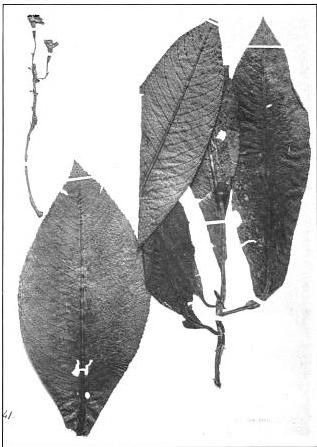 |
| ROLLANDIA CALYCINA G. DonSpecimen in herbarium Museum Paris, ex coll. Gaudichaud no. 41. |
page 379
| PLATE 216. |
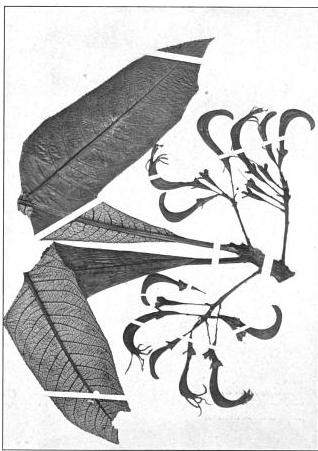 |
| ROLLANDIA CALYCINA G. DonSpecimen (Rock no. 8844) in the College of Hawaii Herbarium. |
page 380
| PLATE 217. |
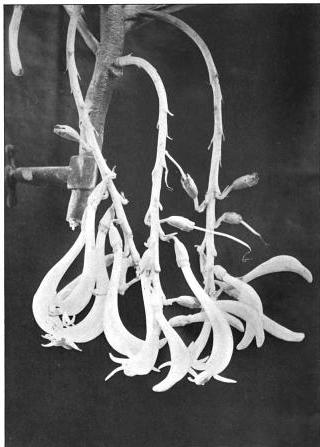 |
| ROLLANDIA HUMBOLDTIANA Gaud.Showing inflorescence (flowers white), about two thirds natural size; from living specimen collected on Mt. Olympus, Oahu. |
page 381
here referred to it. The question will always be an open one, as it is next to impossible to identify the fragmentary specimen in the Paris Museum.
Rollandia crispa occurs at the lower elevations from a few hundred feet in the valleys on the windward and leeward side up to 1800 feet along the Mt. Olympus trail, in company with Cyrtandra, Boehmeria stipularis, Touchardia latifolia, Musa, and others.
Rollandia crispa muricata Rock var. nov.
Habit of the species, leaves obovate oblong, up to 50 cm long, 13 cm broad, pale green glabrous above, with an olivaceous tomentum underneath; peduncle longer up to 8.5 cm; calyx green, pubescent, the lobes oblong, green, pubescent, as long as the tube; corolla pubescent outside, thin, the lobes muricate or scabrous as in Cyanea scabra; staminal column glabrous, only the lower anthers tufted.
OAHU: Nuuanu Valley, flowering September 1914, Rock no. 10283 in herbarium of the College of Hawaii.
The specimens referred to var. muricata cannot be placed with any other species than Rollandia crispa. It has the short petioled leaves and the glabrous staminal column in common with the species, but differs in the tomentose leaves and muricate or scabrous corolla lobes. It grows at an elevation of about 600 feet in Nuuanu Valley.
Rollandia calycina G. Don Gen. Syst. Gard. III:699. 1834. Lobelia calycina Cham. in Linnaea VIII:222. 1833. Delissea calycina Presl Prodr. Monogr. Lobeliac. 47. 1836. Cyanea aspera A. Gray in Proceed. Am. Acad. V:148. 1862. Rollandia scabra Wawra in Flora od. Allgem. Bot. Zeit. XXXI:46. 1873. (Plate 215, 216.)
Stem 1.3-2 m tall, muricate, the young shoots and inflorescence covered with a dark brown tomentum; leaves chartaceous ovate-elliptical to obovate-oblong, 20-42 cm long, 7-12 cm wide, on petioles 3.5-8 cm long, shortly acuminate, contracting more or less suddenly at the base, unevenly crenulate or dentate, the upper face dotted with short stiff hairs on conical papillae, the lower coarsely tomentose particularly along the veins, the rib and petiole muricate; raceme 4-8 cm in flower, longer when with fruit, several-flowered near the apex, distantly bracteate below, the bracts about 8 mm; pedicels about 2.5-3 cm, bibracteolate at the middle; calyx pubescent the obconical tube 12-15 mm, the broad truncate oblong lobes 5-10 mm; corolla falcate from a rather broad base, up to 8 cm in length, faintly puescent, dark purplish-red with blackish stripes; staminal column adnate to less than one-half its length, slightly pubescent, the anthers hairy along the base and sutures, the upper and lower anthers tufted at the apex; berry ovoid nealy 2 cm long; seeds pale yellow.
OAHU: Chamisso in Herbarium Berlin; — Gaudichaud no. 141 in herbarium Museum Paris (as Rollandia ferruginea, aspera); — U. S. Exploring Exped.; — Wawra no. 1794 in Herbarium Vienna; — Waiolani, Hillebrand in Herbarium Berlin; — Punaluu Mountains, flowering August 1908, Rock no. 410-a, fruiting December 24-29, 1908, no. 410 in the herbarium of the College of Hawaii; — Punaluu-Koolauu range, flowering August 1911, Rock no. 8844 in herbarium of the College of Hawaii.
page 382
Rollandia calycina is a very distinct species and is easily recognized, even if not in a flowering stage, by the papillose hispid leaves.
The species was collected by Gaudichaud in young fruit; it was never published by him, but bears the name Rollandia ferruginea aspera, with a question mark after Rollandia.
Wawra's specimen (Rollandia scabra) belongs to Rollandia calycina and not to Rollandia lanceolata as reported by Hillebrand.
The writer's material varies slightly from the original descriptions; the leaves are longer and less suddenly contracting at the base, the peduncles are also longer; otherwise the same.
According to Hillebrand, Meyen's specimen labeled "R. crispa" belongs to R. calycina.
Rollandia Humboldtiana Gaud. Bot. Voy. Bonité, table 76. 1839-1852. Delissea racemosa Mann in Proceed. Amer. Acad. VII:181. 1868. Rollandia pedunculosa Wawra in Flora od. Allgem. Bot. Zeit. XXXI:46. 1873. Rollandia racemosa Hillebr. Flora Hawaii. Isl. 246. 1888. (Plate 217.)
Stem 1 m to 2 m tall, leaves chartaceous, obovate oblong, 26 - 40 cm long, 8 - 15 cm wide, shortly acuminate at the apex, suddenly decurrent at the base, merging into a short petiole of 3 - 4 cm, the latter slightly margined, glabrous above, pale, and pubescent underneath, veins darker, margin eroso-dentate; racemes axillary of variable length 8 - 40 cm, horizontal or drooping, pubescent, loosely bracteate, floriferous in the upper third; pedicels 1.5 cm, in the axils of the bracts, bibracteolate about the middle; calyx cylindrical to ovate about 10 mm, the lobes varying in length from 3 - 10 mm, acute or truncate, pubescent; corolla white or purple, falcate 7 - 7.5 cm long, pubescent; staminal column glabrate; anthers glabrous the lower only bearded; fruit ovate to obovate, pale orange yellow.
OAHU: Gaudichaud; — Horace Mann & Brigham in Herbarium Cornell (Delissea racemosa); — Wawra no. 2520 in Herbarium Vienna; — Konahuanui, flowering anno 1884, J. Lydgate in Herbarium Berlin; — Konahuanui, October 1872. Hillebrand in herbarium Bishop Museum, Honolulu; — Punaluu Mts., flowering November 14, 1908, Rock no 811 in herbarium of the College of Hawaii; — same locality, October 31, 1914, Rock in herbarium College of Hawaii; — Punaluu camp, August 1911, Rock no 8841 in herbarium College of Hawaii; — Konahuanui, September 1912, Rock in herbarium College of Hawaii; — Palolo Mt. Olympus trail, flowering October 1912, Rock no. 10251 in herbarium of the College of Hawaii.
Rollandia Humboldtiana figured by Gaudichaud in his Atlas of the Botany Voyage Bonité represents a plant in the flowering stage, but with flowerbuds only. Everyone who has worked on Hawaiian Lobelioideae knows that a raceme keeps on growing till practically the last fruit has matured. This accounts for the variable length of the racemes (8 - 40 cm). Hillebrand was well aware of the facts above mentioned, but could not have been very well acquainted with Gaudichaud's plate of R. Humboldtiana or else he would have placed Mann's Delissea racemosa as a synonym of R. Humboldtiana. This latter species has very short petioled leaves, and as can be seen in the excellent plate, the upper anthers are naked; this is also the case with the plants referred by both Mann and Hiilebrand
page 383
to R. racemosa, which is a synonym of R. Humboldtiana. The plants which Hillebrand refers to R. Humboldtiana have long lanceolate oblong leaves on long petioles, and racemes about 7 cm long; he also says floriferous from the base. Anyone on examining Gaudichauds plate can see that the raceme is not floriferous from the base, but at the apex.
Hillebrand also states upper anthers ciliate; they are not at all ciliate. In Gaudichaud's plate the drawing of the undeveloped raceme measures about 12 cm. As the plant is evidently considerably reduced, the specimen from which the drawing was made must have had a raceme about 16 - 18 cm long. The somewhat erect habit of the raceme is in all probability due to its being an immature one, as there are no open flowers on it.
Mann's specimen of his Delissea racemosa was without flower and consequently he was unable to place it in Rollandia.
Wawra justly described a Rollandia Kaalae from Mt. Kaala, whence Mann's and Hillebrand's specimens were collected and which were referred by them to R. Humboldtiana. Hillebrand reduced Wawra's Rollandia Kaalae to what he considered R. Humboldtiana. Wawra himself states that R. Kaalae is closely related to Rollandia lanceolata, and so it certainly is, if not a mere form of that variable species. There is no other Rollandia save Rollandia racemosa which in habit can be compared with Gaudichaud's Rollandia Humboldtiana. There is no doubt that these two plants are identical, and as the specific name Humboldtiana is the older one, R. racemosa must be reduced to it. In regard to the calycine lobes, it may be remarked that the writer found exactly the same calycine lobes as described by Mann (hardly exceeding a line in length) and intermediates ranging up to 10 mm long; they are acuminate, rounded, acute and truncate; in one word exceedingly variable.
DOUBTFUL SPECIES.
Lobelia pinnatifida Cham. Lobelia ambigua Cham.
The above two species are in all probability Rollandias; the first one is perhaps a young plant, as nearly all the Hawaiian Rollandia have lobed leaves in their young state. Lobelia pinnatifida is, of course, not a true Lobelia, as in the description it is stated 'racemis axillaribus.' It may be related to Wawra's Rollandia longiflora, which keeps its sinuately lobed leaves even in the flowering stage.
The second species, which is Rollandia? ambigua G. Don, may be identical with Rollandia Humboldtiana, but that is a mere conjecture.
SPECIES EXCLUDENDA.
Rollandia Fauriei Lévl. in Fedde Repertor. Spec. nov. XII:506. 1913. == Cyanea spathulata (Hillebr.) Heller.
page 384
DOUBTFUL SPECIES OF HAWAIIAN LOBELIOIDEAE.
Delissea Fauriei Lévl. in Fedde Repert. Spec. nov. XII:505. 1913.
"Frutex 4-5 pedibus alta ramosa; cortice exfoliante; folia oblonga, glabra flaccida pellucida; pedunculo 1/2 pollice; corolla 2 1/2 poll. longa; capsula cylindrico-oblonga."
SANDWICH: Molokai, ravine á Pukoo, rare, mai 1910 (Urb. Faurie, 572).
The description of this species is worthless; besides, none of the Hawaiian Lobelioideous genera save Lobelia and Trematolobelia have capsules. His Delissea Fauriei may be anything, as, for example Lobelia hypoleuca, which has an oblong cylindrical capsule, or it may be Clermontia arborescens, which has no capsules.
The writer has not seen a specimen; among the plants sent him by Léveillé, neither this species nor the other two, Cyanea salicina and Clermontia carinifera, were represented. Clermontia carinifera is perhaps Clermontia Gaudichaudii or Cyanea fissa. His Cyanea salicina is in all probability Cyanea spathulata, as he described specimens of that latter species as Rollandia Fauriei.
Cyanea spathulata varies considerably in the length of the leaf, and this might have induced him to describe it again in another genus.
Following are the descriptions of the other two species:
Cyanea salicina Lévl. Fedde Repert. Spec. nov. XII:505. 1913.
"Folia flaccidissima elongata anguste lanceolata, nervis arcuatis, margine confluentibus, vix vel non subdenticulata, subtus secus nervos expassim sparse pilosa, breviter petiolata acuminata."
"A. C. spathulata foliis flaccidissimis valde acutis differt."
In the description of Cyanea salicina only the leaves are described; how he came to the conclusion that Faurie's plant no. 10 is a Cyanea is more than a puzzle.
SANDWICH: Kauai, Kealia janv. 1910 (Urb. Faurie no. 569).
Clermontia carinifera Lévl. Fedde Repert. Spec. nov. XII:505. 1913.
"Folia ovata membranacea apice abrupte contracta anastomoso nervia crenulata glabra nervo primaria supra carinato, petiolo 3 cm long; pedunculo 1 cm; calyx campanulatus; dentibus acutis cucullatis, remotis; tertiam corollae partem aequano; corolla suberecta tomentella."
SANDWICH: Kauai, Koloa, dec. 1909 (Urb. Faurie. 10).
page 385
SPECIES OF LOBELIOIDEAE CULTIVATED IN THE HAWAIIAN ISLANDS.
Lobelia Erinus L., a native of South Africa, is occasionally cultivated as a border plant; while a true Lobelia, it has little in common with our native arborescent forms.
Lobelia Erinus is well known and cultivated for its blue flowers.
Isotoma longiflora Presl, a native of the West Indies, is an exceedingly poisoinous plant. It