COLLEGE OF HAWAII PUBLICATIONS
BULLETIN NO. 2.
____________
THE HAWAIIAN PEPEROMIAS
BY
CASIMIR de CANDOLLE
(Geneva, Switzerland)
AND
DESCRIPTIONS OF NEW SPECIES
OF
HAWAIIAN PLANTS.
BY
J. F. ROCK
HONOLULU:
PUBLISHED BY THE COLLEGE
OCTOBER, 1913.
Page 39
New Species of Hawaiian Plants
_____________
By
Joseph F. Rock
Botanist, College of Hawaii
_____________
GESNERIACEAE
Cyrtandra cyaneoides Rock sp. nov.
Plant subherbaceous, somewhat woody at the base, stem erect, not branching, 11-12 dm high, 4 cm in diam., bearing a crown of leaves at the apex, not unlike a species of Cyanea; leaves 45-55 cm long, including the thick winged petiole, 22.5-35 cm broad, midrib fleshy, obovate, rounded at the apex, suddenly narrowing below into a margined petiole, the latter 1.5 cm thick, texture of leaves thick but coriaceous to fleshy, upper surface deeply rugose, all veins impressed, dark green, lighter underneath, glabrous, dull, young leaves and petioles covered with a light silky brown tomentum, with erose margins, young leaves almost fringed. Flowers numerous in subsessile clusters surrounding the stem and hidden; calyx with prominent veins, curved, yellowish brown, five cleft, bi-labiate, lower lip consisting of two sepals 12 mm long, suddenly narrowing into filiform apices, upper lip of three sepals half as long as lower lip, the two outer ones only beaked, all parts covered with a silky brown tomentum; corolla enclosed in the calyx, white, 36 mm long including the 25 mm long tube, slightly curved, two upper petals rounded and smaller than the three lower which are acute, pubescent; stamens adhering in the lower half of the tube, filament 10 mm long; style 14 mm long, green, thickening towards the base; stigma flattened, two lobed, the lobes obtuse, 2 mm long; fruit ovoid (immature), calyx deciduous from fruit, on pedicels of 8-10 mm, and covered in its young state with a brown tomentum.
Kauai: Growing on cliffs near streams or waterfalls at an elevation of 4000 feet, type no. 2282, College of Hawaii Herbarium. Only one specimen observed, collected March 3, 1909, Kaholuamano, along trail to Waialae Valley, when in company with Mr. Francis Gay, who gave Mapele as the native name of the plant.
This species is one of the most striking Cyrtandras the writer has ever met with in the Hawaiian forests. It resembles a Cyanea of the section Palmaeformes, hence the specific name.
Page 40
CAMPANULACEAE-LOBELIOIDEAE
Clermontia montis-Loa Rock sp. nov.
A small tree or shrub, many branched; leaves thick leathery, glossy, dark green above, lighter underneath, flowers single or two on a very short peduncle; calyx, ovarian portion oblong, green, as well as the lobes which are twice as long as, and enclosing the corolla; corolla light purplish green, the dorsal slit extending below the middle; staminal column dark purple, glabrous, anthers darker, glabrous, the two lower penicillate; stigmatic lobes short, with a whitish tomentum at the base; berry large, orange-colored, globose to ovoid, 25 mm in diam.
Hawaii: Forests of Naalehu, Kau, southern slopes of Mauna Loa, elevation 4000 feet, in dense forest. Collected January 9, 1912. Type no. 10002 in the College of Hawaii Herbarium.
This species seems to be intermediate between Cl. macrocarpa and Cl. oblongifolia, though quite distinct from either. The flowers are much smaller than in either of these species and are on very short peduncles of often only 3 mm.
Clermontia Waimeae Rock sp. n.
A shrub 3-5 m high, many branched, of the typical Clermontia type; branches slender, glabrous; leaves bright green, glossy, subcoriaceous to chartaceous, glabrous on both sides, only the young leaves puberulous underneath, elliptic-lanceolate, acute at both ends, mucronate at the apex, crenate to crenulate, callous, covered with a fine impressed areolar network, midrib reddish, 10-15 cm long, 2-3.5 cm wide, on petioles of 25-3.5 cm; cyme 3-5 flowered, puberulous, axillary, the common peduncle 2-3 cm, pedicels 10-15 mm, bibracteolate at or below the middle; ovarian portion of calyx subglobose, 6-8 mm in diam., the lobes linear-lanceolate recurved, acute, 5-8 mm long, puberulous, corolla purple, slender, slightly curved, somewhat pubescent, 3-4 cm long, 3-4 mm wide, deeply lobed more than half the length of the corolla, the lobes linear-lanceolate, acute, the dorsal slit not always extending to the base, but often only beyond the middle; staminal column glabrous, anthers entirely glabrous, the lower ones bearded only; fruits dark orange yellow, globose with truncate apex and persistent calycine lobes.
Page 41
Hawaii: Dense swampy forests above Waimea Village, Parker Ranch, elevation 4000 feet. Coll. J. F. Rock, July 12, 1909. Type no. 4794. — the Herbarium Board of Agric. & For. Hawaii.
An exceedingly handsome species, related to Cl. parviflora Gaud. but differing from it in the short calycine lobes, long slender corolla, which is much larger, and the subcoriaceous elliptic-lanceolate leaves, which remind one of those of Cl. persicaefolia Gaud.
It may be remarked that this species, together with Cl. leptoclada, Cl. parviflora, Cl. parviflora var. calycina, and var. pleiantha seem all more or less related and should form a section by themselves. There are a number of other varieties not yet described which would also fall into this group. The close relationship of these plants is unmistakable; it however contradicts Hillebrand's sectional arrangement.
It may be remarked that the species published by H. Léveillé in Fedde Repertorium X. 10/14 (1911) 156 under the name Cyanea Blinii Lévl. sp. n. collected by Abbé Faurie, no. 575, May, 1909, at Glenwood, near Hilo, Hawaii, of which the writer possesses a co-type, is Clermontia parviflora Gaud. β var. pleiantha Hbd.
.Clermontia Kohalae Rock var. robusta Rock var. nov.
A small tree or shrub, branches exceedingly stout, woody to the last ramification, bark thick corky and covered with numerous thick knobby leaf-scars; leaves smaller than in the species and on much shorter petioles, densely crowded at the apex of each branchlet; inflorescence the same as in the species, flowers thicker and more fleshy, the cymes in the axils of the uppermost leaves and not all along the stem as in the species.
Hawaii: Mountains of Kohala, along stream beds and near waterfalls at an elevation of 1500 feet, back of Kohala proper. Coll. J. F. Rock July 1910; type no. 8811 in the Board of Agriculture and Forestry Herbarium.
This variety is one of the most robust Clermontia known to the writer.
Page 42
Cyanea communis Rock sp. n.
Plant single stemmed, erect, not branching, fleshy, but woody towards the base, hirsute in the upper portion, 4-16 dm high, leaves pale green, ovate-oblong, acuminate at both ends, chartaceous ,irregularly serrate to dentate with the exception of the base proper, glabrous or slightly hispidulous above, pubescent underneath or only along the prominent veins and midrib, young leaves hirsute on both faces, 10-20 cm long, 3-5 cm wide, on hirsute petioles of 2.5-6 cm; racemes arranged all along the naked stem and in the axils of the leaves; peduncle 1.5-3 cm, hirsute, occasionally with foliaceous bracts, or naked, or with a few knobby scars at the end, 3-7 flowered, pedicels slender, hirsute, 6-12 mm; calyx ovoid, puberulous, the lobes one third its length, acute, triangular; corolla pale purple to pink, slightly curved, tomentulose, 30 mm long, 4 mm wide, very thin, the dorsal slit extending only one third its length or even less, the lobes unequal, linear; staminal column galbrous as are the bluish anthers; fruit ovoid to globose, dark orange colored 10-16 mm in diameter, crowned by the calycine lobes; seeds smooth, shining, reddish brown.
Kauai: In the forests of Kaholuamano, above Waimea; the most common Cyanea. The plant is absent at Halemanu which latter locality is separated from the former by the Waimea canyon. The plant is terrestrial and does not branch like C. hirtella, which is common at Halemanu and is a branching shrub 20 feet in height. Cyanea communis was also observed by the writer on the high central plateau and at the summit of Kauai, Mr. Waialeale, the only Cyanea present on that mountain. It was found growing on treees, thickly covered with moss. It ranges from an altitude of 4000 to 5000 feet. Coll. J. F. Rock; Sept. 1909, no. 4885, which is the type in the Board of Agric. and Forestry Herbarium, no. 5942, Waialae Valley, and Octob. 1911, no. 8865, Kaholuamano, fruiting only. The plant flowers in the early part of the summer. There is a fruiting specimen of this species in the Gray herbarium, collected by A. A. Heller, Aug. 30, 1895, no. 2769, from the type locality.
The plant is quite different from C. hirtella, which the writer had occasion to compare with C. communis growing in the field. It is undoubtedly related to C. hirtella, but differs from it in the smaller, very pale flowers, in the arrangement of the racemes, and in the much smaller leaves which are of entirely different shape. However the species described would form a marked group with C. hirtella, C. fissa, C. recta, and C. sylvestris.
Hillebrand says that C. recta (which he had not seen) seems to border on var δ of C. angustifolia. The writer had opportunity to examine Wawra's type through the courtesy of Prof. Dr. A. Zahlbruckner of Vienna and must state that C. recta is a very distinct species and has no resemblance to any variety of C. angustifolia.
Page 43
Cyanea wailauensis Rock sp. n.
Plant erect, 1.5 m high, not branching, stem fleshy, but woody at the base, unarmed and covered in its upper portion with leaf-scars, with a crown of leaves at the apex; leaves chartaceous when dry, somewhat fleshy when fresh, pale green, dull and glabrous above, with prominent veins and impressed midrib, obovate-oblong, cuspidate to acute at the apex, gradually narrowing at the base, somewhat wavy and eroso-dentate at the margin, puberulous underneath, 30-40 cm long, 10-18 cm wide on petioles of 4-8 cm, young leaves hispid; racemes arranged along the upper portion of the stem, somewhat similar to Cyanea acuminata, peduncle thick, densely studded with large close knobby scars of a pale color almost from the base, about 4 cm long, 6-8 flowered at the apex, peduncle hirsute as are the linear bracts; pedicels 1 cm long, hispid; calyx hispidulous to hirsute, the ovarian portion 10 mm, the linear oblong lobes 15-18 mm, free to the base; corolla of a dirty white, the tube 22-25 mm, hirsute as are the unequal lobes, the dorsal slit extending 2/5 its length; staminal column dark purple, glabrous, the lower anthers bearded, stigma surrounded at its base by a tuft of small, white hairs; fruit unknown; but calyx-lobes persistent with fruit as is evidenced from very young fruits.
Molokai: Valley of Wailau; at the bottom of the valley at 1000 feet elevation, near the head of Wailau, along the streambed among dense vegetation of ferns, Cyanea grimesiana, Antidesma platyphyllum, Musa sapientum, etc. Coll. J. F. Rock, April 1910, type no. 8812 in College of Hawaii Herbarium.
The plant comes nearest to C. solenocalyx Hbd., but differs from it in the often cuspidate leaves, thick peduncle with dense knobby scars and the very short white flowers, which are almost hidden in the calyx.
Cyanea macrostegia Hbd. var. parvibracteata Rock var. n.
Leaves large, 45-64 cm by 7-14 cm, coriaceous, scabrous above, dull pubescent underneath, margin irregularly notched or laciniform, broadly oblong in outline; peduncle 4-6 cm, fleshy, bracteate at the apex, bracts linear-subulate 5 by 1 mm; pedicels 15 mm, apparently naked; calyx pubescent, the ovarian portion obconical, the lobes as in var. β; corolla dark purple, pubescent as in var. β; berry ovoid, dark yellowish, 25-30 mm by 18-27 mm, crowned by the calycine lobes.
Maui: Northwest slopes of Mt. Haleakala, East Maui, along the trail leading from Ukulele to Waikamoi, elevation 5000 feet, flowering March 1912, Rock and Ceresole no. 10057; fruiting May 1911, northern slopes of Haleakala along a stream above Nahiku, elevation 3500 feet, Rock no. 8792, in the Herbarium of the College of Hawaii.
Page 44
Rollandia purpurellifolia Rock sp. n.
Plant 3-5 dm high with fleshy stem, unbranched, unarmed and perfectly glabrous; leaves subsessile or on petioles of 5-8 mm, linear-oblong, 16-35 cm long, 3.5-6.5 cm wide, dull, dark green above, dark purple underneath and shining, perfectly glabrous on both sides, acute or obtuse at the apex, with irregularly denticulate margins, but the last third entire, inflorescence perfectly glabrous, axillary, peduncles slender, with few knobby scars, 15-25 mm long, bracteate at the apex, pedicels slender, blackish-purple, 12-20 mm long, bi-bracteolate below the middle; flowers unknown; fruits dark purple to black, obovoid, crowned with the 4-6 mm long, acute calycine lobes, 15-18 mm long when mature.
Oahu: dense forests of Punaluu Mts., at the summit ridge above Hauula in dense shade with Lysimachia longisepala and numerous ferns, etc.
A striking species with dark purple leaves. Coll. J. F. Rock, Aug. 1908 and August, 1911; type no. 8824 in the Herbarium of the Board of Agriculture and Forestry, Honolulu.
The plant comes nearest to R. longiflora Wawra.
Rollandia truncata Rock sp. n.
A low plant 3-4 dm high with fleshy muricate stem; leaves large, chartaceous, broadly obovate-oblong, acute at the apex, decidedly truncate at the base with perhaps a slight indication of becoming subcordate, pale green, glabrous above, with here and there, especially on the veins, a few minute conical spines, 40-42 cm long, 18-20 cm wide, puberulous underneath, on muricate petioles of 14 cm; racemes axillary, slender, 5.5 cm long, bracteate from the base, hispidulous, the number of bracts increasing towards the apex, whole inflorescense rather broadly contracted, the lower flowers mature, while the apical ones occur as minute buds; pedicels single in the axils of each bracts, long, slender, 22-26 mm long, bi-bracteolate at or below the middle, pubescent; calyx 10 mm long, the ovarian portion obconical, the lobes as long as the tube, 5 mm, broadly obtuse; corolla pale purplish-pink, slender, very thin puberulous in the bud, glabrous when open, slightly curved, or almost straight, the dorsal slit extending to the middle, staminal column only at the very base adnate to the corolla, often hardly noticeably so, glabrous, pale; anthers bluish, glabrous, the two lower bearded.
Page 45
Oahu: Mountains of Punaluu, Punaluu Valley trail, 1000 feet elevation in company with Cyrtandra, Scaevola, Acacia Koa, etc. Coll. J. F. Rock Aug. 1911, type no. 8840 in the herbarium of the Board of Agriculture and Forestry which is in the safekeeping of the College of Hawaii.
This exceedingly interesting plant seems to furnish almost the intermediate between the genera Rollandia and Cyanea. In the former genus the dorsal slit extends to the middle while in the latter beyond the middle; the staminal column in this species is only at the very base adnate to the corolla, appearing almost free, a fact which brings it very near to Cyanea; in the outwards aspect it is however a typical Rollandia.
TREMATOLOBELIA Zahlbr. in lit.
Syn Trematocarpus A. Zahlbr. in Ann. Mus. Vindob. VI. 3|4 (1891) 430 fig. 1.
Calycis tubus sub anthera adnatus, subglobosus, limbus 5-partibus; corolla arcuata, decidua, tubo dorso a basi fisso, limbi lobis incurvis inaequalibus, 2 majoribus altius liber, rectus, tubo corollae multo longior; antherae 2 minores vertice penicillatae, 3 majores glabrae; ovarium inferum, 2-loculare, placentis ∞-ovulatis. Capsula infera, lignosa, vertice clausa et umbonata, lateraliter inter costas praesertim versus basim foraminibus ovalibus aut rotundatis dehiscens. Semina parva, pressione mutua marginata. Embryo rectus, radicula juncta hilum, lobis rotundatis plantis; ex Zahlbr. Ann. l.c.p.
The genus Trematolobelia consists of a single species and two varieties. The latter are new described here in the following pages.
Trematolobelia macrostachys A. Zahlbr.
Syn.: Trematocarpus macrostachys A. Zahlbr. in Ann. Mus. Vindob, VI 3|4 (1891) 432. — Lobelia macrostachys Hook. et Arn. Bot. Beech. Voy. (1832) 88; DC. Prodr. VII. (1838) 387; — Wawra in Flora (1873) 48; — Hbd. Fl. Haw. Isl. (1888) 238. — Delissea? macrostachys Presl Prodr. Lobel. (1836) 47. For reference to discussion on Trematocarpus see Ann. of Bot. VII. (1893) 289 and 397.
Page 46
In a letter received from Dr. A. Zahlbruckner the writer's attention was called to the controversy in regard to the genus Trematocarpus. The writer, who has had ample opportunity to study this plant in all its stages in the field and that on all the islands of the Hawaiian group, can only corroborate Dr. Zahlbruckner's conclusions. As is known, the plant flowers the last year of its life, and perfectly mature fruiting specimens, of which the epicarp had decayed, were observed by the writer in the Hawaiian forests. All capsules had the peculiar holes, which are very numerous and of different sizes and shapes, becoming larger at the base of the capsule. Mr. Botting Hemsley suggested that these holes may have been the work of insects in the herbarium and that Zahlbruckner had monstrous capsules. This the writer can absolutely prove to be not the case as is shown in the accompanying Illustration. (Plate XI). He can also verify that the apex of the capsule is always indehiscent and that even after pressure had been applied it remained unopened, the carpidia had however become separated from the ligneous capsular wall, were torn, and the capsules were empty. All this was observed in the field and not from specimens preserved in an herbarium for sixty years or more as was the case with Dr. Stapf's specimens.
The flowering habit of this beautiful plant is also different from that of the other Hawaiian Lobelia, as the accompanying illustration (plate XII) shows.
Trematolobelia macrostachys Zahlbr. var. grandifolia Rock var. n.
Plant erect, branching as in the species; stem dark reddish, leaves large, obovate-oblong, subentire or faintly crenulate with callous glands, pale green, midrib dark, blackish, acute or obtuse at the apex, gradually narrowing at the base into broad, margined petioles of 2-5 cm, 26-30 cm long, 5-7 cm broad; racemes longer than in the species, robust 50-60 cm long, bracts broad, foliaceous; calyx twice as large as in the species, corolla not of even width, somewhat sigmoid, pure white, broader and longer than in the species.
Hawaii: Mountains of Kohala, along the edge of Kawainui gorge, 4400 feet elevation. Coll. flowering Oct. 1909, R. S. Hosmer; type no. 6090 in Board of Agriculture and Forestry (College of Hawaii) Herbarium.
var. Kauaiensis Rock
Syn.: Lobelia macrostachys H. et. A. var. Kauaiensis Rock in Indig. Trees Haw. Isl. (1913) 77 nom. nud.
Plant much smaller than the species, stems black; leaves linear oblong, acuminate at both ends, dark green, glossy with red veins, midrib and callous glands, 16 cm long, 3 cm wide; racemes short, 24-34 cm long, flowers very strongly arched, the apex returning to the level of the base, of a scarlet red; otherwise as in the species.
Page 47
Kauai: Summit of Mt. Waialeale, elevation 5200 feet, in the oopen flat swamps in company with Lobelia kauaiensis, Tetraplasandra Waialealae, Geranium humile var. Kauaiense, etc. Also along Kailiili and Kaluiti strams and near Keaku cave; flowering Oct. 20, 1911. Coll. J. F. Rock; type in the College of Hawaii Herbarium, no. 8877.
A very handsome plant and quite conspicuous by its bright red flowers, dark green leaves, with red venation.
Lobelia Gaudichaudii DC. var. longibracteata Rock var. n. in Indib. Trees Haw. Isl. (1913) 78 nom. nud.
Plant 3-5 m high, branching candelabra like into 5-7 erect ascending branches, leaves as in species though longer; racemes larger and longer, and covered throughout with a viscous exudation; peduncles about 6 cm long; calyx as in the species, the calycine lobes linear lanceolate, acuminate, 3.5 cm long, 5 mm wide, reaching about to the middle of the corolla, bracts linear lanceolate, 60-80 mm long; 6-10 mm wide, reddish, acuminate, minutely denticulate near the apex; corolla as in the spcies.
This variety is at once distinguished from the species in its branching habit, and larger size, but mainly in the long racemes with their long,linear-lanceolate, acuminate bracts, and long calycine lobes. One of the handsomest Hawaiian Lobelias.
Maui: On the highest point of West Maui on the very edge overlooking Iao Valley, 5700 feet elevaiton, in company with Clermontia grandiflora, Pelea, etc. Coll. flowering, Aug. 1910, Rock and Hammond; type no. 8818 in College of Hawaii Herbarium.
Page 48
Remarks on certain Hawaiian plants described by H. Léveillé in Fedde Repertorium X. 10/14 (1911) 156-157.
____________
Cyanea Fauriei Lévl. (no. 565 Faurie.) This species is identical with Cyanea coriacea Gray; at first sight it appears to be related to C. comata Hbd. Gray's specimens had young and not fully developed racemes which accounts for the description giving the length as 3 inches. The writer has abundant material with racemes of varying length from 7 to 22 cm.
Clermontia Fauriei Lévl. (no. 578 Faurie.) This is a very young branch of Clermontia Gaudichaudii, the only representative of the genus Clermontia found on Kauai. Owing to its being from a young specimen the leaves appear very thin and pale green.
H. Léveillé certainly confused many Hawaiian plants; some cases are really unpardonable and ridiculous. The common nyctaginaceous Pisonia Brunoniana, of which he had fine fruiting specimens, he labeled Labordea, and our Pisonia sandwicensis Hbd., he describes in Fedde Repertorium as a new species under the name of Labordea Fauriei Lévl., saying a ceteris speciebus diversa; this is certainly true, for a nyctaginaceous plant must certain differ from a loganiaceous one.
One very unpardonable mistake he made was in describing the well known Hibiscus schizopetalus, which is cultivated all over the tropics and is a common garden plant in Honolulu as Hibiscus Fauriei Lévl., sp. n.
Besides this, he describes as new species ordinary road weeds, as for example a world-wide Crepis, as Crepis molokaiensis Lévl. sp. n.
Suttonia molokaiensis Lévl., (no. 435 Faurie). This plant is not a Suttonia at all but a variety of the sapotaceous Sideroxylon spathulatum Hld., described by the writer in his Indig. Trees Haw. Isl., page 392.
Metrosideros Feddei Lévl. (no. 25 Faurie). This is Heller's Nania tremuloides, now Metrosideros tremuloides (Heller) Rock.
Labordea Fauriei Lévl. (no. 713 Faurie) Identical with the nyctaginaceous Pisonia sandwicensis Hbd. now Rockia sandwicensis (Hbd.) Heimerl.
Page 49
Viola sandwicensis Lévl. (no. 1 Faurie).
The fragment of a plant bearing the above name is at once recognizable as a Cyrtandra. It is indeed surprising to find a Cyrtandra described as a new species of Violet. The larger portion of every number of Fedde's Repertorium consists of Decades plantarum novarum by H. Léveillé, which have reached now the number CXXIV with 1240 new species. If all are of the same nature as his descriptions of new Hawaiian plants, most certainly there will be an appalling synonymy and a chaos which will take much longer to straighten out than it took H. Léveillé to create.
All the numbers mentioned are in the possession of the Herbarium of the College of Hawaii. They were bought from Abbé Faurie.
J. F. ROCK.
Page 50
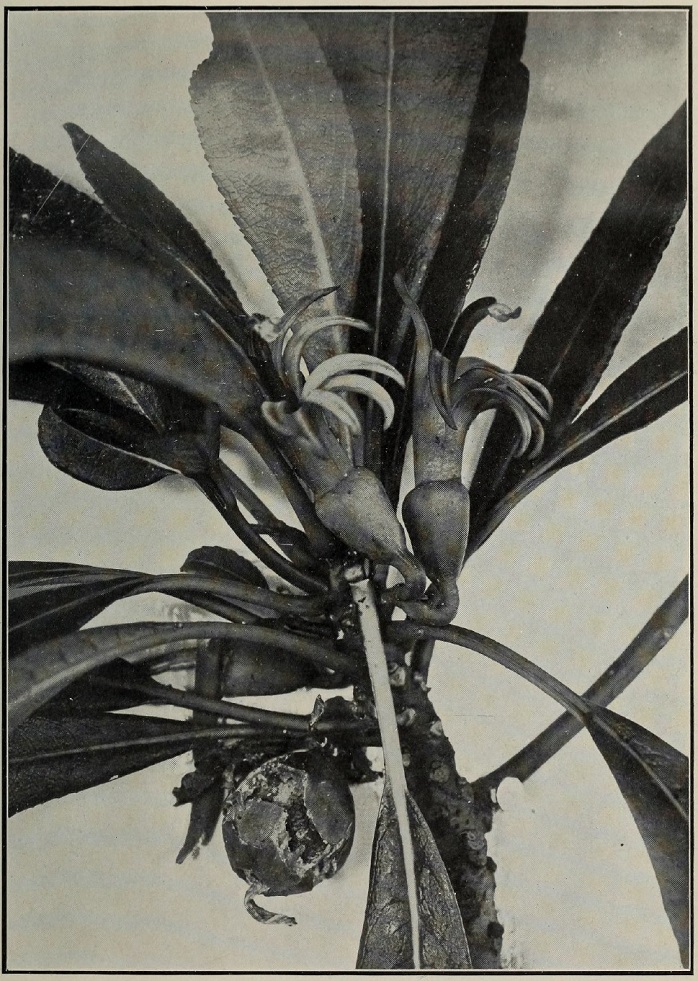
Plate IX.
Clermontia montis Loa Rock. Natural size.
Page 51
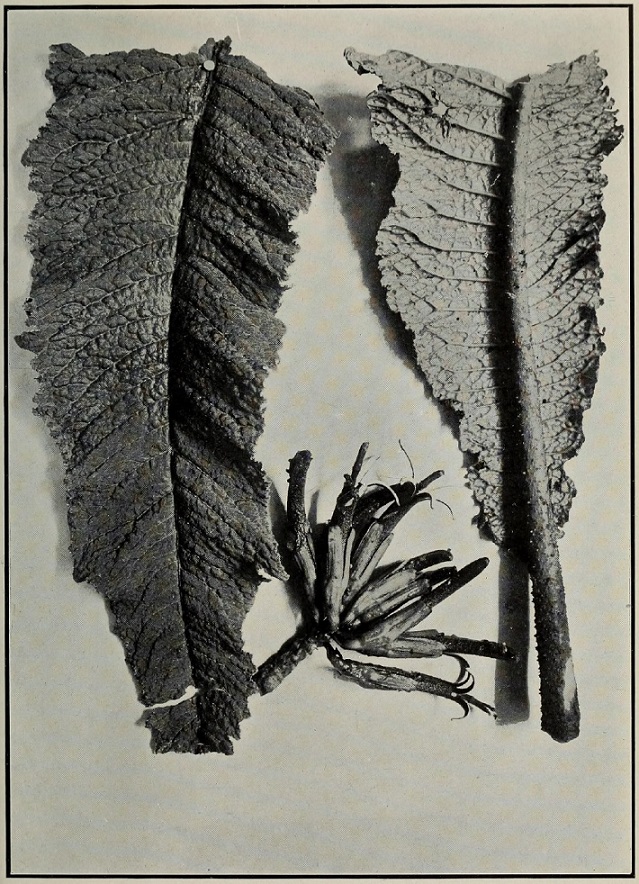
Plate X.
Cyanea macrostegia Hbd. var. parvibracteata Rock. One-half natural size.
Page 52
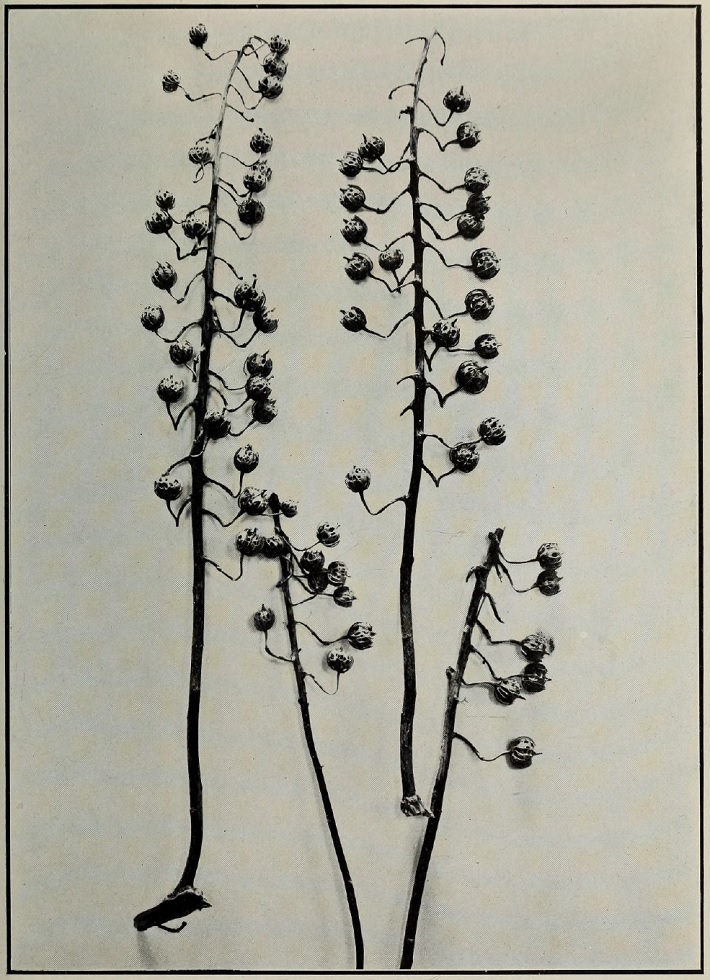
Plate XI.
Trematolobelia macrostachys Zahlbr. Showing portions of fruiting racemes perfectly mature.
Page 53
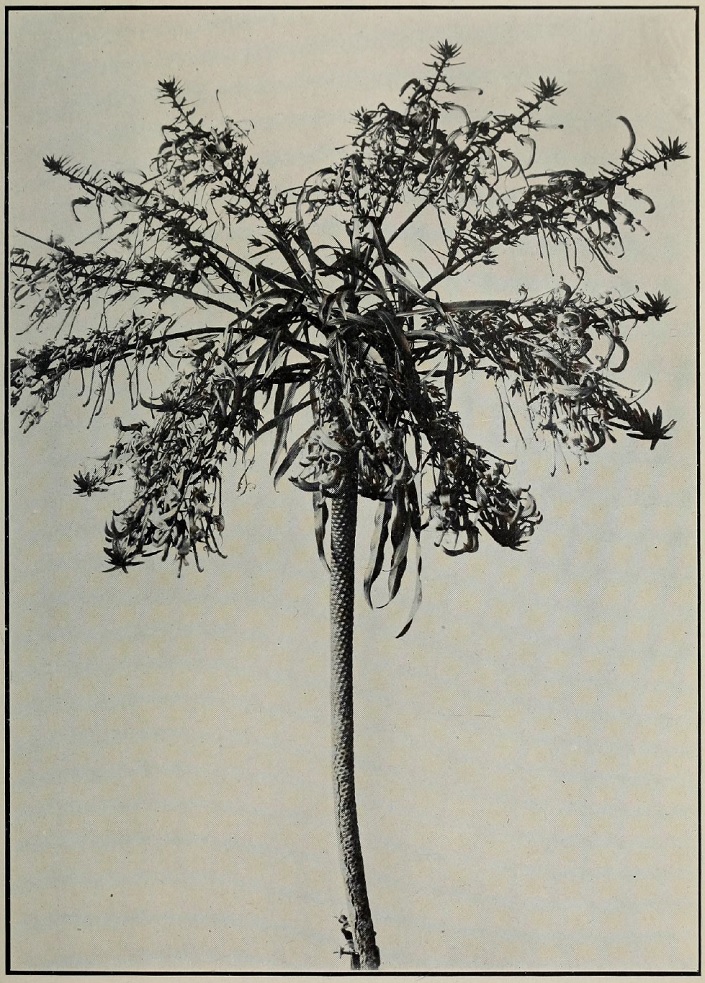
Plate XII.
Trematolobelia macrostachys Zahlbr. Typical Oahu specimen in flower, about one-fifth natural size.