
Clermontia persicifolia
Genus: Clermontia sect. Clermontia with petaloid sepals.
Range: O'ahu; both Ko'olau (common) and Wai'anae (rarer) ranges, wet forest, 305-850 m. Rock (1913) says it was common in the Palolo Valley and on Waiolani, both in the southern Ko'olau's. Sebastian Marquez (2011, studiamirabilium.com) says there are several individuals that are easy to see from the Ka'au crater rim trail in the Palolo Valley. Not Lanai as reported by Rock (see note in Degener, 1956).
Growth form: Shrub, 2-6 m tall.
This species was the second described by Gaudichaud who used the spelling persicifolia. De Candolle (1838) adopted the latin spelling persicæfolia. Hillebrand (1888) and Heller (1897) continued this trend using the variant persicaefolia. Rock used the "ae" spelling for his Indigenous Trees book (1913), but then switched to "persicifolia" for his monograph (1919). Wimmer (1943), Degener (1956) and Lammers (1990, 1991) continued the use of Gaudichaud's spelling: persicifolia.
How to identify: Degener says it is the most common of the Clermontia of the Ko'olau Range. One of five Clermontia that occurs on O'ahu. Three of these have dark, glossy, leathery leaves; the other two, C. kakeana and the extinct Cl. multiflora, have dull, papery leaves. Of the remaining three, Cl. persicifolia has narrow, elliptic, quite stiff leaves; the other two species, Cl. fauriei and Cl. oblongifolia, tend towards oblong leaves that are slightly wider. Lammers (1991) notes that collectors have confused Cl. persicifolia and Cl. oblongifolia.
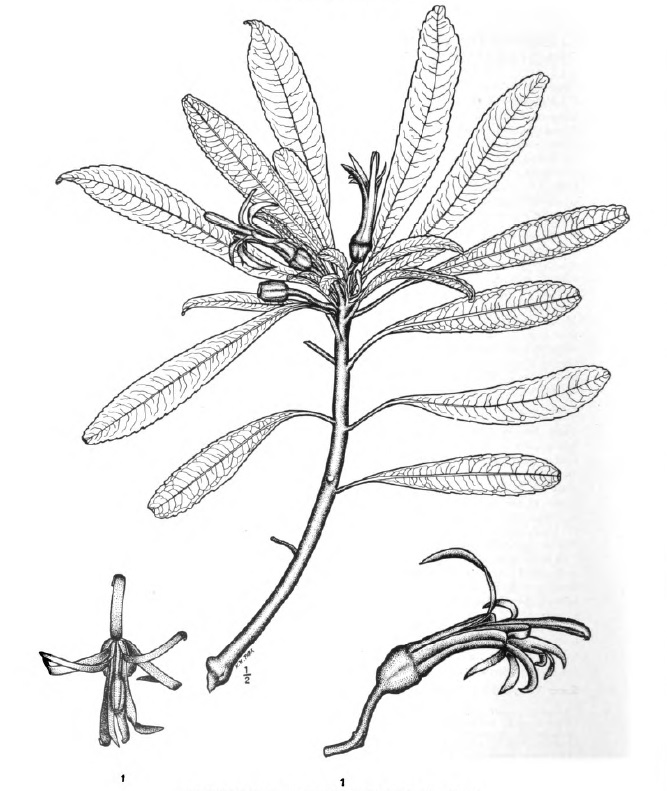
Illustration from Degener, 1956
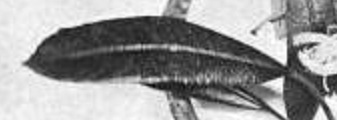
Detail from Rock, 1919, Plate 173
Description: The typical Clermontia form, a candelabra-like branching, terrestrial or epiphytic shrub reaching 6m in height. Rock describes it as having a "beautiful, round, symmetric crown". Young branches glabrous and purple; bark smooth green becoming grayish-brown and longitudinally fissured with age. Leaves: elliptic to oblanceolate, 7 - 16 cm x 1½ - 4 cm, apex acute to acuminate, base cuneate narrowing into a distinct petiole 2 - 7 cm long. The upper surface is glossy and dark green; the margin is coarsely crenulate, revolute giving the leaf a rigidness; the lower surface is pale green, glabrous. The conspicuous venation shown in Degener's illustration is only seen on the undersurface.
Sources:
- Gaudichaud, 1829;
- G. Don, 1834;
- De Candolle, 1838;
- Gray, 1861 (pro parte of Clermontia grandiflora var. oblongifolia);
- Wawra, 1873 (as Clermontia parviflora, cf. Rock, 1913a);
- Hillebrand, 1888;
- Heller, 1897;
- Rock, 1913;
- Rock, 1919;
- Wimmer, 1943;
- Wimmer, 1943 (as Clermontia epiphytica);
- Degener, 1956;
- Wimmer, 1968;
- Wagner et al., 1990.