BULLETIN
OF THE
TORREY BOTANICAL CLUB
FOUNDED BY WILLIAM HENRY LEGGETT, 1870
EDITOR
ALEXANDER WILLIAM EVANS
ASSOCIATE EDITORS
| JEAN BROADHURST | WILLIAM GEORGE MARQUETTE |
| JAMES ARTHUR HARRIS | HERBERT MAULE RICHARDS |
| MARSHALL AVERY HOWE | ARLOW BURDETTE STOUT |
| NORMAN TAYLOR | |
NEW YORK
1917 PUBLISHED FOR THE CLUB THE NEW ERA PRINTING COMPANY LANCASTER, PENNSYLVANIA
Page 229
Vol. 44 No. 5.
BULLETIN
OF THE
TORREY BOTANICAL CLUB
_____________
Notes on Hawaiian Lobelioideae, with descriptions of new species and varieties
JOSEPH F. ROCK
(WITH PLATES 9-16)
The writer has prepared a monograph on the Hawaiian lobelioideous genera Cyanea, Rollandia, Clermontia, Delissea, Trematolobelia and Brighamia, and on the endemic species of the genus Lobelia. But owing to the length of time necessary for the publication of the rather voluminous manuscript of the whole monograph, he thought it wise to publish the new species first in botanical periodicals or bulletins. The majority of the new species of Cyanea and Clermontia have appeared in the writer's book on the Indigenous Trees of the Hawaiian Islands (1913), in Botanical Bulletin No. 2, of the College of Hawaii Publications and in the Bulletin of the Torrey Botanical Club. With two exceptions the species and varieties described in the present paper belong to the genus Cyanea, which has by far the largest number of species of the lobelioideous genera represented in the Islands. Clermontia comes next, with Rollandia and Delissea following.
Page 230
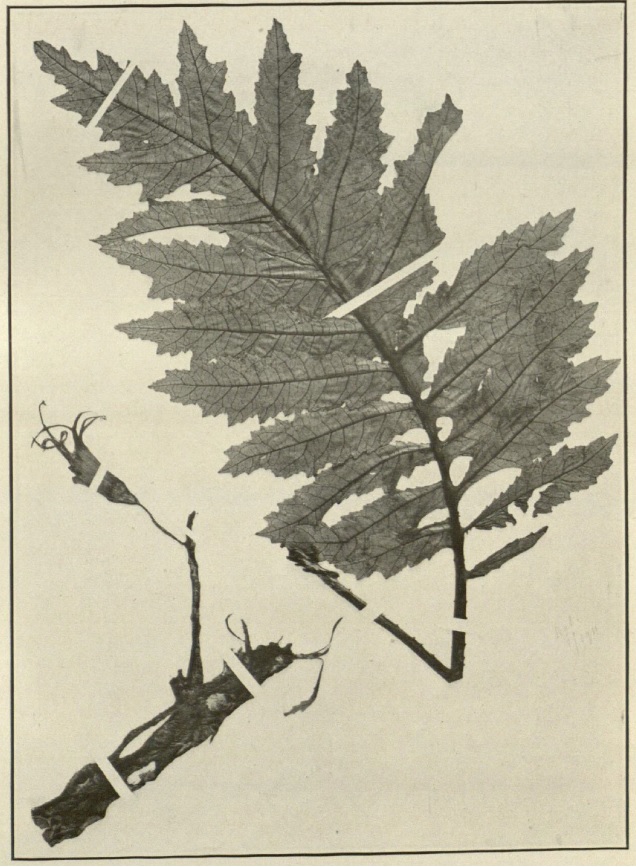
1. Cyanea noli-me-tangere sp. nov.
Plant subherbaceous, 3-20 dm. high, terrestrial, branching only when broken, spinescent throughout, with the exception of the fruit and corolla; stem green, somewhat fleshy, entirely covered with strong, pale yellow, hollow spines; leaves bright green, ovate-oblong, somewhat acute at the apex, rounded at the base, thin in texture, irregularly and sinuately notched, with minute, mucronulate teeth along the margin, covered with yellow spines at more or less regular intervals of 7-10 mm. on both surfaces, 9-21 cm. long, 4-7.5 cm. wide, on spinescent petioles 1.5-4 cm. in length, glabrous or slightly pubescent; inflorescence axillary, the spinescent peduncle 2-2.5 cm. long, multibracteate two thirds its length; pedicels 6-10 mm. long when in flower, 20 mm. when in fruit, pubescent with whitish hairlets; calyx similarly pubescent, calycine lobes triangular, acuminate, 3 mm. long; corolla greenish white, slightly pubescent, strongly curved, 4cm. long, of unequal width, broadest portion (7 mm.) beyond the dorsal slit, the latter extending one third the length of the corolla, upper corolla lobes 12 mm. long, the three lower 8 mm. long; staminal column green, glabrous, as are the anthers, only the two lower being penicillate; stigma pubescent; fruit orange-colored, pubescent, ovoid, 1 cm. long; seeds dark brown, shining. [PLATE 9.]
HAWAII: terrestrial, in the forests of Glenwood, usually in the more or less uniform fern forest at an elevation of 3,500 feet, March 20, 1908, H. L. Lyon 8847 (fruiting specimens); December 23, 1914, J. F. Rock & M. L. Copeland 10351 (flowering specimens), type. Both specimens are in the herbarium of the College of Hawaii.
MAUI: in the rain forest on the northwestern slopes of Mt. Haleakala, along the Honomanu trail, April, 1911, J. F. Rock 8796a (leaf specimens only); in the forests back of Nahiku, at an elevation of 4,000 feet, April, 1911, J. F. Rock.
In Hillebrand's herbarium in the Botanical Museum at Berlin there are four specimens of a Cyanea which he labeled with a manuscript name. Three of these came from Molokai and one from Maui. Two of the specimens, which are undoubtedly related to the writer's C. noli-me-tangere, belong to Cyanea scabra Hillbrd., while the others represent two varieties, probably of the latter.
Cyanea noli-me-tangere differs from Cyanea scabra in the spinescent leaves and in the corolla lobes which are smooth instead of scabrous. The corolla lobes of Hillebrand's plants are also scabrous. Cyanea noli-me-tangere is related to Cyanea palakea Forbes. It differs from it in the longer-petioled, spinescent leaves, which are ovate to obovate-oblong and not sinuate. Cyanea palakea Forbes seems to be very close to the writer's Cyanea stictophylla from near the locality where Forbes collected his specimens.
Page 231
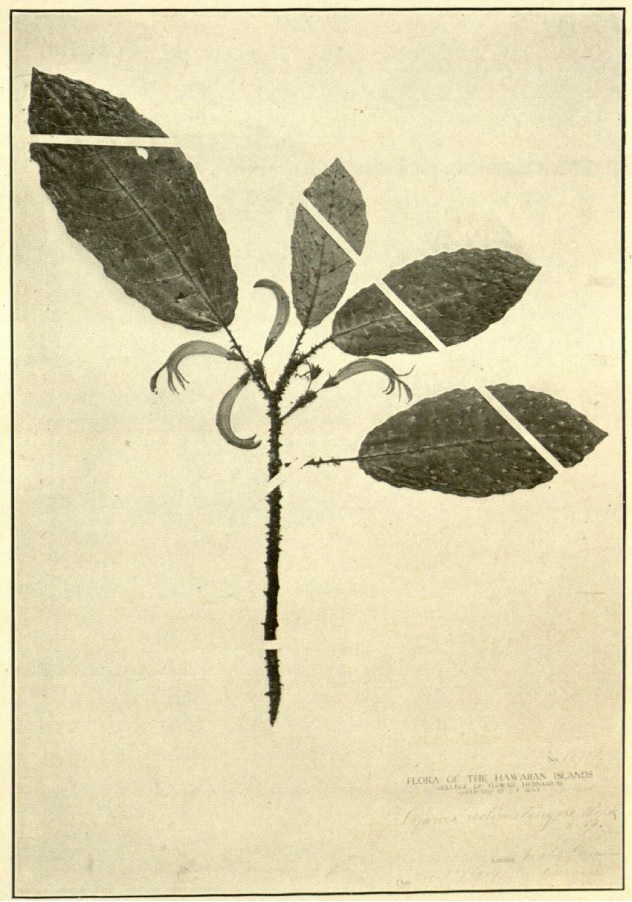
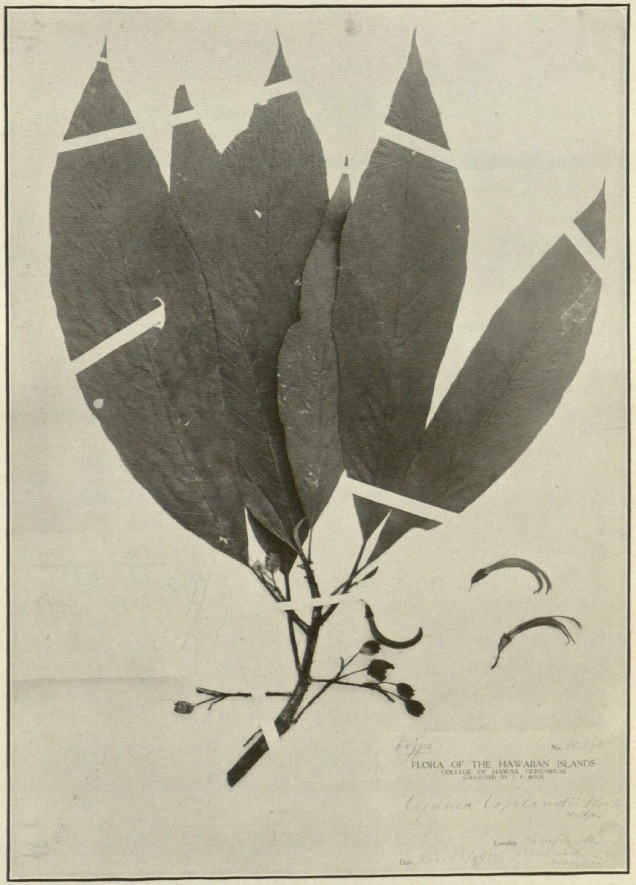
2. Cyanea Copelandii sp. nov.
Plant herbaceous, epiphytic, 30-40 cm. tall, not branching, stem fleshy throughout, green, with distant leaf scars; leaves dark green, oblong, acuminate at the apex, gradually narrowing and slightly rounded below, 22.5-27 cm. long, 5-8 cm. wide, on petioles 4.5-5.5 cm. long, midrib prominent underneath as are the veins, the latter slightly impressed above, margin of leaf unevenly wavy, minutely and closely denticulate, denticulation mucronulate, glabrate above, slightly pubescent below, especially the veins and midrib, pubescence consisting of minute reddish brown hairlets; inflorescence axillary, peduncles 4-5 cm. long when in flower, 5.5 cm. long when in fruit, with a rusty colored pubescence; pedicels three or four, 11-16 mm. long, 2 mm. thick, calyx greenish with purplish tinge, pubescent, ovarian portion ovoid-oblong, 1 cm. high, 6 mm. in diameter, ten-ribbed, the calycine lobes triangular-dentiform, the tips dark purplish, 2 mm. long; corolla yellowish flesh-colored, slightly curved when open, of equal width throughout, 4 cm. long, 6 mm. wide, the dorsal slit extending not quite to the middle, the two upper lobes 2 cm. long, the three lower 1 cm. long, with a purplish pubescence mainly along the nerves, the tips of the lobes mucronulate; staminal column green, pale, perfectly glabrous, shorter than the corolla, the tube glabrous inside, with the exception of the base which is tufted with whitish hairlets; style green, glabrous, stigma slightly two-lobed; anthers glabrous, the lower only penicillate; fruit dark orange, oblong, 15 mm. long, 10 mm. wide, slightly ribbed, crowned by the calycine teeth. [PLATE 10.]
HAWAII: on trunks of trees and tree ferns, not common, in the rain forest of Glenwood, at an elevation of 3,500 feet, December 23, 1914, J. F. Rock & M. L. Copeland 10350 (flowering and fruiting specimens), type, in the herbarium of the College of Hawaii.
Named for my friend, Mr. M L. Copeland, who accompanied me on botanical excursions on Hawaii. The species belongs to the herbaceous cyaneas and is related to Cyanea stictophylla Rock and Cyanea communis Rock.
Page 232
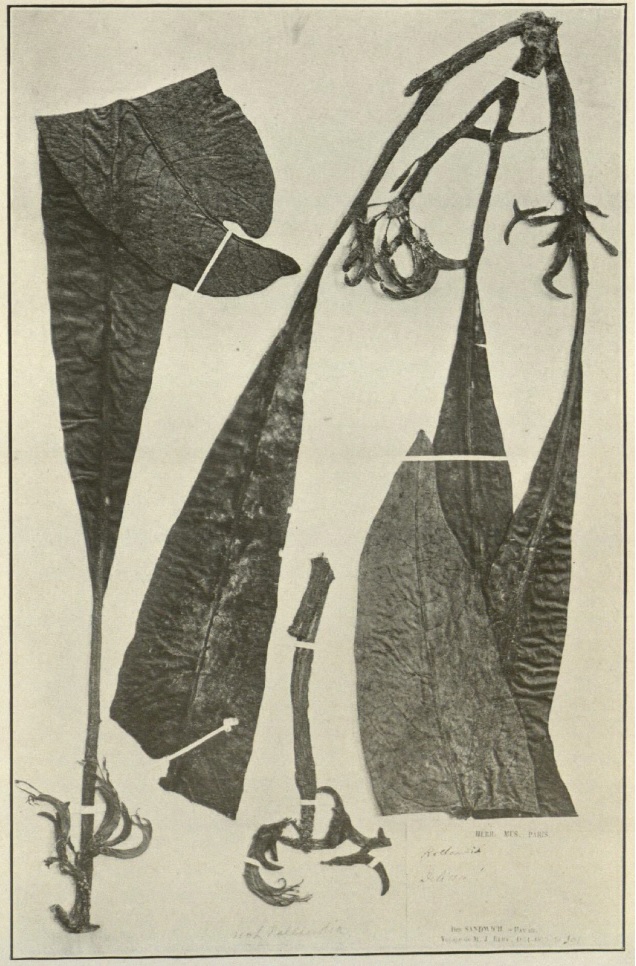
3. Cyanea Fernaldii sp. nov.
Leaves lanceolate-oblong, thin in texture when dry (chartaceous), dark green above, paler underneath, with prominent midrib, subentire with somewhat wavy margin, minutely and closely denticulate, bluntly acuminate at the apex, 34-40 cm. long, puberulous on both sides, the apparently fleshy petiole 12 cm. or more in length, near the blade of the leaf showing signs of murication; peduncle fleshy (apparently), nearly as long as the petioles, 8-10 cm. long or a little more, naked its entire length, pubescent with round scars near the apex; bracts foliaceous, 3.5 cm. long, dentate, only present at the apex of peduncle; pedicels short, filiform, 12-15 mm. long, pubescent; calycine lobes triangular, 2.5 mm. long, the ovarian portion of calyx 7 mm. long, oblong, nearly cylindrical, pubescent; corolla evidently white, pubescent outside, slightly curved, 4 cm. long, 6 mm. wide, glabrous inside, the lobes not muricate; staminal column glabrous, as well as anthers, the lower only penicillate; fruit unknown. [PLATE 11.]
HAWAII: without definite locality, 1851-1855, J. Remy 301, type. Specimens are preserved in the herbarium of the Natural History Museum at Paris and in the Gray Herbarium.
The specimen in the Paris Museum, a photograph of which is here reproduced, is labeled Rollandia and Delissea; the duplicate in the Gray Herbarium is marked Rollandia Humboldtiana Gaud. That the species is not a Rollandia is evidenced by the free staminal column, while the absence of dorsal knobs would separate it from Delissea. The species belongs, in fact, to the section Cyaneae genuinae and comes exceedingly close to Cyanea platyphylla Hillbrd., differing in the long, narrowly oblong leaves and in the exceedingly long peduncles; otherwise the two species correspond closely.
The plant is named for Professor Fernald of the Gray Herbarium, to whom the writer is indebted for many favors received and especially for the loan of this particular species. The type is in the Gray Herbarium, Remy, No. 301. The writer had at first drawn up a description from the specimen in the Paris Museum, which is much better than the type specimen. Unfortunately the description was in some way lost after the specimen had been returned to Paris. Professor Fernald then sent me again the one in the Gray Herbarium, from which the description is drawn. The illustration represents the much more complete specimen in the Paris Museum. The writer had the Paris and Gray collections of Lobelioideae at his disposal for study at the same time, so there is no mistake in the identity of both specimens here in question.
Page 233
4. Cyanea Remyi sp. nov.
Plant glabrous throughout; leaves thick, chartaceous, mostly 38-40 cm. long and 15 cm. wide, on petioles 10-12 cm. long; peduncle 7-8 cm. long, pedicels filiform, 1 cm. long; flowers (only a single flower bud remaining) purplish pink, glabrous, and of very thin texture. [PLATE 12.]
KAUAI or NIIHAU: without definite locality, 1851-1855, J. Remy 302 bis, type, in the herbarium of the Natural History Museum at Paris. The specimen is labeled Delissea but represents a typical Cyanea. The species has not again been collected and is very distinct. Nothing is known in regard to height or habit of growth.
5. Cyanea Bishopii Rock, Indig. Trees Haw. Isl. 509. 1913
Cyanea Kunthiana? Hillbrd. Fl. Hawaiian Isl. 264. 1888. Not Delissea Kunthiana Gaud..
MAUI: on the ridge overlooking Wailuku, back of Lahaina, West Maui, January, 1871, E. F. Bishop, type; slopes of Haleakala, wet forest between Waikamoi and Honomanu Gulch, along Kula pipe line trail in dense swampy jungle, west of Olinda, East Maui, at an elevation of 4200 feet, October, 1910, J. F. Rock 8572 (fruiting specimens); May, 1911, J. F. Rock 8806 (flowering specimens). Type specimens are preserved in the Gray Herbarium and in the herbarium at Berlin (PLATE 13); the other two specimens, which agree with the type, are in the herbarium of the College of Hawaii (PLATE 14).
With the type specimen in the Gray Herbarium is a letter address to Professor Asa Gray by Mr. Bishop, who writes as follows:
I have recently come to East Hampton, June 15, 1872, from the Hawaiian Islands and have brought a few plants which I have collected. While there I had communication with Dr. Hillebrand who has made large collections. But he left for Germany where he intends publishing a work on the Island Flora. I have therefore some plants which are entirely new. All my collections have been made on West Maui.
I enclose two plants herewith: a Cyanea found at an elevation of 4,000 feet. It was unfortunately not quite open but the buds are large and apparently of full size. The plant has a simple upright stem about 2 to 4 feet high. There are probably 10 to 15 full-sized leaves closely ranged at the apex of the plant. The specimen is full sized. Found January, 1871.
Page 234
He then refers to the other plants, a Hesperomannia; at the foot of the letter is a note, probably written by Professor Gray, as follows: "Write and send the Cyanea to Hillebrand."
Hillebrand referred this plant doubtfully to Cyanea Kunthiana (Gaud.), a species figured but not described by its author (Voy. Bonité pl. 77. 1839-52.) under the name Delissea Kunthiana. That it is not this species is evidenced by the fact that the lobes of the mature corolla are exceedingly short and retrorsely dentate or scabrous; the whole aspect, moreover, is different from the plant figured.
6. Cyanea truncata comb. nov.
Rollandia truncata Rock, Coll. Haw. Publ. Bot. Bull. 2: 44. 1913.
After careful reconsideration, while arranging the manuscript for his monograph on the Hawaiian Lobelioideae two year ago, the writer came to the conclusion that this species must be transferred to the genus Cyanea. The staminal column is free from the corolla and therefore belongs to Cyanea, even if the whole outward appearance is decidedly that of a Rollandia. It seems to furnish the intermediate between the two genera, as was pointed out by the writer in the original publication. Cyanea Juddii Forbes (Occ. Pap. Bish. Mus. 6:3, 68. 1916) is probably identical with it. The type of the species is shown on PLATE 15.
7. Cyanea angustifolia Hillebrandii var. nov.
Cyanea angustifolia (Cham.) Hillbrd. Hillbrd. Fl. Hawaiian isl. 253. 1888 (in part).
A small, sparingly branching shrub 2 m. high, branches slender, glabrous; leaves ovate to ovate-oblong, 8-14 cm. long, 3-4 cm. wide, on petioles 2.5-3.5 cm. long, glabrous above, puberulous underneath, serrulate to crenulate, acute at both ends, peduncle very short, 1-1.5 cm. long; pedicels 5-10 mm. long, flowers as in the typical form of the species, only very small, 15 mm. long, 1.5 mm. wide.
MAUI: northern slopes of Mt. Haleakala, Keanae Valley, at an elevation of 1,000 feet, April, 1911, J. F. Rock 8799 (flowering specimens), in the herbarium of the College of Hawaii.
Page 235
8. Cyanea angustifolia lanaiensis var. nov.
Cyanea angustifolia β. Hillbrd. l.c.
Plant 3-4 m. high, branching a few decimeters above ground, the branches erect and densely foliose at the apex; leaves dark green, membranous, glabrous on both sides, elongate-oblong, bluntly acute at the apex, rounded at the base, or slightly uneven-sided, coarsely serrate with uncinate teeth, 10-18 cm. long, 4-5 cm. wide, on petioles 4.5-6 cm. long; racemes much shorter than in the typical form of the species, about 3.5 cm. long, few-flowered, flowers smaller, whitish.
LANAI: without definite localities, 1851-56, J. Remy 304; July, 1870, W. Hillebrand, Mahana Valley, July, 1910, J. F. Rock 10257; Kaiholena Valley, July, 1910, J. F. Rock 8053. The first specimen mentioned is in the herbarium of the Natural History Museum at Paris; the last two, in the herbarium of the College of Hawaii.
The variety lanaiensis differs from the typical form of the species in the broader leaves, rounded at the base and coarsely serrate with uncinate teeth; also in the short and few-flowered racemes.
9. Cyanea ferox horrida var. nov.
Cyanea ferox β. var. Hillbrd. Fl. Hawaiian Isl. 259. 1888.
A branching shrub 18-22 dm. high, branching usually at the base, trunk and branches covered with thorns; leaves all pinnatisect, crowded at the apex of the branches for about 25 cm., peduncles arranged all along the branches for about 25 cm., four to five flowered, bracteate at the apex, bracts 5 mm.; pedicels 10 mm., bracteolate at the middle; flowers unknown; ;berry ovoid, 20-25 mm., bright yellow, crowned by the calycine lobes.
Maui: western slope of Mt. Haleakala, in dense forest on the slopes of the crater Puukakai, at an elevation of 4,500 feet, along watercourses, quite abundant in company with Cyanea hamatiflora Rock, Rubus hawaiensis Gray, Cyanea macrostegia Hillbrd., etc., March, 1912, Rock & Ceresole 10056 (fruiting specimens), in the herbarium of the College of Hawaii.
Page 236
10. Cyanea Grimesiana cylindrocalyx var. nov.
Leaves pinnate at the base, pinnatisect towards the apex, the pinnae sinuately notched or lobed, the lobes denticulate; calyx tube long, cylindrical, 2.5-3.5 cm., including the ovarian portion, irregularly lobed, the lobes of uneven length from 4-10 mm., corolla more or less hidden in the calyx tube, dark purple; the upper anthers not bearded. [PLATE 16.]
HAWAII: Waipio Bay, December, 1851 (?), J. Remy 309 (without flower or fruit), in the herbarium of the Natural History Museum at Paris; Waipio Valley (Waima branch), Juy 16, 1909, J. F. Rock 4629 (flowering specimen), type, in the herbarium of the College of Hawaii.
A distinct variety, differing in the very shortly and unevenly lobed, cylindrical calyx, and in the upper anthers which are not bearded; the leaves are not openly pinnate, but closely pinnate in the lower portion and pinnatisect in the middle and upper portions of the leaf.
11. Cyanea hardyi sp. nov.
A small tree 5-7 m. in height, with several straight ascending branches bearing large crowns of leaves at the apices; branchlets covered with leaf-scars; leaves narrow, linear-oblong, chartaceous, the margins crenulate to denticulate, denticulations close in the upper portion, coarser and wider apart in the second third, lacking at the base, midrib prominent underneath, the veins purplish, closely reticulate, dark green above, lighter underneath, 20-30 cm. long, 2.5-5 cm. wide, acuminate to acute at the apex gradually tapering into a margined petiole 2.5-8 cm. in length; racemes very slender, axillary, in the axils of the leaves and below the crown of leaves in the axils of the scars of fallen leaves, 20-25 cm. long, naked in the lower three fourths, minutely bracteate; the filiform pedicels bibracteolate at the middle; flowers deep purplish black, the calyx turbinate, strongly ribbed when dry, minutely toothed; corolla semi-curved, the dorsal slit extending to the middle, glabrous, anthers and staminal column glabrous, the lower anthers bearded; fruit unknown.
KAUAI: Olokele Canyon, at an elevation of 1400 feet, November, 1915, W. V. Hardy 12767 (flowering specimens), type, in the herbarium of the College of Hawaii; Olokele Canyon, one mile from intake, October, 1916, J. F. Rock 12765 (sterile specimens only); same locality, October, 1916, A. P. Hitchcock 15242, in the United States national herbarium; below Kaholuamano, at an elevation of 2600 feet, October, 1916, J. F. Rock 12766 (with undeveloped racemes).
The species is named in honor of Mr. W. V. Hardy, Assitant Engineer in the United States Hydrographic Survey.
Page 237
In the College of Hawaii Publications, Botanical Bulletin 2, the writer stated that Cyanea coriacea (Gray) Rock was a very variable species and that the racemes in J. Remy's No. 302, preserved in the herbarium of the Natural History Museum at Paris, were not fully developed. This number was collected on the island of Kauai, in 1852, and a duplicate specimen preserved in the Gray herbarium served as the type of Delissea coriacea Gray (Cyanea coriacea Rock). The species is characterized by thick, leathery, long-petioled leaves and by very short and stout racemes. It has recently been collected by W. V. Hardy in the Waioli River Basin, Kauai, at an elevation of 5000-7000 feet, this being the second known locality for the plant.
Another species of Cyanea, with racemes 7-22 cm. in length, is known to the writer from abundant material. It was originally collected by Hillebrand and referred by him to Delissea coriacea Gray. It was afterwards found by the Abbé Faurie and proposed as a new species by Léveillé under the name Cyanea Fauriei, the long racemes being emphasized in his description. This species is cleary distinct from Delissea coriacea and must stand as a good species.
In certain respects C. Hardyi is intermediate between C. Fauriei and C. coriacea. it differs mainly in its leaves, which are linear-oblong and acuminate, tapering gradually into a margined petiole. It is further characterized by its habit and by its dark purplish black inflorescence. In C. Fauriei the leaves are obovate-oblong, with longer petioles and abruptly cuneate at the base, the petioles not being margined; the inflorescence is pale lilac and more robust.
The following species, given in their natural order, range into each other and are consequently very closely related: C. coriacea, C. Fauriei, C. Hardyi, C. spathulata Rock, C. angustifolia (Cham.) Hillbrd., C. comata Rock, and perhaps C. Mannii Rock and C. obtusifolia Rock.
Page 238
12. Lobelia kauaiensis villosa var. nov.
Stem 6-10 dm. high, covered with leaf-scars as in the typical form of the species, inflorescence branching candelabra-like, or a single spike about 55 cm. long and 1 cm. or more in diameter, villous-hairy throughout, light green in color; lower leaves oblong, sessile with a broad base, 9-14 cm. long, 3.5 cm. wide with thick prominent midrib and obscure venation, bluntly acute at the apex, glabrous below with the exception of the midrib and the entire margin, pubescent above, upper leaves gradually reduced to foliaceous, broadly ovate bracts; raceme more densely flowered than in the typical form, villous, the flowers arranged along the upper third of the spike, pedicels and calycine tube villous with whitish gray hairs, the calycine lobes green, but ciliate at the margin; corolla shorter than in the typical form but broader, whitish green, the veins very indistinct, only visible in the buds, slightly purplish tinged.
KAUAI: Mt. Waialeale, at an elevation of 5,000 feet, September 23, 1909, J. F. Rock 5823a (flowering specimens); October 21, 1916, J. F. Rock & A. S. Hitchcock 12741 (also flowering specimens), type. Both specimens are preserved in the herbarium of the College of Hawaii.
A much stouter plant than the typical form of the species, differing in the broad, fleshy, oblong leaves, and broad, ovate bracts. The whole aspect of the plant is different; the typical form is glabrous and has dark purple, slender, glabrous racemes, while the racemes in the variety, which is almost worthy of specific rank, are thick, stout, bright green and villous throughout. The villosity and compact character of the plant are not due to location, for both the typical forms and the variety grow side by side in the open bog of Mt. Waialeale on the island of Kauai, at an elevation of 5,000 feet, in company with Compositae, Drosera longifolia L., several species of Plantago, Panicum monticola Hook. f., P. isachnoides Munro, P. imbricatum Hillbrd. and Oreobolus furcatus H. Mann.
13. Lobelia Gaudichaudii coccinea var. nov.
Stem 3-7 cm. long, foliose at the apex, the single spike about 60 cm. long, leaves narrow, oblong, bluntly acute at the apex, narrowing at the base but sessile, 15-18 cm. long, about 1.5 cm. wide; the raceme open-flowered, glabrous throughout, flowers smaller than in the typical form of the species, glabrous, deep carmine red.
OAHU: summit of Mt. Konahuanui, on the very edge of the cliff overlooking Waimanalo, September, 1912, Glen W. Shaw 12742 (flowering specimens), type; Mt. Lanihuli, September, 1914, J. F. Nelson & J. Stone 10003 (flowering and fruiting specimens). Both specimens are preserved in the herbarium of the College of Hawaii.
Page 239
This rather handsome plant is quite distinct from the true Lobelia Gaudichaudii DC., differing in the smaller deep red flowers, narrow lanceolate leaves with a pubescent midrib, and long, slender, loosely flowered, glabrous raceme.
COLLEGE OF HAWAII,
HONOLULU, TERRITORY OF HAWAII.
Explanation of plates 9-16
Cyanea noli-me-tangere Rock. Photograph of the type specimen.
Cyanea Copelandii Rock. Photograph of the type specimen, somewhat reduced.
Cyanea Fernaldii Rock. Photograph of the specimen in the Paris Museum.
Cyanea Remyi Rock. Photograph of the type specimen.
Cyanea Bishopii Rock. Photograph of the specimen in the herbarium at Berlin.
Cyanea Bishopii Rock. Photograph of the East Maui specimen collected by the writer..
Cyanea truncata Rock. Photograph of the type specimen.
Cyanea Grimesiana cylindrocalyx Rock. Photograph of the type specimen.
BULL. TORREY CLUB VOLUME 44, PLATE 9
BULL. TORREY CLUB VOLUME 44, PLATE 10
CYANEA COPELANDII Rock
BULL. TORREY CLUB VOLUME 44, PLATE 11
CYANEA FERNALDII Rock
BULL. TORREY CLUB VOLUME 44, PLATE 12
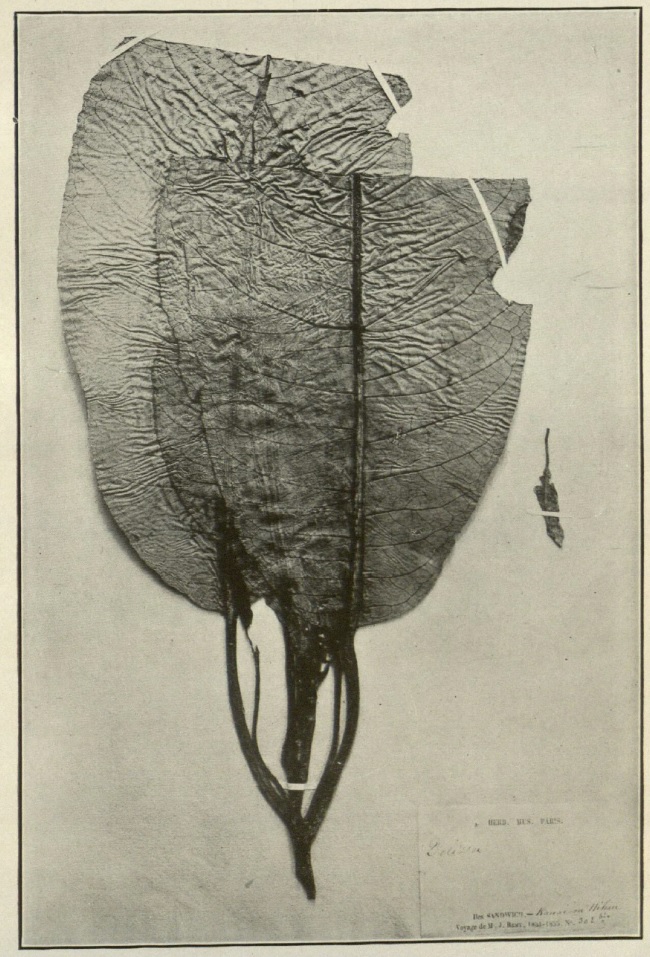
CYANEA REMYI Rock
BULL. TORREY CLUB VOLUME 44, PLATE 13
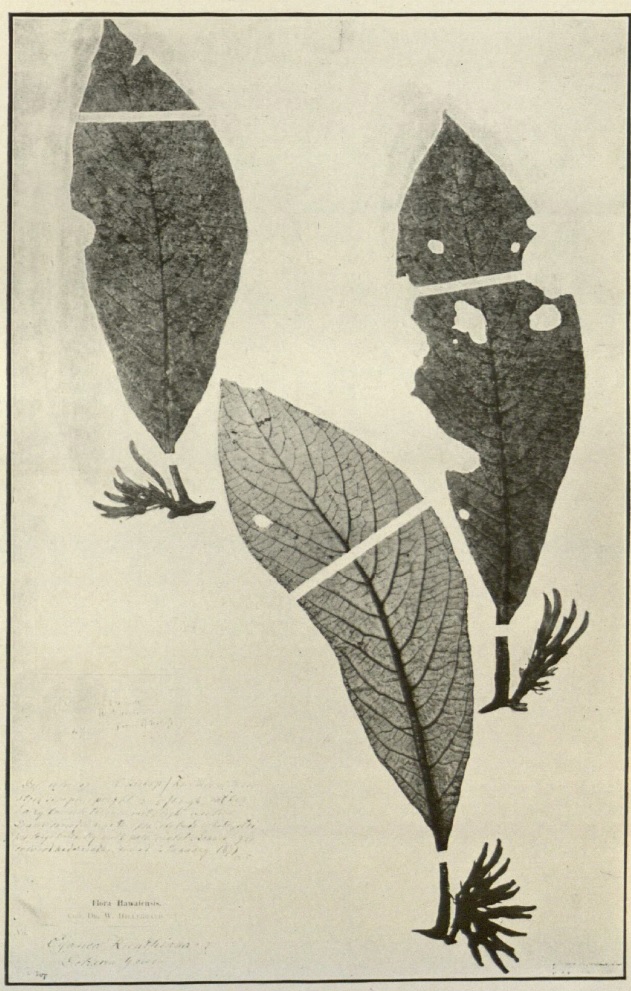
CYANEA BISHOPII Rock
BULL. TORREY CLUB VOLUME 44, PLATE 14
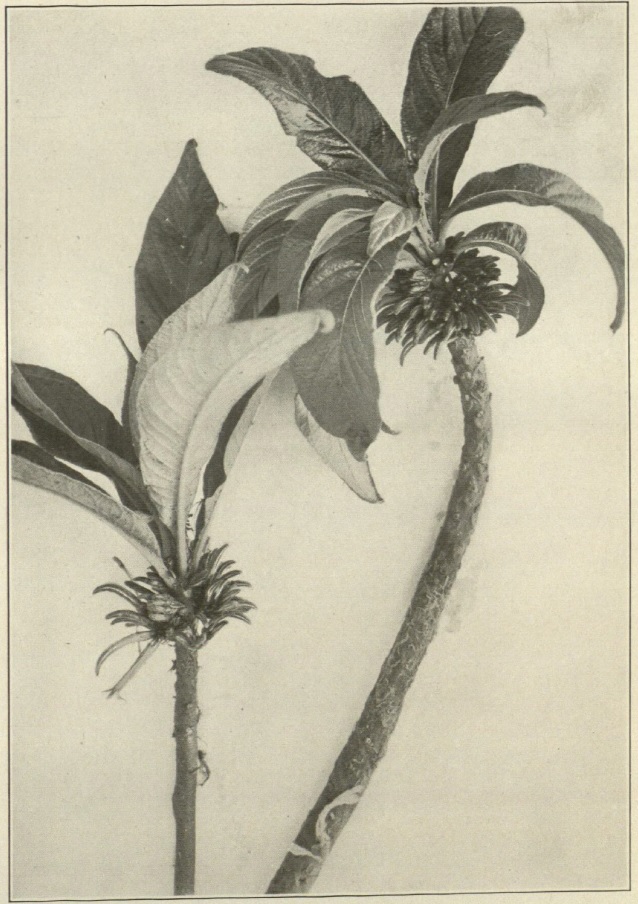
CYANEA BISHOPII Rock
BULL. TORREY CLUB VOLUME 44, PLATE 15
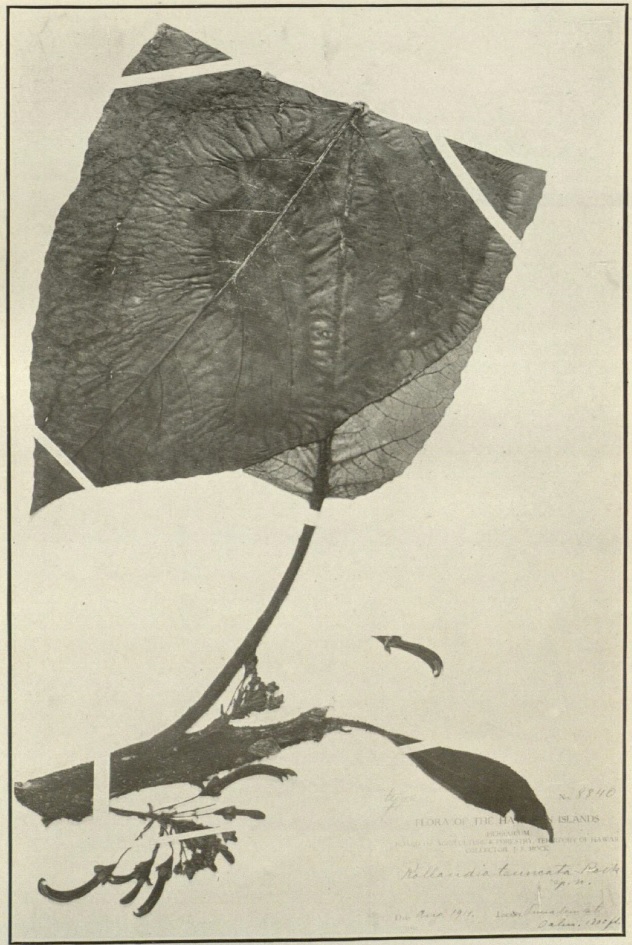
CYANEA TRUNCATA Rock
BULL. TORREY CLUB VOLUME 44, PLATE 16