
Cyanea obtusa
Genus: Cyanea section Delisseoideae.
Conservation status: Extinct; last collected in 1919.
Range: Maui, wet forests.
Growth form: Shrub, 2-5 m tall.
Etymology: Obtuse leaf tips are not uncommon in the Hawaiian lobeliads, nor even in Cyanea, but this early described species (Gray, 1861) was the first non-Clermontia described with an obtuse leaf tip.
This species first described by Gray from a specimen collected by the U.S. Exploring Expedition was collected a few more times from 1870 to 1919, but never again after Forbes' collection in 1919. The variety mollis from Hawai'i, described by Gray and continued as such by Hillebrand, Rock and Wimmer, was reclassified by Lammers to Clermontia pyrularia. The possibility that Cl. pyrularia is an inter-generic hybrid goes some way to explain how an individual could be misclassified. Rock, in two publications, Bull. Torrey Bot. Club, 1917, p. 237 and Haw. Lob, 1919, p. 209, refers to a species Cyanea obtusifolia that is likely Cyanea obtusa. Note that these two errors are actually only one since the sentences in the two publications are nearly identical.
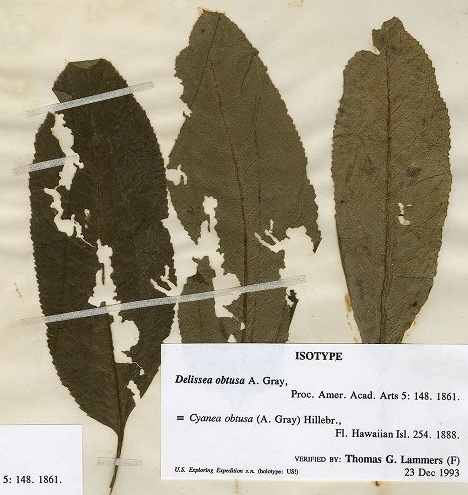
Description: In habit, it was best described by Hillebrand who actually collected the plant, as a woody shrub from 2 to 5 m tall, with many spreading branches; the juvenile branches are pubescent. Other Cyanea in the Delisseoideae section are also shrubby. The wood is described as compact with a narrow cavity (Rock's specimen is likely not Cy. obtusa so his comment about chartaceous diaphragms can be ignored). Leaves are of an average size, ranging from 15-30 cm long by 4-9 cm wide, membranous, serrulate with an obtuse (or shortly acuminate) apex. Ribs and veins are puberulous on both surfaces. They sit on a petiole of 3.5-10 cm long. Obtuse apices are not uncommon in Cyanea; see note above concerning the specific epithet.
Sources:
- Gray, 1861 (as Delissea obtusa);
- Gray's (1861) Delissea obtusa var. mollis is Clermontia pyrularia;
- Mann, 1868 (as Delissea obtusa);
- Hillebrand, 1888 (pro parte, the Hawaiian specimen is Clermontia pyrularia);
- Rock, 1917 and Rock, 1919 both reference Cyanea obtusifolia, this is likely meant to be Cyanea obtusa.;
- Rock, 1919 (pro parte, the Hawaiian specimen is Clermontia pyrularia);
- Wimmer, 1943 (pro parte, the Hawaiian specimen is Clermontia pyrularia);
- Wagner et al., 1990.