
Cyanea pohaku
Genus: Cyanea section Delisseoideae
Status: Extinct.
Etymology: This species was first collected and described by J. F. Rock who placed it in Clermontia based on its cymose inflorescence. He gave it the epithet haleakalensis from the location of its discovery. Lammers transferred the species to Cyanea but due to the prior use of the name Cyanea haleakalensis by St. John (see Cyanea copelandii) Lammers needed a new name. He used pohaku which means rock in the Hawaiian language in honor of J. F. Rock, the plant's discoverer.
Range: Maui, on the cinder cone Pu'unianiau on the northwestern face of Haleakalā, subalpine shrubland; 2,130m.
Growth form: Tree, 3-6 m tall.
Status: This species is known only from the type species collected in 1910.
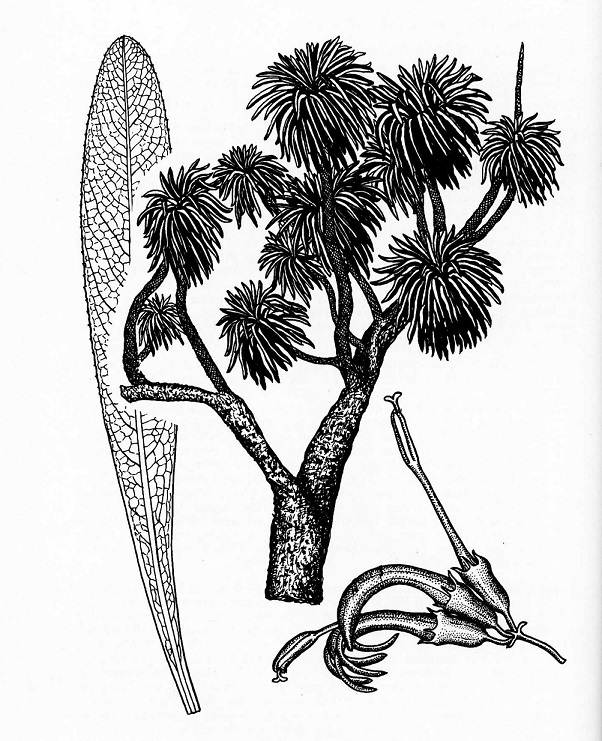
Illustration from Degener, 1966
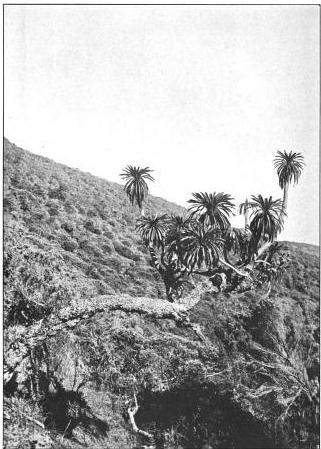 Photo from Rock, 1913
Description: Now extinct and known only from three specimens collected in 1910. Habit: amongst the tallest of all the Hawaiian lobeliads, they are 10 to 20 feet (3 to 6 m) tall with robust trunks. Branching, as with others in the section Delisseoideae. One of the photographed specimens branched about 1 meter from base and the other maybe three meters from the base. In both cases, the plants were leaning with ascendant branches. The narrow leaves are clustered at the ends of branches, pom-pom like, giving the appearance of a Dracaena. Leaves: oblanceolate of average length for the Hawaiian lobeliads, but quite narrow even for the Delisseoideae section, 16 - 30 cm long by 1.5 - 4 cm wide, subsessile, dark green above, pale underneath, both sides glabrous, crenate for the upper half, entire below.
Sources:
- Rock, 1913 (as Clermontia haleakalensis);
- Rock, 1919 (as Clermontia haleakalensis);
- Wimmer, 1943 (as Clermontia haleakalensis);
- Degener, 1966 (as Clermontia haleakalensis);
- Wagner et al., 1999.