|
DAS PFLANZENREICH Regni vegetabilis conspectus ____________ Im Auftrage der Deutschen Akademie der Wissenschaften zu Berlin herausgegeben von A. Engler (†) · L. Diels (†) fortgesetzt von H. Stubbe und K. Noack Redakteur R. Mansfeld IV. 276b (106. Heft): ____________ Campanulaceae — Lobelioideae ____________ von F. E. Wimmer I. Teil Mit 51 Figuren, 4 Verbreitungskarten und 4 Autotypietafeln im Text Erschienen am 25. Mai 1943 im Verlag Wilhelm Engelmann, Leipzig Nachdruck Ausgegeben (Bogen 1 — 17) am 15.1.1956 1956 ____________ AKADEMIE - VERLAG · BERLIN |
THE PLANT KINGDOM
____________ Published by A. Engler (†) · L. Diels (†) For the German Academy of Sciences, Berlin Continued by H. Stubbe und K. Noack Editor R. Mansfeld IV. 276b (Book 106): ____________ Campanulaceae — Lobelioideae ____________ by F. E. Wimmer Part I. With 51 Figures, 4 Maps, and 4 Plates Published May 25, 1943 by Wilhelm Engelmann, Publisher, Leipzig Reprint Issued (Signatures 1 — 17) on January 15, 1956 1956 ____________ AKADEMIE - VERLAG · BERLIN |
:::
Page 1
|
CAMPANULACEAE —LOBELIOIDEAE. VonFranz Elfried Wimmer. |
CAMPANULACEAE —LOBELIOIDEAE. ByFranz Elfried Wimmer. |
|
Subfam. Lobelioideae Schönland in Engler & Prantl, Natürl. Pflanzenfam. IV, 5 (1894) 63. — Fam. Lobeliaceae A. L. de Jussieu in Annal. Mus. Paris XVIII (1811) 1 (excl. Stylidieaeis et Goodenovieaeis). — Fam. Lobelieae Kurt Sprengel, Anleitung zur Kenntnis d. Gewächse II (1818) 525 (excl. generibus praeter Lobeliam). — Campanulaceae A. L. de Jussieu, Gen. Pl. (1789) 165. — Campanulaceae Trib. Lobelieae Alph. de Candolle, Monogr. Campanulac. (1830) 36. — Campanulaceae Subdiv. Lobeliariae H.G.L.Reichenbach, Handb. d. natürl. Pflanzensyst. (1837) 186. — Campanulaceae Subfam. Rapuntiatae Post et Kuntze, Lex. Gen. Phanerog. (1904) 702. — Dortmanniaceae Ruprecht, Fl. Ingrica (1860) 649. |
Subfam. Lobelioideae Schönland in Engler & Prantl, Die Natürlichen Pflanzenfamilien IV, 5 (1894) 63. — Fam. Lobeliaceae A. L. de Jussieu in Annal. Mus. Paris XVIII (1811) 1 (excl. Stylidieaeis et Goodenovieaeis). — Fam. Lobelieae Kurt Sprengel, Anleitung zur Kenntnis der Gewächse II (1818) 525 (excl. genera not Lobeliam). — Campanulaceae A. L. de Jussieu, Genera Plantarum (1789) 165. — Campanulaceae Trib. Lobelieae Alphonse de Candolle, Monographie des Campanulées (1830) 36. — Campanulaceae Subdiv. Lobeliariae H.G.L. Reichenbach, Handbuch des natürlichen Pflanzensystems (1837) 186. — Campanulaceae Subfam. Rapuntiatae Post & Kuntze, Lexicon Generum Phanerogamarum (1904) 702. — Dortmanniaceae Ruprecht, Flora Ingrica (1860) 649. | |
Wichtigste Literature. Systematik. Sub Lobelioideae Schönl. l. c.: Reiche, Fl. Chile V (1910). — A. Zahlbruckner, Neue Arten und Formen d. Lobelioid. in Fedde, Repert. Spec. Nov. XIII (1915) 528, XIV (1915) 133, 180. — Rock, The Indig. Trees Hawaiian Isl. (1913) 469; A Monogr. Study Hawaiian Lobelioideae (1919). — F. E. Wimmer, Lobelioideae, in Fedde, Repert. Spec. Nov. XIX (1924) 241, 385, XXII (1926) 193, XVI (1929) 1, XXIX (1931) 49, XXXVIII (1933) 1; in Notizbl. Bot. Gart. Berlin X (1929) 730, XII (1934) 103; in Annal. Naturhistor. Mus. Wien XLVI (1933) 239; Consp. Lobel., in Revista Südamericana Bot. II (1935) 89; Burmeistera, in Fedde Repert. Spec. Nov. XXX (1932) 1-52 c. tab. — Jahandiez & Maire, Cat. Pl. Maroc. III (1934) 738. — Sub Lobeliaceae: A.L. Jusieu, l.c.; Dict. V (1823) 97 (excl. ut supra). — A. De Candolle, Théorie Elément. (1819) 246. — Bartling, Ordines natural. Pl. (1830) 150. — G. Don, General System Gard. and Bot. III (1834) 697 (excl. Cyphia). — Presl, Prodr. Monogr. Lobeliac. (1836). — Endlicher, Genera Pl. (1838) 509. — A. De Candolle, Prodr. VII (1839) 339. — Meisner, Pl. Vasc. Genera (1836-43) 240. — Spach, Vég. Phan. IX (1840) 240. — Gay, Hist. Chile Bot. IV (1849) 319. — Miquel, Fl. Indiae Batav. II (1856) 571. — Grisebach, Fl. Brit. West Ind. Isl. (1864) 385. — Le Maoutet Decaisne, Traité Génér. de. Bot. (1868) 149. — Kanitz in Martius, Fl. Brasil VI. 4 (1878) 130. — A. Gray, Synopt. Fl. N. Am. II/1 (1886) 1 (excl. Trib. Cyphiear.). — Hillebrand, Fl. Haw. Isl. (1888) 234. — Koch, Synopsis d. Deutsch. und Schweizer Fl. ed. 3 (1902) 1243. — Hegi, Fl. Mitteleuropa VI/1 (1915) 391. — Ridley, Fl. Malay Peninsula II (1923) 199. — Rendle, Classif. Flow Pl. II (1924) 582. — Wettstein, Handb. (1924) 837. — Lecomte & Gagnepain, Fl. Générale Indo-Chine III (1930) 671. — Hutchinson & Dalziel, Fl. West Trop. Africa II/1 (1931) 191. — Standley, Fl. Costa Rica IV (1938) 1405. — Sub Campanulaceae: A.L. Jussieu, Gen. Pl. (1789) 165. — R. Brown, Prodr. Fl. Novae Holland. (1810) 562. — Hooker fil., Handb. New Zealand Fl. (1867) 169. — Hemsley, in Voyage Challenger Exped. III (1884) 45. — Drake del Castilloo, Fl. Polynés. Franç. (1893) 113. — Britton & Brown, Illustr. Fl. N. Am. States and Canada III (1898) 252. — Fawcett & Rendle, Fl. Jamaica VII (1936) 136. — Sub Campanulac. Trib. Lobelieae A. De Candolle, l.c. Sonder in Harvey & Sonder, Fl. Cap. III (1865) 531. — Bentham, Fl. Austral. IV (1869) 122. — Bentham & Hooker fil., Gen. Pl. II (1876) 542. — Hemsley, in Oliver, Fl. Trop. Africa III (1877) 463. — Hooker fil. & Thomson, Fl. Brit. India III (1881) 422. — Baillon, Histoire Pl. VIII (1886) 362. — F. M. Bailey, Synopsis of the Queensland Fl. III (1900) 915. — Cheeseman, Manual of the New Zealand Fl. (1906) 396. — |
Principal Literature Systematics. Sub Lobelioideae Schönland l.c. — Reiche, Flora de Chile V (1910) — A. Zahlbruckner, Neue Arten und Formen d. Lobelioid. in Fedde, Repert. Spec. Nov. XIII (1915) 528, XIV (1915) 133, 180. — Rock, The Indig. Trees Hawaiian Isl. (1913) 469; A Monogr. Study Hawaiian Lobelioideae (1919). — F. E. Wimmer, Lobelioideae, in Fedde, Repert. Spec. Nov. XIX (1924) 241, 385, XXII (1926) 193, XVI (1929) 1, XXIX (1931) 49, XXXVIII (1933) 1; in Notizbl. Bot. Gart. Berlin X (1929) 730, XII (1934) 103; in Annal. Naturhistor. Mus. Wien XLVI (1933) 239; Consp. Lobel., in Revista Südamericana Bot. II (1935) 89; Burmeistera, in Fedde Repert. Spec. Nov. XXX (1932) 1-52 c. tab. — Jahandiez & Maire, Cat. Pl. Maroc. III (1934) 738. — Sub Lobeliaceae: A.L. Jusieu, l.c.; Dict. V (1823) 97 (excl. ut supra). — A. De Candolle, Théorie Elément. (1819) 246. — Bartling, Ordines natural. Pl. (1830) 150. — G. Don, General System Gard. and Bot. III (1834) 697 (excl. Cyphia). — Presl, Prodr. Monogr. Lobeliac. (1836). — Endlicher, Genera Pl. (1838) 509. — A. De Candolle, Prodr. VII (1839) 339. — Meisner, Pl. Vasc. Genera (1836-43) 240. — Spach, Vég. Phan. IX (1840) 240. — Gay, Hist. Chile Bot. IV (1849) 319. — Miquel, Fl. Indiae Batav. II (1856) 571. — Grisebach, Fl. Brit. West Ind. Isl. (1864) 385. — Le Maoutet Decaisne, Traité Génér. de. Bot. (1868) 149. — Kanitz in Martius, Fl. Brasil VI. 4 (1878) 130. — A. Gray, Synopt. Fl. N. Am. II/1 (1886) 1 (excl. Trib. Cyphiear.). — Hillebrand, Fl. Haw. Isl. (1888) 234. — Koch, Synopsis d. Deutsch. und Schweizer Fl. ed. 3 (1902) 1243. — Hegi, Fl. Mitteleuropa VI/1 (1915) 391. — Ridley, Fl. Malay Peninsula II (1923) 199. — Rendle, Classif. Flow Pl. II (1924) 582. — Wettstein, Handb. (1924) 837. — Lecomte & Gagnepain, Fl. Générale Indo-Chine III (1930) 671. — Hutchinson & Dalziel, Fl. West Trop. Africa II/1 (1931) 191. — Standley, Fl. Costa Rica IV (1938) 1405. — Sub Campanulaceae: A.L. Jussieu, Gen. Pl. (1789) 165. — R. Brown, Prodr. Fl. Novae Holland. (1810) 562. — Hooker fil., Handb. New Zealand Fl. (1867) 169. — Hemsley, in Voyage Challenger Exped. III (1884) 45. — Drake del Castilloo, Fl. Polynés. Franç. (1893) 113. — Britton & Brown, Illustr. Fl. N. Am. States and Canada III (1898) 252. — Fawcett & Rendle, Fl. Jamaica VII (1936) 136. — Sub Campanulac. Trib. Lobelieae A. De Candolle, l.c. Sonder in Harvey & Sonder, Fl. Cap. III (1865) 531. — Bentham, Fl. Austral. IV (1869) 122. — Bentham & Hooker fil., Gen. Pl. II (1876) 542. — Hemsley, in Oliver, Fl. Trop. Africa III (1877) 463. — Hooker fil. & Thomson, Fl. Brit. India III (1881) 422. — Baillon, Histoire Pl. VIII (1886) 362. — F. M. Bailey, Synopsis of the Queensland Fl. III (1900) 915. — Cheeseman, Manual of the New Zealand Fl. (1906) 396. — |
Page 2
|
Morphologie und Entwicklungsgeschichte. Payer, Traité sur l'Organogénie (1857). 744. — Eichler, Blüthendiagramme I (1875) 28, 297. — Schumann, Neue Untersuch. über Blütenanschluß (1890) 357. — Armand, Fécondation et Développement de l'Embryo chez les Lobélacées, in compt. Rend. Acad. Sci. Paris CLV (1912) 1534; Les Phénomènes cinétiques de la Prophase hétérotyp. chez le Lobelia Erinus, l. c. CLVI (1913 1089; Les Phénomènes nucléaires de la Cinèse hétérotyp. chez le Lobelia urens, l. c. CLXXII (1921) 762. — Schnarf, Vergleich. Embryologie der Angiospermen (1931) 214. — Rosen, W., Zur Embryologie der Camp. und Lobel., in Medd. Göteborgs Bot. Trädgard VII (1932) 31. — Kausik, S. B., The Life-History of Lobelia trigona Roxb. with special Reference to the Nutrition of the Embryo-Sac, in Proc. Indian Acad. Sci. Bangalore II (1935) 410; Gametogenesis and Embryogeny in Lobelia nicotianaefolia Heyne, in Journ. Indian Bot. Soc. XVII (1938) 161 c. t. 4, 5, 7. — Crété, P., Embryogénie des Lobéliacées. Développem. de l'embryon chez la Lobelia syphilitica, in Compt. Rend. Paris CCVII (1938) 1777; La Polyembryonie chez la Lobelia syphilitica, in Bull. Soc. Bot. Françe LXXXV (1938) 580. |
Morphology und Development. Payer, Traité sur l'Organogénie (1857). 744. — Eichler, Blüthendiagramme I (1875) 28, 297. — Schumann, Neue Untersuch. über Blütenanschluß (1890) 357. — Armand, Fécondation et Développement de l'Embryo chez les Lobélacées, in compt. Rend. Acad. Sci. Paris CLV (1912) 1534; Les Phénomènes cinétiques de la Prophase hétérotyp. chez le Lobelia Erinus, l. c. CLVI (1913 1089; Les Phénomènes nucléaires de la Cinèse hétérotyp. chez le Lobelia urens, l. c. CLXXII (1921) 762. — Schnarf, Vergleich. Embryologie der Angiospermen (1931) 214. — Rosen, W., Zur Embryologie der Camp. und Lobel., in Medd. Göteborgs Bot. Trädgard VII (1932) 31. — Kausik, S. B., The Life-History of Lobelia trigona Roxb. with special Reference to the Nutrition of the Embryo-Sac, in Proc. Indian Acad. Sci. Bangalore II (1935) 410; Gametogenesis and Embryogeny in Lobelia nicotianaefolia Heyne, in Journ. Indian Bot. Soc. XVII (1938) 161 c. t. 4, 5, 7. — Crété, P., Embryogénie des Lobéliacées. Développem. de l'embryon chez la Lobelia syphilitica, in Compt. Rend. Paris CCVII (1938) 1777; La Polyembryonie chez la Lobelia syphilitica, in Bull. Soc. Bot. Françe LXXXV (1938) 580. |
|
Anatomie. Hofmeister, Lehre von der Pflanzenzelle (1867) 617. — De Bary, Vergleichende Anatomie (1877) 193. — Bower, Struct. Stem of Rhynchopetalum, in Journ. Linn. Soc. XX (1883) 440. — Selligmann, Über anatom. Beziehungen der Campanulaceen and Lobeliaceen zu den Compositen, in Bot. Centralbl. XLIII (1890) 1-5. — Solereder, Syst. Anat. (1899) 534, Ergänzbd. (1908) 192. — Ydrac, Sur l'appareil laticifère del Lobél., in Journ. Bot. XIX (1905) 12; Recherches anat. sur les Lobéliacées (1905). — Tswett, Recherches anat. sur les Hydatodes, in Revue Gen. Bot. XIX (1907) 305. — Armand, Recherches morphol. sur le L. Dortmanna, in Revue Gen. Bot. XXI (1912) 465. — Hallquist,, Ein Beitrag zur Kenntnis der Pneumatophoren, in Svensk ot. Tidskr. (1914) 300. — Holroyd, Medullary Bundles in Lobelia puberula, in Am. Journ. of Bot. XV (1928) 442. — Pankova, Etude anatomo-microchim. comparée de Lobelia inflata L., L. sessilifolia Lamb. et L. Dortmanna L. in Sovietskaia Botanika (1938) N. 3, p. 66-80 cum 24 fig. (russisch). |
Anatomy. Hofmeister, Lehre von der Pflanzenzelle (1867) 617. — De Bary, Vergleichende Anatomie (1877) 193. — Bower, Struct. Stem of Rhynchopetalum, in Journ. Linn. Soc. XX (1883) 440. — Selligmann, Über anatom. Beziehungen der Campanulaceen and Lobeliaceen zu den Compositen, in Bot. Centralbl. XLIII (1890) 1-5. — Solereder, Syst. Anat. (1899) 534, Ergänzbd. (1908) 192. — Ydrac, Sur l'appareil laticifère del Lobél., in Journ. Bot. XIX (1905) 12; Recherches anat. sur les Lobéliacées (1905). — Tswett, Recherches anat. sur les Hydatodes, in Revue Gen. Bot. XIX (1907) 305. — Armand, Recherches morphol. sur le L. Dortmanna, in Revue Gen. Bot. XXI (1912) 465. — Hallquist,, Ein Beitrag zur Kenntnis der Pneumatophoren, in Svensk ot. Tidskr. (1914) 300. — Holroyd, Medullary Bundles in Lobelia puberula, in Am. Journ. of Bot. XV (1928) 442. — Pankova, Etude anatomo-microchim. comparée de Lobelia inflata L., L. sessilifolia Lamb. et L. Dortmanna L. in Sovietskaia Botanika (1938) N. 3, p. 66-80 cum 24 fig. (russian). |
|
Biologie. Hildebrand, Die Geschlechter-Verteilung (1867) 30, 64 — Urban, Die Bestäubungseinrichtungen vei den Lobeliaceen, in Jahrbuch Bot. Gart. Berline I (1881) 260. — Knuth, Blütenbiologie II/2 (1899) 1. — Reiche & Johow, Zur Kenntnis der Bestäubung chil. Campanulaceen, in Verhandl. deutsch. wiss. Verein. Santiago de Chile IV (1901) 1, 345, 425. — Werth, in Bot. Jahrb. 53 (1915) Beibl. Nr. 116, p. 331, 335, 350, 356, 363, 368, 373. — Porsch, Vogelblumenstudien I (1924) 603, 629, II (1929) 237. — Graenicher, On humming-bird flowers, in Bull. Wisconsin Nat Hist. Soc. VIII (1910) 183 [Ref. darüber im Bot. Centralblatt CXX (1912) 35]. — Wagner, A., Über eine unzweckmäßige Einrichtung in Blütenbau von Lobelia laxiflora, in Vericht. Deutsch. Bot. Ges. XXXV (1917) 360. |
Biology. Hildebrand, Die Geschlechter-Verteilung (1867) 30, 64 — Urban, Die Bestäubungseinrichtungen vei den Lobeliaceen, in Jahrbuch Bot. Gart. Berline I (1881) 260. — Knuth, Blütenbiologie II/2 (1899) 1. — Reiche & Johow, Zur Kenntnis der Bestäubung chil. Campanulaceen, in Verhandl. deutsch. wiss. Verein. Santiago de Chile IV (1901) 1, 345, 425. — Werth, in Bot. Jahrb. 53 (1915) Beibl. Nr. 116, p. 331, 335, 350, 356, 363, 368, 373. — Porsch, Vogelblumenstudien I (1924) 603, 629, II (1929) 237. — Graenicher, On humming-bird flowers, in Bull. Wisconsin Nat Hist. Soc. VIII (1910) 183 [Ref. darüber im Bot. Centralblatt CXX (1912) 35]. — Wagner, A., Über eine unzweckmäßige Einrichtung in Blütenbau von Lobelia laxiflora, in Vericht. Deutsch. Bot. Ges. XXXV (1917) 360. |
|
Teratologie und Pathologie. Spegazini, Fungi Chil. (1910) 188. — Penzig, Pflanzenterat. ed. 2. II (1921) 529. — Saunders, Double flowers, in Journ. Roy. Hort. Soc. XXXVIII (1913) 469. |
Teratology and Pathology. Spegazini, Fungi Chil. (1910) 188. — Penzig, Pflanzenterat. ed. 2. II (1921) 529. — Saunders, Double flowers, in Journ. Roy. Hort. Soc. XXXVIII (1913) 469. |
Page 3
|
Geogr. Verbreitung. Guppy, Observ. of a Naturalist II (1906) 250. — Ehrhardt, Die geogr. Verbr. der Kautschuk- und Guttaperchapfl., in Angewandte Geogr. I (1903) Heft 9. — Floristik siehe unter Systematik. |
Geographic Distribution. Guppy, Observ. of a Naturalist II (1906) 250. — Ehrhardt, Die geogr. Verbr. der Kautschuk- und Guttaperchapfl., in Angewandte Geogr. I (1903) Heft 9. — Floristik siehe unter Systematik. |
Character. Flores hermaphroditi, rarissime dioeci, zygomorphi (corolla Dialypetali excepta), pentameri. Calycs tubus (hypanthium, receptaculum calycis) ovario adnatus, raro superne plus minusve liber; lobi calycis 5, aequales vel inaequales, dentiformes vel elongati, liberi, rarissime partim connati, persistentes in fructu, rarissime decidui, aestvatio valvaris. Corolla irregularis, sympetala, 5-mera, eius tubus integer vel in dorso longitudinaliter fissus, raro in basi fenestratus, rarissime in 5 petala se dissolvens vel tubo inconspicuo; limbus corollae 5-partitus, plerumque bilabiatus: lobi inaequales vel subaequales, lobi 2 superiores (postici) interdum usque ad basim soluti; lobus imus raro profundius, rarissime usque ad basim fere disjunctus; labium inferius secus trifidum usque tripartitum, rarius omnes lobi patenti-deflexi quasi unilabiata. Corolla epigyna, rarissime hypogyna. Stamina 5 cum lobis corollae alternantia, in tubum angustum cylindricum connata: Filamenta aequaliter anguste linearia, versus basim plerumque soluta, a corolla libera vel corollae inserta; antherae in tubum connatae 1), biloculares, introrsum longitudinaliter dehiscentes, longitudine inaequales, 3 superiores gradatim sublongiores quam 2 inferiores, in apice omnes vel 2 inferiores antherae tantum pilis liberis barbatae, raro nudae, aut 2 inferiores appendice cartilaginea triangulari terminatae vele 2-4-aristate. Pollen oblongo-ovoideum, medio sucatum, 18-20 μ in diam. (cf. supplement) Ovarium inferum, raro semi- vel totaliter superum, 2-loculare, rarissime 1-loculare. Carpella 2. Placentae dissepimento centrali utrinque affixae, rarissime parietales; ovula anatropa, numerosa, rarissime pauca. Stylus 1, simplex, filiformis. Stigma bilobum, rarissime integrum, infra lobos annulo pilorum collectorum instructum. Fructus bilocularis, raro unilocularis, indehiscens, baccatus vel capsula diverso modo dehiscens. Semina minima, laevia vel foveolata vel rugosa, plerumque ellipsoidea, oblonga vel trigona, rarius compressa vel alata. Embryo rectus, albumine carnoso cinctus, cotyledonibus obtusis.
Herbae annuae vel perennes, suffrutices vel frutices, rarius arborescentes aut palmaeformes, lactescentes, plerumque venenosae. Folia alterna, rarissime opposita vel verticillata, indivisa, raro profunde incisa vel pinnati-partita aut palmati-partita. Stipulae nullae. Flores solitarii, axillares vel in racemis terminalibus aut lateralibus dispositi, in genere Phyllochari autem epiphylli. Corolla caerulea, rubra vel violacea, rarius viridula, lutea, alba vel picta. Stomata hydathodum biseptata, proprietas Lobelioidearum sola.
Genus typicum: Lobelia L.
Genera 25 cum circ. 1100 speciebus, incolae imprimis zonae tropicae et subtropicae omnium terrarum, rarius in regione temperata.
__________________
1) Solum in genere Cyrtandroidea inveniuntur antherae ("in exsiccatis speciminibus saltem", fide F. Brown) demum segregatae et in Syphocampylo schizandro E. Wimm. antherae valde pilosae jam in alabastro ab invicem sunt solutae, filamenta autem ut in reliquis Lobelioideis tubulosa. — Hoc factum demonstrat manifeste arctam affinitatem huius subfamilae cum ceteris Campanulaceis, qua causa eam a familia Campanulacearum non ut familiam propriam separavi, sicut usque hodie plures botanici faciunt, sed ut subfamiliam bonam Campanulacearum approbo.
Page 4
|
Vegetationsorgane. Bei den Lobelioideen finden wir alle Wuchsformen vertreten, von einjährigen zarten Kräutern bis zum Strauch und kleinen Baum. Annuelle-Arten begegnen uns besonders bei den Gattungen Downingia, Heterotoma, Diastatea, Laurentia, Lobelia, Phyllocharis und Pratia, während in den anderen Genera solche Formen selten sind. Die Perenne bilden meist einachsige Stauden, die alljährlich beblätterte und blütentragende Stengel hervorbringen. Pflanzen mit verkürztem Stengel und grundständiger Blattrosette finden sich nur selten, so bei Lysipomia, Laurentia minuta, L. scapigera und einigen Lobelia-Arten. Eine Blattrosette aus doppelröhrigen Blättern mit fast nacktem Stengel besitzt die im Wasser wachsende Lobelia Dortmanna, deren relative Muttersprosse alljährlich absterben, während die Erneuerungssprosse erhalten bleiben, die auf diese Weise scheinbar unabhängige Individuen bilden (Schönland). Nicht selten sind besonders bei Lobelia subgen. Tupa mehrjährige, monokarpische Gewächse mit oft hohem unverzweigtem Stamme und langen Blütentrauben, wie die "Riesenlobelien Afrikas" und der Hawaiischen Inseln. Unter den zwergigen Kräutern entwickeln manche kriechede Ausläufer wie Lobelia nana, L. arfakensis, L. linnaeoides, Hypsela (Fig. 1) und mehrere Pratia-Arten. |
Vegetative organs. In the Lobelioids, we find all forms of growth represented, from annual tender herbs to shrubs to small trees. Annual species are found in the genera: Downingia, Heterotoma, Diastatea, Laurentia, Lobelia, Phyllocharis and Pratia, while in other genera such forms are rare. The perennials are typically uniaxial, annually producing leafy and flower bearing stems. Plants with short stems and ground-hugging rosettes are rare, found only in Lysipomia, Laurentia minuta, L. scapigera and some Lobelia spp. Lobelia dortmanna is a rosette plant with a bare stalk similar to the spring onion which grows in the water. Each year the mother stalks die while the offshoot stalks continue as seemingly unrelated individuals (Schönland). Not infrequent, particularly in Lobelia subgen. Tupa are perennial, monocarpic plants with tall, unbranched stems and long flower clusters, such as the "giant lobelias from Africa" and those found in Hawaii. Amongst the drawf herbs, there are some creepers such as Lobelia nana, L. arfakensis, L. linnaeoides, Hypsela (Fig. 1) and several Pratia spp. |
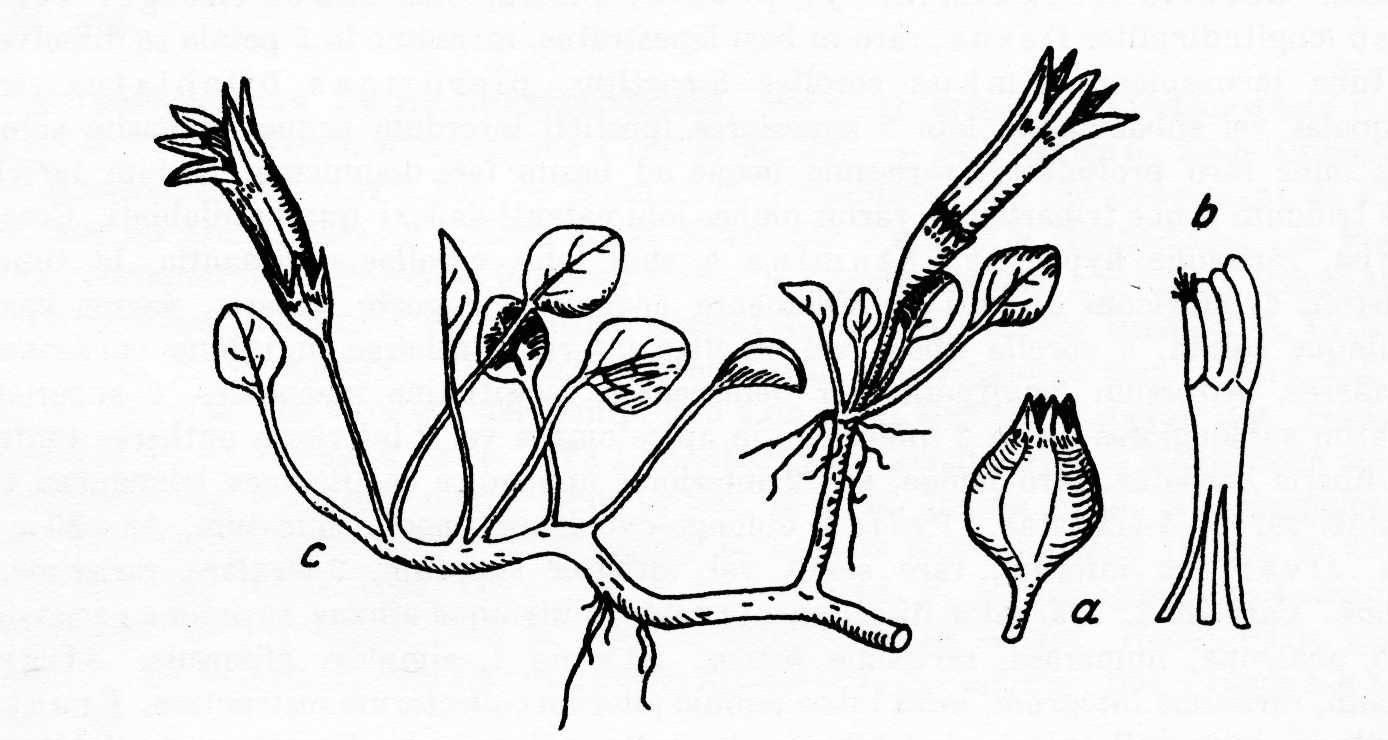
Fig 1. Hypsela reniformis (HBK.) Presl, c Habitus ca. 2/1, b Stamina 8/1, a bacca 3/1. — Orig.
|
Halbsträucher und Sträucher kommen vorwiegend vor bei Burmeistera, Centropogon, Siphocampylus, darunter oft Spreizklimmer, bei Apetahia und Dialypetalum, sehr selten bei Lobelia. Robuste Sträucher und baumartige Formen vom Habitus einer Palme, die bis 15 m hoch werden, treffen wir vorzüglich bei Clermontia, Cyanea (Fig. 2) und Delissea an. |
Subshrubs and shrubs are found mainly in Burmeistera, Centropogon, Siphocampylus, Apetahia, and Dialypetalum, these last two often including scramblers. Subshrubs and and shrubs are very rare in Lobelia. Robust shrubs and palm-like trees, which are up to 15m high, are found in Clermontia, Cyanea (Fig. 2), and Delissea. |
|
Die Blätter der Lobelioideen sind fast durchwegs spiralig angeordnet, häufig in 2/5-Stellung. Nur bei Sipocampylus sect. Verticillati und bei einigen Arten der Gattung Monopsis stehen die Blätter in zwei- bis mehrblättrigen Wirteln. Die Blätter des Stegels sind in der Regel gleichmäßig verteilt. Grundständige Blattrosetten sind, wie oben erwähnt, eine Seltenheit, ebenso verhältmäßig dichtstehende Blätter oder zusammengedrängte Blattkreise, die das Ende des Stammes oder der Zweige krönen. Nebenblätter fehlen stets. |
The leaves of the lobeliads are arranged almost entirely spirally, often with a winding angle of 2/5. Only in Siphocampylus sect. Verticillati and in some species of the genus Monopsis the leaves are in two or muulti-leaf whorls. As a rule, the leaves of the stems are uniformly distributed. Basal leaf rosettes are, as mentioned above, are a rarity, as are moderately dense packs or whorls of leaves that crown the end of the trunk or branches. Stipules always absent. |
|
Die Form der Laubblätter weist keine große Verschiedenheit auf. Sie sind fast stets ganz, a Rande gezähnt, gekerbt, selten gesägt oder mehr oder minder tief eingeschnitten oder gar fiederteilig bis gefiedert (Fig. 2); nur vei Lobelia dissecta und Siphocampylus mirabilis handförmig geteilt. Ein Petiolus ist meist ausgebildet, indes fehlen auch sitzende und halbstengelumfassende Blätter nicht, so bei mehreren Lobelia und Monopsis, selten in anderen Gattungen. Oft trifft es zu, daß der Petiolus nach oben allmä'hlich kürzer wird, so daß die obersten Blätter sitzen sind. |
The shapes of the leaves do not show great variance. The leaf margins are almost always dentate or crenate. Less common are serrate to more or less deeply divided or even pinnatipartite to pinnate (Fig. 2); palmately divided leaves are found only in Lobelia dissecta and Siphocampylus mirabilis. Petioles are usually present, however, there are sessile and semi-sessile leaves, mostly in Lobelia and Monopsis, rarely in other species. Often, it is found that the petiole gradually shortens upward, so that the uppermost leaves are sessile. |
|
Eine Reduktion der Blattfläche und oft auch der Zahl der Blätter findet sich bei den nicht gerade häufigen xerophilen Arten, bei denen fadenförmige oder nadelartige Blätter auftreten; hierher gehören die in steppen- oder wüstenartigen Gebieten lebenden Lobelien wie L. capillipes, capillifolia, decipiens, setacea, pinifolia, mehrere Monopsis-Arten in Südafrika sowie Lobelia rarifolia (parvifolia R.Br.) und L. gibbosa in Australien. Bei letzteren sind aber nicht nur die Blätter, sondern auch die Stengel sukkulent, so daß diese und verwande Arten imstande sind, Saftvorrat aufzuspeichern und so in die Trockenzeiten hinein weiterzublühen, ja selbst, wie Diels beobachtete hat, ohne Erde und Wasser sich längere Zeit frisch zu erhalten und die Blüten zu öffnen. Bei vielen krautigen Arten, die stark der Sonne ausgesetzt sind, sind die unteren geschützten Blätter oft bedeutend größer, wogegen die nach oben hin folgenden, weniger geschützten oder ungescützten Blätter an Größe rasch abnehmen und an Zahl geringer werden, um die verdunstende Blattfläche zu verringern, wie z. B. bei der häfig kultivierten Lobelia Erinus oder L. xalapensis. |
A reduction in leaf area and often the number of leaves can be found in the not very frequent xerophilous species where filamentary or needle-like leaves appear; these are found on steppes or desert areas and include L. capillipes, capillifolia, decipiens, setacea, pinifolia, several Monopsis species in South Africa, and Lobelia rarifolia (parvifolia R.Br.) and L. gibbosa in Australia. In the latter and related species, not only the leaves, but also the stems, remain succulent for a long time without soil and water and are capable of storing up sap and continue to flourish, fresh with open flowers even in the dry season as Diels observed. Many herbaceous species with strong sun exposure have their lower, protected leaves much larger, whereas the upper, less protected leaves rapidly decrease in size and number in order to reduce the evaporative leaf surface. This can be seen in the frequently cultured Lobelia erinus or L. xalapensis. |
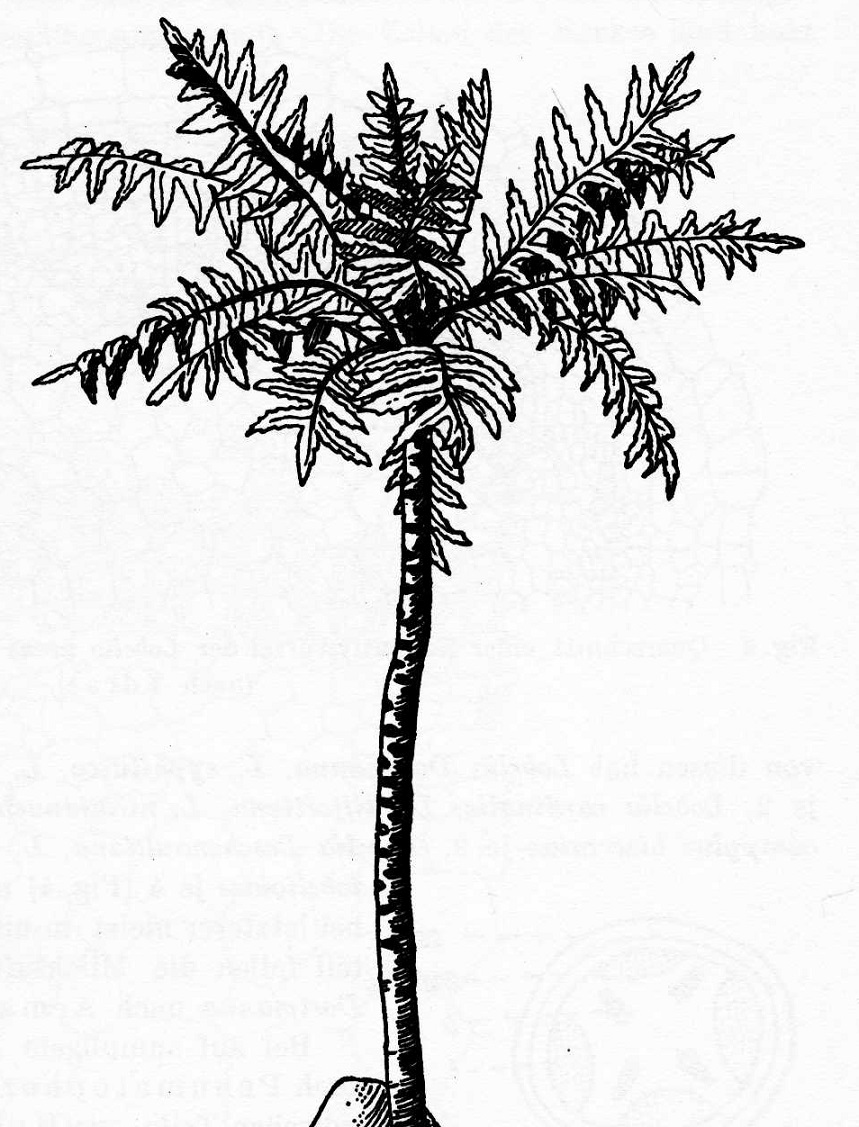
Fig 2. Cyanea asplenifolia (Mann) Hillebr. Habitus plantae palmaeforis, 1/20. — Orig.
Page 5
|
Die Konsistenz der Blätter ist häufig krautig, selten sukkulent oder fleischig, öfter lederartig. Eine Regel dieser Erscheinung ist kaum zu erkennen außer etwa der, daß an rauhen und windigen Orten die Blätter meist lederartige Beschaffenheit, also mehr Festigkeit annehmen, wie dies bei den auf den windgepeitschten Gebirgskämmen wachsenden Clermontia und Cyanea der Fall ist — soweit ich die Sache übersehen kann —, wogegen an tiefer gelegenen und also weniger windigen Orten oder im Waldesschutz weniger derbe Blätter zur Ausbildung kommen. |
The leaves are often herbaceous or leathery, rarely succulent or fleshy. Patterns in leaf texture are difficult to ascertain; as far as I have assessed the matter, leathery, and thus stronger, leaves are found on rough and windy places such as the Clermontia and Cyanea that are found on windswept ridges and less coarse leaves are found in less windy places such as forest interiors. |
|
In den Formen der Wurzel zeigen sich keine besonderen Verschiedenheiten. Sehr selten sind echte Faserwurzeln, wie Lobelia Dortmanna, eine ausgesprochene Wasserpflanze, sie hat. Außer der fadenförmigen Wurzel bei Annuellen finden wir häufig eine Pfahlwurzel mit mehr oder weniger kräftigen Verästelungen. Bei manchen Lobelia treffen wir zylindrisch verdickte Nebenwurzeln an, ähnlich denen unserer Campanula rapunculoides, so bei Lobelia Hartwegii und L. Warscewiczii. |
No significant differences show in the forms of the roots. Only very rarely are the roots truly fibrous as in the water plant, Lobelia dortmanna. Besides the filamentous roots of the annuals, we often find a taproot with more or less robust branches. In some Lobelia, we find thickened secondary roots, similar to those of Campanula rapunculoides, Lobelia hartwegii and L. Warscewiczii (should be L. irasuensis, cf. supplement). |
|
Anatomische Verhältnisse. Mit der Anatomie der Lobelioideen haben sich verschiedene Forscher beschäftigt so De Bary, Bower, M. L. Armand und besonders eingehend F. L. Ydrac [Recherches Anatomiques sur les Lobéliacées (1905)]. Diese zeigten, daß; die Lobelioideen im allgemeinen von dem normalen Bau der Dikotyledonen nicht wesentlich abweichen, aber doch einige charakteristische Kennzeichen aufweisen. Dahin gehört das Vorkommen von Milchsaftröhren, die meist reihenweise angeordneten Gefäße mit zahlreichen elliptischen Hoftüpfeln und seltenen Tracheidformen, das bisher nur bei den Lobelioideen beobachtete Auftreten von zweiteiligen Wasserspalten an den Hydathoden und das vollständige Fehlen von Kalkoxalat-Krystallen. |
Anatomy. Various researchers have worked on the anatomy of the Lobelioids, including De Bary, Bower, M. L. Armand and in particular F. L. Ydrac [Recherches Anatomiques sur les Lobéliacées (1905)]. These researches have shown that the construction of Lobeliads do not differ significantly from the typical construction of other dicotyledons, but they do have some characteristic features, such as the presence of latex tubes usually arranged in rows, vessels with numerous elliptic pits, rare tracheid-like cells observed previously only in Lobelioides, a two-part water column to the hydathodes, and the complete absence of calcic oxalate-crystals. |
Page 6
|
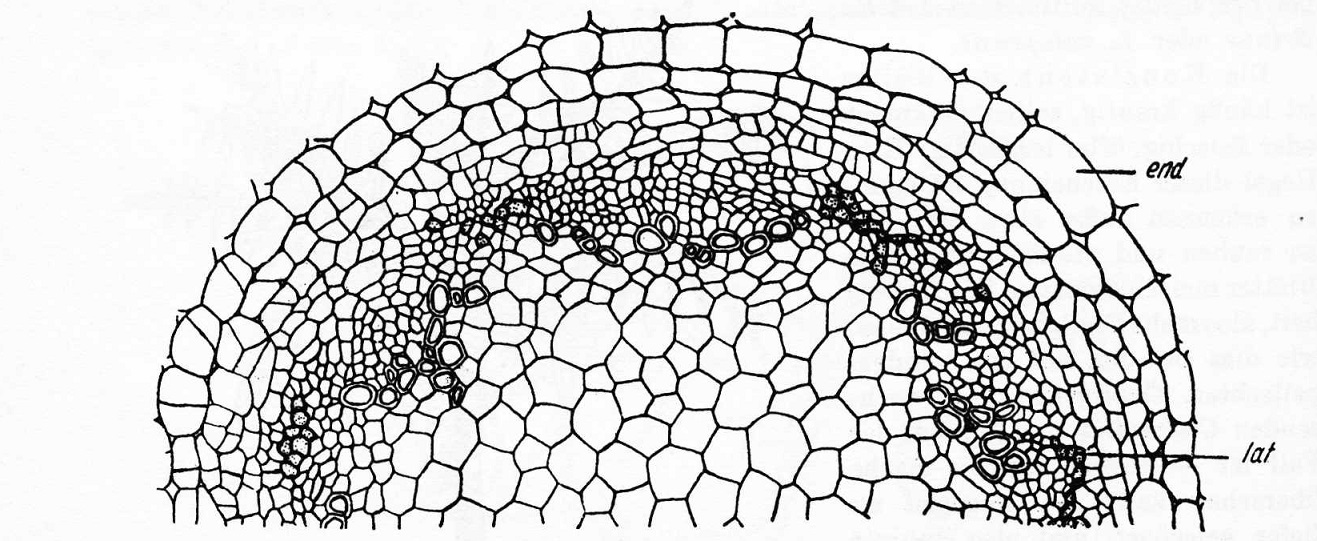
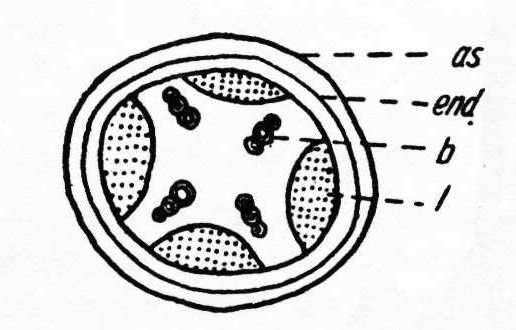
Wurzel. Das Rindenparenchym ist mehr oder weniger entwickelt und besonders bei an nassen Orten oder im Wasser gedeihenden Pflanzen mit großen Lücken ausgestattet wie bei Lobelia Dortmanna, wo außerdem auch reichgetüpfelte Zellen auftreten, die als Brücken swichen der inneren und äußeren rindenschicht dienen. Die Endodermis ist häufig verdickt und bildet um den Zentralzylinder eine Scheide. Das Perikambium besteht meist aus einer Reihe unverdickter Zellen. Der Zentralzylinder setzt sich zusamme aus einem sklerotisierten Mark mit mehr oder weniger zahlreichen primären Holzgefäßen in demselben oder es ist reduziert (Fig. 3). Die Leitstränge bestehen aus 2-8 Bündel; von diesen has Lobelia Dortmanna, L. syphilitica, L. urens, Laurentia (Isotoma) axillaris je 2, Lobelia cardinalis, L. cliffortiana, L. nicotianaefolia, Lysipomia pumila und Siphocampylus biserratus je 3, Lobelia Leschenaultiana, L. nana var. flagelliformis, Heterotoma lobelioides je 4 (Fig. 4) und Pratia montana 5 Gefäßbündel, bei letzterer meist in unregelmäßiger Anordunung. Im Bastteil fallen die Milchsaftröhren auf, die indes bei Lobelia Dortmanna nach Armand fehlen. |
Roots. The cortical parenchyma is more or less developed and especially so in wet locations or plants that grow in water in large gaps, like Lobelia dortmanna, where, moreover, pit-rich cells occur which serve as bridges between the inner and outer bark layers. The endoderm is often thickened and forms a sheath around the central cylinder. The pericambium usually consists of a series of compressed cells. The central cylinder is composed of a sclerotic pith with more or less woody vessels. (Fig. 3). The leading strands consist of 2-8 bundles; of these Lobelia dortmanna, L. syphilitica, L. urens, Laurentia (Isotoma) axillaris have 2, Lobelia cardinalis, L. cliffortiana, L. nicotianaefolia, Lysipomia pumila and Siphocampylus biserratus have 3, Lobelia leschenaultiana, L. nana var. flagelliformis, Heterotoma lobelioides have 4 each (Fig. 4) and Pratis montana has 5 vascular bundles, with the latter usually in an irregular arrangement. The latex tubes end in the phloem fibres, however, they are missing in Lobelia dortmanna according to Armand. |
|
Bei auf sumpfigem Boden wachsenden Pflanzen sorgen auch Pneumatophoren für die Luftzufuhr an die unterirdischen Teile, wie Hallquist an Lobelia exaltata (einem im Gewächshaus zu Stockholm gezogenen Exemplar) beobachtet hat. Sie ragen ½-1, selten bis 7 cm über die Erde hinaus, sind an der Spitze keulig verdickt und ringförmig angeschwollen und kreideweiß wegen des viel Luft führenden Gewebes und der hier sitzenden Pneumathoden. |
When growing on marshy ground, pneumatophores provide air ventilation to the underground parts as Hallquist observed in Lobelia exaltata (as seen in a specimen from the greenhouse in Stockholm.) They protrude ½-1, seldom to 7cm above the ground, are thickened, club-shaped, swollen ring-shaped at the top chalk-white due to the amount of air containing tissue and the pneumathodes |
|
Fig. 3. Querschnitt einer Adventivwurzel der Lobelia urens L. end. Endodermis; lat. Milchsaftgefäße (nach Ydrac). |
Fig. 3. Cross-section of an adventitious root of Lobelia urens L. end. endoderm; lat. latex vessel (from Ydrac). |
|
Fig. 4. Heterotoma lobelioides. Schematischer Schnitt durch die Wurzel. as Korkschicht, end Endodermis, b Xylem, l Phloem. |
Fig. 4. Heterotoma lobelioides. Schematic section of the root. as cork, end Endodermis, b Xylem, l Phloem. |
Page 7
|
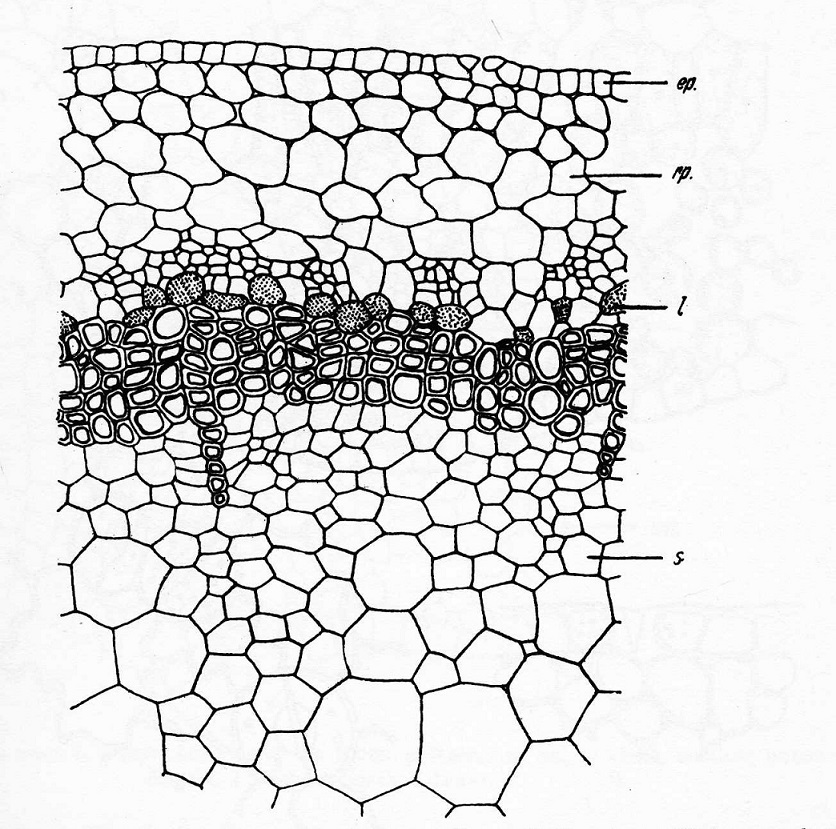
Stamm. Die Epidermis (Fig. 5) besteht aus kubischen oder langgestreckten Zellen und ist mit dünner, selten stark verdickter Cuticula (Lobelia Leschenaultiana) umkleidet. Das Rindenparenchym ist bald ganz aus rundlichen Zellen mit kleinen Interzellulargängen (Lobelia cardinalis, L. sessilifolia), bald mit großen Lufträumen (Lobelia Dortmanna, L. splendens, Downingia elegans) versehen und häufig kollenchymatisch ausgebildet wie bei Clermontia grandiflora, Delissea rhytidosperma und Lobelia tupa. Die Korkbildung erfolgt entweder subepidermal (Apetahia, Lobelia Leschenaultiana, Siphocampylus biserratus) oder im äußeren Parenchym der primären Rinde (Clermontia). Die Endodermis mit den Casparyschen Punkten ist bei den Kleinwüchsigen Arten häutig gut entwickelt, bie den großen Arten wenig oder nicht sichtbar. Der Perizykel ist einfach oder doppelreihig und sehr selten sklerotisiert. Der Weichbast bietet das Bild eines geschlossenen Ringes, in dem die Siebröhren entweder zerstreut (Centropogon Berterianus) oder in getrennten Gruppen (Heterotoma lobelioides, viele Lobeliae und Pratiae) angeordnet sind, oder er enthät verschieden große Keile, die durch die Markstrahlen voneinander getrennt sind (Clermontia grandiflora, Delissea rhytidosperma, Siphocampylus biserratus und andere). Der Holzteil ist im allgemeinen gut entwickelt und bildet einen geschlossenen ring, bei Pratia und Lobelia chinensis (Radicans Thb.) besteht er aus 2 gegenüber liegenden und durch das Markparenchym getrennten Halbbogen. Die inneren Holzgefäße sind in radialen Längsreihen, die äußeren weniger regelmäßig angeordnet. Die Zellen des Markes sind bald verhalzt, bald nicht verholzt. Der mittlere Tiel des Markes wird oft resorbiert. Bei Lobelia puberula hat Holroyd [Am. Journ. of Bot. XV (1928) 442 c. fig.] markständige Gefäßbündel nachgewiesen, wie solche auch bei den Campanuloideen und Goodeniaceen beobachtet wurden. Sie werden vom primären Meristem erzeugt und bestehen hauptsächlich aus Phlöemgewebe, das später ein Periphlöemkambium und schließlich kollaterale bis obkonzentrische Gefäßbündel heranbildet. Da diese markständigen Gefäßstränge ein zusätzliches mechanisches Element bedeuten, entbehren diese Pflanzen der Bastfasern. |
Phloem. The epidermis (Fig. 5) consists of square or elongated cells with thin, rarely thickened (Lobelia leschenaultiana), cuticle coverings. The cortical parenchyma is soon entirely of rounded cells with small intercellular gaps (Lobelia cardinalis, L. sessilifolia), sometimes with large air spaces (Lobelia dortmanna, L. splendens, Downingia elegans) and are often collenchymatous as in Clermontia grandiflora, Delissea rhytidosperma and Lobelia tupa. The cork formation occurs either subepidermal (Apetahia, Lobelia leschenaultia, Siphocampylus beserratus) or in the outer parenchyma of the primary cortex (Clermontia). A Casparian strip is well developed in the dwarf species, but small or not visible in the larger species. The pericycle is simple or a double row and rarely sclerotized. The soft bast has the image of a closed ring in which the sieve tubes are either scattered (Centropogon berterianus), arranged in separate groups (Heterotoma lobelioides, many Lobelia and Pratia), or contained in different sized wedges which are separated by the medullary rays (Clermontia grandiflora, Delissea rhytidosperma, Siphocampylus biserratus and others). The wooden section is well developed and generally forms a closed ring; in Pratia and Lobelia chinensis (radicans Thb.) it consists of 2 opposite semicircular sections separated by the pith parenchyma. The inner wood vessels are in radial longitudinal rows, less regularly ordered than the outer vessels. The cells of the pith are sometimes woody, sometimes not. The middle part of the pith is often reabsorbed. In Lobelia puberula, Holroyd [Am. Journal of Bot. XV (1928) 442 c. fig.] has observed permanent vascular bundles in the pith, similar to those observed in the Campanulaceae and Goodeniaceae. They are generated by the primary meristem and consist mainly of phloem tissue which later form into the periphloem cambium and finally obconcentric secondary vessels. Since these pith vascular strands add additional mechanical support, this plant does not have bast fibers. |
|
Fig. 5. Querschnitt durch den Stengel von Lobelia urens L. ep Epidermis, rp Rindenparenchym, l Milchsaftgefäße, s Mark (nach Ydrac). |
Fig. 5. Cross section of stem of Lobelia urens L. ep epidermis, rp cortical parenchyma, l latex tubes, s pith (nach Ydrac). |
Page 8
|
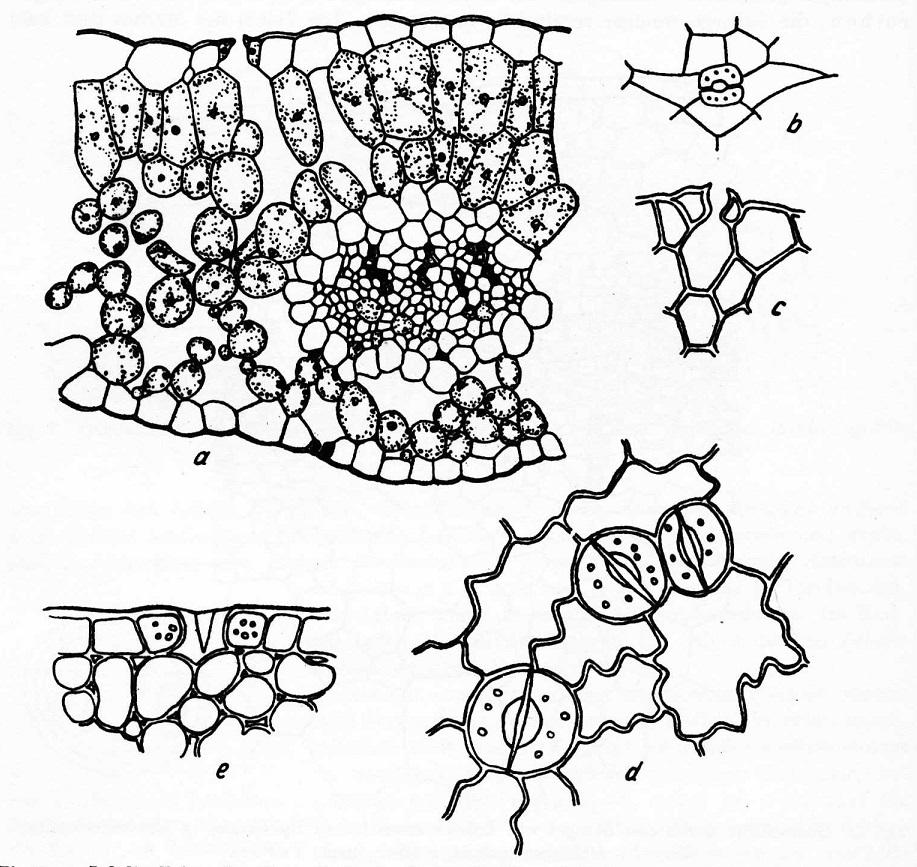
Blatt. Im Blattbau begegnen wir sowohl dorsiventralen als auch isolateralen Blättern, eine Regel ist nicht zu erkennen. Es können in derselben Gattung beide Formen auftreten, so bei Lobelia, wo wir bei L. cardinalis, L. Erinus (Fig. 6a), L. Leschenaultiana und anderen bifaziale, bei L. coronopifolia, L. gaudeloupensis, L. inflata, L. urens u.a. homogene Blätter antressen, bei letzteren öfters mit einem Ansatz zu einem Pallisadengewebe. Der Mittelnerv ist bi- oder plankonvex, die Epidermis mehr oder minder verdickt und öfters mit Haaren versehen. Die Wandungen der Epidermiszellen der Blattoberseite sind weniger verdickt als die der Unterseite. Spaltöffnungenn (Fig. 6b, c) kommen nur unterseits und in großer Zahl oder beiderseits vor und sind meist von 3-5 Nebenzellen umgeben. Das Rindenparenchym ist in der Regel schwach kollenchymatisch. Das Perikambium besteht meist nur aus einer, seltener aus zwei Zellreihen. Im Weichbast liegen stets Gruppen feiner Siebröhren zwischen weiten Parenchymzellen. Auch hier sind die Holzgefäße in radialen Reihen angeordnet und durch ein zelluloses Parenchym getrennt. Die Gefäßbündel bilden bald einen flachen bis stark gewölbten Halbkreis (Lobelia, Laurentia, Pratia, Downingia, Lysipomia, manche Centropogon, viele Siphocampylus, Sclerotheca), bald 2 Bogen: einen unteren stark gebogenen und einen oberen kleineren und flachen (Heterotoma, Brighamia, Delissea), bald einen rundum geschlossenen Ring (Apetahia). |
Leaves. In leaves, we encounter both dorsoventral and isolateral leaves, no rule has been seen. Both forms can occur in the same genus, as in Lobelia where L. cardinalis, L. Erinus (Fig. 6a), L. Leschenaultiana and others are bifacial and in L. coronopifolia, L. gaudeloupensis, L. inflata, L. urens and others have unifacial leaves, the latter often have Palisade tissue. The midrib is bi- or plano-convex, the epidermis more or less thickened, and often occuring with hairs. The walls of the pidermal cells of the upper leaf surface are less thickened than those of the bottom. Stomata (Fig. 6 b, c) occur either only on the bottom and in large numbers, or on both surfaces and are usually surrounded by 3 to 5 subsidiary cells. The cortical parenchyma is usually weakly collenchymatous. The pericambium consists mostly of a single, rarely of two, cell lines. In soft bast, there are always groups of fine sieve tubes between wide parenchyma cells. Again, the woody vessels are arranged in radial rows and separated by cellulose parenchyma. The vascular bundles quickly form a flat to strongly curved semicircle (Lobelia, Laurentia, Pratia, Downingia, Lysipomia, some Centropogon, many Siphocampylus, Sclerotheca), then two arcs: a lower strongly bent and an upper, small and flat (Heterotoma, Brighamia, Delissea), then a completely closed ring (Apetahia). |
|
Fig. 6. a Lobelia Erinus L. Querschnitt durch das Blatt. — b L. Dortmanna L. Spaltöffnung von oben, c quer durchschnitten. — e Zweikammerige Wasserspalte im Querschnitt und d von oben (a-c nach Armand, e, d nach Tswett). |
Fig. 6. a Lobelia Erinus L. Cross-section of leaf. — b L. Dortmanna L. stomata from above, c cut crosswise. — e two-chamber water column in cross-section and d from above. (a-c from Armand, e, d from Tswett). |
|
Eine eigentümlice Bildung hat das Blatt der Lobelia Dortmanna. Das Mesophyll, deutlich bifazial gebaut, besteht einesteils aus kleinen rundlichen Zellen, die viel Protoplasma und Chlorophyll enthalten, andernteils aus großen rundlichen mit Luft erfüllten Zellen und enthält zunächst keine Luftschächte, doch bald wird die ungefärbte Mittelschicht durch Aufsaugung der Zellwände zerstört und es bilden sich zwei zylinderförmige Luftgänge aus, je einer neben der stehenbleibenden medianen Parenchymplatte. Dabei formt sich die subepidermale Schichte in ein Palisadengewebe um, während die untere Schichte zu einem festgefügten, ebenfalls chlorophyllführendem Gewebe wird. Die 5-6 Gefäßbündel breiten sich im Verein mit den Milchsaftästen im Mesophyll der ganzen Blattfläche aus und enden, büschelig verbreitert, unter den bräunlichen Hydathoden. |
L. dortmanna has a peculiar leaf shape. The mesophyll, significantly bifacial, partially consists of smalll round cells containing much protoplasm and chlorophyll, the other part consists of large round air-filled cells, initially containing no air vents, but quickly the uncolored middle section is destroyed by the absorption of the cell walls and forms two cylindrical air passages, each standing next to the parenchyma layer. Here, the sub-epidermal layers forms into Palisade tissue, whereas the lower layer is firmly established to the chlorophyll rich tissue. The 5-6 vascular bundles spread, together with the milky latex tubes, through the mesophyll to the whole leaf area and terminate, widened, tufted, among brownish hydathodes. |
Page 9
|
Tswett und Flachsberger untersuchten die Wasserspalten der Lobelioideen in 11 Gattungen und fanden, daß sie durch eine Cuticula verschlossen sind, von der aus eine ziemlich dicke, kutinisierte Scheidewand in den Spaltenraum hineinragt und diesen so in zwei Kammern teilt (Fig. 6 d, e). Die Schließzellen sind stets lebendig, enthalten Protoplasma, Chloroplasten und Stärke und schließen niemals den Porus. Diese zweiteiligen Wasserspalten befinden sich auf der Ober- oder Unterseite oder Spitze der Zähnchen des Blattrandes, etwa 10-12 an Zahl, sind rund und haben einen Durchmesser von 30 μ (wogegen die anderen Spaltöffnungen nur 17 μ messen). Diese Art der Hydathoden ist nach obigen Forschern eine Eigentümlichkeit der Lobelioideen und wird bei sonst keiner anderen Pflanzenfamilie gefunden. Sie ist daher ein vorzügliches anatomisches Merkmal der Lobelioideen. |
Tswett and Flachberger studied the water column of 11 genera of the lobeliads and found that they are closed by a cuticle, from which protrudes a fairly thick waxy, waterproof septum that separates the column into two chambers. The guard cells are always living, contain cytoplasm, chloroplasts, are robust and never close the pore. The two-part water columns are found on the top or bottom or top only of the laminar teeth, are round and have a diameter of 30μ (whereas theh other stomata only measure 17μ). This type of hydathode, according to the above researchers, is unique to the lobeliads and thus is an distinguishing anatomical feature of them. |
|
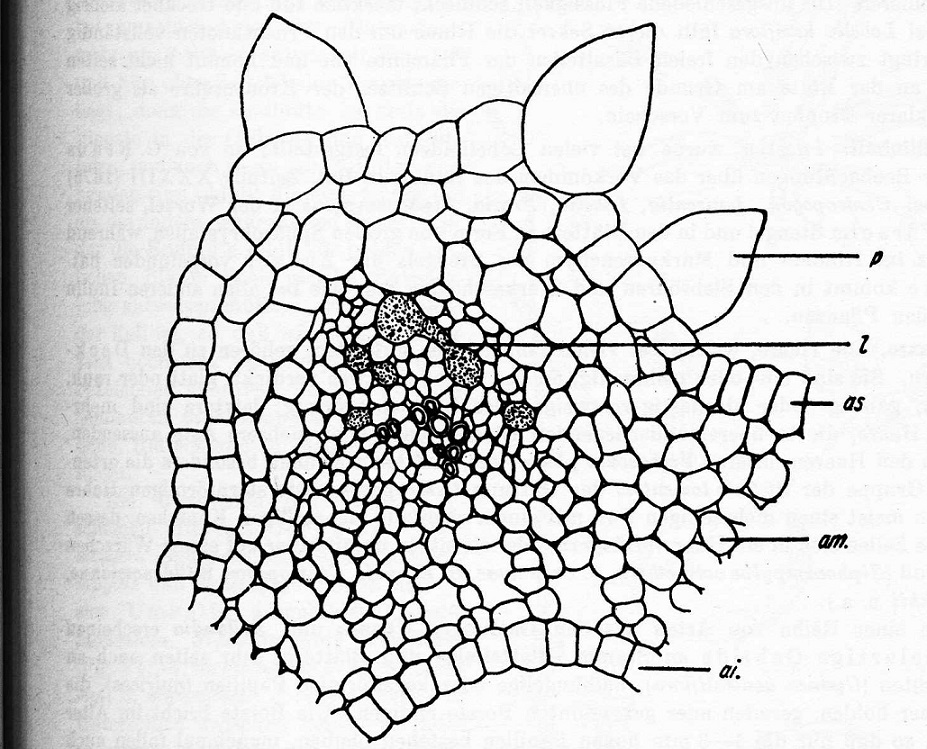
Blüte. — Die untersuchten Blüten zeigen im allgemeinen den gleichen Bau (Fig. 7). Die äußere Fläche (des röhrigen Teiles der Blüte) besteht aus einem dichten Parenchym, dessen äußerste Schichte öfter einzellige, kegelförmige oder verlängerte oder mehrzellige sternartige Haare oder Papillen aufweist. Die Innenseite wird von einem lakunöses Gewebe gebildet. Die Gefäßbüdel sind gut entwickelt. Die weitlumigen Michsaftröhren verlaufen im äußeren Teil des Phloëms. Auch die Placenten haben großenteils lakunöses Gewebe, während die Scheidewand des Fruchtknotens, an dem die Placenten befestigt sind, durch Schichten sklerotisierter Zellen verstärkt ist. Am Grunde der Blüte rings um den Scheitel des Fruchtknotens befindet sich ein Drüsengewebe, das den Nektar absondert. Es ist nach A. Wagner ein mehrschichtiges, farbloses und interzellularenarmes Parenchym, indessen stark kutinisierter Epideris sich viele Spaltöffnungen befinden, die als Saftventile funktioniernen. Die ausgeschiedene Flüssigkeit schmeckt merklich süß und trocknet klebrig ein. Bei Lobelia laxiflora füllt dieses Sekret die Rinne um den Fruchtknoten vollständig aus, dringt zwischen den freien Basalteilen der Filamente vor und kommt nicht selten außen an der Blüte am Grunde des oberseitigen Schlitzes der Kronenröhre als großer wasserklarer Tropfen zum Vorschein. |
Flowers: — The examined flowers general exhibit the same construction (Fig. 7). The outer surface (the tubed part of the flower) consists of a dense parenchyma whose outermost layer often has unicellular, conical or elongated, or multicellular star-like hairs or papillae. The inside is formed by lacunar tissue. The vascular bundles are well developed. The wide milk latex tubes extend in the outer part of the phloem. The placentas have largely lacunar tissue while the septem of the ovary to which the placenta is attached, is reinforced by layers of sclerotized cells. At the base of the flower, around the apex of the ovary, is glandular tissue which secretes nectar. According to A. Wagner, it is a multilayered, colorless parenchyma, however, the epidermis is very waterproof and the many stomata function as nectar valves. The liquid excreted tastes noticeably sweet and dries tacky. In Lobelia laxiflora this secretion fills the gutter of the ovary completely, penetrates between the free basal part of the filaments and not uncommonly appears as large, clear water drops outside of the flower at the base of the upper-side slot of the corolla tube. |
|
Fig. 7. Lobelia urens L. Querschnitt durch die Blüte. p Haare, as, am, ai obere, mittlere, untere Schicht, l Milchsaft (nach Ydrac). |
Fig. 7. a Lobelia urens L. Cross-section of flower. p hair, as, am, ai upper, middle, lower layer, l latex tube (after Ydrac). |
Page 10
|
Zellinhalt. Inulin wurde bei vielen Lobelioideen festgestellt; so von G. Kraus [Einige Beobachtungen über das Vorkommen des Inulins in Bot. Zeitung XXXIII (1875) 171] bei Centropogon, Laurentia, Lobelia, Pratia, Siphocampylus in der Wurzel, seltener nach Ydrac im Stengel und in den Blättern in Form von großen Sphärokrystallen, während Kraus im Rinden- und Markparenchym des Stengels nur Zucker vorgefunden hat. Stärke kommt in den siebröhren und Stärkescheiden vor, wie bei allen anderen Inulin führenden Pflanzen. |
Cell contents: Inulin has been found in many Lobeliads by G. Kraus [Einige Beobachtungen über das Vorkommen des Inulins in Bot. Zeitung XXXIII (1875) 171], in the root in Centropogon, Laurentia, Lobelia, Pratia, Siphocampylus and rarely, according to Ydrac, in the stems and leaves in the form of large nodular crystals. While Kraus only found it in the bark and sugary pith parenchyma of the stem. Starch is found in the sieve tubes and starch sheaths, as in other inulin carrying plants. |
|
Haare. Die Haare, welche bei vielen Lobelioideen auftreten, gehören zu den Deck-haaren. Sie sind ein- oder mehrzellig, an den Wänden etwas verdickt, glatt oder rauh, zellige Haare, die in übereinanderliegenden Etagen einen oder mehrere Äste aussenden, ähnlich den Haaren unseres Verbascum phlomoides, und kennzeichnen besonders die artenreiche Gruppe der Stellato-tomentosi der Gattung Centropogon. Die sternförmigen Haare besitzen meist einen mehrzelligen Fuß mit einem ebenfalls mehrzelligen Köpfchen, dessen einzelne Zellen sich in ein Haar verlängern, oder sie sitzen unmittelbar auf einem Wärzchen ohne Fuß (Siphocampylus actinothrix, S. Columnae, S. Elfriedi, Centropogon, Willdenowianus, C. Smithii u. a.). |
Hair: Hair, which occur in many lobeliads, is usually external hair. They are uni- or multicellular hairs, on slightly thickened cell walls, rough or smooth, arising from one or more divisions of the cell faces, similar to the hair of Verbascum phlomoides, featured particularly in the stellato-tomentosi group within the Centropogon. The star-shaped hairs usually have a multicellular base and a multicellular apex whose individual cells are extended in a hair, or they sit directly on warts without a foot (Siphocampylus actinothrix, S. Columnae, S. Elfriedi, Centropogon, Willdenowianus, C. Smithii et al.). |
|
An einer Reihe von Arten aus den Gattungen Cyanea und Rollandia erscheinen stachelartige Gebilde an Stamm, Blattstielen und Blättern, sehr selten auch an den Blüten (Cyanea aculeatiflora), halbkugelige oder kegelförmige Papillen (murices), die mit einer hohlen, geraden oder gekrümmten Borste endigen. Die Borste bricht im Alter oft ab, so daß nur die 1-3 mm hohen Papillen bestehen bleiben, manchmal fallen auch diese noch ab, so daß jener Teil der Pflanze sich nur höckerig oder rauh anfühlt. Ob diese Stachelpapillen auch einen besonderen Saft enthalten, konnte an dem getrockneten Material nicht festgestellt werden. Jedenfalls bilden dieselben schon durch ihre Schärfe einen Schutz der Pflanze. |
Thorn-like structures appear on a number of species in the genera Cyanea and Rollandia, on the trunks, petioles, and leaves, and very occasionally on the flowers (Cyanea aculeatiflora). These are hemispherical or conical papillae (murications), which end with a hollow, straight or curved bristle. The bristle often breaks off with age, so that only the 1-3 mm high papillae remain, sometimes these also fall off so that the plant feels bumpy or rough. Whether these bristled papillae also contain latex could not be ascertained from the dried material. In any case, their sharpness already serves as protection for the plant. |
Page 11
|
Blütenverhältnisse. Blütenstände. Die Blüten der Lobelioideen stehen entweder einzeln in den Achseln von Laubblättern oder Brakteen, oder in einfachen, bald langen, bald verkürzten Trauben, sehr selten gibt es verzweigte Trauben. Nicht selten rücken die einzeln in den Blattwinkeln stehenden Blüten so eng zusammen, daß man von beblätterten Trauben sprechen kann wie bei der Gruppe der Foliato-racemosi der Gattung Siphocampylus der bei Lobelia laxiflora. Sehr häufig gehen die Blätter allmählich in Brakteen über, wobei einige Blüten noch in den Achseln normaler Stengelblätter stehen, während die darüber befindlichen Blätter den Eindruck von Brakteen gewinnen under der Blütenstand als Traube anzusprechen ist. Die razemösen Infloreszenzen sind meist teminal ohne Endblüte, selten mit Endblüten wie bei vielen Lobelia der Sektion Holopogon. Die terminalen Trauben der australischen Arten vom Typus der Lobelia gibbosa (Fig. 8) betrachtet Schönland als terminale Wickel, bei denen ein Sympodium ausgebildet ist und die so das Aussehen von Trauben erhalten. Die anderen Arten vom Typus der Lobelia rarifolia entwickeln armblütige panikulate Infloreszenzen. Bei den endemischen Gattungen der Sandwich Inseln, Delissea, Clermontia, Cyanea, Rollandia und Brighamia, bei Centropogon lateriflorus, Siphocampylus membranaceus, oblongifolius und crenatus (Fig. 8c) und bei Grammatotheca galeopsoides sind die Blütentrauben axillar. Bei Clermontia ist der Blütenstand oft auf 2 Blüten reduziert, der von mehreren Autoren als Cyma angesehen wurde; indes dürften wir in dieser 2-blütigen Infloreszenz doch nur eine armblütige Traube vor uns haben, da bei manchen Arten der Blütenstand mehr als 2 Blüten entwickelt (Fig. 8d) und hier ohne Zweifel eine Traube vorliegt; denn die Endblüte ist stets die jüngste in der Ordnung und Aufblühfolge, und auch wenn nur 2 Blüten vorhanden sind, blüht die eine früher auf als die andere, während bei einer Cyma, der die Endblüte fehlt, die beiden seitlichen Blüten doch gleiche Entwicklung aufweisen müßten, was aber nicht der Fall ist, so daß wir diese Infloreszenz höchstens als eine pseudocymöse bezeichnen könnten. Bei den 2 vorher genannten Siphocampylus ist der seitliche Blütenstand doldenartig ausgebildet. |
Floral descriptions. Inflorescences The flowers of the lobeliads are either individual in theh axils of leaves or bracts, or in simple, sometimes long, sometimes short racemes, or rarely branched racemes. Not infrequently, the axillary, solitary flowers are packed so densely that one can speak of a leafy raceme, such as those that occur in the Foliato-racemosi group of the genus Siphocampylus or in Lobelia laxiflora. Often, the transition from leaves to bracts is gradual, some flowers appear in the axils of normal stem leaves, while above it the leaves give way to bracts and the inflorescence would be considered a raceme. The racemes are usually terminal without a terminal flower, rarely with a terminal flower like many in Lobelia section Holopogon. The terminal inflorescences of the Australian species of the type Lobelia gibbosa (Fig. 8) were considered by Schönland as terminal cyme, but in which sympodial growth maintains the appearance of a raceme. Other kinds, such as Lobelia rarifolia develop a few-flowered panicle. In the endemic genera of the Sandwich Islands, Delissea, Clermontia, Cyanea, Rollandia and Brighamia, as well as Centropogon lateriflorus, Siphocampylus membranaceus, S. oblongifolius and S. crenatus (Fig. 8c), the racemes are axillary. In Clermontia the inflorescence is often reduced to 2 flowers, which was considered by several authors as a cyme; however, we consider this 2-flowered inflorescence to be a few-flowered racemes because in some species the inflorescence does have more than 2 flowers and this is, undoubtedly, a raceme (Fig. 8d); because the terminal flowers is always the youngest in blooming order and when there are only two blooms, one blooms earlier than the other, while in a cyme that lacks the terminal flower, the two lateral flowers would have the same development which is not the case here, so that we could call this inflorescence pseudocymose. In the two aforementioned Siphocampylus, the lateral inflorescence is umbel-like. |
|
Die terminalen Blütenstände erscheinen öfter als Corymbus (Burmeistera multiflora, zahlreiche Siphocampylus und Centropogon) oder fast wie eine Umbella ausgebildet (Lobelia fasciculata, Siphocampylus densiflorus (Fig. 8b), S. corymbiferus Pohl, S. Lindleyi, S. microstoma, S. reticulatus). Der Unterschied zwischen beiden ist indes so verwischt, daß man ihn zur Gruppenbildung fast nicht verwenden kann. |
The terminal inflorescences appear like corymbs (Burmeistera multiflora, numerous Siphocampylus and Centropogon) or umbel-like forms (Lobelia fasciculata, Siphocampylus densiflorus (Fig. 8b), S. corymbiferus Pohl, S. Lindleyi, S. microstoma, S. reticulatus). The difference between the two, however, is so blurred that it cannot be used for grouping. |
|
Grundständige Blütenstiele sind eine große Seltenheit und finden sich bei Lysipomia, Laurentia minuta, L. scapigera und Lobelia Dortmanna. |
Basal flower stalks are very rare and can be found in Lysipomia, Laurentia minuta, L. scapigera und Lobelia dortmanna. |
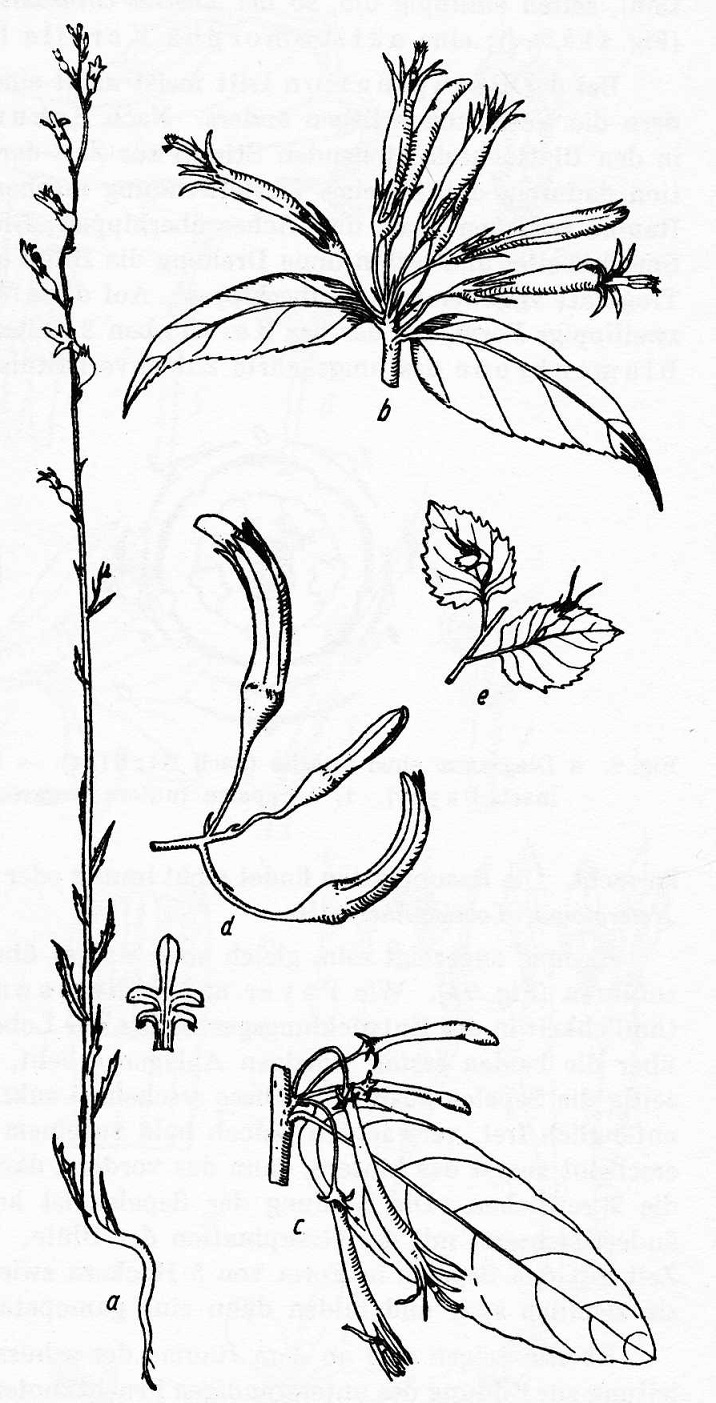
Fig 8. a Lobelia gibbosa var. Browniana (R. & S.) Bailey. Habitus ½ — b Siphocampylus densiflorus Planch. — c S. crenatus E. Wimm. — d Clermontia Samuelii Forb. Inflorescentia completa. — e Phyllocharis lamiifolia E. Wimm. (should be Phyllocharis subcordata Merrill et Perry, cf. supplement).
— Orig.Page 12
|
Die Blüten sind, zwei Ausnahmen (Grammatotheca und Downingia) abgerechnet, gestielt; bei diesen beiden Gattungen haben die Fruchtknoten anfänglich das Aussehen eines Pedicellus, der erst im Laufe der Zeit anschwillt und zu einer lang-linearen Frucht wird. Häufig trägt der Pedicellus 2 opponierte, zufällig auch distanzierte Vorblätter oder Brakteolen meist am Grunde, seltener in oder über der Mitte desselben, noch seltener am Grunde des Kelches oder mit demselben verwachsen. Die Brakteolen sind meist klein und unscheinbar, drüsenartig bei vielen Arten von Lobelia, sonst subulat oder fadenförmig, selten blattartig und auffällig wie bei Siphocampylus longibracteolatus. |
The flowers, except in Grammatotheca and Downingia are pedicellate; in these two genera the ovary initially appears as a pedicel, but in the course of time swells into a long-linear fruit. Frequently the pedicel has two opposite, or sometimes alternate, prophylls or bracts, usually at the base, more rarely near the middle or rarer still at the base of the perianth. The bracts are usually small and inconspicuous, glandular in many species of Lobelia, otherwise subulate or filiform, rarely foliaceous and flashy as in Siphocampylus longibracteolatus. |
|
Die Einzelblüten (Fig. 9) sind zwitterig, sehr selten zweihäusig wie bei einigen australischen Arten (Lobelia pratioides, mehrere Arten von Pratia), 5-zählig, median zygomorph, häufig zweilippig nach dem Verhältnis 2/3 (wenigstens nach der Resupination), selten einlippig 0/5, so bei Lobelia chinensis und häufig bei Lobelia subgen. Tupa (Fig. 11 b, c, f); eine aktinomorphe Korolle hat nur Dialypetalum (Fig 13j). |
The individual flowers (Fig. 9) are hermaphroditic, rarely dioecious, as in some Australian species (Lobelia pratioides, several types of Pratia), 5-merous, bilaterally zygomorphic, often two-lipped with a 2/3 pattern (at least after resupination), rarely single lipped with a 0/5 pattern as in Lobelia subgen. Tupa (Fig 11 b,c,f); an actinomorphic corolla is only found in Dialypetalum (Fig 13j). |
|
Bei der Resupination tritt meist nicht eine Drehung der Blüte um 180° ein, sondern die Verhältnisse liegen anders. Nach Schumann erhalten die Blüten mit kurzen in den Blattachseln stehenden Stielen zur Zeit der Anthese ihre eigentümliche Resupination dadurch, daß sie eine Viertelwendung machen und bald rechts, bald links aus dem Raume zwischen Blatt und Achse überkippen blütenn mit langen Stielen überragen den Sproßscheitel und lassen ohne Drehung die Blüte einfach nach der Seite, welche von dem Tragblatt abgewendet ist, überkippen, Auf diese Weise erlangt die Blüte die gewöhnliche zweilippige Form, bei der der Kelch oben 3, unten 2 Segmente besitzt, während bei der blumenkrone das umgekehrte Zahlenverhältnis (Oberlippe 2, Unterlippe 3 Segmente) herrscht. Die Resupination findet nicht immer oder nicht regelmäßig statt, so bei Monopsis, Heterotoma, Lobelia thermalis. |
Resupination usually does not rotate the bloom 180°, but differs in each situation. According to Schumann, flowers with short pedicels growing from leaf axils obtained at the time of anthesis have made a quarter turn to the right and then to the left out of the space between the blade and the shaft. Flowers with long pedicels tower above the shoot apex and grow only turning the flower to the side which faces away from the support, tipping, in this way the flower acquires the typical double lip shape in which the cup has 3 up and 2 down segments, whereas in the corolla, the reverse ratio (upper lip 2, lower lip 3 segments) prevails. Resupination does not occur, or is not regular, in Monopsis, Heterotoma and Lobelia thermalis. |
|
Es mag angezeigt sein, gleich auch einiges über die Entwicklung der Blüte anzuführen (Fig. 9b). Wie Payer und Schumann darlegen, ist die wesentlichste Eigentümlichkeit in der Entwicklungsgeschichte der Lobelioideenblüte daß sich das Primordium über die beiden ersten winzigen Anlagen erhebt, fünf lappige Gestalt erhält und gleichzeitig die Sepalen ausbilden. Diese erscheinen sukzessive in der Quinkunzialordnung, sind anfänglich frei, verwachsen jedoch bald zu einem gamosepalen Klech. Von den Sepalen erscheint zuerst das hintere, dann das vordere, darauf das andere hintere und zum Schluß die 2 seitlichen. Die Stellung der Sepalen ist kennzeichnend für alle Lobeloideen und ändert sich erst mit der Resupination der Blüte. Die Petalen entwickeln sich zu gleicher Zeit mit den Sepalen in Form 5 Höckern zwischen diesen; zuerst isoliert, verwachsen sie ziemlich spät und bilden dann eine gamopetale Blumenkrone. (Fig. 9b). |
It may similarly be shown that in the flower development, some parts lead. As Payer and Schumann demonstrate, the essential peculiarity in the evolution of Lobeliad flowers is that the primordium on the tiny plants rises, lobed shapes arise and simultaneously the sepals form. These appear successively in five parts and are initially free, but soon unite to form the united calyx cup. One of the dorsal sepals appear first, then the forward, then the other dorsal and finally the two lateral sepals. The position of the sepals is characteristic of all Lobeliads and will not change until the resupination of the bloom. The petals are developing at the same time as the sepals in the form of 5 cusps between the sepals; at first isolated, then growing together only quite late to form the united petal corolla. (Fig. 9b). |
|
Ebenso zeigen sich an dem Raume der Schüsselförmigen Vertiefung, welche die Einleitung zur Bildung des unterständigen Fruchtknotens ist, die 5 mit den Petalen abwechselnden und untereinander getrennt bleibenden Anfänge der Staubgefäße. |
There is also a bowl-shaped depression, which is theh precursor to the formation of the inferior ovary. The beginnings of the five stamens alternate with the petals |
|
Schließlich werden in der Mitte 2 schnell sich vertiefende Furchen sichtbar, die Anfänge der Fächer des Ovariums, an deren Scheidewand eine große Placenta erscheint, die sich mit anatropen Ovula bedeckt. Gleichzeitig bilden sich zwei über den Fächern sich bald verbindende Ringe, die wie eine Haube über jenen sitzen und an der Spitze 2 Lippen formen: der beginnende Stylus mit den 2 Narben. |
Finally, two quickly deepening furrows appear in the center, these are the beginning of the compartments of the ovaries, at the septum a large placenta appears which is covered with anatropous ovules. Simultaneously, with the formation of the two compartments, a linked ring forms that fit over these like a hood with two lips on top: the beginning of the style with two scars. |
|
Der Kelch ist so orientiert, daß das unpaare Kelchblatt, das, wie erwähnt, vor der Resupination nach vorn (unten) angelegt ist, hernach nach hinten (oben) fällt und dann dieselbe Stellung einnimmt wie bei den Campanuloideen. |
The calyx is oriented so that the unpaired sepal which, as mentioned, prior to resupination is forward (below), afterwards is back (up) and thus in the same position as it occupies in Campanulids. |
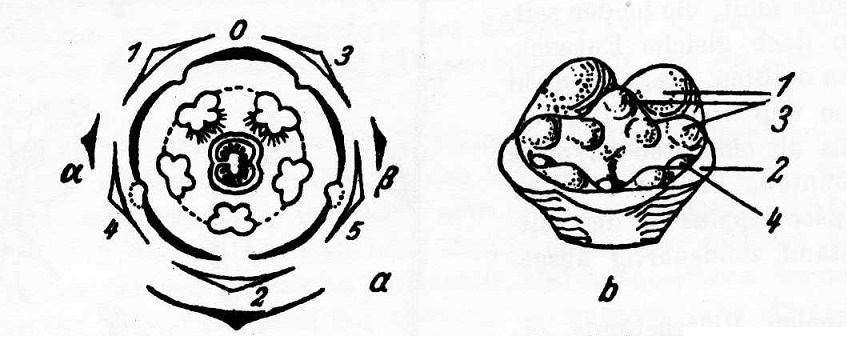
Fig. 9. a diagramm einer Lobelia (nah Eichler). — b Entwicklung der Blüte bei L. funglens w. (nach Payer). 1, 2 Sepalen (untere weggeschnitten), 3 Petalen, 4 Stamina.
Page 13
|
Der Kelchsaum ist stets in 5 Zipfel geteilt, die meist mehr oder minder gleich groß und gleich gestaltet sind, zahnförmig bis blattartig, manchmal am Grunde verwachsen [Centropogon gamosepalus, C. caligatus (Fig. 12 d), C. calycinus, C. inflatus]. Bei Clermontia sect. Genuinae (Fig. 19), sind die Kelchzipfel so lang oder fast so lang wie die Korolle und verwachsen, später löst sich meist der oberste Zipfel bis zum Grunde von dem übrigen; nach dem Verblühen fallen sie samt der Korolle ab, während sonst die Kelchzipfel in der Regel persistent sind. Bei Heterotooma (Fig 11 g) rücken die 2 untersten Kelchzipfel weiter nach abwärts, oft bis an den Grund des Korollenspornes, so daß der Kelch zweilipig erscheint. Zuweilen tragen die Kelchzipfel nach abwärts gerichtete Anhänge wie bei Lobelia Claytoniana (Fig. 14 r), L. appendiculata und L. syphilitica. |
The calyx is always divided into 5 lobes, which are usually more or less the same size and shape, foliaceous, sometimes connate [Centropogon gamosepalus, C. caligatus (Fig. 12 d), C. calycinus, C. inflatus]. In Clermontia sect. Geuinae (Fig 19), the sepals are as long or nearly as long as the corolla and connate, apically the top lobe splitting from the remaining bottom lobes; after flowering they fall off along with the corolla while typically the calyx is persistent. In Heterotoma (Fig 11 g) the two lowest calyx lobes are pushed basally and form Corolla spurs, so that the calyx appears two lobed. Sometimes the calyx lobes carry basal appendages like Lobelia Claytoniana (Fig. 14 r) (should be L. spicata var. leptostachys (A.DC.)McVaugh, cf. supplement), L. appendiculata and L. syphilitica. |
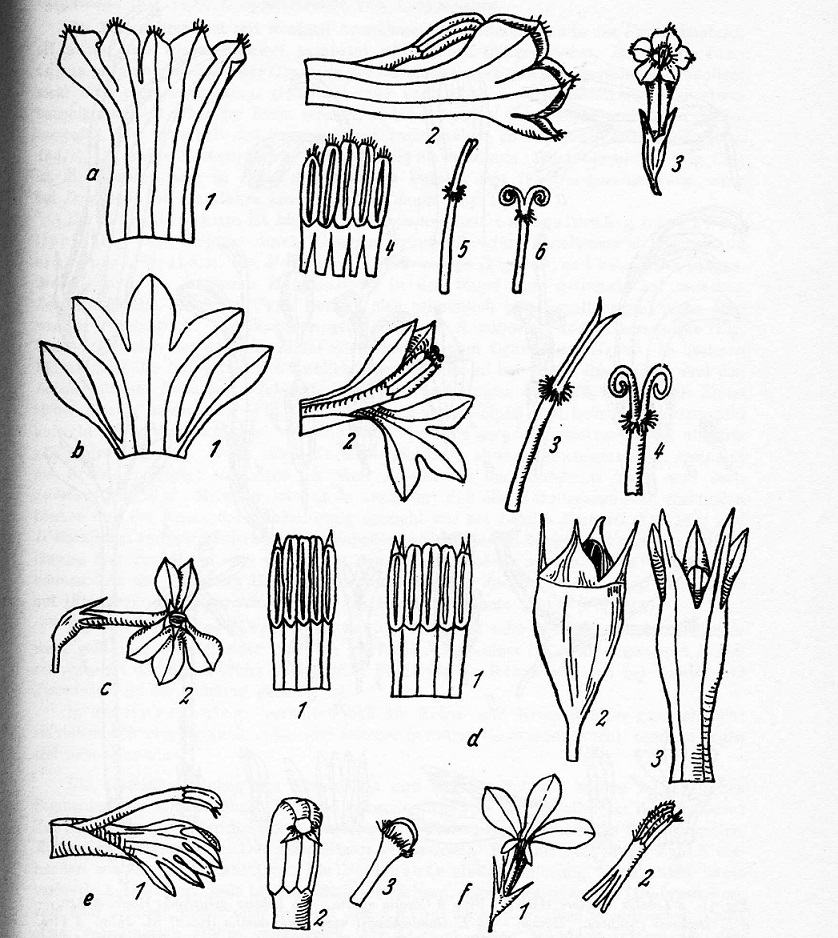
Fig. 10 a Monopsis simplex (L.) E. Wimm. 1-2 Corolla, 3 Flos, ca. duplo auct., 4 stamina expansa, 5,6 stigma. — b Monopsis scabra (Thb.) Urb. 1-2 corolla, 3-4 stigma. — c Laurentia hypocrateriformis (R. Br.) E. Wimm. 2 Flos, 1 antherae expansae. — d Laurentia secunda (L.f.) O.Ktze. 1 Antherae expansae, 2 capsula, 3 corolla, omnes magn. auct. — e Lobelia jasionoides (A.DC.) E. Wimm. 1 Corolla lobis deflexis, 2 antherae, omnes magn. auct., 3 stigma. — f L. Erinus L. var. grandiflora Paxt. cum tubo stamineo.
Page 14
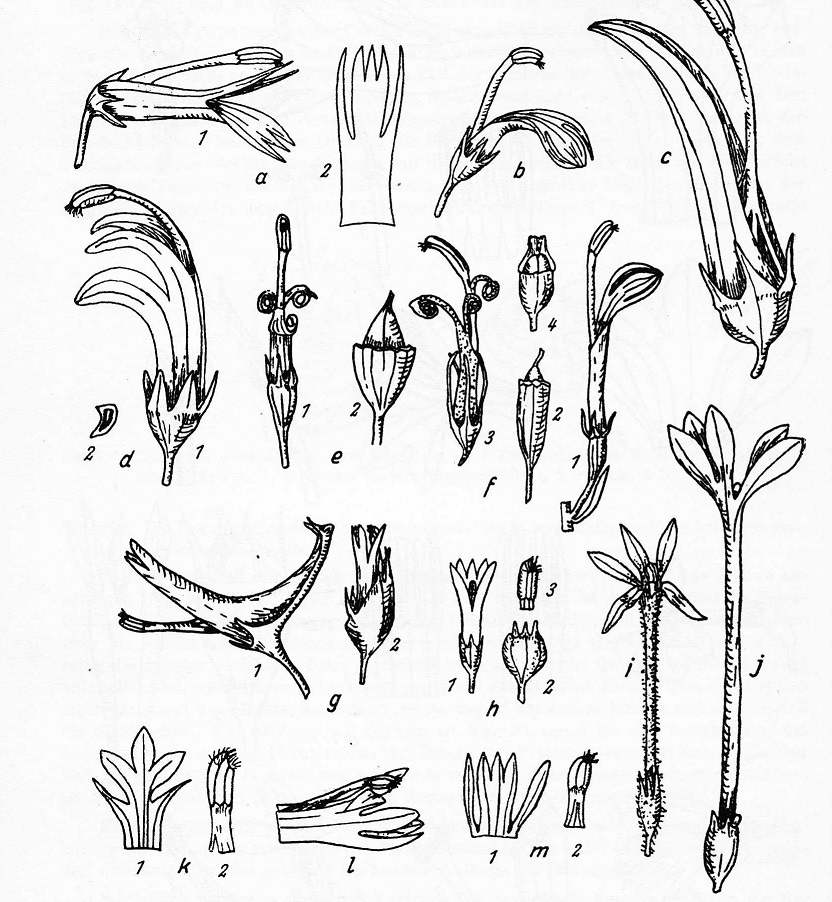
Fig. 11 a Lobelia laxiflora HBK. 1 Flos, 2 Corolla aperta. — b Lobelia polyphylla Hook. & Arn. — c L. deckenii (Aschers.) Hemsl. — d L. Gaudichaudii var. gloria-montis (Rock) St. John. 1 Flos, 2 Semen, auct. — e L. Grayana E. Wimm. 1 Flos, 2 Capsula 2/1. — f L. hypoleuca Hlb. 1 Flos, 2 Capsula, 3 var. heterocarpa E. Wimm., 4 capsula. — g 1 Heterotoma lobelioides Zucc., 2 H. cordifolia (Hook. & Arn.) Mc Vaugh 2/1. — h Hypsela tridens E. Wimm. 1-3 Flos, bacca, antherae, omnes auct. — i Laurentia longiflora (L.) Peterm. (should be Endl., cf. supplement) 1/2. — j Brighamia insignis A. Gray. 1-½ magnit. — k Grammatotheca erinoides (L.) Sond. (should be Grammatotheca bergianan (Cham.) Pr., cf. supplement) 1 Corolla, 2 Stamina, auct. —l Lobelia thermalis Thunb. — m Lobelia depressa L.f. 1 Corolla, 2 Stamina, aucta. (Orig.)
Page 15
|
Die Blumenkrone ist mit wenigen Ausnahmen dem oberen Rande des Fruchtknotens, oft mittels eines Discus inseriert, sympetal, mit einem 5-teiligen Saum. Der Korollen-tubus ist ganz oder auf der Oberseite der Länge nach gespalten, gerade, oder häufiger mehr oder weniger gebogen, gleichweit oder nach oben hin trichterförmig oder etwas bauchig erweitert, über der Basis verengt, so besonders bei Centropogon und vielen Siphocampylus, oder unterhalb des Saumes etwas verschmälert, so häufig bei Burmeistera (Fig. 13 d, e). Oft ist die Kronenröhre 2-4-mal so lang als der Saum. Bei Dialypetalum (Fig. 13 j) ist die Korollenröhre so kurz, daß man die Petalen fast für frei ansehen kann, auch bei Downingia ist die Röhre kürzer als der Saum (Fig. 13 f). |
The corolla is usually inserted, with a few exceptions, into the upper border of the ovary by a disk, sympetalous, 5-lobed. The corolla tube is completely on top lengthwise split, straight, or often more or less bent, cylindrical or funnel-shaped or slightly swollen bulbous and narrower over the ovary, thus so especially in Centropogon and many Siphocampylus, or narrowing slightly below the lobes, as common in Burmeistera (Fig 13 d, e). Often the crown tube is 2-4 times as long as the lobes. In Dialypetalum (Fig. 13 j), the corolla tube is so short that it appears the petals are almost free, in Downingia the tube is shorter than the lobes. |
|
Der Korollensaum ist bis auf Dialypetalum stets unregelmäßig oder zweilippig (Fig. 13 j), seltener durch Abwärtsneigung aller fünf Korollenzipfel anscheinend einlippig (fig. 11 b, c). Bei Monopsis sect. Dobrowskya (Fig. 10 b) und bei Lobelia subgen. Mezleria sind die 2 oberen Korollenzipfel in der Regel ganz getrennt; bei manchen Lobelia aus dem Subgenus Tupa trennen sich allmählich alle Korollenzipfel mehr oder weniger voneinander. Bei Siphocampylus Sceptrum, S. sulfureus und S. corynoides (Fig. 13 a-c) löst sich der unterste Zipfel allein fast bis zum Grunde der Krone. In anderen Fällen bietet der Saum fast den Anblick eines Helmes, so bei vielen Burmeistera und den Lobelia subgen. Tupa sect. Galeatella (Fig. 11 d) und einigen Centropogon, oder die Zipfel stehen glockig auseinander (Fig. 13 a), oder die 2 oberen Zipfel sind bedeutend kürzer und aufrecht bis zurückgeschlagen, während die Unterlippe gerade vorgestreckt oder abwärts geneigt ist (Fig. 10 f). Wenn alle 5 Korollenzipfel nach abwärts geschlagen sind, erscheint die Krone einlippig; so zeigen es viele Lobelia aus dem Subgenus Tupa und sect. Isolobus (Fig. 10 g). Mitunter kommt es auch vor, daß alle Korollensegmente verbunden bleiben und die Krone dann kahnförmig aussieht wie bei Lobelia Deckenii (Fig. 11 c) und L. elgonensis, zwei afrikanischen Riesenlobelien, oder dieselben hängen nur mit den Spitzen längere Zeit zusammen, wie wir es bei den meisten Lobelia subgen. Tupa wahrnehmen können. An der Basis der Unterlippe treten bei vielen Lobelia zwei Höcker oder Falten auf (Fig. 10 f). Bei Heterotoma endigt die Korolle in einem Sporn (Fig. 11 g). |
The corolla lobes, with the exception of Dialypetalum are always irregularly or double lipped (Fig 13 j), or rarely all five corolla lobes appear as a single bottom lip (Fig. 11 b, c). In sect. Monopsis sect. Dobrowskya (Fig. 10 b), and in Lobelia subgen. Mezleria, the top two corolla lips are usually quite separate; in some Lobelia from the subgenus Tupa, all corolla lips more or less gradually separate from each other. In Siphocampylus sceptrum, S. sulfureus and S. corynoides (Fig. 13 a-c) the bottom lip separates almost to the bottom of the corolla. In other cases, the lobes have nearly the appearance of a helmet as in many Burmeistera and Lobelia subgen Tupa sect. Galeatella (Fig. 11 d) and in some Centropogon, or the lips are bell-like (Fig. 13 a), or the 2 upper lobes are much shorter and erect while the lower lip is stretched out and points downwards (Fig. 10 f). If all 5 corolla lobes are downwards pointing, then the corolla appears single-lipped as occurs in many Lobelia from the subgenus Tupa and from sect. Isolobus (Fig. 10 g). Sometimes it occurs that all the corolla segments remain connected and the corolla will appear boat-shaped as in Lobelia deckenii (Fig. 11 c) and L. elgonensis, two African giant lobelias, or they can remain connected for most of their length with only the tips separate, as we find in most Lobelia subgen. Tupa. At the base of the lower lip there occur in many Lobelia two humps or wrinkles (Fig. 10 f). In Heterotoma, the corolla ends in a spur (Fig. 11 g). |
|
Die Färbung der Korolle ist hauptsä;chlich rot oder blau oder violett seltener weiß, gelb oder grünlich oder zwei- bis vierfarbig. Besonders bei Centropogon und Siphocampylus ist der Saum öfters von anderer Farbe als die Röhre, wogegen bei Lobelia und Downingia oft der Schlund gefleckt ist. |
The corolla is mostly red or blue or purple, rarely white, yellow or greenish or two- to four-colored. Especially with Centropogon and Siphocampylus the lobes are often of a different color than the tube, whereas in Lobelia and Downingia often the throat is spotted. |
|
In der Knospenlage verhalten sich die Kelch- und Kronenblätter ganz ähnlich; sie reihen sich klappig aneinander oder seltener berühren sie einander nicht, sondern liegen frei nebeneinander. |
In the vernation, the sepals and petals behave quite similarly; they are lined up together touching, or rarely not touching, but are free from each other. |
|
Die Stamina bestehen aus Staubfäden und Staubbeutel und stehenn zwischen den Segmenten der Kronenröhre. Sie sind entweder frei von der Korolle (bei dem größeren Teil der Gattungen) oder der Korolle inseriert (bei Centropogon, den meisten Siphocampylus, Rollandia, Laurentia sect. Isotoma und sect. Palmerella). Sie sind stets in der Zahl 5 vorhanden wie die Korollenblätter. Die Filamente sind bandförmig, nach unten kaum verbreitert, teils ganz, teils bis zur Mitte verwachsen, sehr selten ganz frei (Dialypetalum), kahl oder behaart, bleich oder gefärbt. Die Antheren sind zu einer zylindrischen, meist etwas gekrümmten Röhre verwachsen (Fig. 14 a-c), deren Mündung infolge der verschiedenen Länge der einzelnen Staubbeutel schief und verengt (Fig. 14 a) oder breit offen ist (Fig. 14 b, c); letzteres ist typisch für Burmeistera. Sie sind zweifächerig, springen nach innen auf und entleeren den Pollen meist vor der Reife der Narbe (protrandrisch). Die Antherenröhre ist stets gefärbt, nackt oder rundum oder nur am Rücken behaart. Der Haarbesatz der Antherenspitzen ist für die Gruppenbildung wichtig. Im allgemeinen (etwa 2/3 aller Arten) sind die 3 oberen Antheren an der Spitze kahl und die 2 unteren (Kürzeren) Antheren mit einem Bart oder Anhang versehen. Bei den übrigen Arten sind entweder alle Antheren am Vorderrand mit Haaren besetzt [Lobelia sect. Holopogon, Monopsis (Fig. 10 a)] oder alle kahl (Lobelia columnaris, Burmeistera fusco-apicata, B. virescens) oder alle mit wenigen langen, hinfälligen Haaren versehen [Burmeistera sect. Imberbes (Fig. 13 a)]. Der oben erwähnte Besatz der 2 unteren Antheren ist ebenfalls veschieden gestaltet: Am häufigsten sind die Haare steif und pinselartig angeordnet (Fig. 12 c, d, h), selten sind sie krauswollig (Burmeistera sect. Barbatae) oder zu einem dreieckigen knorpeligen Sporn gleichsam zusammengelötet, den manchmal noch kürzere Borsten umgeben [Centropogon sect. Eucentropogon (Fig. 12c)]; ebenso selten besteht der Besatz nur aus je 1-2 am Grunde verbreiterten Borsten ohne oder mit noch weiteren kürzeren Haaren (die meisten Laurentia [Fig. 10 c-e], die Lobelia-Arten subgen. Mezleria und Hypsela). |
The stamens consist of filaments and anthers and stand between the segments of the corolla tube. They are either free from the corolla (for the majority of the genera) or adnate to the corolla (in Centropogon, most Siphocampylus, Rollandia, Laurentia sect. Isotoma and sect. Palmerella). There are always five present like the corolla lobes. The filaments are band-shaped, barely widening basally, either partly or completely connate at the middle, very rarely free (Dialypetalum), glabrous or hairy, pale or colored. The anthers form a cylindrical, usually slightly curved, fused tube (Fig 14 a-c), the mouth of which, due to the different lengths of each anther is either oblique and narrowed (Fig. 14 a) or wide open (Fig. 14 b, c); the latter is typical of Burmeistera. They are two-lobed, openning inwards and unload the pollen usually before the ripening of the stigma (protrandry). The anthers are always colored, glabrous, completely hairy or hairy only on the back. The hairs of the anther tips are important for the formation of the groups. Generally (about 2/3 of the genera) are found with the upper 3 anthers bare at the head and the 2 lower (shorter) anthers with a beard or attachments. In the remaining species either anthers have hair along the anterior border [Lobelia sect. Holopogon, Monopsis (Fig. 10 a)] or all are without haris (Lobelia columnaris, Burmeistera fusco-apicata, B. virescens) or all with a few long, frail hairs [Burmeistera sect. Imberbes (Fig. 13 a)]. The above-mentioned hairs of the two lower anthers is arranged in various forms: most often the hair is stiff and brush-like (Fig. 12 c, d, h), rarely are they woolly (Burmeistera sect. Barbatae) or a triangular, cartilaginous spurs nearly fused, surrounded sometimes with even shorter bristles [Centropogon sect. Eucentropogon (Fig. 12 c)]; rarely, only 1-2 anthers have bristles, widened at the base, with or without still shorter hairs (most Laurentia [Fig. 10 c-e], some Lobelia subgen. Mezleria and Hypsela). |
Page 16
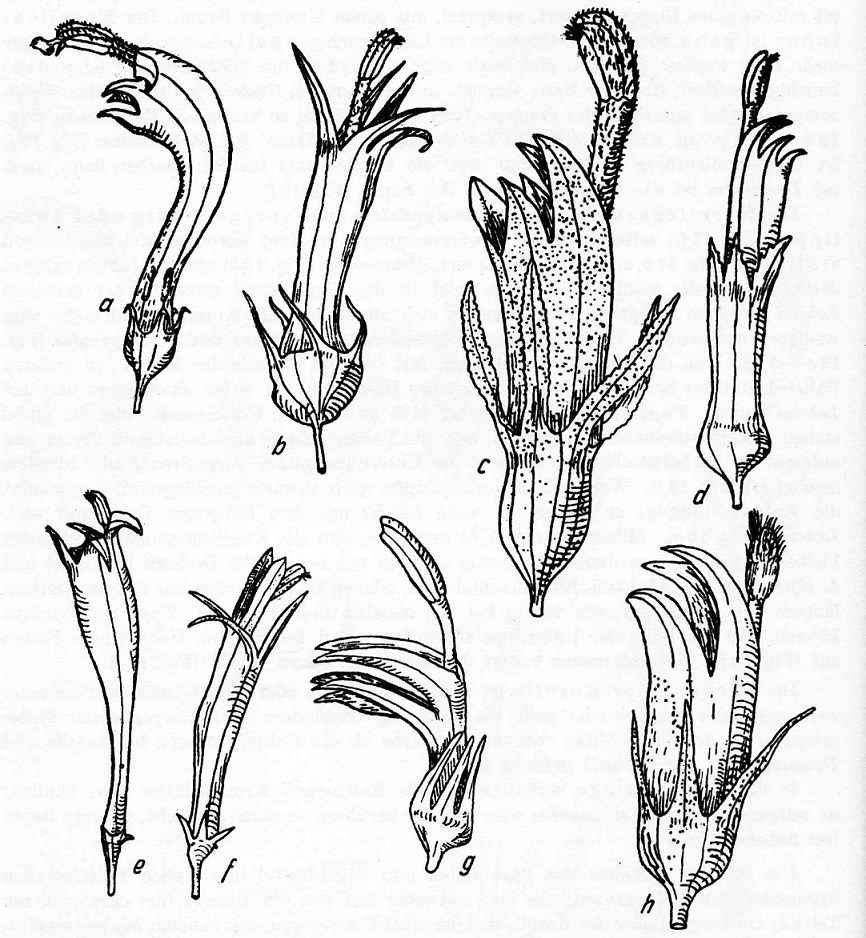
Fig. 12. a Centropogon loretensis E. Wimm. — b C belliflorus E. Wimm. — c C. Brittonianus A. Zahlbr. — d C. caligatus E. Wimm. — e Siphocampylus fulgens Leb. — f S. Planchonis E. Wimm. — g S. Weberbaueri A. Zahlbr. — h S. albus E. Wimm., omnes 1/1. — Orig.
Page 17
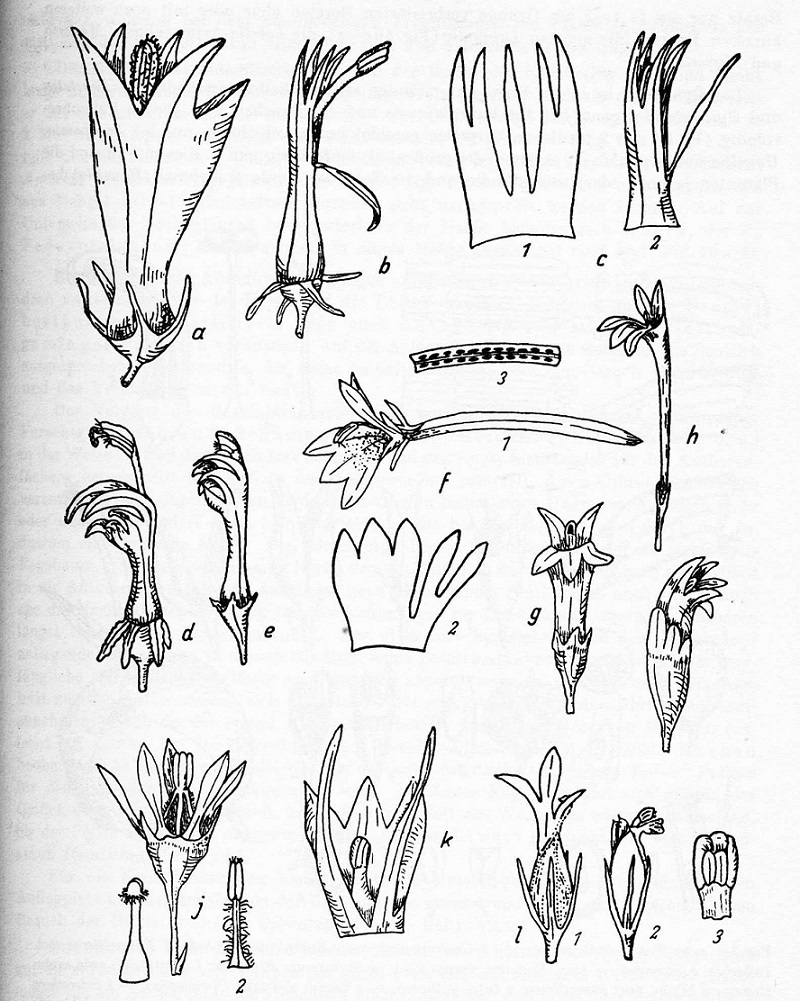
Fig. 13 a Siphocampylus niveus (W.) Vatke, 1/1. — b S. Sceptrum Decne. 1/1. — c S. corynoides E. Wimm. 1/1. 1-2 Corolla. — d Burmeistera refracta E. Wimm. 1/1. — e B. lignescens E. Wimm. 1/1. — f Downingia elegans (Dougl.) Torr. 1 Flos cum germine elongato 1/1, 2 corolla aperta, aucta, 3 sectio longitud. partis germinis. — g Lysipomia pumila (Wedd.) E. Wimm. 2/1. — h L. linearifolia E. Wimm. ca. 1/1 — i L. acaulis HBK. 4/1. — j Dialypetalum floribundum Benth. 4/1 1 Stylus cum stigmate et pilorum collectorum annulo, 2 stamen. — k Phyllocharis Schlechteri Diels 4/1. — l Diastatea micrantha (HBK) McVaugh 6/1. 1 Flos, 2 capsula a flore emarcido inclusa, 3 antherae 10/1. — fig. k sec. Diels, reliquae orig.
Page 18
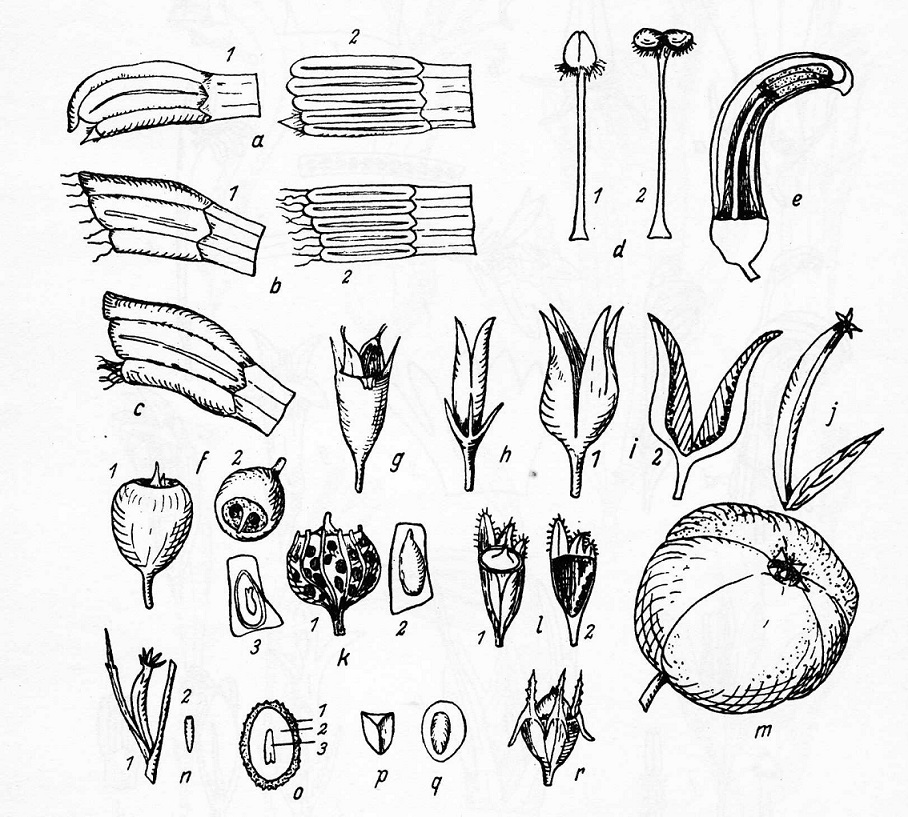
Fig. 14 a-c Tubus antherarum: 1-2 Centropogonis sect. Eucentropogon; b 1-2 Burmeisterae sect. Imberbes; c Burmeisterae sect. Barbatae, omnes auct. d Stylus cum stigmate: 1 capitiformi ante evolutionem, 2 bilobo post exsertionem e tubo anthereo. — e Sectio alabastri Clermontiae. — f Sclerotheca arborea (Forst.) A.DC. Capsula visa a latere, 2 a summo, 1/1. — g Capsula, 2 valvis loculicide dehiscens Lobelia Erinus L., aucta. — h Diastatea virgata Scheidw. 2/1. — i Apetahia Margaretae (F. Brown) E. Wimm. 1/1, 2 capsula dissecta. — j Grammatotecha erinoides (L.) Sond. Fructus, ca. 1/1. — k Trematolobelia macrostachys (Hook. & Arn.) A. Zahlbr. 1 Capsula 1/1, 2 Semen 10/1, 3 Semens dissectum. — l Lysipomia sphagnophila Griseb. 3/1, 2 capsula dissecta. — m Burmeistera glauca E. Wimm. Bacca inflata 1/1. — n Howellia aquatilis A. Gray, 1 fructus, 2 semen, parum auct. — o Semen Lobeliae inflatae L. dissectum 15/1. 1 Testa, 2 endospermium, 3 embryo. — p Semen transverse dissectum Lobeliae gibbosae L. 10/1. — q Lobelia exaltata Pohl, semen alatum, 10/1. — r L. Claytoniana Michx. (should be L. spicata var. leptostachys (A.DC.)McVaugh, cf. supplement), Capsula, ampl. 2/1. — Orig.
Page 19
|
Das Gynäzeum ist in der Regel unterständig, seltener halbunterständig, bei Diastatea und Cyrtandroidea ganz, bei Lobelia xalapensis und L. Chevalieri zum großen Teil oberständig. Es ist aus 2 medianen Carpellen gebildet und zweifächerig, nur bei Lysipomia, Howellia und Apetahia ist es ganz oder großenteils einfächerig und in diesem Fall sind die Plazenten (grund- oder) wandständig und die Zahl der Ovula manchmal (Howellia) beschränkt, während bei dem zweifächeriigen Fruchtknoten die Plazenten beiderseits der mittelständigen Scheidewand angeheftet sind und zahlreiche Ovula tragen. |
The gynoecium is usually inferior, rarely semi-inferior, in Diastatea and Cyrtandroidea entirely, in Lobelia xalapensis and L. Chevalieri almost entirely superior. The carpels are central and bi-locular, only in Lysipomia, Howellia and Apetahia is the gynoecium largely unilocular and, in this case, the placentas (basal- or) marginal and the number of ovules sometimes limited (Howellia), while in the bi-carpellate ovary, the placentation is axile on both sides of a mid-sized partition with numerous ovules. |
|
Der Griffel ist fadenförmig, trägt an der Spitze die Narbe (Fig. 14 d) und bleibt lange in der Staubgefäßröhre verborgen (Fig. 14 e). Erst im Verlaufe des Blühens tritt er aus der Antherenröhre hervor und die vorher kopfförmige Narbe spaltet sich nun in 2 Narbenlappen von meist rundlicher Gestalt; bei Monopsis (Fig. 10 a 5-6, b 3-4) teilt sich die Narbe in 2 längere fadenförmige Schenkel, die sich spiralig zurückrollen; Apetahia raiateensis dagegen soll die kopfförmige Narbe beibehalten, eine Angabe, die aus Mangel an gut entwickeltem Material nicht nachgeprüft werden konnte. Auf der Unterseite der Narbenlappen oder unterhalb der Narbe befinden sich Haare, die als Fegevorrichtung dienen und oft in einem Ringe angeordnet sind (vgl. Fig. 10 a, b). |
The style is thread-like with a stigma at the top (Fig. 14 d) and remains long hidden in the stamen tube (Fig. 14 e). Only in the course of flowering does it emerge from the anther tube and the previously head-shaped stigma splits into 2 lobes of usually roundish shape; in Monopsis (Fig 10 a 5-6, b 3-4) the stigma is divided into two long thread-like limbs, the back curls up spirally; on the contrary, Apetahia raiateensis maintains the head-shaped stigma, a statement that could not be verified due to lack of well-developed material. On the underside of the stigma lobes or below the stigma are hairs that serve as a sweeping device and often arranged in a ring (see Fig. 10 a,b). |
|
Bestäubung. Mit Ausnahme von einigen zweihäusigen Pratia-Arten sind alle Lobelioideen zwitterblütig. In der Regel sind die Blüten derselben dichogam und für Fremd-bestäubung eingerichtet, wenn auch Autogamie oder zumindest Geitonogamie gelegentlich vorkommt. Auf die Anlage für Xenogamie weist hin die deutlich ausgesprochene Proterandrie, die meist lebhafte Färbung und der Geruch vieler Blüten und das Vorhandensein von Nektar. |
Pollination. With the exception of some dioecious Pratia spp., all Lobeliads are hermaphroditic. In general, the flowers are the similarly arranged dichogamous and cross-pollinated, although autogamy or at least geitonogamy. Promoting allogamy are the marked proandry, the smell of many flowers and the presence of nectar. |
|
Der Vorgang der Bestäubung spielt sich nach den Beobachtungen verschiedener Forscher (Hildebrand, Schumann, Elliot, C. Reiche, Johow, Meehan u.a.) in der Weise ab daß der Pollen fast noch während des Knospenzustandes aus den Antheren-fächern herausquillt und sich in der Antherenröhre sammelt, deren Öffnung anfänglich verengt und auch durch die am Ende der Antheren befindlichen Haare am Ausfallen mehr oder weniger behindert wird, eine Einrichtung, die bei den Goodeniaceen durch das Indusium eine Analogie findet. Die zweilappige Narbe hat unterseits oder an ihrer Basis Fegehaare. Die noch geschlossene Narbe dringt allmählich durch Verlängerung des Griffels in die Antherenröhre vor und kehrt den noch vorhandenen Blütenstaub nach außen, noch ehe die Narbe konzeptionsfähig ist. Sie kommt erst zur Entwicklung, wenn die Antheren längst ihren Pollen abgegeben haben. Der etwa zurückgebliebene und dem Narbenkopf anliegende Pollen kann in diesem Stadium keine Selbstbestäubung bewirken, da die empfängliche Narbenfläche vorläufig noch gänzlich abgeschlossen ist und erst nach dem Austritt aus der Antherenröhre sich entfaltet. Jetzt erst ist sie fähig, den Blütenstaub aufzunehmen. Doch da der eigene Blütenstaub bereits ausgefallen oder von Insekten entfernt ist, kommt für die Befruchtung nur fremder Blütenstaub in Betracht. Meehan beobachtete an Lobelia cardinalis, daß bei der Reife der Antheren stets ein Teil des Pollens für den folgenden Tag zurückgehalten wird. In diesem Fall verlängert sich alsbald der Griffel, dann folgt ein Stillstand, um nach kurzer Zeit das Wachstum wieder fortzusetzen, bis der Pollen so reichlich ausgeworfen wird, daß oft die roten Kronenblätter vom Blütenstaub förmlich bedeckt sind. |
Pollination, according to the observation of various researchers (Hildebrand, Schumann, Elliot, C. Rich, Johow, Meehan and others), in that during the bud state, the pollen almost oozes from the anthers and gathers in the anther tube whose opening narrows initially and is also blocked by the anther hairs at the apices, a device that find analogy in the Goodeniaceae via indusium. The two-lobed stigma has, at their base, sweeping hairs. The still closed stigma gradually penetrates the anther tube by extending the style and pushes the pollen out, before the stigma is receptive. It only comes to development after the anthers have long since given their pollen. The transfer of any residual pollen to the stigmatic head cannot cause self-pollination at this stage because the receptive stigmatic surface is completed and exposed only after exiting the anther-tube. Only then is the stigma able to take up pollen and because its own pollen has already fallen or been taken by insects, fertilization is only made with non-self pollen. Meehan observed in Lobelia cardinalis, that during the maturation of the anthers, a portion of the pollen is retained for the following day. In this case, as the style extends, it stops and then resumes, thus the pollen is so abundantly ejected that the red petals are covered in pollen. |
|
Für die Fremdbestäubung bietet die breite Unterlippe den Insekten einen guten Anflugplatz und der am Grunde der Blumenkrone ausgesonderte Saft einen Anreiz für den Besuch der Blüten und eine Belohnung für die Befruchtung. |
For the cross-pollination, the wide lower lip provides a good insect landing place and the juice exuded at the base of the corolla an incentive for visiting the flower and a reward for fertilization. |
|
Autogamie kann dadurch eintreten, daß ein etwa haften gebliebener Blütenstaub auf die zurückgeschlagenen Lappen der leicht nach abwärts geneigten Narbe fällt. Dabei mögen die am Antherenmunde stehenden Haare mithelfen, daß nicht aller Pollen sogleich entfernt wird, sondern für eine etwa notwendige Selbstbestäubung zurückgehalten wird. Reiche fand, daß Downingia pusilla, Lobelia alata und Pratia repens, die rötliche bis weißliche Blüten besitzen, autogam sind oder höchstens schwach geitonogam. Ebenso berichtet Nils über Lobelia Dortmanna, daß dieselbe autogam ist Dabei tritt hier oft die Narbe niemals aus der Antherenröhre heraus. Die Befruchtung erfolgt dadurch, daß der Pollen zwischen die innerhalb der Antherenröhre geöffneten Narbenlappen eindringt. Bisweilen vollzieht sich die Befruchtung schon innerhalb der geschossenen Blüte, besonders bei den Unterwasserblüten, die jedoch später geöffnet werden. Auch wenn die Narbe später heraustreten sollte, findet kaum eine Bestäubung statt, da sie von Insekten kaum besucht werden. Die stattgehabt Befruchtung zeigt die Pflanze an, indem sich die Stiele der Unterwasserblüten nach oben, die der Oberwasserblüten stark bogenförmig nach unten richten. |
Autogamy may occur in that some retained pollen may adhere to the slightly downward inclined, folded-back flap of the stigma. This aids, like the hairs on the anthers, in that not all pollen is immediately removed, but some is retained for self-pollination when necessary. Reiche found that in Downingia pusilla, Lobelia alata und Pratia repens, the reddish to white flowers are autogamous, or at most slightly geitonogamous. Likewise, Nils reports that Lobelia dortmanna is similarly autogamous, often forming the stigma prior to leaving the anther tube. Fertilization takes place when the pollen lands on the open stigma lobes between the anthers. Sometimes fertilization takes place when the flower is still closed, especially in the underwater flowers which open later. Although the stigma does emerge later, pollination rarely takes place as they are only rarely visited by insects. The place of the fertilization is indicated by the stems of the flowers which point upward for underwater flowers and are strongly curved downwards for abovewater flowers. |
Page 20
|
Etwas anders als die übrigen Lobelioideen verhalten sich die zu Monopsis gehörigen Arten. Urban hat bei diesem Genus Homogamie festgestellt. Die Blüten sind nicht resupiniert, sodaß hier die zweilippige Korolle eine 3-spaltige Oberlippe und eine 2-teilige Unterlippe hat. Die Staminalröhre ragt zur Hälfte aus der Kronenröhre heraus. Die Narben sind hier nicht rundlich bis eiförmig, sondern fadenförmig verlängert Sie treten schon beim Aufblühen aus der Antherenröhre heraus und rollen sich bald spiralig um. Dabei befindet sich der tellerförmige Haarring des Griffels am Grunde der Antherenröhre. Beim Besuch eines Insektes wird die Staminalröhre nach abwärts gedrückt, dadurch der unten S-förmig gebogene Griffel gestreckt und die Narbe weiter emporgeschoben, so daß der Haarkranz den in der Antherenröhre liegenden Pollen herauspreßt (Monopsis lutea), oder der Griffel wächst so schnell, daß die Narbe samt dem dden Pollen herausfegenden Haarring bald aus der Antherenröhre hervortritt. Dabei rollen sich die Narbenschenkel so starkzurück, daß die Pollenkörner, die am Haarring haften blieben, berührt werden müssen (Monopsis simplex). Daraus geht hervor, daß bei Monopsis sowohl Fremdbestäubung durch Insekten als auch bei fehlendem Insektenbesuch Selbstbestäubung stattfinden kann. |
Monopsis behaves differently than the other Lobeliads. Urban has found homogamy in this genus. The flowers are not resupinate, so here the lower lip is double lobed and the upper lip is 3-lobed. The staminal tube protrudes halfway out of the corolla tube. The stigma are not circular to ovoid, but rather thread-like and elongated, rolling and spiralling, contacting the anthers during flowering. A plate-shaped ring of hairs surrounds the style at the base of the anthers. When an insect visits, the staminal column is pressed downwards, thereby stretching the curved, S-shaped style and the stigma is pushed upwards so that the hair ring lying in the pollen is squeezed (Monopsis lutea), or the style grows so quickly that the stigma together with the pollen from the swept from the ring of hairs soon emerges from the anther tube. Here, the stigmas roll back so strongly that the pollen grains, adhered to the ring of hairs will be touched (Monopsis simplex). It is evident that in Monopsis, cross-pollination by insects can occur as well as self-pollination in the absence of insects. |
| Die durch ihre häufig nicht resupinierten Blüten der Monopsis etwas näher stehende Lobelia thermalis weicht nach Urban in der Befruchtung von den übrigen Lobelia nicht ab. | The non-resupination of the flowers of Monopsis somewhat similar to Lobelia thermalis does not differ in the fertilization of the other Lobelia according to Urban. |
|
Darwin fand Lobelia cardinalis zum Teil unfruchtbar vor, zum Teil von Hummeln besucht und fruchtbar. Er schloß daraus auf die Notwendigkeit der Fremdbestäubung für die Fruchtbarkeit der Lobelien. Darauf scheint auch der Bau der Antherenröhre hinzudeuten, die Verdickungsleisen an verholzten Parenchymzellen aufweist, was als Anpassung an den Besuch schwerer Bestäuber gedeutet wird (Reiche). |
Darwin observed a barren Lobelia cardinalis visited by bumblebees become fruitful. He concluded the need for cross-pollination for the fertility of Lobeliads. Plus the construction of the anthers includes thickening by woody parenchyma cells, which suggests an adaptation to visits by heavy pollinators (Reiche). |
|
Als Bestäuber der Lobelioideen kommen in Betracht von den Insekten verschiedene Apiden (Ceratina dupla, Megachile brevis, Alcidamea producta, Apis mellifica, Xylocopa virginica, Halictus connexus, Andrena u.a.), Bombyliden (z.B. Bombus americanorum, B. fervidus, B. pensylvanicus), Scolia dubia und Lepidopteren (z. B. Pieris protodice, P. rapae, Chrysophanus thoe, Ancyloxypha numitor, Pamphila peckius, P. cernes, Papilio philenor, P. troilus). Natürlich kommen auch hier Fälle vor, wo gewisse Insekten aus lauter Geschäftigkeit den natürlichen Zugang zum Nektar hintansetzen und den Nektar durch anbiß der Kronenröhre oder durch den Rückenspalt holen, ohne die Pflanze zu bestäuben. So wurde dies beobachtet bei Lobelia cardinalis, wo Bombus americanorum, Augochlora pura und Halictus connexus als Nektarräuber auftraten. |
Amongst the insect pollinators of Lobeliads are Apiden (Ceratina dupla, Megachile brevis, Alcidamea producta, Apis mellifica, Xylocopa virginica, Halictus connexus, Andrena et al.), Bombyliden (e.g. Bombus americanorum, B. fervidus, B. pensylvanicus), Scolia dubia and Lepidopteren (e.g. Pieris protodice, P. rapae, Chrysophanus thoe, Ancyloxypha numitor, Pamphila peckius, P. cernes, Papilio philenor, P. troilus). Of course, there are cases where certain insects in their busyness and disregard bypass the natural access to the nectar and get it by biting the corolla tube or through the dorsal gap and thus do not effect pollination of the plant. This has been observed in Lobelia cardinalis, where Bombus americanorum, Augochlora pura and Halictus connexus are the nectar robbers. |
|
Fast alle großblütigen Lobelioideen sind typische Vogelblumen und auf die Bestäubung hauptsächlich durch Vögel angewiesen. Zu diesen Gattungen gehören vorzüglich Siphocampylus, Centropogon, Burmeistera, Tupa großenteils, Delissea, Cyanea, Clermontia, Rollandia und einige Pratia-Arten. Die Blüten dieser Genera messen 2 bis 8 cm, sind oft sehr engröhrig, wenigstens im unteren Teile (Kaum 2 mm in Durchmesser) und mehr oder weniger stark gebogen, manchmal fast im rechten Winkel (Siphocampylus dossennus), selten gerade und weitröhrig (Siphocampylus albus, S. umbellatus), und die Unterlippe oft nach abwärts geschlagen oder mehr oder weniger zurückgerollt, so daß die Blüte für den Anflug der Besucher kaum eine rechte Stütze bietet und mehr für Bestäuber eingerichtet erscheint, die den Blütensaft im Schwebeflug herausholen. Der Blütenfarbe nach snd die Gattungen und Arten recht verschieden. Während bei Burmeistera grünliche und gelbgrünliche Blüten vorherrschen, sind bei Centropogon und Siphocampylus Rot in allen abstufungen, Violett, Rotgelb, Doppelfarbe (Röhre rot, Saum gelb oder grün) die Hauptfarben. Bei Lobelia ist Blau (hell- bis dunkelblau, stahlblau, oft mit anders gefärbtem Schlund), seltener Rot oder Violett vorherrschend. Bei den auf Hawaii endemischen 4 Genera ist hauptsächlich weiß und purpurn in verschiedene Abstufungen vertreten (Näheres bei Porsch, Vogelblumenstudien, und Kritische Quellenstudien über blumenbesuch durch Vögel). |
Almost all large-flowered Lobeliads are typical bird flowers and rely mainly on bird pollination. These genera include principally Siphocampylus, Centropogon, Burmeistera, Tupa to some extent, Delissea, Cyanea, Clermontia, Rollandia and some Pratia species. The flowers of the genera measure 2 to 8 cm, quite tubular, at least in the lower parts (less than 2 mm in diameter) and more or less strongly curved, sometimes almost to a right angle (Siphocampylus dossennus), rarely straight or wide-tubular (Siphocampylus albus, S. umbellatus), the ower lip often pushed downward or more or less rolled back so that the flower hardly has a good support for visitors landing and appear more adapted for pollinators to draw the nectar while hovering. The flower color differs by genera and species. In Burmeistera greenish-yellow and greenish flowers prevail which in Centropogon and Siphocampyus red (tube red, yellow or green lobes), violet, reddish yellow, and double color gradations are the principal coloration patterns. In Lobelia, blues (light to dark blue, steel blue, often with different colored throats) predominate, rarely red or purple. In the four endemic Hawaiian genera, the flowers are mainly found in different shades of whites and purples (details in Porsch, Vogelblumenstudien and Kritische Quellenstudien über blumenbesuch durch Vögel). |
Page 21
|
Merkwürdig mutet es an, daß, wie Meehan beobachtete, dort, wo die blaublühende Lobelia syhilitica und die scharlachrotblühende Lobelia cardinalis nebeneinander wuchsen, die blaublühende Pflanze häufig von Insekten beflogen wurde, während die Lobelie mit roten Blüten nur von Kolibris, aber nicht von Insekten besucht wurde. Bezüglich der Fruchtbarkeit wurde kein Unterschied bemerkt. Elliot fand ebenfalls, daß L. cardinalis von Trochilus colubris, überdies aber auch von Lepidopteren und Bombus americanorum beflogen wurde, während die nicht seltene Hybride zwischen dieser und L. syphilitica nicht von Kolibris, sondern nur von Insekten aufgesucht wurde, letztere also allein für die Hybridiszation der beiden Arten sorgen. |
Strangely, Meehan observed blue flowering Lobelia syphitica and scarlet-red Lobelia cardinalis growing next to each other and the blue-flowering plant was often visited by insects, while the red-flowering lobelia only by hummingbirds and not by insects. As to fertility, no difference was noted. Elliot observed that L. cardinalis was visited by Trochilus colubris as well as by lepidopterans and Bombus americanorum while rare hybrids between this and L. syphilitca were not visited by hummingbirds, but only by insects, so this latter category is the only possibility for hybridization between the two species. |
|
Frucht, Same und Keimung. Die Früchte der Lobelioideen entstehen aus dem fast durchwegs unterständigen Fruchtknoten, der aus zwei Karpellen gebildet und in der Regel auch zweifächerig ist, doch kommen auch vollständig und mehr oder weniger unvollstänndig einfächerige Früchte vor. Durch vollkommen oberständige Früchte zeichnen sich Diastatea und Cyrtandroidea aus; fast ganz oder großenteils oberständige Frucht hat auch Lobelia xalapensis und L. Chevalieri, wohl die einzigen Arten von allen Lobeliae, und einige Siphocampylus. Mit Ausnahme dieser oberständigen Früchte ist die Frucht mit der Kelchröhre stets ± verwachsen. Diese wird von 10 Längsnerven durchzogen, von denen meist 5 stärker hervortreten, so daß die Frucht häutig 5-, seltener big 10-rippig oder 5- bis 10-furchig erscheint, wobei die Rippen öfter auffällig anders gefärbt sind als das dazwischen liegende Gewebe (Fig. 15, 16). |
Fruit, seed and germination. The Fruits of the Lobeliads arise almost always from inferior ovaries, which are usually bilocular formed by two carpels, but also completely, or nearly so, unilocular fruits. Diastatea and Cyrtandroidea are distinguished by their superior ovaries; superior or nearly superior ovaries are also found in Lobelia xalapensis and L. chevalieri and some Siphocampylus, probably the only examples in all of Lobeliae Except for those with superior ovaries, the fruit grows ± with the calyx tube. This is crossed by 10 longitudinal nerves of which 5 are more prominent; the fruit is 5-membranous with 5-, rarely 10-ribs or 5- to 10-furrows with the ribs often dyed strikingly different from the intervening tissue (Fig. 15, 16). (cf. supplement) |
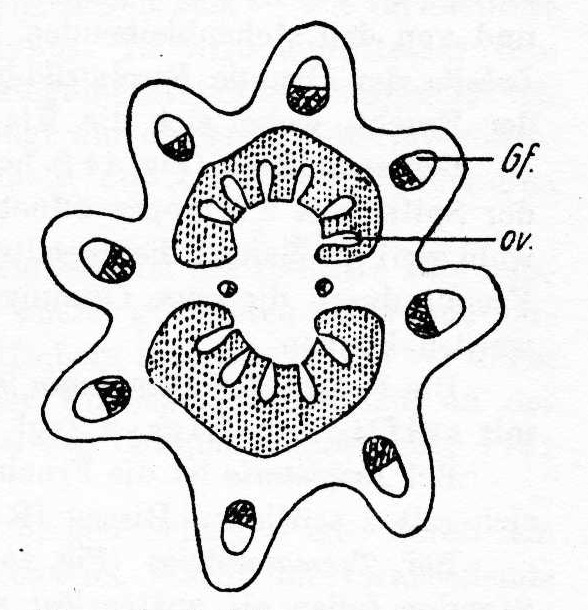 Fig. 15. Lobelia urens L. Querschnitt durch die Frucht. Gf Gefäßbündel.
Ov Samenanlagen. |
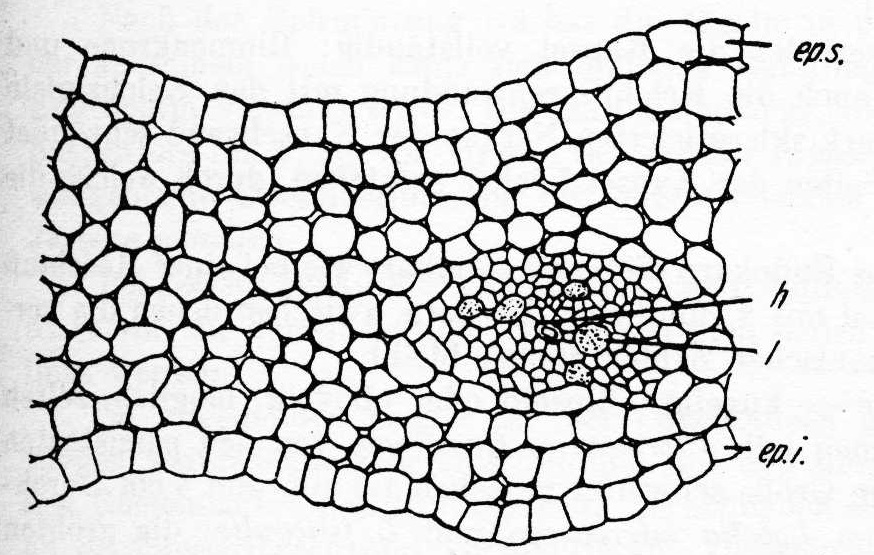 Fig. 16. Lobelia urens L. Querschnitt durch die Fruchtscheidewand. ep.s opere
Epidermis,
h Xylem, l Milchsaftgefäße, ep.i untere Epidermis (nach Ydrac). |
|
Die Früchte lassen sich in 2 Gruppen einordnen: 1. Beeren, deren Wand mehr oder weniger fleischig ist und die einen Saft enthalten, der in manchen Fällen angenehm süß schmeckt, so bei Centropogon cornutus und C. vinosus, weswegen dieselben auch gegessen werden. 2. Kapselfrüchte, die a) mit 2 endständigen Klappen aufspringen oder b) mit seitlichen Rissen oder c) mit rundlichen Löchern sich öffnen, oder d) mit einem runden Deckel an der Spitze aufspringen. |
The fruits can be divided into two distinct categorieis: 1 Berries, which are more or less fleshy and contain a juice that tastes pleasantly sweet in some cases, as with Centropogon cornutus and C. vinosus, which are, therefore, eaten. 2) Capsular fruits that a) dehisce via two terminal flaps or b) via lateral slits or c) openings with round holes or d) a round lid at the top. |
|
Wie schon bemerkt, sind die Früchte meist zweifächerig; zu den Gattungen mit einfächerigen Früchten gehören Apetahia mit unterständiger an der Spitze mit 2-4 Klappen aufspringender Kapsel; Howellia, deren Kapsel mit einem seitlichen Risse (nach Greene) aufspringt; endlich Lysipomia mit einer Kapsel (Büchse), die mit einem halbkugelig gewölbten Deckel an der Spitze aufspringt. Die Scheidewand fehlt meist ganz, die Samen sind an einer grundständigen zentralen Placenta befestigt oder meist wandständig. |
As previously noted, the fruits are typically bilocular, however, the genera with unilocular fruits are: Apetahia which is always inferior ands has a 2-4 flapped, dehiscing capsule; Howellia whose capsule pops open via a lateral valves (according to Greene); and finally Lysipomia with a capsule that springs open with a hemispherical domed apical lid (Büchse). The septum is usually missing completely, the seeds are attached to a basal, central placenta or mostly parietal. |
Page 22
|
Von den übrigen Gattungen haben eine zweifächerige, unterständige Beere zur Frucht: Clermontia, Cyanea, Delissea, Rollandia, Centropogon, Burmeistera (Fig. 14 m), Pratia und Hypsela (Fig. 14 h). Die Angabe Presls, daß bei Hypsela die Scheidewand unvollständig, nur an der Basis und Spitze befestigt, am Rande aber frei ist, konnte ich nicht bestätigt finden. Sie gleicht vielmehr ganz der Beere einer Pratia. |
In the bilocular genera, those that always have inferior berries are: Clermontia, Cyanea, Delissea, Rollandia, Centropogon, Burmeistera (Fig. 14 m), Pratia and Hypsela (Fig. 14 h). Presl found that the Hypsela septum in incomplete, attached only at the base and apex, but the edge is free, I cannot confirm this, but rather found it to be like the berry of a Pratia. |
|
Bei Cyrtandroidea ist nach Forest Brown die Frucht eine oberständige Beere. |
In Cyrtandroidea, according to Forest Brown, the fruit is always a superior berry. |
|
Bei Siphocampylus, Lobelia, Laurentia, Diastatea, Heterotoma, Monopsis, Dialypetalum und Phyllocharis ist die Frucht unterständig und springt mit 2 terminalen Klappenfachspaltigauf, wobei sich die Klappen nur bis zur Mitte der Frucht trenne und von den stehenbleibenden Kelchzipfeln umgeben sind (Fig. 10 d2). Nur bei einigen Lobelia der Gruppe Revolutella geht die Trennung der Klappen schließlich bis zu Grund der Frucht, wobei sich die Klappen der Länge nach noch einmal spalten. |
In Siphocampylus, Lobelia, Laurentia, Diastatea, Heterotoma, Monopsis, Dialypetalum and Phyllocharis the fruit is inferior and dehisces with two terminal flaps, with the flaps separating only to the middle of the fruit and surrounded by the permanent calyx lobes (Fig. 10 d 2). Only in some Lobelia of the Revolutella group where the separation of the valves is complete to the base of the fruit, with the flaps split lengthwise again. |
|
Grammatotheca (Fig. 14 j) hat eine sitzende, lineare Frucht, die such zuerst an der Spitze mit 2 Klappen öffnet und später auch an den Seiten der Länge nach aufreißt, wohl weil die Samen, beiderseits der Scheidewand in 2 Reihen stehend, bei der Länge der Frucht durch die enge Öffnung an der Spitze nicht oder nur sehr langsam ausgestreut werden können. |
Grammatotheca (Fig. 14 j) has a sedentary, linear fruit that first opens at the top with 2 flaps and later tears lengthwise at the sides, probably because the seeds which are arranged lengthwise in 2 rows on both sides of the septum would only be very slowly scattered if they dispersed only through a narrow apical opening. |
|
Die Frucht der Downingia ist ebenfalls sitzend und langlinear, sie öffnet sich aber nur mit seitlichen Rissen (vgl. Fig. 13 f.). |
The fruit of Downingia is similarly sedentary and long-linear, but it opens only with lateral slits (see Fig. 13 f). |
|
Bei Brighamia ist die Frucht zuerst fleischig, wird aber schließlich trocken und öffnet sich mit 2 seitlichen Rissen (Rock). |
In Brighamia, the fruit is at first fleshy, but eventually drying and opening via two lateral slits (Rock). |
|
Bei Trematolobelia (Fig. 14 k) verholzt die Kapsel vollständig; Blumenkrone und Stamina fallen ab, später löst sich auch die Kelchröhrenwandung mit den Kelchzipfeln los und das Gewebe zwischen den stark sklerotisierten Nerven der Kapselwand schwindet allmählich, so daß dadurch an den Seiten der Kapsel Löcher entstehen, durch welche die Samen ins Freie gelangen können. |
In Trematolobelia (Fig. 14 k) the capsule is entirely woody; the corolla and stamens fall off, then the calyx tube walls dissolves, thus with the calyx lobes missing and the disappearing tissue between the strongly sclerotic capsule wall nerves, holes arise on the sides of the capsule through which the seeds are dispersed. |
|
Bei Sclerotheca (Fig. 14 f) wird das Endokarp dick und steinhart wie bei einer Haselnuß und öffnet sich schließlich am Scheitel mit 2 rundlichen Löchern, zwischen denen die verhärtete Basis des Griffels wie ein konischer Zapfen stehen bleibt. |
In Sclerotheca (Fig. 14 f) the endocarp is thick and rock hard like a hazelnut and opens apically via two rounded holes, between which the hardened base of the style remains as a conical pin. |
|
Der Form nach sind die Früchte ± kugelig, ellipsoid oder obovoid, länglich, selten langlineal und mit wenigen Ausnahmen (alle Clermontiae Genuinae) von den persistenten Segmenten des Kelches gekrönt. Ihre Größe schwankt zwischen 1,5 mm und 4 cm Durchmesser. Die kleinsten Früchte haben Lobelia microcapra und L. filicaulis; die Größten Früchte finden sich bei Clermontia und Burmeistera. Nicht selten sind die Früchte schön gefärbt, besonders die beerenartigen, gelb, orangerot, violett, purpurn, ohne Zweifel zu dem Zwecke, um Vögel anzulocken und so für ihre Verbreitung zu sorgen. Das Vorkommen zahlreicher Epiphyten aus der Reihe der Bacciferae ist darauf zurückzuführen. |
In form, the fruits are ± spherical, ellipsoid or obovoid, rarely long-linear and with a few exceptions (all Clermontiae Genuinae) crowned with the persistent lobes of the calyx. The size varies between 1.5 mm and 4 cm diameter. The smallest are Lobelia microcarpa and L. filicaulis; the biggest fruits are found in Clermontia and Burmeistera. Not infrequetly, the fruits are beautifully colored, especially the berry-like, in yellows, oranges, violets and purples, no doubt for the purpose of attracting birds and thus ensuring their dissemination. Similarly, this explains the occurrence of numerous epiphytes. |
|
Besondere Hilfsmittel zur Verbreitung der Früchte sind nicht ausgebildet. Wohl aber gestatten manche verholzte Früchte und besonders die bei vielen Burmeistera vorkommenden stark aufgeblasenen und lufthaltigen Beeren, daß sie vom Winde leicht entführt und auf dem Wasser sich lange schwimmend erhalten können und so für die Verbreitung der Arten mitwirken. Bei den saftigen und fleischigen Früchten kommt, wie schon bemerkt, hauptsächlich die Verbreitung derselben durch Vögel in Betracht, denen die Beeren zur Nahrung dienen. |
Special means for disseminating the fruits are not formed. But some woody fruits, especially in many Burmeistera, are greatly inflated and some berry can float on the water or can be slightly abducted by the wind and thus assist in the distribution of the species. The juicy and fleshy fruit, as already mentioned, are disseminated by birds which use the berries for food. |
|
Die Samen sind durchwegs klein (0,3-1 mm, sehr selten etwas größer, nur Howellia aquatilis hat is 3 mm lange Samen), meist ellipsoid und etwas zusammengedrückt, seltener rundlich oder linsenförmig oder dreikantig oder geflügelt oder unregelmäßig-viereckig plattenartig. Ihre Schale ist häutig oder krustig, glatt und glänzend oder sehr fein netziggrubig, seltener rauh und mit Wärzchen bedeckt (so nur nordamerikanische Lobeliae) oder quer-wellig-runzelig und weißlich (nur bei Delissea). Sonst ist deren Farbe meist braun, seltener schwarzbraun bis fahlgelb. die Testa wird aus einer einzigen Zellschicht gebildet. Die Zellen sind in der Regel langgestreckt-polygonal oder isodiametrisch-polygonal, haben dicke, sehr fein durchbohrte Wandungen und sind in Längsreihen geordnet. |
The seeds are all small (0.3-1 mm, very rarely somewhat larger, only Howellia aquatilis has a seeds that reaches 3 mm, mostly ellipsoid and slightly compessed, rarely rounded or lenticular or triangular or winged or irregularly-quadrangular plate-like. Their surface is membranous or crusty, smooth or shiny or very finely reticular-pitted, rarely rough with warts (only the North American Lobeliae) or cross-wavy-wrinkled and whitish (only Delissea). Otherwise, the color is usually brown, rarely black-brown to pale yellow. The testa is formed from a single layer of cells. The cells are usually elongated-polygonal or rounded or angular-polygonal, and have thick, very finely pierced walls and are arranged in longitudinal rows. |
Page 23
|
Das Nährgewebe besteht aus verhältnismäßig großen polygonalen Zellen, ist fleischig und fettreich und umschließt in der Mitte den geraden, mit 2 rundlichen Kotyledonen ausgestatteten Embryo. |
The endosperm consists of relatively large polygonal cells, is fleshy and rich in fats and fills the middle with two rounded cotyledon embryos. |
|
Bezugs der Embryologie liegen Angaben vor über Lobelia, Pratia und Laurentia. |
Information concerning embryology is available for Lobelia, Pratia und Laurentia. |
|
Die Pollenkörner entwickeln sich in normaler Weise. Zur Zeit der Befruchtung sind sie bei Lobelia sp. zweikernig (Schnarf). |
The pollen grains develop normally. At the time of fertilization, in Lobelia spp., they are binucleate (Schnarf). |
|
Die Samenanlage ist anatrop, tenuinucellat und zeigt ein mäßig dickes Integument. Im Nucellus wird eine einzige primäre Archesporzelle ohne bildung einer Deckzelle zur Embryosackmutterzelle. Der ausgebildete Embryosack entwickelt sich — wie für mehrere Lobelia-Arten festgestellt wurde — nach dem Normaltypus. Es wird unmittelbar vom Integument umschlossen, dessen innere Epidermis als Integumenttapetum ausgebildet ist. Dieses umschließt den Embryosack fast ganz, aus ihm ragt nur dessen erweiterter mikropylarer Teil heraus. Der Eiapparat ist normal entwickelt, die Antipoden degenerieren sehr bald. |
The ovule is anatropous, tenuinucellate and has a moderately thick integument. In the nucellus is a single primary megaspore without formation a top cell to the embryo sac mother cell. The embryo sac develops - as was noted in several Lobelia spp. - as the normal type. It is directly surrounded by the integument, whose inner epidermis is formed at integument tapetum. This surrounds the embryo sac almost entirely, from which only projects the widened micropylar. The egg aparatus develops normally, the antipodes degenerate quickly. |
|
Für Vertreter der Gattungen Lobelia, Pratia und Laurentia ist die zellulare Bildungsweise des Endosperms nachgewiesen. Die Richtung der zuerst gebildeten Zellwände verläuft wie bei den anderen Campanulaceen. Von systematischem Interesse ist die vor allem bei Lobelia genauer beschriebene Ausbildung terminaler Endospermhaustorien, an der sich bei den Lobelioideen nur zwei Endospermkerne, bei den Campuloideen aber vier Kerne beteiligen. |
For members of the genera Lobelia, Pratia and Laurentia the cellular mode of formation of the endosperm has been demonstrated. The direction of the cell walls formed first proceeds as with the other Campanulaceae. For systematic interest especially, in Lobelia, the endosperm haustoria involves only two nuclei in Lobelioideae, whereas there are four in Campanuloideae. |
|
Nach der Befruchtung wächst die Eizelle in einen langen Schlauch aus, durch den der an seinem freien Ende sich bildende Keimling in das im Wachstum vorauseilende endosperm versenkt wird. Die Zellteeilungsfolge, die zur Bildung des Keimlings und des Suspensors führt, ist von Crété bei Lobelia syphilitica genau verfolgt worden. Sie zeigt weitgehende Übereinstimmung mit entsprechenden Befunden bei Campanula patula und Jasione montana. |
After fertilization, the egg grows intoa long tube through which at its free end the forming seedling is submerged in the endosperm. The cell division, leading to the formation of the embryo and suspensor, has been pursued by Crété in Lobelia syphilitica . He showed broad agreement with corresponding findings in Campanula patula and Jasione montana. |
|
Bei Lobelia syphilitica kommt eine eigentümliche, sonst nicht bekannte Polyembryonie vor, die darauf beruht, daß gelegentlich Zellen des Suspensors zu Anlagen des Keimlings werden. |
In Lobelia syphilitica, a peculiar, well-known polyembryony occurs due to occasionally the cells of the suspensors give rise to seedlings. |
|
Im allgemeinen zeigen die bei Lobelioideen gemachten embryologischen Beobach tungen weitgehende übereinstimmung mit den übrigen Subfamilien der Campanulaceen, den Goodeniaceen und Stylidiaceen. Sie schließen sich unter den Sympetalen am nächsten an Scrophulariaceen und Verwandte an. Dagegen erscheinen die Lobelioideen durch eine deutlich ausgeprägte Kluft von den Compositen getrennt (Schnarf). |
In general, the Lobelioideae, in terms of embryology behave broadly the same as the rest of the subfamily Campanuloideae, the Goodeniaceae and the Stylidiaceae. Their closest relatives within the sympetalous plants are the Scrophulariaceae. By contrast, the Lobelioideae have a clear gap to the composites (Schnarf). |
|
Über den Einfluß des Lichtes bei der Keimung der Samen der Lobelia inflata wurden von Muenscher [Journal of Agricult. Research 52 (1936) No. 8, S. 627] Versuche gemacht. Danach läßt sich folgendes feststellen: Die Samen von Lobelia inflata bewahren ihre Keimfähigkeit fast 5 Jahre lang bei trockener Lagerung. Die Keimung, die sonst zwischen dem 9.-20. Tag erfolgt, unterbleibt bei Ausschluß des Lichtes fast gänzlich. Einige tausend Samen wurden in dunkler Kammer, andere im Sonnenlicht zur Keimung ausgesät. Die letzten keimten gut, von den ersten kam kein Same zur Keimung. Samen auf feine Erde im freien Felde obenhin gestreut, keimten nach 16 Tagen, während von den Samen, die 1 cm hoch mit Erde bedeckt wurden, nur 3 keimten. Ähnlich verhielten sich Lobelia cardinalis und L. syphilitica. Dagegen wiesen Lobelia Erinus und L. tenuior fast gleiche Keimungsresultate im Licht und im Dunkel auf. Die Samen von Lobelia Dortmanna und L. Kalmii, zweien Wasserpflanzen, zeigten ein ganz anderes Verhalten. Sie verloren durch Trocknung ihre Keimkraft. Im kalten Raum oder unter Wasser aufbewahrt, keimten nach 15 Tagen von den im Licht aufbewahrten Samen 75%, von den im Dunkeln aufbewahrten Same 57%, von den trocken aufbewahrten Samen jedoch keiner. |
Münscher [Journal of Agricult. Research 52 (1936) No. 8, p. 627] studied the influence of light on the germination of seeds in Lobelia inflata. From that study the following can be established: the seeds of Lobelia inflata preserve their viability for germination for nearly 5 years in dry storage. Germination, otherwise, begins between the 9th to 20th day, except in the absence of light. Several thousand seeds were sown in both dark chambers and in sunlight. The latter germinated well, from the first no seeds germinated. Seeds scattered on the surface of fine soil in the open field germinated after 16 days, while of those covered with 1 cm of soil, only 3 germinated. Lobelia cardinalis and L. syphilitica behaved similarly. By contrast, Lobelia erinus and L. tenuior showed almost identical germination in light and in dark. The seeds of Lobelia dortmanna and L. kalmii, two water plants, showed very different behavior. They lost their ability to germinate after drying. In a cold room or stored under water, 75% of seeds kept in the light germinated after 15 days, 57% of those stored in the dark, but none from those that were dried. |
|
Das Licht wirkt auf das Samen-Innere. Wird von der Samen-Schale viel Licht absorbiert, so gelangt weniger in das Innere des Samens hinein und ist dann die Keimung geringer. Der Keimungsvorgang ist an das Vorhandensein von wenn auch geringen Lichtmengen gebunden. |
The light acts on the inner seed. The seed coat absorbs light, so less passes into the interior of the seed and germination is lower. The germination process is linked to the presence of small amounts of light. |
Page 24
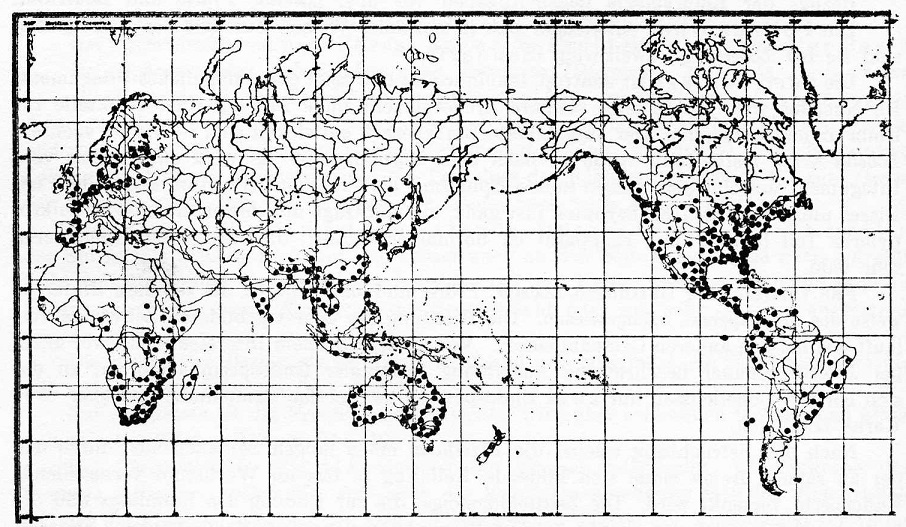 Karte 1. Verbreitung von Lobelia subgen. Lagotis.
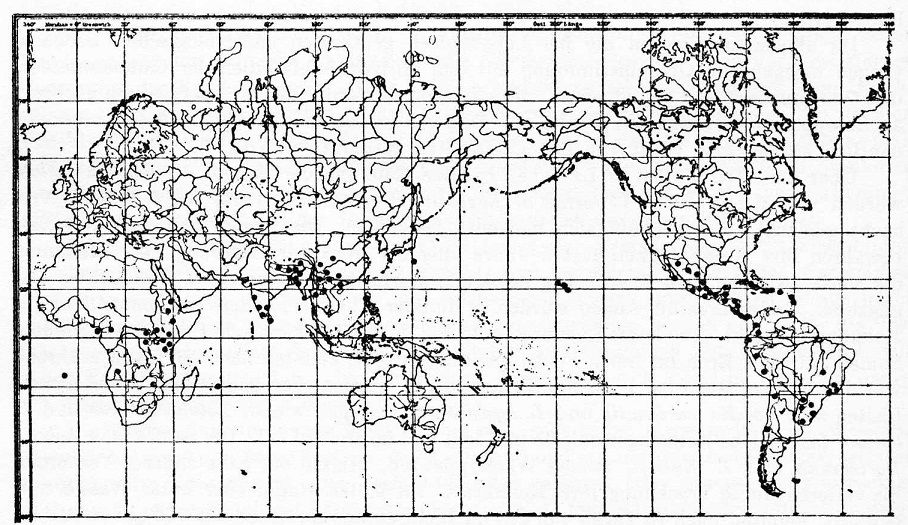 Karte 2. Verbreitung von Lobelia subgen. Tupa.
Page 25
|
Geographische Verbreitung. Die Lobelioideen kommen in allen f¨nf Weltteilen vor. Das Hauptverbreitungsgebiet und wahrscheinlich auch das Ursprungsland derselben ist Amerika, von wo aus sich dieselben in den übrigen Weltteilen, weitergetragen durch Wind und Wellen, angesiedelt haben dürften. Wir finden in Amerika zumindest die Haupttypen fast aller Gattungen, aus denen sich alle übrigen Genera je nach Standort, Bodenbeschaffenheit und Klima in verschiedener Weise weiterentwickelt haben können: Beerentragende und kapselfrüchtige, solche mit geschlossener und solche mit geschlitzter Kronenröhre; zwergige und hohe Kräuter und strauch- bis baumartige Pflanze; es hat die meisten (12) Gattungen und die meisten (über 650) Arten aufzuweisen und dieselben sind über den ganze Kontinent, von Kanada bis zum Kap Horn, verbreitet. 8 dieser Gattungen sind endemisch: Burmeistera und Diastatea (Mittelamerika bis Peru), Centropogon (Mittelamerika bis Bolivia), Siphocampylus (Antillen, Südamerika bis etwa zum 35° s.Br.), Lysipomia (Anden Südamerikas), Heterotoma (Mexiko und südlich angrenzendes Gebiet), Downingia (Californisches Gebiet), Howellia (Californisches Gebiet und Chile). 4 Genera (Lobelia, Laurentia, Pratia und Hypsela) sind weiter verbreitet: Hypsela tritt auch in Australien und Neuseeland auf, Pratia in Africa, Asien und Australien bis zu den Aucklands-Inseln, Laurentia in Afrika und Australien. Lobelia hat die weiteste Verbreitung und wird in allen fünf Weltteilen angetroffen. Ihr Subgenus Lagotis (Verbr. Karte 1) reicht vom südlichen Kanada über die Vereinigten Staaten und Zentralamerika nach Südamerika, geht von dort nach Südafrika über, wo es am reichhaltigsten sich entfaltet, steigt von dort zum tropischen Afrika hinauf und gelangt über Vorderindien und die malaischen Inseln bis Australien. Nach Norden entsendet sie einige Arten über Japan bis nach Sibirien bis etwa zum 58° n.Br., wo nur mehr eine Art gedeiht, die Lobelia sessilifolia Lamb. Mit einer Lücke von Westsibirien bis Ostrußland setzt sich der nördliche Kreis mit Lobelia dortmanna zwischen dem 62. und 52° n. Br. von West-Rußland über Schweden, Nord-Deutschland, Belgien und England fort und endet in Kanada. In der kalten gemäßigten Zone hat Lobelia also nur spärliche Vertreter, während in der gemäßigten, subtropischen und tropischen Zone ihre Arten zahlreich erscheinen. Das Subgenus Tupa der Lobelia dagegen zieht in einem breiten Gürtel fast zwischen den Wendekreisen von den Antillen nach Brasilien und Chile und über das tropische Afrika und Südasien bis zu den Hawaiischen Inseln (Verbr.-Karte 2). Die Zahl der Arten diese Subgenus ist geringer, aber sie sind viel mannigfaltiger entwickelt und erreichen in den "Riesenlobelien" des tropischen Afrika ganz charakteristiche Formen. Nicht weniger merkwürdig sind die Lobelien auf Hawaii, wo die Gruppe der Galeatella (Fig 11 d) eine fast helmförmige Korolle ähnlich der der Burmeisterae erzeugt, während die andere Gruppe der Revolutella (Fig. 11 e-f) in der Form der Korolle den Siphocampylus floribundus zum Vorbild genommen haben mag. Die dritte Gattung, welche in allen fünf Weltteilen vorkommt, ist die der Lobelia nah verwandte Laurentia, deren einzelne Arten meist nur auf ein kleineres Areal beschränkt sind (Verbr.-Karte 3), ausgenommen Laurentia longiflora (L.) Peterm., die auf den Antillen einheimisch ist und von dort aus auf das amerikanische Festland gewandert ist und wahrscheinlich durch die Kultur weiter verschleppt wurde, so nach der Insel Reunion, Ceylon, Java, Malakka und den Hawaiischen Inseln. Laurentia minuta (L.) und L. Gasparrinii sind auf den Inseln und angrenzenden Ländern des Mittelländischen Meeres daheim; erstere wurde indes auch auf den Kanarischen Inseln und im Kapland gefunden. Es sind durchwegs kleine niederliegende oder aufrechte Kräuter, ausgenommen etwa Laurentia longiflora, die kräftiger ist und auch durch eine große, weiße Blüte sich auszeichnet, derentwegen sie wohl nicht selten kultiviert wird. Von Laurentia longiflora abgesehen, wohnen alle Laurentia außerhalb der Wenderkreise ungefähr zwischen dem 25-44° n. und s. Breite. |
Geographical Distribution. The lobeliads are present on all five continents. The main area of distribution and probably the country of origin is America, from where they were likely carried by the wind and waves to the other parts of the world. In America, we find the main types of almost all genera, from which all other genera may have evolved depending on location, soil conditions and climate in various ways: Berries and capsular fruits, those with closed and those with slit corolla tubes; dwarf and large herbs and shrubs to tree-like plants; it has the most (12) genera and the most (over 650) species spread over the entire continent, from Canada to Cape Horn. Eight of these genera are endemic: Burmeistera and Diastatea (Central America to Peru), Centropogon (Central Amerika to Bolivia), Siphocampylus (Antilles, South America to about 35° s.Br.), Lysipomia (Andes of South America), Heterotoma (Mexico and south adjacent area), Downingia (California area), Howellia (California area und Chile). Four genera (Lobelia, Laurentia, Pratia and Hypsela) are more widespread: Hypsela occurs in Australia and New Zealand, Pratia in Africa, Asia and Australia to the Auckland Islands, Laurentia in Africa and Australia. Lobelia is the most widespread and is found in all five continents. The subgenus Lagotis (Geog. Map 1) ranges from southern Canada through the United States and Central America to South America, going from there to South Africa, where it becomes its richest, and from there rises up through tropical Africa, passes through the Indian subcontinent, the Malay Islands and to Australia. To the north is sends some species over Japan to Siberia until about 58° N where only the species Lobelia sessilifolia Lamb. grows. After a gap of western Siberia to eastern Russia, the northern circuit picks up with Lobelia dortmanna found between 62 and 52° N. from West Russia over Sweden, Northern Germany, Belgium and England and ends in Canada. In the cold temperate zone Lobelia has very few representatives while the species are numerous in the temperate, subtropical and tropical zones. The subgenus Tupa of Lobelia, in contrast, is found in a wide belt between the tropics of the West Indies to Brazil and Chile and tropical Africa and South Asia to the Hawaiian Islands (Geog. Map 2). The number of species of this subgenus is lower, but they are much more varied and develop to achieve the characteristic form of the "giant lobelia" of Tropical Africa. No less strange are the lobeliads of Hawaii, where the group Galeatella (Fig. 11 d) produces an almost helmet-shaped corolla similar to the Burmeisterae, while the other group of Revolutella (Fig. 11 e-f) has the same corolla shape as Siphocampylus floribundus. The third type which is found on all five continents is Laurentia closely related to Lobelia whose individuals are mostly confined to smaller areas (Geog. Map 3), except Laurentia longiflora (L.)Peterm. indigenous to the Antilles and has from there migrated to the American mainland and probably brought my humans to the islands of Reunion, Ceylon, Java, Malacca and the Hawaiian Islands. Laurentia minuta (L.) A.DC. and L. gasparrinii are found on the islands and neighboring countries of the Mediterranean; the formers is also found on the Canary Islands and the Cape. These are consistently small prostrate or erect herbs, excepting Laurentia longiflora which is more robust and is distinguished by its large white flowers, for which they have been cultivated. Apart from Laurentia longiflora, all Laurentia live outside the tropics in a band betwen 25-44° north and south. |
|
Diastatea ist fast ganz auf Zentralamerika angewiesen, nur D. micrantha ist, dem Laufe der Kordilleren folgend, bis Peru gewandert. |
Diastatea is almost entirely confined to Central America, only D. micrantha has migrated to Peru, following the course of the Cordilleras. |
Page 26
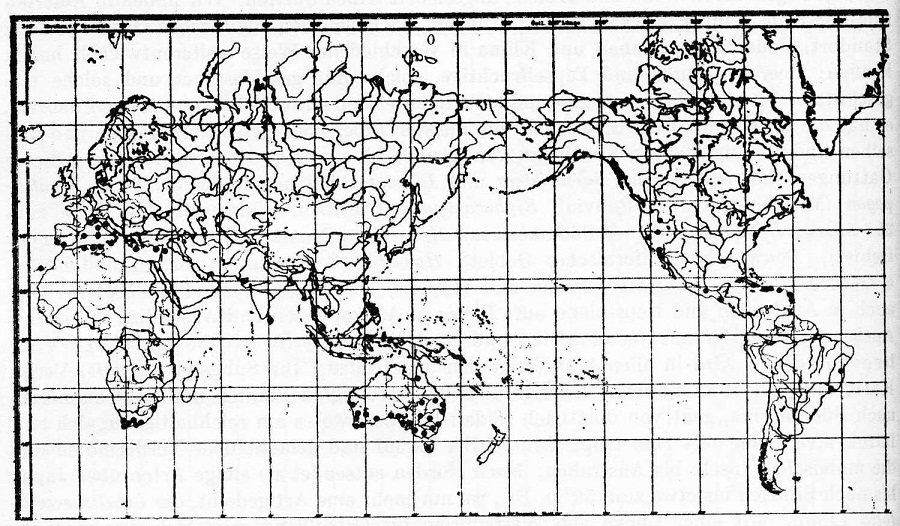 Karte 3. Verbreitung von Laurentia.
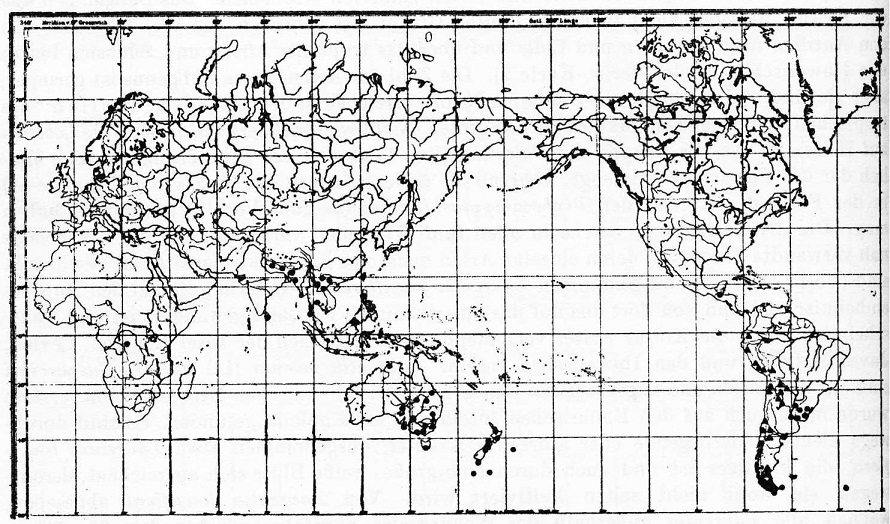 Karte 4. Verbreitung von Pratia und Hypsela.
● Pratia. ▲ Hypsela.
Page 27
|
Das Genus Pratia (Verbr.-Karte 4) ist mit 26 Arten in Australien, Asien, Zentral- und Süd-Amerika verbreitet, 1 Art wurde auch in Afrika gefunden. Einige Arten ausgenommen, sind es durchwegs kleine, kriechende Kräuter, die von allen Lobelioideen am weitesten nach Süden vordringen, so P. repens Gaudich. bis zum Kap Hoorn und P. arenaria bis zu den Aucklands-Inseln. Die meisten Arten weist Australien mit Neu-Seeland, dann die indonesischen Inseln bis Südchina auf. Im mittleren Südamerika fällt die große Verbreitung der P. hederacea auf. |
The genus Pratia (Geog. Map 4), with 26 species, is common in Australia, Asia, Central and South America, one species is also found in Africa. Except for a few species, they are consistently a small, creeping herb that are the lobeliads that have established furthest south, P. repens Gaudich. found in Cape Horn and P. arenaria in the Auckland Island. The regions with the most species are Australia and New Zealand and the Indonesian islands to southern China. In central South America is found the widespread P. hederacea. |
|
Mit Pratia eng verwandt, wenn nicht zu ihr gehörig, ist Hypsela, die in den Anden Südamerikas, von Ecuador bis zur Magellanstraße zu Hause ist. Neuerdings habe ich in den Herbarien Pflanzen aus Australien entdeckt, die ob ihrer beerenartigen Frucht auch zu Hypsela zu rechnen sind und bisher zu Laurentia fluviatilis geworfen wurden (V.-Karte 4). |
Closely related to Pratia, if not part of that genus, is Hypsela which is found in the South American Andes from Ecuador to the Straits of Magellan. Lately, I have discovered on herbaria plants from Australia, that the berry-like fruits found in Hypsela have given rise to Laurentia fluviatilis (Geog. Map. 4). |
|
Monopsis und Grammatotheca kommen in regelmäßigen Beständen in Südafrika vor, erstere auch in tropischen Afrika; sie wurden vereinzelt auch an der Westküste Australiens gefunden. |
Monopsis and Grammatotheca occur periodically in South African collections, the former is also foound in tropical Africa; they were occasionally found on the west coast of Australia. |
|
Zwei californische Gattungen, Downingia und Howellia, finden sich, beide mit je einer Art, wieder in Chile, krautige zarte Pflanzen, die meist am oder im Wasser wachsen, sonst aber wenig Gemeinsames haben. |
Two Californian genera, Downingia and Howellia, are both also found in Chile, both are herbaceous, delicate plants that grow mostly on or in the water, but otherwise have little in common. |
|
Die einander habituell sehr nahe stehenden Gattungen Burmeistera, Centropogon und Siphocampylus haben fast dasselbe Verbreitungsgebiet, die Kordilleren mit ihren nach Osten ziehenden Ausläufern, und dieselben Lebensbedingungen: Feuchte und schattige Orte im Busch- und Urwald, an Wasserläufen und Teichen oder Sümpfen, an Waldrändern und in Gebirgstälern, meist in Höhenlagen zwischen 1000-3000 Metern. Bei Burmeistera sind Epiphyten keine Seltenheit; bei Centropogon und Siphocampylus sind Spreizklimmer oder lianenartige Formen oft genug anzutreffen. Von den drei Genera reicht Centropogon am weitesten nach Norden, nämlich bis ins Südamerika bis Bolivia und Peru verbreitet, in tieferen Lagen allerdings selten. Burmeistera reicht von Guatemala bis Peru und ist bisher auf den Antillen und in Brasilien nicht gefunden worden. Siphocampylus dagegen ist nördlich der Landenge von Panama fast nicht vertreten, wohl aber gehört ihm in Südamerika ein großer Wohraum, der von Colombia bis Argentinien reicht Das Hauptverbreitungsgebiet aller drei Genera ist aber Colombia. |
The closely related genera Burmeistera, Centropogon und Siphocampylus share almost the same distribution area on the Cordilleras and their eastward foothills and almost the same habitat: humid and shady places in the bush and jungle, near streams, ponds and marshes or forest edges or mountain valleys, mostly at altitudes between 1000-3000 meters. In Burmeistera epiphytes are not uncommon; in Centropogon and Siphocampylus spreading climbers or liana-like forms are common. Of these three genera, Centropogon extends furthest north, in South America it found in Bolivia and Peru, though rare and at lower altitudes. Burmeistera ranges from Guatemala to Peru and has not been found in the Antilles or in Brazil. Siphocampylus, however, is almost not found north of the isthmus of Panama, but belongs only to South America with a great range from Argentina to Colombia. The main distribution area of all three genera is Colombia. |
|
Das Gegenteil der vorigen bietet die kleine, rasen- und polsterförmige überzüge bildende Lysipomia auf den Höhenrücken der Anden von Colombia bis Peru, wo sie, bald einem Sempervivum, bald einem Moose oder einem kleinen Taraxacum ähnlich, in 3000 bis 4000 m Höhe vegetierien. |
The opposite of the previous cases, Lysipomia creates small cushion-like colonies on the ridge of the Andes from Colombia to Peru, where they join Sempervivum, mosses and Taraxacum vegetation at 3000 to 4000 m altitude. |
|
Von den nur außerhalb Amerikas zu findenden und noch nicht berührten Gattungen sei zunächst das auf Madagascar einheimische Dialypetalum genannt, das infolge seiner fast freiblättrigen Blumenkrone in der ganzen Familie einzig dasteht. Es bildet Sträucher und wurde bisher nur im Innern der Insel an Bachrändern gefunden. Die übrigen Lobelioideen Afrikas, nämlich Lobelia, Laurentia, Grammatotheca, Monopsis und Pratia wurden schon oben erwähnt. |
Of the genera found outside of America, Dialypetalum, a native to Madagascar, stands alone in the family due to its almost free petalled corolla. It forms shrubs and has been found only in the interior of the island on stream edges. The remaining African lobeliads namely Lobelia, Laurentia, Grammatotheca, Monopsis and Pratia were mentioned previously. |
|
Asien beherbergt nur 2 Gattungen: Lobelia und Pratia; es weist keine endemische Gattung auf. |
Asia is home to only two genera: Lobelia and Pratia; it has no endemic species. |
|
Dafür aber bringen uns Inseln im Großen Ozean eine ganze Reihe endemischer Genera. Auf Neu-Guinea treffen wir Phyllocharis, ein niedriges Kraut, bei der die Blüten auf dem Mittelnerv des Blattes entspringen und das in feuchten Bergwäldern weit verbreitet ist. |
There are a number of genera endemic to oceanic islands. In New Guinea, there is Phyllocharis, a low herb, on which the flowers grow from the midrib of the leaf and which is widespread in humid mountain forests. |
|
Auf den Hawaiischen Inseln kommen 6 endemische Gattungen vor: Brighamia, eine kuriose Pflanze mit einem stalaktitenförmigen, fleischigen Stengel von 1-4 m Höhe, der auf seiner Spitze die Blätter und großen, weißen, duftenden Blüten trägt und auf Felsklippen seinen Standort hat. Bisher wurde dieselbe beobachtet auf Niihau, Kauai, Molokai und Lanai. |
There are six endemic genera on the Hawaiian Islands: Brighamia, a curious plant with a stalactite shaped fleshy stalks of 1-4 m in height, the leaves are large, the flowers are white and fragrant held apically, it grows on cliffs. It has been found on Niihau, Kauai, Molokai and Lanai. |
|
Die zweite nicht weniger interessante Gattung stellt Trematolobelia dar, ein bis 4 m hoher Stamm, der an der Spitze mehrere Zweige mit ansehnlichen Blütentrauben in fast doldenförmigger Anordnung trägt. Sie wächst auf allen Inseln mit Ausnahme von Niihau und Kahoolawe auf Bergen, an Hochmooren und in offenen Wäldern ungefähr zwischen 600-1200 m Seehöhe. Öfter wird dieselbe auch als Epiphyt angetroffen. |
The second, and no less interesting, genus is Trematolobelia which has 4 m high stems topped by several branches with handsome flowers clusters in an almost umbel-like arrangement. It grows on all islands except Niihau and Kahoolawe on mountains, in bogs and in open woods between 600-1200 m above sea level. It is often encountered as an epiphyte. |
Page 28
|
Die 4 beerentragenden Gattungen der Hawaiischen Inseln, die in der Tat wohl nur ein gutes Genus bilden, sind auf allen Inseln zerstreut, nur Rollandia kommt, mit Ausnahme der R. parvifolia in Kauai, nur auf Oahu vor. Von diesen Gattungen ist Cyanea die art- und formreichste. Ein Teil derselben hat palmähnlicht racht und erreicht in der C. leptostegia eine Höhe von 15 m. Diese ist zugleich die höchste aller Lobelioideen. Manche sind mit kegelförmigen Stacheln bewehrt, wieder andere haben farnähnliche, fast gefiederte Blätter, bei den Lobelioideen eine sehr seltene Erscheinung. Sie bewohnen gewöhnlich die regenreichen Gebirgswälder in der Seehöhe von 300-1500m. |
The four berry bearing genera of the Hawaiian Islands, which, in fact, probably all should be considered a single genus, are scattered through the islands; only Rollandia with the exception of R. parvifolia on Kauai, comes from a single island, Oahu. Of these genera, Cyanea has the richest number of species and forms. Some of them have a palm-like habit and in C. leptostegia achieve a height of 15m. The tallest of all the lobeliads. Some are armed with conical spines, other have fern-like, almost feathery leaves, which, in the lobeliads, is a very rare phenomenon. they typically inhabit the rainy mountain forests at an altitude of 300-1500 m. |
|
Auch Clermontia kommt meist an denselben Standorten vor, geht aber etwas höher hinauf (600-1800 m). Ihr Stamm ist baumartig oder strauchig, aber stets, und zwar in der Regel kandelaberartig-verzweigt, wodurch sie vor den übrigen meist leicht erkennbar ist. Die strauchigen Formen sind durchwegs Epiphyten und kommen meist in Gesellschaft vor mit Cibotium, Metrosideros, Myoporum, Acacia koa u. a. |
Clermontia usually occurs in the same locations, but some at higher elevations (600-1800 m). Its trunk is either tree-like or shrubby, but always, as a rule candelabra-branched, whereby it is usually easy to recognize from others. The shrubby forms are consistently epiphytes and usually come in society with Cibotium, Metrosideros, Myoporum, Acacia koa et al. |
|
Rollandia ist im Verhältnis zu den benachbarten Genera eine bescheidene Gattung, sowohl was Zahl als Größe und Verbreitung anbelangt. Sie scheint erst im Aufstieg begriffen zu sein, wenn derselbe nicht durch Vernichtung der günstigen Existenzbedingungen,einerseits infolge der gesteigerten Viehwirtschaft, andererseits durch das ständige Vordringen des Paspalum conjugatum (Hilogras) wie bei Delissea und Clermontia unmöglich gemacht wird. Sie bewohnt ebenfalls die feuchten Regenwälder, aber mehr die unteren Regionen von ca. 250-400 m über dem Meere, wo es oft in großen Beständen vorkommt. Rock nennt das Punaluu-Gebirge ein wahres Paradies für Rollandia. |
Rollandia is comparison to the preceding genera is a modest genus, both in terms of number of species and distribution. It seems to be in the beginning of expansion, unlike Delissea and Clermontia, which is unlikely given the destruction of the habitat of on one hand by increased livestock production and on the other hand by the constant encroachment of Paspalum conjugatum (Hilograss). They also inhabit the humid rainforests, but moreso in the lower regions of about 250-400 m about the sea, where it is often found in large colonies. Rock called the Punaluu mountains a paradise for Rollandia. |
|
Delissea, von den 4 Genera wahrscheinlich das älteste und nach Rocks Meinung dem Untergange zusteuernde Genus, lebt meist in den trockeneren Teilen der Wälder von ca. 900-1800m über dem Meere und hat sich besonders auf den steilen vulkanischen Kegeln erhalten, wo es vor dem Zubiß des weidenden Viehes geschützt ist; so vor allem D. undulata auf Hawaii, wo sie in größerer Anzahl und bei 5 cm Stammdurchmesser bis 10 m hoch angetroffen wird. Die übrigen sind bedeutend niedriger und meist strauchig. |
Delissea, probably the oldest of the four genera and heading towards extinction according to Rock, usually lives in the drier parts of the forest at about 900-1800 m above the sea and is especially found on the steep volcanic cones there is some protection from the grazing cattle; especially common here is D. undulata of Hawaii, which has a 5 cm trunk diameter and grows up to 10 m tall. The other Delissea are considerably smaller and often shrubby. |
|
Auf den östlichsten Inseln im Stillen Ozean begegnen uns noch 3 Gattungen: Apetahia mit 3 Arten von baum- oder strauchartigem Wuchs auf den Gesellschaftsinseln. Sie besitzt eine einfächerige aufspringende Frucht (Fig. 14 i). |
On the easternmost islands of the Pacific Ocean, we encounter 3 genera: Apetahia with 3 types of tree- or shrublike growth on the Society Islands. It has a unilocular dehiscent fruit (Fig 14 i). |
|
Endlich Sclerotheca und Cyrtandroidea, Sträucher und Bäume auf den Gesellschafts und Marquesasinseln, besonders Tahiti, und auf der Insel Roratonga. Auch hier ist die Frucht merkwürdig Sie ist zwar wie die meisten der Lobelioideen zweifächerig, aber bei ersterer gleicht sie einer Nuß, nur daß sie sich am Scheitel mit 2 rundlichen Löchern öffnet (Fig. 14 d); bei der zweiten einer länglichen Beere, die, ähnlich der Kapsel der Diastatea, oberständig ist. |
Finally, Sclerotheca and Cyrtandroidea, shrubs and trees found on the Society Islands, the Marquesas, especially Tahiti, and on Roratonga. Again, the fruit is remarkable though it is, like most Lobeliads, bilocular, but here in the former, it is like a nut with two rounded open holes at the top (Fig. 14 d) and in the latter an oblong berry that is similar to the superior capsule of Diastatea. |
|
So finden wir die Lobelioideen in der ganzen Welt verbreitet, aber sehr ungleichmäßig verteilt. Nur wenige Arten von Lobelia, Pratia und Hypsela wagen sich weiter nach Norden oder Süden vor. Die übrigen leben fast zur Gänze innerhalb des 40. nördlichen und südlich Breitegrades. Die Brennpunkte ihrer Verbreitung sind die Anden des tropischen Amerika, Südafrika und die Sandwich-Inseln. Charakteristisch für die Landschaft werden die Lobelioideen, so weit mir bekannt, nur im tropischen Afrika, wo die Riesenlobelien in größerer Zahl ihre blütenreichen Stämme entfalten, und auf den Sandwich Inseln, wo Cyanea, Clermontia und Delisea gelegentlich bestandbildend auftreten. |
Thus we find the lobeliads distributed through the world, though very unevenly. Only a few species of Lobelia, Pratia and Hypsela venture far to the north or south. The remaining live almost entirely within the 40° northern and southern latitudes. The focal points of the distribution are the Andes of tropical America, Africa and the Hawaiian Islands. As dominant members of the landscape the lobeliads, are to my knowledge, only those of tropical Africa, where the giant lobelias develop their flowery stems in great numbers, and in the Hawaiian Islands, where Cyanea, Clermontia and Delisea occur occasionally forming stands. |
|
Nutzen. Wenn auch der Nutzen der Lobelioideen kein bedeutender ist, so gibt es doch genug Arten, die entweder zu Heilzwecken oder als Zierpflanzen verwendet werden oder deren Blätter und Früchte gegessen werden. |
Ethnobotany. Even though the benefits of Lobeliads is not significant, there are several species used for medicinal purposes, ornamental plants or their leaves and fruit are eaten. |
Page 29
|
Von den Heilpflanzen ist besonders Lobelia inflata bekannt, die im östlichen Nord-amerika häufig ist und "Indian Tobacco" genannt wird. Das Kraut ist reich an Milchsaft, hat einen unangenehm scharfen, kratzenden und tabakähnlichen Geschmack, wird zur Blütezeit gesammelt und ist als Herba Lobeliae oder Herba Lobeliae inflatae (Ph. Germ. II, 131 und 335) offizinell. Es wird davon ein Aufguß oder eine Tinktur bereitet. 5 g des giftigen Krautes sollen genügen, u einen erwachsenen Menschen zu töten. |
Of the medicinal plants, Lobelia inflata is particularly important; it is often called "Indian tobacco" in eastern North America. The herb is rich in latex, has an unpleasant, sharp, abrasive and tobacco-like taste. It is collected at flowering time and is called Herba Lobeliae or Herba Lobeliae inflatae (Ph. Germ. II, 131 and 335). It is prepared as an infusion or tincture. Five grams of the toxic herb should be enough to kill an adult human. |
|
Der wirksame Bestandteil der Pflanze ist das Lobelin, 1842 von Procter im Samen aufgefunden, ein Derivat des Ketonalkoholes des Methylpiperidins, C22H27O2N, ein hellgelbes, gewürzhaft riechendes, tabakartig schmeckendes, nicht flüchtiges Alkaloid, das in der Pflanze an die kristallisierende Lobeliasäure gebunden ist. In größeren Gaben erzeugt es Übelkeit, Erbrechen, Durchfall, Schwindel und Zittern. In kleineren Gaben (5 Tropfen der Tinktur) wirkt es beruhigend auf die Nerven der Atmungsorgane und wird bei Asthma, Keuchhusten und krampfhaften Husten gegeben. Ein zweiter isolierter chemischer Stoff, das Inflatin, ist nicht genauer bekannt und ohne therapeutische Bedeutung. Die Indianer rauchen die Blätter der Pflanze in einer Pfeife; der Rauch ist viel milder als der des Tabaks. |
The active ingredient in the plant is Lobelin, discovered in 1842 by Procter in the seeds. It is a derivative of Ketonalcohol of methylpiperidine, C22H27O2N, a light yellow, spicy smelling, tobacco-like tasting, non-volative alkaloid that is bound in the plant as the crystalling Lobelia-acid. In larger doses, it produces nausea, vomiting, diarrhea, dizziness and tremors. In smaller doses (5 drops or tincture), it has a calming effect on the nerves of the respiratory system and is given in asthma, whooping cough and spasmodic cough. A second isolated chemical substance is Inflatin which is not known precisely and is without therapeutic significance. The Indians smoke the leaves of the plant in a pipe; the smoke is much milder than that of tobacco. |
|
Eine andere krampfstillende und ebenfalls gegen Asthma gebrauchte Pflanze ist Lobelia nicotianaefolia aus Vorderindien und Ceylon, "Deonal" oder "Bokenal" der Einheimischen. Von ihr werden die Blätter als Aufguß verwendet. Nach Rosen und Lloyd enthält die Pflanze zwei Alkaloide, ähnlich denen der Lobelia inflata, von denen das Lobelin in amorphem, das Inflatin in kristallisiertem Zustand erhalten wurde. |
Another antispasmodic and also used against asthma is the plant Lobelia nicotianaefolia from south Asia and Ceylon, called "Deonal" or "Bokenal" by the locals. From it, the leaves are used as an infusion. According to Rosen and Lloyd, the plant contains two alkaloids, similar to those of Lobelia inflata of which Lobelin is an amorphous and Inflatin was obtained in the crystallized state. |
|
Lobelia pyramidalis wird bei den Nepalensern als stimulans verwendet. |
Lobelia pyramidalis is used by the Nepalese as a stimulant. |
|
Lobelia Giberroa und Lobelia Rhynchopetalum werden wegen ihres scharfen, mild zusammenziehenden Milchsaftes von den Abessiniern gegen gewisse chronische Augenleiden angewendet; die Samenkörner derselben mit Butter gemischt sollen die Wehen abkürzen und leichte Geburtherbeiführen. Der Rauch des Holzes,das sonst zum Bau von Hütten gebraucht wird, verursacht, in geringer Menge eingeatmet, Erbrechen, durch längere Zeit eingeatmet, aber sogar den Tod (Dillon). |
Lobelia Giberroa und Lobelia Rhynchopetalum are used, due to their sharp, mild astringent milk sap, by the Abyssinians for certain chronic eye diseases; the seeds of the same are mixed with butter to shorten labor and easy birth inducing. The smoke of the wood, which is used for the construction of cottages, causes, when inhaled in small amounts, vomiting, and when inhaled for longer times, even death (Dillon). |
|
Die Wurzel del Lobelia syphilitica wurde von den Eingeborenen Nordamerikas als spezifisches Mittel gegen venerische Krankheiten gebraucht und einige Zeit auch von Ärzten angeblich it großem Erfolg gegen Syphilis angewendet. Heute steht es kaum mehr in Verwendung. |
The root of Lobelia syphilitica was used by the natives of North America as a specific remedy for venereal diseases and some doctors alledgedly used it successfully against syphilis. Today, it is hardly used. |
|
Lobelia laxiflora und deren Varietäten werden von den mexikanischen Ärzten als Mittel zum Erbrechen, zur Förderung des Auswurfes und bei asthmatischen Beschwerden gelobt. Nach Altamirano (mitgeteilt in Ydrac, p. 159) ist diese Pflanze dem Apomorphin, der Ipecahuanha und der Brechnuß (Nux vomica) vorzuziehen, besonders da es auch subkutan angewendet werden kann. |
Lobelia laxiflora and their varieties are praised by Mexican doctors as a means to induce vomiting, to promote expectoration and treat asthmatic complaints. According to Altamirano (reported in Ydrac, p. 159), this plant is the preferred source for Apomorphin, Ipecacuanha and Nux vomica, especially since it can be administered subcutaneously. |
|
Ähnlich gilt auch Lobelia decurrens aus Chile und Peru als Mittel zum Erbrechen und als Purgativum, ist jedoch nicht ohne Gefahr. |
Similarly in Chile and Peru, Lobelia decurrens is used to induce vomiting and as a purgative, but is not without danger. |
|
Lobelia cardinalis und L. splendens gelten als Mittel gegen Würmer. |
Lobelia cardinalis and L. splendens are used as a remedy for worms. |
|
Lobelia pinifolia wird gebraucht als Diureticum bei Rheumatismus und Hautleiden. |
Lobelia pinifolia is used as a diuretic in rheumatism and skin diseases. |
|
Der Saft von Centropogon laxus wird bei Herzkrankheiten und zu starken Menses angewendet (Dryander). |
The sap of Centropogon laxus is used in heart disease and excessive menstruation (Dryander). |
|
Die meisten Lobelioideen sind, wie wir schon aus den bisher angeführten Arten ersehen konnten, gefährliche Giftpflanzen. Ihre Verwendung erfordert stets große Vorsicht. Als besonders schwere Giftpflanzen werden folgende genannt: Laurentia (Isotoma) longiflora, auf den Antillen einheimisch, mit der Base Isotomin, ein Nerven- und Herzgift, das auch Pferden, die das Kraut fressen, den Tod bringen kann, weswegen es bei den Kubanern "Reventa Caballos" heißt. |
Most lobeliads are, as we have seen from those previously mentioned, dangerous poisonous plants. Their use always requires great caution. Particularly poisonous plants are mentioned: Laurentia (Isotoma) longiflora, indigenous to the West Indies, with the base isotomin, a nerve and heart poison, which can also bring death to horses that eat it, which is why the Cubans call it "Revento Caballos". |
|
Lobelia Tupa ist nach Feuillé so giftig, daß schon dessen Geruch Erbrechen herbeiführt und der Saft, wenn er mit den Augen in Berührung kommt, heftige Entzündung derselben und sogar völlige Erblindung verursacht Nichtsdestoweniger soll der Saft in Chile zur Untnerdrückung der Zahnkaries Verwendung finden (Lesson). Der Saft der Varietät Berterii soll hingegen bei Augenleiden benutzt werden. |
Lobelia tupa is so toxic, according to Feuillé that even its smell causes vomiting and the sap when it comes in contact with the eye causes severe inflammation and complete blindness, nevertheless, the sap is used in Chile to supress dental caries (Lesson). The sap of the variety Berterii should, however, be used with eye problems. |
|
Pratia concolor, Lobelia stricta, L. Dortmanna, L. urens und L. purpurascens haben sich als sehr giftig erweisen. letztere steht indes in Verwendung gegen Schlangenbiß. |
Pratia concolor, Lobelia stricta, L. Dortmanna, L. urens and L. purpurascens are all very toxic; the latter, however, is used against snakebites. |
Page 30
|
Trotz des gefährlichen Charakters der meisten Arten versichern verschiedene Sammler daß die Einheimischen die Blätter mancher Arten, so von Lobelia anceps L.f., L. ansinoides, Centropogon vinosus, C. granulosis, C. alens und manchen anderen als Gemüse zubereiten und essen, die Maori die jungen Triebe der Pratia physaloides als große Delikatesse genießen. |
Despite the dangerous nature of most species, different collectors have assured me that the locals eat the leaves of some species such as Lobelia anceps L.f., L. ansinoides, Centropogon vinosus, C. granulosis, C. alens and others as vegetables; for the Maori, the young shoots of Pratia physaloides are a great delicacy. |
|
Die Beeren verschiedener Arten werden ebenfalls gegessen: Von Centropogon cornutus, C. vinosus (Beeren süß mit Weintraubengeschmack, Archer!), von manchen Clermontia, besonders von C. clermontioides (Haha-ai-a-aka-manu) mit großen gelben süßen Beeren. Auch vielen Vögeln dienen die Beeren der Lobelioideen als Nahrung. |
The berries of various species are also eaten: from Centropogon cornutus, C. vinosus (berries sweet with grape flavor, Archer!), from Clermontia, especially C. clermontioides (Haha-ai-a-aka-manu) with large, yellow, sweet berries. Also many birds use the berries of the lobeliads as food. |
|
Einige Arten, darunter insbesondere Centropogon Caoutchouc und Siphocampylus campanulatus enthalten in ihrem Milchsaft Kautschuk; meines Wissens werden sie aber zur Gewinnung dieses Stoffes nicht benützt 1). |
Some species, including in particular Centropogon Caoutchouc und Siphocampylus campanulatus, contain rubber in their latex; as far as I know, this is not used in the production of this substance 1). |
| Eine ganze Reihe von Lobelioideen wurden oder werden als Zierpflanzen gehalten, da sie durch ihre leuchtenden Blüten und ihr meist lange dauerndes Blühen wertvoll sind. Die am häufigsten kultivierten sind: Lobelia amoena, L. cardinalis, L. cordigera (fulgens W.), L. coronopifolia mit der Var. caerulea, L. cuneifolia, L. Erinus, meist var grandiflora Paxt., die bekannteste und verbreitetste Art; . gracilis Andr. mit der var. major, L. syphilitica und deren Hybriden mit L. cardinalis und L. splendens oder L. cordigera; L. purpurascens und L. tenuior. Von den hochwüchsigen Stauden: Lobelia laxiflora mit der var. angustifolia (Lobelia Cavanillesiana hort.), L. persicifolia Lam. (Krausii), L. polyphylla, L. pyramidalis, L thapsoidea, L. Tupa. — Downingia elegans und pulchella. — Laurentia (Isotoma) axillaris und longiflora. — Monopsis lutea und simplex (debilis). — Pratia nummularia (begonifolia) und P. montana. — Centropogon coccineus, C. cordifolius, C. cornutus (fastuosus, surinamensis), C. Lucyanus. — Siphcampylus amoenus, S. fimbriatus, S. fulgens Leb., S. giganteus, S. glandulosus, S. Lindleyi, S. longepedunculatus, S. reticulatus (lantanifolius) mit der var. glabriusculus, S. manettiaeflorus, S. microstoma, S. Orbignianus, W. Westinianus. |
A whole series of Lobeliads were, or are, kept as ornamental plants because they are valuable for their bright flowers and their long lasting blooms. The most commonly cultivated are: Lobelia amoena, L. cardinalis, L. cordigera (fulgens W.), L. coronopifolia with var. caerulea, L. cuneifolia, L. Erinus, mostly var grandiflora Paxt., the best known and most common species; . gracilis Andr. with var. major, L. syphilitica and their hybrids with L. cardinalis and L. splendens or L. cordigera; L. purpurascens and L. tenuior. Of the tall perennials: Lobelia laxiflora with var. angustifolia (Lobelia Cavanillesiana hort.), L. persicifolia Lam. (Krausii), L. polyphylla, L. pyramidalis, L thapsoidea, L. Tupa. — Downingia elegans und pulchella. — Laurentia (Isotoma) axillaris und longiflora. — Monopsis lutea and simplex (debilis). — Pratia nummularia (begonifolia) and P. montana. — Centropogon coccineus, C. cordifolius, C. cornutus (fastuosus, surinamensis), C. Lucyanus. — Siphcampylus amoenus, S. fimbriatus, S. fulgens Leb., S. giganteus, S. glandulosus, S. Lindleyi, S. longepedunculatus, S. reticulatus (lantanifolius) with var. glabriusculus, S. manettiaeflorus, S. microstoma, S. Orbignianus, W. Westinianus. |
|
Geschichte der Lobelioideen. Die erste Pflanze, die den Lobelioideen angehört, begegnet uns als "Gladiolus stagnalis Dortmanni" bei Clusius (Charles l'Ecluse) in seinen Curae Posteriores (1611) p. 40 und ist identisch mit der späteren Lobelia Dortmanna 2) L., die eine im nördlichen Europa ziemlich verbreitete Wasserpflanze ist. Unter dem Namen Gladiolus aquaticus seu palustris soll sie schon (fide Linnaei) bei Dodonaeus (Rembert Dodoens) Stirpium Historia (1553) p. 950 aufscheinen, doch konnte ich die Angabe nicht nachprüfen. 1623 erwähnt sie C. Bauhin im Pinax Theatre Botanici p. 202 als Leucojum palustre flore subcaeruleo, währenddem sie bei Rajus (John Ray), Historia Plant. (1688) pp. 1325, 1911 und in dessen Synopsis Methodica Stirpium Britann. (1724) ed. 3. p. 237 weider unter dem Namen Gladiolus stagnalis Dortmanni erscheint, ebenso 1701 in Rudbecks Campi Elysii 2. Band, p. 202, wo sie sub fig. 15 zum erstenmal abgebildet wird. Aber schon 1720 erhält sie von Rudbeck (Acta Upsal. p. 97, t. 2) einen eigenen Gattungsnamen, Dortmanna lacustris floribus sparsis pendulis und wird wieder abgebildet. Nachdem sie noch 1718 in Miscellaneous Observations von J. Blair mit dem Namen Campanula aquatica bedacht worden war, gab ihr schließlich Linné in Flora Lapponica n. 297 im Jahr 1737 den von Plumier 1703 geprägten Namen Lobelia, allerdings irrtümlicherweise. Wir werden später darauf zurückkommen. Lobelia Dortmanna ist also die erste und älteste Lobelia, die uns in der Literatur begegnet. |
History of the Lobeliads: The first plant of the lobeliads to be described is "Gladiolus stagnalis Dortmanni" by Clusius (Charles l'Ecluse) in his Curae Posteriores (1611) p. 40 and is identical to that later named Lobelia dortmanna 2) L., which is a fairly widespread in northern European water plant. Under the name Gladiolus aquaticus seu palustris is appeared earlier (fide Linnaei) in Dodonaeus' (Rembert Dodoens) Stirpium Historia (1553) p 950, but I could not verify the statement. In 1623, C. Bauhin, in Pinax Theatre Botanici, p. 202, mentions Leucojum palustre flore subcaeruleo, whereas they appear in Rajus (John Ray), Historia Plant. (1688) pp. 1325, 1911 and its synopsis Methodica Stirpium Britann. (1724) ed. 3. p. 237 under the name Gladiolus stagnalis dortmanni. In 1701, in Rudbecks Campi Elysii Vol. 2, p. 202, as fig. 15, it is illustrated for the first time. As early as 1720 (Rudbeck, Acta Upsal. p. 97, t. 2), it receives its own generic name Dortmanna lacustris floribus sparsis pendulis and is again illustrated. It appears again in 1718 in Miscellaneous Observations by J Blair as Campanula aquatica and finally in 1737 in Linnaeus' Flora Lapponica n. 297 under the Lobelia coined by Plumier in 1703, but erroneously. We will return to this later. Lobelia dortmanna is therefore the first and oldest Lobelia that is encountered in the literature. |
|
In der Folge werden zunächst 2 amerikanische Arten, die wegen ihrer großen scharlachroten Blüten als Zierpflanzen in die europäischen Gärten Eingang gefunden hatten, bekannt: Lobelia cardinalis L. durch John Parkinson, Paradisus Terrestris (1629) p. 356, und L. cordigera Cav. oder L. splendens Willd. — welche der beiden Arten, läßt sich nicht entscheiden — die Hernandez in dem Rerum Med. N. Hispaniae Thesaurus seu Plantarum ... Mexicanorum Historia, p. 879 t. 880, 1651 als Rapuntium maximum, coccineo spicato flore anführt. |
The first two American species to be discovered and as a result of their large scarlet flowers entered into European gardens as ornamental plants were: Lobelia cardinalis L. by John Parkinson, Paradisus Terrestris (1629) p. 356 and L. cordigera Cav. or L. splendens Willd. — which of these two species cannot be decided — in Hernandez' Rerum Med. N. Hispaniae Thesaurus seu Plantarum ... Mexicanorum Historia, p. 879 t. 880, 1651 cited as Rapuntium maximum, coccineo spicato flore. |
___________________
|
1) Auf eine Anfrage bei Prof. Luis Mille in Quito erhielt ich zur Antwort, daß von einer Kautschukerzeugung aus den genannten Pflanzen nichts bekannt sei. |
1) Based on pers. comm. with Prof. Luis Mille in Quito who told me that nothing was known of rubber production from the plants mentioned. |
|
2) Dortmannn war ein holländischer Apotheker, der diese Pflanze als Gladiolus ansah und unter diesem Namen an Clusius sandte. |
2) Dortmann was a Dutch pharmacist who considered this plant a Gladiolus, and sent it to Clusius under that name. |
Page 31
|
Die zweite europäische Art, Lobelia urens L., findet sich auch schon frühzeitig erwähnt bei C. Bauhin, Pinax (1623) p. 110 und in dessen Prodromus Theatri Bot. (1671) p. 53 als Draba flore caeruleo galeato; kurz vorher im Jahre 1669 bei Morison, Hortus Regius Blesensis p. 300 und kurz darauf 1674 in Boccone, Icones et Descript. rariorum plantarum Siciliae, Melitae, Galliae et Italiae p. 20, t. 11, während sie in Morison, Pl. Historia Universalis Oxon. (1715) sect. 5, p. 467, t. 5. f. 56 Rapunculus galeatus bleseensis s. soloniensis flore violaceo minore genannt wird. |
The second European species, Lobelia urens L. is also mentioned early in C. Bauhin's Pinax (1623) p. 110 and also his Prodromus Theatri Bot. (1671) p. 53 as Draba flore caeruleo galeato; also shortly before in 1669 with Morison's Hortus Regius Blesensis p. 300 and shortly after in 1674 in Boccone's Icones et Descript. rariorum plantarum Siciliae, Melitae, Galliae et Italiae p. 20, t. 11, also in Morison's Pl. Historia Universalis Oxon. (1715) sect. 5, p. 467 t. 5 f. 56 as Rapunculus galeatus blesensis s. soloniensis flore violaceo minore. |
|
Fast zu gleicher Zeit im Jahre 1676 wurde die damals als Heilpflanze in hohem Ansehen stehende Lobelia syphilitica L. aus Nordamerika durch Dodart, Mémoires pour servir a l'histoire des plantes p. 297 den Europäern Bekannt gemacht als Rapuntium Americanum, flore dilute caeruleo. |
Almost at the same time in 1676, Lobelia syphilitica L. from North America was made known to the Europeans by Dodart in his Mémoires pour servir a l'histoire des plantes p. 297, as Rapuntium Americanum, flore dilute caeruleo. |
|
Bald darauf werden beschrieben und zum Teil auch abgebildet: In Breyn, Exot. et aliar. minus cognit. Plantarum Centuria I. (1678) tt. 87, 88, 89: Rapunculus aethiopicus, violaceo paleato flore foliis pinastri = Lobelia pinifolia L.; Rapuntium aethiopicum, flore caeruleo galeato, foliis Coronopi = Lobelia coronopifolia L.; Rapuntium aethiopicum caeruleo-galeato flore, foliis dentatis = Lobelia lutea L. (L. Breynii Lam.). Und bei Hermann, Horti acad. Lugduno-Batavi Catalogus (1687) t. 109; Campanula minor africana, erini facie, caul. procumb. = Grammatotheca erinoides (L.) Sond.; desselben t. 110: Campanula minor afr., erini facie, fl. violaceo, caul. erectis = L. Erinus L., die schon damals und noch heute allbekannte Zierpflanze aus dem Kapland. | Soon after are described and illustrated in part: In Breyn, Exot. et aliar. minus cognit. Plantarum Centuria I. (1678) tt. 87, 88, 89: Rapunculus aethiopicus, violaceo paleato flore foliis pinastri = Lobelia pinifolia L.; Rapuntium aethiopicum, flore caeruleo galeato, foliis Coronopi = Lobelia coronopifolia L.; Rapuntium aethiopicum caeruleo-galeato flore, foliis dentatis = Lobelia lutea L. (L. Breynii Lam.). And in Hermann's Horti acad. Lugduno-Batavi Catalogus (1687) t. 109; Campanula minor africana, erini facie, caul. procumb. = Grammatotheca erinoides (L.) Sond.; and on t. 110: Campanula minor afr., erini facie, fl. violaceo, caul. erectis = L. Erinus L., which already at that time and still today are well-known ornamental plants from the Cape. |
|
Vor 1700 waren also nur 10 Lobeliae, die 2 in Europa vorkommenden, 5 afrikanische und 3 amerikanische, die praktische Bedeutung erlangt hatten, bekannt. |
Before 1700, thus, only 10 Lobeliae were known, 2 in Europe, 5 in Africa and 3 in America, and had acquired practical significance. |
|
1700 faßt Tournefort in den Institutiones Rei Herbariae p. 163 alle ihm bekannten Arten unter dem Namen Rapuntium zusammen, nur Lobelia Erinus L. erscheint auf p. 131 merkwürdigerweise als Trachelium minus africanum, floribus violaceis per caulem sparsis. |
In 1700, Tournefort summarizes together in his Institutiones Rei Herbariae p. 163, all known species under the name Rapuntium, only Lobelia Erinus L. appears, curiously, on p. 131 as Trachelium minus africanum, floribus violaceis per caulem sparsis. |
|
Der Name Rapuntium erscheint zum erstenmal bei Columna, Minus cognit, rariorumque Stirpium Ecphrasis (1616) und bezeichnet dort Campanula- und Phyteuma-Arten. Nach Tournefort haben noch Miller, Gärtner, Moench, Presl und schließlich Post & Kuntze diesen Namen für Lobelia als den ältesten requirier, doch mit Unrecht, da sein Schöper damit andere, nicht zu den Lobelioideen gehörige Pflanzen mit rübenartig verdickten Wurzeln bezeichnete. Der Gattungsname Dortmanna (Rudbeck, 1720) ist eindeutig, wurde auch von Linné in der 1. Editio des Systema Nat. 1735 aufgenommen, später von G. Don, General System III (1834) 715, Adanson, Familles des Plantes II (1763) 134 und O. Kuntze, Revisio Gen. II (1891) 379 als der älteste gütige Name verfochten, aber schon 1737 (Flora Lapp.) läßt Linné den Namen fallen und nimmt dafür den Namen Lobelia auf, indem er gleichzeitig alle anderen Namen (Rapuntium, Rapunculus, Cardinalis, Dortmanna) zurückweist. Hören wir seine eigenen Worte: "Dortmann haec Rudb. ejusdem generis est cum Rapuntio T., Cardinali Riv., Lobelia Pl; retinemus itaque nomen Lobeliae, cum Rapuntium, Rapunculus, Rapistrum a Rapa, cum qua nullam habent affinitatem, conficta sint vocabula; Cardinalis autem nomen minus quadrat...; uno verbo nomina ejusmodi conveniunt potius Tulipamaniacis et Hyacinthophilis quam Botanicis. Dortmannae nomen dein serius est impositum." Fl. Lapp. p. 227. |
The name Rapuntium appears for the first time in Columna's Minus cognit, rariorumque Stirpium Ecphrasis (1616) where he describes Campanula- and Phyteuma- species. Afterwards Tournefort, Miller, Gärtner, Moench, Presl and finally Post & Kuntze continue the use of this name as the oldest, but wrongly, as Schöper had designated it for other, non Lobeliad plants with beet-like thickened roots. The genus name Dortmanna (Rudbeck, 1720) is unambiguous and was used by Linnaeus in the 1st Editio of Systema Nat. 1735 and was later adopted by G. Don, General System III (1834) 715, Adanson, Familles des Plantes II (1763) 134 and O. Kuntze Revisio Gen. II (1891) 379 who championed it as the oldest genus name; but Linnaeus drops the name and instead adopts Lobelia and simultaneously rejects all other names (Rapuntium, Rapunculus, Cardinalis, Dortmanna). In his own words: "Dortmanna of Rudb. is the same genus as Rapuntio T., Cardinali Riv., Lobelia Pl; We retain the name Lobelia since Rapuntium, Rapunculus, Rapistrum a Rapa are invented words, Cardinalis is less fitting...; names such as Tulipamaniacis and Hyacinthophilis come from words rather than the names of botanists. The name Dortmanna came later." Fl. Lapp. p. 227. |
|
Der Name "Lobelia" ist von Plumier, Nova Genera Pl. Americ. (1703) p. 21, t. 31 für eine Pflanze geschaffen worden, die keine Lobelia im Sinne Linnés ist, sondern zu dem später aufgestellten Genus Scaevola L. gehört, aber Linné hielt lange Zeit beide für ein Genus; erst in der Mantissa altera, 1771, p. 481 erkennt Linné deren generelle Verschiedenheit und trennt sie in 2 Genera ("Lobelia Plumieri. Scaevola, distincti generis.") führt also für Lobelia Plum. den Namen Scaevola ein und vereinigt under Lobelia L. die früheren Rapuntium-Arten. Doch war auch hetzt Lobelia noch kein einheitliches Genus. Bergius schälte aus ihm ein neues Genus heraus und nannte es Cyphia (Descript. Pf. Cap. [1767] p. 172), das Linné in der Mantissa 1771 zwar erwähnt, aber sonst nicht weiter beachtet. Erst in der Ausgabe der Species Pl. von Willdenow (1797) p. 952 findet Cyphia seinen Platz. Linné hätte sicher besser getan, den klar umrissenen Namen Dortmanna statt Lobelia festzuhalten; es wären dadurch viele Verwicklungen und nomenklatorische Zweifel vermieden worden, aber da nun in den Species Pl. 1753 Lobelia im heutigen Sinne charakterisiert ist und von den dort angeführten 25 Arten 19 zu den Lobelioideen gehören und obwohl Lobelia Plumieri i.e. Scaevola an erster Stelle gleichsam als Typus geners steht, hat sich die Mehrzahl der Botaniker für die Beibehaltung des Namens Lobelia entschieden, so daß wir diesen zu den Nomina Conservanda rechnen und beibehaten. Sonst würde ja der Wirrwarr noch größer. |
The name "Lobelia" is from Plumier, Nova Genera Pl. Americ. (1703) p. 21, t. 31 created for a plant that is not in the sense Lobelia Linnaeus, but rather belongs to the later established genus Scaevola L., but Linnaeus long considered them both a single genus; ony in the Mantissa altera, 1771, p. 481 does Linnaeus recognize the generic differences, separating the two genera ("Lobelia Plumieri, Scaevola, distincti generis.") adding the name Scaevola to Lobelia for the species previously united as Rapuntium- species. But Lobelia was still not a single genus. Bergius peeled from it a new genus calling it Cyphia (Descript Pf. Cap. [1767] p. 172) which Linnaeus, although mentioning it in the Mantissa 1771, otherwise ignored. Only in the Willdenow (1797) edition of Species Pl., p. 952, does Cyphia find its place. Linnaeus would certainly have done better to stick to the well-defined name Dortmanna instead of Lobelia; this would have avoided many complications and nomenclatural doubts, but since the Species Pl. 1753 listed 25 species, 19 belonging to Lobelia characterized in its modern sense, and inspite of Scaevola being paramount to the type of the genus, the majority of botanists have decided to retain the name Lobelia so that we maintain this as Nomina Conservanda. As otherwise, the confusion would be greater. |
Page 32
|
Das 2. Genus der Lobelioideae, das noch vor 1700 bekannt wurde durch 2 kleine Arten der Mittelmeerländer, beschrieb Boccone in Museum di Piante Rare(1674) p. 35, t. 27 als Rapunculus aquaticus repens minimus alpinus, Bellidis folio, flore caeruleo inaperto alba macula notato. Micheli stellte für sie die Gattungen Laurentia auf (Nova Pl. Genera [1729] p. 18, t. 14). Linné nahm das Genus nicht in die Species auf, sondern nannte die eine Lobelia Laurentia L. = Laurentia Gasparrinii (Tineo) Strobl, die andere Lobelia minuta L. = Laurentia minuta (L.) A.DC, doch Adanson, Fam. II (1763) 134 proklamierte es als eigenes Genus. |
The second genus of the Lobeliaceae was known prior to 1700 from two small species found in the Mediterranean countries, Boccone described them in his Museum di Piante Rare (1674) p. 35, t. 27 as Rapunculus aquaticus repens minimus alpinus, Bellidis folio, flore caeruleo inaperto alba macula notato. Micheli established them in the genus Laurentia (Nova Pl. Genera [1729] p. 18, t. 14). Linnaeus recognized the species, but not the genus, he named one Lobelia Laurentia L. = Laurentia Gasparrinii (Tineo) Strobl, and the other Lobelia minuta L. =Laurentia minuta (L.) A.DC, but Adanson, Fam. II (1763) 134 proclaimed it as a separate genus. |
|
Nun blieb es lange Zeit still. Die Zahl der Arten war wohl inzwischen auf über 150 angewachsen; aber erst 1817 erblickt eine neue Gattung das Licht der Welt, nachdem mehrere Arten derselben schon längere Zeit bekannt waren, nämlich Monopsis Salisb. in Transact. Hort. Soc. Lond. II, p. 37, zu der Lobelia debilis L.f., L. campanulata Lam. und L. Lutea L. gehören. |
After a long period of silence, during which the number of species probably grew to more than 150, but only in 1817 does the world see a new genus, namely Monopsis Salisb. Transact. Hort. Soc. Lond. II, p. 37 into which he places Lobelia debilis L.f., L. campanulata Lam. and L. lutea L. |
|
Bald darauf, 1819, erscheint in Humboldt, Bonpland & Kunth, Nova Gen. et Spec. Americ. III, p. 318 die Gattung Lysipomia, von der vorher auch nicht eine Art bekannt war. Mit dieser Gattung habe ich das 1857 von Weddell, Chloris And. II, p. 11 geschaffene Genus Rhizocephalum vereinigt, da beide in den wesentlichen Eigenschaften übereinstimmen. Beide sind auch auf die Anden Südamerikas in ihrem Vorkommen beschränkt. |
Soon after, in 1819, in Humboldt, Bonpland & Kunth, Nova Gen. et Spec. Americ. III, p. 318, the genus Lysipomia appears based on a previously unknown species. With this genus, I have merged the genus Rhizocephalum from Weddell's Chloris And. II, p. 11 because both coincide in essential properties. Both a restricted to the Andes of South America. |
|
Die Weltreise Gaudichauds brachte viel neues Material aus den Südsee-Inseln, aus dem derselbe 5 neue Gattungen heraushob: Delissea, Cyanea, Clermontia, Rollandia und Pratia und 1826 in dem Werke Voyage autor du monde de l'Uranie et la Physicienne exéc. par Freycinet, Botanique, publizierte und abbildete. Pratia repens Gaudich. stammt allerdings von der Magellanstraße her, sonst ist aber Pratia hauptsächlich in und um Australien vertreten. |
The world-traveller Gaudichaud brought a lot of new material from the South Sea Islands, from this he established 5 new genera: Delissea, Cyanea, Clermontia, Rollandia and Pratia which he published and illustrated in 1826 in his Voyage autor du monde de l'Uranie et la Physicienne exéc. par Freycinet, Botanique. Pratia repens Gaudich. comes from the Straits of Magellan, but otherwise Pratia is mainly present in and around Australia. |
|
Im selben Jahre wurde auch im Botan. Register XII (1826) t. 964 von Lindley Isotoma, das in R. Browns Prodromus Fl. N. Holl. (1810) p. 565 bereits als eine Sectio Lobeliae aufscheint, als Genus beschrieben und abgebildet, von Petermann aber 1849 in Das Pflanzenreich p. 444 mit Laurentia vereinigt und das mit Recht, da zwischen beiden keine bedeutenden Unterschiede erkennbar sind. G. Don trennte 1834 im General System III, 717 Hippobroma als eigene Gattung für Isotoma longiflora (L.) Presl = Laurentia longiflora (L.) Peterm. ab, doch ohne triftigen Grund und fand deswegen auch keine Nachfolger. |
In the same year, in Botan. Register XII (1826) t. 964, Lindley describes and illustrates Isotoma which already appeared as a section of Lobelia in R. Brown's Prodromus Fl. N. Holl. (1810) p. 565, which Petermann in 1849 in Das Pflanzenreich p. 444, combines with Laurentia and rightly so, since no significant differences can be seen between the two. G. Don, in his 1834 General System III, p. 717 created Hippobroma as a distinct genus for Isoltoma longiflora (L.) Presl = Laurentia longiflora (L.) Peterm., (should be Endl., cf. supplement) but without good reason and thus this was not adopted by his successors. |
|
1829 kam noch Clintonia Douglas in Lindl. Bot. Register XV, t. 1241 dazu, der Name war aber schon von Rafinesque für ein Genus der Liliaceen vorweggenommen worden und sohin ungültig. Rafinesque hat daher für dieses Genus den Name Boelia - aus einer Umstellung der ersten 3 Buchstaben des Wortes Lobelia gebildet - geprägt, Atlantic Journal (1832) p. 120, ihn aber bald in seinen zwei folgenden Werken: Herb. Rafinesquian., 1833, p. 48 und Flora Telur. III, 1836, p. 5 durch Gynampsis ersetzt. Beide Namen scheinen aber unbekannt geblieben zu sein, da Kunth in seiner Enumeratio P. V, 156 (1850) dafür den Namen Wittia einsetzt. Nichtsdestoweniger gibt Torrey, Pacif. Rail. Rep. IV, 116 (1856) diesem Genus wieder einen neuen Namen, Downingia der in der Folge für diese Genus weiter gebraucht und schließlich trotz dreier älterer gültiger Namen in die Liste der Nomina Conservanda aufgenomen wurde. Er erscheint somit als der jetzt gültige Name. |
Douglas gave us the genus Clintonia in Lindl. Bot. Register XV (1829), t. 1241, but this name was already used by Rafinesque for a genus of Liliaceae and was therefore invalid. Rafinesque (Atlantic Journal p. 12, 1832) therefore, used instead the name Boelia for this genus - formed from a conversion of the first 3 letters of the word Lobelia. But in his two following works he replaced this with Gynampsis (Herb. Rafinesquian., 1833, p. 48 and Flora Telur. III, 1836, p. 5). But both names seem to have remained unknown, since Kunth, in his Eneratio P. V, 156 (1850), used the name Wittia. Nevertheless, Torrey, in Pacif. Rail. Rep. IV, 116 (1856) gave this genus another new name, Downingia which despite three older names, was placed on the list of Nomina Conservanda and therefore the now valid name. |
Page 33
|
Das folgende Jahrzehnt scheint den Lobelioideen ein besonderes Interesse entgegengebracht zu haben, da es nicht weniger als 23 neue Gattungen ans Licht brachte, von denen allerdings nur 6 ihren Platz behaupten konnten, das sind: Siphocampylus Pohl, Pl. Brasiliae Icones et Descript. II, (1831), p. 104, aus Südamerika; Heterotoma Zuccarini, publiziert in der Flora XV, 2. Beil. (1832) p. 101, aus Mexiko; Centropogon, Hypsela und Grammatotheca Presl, Prodr. Monogr. Lobeliacearum (1836); Sclerotheca A.DC. Prodr. VII (1839) 356. Die 17 anderen Gattungen: Canonanthus, Hippobroma, Holostigma, Parastranthus, alle von G. Don 1834; Mezleria, Myopsia, Dobrowskya, Tylomium, Solenopsis, Enchysia, Byrsanthes, Trimeris, Macrochilus, alle von Presl a.a.O. 1836; Rhychopetalum Fresenius 1838; Isolobus und Piddingtonia von A. De Candolle l. c. 1839 waren zum Teil Synonyme zu schon bestehenden Gattungen, zum Teil auf zu wenig bedeutende und verläßliche Unterschiede gegründet und wurden daher später meist nur für Sektionen verwendet. |
The Lobeliads seem to have been of special interest in the following decade, since it brought no less than 23 new genera to light, however, only 6 of these have been confirmed. These are: Siphocampylus Pohl, Pl. Brasiliae Icones et Descript. II, (1831), p. 104, from South America; Heterotoma Zuccarini, published in The Flora XV, 2. Beil. (1832) p. 101, from Mexico; Centropogon, Hypsela und Grammatotheca Presl, Prodr. Monogr. Lobeliacearum (1836); Sclerotheca A.DC. Prodr. VII (1839) 356. The 17 other genera: Canonanthus, Hippobroma, Holostigma, Parastranthus, all from G. Don 1834; Mezleria, Myopsia, Dobrowskya, Tylomium, Solenopsis, Enchysia, Byrsanthes, Trimeris, Macrochilus, all from Presl l.c. 1836; Rhychopetalum Fresenius 1838; Isolobus and Piddingtonia from A. De Candolle l. c. 1839 are here considered synonyms placed in existing genera, partly due to too little significant and reliable differences, and were therefore later usually used only for the sections. |
|
Presl, der in seinem Prodromus die Familie zum erstenmal zusammenfaßte und viele neue Arten beschrieb, führte für Lobelia L. aus den schon oben angegebenen Gründen wieder den vermeintlich ältesten Namen Rapuntium ein, aber er fand keine Gefolgschaft außer O. Kuntze. Die von Presl unter Rapuntium angeführten Sektionen sind auf wenig charakteristiches Merkmale aufgebaut und kaum der Erwähnung wert, lassen aber bereits erkennen, wie schwierig es ist, bei den Lobelioideen sichere Sektionenen herauszuschälen. Den Gattungsnamen Lobelia wandte Presl ohne ersichtlichen Grund auf jene Arten an, die Pohl 1831 unter Siphocampylus zusammengefaßt hatte, eine Willkür, die denn auch keine Nachahmer fand. Eine gute Zusammenstellung aller bis dahin bekannten "Lobeliaceae" lieferte Alphons De Candolle in DC. Prodromus VII, pp. 339-413. |
Presl, in his Prodromus, described the combined family for the first time and introduced many new species, he again introduced for Lobelia L. for the reasons give above, the supposedly oldest name Rapuntium, but he found no allegiance except O. Kuntze. The sections listed by Presl under Rapuntium are built on small characteristic features and are hardly worth mentioning, and already proved difficult to single out safe sections in the Lobeliads. The genus name Lobelia was used by Presl, for no apparent reason, for those species that Pohl had combined under Siphocampylus, which because of its arbitrariness found no imitators. A good compilation of all hitherto known "Lobeliaceae" is found in Alphons De Candolle's Prodromus VII, pp. 339-413. |
|
1841 erkannte Scheidweiler (Allgem. Gartenzeitung von Otto und Dietrix IX, p. 396) an einer in Mexiko vorkommenden Pflanze ein neues Genus, das er Diastatea nannte, das aber unbekannt geblieben zu sein scheint, da die hierhin gehörigen Arten in der Folge zu Lobelia oder Laurentia gestellt wurden, so Lobelia ramosissima Mart. & Gal. 1842, welche als Diastatea virgata Scheidw. schon deutlich beschrieben war. Das Genus ist leicht kenntlich durch den Mangel einer Kelchröhre und ganz freie unterständige Sepalen. |
1841 saw Scheidweiler (Allgem. Gartenzeitung von Otto und Dietrix IX, p. 396) introduce a new genus, occurring in Mexico, which he named Diastatea, but which seems to have remained unknown, since subsequently discovered related species had been placed in Lobelia or Laurentia, as for example Lobelia ramosissima Mart. & Gal. 1842 which is Diastatea virgata Scheidw. as had already been clearly described. The genus is easily recognized by the lack of a calyx tube and completely free, inferior sepals. |
|
1852 vermehrte Turczaninow die Zahl der Gattungen durch das Genus Cremochilus [Bull. Soc. Imp. Natur. Moscou XXV/2, p. 174 und in Flora (1853) 741]. Auch ich hielt es lange für eine gute begrenzte Gattung, doch zeigten mir neuere Funde, daß es von Siphocampylus nicht gut getrennt werden kann und nur Sektionscharakter besitzt. |
In 1852, Turczaninow increased the number of genera with the genus Cremochilus [Bull. Soc. Imp. Natur. Moscou XXV/2, p. 174 und in Flora (1853) 741]. I considered this a good, though small genus, but later it was found not well separated from Siphocampylus and has only the characteristics of a section. |
|
Auf ihren Reisen durch Colombia entdeckten Karsten und Triana eine dem Centropogon nahestehende Gattung, die Triana 1854 (Nuevos jeneros i species de plantas para la Flora Neo-Granadina p. 13) als Burmeistera beschrieb, wobei er nur die eine Art B ibaguensis anführt, die sonderbarerweise seither nicht wieder gefunden wurde. Heute zählt Burmeistera 77 Arten. |
On their travels through Colombia, Karsten and Triana discovered Centropogon, the related genus, which Triana described in 1854 (Nuevos jeneros i species de plantas para la Flora Neo-Granadina p. 13) as Burmeistera, wherein he cites only one type B. ibaguensis that has strangely not been found again. Today Burmeistera has 77 species. |
|
Die kurioseste Pflanze der Lobelioideen ist wohl Brighamia, die Asa Gray 1867 beschrieb. Ihr Stamm ist dickfleischig-stalaktitenförmig und trägt nur an der Spitze ein Büschel Blätter mit großen langröhrigen weißen Blüten. Bisher ist nur eine Art mit einer gelbblühenden Varietät von den Hawaiischen Inseln bekannt, die dort auf Felsenklippen wächst, die von der Brandung des Meeres übersprüht werden. |
The most curious plant of the Lobeliads is probably Brighamia that Asa Gray described in 1867. Its trunk is thick, fleshy, stalactite-like and has only a tuft of leaves at the top of the stem with large, long tubular white flowers. As yet, only known from the Hawaiian Islands, including a yellow-flowered variety, it grows on rocky cliffs which are sprayed by the surf of the sea. |
|
In Jahre 1876 wurden zwei neue Gattungen veröffentlicht. Die eine stammt von Madagaskar und wurde von Bentham Dialypetalum genannt wegen der anscheinend freiblättrigen Korolle, die in unserer Subfamilie ein Unikum darstellt und eine Bindeglied zu den Campanuloideae bildet. |
In 1876, two new genera were published. One comes from Madagascar and was called by Bentham Dialypetalum because of its apparently free-petaled corolla, which is a rarity in our subfamily and forms a link to the Campanuloideae. |
|
Die andere Gattung, Palmerella von A. Gray genannt, ist in Kalifornien heimisch und kann wohl von Laurentia nicht getrennt werden. |
The other genus, Palmarella, named by A. Gray, is native to California and can probably not be separated from Laurentia. |
Page 34
|
Verschiedene Arten in Brasilien, die sich durch geflügelte Samen auszeichnen, vereinigte Kanitz 1878 in der Flora Brasiliensis unter dem neuen Gattungsnamen Haynaldia; sie weisen aber so viel Gemeinsames mit Lobelia subgen. Tupa auf, unter denen sich ebenfalls mehrere Species mit geflügelten Samen aus dem tropischen Africa vorfinden, daß sich auch diese Genus nicht aufrechterhalten läßt. |
Kanitz, in 1878 in the Flora Brasiliensis, united different Brazilian species, which are characterized by winged seeds, under the new generic name Haynaldia; but they have much in comon with Lobelia subgen. Tupa from tropical Africa, amongst whom there are also several species with winged seeds, thus this genus cannot be maintained. |
|
1879 machte uns wieder A. Gray eine Gattung bekannt, die in Kalifornien ihren Ursprung hat und an unsere Callitriche-Arten erinnert und von ihm den Namen Howellia erhielt. |
In 1879, A. Gray gave us another California species which reminds us of our Callitriche species and was named Howellia by him. |
|
1882 entdeckte Baillon in Sammlungen, die von den Gesellschaftsinseln kamen, eine noch bis heute nicht genügend gut bekannte neue Gattung, die er nach dem einheimischen Namen derselben Apetahia nannte. Sie enthält Sträucher mit großen brighamia-ähnlichen Blüten und einfächerigen Fruchtknoten. |
In 1882, Baillon discovered in his collections from the Society Islands, a new genus that is still not sufficiently well known to this day, which he named after the local name of the same Apetahia. It contains shrubs with large Brighamia-like flowers and unilocular ovaries. |
|
1891 erkannte A. Zahlbruckner in der schon lange bekannten Lobelia macrostachys Hook.f. & Arn. von den Hawaiischen Inseln, und zwar an den Früchten einer im Wiener Herbar liegenden und von Wawra gesammelten Pflanze, daß sie von Lobelia generisch verschieden ist; er publizierte seine Entdeckung in den Annalen des Wiener Naturhistor. Museums und nannte sie Trematocarpus, welchen Namen er - weil ein Homonym -, 1913 in Trematolobelia abänderte. |
In 1891, A. Zahlbruckner saw Lobelia macrostachys Hook.f. & Arn. a long known species from the Hawaiian Islands, and its fruit collected by Wawra and lying in the Vienna Herbarium and determined that it was different from Lobelia; he published his discovery in the Annalen des Wiener Naturhistor. Museums and called it Trematocarpus, a name - because it was a homonym, was amended in 1913 to Trematolobelia. |
|
Nun schienen die Gattungen der Familie erschöpft zu sein. Denn es dauerte fast 3 Jahrzehnte, bis wieder eine neue Gattung gemeldet wurde, die L. Diels in Sammlungen, die von Neu-Guinea kamen, entdeckte und wegen der auf dem Blatt entspringenden Blüten Phyllocharis nannte (1917). |
Now the genera of the family seem to be exhausted, because it took almost 3 decades until a new genus was reported. L. Diels discovered and named a new genus coming from New Guinea, Phyllocharis, named because the flowers arise from the leaves (1917). |
|
Das jüngste Genus, erst 1935 von F. Brown auf den Marquesas-Inseln entdeckt und Cyrtandroidea genannt, gehört nach dem Autor den Lobelioideen an. Da ich die Pflanze nicht gesehen habe, bin ich nicht sicher, ob dies richtig ist, zumal der Autor angibt, daß die Pflanze einen stylus conspicue pilosus besitzt, was bei keiner anderen Lobelioidee vorkommt. |
The youngest genus belonging to the Lobeliads, named only in 1935, and discovered by F. Brown in the Marquesas is Cyrtandroidea. Since I have not seen the plant, I am not sure if this is correct, since the author indicates that the plant has a conspicuously pilose style, a trait that does not occur in any other Lobeliad. |
|
Die Familie umfaßt sonach heute 25 Gattungen mit über 1100 Arten. Die letzte zusammenfassende Arbeit über die "Lobeliaceae" vor 100 Jahren von A. De Candolle enthält 358 Arten, so daß also die Mehrzahl der Arten später hinzugewachsen ist. Außer-dieser Arbeit wären, abgesehen von den Bearbeitungen in den Lokalfloren, besonders zu erwähnen Rocks Monographie über die Lobelioideae der Hawaiischen Inseln, "A monographic Study of the Hawaiian Species of the Tribe Lobelioideae" 1919; des Verfassers Arbeiten über neue Lobelioideae und eine monographische Arbeit über Burmeistera, veröffentlicht meist in Feddes Repertorium Spec. Nov. von 1924-1935; ferner Gleasons "Studies on the Flora of northern South America", erschienen im Bulletin of the Torrey Bot. Club 1924-25, in denen eine Reihe neuer Arten von Burmeistera, Centropogon und Siphocampylus beschrieben werden. |
Today the family includes 25 genera and over 1100 species. The last summary paper on the "Lobeliaceae" published by A. De Candolle over 100 years ago contains 358 species, thus the majority of the species are new to the list. Beyond this work and apart from the edits to the local floras, there is Rock's monograph on the Lobeliads of the Hawaiian Islands "A monographic study of the Hawaiian species of theh Tribe Lobelioideae" 1919; the author's work on new Lobelioideae and one onograph on Burmeistera, mostly published in Feddes Repertorium Spec. Nov. from 1924-1935; further Gleason's "Studies on the Flora of northern South America", published in the Bulletin of the Torrey Bot. Club 1924-25, in which a number of new species of Burmeistera, Centropogon and Siphocampylus are described. |
|
Über die Lobelien des tropischen Afrikas schrieben Rob. E. & Thore C. E. Fries (Svensk Bot. Tidskrift 1922), L. Hauman (Mémoires Instit. Roy. Colonial Belge 1933) und Frau E.A.Bruce (Bulletin of Miscell. Inform. 1934). Die Doktordissertation von Rogers McVaugh befaßt sich mit "Studies in the Taxonomy and Distribution of the eastern North American Species of Lobelia" (Rhodora 1936). Wieder mit den Hawaiischen Lobelioideae beschäftigt sich Harold St. John (Occas. Pap. Bishop Mus. 1935 und 1939), deren Mannigfaltigkeit noch immer nicht erschöpft ist. |
The lobeliads of tropical Africa were considered by Rob. E. & Thore C. E. Fries (Svensk Bot. Tidskrift 1922), L. Hauman (Mémoires Instit. Roy. Colonial Belge 1933) and Frau E.A.Bruce (Bulletin of Miscell. Inform. 1934). The doctoral dissertation of Rogers McVaugh concerned "Studies in the Taxonomy and Distribution of the eastern North American Species of Lobelia" (Rhodora 1936). And, again concerning the Hawaiian lobeliads whose diversity is still not exhausted, there are the papers of Harold St. John (Occas. Pap. Bishop Mus. 1935 and 1939). |
|
Die anatomischen Verhältnisse der Lobelioideae legte F.L.Ydrac in den "Recherches anatom, sur les Lobeliacées" 1905 eingehend dar. |
The anatomy of the lobeliads is covered extensively in F.L.Ydrac's 1905 "Recherches anatom, sur les Lobeliacées" |
Page 35
|
Verwandschaftliche Verhältnisse. Einteilung. Obwohl eine Reihe von Botanikern die hier behandelten Pflanzen noch immer als eigene Familie Lobeliaceae führt, können dieselben doch nur als Subfamilie der Campanulaceae, wie dies in den Natürlichen Pflanzenfamilien, Band IV, Abt. 5, p. 63 geschieht, betrachtet werden. Die nahe Verwandtschaft zu den Campanulaceen ist zu offenbar, als daß sie nicht beachtet werden könnte; doch weisen sie, die Lobelioideae, auch wieder genug charakteristische Züge auf und sind an Artenzahl so bedeutend, daß sie in dem Kreis der Verwandten klar hervortreten. |
Relationships between species. Classification. Although a number of botanists still treat the plants here as their own family Lobeliaceae, they might also be considered only a subfamily of the Campanulaceae, as in the Natürlichen Pflanzenfamilien, Band IV, Abt. 5, p. 63 they happen to be considered. The close relationship to the Campanulaceae is apparent, but the Lobelioideae have enough significant, characteristic features and are clearly in the same circle with respect to species richness. |
|
In anatomischer Hinsicht unterscheiden sich die Lobelioideen von den übrigen Campanulaceen nicht wesentlich,doch sind einige Verschiedenheiten bemerkenswert. |
In anatomical terms, the Lobelioideae do not differ significantly from the Campanulaceae, but there are some remarkable differences. |
|
Da sind zuerst zu erwähnen die eigentümlichen von Tswett entdeckten Wasserspalten, die durch einen Keil in zwei Kammern geteilt werden und ein ausschließliches Charakteristikum der Lobelioideen sind und weder bei den anderen Campanulaceen noch auch bei allen übrigen Pflanzenfamilien beobachtet worden sind. |
First, there are the peculiar water columns that are divided by a wedge into two chambers discovered by Tswett which are characteristic of the lobelioideae and have not been observed in other Campanulaceae nor in any other plant family. |
|
Die Gefäße der Lobelioideen sind in der Regel reihenweise angeodnet und die Gefäßwände mit zahlreichen großen, elliptischen Hoftüpfeln versehen. Bei den übrigen Campanulaceen aber sind die Gefäße meist isoliert und die Hoftüpfel klein, kreisrund und in geringer Zahl vorhanden. Im allgemeinen ist das mechanische System bei den Lobelioideen stärker entwickelt als bei den übrigen Campanulaceen; dadurch und auch durch die Anordnung der Gefäße kommen die Lobelioideen den Compositen näher als den Campanuloideen. Die Markstrahlen sind bei den Lobelioidden viel zahlreicher als bei den Campanuloideen, wo sie fast immer nur aus einer Zellreihe bestehen (Seligmann). |
The vessels of the Lobelioideae are generally arranged in rows and the vessel walls covered with numerous large, elliptical bordered pits. In other Campanulaceae, the vessels are usually isolated and the bordered pits are small, circular and present in small numbers. Generally, the mechanical system in the Lobelioideae is more developed than in the other Campanulaceae; this and also the arrangement of the vessels brings the Lobelioideae closer to the composites than to the Campanuloideae. The medullary rays are much more numerous in the Lobelioideae than in the Campanuloideae where they almost always consist of only one cell line (Seligmann). |
|
Das Vorkommen von gegliederten Milchsaftgefäßen und von Inulin bei allen Campanulaceen wie bei den Compositae-Liguliflorae mag als Hinweis ihrer Verwandtschaft erwähnt sein. Dagegen fehlt den Lobelioideen wie den übrigen Campanulaceen gewöhnlich der Bastfaserring, die Sekretgänge und Kalkoxalatkristalle, die den Compositen eigentümlich sind. |
The presence of structured latex vessels and of inulin in all Campanulaceae and also in Compositae-Liguliflorae may be mentioned as an indication of their relationship. By contrast, the Lobelioideae and the other Campanulaceae, are usually missing the bast fiber ring, the secretion courses and the calcic oxalate-crystals peculiar to the Composites. |
|
Die Entwicklung des Embryos stimmt im großen ganzen mit der der Campanulaceen überein, doch weicht bei den Lobelioideen nach Billings die Ausbildung der terminalen Endospermhaustorien ab, indem nur 2 Kerne anstatt 4 an deren Bildung sich beteiligen. |
The development of the embryo agrees in the whole with the Campanulaceae, but in the Lobelioideae differs according to Billings by only 2 kernels, instead of 4, participate in the formation of the terminal endosperm haustoria. |
|
In morphologischer Beziehung ist zum Unterschied von den Campanuloideen die Blüte stets zygomorph, ähnlich derjenigen der Subfamilie der Cyphioideen. Auch bei Dialypetalum, wo die Korolle den Eindruck einer regelmäßigen macht, ist trotzdem der Antherentubus symmetrisch gebaut. Ebenso fehlt den übrigen Campanulaceen die Resupination der Blüten, während sie bei den Lobelioideen die Regel bildet. Die Filamente sind ganz oder zum Teil untereinander verwachsen und bei einer großen Zahl der Korolle inseriert. Die Antheren sind fast stets fest miteinander verwachsen 1), ungleich lang und an der Spitze fast durchwegs mit einem Bart versehen. Die Syngenesie ist ein konstantes Merkmal der Lobelioideen, welches sie deutlich aus der Familie der Campanulaceen heraushebt und den Compositen nähert. Nur ein Genus der Campanuloideen, Symphyandra, besitzt auch zu einer Röhre verwachsene Antheren, doch ist diese regelmäßig und die Antheren alle von gleicher Länge und ohne Haarbesatz an der Spitze. |
Morphologically, unlike the Campanuloideae, the flower is always zygomorphic, similar to the subfamily Cyphioideae, even in Dialypetala where the corolla gives the impression of being regular, although the anther tube is build symmetrically. Also unlike the rest of the Campanulaceae resupination of the flowers is the rule in Lobelioideae. The filaments are entirely or partially connate and inserted in a large number of the corolla. The anthers are almost always firmly connate 1), unequal in length and almost always bearded at the top. The syngesium is a constant feature of the Lobelioideae which differentiates it significantly from the family Campanulaceae and the Composites. Only one genus of Campanuloideae, Symphyandra, also has a tube formed by the anthers, but the anthers are all of equal length and no hair is found at the apex. |
|
Von den Cyphioideen, den Goodeniaceen und Stylidiaceen, die alle auch unregelmäßige Blüten und ein ganz oder teilweise 2-fächeriges Ovarium aufweisen, sind die Lobelioideen verschieden durch die 5 in eine Röhre verwachsenen Stamina oder, wenn die Antheren ebenfalls verwachsen sind wie bei manchen Goodeniaceen, diese ein becherförmiges Indusium unterhalb der Narbe besitzen und keine Milchsaftgefäße führen. |
The Cyphioideae, the Goodeniaceae and Stylidiaceae all have irregular flowers and all or part have 2-locular ovaries, they differ from the Lobelioideae by the five fused staminal tube or when the anthers are fused as in some Goodeniaceae, by the cup-shaped indusium held below the stigma and the lack of latex vessels. |
|
Bezüglich der Einreihung der Lobelioideen in die Ordnung der natürlichen Pflanzenfamilien plädiert Ydrac für eine eigene Familie und will dieselben in die unmittelbare Nähe der Compositen gestellt wissen. "Die Syngenesie", sagt er, "ermöglicht es jeder Einzelpflanze sich fast automatisch zu befruchten und ist daher für uns ein Zeichen der Vervollkommnung, welche die Lobeliaceen unmittelbar an die Seite der Compositen stellt und sie von den Campanulaceen vollständig trennt. Diesem unterscheidenden Charakter kann man noch beifügen die Unregelmäßigkeit der Blüte und das Fehlen des perimedulären Bastes". Die Ordnung wäre danach folgende: "Composite, Lobeliaceen, Stylidiaceen, Brunoniaceen, Goodeniaceen, Campanulaceen." Wir haben oben gesehen, daß die Selbstbestäubung bei den Lobelioideen durch die Vorgänge bei der Bestäubung eher ausgeschlossen als gefördert wird und die Selbstbestäubung wohl möglich, aber nicht die Regel ist. Es dürfte daher der natürlichen Verwandtschaft mehr entsprechen, wenn wir den Lobeliaceen den Platz in der Familie der Campanulaceen belassen, denen sie durch ihre innere und äußere Organisation sicher viel näher stehen als den Compositen. |
Regarding the classification of the Lobelioideae, Ydrac advocates for its own family and places it in the immediate vicinity of the composites. "The syngesium", he says, "makes it possible for each individual plant to fertilize themselves almost automatically and there therefore for us a sign of perfection, which places the Lobelioideae next to the composites and entirely separated from the Campanulaceae. This distinctive characer can be added to the irregularity of theh flower and the lack of perimedular bast. The order would be as follows: "Composites, Lobeliaceae, Stylidiaceae, Brunoniaceae, Goodeniaceae, Campanulaceae." We have seen before that the self-pollination of the Lobelioideae during the pollination process is not excluded, but rather promoted and self-pollination while probably possible, is not the rule. It is therefore likely that the natural relations are more closely matched if we leave the Lobelioideaes in the Campanulaceae family, which they their inner and outer organization are a closer match than are the composites. |
_____________________
|
1) Nur bei 2 Arten besteht eine Ausnahme: Cyrtandroidea Jonesii F. Brown, bei der (wenigstens im getrockneten Zustand) die Antheren voneinander getrennt sind, und bei Siphocampylus schizandrus E. Wimm., bei dem schon in der Knospe die Antheren frei sind, jedoch nicht die Filamente. |
Only in two species is than an exception: Cyrtandroidea Jonesii F. Brown, in which (at least in the dried state), the anthers are separated, and Siphocampylus schizandrus E. Wimm., in which the anthers are free within the bud, but not the filaments. |
Page 36
|
Innerhalb der Sub-Familie selbst greifen die Hauptcharaktere der Gattungen so sehr ineinander, daß man nur mit Mühe ± naturgemäß begrenzte Gruppen zusammenstellen kann. |
Within the subfamily, the main characters of the genera overlap so much, that one can put together ± natural groups only with difficulty. |
|
Der erste, der es versuchte, die Lobelioideen in ein System zu bringen, war Karl Presl in seinem Prodromus Monographiae Lobeliacearum (1836, Prag). Er teilte die Familie in 3 Tribus ein: |
The first person who tried to bring the lobelioids into a system was Karl Presl in his Prodromus Monographiae Lobeliacearum (1836, Prague). He split the family into three tribes: |
|
Tribus I. Lobelieae. Capsula bilocularis, bivalvis, loculicide-dehiscens. Placentae duae fungosae, medio dissepimenti longitudinaliter adnatae. |
Tribe I. Lobelieae. Capsule bilocular, two valves, dehiscing loculicidally. Placenta two, spongy, middle partitions adnate longitudinally. |
|
Tribus II. Clintonieae. Capsula unilocularis, aut trivalvis longitudinaliter ad suturas, aut operculo dehiscens. Placenta in dissepimento incompleto late diffusa, aut duae parietales filiformes. |
Tribe II. Clintonieae. Capsule unilocular, three longitudinal valves along sutures, dehiscing by lid. Placenta on wide, incomplete partitions or parietal with two thread-like partitions. |
|
Tribus III. Delisseaceae. Fructus indehiscens, baccatus vel siccus, bilocularis. |
Tribe III. Delisseaceae. Fruit indehiscent, berry or dry, two locular. |
|
Für den Verwandtschaftsgrad der Genera ist Presl also die Fruchtart maßgebend und die Anordnung ist, die 2. Tribus ausgenommen, im allgemeinen richtig. Von den Clintonieae sind aber jene Gattungen zu trennen, deren Frucht it einem Deckel aufspringt; dies hat Alphons De Candolle schon 3 Jahre nachher in DC. Prodromus VIII. (1839) 348 durchgeführt, indem er die Clintonieae auf die Gattungen mit "Capsula lateraliter dehiscens" beschränkte und eine neue Tribus Lysipomeae schuf mit folgendem Charakter: "Capsula 1-locularis vel dissepimento incompleto subbilocuularis, apice operculo convexo circumscisse dehiscens". Die Angabe "trivalvis" bei Clintonieae ist allerdings nicht richtig; es gibt keine Gattung der Lobelioideen, deren Ovarium und Frucht mehr als 2 Fächer Hätte. Auch der Tribusname Clintonieae muß ;durch einen anderen ersetzt werden, da Clintonia ein Homonym und ungültig ist; ich setze dafür Howelliinae. |
Clearly, for Presl, the relationships were defined by the fruit type, and except for Tribe II, the relationships are generally correct. Of the Clintonieae, the genera with lids need to be separated; as was done by Alphons De Candolle three years later in Prodromus VIII (1839) 348 in which he limited the Clintonieae to the genera with "laterally dehiscing capsules" and created a new tribe Lysipomeae with the following character: capsule unilocular or bilocular with an incomplete partition, apical lid convex dehiscing circumscissile." However, the word "trivalvis" for Clintonieae is incorrect, there are no lobelioids whose ovary and fruit have more than two locules. Even the tribe name, Cintonieae must be replaced by another as Clintonia is a homonym and invalid; I am proposing Howelliinae. |
|
Diese Einteilung hat sich im Laufe der Zeit erhalten und braucht nur, dem Stande der heutigen Kenntnis der Familie entsprechend, vervollständigt zu werden, um halbwegs natürliche Verwandtschaftsgruppen zu erhalten. |
This classification has been maintained over time and needs to be completed based on the current knowledge of the family, in order to obtain relatively natural affinity groups. |
|
Bentham & Hooker f. [Gen. Pl. II. (1876) 550] und ihnen folgend Schönland [Natürl. Pflanzenfam. IV/5 (1894) 63] hielten diese Ordnung für zu wenig natürlich und suchten die Gattungen nach anderen Gesichtspunkten in ein, wie sie meinten, naturgemäßeres Verhältnis zu bringen. Sie stellten zunächst die Lobeliaceen wieder zu den Campanulaceen (als Tribus oder Subfamilie) und zogen für die Gruppenbildung hauptsächlich die Blütenstände und die Korollenröhreneform heran, jedoch ohne diese Gruppen zu benennen, wohl weil sie ebenso wie später Zahlbruckner, der begonnen hatte, die Lobeliaceen monographisch zu bearbeiten, an dem Versuch einer naturgemäßen Gruppierung der Lobeliaceen verzweifelten. Tatsächlich ist es so, daß die meisten verwendbaren Eigenschaften auf die Gattungen oder selbst innerhalb einer Gattung so regellos verteilt sind oder so ineinander fließen, daß es schwer wird, die Gattungen in eine klare und übersichtliche Ordnung zu bringen. Und ob man die Sacheh so oder so anpackt, stets werden einige sonst nahestehende Genera auseinandergerissen. |
Bentham & Hooker f. [Gen. Pl. II. (1876) 550] and following them Schönland [Natürl. Pflanzenfam. IV/5 (1894) 63] considered this arrangement too course and studied the species from other points in order to make their arrangement more natural. First they returned the Lobeliaceae to the Campanulaceae (as tribes or as a subfamily) and created groups using mainly inflorescences and corolla-tube form - but they did not name their groups, probably because they, like Zahlbruckner later when he edited his Lobeliaceae monograph, were desperate in the attempt to find natural groups. In fact, most of the useful properties are distributed so irregularly across the genera or even within a genus and flow into each other that it is difficult to bring the species into a clear and concise order. And whether one way or another is used to tackle the matter, some genera will always be torn apart. |
|
Ydrac versucht daher vom anatomischen Standpunkt aus die verwandten Genera zu gruppieren. Er stellt 4 Gruppen auf: "1. Delisseae mit folgenden Gattungen: Clermontia, Cyanea Delissea, Centropogon, Brighamia, Apetahia. 2. Lobelieae: Isotoma, Laurentia, Pratia, Lobelia, Rhizocephalum, Downingia. 3. Siphocampyleae: Siphocampylus, Sclerotheca. 4. Heterotoma, das vollkommenste Genus der Lobeliaceen." Diese Aufstellung zeigt uns zwar die anatomischen Beziehungen der Lobeliaceen untereinander, widerspricht aber so sehr den morphologischen Tatsachen, daß man sie praktisch nicht anwenden kann, da sie gar zu heterogene Elemente verwinigt. |
Ydrac tried to group the genera based on anatomy. He used four groups: "1. Delisseae with the following genera: Clermontia, Cyanea Delissea, Centropogon, Brighamia, Apetahia. 2. Lobelieae: Isotoma, Laurentia, Pratia, Lobelia, Rhizocephalum, Downingia. 3. Siphocampyleae: Siphocampylus, Sclerotheca. 4. Heterotoma, the most perfect genus of the Lobeliaceae." This listing shows us the anatomical relationships of the Lobeliaceae, but contradicts so much the morphological facts that it cannot be applied practically because it unites too heterogeneous elements. |
|
In dem System der vorliegenden Arbeit wird ein Mittelweg eingeschlagen. Es stützt sich hauptsächlich auf die Fruchtart, zieht aber zugleich alle jene Merkmale in Betracht, die geeignet sind, die Gruppen und Gattungen, so gut es geht, naturgemäß zu begrenzen. Nur ähnliche meist nur ein Genus enthaltende Gruppen, die streng genommen eigene Gruppen bilden müßten, zog ich der Übersichtlichkeit wegen zusammen. Indes dürfte das kein Schaden für die Sache sein. |
In the present work, a middle course is taken. It relies mainly on the fruit type, but also takes into account all features which are suitable for the groups and genera to create natural limits. For clarity, I pulled some groups together into a single genus, which strictly speaking form their own groups. However, this should not be a detriment to the cause. |
|
Nach diesem Prinzip erhalten wir Lobelioideen I. mit geschlossenbleibender beerenartiger Frucht - Delisseae; II. mit irgendwie sich öffnender Frucht - Lobelieae. Die Blütenstände und der integre oder am Rücken geschlitzte Korollentubus geben den Grund ab für die nächste Unterteilung; besondere Merkmale an anderen Teilen der Pflanze, besonders der Blüte wurden meistens benützt zur Bildung der Gattungen. |
From this principle, we find the following Lobelioideae: I. with non-dehiscing berry-like fruit - Delisseae; II. with dehiscing fruit - Lobelieae. Inflorescences and the integrity or split at the back of the corolla tube provide they key to the next subdivision; special features on other parts of the plant, especially the flower, were mostly used for the formation of the genera. |
Page 37 - 39
Systema Lobelioidearum.
| A. Fructus indehiscens, baccatus vel siccus, lobis calycinis coronatus (deciduis in paucis speciebus ut in Clermontia genuinis); ovarium in vertice plus minusve planum (Bacciferae) | I. Trib. Delisseeae. |
| a. Flores in racemis axillaribus, saltem bifloris, rarissime unifloris. Sandvic. | 1. Subtrib. Cyaneinae. |
| α Semina transverse rugosa, opaca, albida; folia succulenta; corolla alba vel virenti-alba, saepe purpurascenter suffusa, ad basin fissurae dorsalis saepe gibbis 1-3 notata. Vide fig. 17 | 1. Delissea. |
| β Semina laevia, nitida, fusca aut fulva. | |
| I. Filamenta a corolla libera; tubus corollae usque ad medium vel basin fissus. | |
| 1. Inflorescentia racemosa (plerumque corymbiformiter); arbores palmis gracilibus similes vel frutices ramis erecto-patentibus vel rarius herbae robustae (Fig. 2) | 2. Cyanea. |
| 2. Inflorescentia biflora usque pluriflora-subumbellata; plerumque frutices candelabriformiter ramosi (Fig. 8d) | 3. Clermontia. |
| II. Filamenta superiora in medio vel supra medium corollae adnata, eius tubus fere integer sigmoideo-curvatus (Fig. 25) | 4. Rollandia. |
| b. Flores solitarii in axillis foliorum vel bractearum remoti aut in racemis terminalibus dispositi; suffrutices vel frutices, rarius herbae | 2. Subtrib. Burmeisterinae. |
| α Ovarium oblongo-cylindricum superum; flores subracemosi in vertice ramulorum, subsessiles. Polynesia (Fig. 26) | 5. Cyrtandroidea. |
| β Ovarium et bacca infera; flores pedicellati | |
| I. Tubus corollae bilabiatae in dorso fissus; herbae parvae saepe radicantes, raro validae (Fig. 29) | 6. Pratia. |
| II. Tubus corollae integer. | |
| 1. Herbae radicantes vel prostratae; antherarum 2 inferiores apice biaristatae (Fig. 1) | 7. Hypsela. |
| 2. Herbae robustae, suffrutices vel frutices erecti vel scandentes; flores ut plurimum magni; antherum 2 inferiores apice cornutae vel penicillatae aut antherae omnes in orificio sparse villoso-ciliatae vel raro nudae. | |
| * Filamenta a corolla libera, interdum basi adnata; limbus corollae inflatus; antherum tubus antice oblique truncatus, parce ciliatus vel nudus vel 2 inferiores antherae villoso-barbatae (Fig. 13d, e; 14b, c, m) | 8. Burmeistera. |
| ** Filamenta supra isthmum corollae adnata, raro sub basi inserta (Mandonioides); tubus anthereus in orificio angustatus, 2 inferiores antherae appendice triangulari vel pilis liberis terminatae (Fig. 12 a-d; 14a) | 9. Centropogon. |
| B. Fructus diverso modo dehiscens, capsula lobis calycinis persistentibus coronata, infera, raro supera (Diastatea); ovarium in vertice plerumque conicum (Capsuliferae) | II. Trib. Lobelieae. |
| a. Ovarium et capsula bilocularia, capsula in vertice valvis 2 loculicide dehiscens. | |
| α Flores non epiphylli, sed in axillis foliorum vel bractearum orientes | 1. Subtrib. Siphocampylinae. |
| I. Corolla tubo (integro vel in dorso fisso) instructa | |
| 1. Tubus corollae integer (Eusiphon) | |
| * Herbae robustae, plerumque frutices vel suffrutices elati vel scandentes; corolla saepe ampla, limbi obliqui lobus imus reliquis plus minusve profundius solutus. America Merid., pauci Antill. et Am. Centr. (Fig.12e-h) | 10. Siphocampylus. |
| ** Herbae graciles saepe annuae; corolla parva vel, si longa, hypocrateriformis vel tubo infundibulari; antherae 2 inferiores 2-4-aristatae vel penicillatae, rarissime omnes antherae barbatae, tunc planta validior. | |
| + Ovarium et capsula omnino supera; sepala basim gynaecei circumdantia. Mex.-Peru (Fig. 13l) | 11. Diastatea. |
| ++ Ovarium et capsula infera, lobis calycinis coronata (Fig. 10c, d) | 12. Laurentia. |
| 2 Tubus corollae in latere dorsali longitudinaliter fissus (Schizosiphon). | |
| * Corolla sine calcare; lobi calycis plus minusve aequales, appositi. | |
| + Lobi stigmatis subrotundi breves divergentes. | |
| ◦ Flores et fructus pedicellati; capsula circiter subglobosa vel ellipsoidea, non siliquaeformis | 13. Lobelia. |
| ▪ Corolla distincte bilabiata, sect. Isolobus excepta, lobi 2 superiores minores erecti usque reclinati; staminum tubus e fissura corollae parum vel non prosiliens; herbae debiles vel fruticuli graciles (Fig. 10f) | 1. Subgenus Lagotis. |
| ▪▪ Corolla saepe 1-labiata, rarius bilabiata, lobi aequales, saepe deflexi, raro omnes connati | |
| x Herbae graciles humiles vel radicantes; corolla parva (1-4 mm); antherae 2 inferiores 2 setis et pilis brevissimis terminatae (Fig. 11m) | 2. Subgenus Mezleria |
| xx Herbae robustae vel elatae, suffrutices vel frutices; corolla pro genere mediocris vel saepe magna (12-60 mm) lobis apice diu cohaerentibus, saltem iis labii inferioris; tubus stamineus e corolla prosiliens et saepe valde distans (Fig. 11a-f) | 3. Subgenus Tupa. |
| ◦◦ Flores et fructus sessiles, ovarium primo pedicelliforme; capsula siliquaeformis, demum etiam lateraliter disrumpens (Fig. 11k) | 14. Grammatotheca. |
| ++ Stigmatis lobi filiformes spiraliter se revolventes; herbae humiles (Fig. 10a, b) | 15. Monopsis. |
| ** Corolla calcarata, calcar longum vel gibbosiforme tantum; calyx bilabiatus lobis 2 ab aliis distantibus (Fig. 11g) | 16. Heterotoma. |
| II. Tubus corollae inconspicuus, corolla fere choripetala et regularis. Madagasc. (Fig. 13j) | 17. Dialypetalum. |
| β Flores epiphylli, solitarii e costa folii nati; lobi corollae superiores reliquis aliquanto longiores | 2. Subtrib. Phyllocharinae. |
| Genus unicum, herba humilis. Novo-guinea (Fig. 13k) | 18. Phyllocharis. |
| b. Ovarium et capsula bilocularia aut 1-locularia placentis parietalibus, sed capsula aliter se aperiens (rimis lateralibus, poris, valvis vel operculo) | |
| α Fructus rimis lateralibus dehiscens (apud Brighamiam videtur initio carnosus) | |
| I. Herbae debiles caulibus foliatis | 3. Subtrib. Howelliinae. |
| 1. Corolla tubo integro brevi, campanulata; capsula bilocularis elongato-linearis sessilis. Calif., Chile (Fig. 13f) | 19. Downingia. |
| 2. Corolla minuta, in dorso fissa, occasionaliter deficiens; capsula 1-locularis oblongo-obconica pedicellata. Calif., Chile | 20. Howellia. |
| II. Caulis simplicissimus crasso-carnosus aphyllus, fasciculo foliorum coronatus; corolla longa hypocrateriformis tubo integro. Sandwic. | 4. Subtrib. Brighamiinae. |
| Genus monotypum, floribus in racemis axillaribus brevibus (Fig. 11j) | 21. Brighamia. |
| β Capsula modo alio se aperiens. | |
| I. Plantae fruticosae vel arborescentes; corolla magna in dorso fissa. Polynes. | |
| 1. Capsula bilocularis poris se aperiens | 5. Subtrib. Sclerothecinae. |
| * Caulis simplicissimus lignosus, vertice in ramos divisus, floribus racemosis; capsula lignosa, foraminibus multis maturascens. Sandwic. (Fig. 14k) | 22. Trematolobelia. |
| ** Frutices ramosi floribus solitari-axillaribus; capsula drupacea 2 poris vertice se aperiens. Ins. Societ. (Fig. 14f) | 23. Sclerotheca. |
| 2. Ovarium et capsula 1-locularia, apice 2 valvis bifidis dehiscens. Polynes. | 6. Subtrib. Apetahiinae. |
| Genus unicum, floribus solitari-axillaribus | 24. Apetahia. |
| II. Plantae acaules caespitosae; corolla tubo integro; capsula 1-locularis operculo convexo apice dehiscens. | 7. Subtrib. Lysipomiinae. |
| Genus unicum Andium Am. Merid. (fig. 14l) | 25. Lysipomia. |
Page 40
|
Da bei der Bestimmung der hierher gehörigen Pflanzen oft keine reife Frucht vorhanden sein wird, lasse ich einen nach augenfälligeren Merkmalen engerichteten Bestimmungsschlüssel folgen. |
As often no ripe fruit is available to aid in identification, a key using a narrower set of traits follows. |
| A. Tubus corollae fere nullus, corolla regulariter 5-petala. Madag. | Dialypetalum. | ||
| B. Tubus corollae distinctus, limbo irregulari vel bilabiato | |||
| a. Tubus corollae in dorso ± longitudinaliter fissus | |||
| α Corolla calcarata; calycis lobi bilabiati | Heterotoma. | ||
| β Corolla sine calcare. | |||
| I. Flores epiphylli | Phyllocharis. | ||
| II. Flores non epiphylli. | |||
| 1. Flores in racemis axillaribus, interdum 2-1-floris. | |||
| * Genera Sandwic. vide supra: |
|
| ** Species Am. Merid. vide: |
|
| *** Species Afr. trop. | Grammatotheca galeopsoides. |
| 2. Flores solitarii axillares vel in racemis terminalibus (axillaribus autem in Brighamia) | |
| * Flores sessiles, ovarium primo pedunculiforme | Grammatotheca. |
| ** Flores pedunculati. | |
| + Corolla ± 1-labiata, lobi omnes deflexi et apice diu cohaerentes. | Lobelia subgen. Tupa.Lobelia sect. Isolobus. |
| ++ Corolla bilabiata vel lob inaequales patentes. | |
| ◦ Frutices alti, ramosi vel arborescentes. | |
| ▪ Flores in racemis longis | Trematolobelia. |
| ▪▪ Flores in axillis foliorum solitarii | |
| x Ovarium 2-loculare, obovoideum | Sclerotheca. |
| xx Ovarium 1-loculare, ovoideum | Apetahia. |
| ◦◦ Herbae debiles usque fruticuli graciles | |
| ▪ Lobi stigmatis filiformes revoluti | Monopsis. |
| ▪▪ Lobi stigmatis subrotundi expansi | |
| x Ovarium biloculare | |
| * Fructus apice 2 valvis dehiscens | Lobelia subgen. Mezleria. |
| ** Fructus indehiscens, baccatus | Pratis. |
| xx Ovarium 1-loculare. Calif., Chile | Howellia. |
| b. Tubus corollae integer | |
| α Corolla sigmoideo-curvata, magna. Sandwic. | Rollandia. |
| β Corolla recta vel ± arcuato-curvata. | |
| I. Caulis crasso-carnosus, stalactitiformis | Brighamia. |
| II. Calus herbaceus vel lignosus, foliatus vel plantae acaules. | |
| 1. Herbae robustae vel frutices | |
| * Ovarium superum | Cyrtandroidea. |
| ** Ovarium inferum. | |
| + Antherarum tubus orificio aperto, filamenta a corolla libera. | Burmeistera.Siphocampylus sceptrum. |
| ++ Antherarum tubus apice angustato | |
| ◦ Ovarium in vertice ± planum, bacca | Centropogon. |
| ◦◦ Ovarium in vertice conicum, capsula | Siphocampylus. |
| 2. Herbae debiles, parvae, procumbentes vel erecti, raro validiores. | |
| * Ovarium superum | Diastatea. |
| ** Ovarium inferum | |
| + Flores sessiles, ovarium elongato-lineare | Downingia. |
| ++ Flores pedicellati | |
| ◦ Flores scapigeri, folia rosulata | |
| ▪ Species Austro-Am. | Lysipomia. |
| ▪▪ Species Austro-Europ., Afr. | Laurentia minuta. |
| ▪▪▪ Species Austral. | Laurentia scapigera. |
| ◦◦ Plantae caulescentes | |
| ▪ Fructus: bacca, plantae nanae | Hypsela. |
| ▪▪ Fructus: capsula 2 valvis dehiscens, herbae erectae vel prostratae, raro validiores (Isotoma) | Laurentia. |
Page 41
Tribus I. Delisseeae Rchb.
Subdivis. Lobeliar. Delisseeae Rchb. Handbuch des natürl. Pflanzensyst. (1837) 186 et Repert. Herbar. s. Nomenclat. Gen. (1841) 102. — Trib. Delisseaceae Presl, Prodr. Monogr. Lobeliac. (1836) 46, excl. Trimeris; Endlicher, Gen. (1838) 510; Suppl. I (1841) 1392; Enchirid. (1841) 264; A. Decandolle, Prodr. VII (1839) 340; Meisner, Gen. (1839) 241; A. Juss. in Orb. Dict. VII (1849) 416. — Trib. Delisseae Spach, Hist. Véget. Phanérogam. IX (1840) 5722; Lindley, Veget. Kingdom (1846) 693.
Bacciferae E. Wimm. in Macbr. Fl. Peru VI. (1937) 390.
Fructus indehiscens, bacca polysperma succulenta vel sicca interdum inflata, saepe lobis calycis coronata, in Clermontia Genuinis autem delapsis, bilocularis, globosa, ellipsoidea, obovoidea vel oblongo-cylindrica, magnitudine pisi usque ad magnitudinem pomi parvi. Plurimi cibum praebent avibus, pauci etiam ab incolis eduntur.
Genera 8 (should be 9, cf. supplement) cum cr. 430 speciebus, quorum 2 genera, Burmeistera et Centropogon, America inhabitat, 4 genera, Delissea, Cyanea, Clermontia, Rollandia, indigena insulis Sandwicensibus sunt, dum 2 genera latius distributa sunt: Hypsela Austro-Americam et Australiam cum paucis speciebus percurrit; Pratis autem, in Australia late diffusa, pertransit Asiam australem, Africam tantum perstringens, et iterum in America reperitur. (add Cyrtandroideae, indigena Marquesas-Insularum, cf. supplement)
Subtribus I. Cyaneinae E. Wimm. n. subtr.
Flores in racemo vel corymbo axillari, plurifloro, apud Clermontiam autem saepe bifloro vel trifloro, rarissime 1-floro. — Plantae erectae, robustae, subherbaceae vel saepius frutices vel arbores graciles, nonnunquam palmaeformes.
Clavis generum.
| A. Semina opaco-albida, transverse undulato-rugosa; corolla in dorso usque ad medium vel paullo ultra fissa; filamenta a corolla libera (Fig. 17) | 1. Delissea. |
| B. Semina nitido-fusca, laevia. | |
| a. Filamenta a corolla libera | |
| α Arbores palmaeformes vel frutices cum ramis, si adsint, patento-erectis; inflorescentia racemosa pluriflora; corolla in dorso usque ad medium vel ultra fissa (Fig. 18-21) | 2. Cyanea. |
| β Frutices candelabriformiter ramosi, plerumque epiphytici; inflorescentia biflora, rarius subumbellato-pluriflora; corolla in dorso usque ad basin fissa (Fig. 23) | 3. Clermontia. |
| b. Filamenta fere in medio corollae adnata; corolla ultra limbum vix vel breviter fissa, medio latio, sigmoidea-falcata (Fig. 25) | 4. Rollandia. |
|
Nach Rocks Ansicht stammen diese Gattungen von dem in den Anden Südamerikas wachsenden Centropogon ab. Die älteste Gattung ist wohl Delissea, welche alle Zeichen des Niederganges trägt und immer seltener wird, so daß seit Hillebrand (1888) fast keine neuen Arten mehr aufgefunden werden konnten und auch mehrere von den bekannten bereits ausgestorben sind. Auch Rollandia scheint im Untergang begriffen zu sein und zeigt gegen das Abweiden durch weidende Tiere geringe Widerstandsfähigkeit, während Clermontia und besonders Cyanea nicht nur reich an Formen, sondern auch viel häufiger vorkommen, so daß es oft schwer fällt, Gattungen und Arten klar von einander zu trennen. Bei der nahen Verwandtschaft und Ähnlichkeit der 4 Gattungen wäre es am besten, dieselben nach Baillons Vorgang in eine Gattung zusammenzufassen; doch da die Namen schon so lange eingeführt sind und besonders bei Cyanea die Artenzahl eine große ist, empfiehlt es sich, die Genera unangetastet zu lassen. — Der Blütenstand bei Clermontia wurde von Hillebrand als eine Cyma bezeichnet; allein wenn man die Aufblühfolge der Infloreszenz verfolgt — deutlich ist das zu sehen bei Clermontia Samuelii Forbes — so sieht man, daß dieselbe nicht zentrifugal ist, wie bei einer echten Cyma, sondern zentripetal, wie bei razemösen Blütenständen. Und wenn die Infloreszenz nur 2 Blüten entwickelt, so sind die Pedicelli gleich lang und stark, also nicht Endblüte und Seitenast, sondern 2 Seitenäste, deren Blüten — falls eine Cyma vorläge — also auch gleichzeitig aufblühen müßten; aber dies ist nicht der Fall, sondern die eine blüte ist stets in einem älteren Entwicklungszustand als die andere; im Falle aber 3 oder mehr Blüten erscheinen, ist die Endblüte immer auch die jüngste, daher der Blütenstand auch nicht ein begrenzter ist; es liegt also zweifelsohne eine armblütige, doldenartige Traube vor, wie uns ähnliche Blütenstände auch bei Centropogon und Siphocampylus — hier allerdings vielblütig — häufig genug begegnen. Vgl. Fig. 12b, d. Es gibt übrigens in der ganzen Familie nicht eine Art, die einen cymösen Blütenstand hätte, wir finden nur achselständige Einzelblüten oder Trauben. |
Rock proposed that these species are related to Centropogon of the Andes in South America. The oldest type is probably Delissea which shows signs of decline and is increasingly rare. Since Hillebrand (1888) almost no new species have been found and several have gone extinct. Rollandia is also declining and shows low resistance to animal grazing. Clermontia and especially Cyanea are not only rich in forms but also occur much more frequently, so that it is often difficult to separate the genera and species. From the close relationships and similarity of the four genera, it would be best to follow Baillons and merge them into a single genus; but because the names have long standing and especially for Cyanea the number of species is so large, it is advisable to leave the genera untouched. Hillebrand described the inflorescence of Clermontia as a cyme. If the flowering sequence is followed, as can be clearly done in Clermontia samuelii Forbes, it is seen to be centripetal as in a racemose inflorescence, not centrifugal like in a real cyme. When the inflorescence develops only two flowers, the pedicels are equally long and robust, not a terminal flower and a side branch, but rather two side branches. The flowers — if true cymes — would grow at the same time, but this is not the case, rather one bloom is in an older stage of development than the other. When there are three or more flowers, the terminal flower is always the youngest, therefore the inflorescence is not determinate. The inflorescence is a few-flowered, umbel-like cluster similar to those of Centropogon and Siphocampylus, but here many-flowered. See Fig. 12b, d. Incidentally, there are no cymose inflorescences in the family, only axillary single flowers and racemes. |
Page 42
1. Delissea Gaudich.
Delissea 1) Gaudich. Bot. Voy. Freycinet (1826) 457; G. Don Gen. Syst. III. (1834) 699; Presl Prodr. Lobel. (1836) 47; Endl. Gen. I. (1836-40) 512; A. DC. Prodr. VII. (1839) 342; Baillon, Hist. Pl (1886) 364; Benth. et Hook. f. Gem. Pl. II (1876) 542; Hillebrand Fl. Haw. Isl. (1888) 248; Engler et P., Natürl. Pflanzenfam. IV/5 (1894) 64.(cf. supplement) Rock Haw. Lobel. (1919) 343.
Hypanthium obconicum vel oblongum, sepala dentiformia. Corolla tubulosa, e basi angusta parum ampliata, plus minus-curvata, in dorso usque ad medium fissa ibique 1-3 gibbis notata. Filamenta a corolla libera, alba, glabra. Antherarum inferiores pilis terminatae. Stigma breviter bilobum. Germen et bacca 2-locularia, ovoidea, disco epigyno angusto. Semina albida, opaca, transverse undulata-rugosa, numerosa, vix 1 mm longa. — Suffrutices vel frutices ramosi vel simplices, saepe plus minus carnosi. Folia alterna, simplicia, succulenta (in sicco flaccida et semipellucida), dilute viridia, nitida. Racemi axillares, bracteolis deciduis, flores albi vel virenti-albi, raro lilacini (Fig. 17).
Species 8 endemicae in insulis Sandwicensium.
| A. Corolla supra 35 mm longa, curvata, alba vel caerulescens | Sect. 1. Macranthae. |
| a. Folia late cordata vel ovato-oblonga | D. subcordata |
| b. Folia oblanceolata vel oblonga | |
| α. Folia oblanceolata, repando-denticulata | D. sinuata |
| β. Folia oblonga. | |
| I. Folia irregulariter laciniata | D. laciniata |
| II. Folia callose denticulata | D. rivularis |
| B. Corolla usque ad 25 mm longa, subrecta, virenti-alba | Sect. 2. Micranthae |
| a. Folia oblonga vel lanceolata. | |
| α. Folia laciniata | D. parviflora |
| β. Folia repando-dentata vel argute dentata. | |
| I. Petioli vix tertiam partem folii adaequantes; caulis ramosus | D. rhytidosperma |
| II. Petioli saltem dimidium folium adaequantes; caulis simplex | D. fallax |
| b. Folia anguste ovato-oblonga; petioli longitudine folii dimidii; caulis simpliccisimus | D. undulata |
| (Folia ovata vel oblong-elliptica, dentata, petioli cr. 15 mm longi | D. laciniata parviflora) |
Sect. 1. Macranthae Hillebr.
Macranthae Hillebr. Fl. Haw. Isl. (1888) 249; Rock Haw. Lobel. (1919) 345.
1. Delissea subcordata Gaudich. l.c. 457, t. 77; A. DC. Prodr. l.c. 342; Mann in Proceed. Am. Ac. V. (1862) 148; Hillebr. l.c. 249; Rock l. c. 345, t 195. — D. undulata A. Gray in Proceed. Am. Acad. V. (1862) 148. p. p. — Frutex ramosus, glaber, 1,5-3 m altus. Folia tenuia, membranacea, ovata, acute usque acuminata, basi subcordata vel truncata, 15-23 cm lg. et 7-12 cm lt., leviter dentata, petiolus 7-18 cm lg. Flores in racemis multifloris, inferne nudis, 7-10 cm longis; pedicelli 16-18 mm lg. bracteolis 3 mm longis. Hypanthium oblong-obconicum, sepalis 5 dentiformibus. Corolla alba, falcata, 45 mm lg., gibbo dorsali supra medium corollae, lobi cr 12 mm longi, conniventes. Bacca ovoideo-oblonga, 15 x 8 mm.
_____________ 1) A. M. Delisse, pharmacien à l'Ile de France, naturaliste d'expédition française aux Terres australes de 1800-1804. (Gaudichaud.)
Page 43
Sandwich-Inseln (Gaudichaud, Herb. Paris). — Oahu: Kaala Gebirge (Mann et Brigham n. 573! Wawra n. 2224, 2229!); Wailupe, Manoa, Nuuanu, Waialua, Kaala (Hillebrand!); Pauoa Valley near Tantalus und Niu Valley (Rock no. 4859, 4859b). — Kauai (Hillebrand).
var. obtusifolia Wawra in Flora LVI. (1873) 7; Hillebr. Fl. Haw. Isl. (1888) 249; Rock Haw. Lobel. (1919) 349, t. 196. — Folia elliptica, obtusa, 22-30 cm lg. et 10-17,5 cm lt. Sepala longiora, saepe hypanthium aequantia; gibbus in dorso corollae saepe deficiens.
Oahu: Halemano, Waipio (Hillebrand, Wawra n. 2355!).
2. Delissea laciniata Hillebr. Fl. Haw. Isl. (1888) 249; Rock Haw. Lob. (1919) 349, t. 197. — Frutex ramosus. Folia oblonga, acuta, basi in petiolum 7,5-12,5 cm abrupte angustata, irregulariter laciniata (lobi acuti patentes dentati), inter lobos et ad apicem dentata, 12-15 cm longa, 9 cm lata, Racemi 4-5 cm longi, graciles, in dimidio inferiore nudi, 6-10-flori, pedicelli 12 mm longi, bracteae breves, lineares. Hypanthium obconicum, lobi dentiformes. Corolla alba, falcata, 37 mm longa, gibbus dorsalis infra medium et 2 gibbi parum altius locati, lobi linearis Antherarum tubus in basi subpubescens. Bacca obovoidea, caerulescens, cr 12 mm lg.
Oahu: Wailupe (Hillebrand!). — Species rara postea non recollecta est.
var. parvifolia Rock Haw. Lobel (1919) 349, t. 198. — Folia multo minora, 6-6,5 cm lg. et 2-3 cm lt., ovata usque elliptico-oblonga, utrinque subacuminata, irregulariter dentata. Corolla 25 mm longa. Bacca cr 7 mm lg.Oahu: Wailupe (Hillebrand!).
3. Delissea sinuata Hillebr. Fl. Haw. Isl. (1888) 250; Rock Haw. Lobel. (1919) 349, t. 199. — Caulis simplex, erectus, subherbaceus, 60-120 cm altus. Folia oblanceolata, 25-27,5 cm lg. et 5-7,5 cm lt., subacuminata, basi sensim angustata in petiolum 7,5 bis 12,5 cm longum, margine sinuato-vel repando-dentata cum dentibus adpressis. Pedunculus 37-50 mm longus, subnudus, multiflorus, pedicelli 10 mm longi, bracteoli breves lineares. Hypanthium cylindricum, lobi dentiformes. Corolla alba, falcata, 37 mm longa, gibbus dorsalis saepe absens, secus in medio. Antherarum tubus in basi subpubescens.
Oahu: Makaleha Valley, Nordseite des Kaala Gebirges (Hillebrand!).
var. lanaiensis Rock Haw. Lobel. (1919) 353, t. 200. — D. sinuata var. β. Hillebr. l. c. — Folia oblonga vel oblanceolata, 15-17 cm lg. et 5 cm lt., Pedunculus usque 12 mm longus, pauciflorus. Bacca cylindrica 12 mm lg.
Lanai (Hillebrand).
D. laciniata, D. sinuata und D. parviflora sunt arcte affines. Var. supra dicta proprius accedit ad D. rhytidospermam, a qua floribus majoribus et bacca cylindrica distat.
4. Delissea rivularis (Rock) E.Wimm. n.c. — Cyanea rivularis Rock The Indig. Trees Haw. Isl. (1913) Add. 511; Rock Haw. Lobel. (1919) 219, t. 118, 119 — Frutex simplex vel basi ramosus, 4-5 m altus. Rami tomentosi, vertice foliosi. Folia oblonga, 20-30 x 3-8 cm, utrinque obtusiuscule subacuminata crenulata vel callose denticulata, in petiolum tomentosum, 4-8 cm longum, angustata, supra pubescentia, subtus pallida et velutino-tomentosa. Inflorescentia tomentosa. Pedunculi 4-8 cm longi, vertice multiflori, secus nudi, bracteoli subulati, pedicelli 10-15 mm longi. Hypanthium campanulatum, purpureo-viride, 6 mm lg., lobi triangulares, 4 mm longi. Corolla albida cum striis cyaneis, velutino-tomentosa, curvata, 3-4 cm longa, in dorso non usque ad medium fissa ibique gibbo in alabastro notata, lobi lineares, cr 12 mm longi. Filamente glabra, alba. Antherarum tubus caerulescens, basi subpubescens. Bacca cyaneo-atra, globosa, cr 12 mm in diam., semina albida, minute rugosa.
Kauai: Hochplateau oberhalb Waimea beim Waiakealoha Wasserfall, 1200 m, blüh. im Sept. (Rock n. 6365!). — Waialae Valley, blüh. und frucht. im Okt. (Rock n 9010). — Kaholuamano, blüh. im Okt. (Rock n. 13104; A. S. Hitchcock).
Planta characteribus Delisseae singularibus insignis, exinde ad Delisseam transferenda. Haec species exemplum praebet affinitatis arctissimae 4 generum Hawaiiensium saepe vix discernendorum.
Page 44
Sectio. 2. Micranthae Hillebr.
Micranthae Hillebr. Fl. Haw. Isl. (1888) 249; Rock Haw. Lobel. (1919) 345.
5. Delissea parviflora Hillebr. l.c. 251; Rock l.c. 359, t. 205. — Caulis vel rami carnosi et distanter foliati. Folia lanceolato-oblonga, 12-15 cm lg. et 1,2-3,7 cm lt., utrinque acute et basi in petiolum 25-37 mm angustata, margine irregulariter sinuato-dentata, lobi triangulares, acuti, dentati, 6-12 mm longi, lamina glabra. Pedunculus 18-24 mm longus, pauciflorus, pedicelli 6 mm longi bracteolis dentiformibus. Hypanthium 4-5 mm longum lobis dentiformibus. Corolla 18 mm lg., subrecta cm gibbo dorsali in medio. Antherae glabrae. Bacca subglobosa 8 mm in diam.
Hawaii: Kohala Gebirgszug, Wälder von Mauna Kea, 1350 m (Hillebrand [Parker] n. 84!) — Hamakua (Hillebrand!).
6. Delissea rhytidosperma Mann in Proceed. Am. Acad. VII. (1867) 180; Hillebr. l.c. 250; Rock l.c. 357, t. 202, 203. — D. Kealiae Wawra in Flora LVI. (1873) 10. Frutex arborescens vel ramosus, cr 1,2 m altus. Folia oblonga vel lanceolata, 12-19 cm lg. et 2,5-5,5 cm lt., obtusiuscule acuminata, basi angustata in petiolum 2-5 cm longum, margine sinuata vel dentata. Pedunculus 1-2 cm lg., inferne nudus, 7-12-florus, bracteoli lineares 5 mm longi; pedicelli 1 cm lg. Hypanthium obconicum, lobi dentiformes. Corolla virenti-alba, subrecta, 14-20 mm longa, extus glabra, intus farinoso-puberula, gibbus dorsalis infra medium, Filamenta glabra. Antherarum tubus saepe pilosus in basi. Bacca subglobosa, aurantiaca, 7-12 mm.
7. Delissea fallax Hillebr. Fl. Haw. Isl. (1888) 251; Rock Haw. Lobel. (1919) 359, t. 204. — Caulis simplex (?), in superiore parte carnosus, distanter foliatus. Folia lanceolato-oblonga, 20-23 cm lg. et 5 cm lt., breviter acuminata, basi in petiolum 10-12 cm longum contracta, margine denticulata, opaca, semipellucida. Pedunculus fructiger 37 bis 50 mm lg., in dimidia parte inferiore nudus; pedicelli 10 mm lg., bracteolae subulatae 3 mm lg. Hypanthium ovoideum, 5 mm longum, lobi triangulares 3 mm longi. Corolla 18 mm longa subrecta, gibbus dorsalis in medio. Antherae glabrae. .Bacca subglobosa 6-8 mm longa.
Hawaii: Wälder von Hamakua und Hilo (Hillebrand!).
8. Delissea undulata Gaudich. Bot. Voy. Freyc. (1826) 457, t. 78; A. DC. Prodr. VII. (1839) 342; Hillebr. l. c. 250; Rock l. c. 353, t. 11, 13, 201. — Delissea undulata var. serrulata Wawra in Flora LVI. (1873) 8. — Caulis simplicissimus, erectus, habitu palmae, 2-9m altus, 4-5 cm crassus ad basim, cinereus, per totam longitudinem cicatricibus foliorum tectus, vertice dense foliatus. Folia ovato-lanceolata, 14-16 cm lg. et 4-8 cm lt., apice acute, basi subcordata vel rotundata vel breviter acuta, margine undulata irregulariter sinuata vel dentata, viridia, supra rubromaculata, petiolus 6-15 cm longus. Pedunculi 12-32 mm longi, in apice bracteati; pedicelli 5-8 mm longi, basi bibracteolati. Hypanthium turbinatum, viride vel purpurascens, lobi minute dentiformes. Corolla rubescens vel lutescens vel virenti-alba, subrecta, 20-26 mm longa, gibbi 3 in medio. Filamenta glabra, pallida. Antherae cinereo-fuscae. Stigma viride lobis 2 ovatis. Bacca ovoidea, nigra, 10-12 mm longa, succum purpureum continens (Fig. 17).
Insulae Sandwicenses (Gaudichaud, Herb. Paris, Gaudichaud no. 50, Herb. Del.!) — Niihau (Mann et Brigham). — Kauai (Remy no. 300). — Maui: Lahaina, Olowalu, Waikapu, in Schluchten auf offenen Felsklippen (Hillebrand!); Waihee Valley (Wawra no. 1943!); West-Maui, Waikapu (Lydgate!). — Hawaii: Nord Kona, Puuwaawaa hill, 900m, blüh. im Juni (Rock no. 3950); Süd Kona, Pulehua, südliche Abhänge des Mauna Loa, 1500m, blühend und frucht. im Febr. (Rock no. 10053!).
Page 45
Haec species in mentem reducit Cyaneas sectionis Palmaeformis, a quibus solummodo differt corolla trigibbosa et seminibus albis profunde transverse rugosis. Crescit, ut Rock in monographia sua pulchra l. c. p. 357 ait, in monte Mauna Loa in zone superiore silvestri in societate una cum Acacia koa, Myoporo sandwicensi, Sophora chrysophlla, Santalo Pilgeri et attingit hic, imprimis in conis vulcanicis exstinctis et in imo cratere exstincto, altitudinem 10 metrorum. Etiam in silva reliqua reperitur, sed propter foliorum altam coronam inter ramos arborum Koa et Mamani saepe occultam facile praeteritur. In silva montis Puuwaawaa plant quidem numerosa, sed altitudinem tam insignem non attingit.
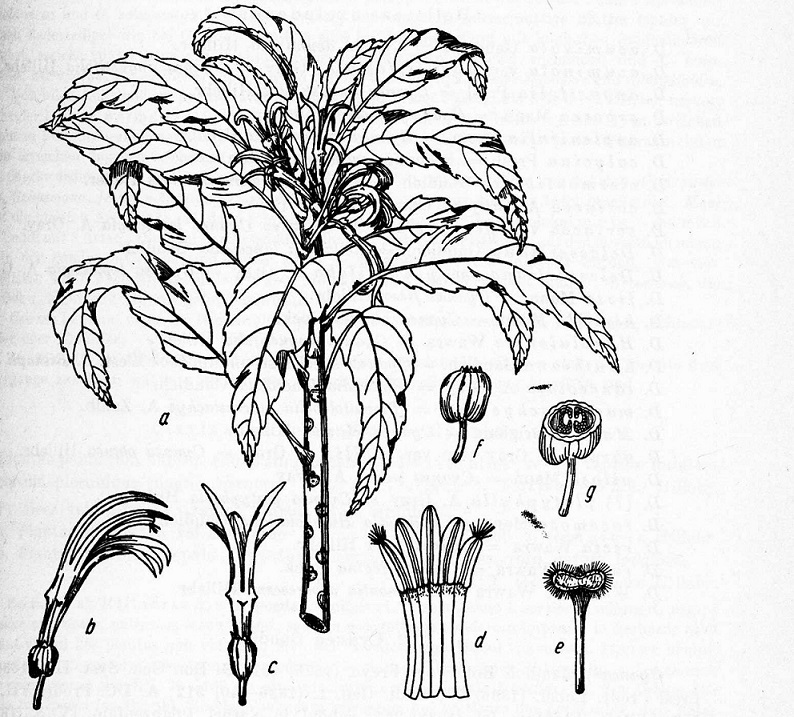
Fig 17. Delissea undulata Gaudich. a Habitus, ca. 1/5, b flos a latere, c flos a dorso, d stamina, e stigma bilobum, f bacca, g eadem transverse dissecta (nach Gaudichaud).
Delisseae dubiae:
D. Fauriei Lévl. in Fedde Repert. Nov. Spec. XII. (1913) 505; Rock Haw. Lobel. (1919) 384 inter Dubias. — "Frutex 4-5 pedibus altus ramosus; cortice exfoliante; foliis oblongis glabris flaccidis pellucidis; pedunculo ½ pollice; corolla 2½ poll. longa; capsula cylindrico-oblonga."
Sandwichinseln: Molokai: ravine à Pukoo, rare, mai 1910 (U. Faurie n. 572). — Si species revera capsulas possidet, nullo modo ad Delisseeas pertinet. Typum non vidi.
D. filigera Wawra in Flora LVI. (1873) 31. —
"Arbuscula biorgyalis, e basi diffuse ramosa, ramulis apice foliosis. Folia oblonga, 4-5 poll. lg. et 1½ poll. lt., breviter obtuse acuminata, in petiolum subbipollicarem producta, nitidula, apicem versus serrulata. Pedunculi in foliorum subapicalium axillis solitarii medio bracteolis 2 minutissimis, denum bacca delapsa decorticati et lignescentes, filum albidum rigidum formantes. Bacca cerasi magnitudine.""Maui, non Kauai: Wälder oberhalb Waihee" (Wawra n. 1955! — specimen fruct., 1 pedunculus tantum gerens, hb. Wien); Rock identificat eam cum Clermontia grandiflora Hilleb., St. John identitatem negat, etiam mihi incerta videtur.
Page 46
Delisseae excludendae:
| D. acuminata Gaudich. | = | Cyanea acuminata Hillebr. |
| D. acuminata var. angustifolia A. Gray | = | Cyanea angustifolia Hillebr. |
| D. angustifolia Presl | = | Cyanea angustifolia Hillebr. |
| D. arborea Mann | = | Cyanea arborea Hillebr. |
| D. asplenifolia Mann | = | Cyanea asplenifolia Hillebr. |
| D. calycina Presl | = | Rollandia calycina G. Don |
| D. clermontioides Gaudich. | = | Clermontia clermontioides Heller |
| D. coriacea A. Gray | = | Cyanea coriacea Rock |
| D. coriacea var. pinnatiloba A. Gray [error?] | = | Cyanea leptostegia Rock |
| D. Delessertiana Gaudich. [error? s.b. Rollandia] | = | Rollandia lanceolata Gaudich. |
| D. Delessertiana var pinnatiloba A. Gray | = | Cyanea leptostegia Rock |
| D. fissa Mann | = | Cyanea fissa Hillebr. |
| D. hirtella Mann | = | Cyanea hirtella Rock |
| D. Honolulensis Wawra | = | Cyanea angustifolia Hillebr. |
| D. Kunthiana Gaudich. | = | Cyanea species secundum Rock est. C. Bishopii Rock |
| D. lanceolata A. Gray | = | Rollandia lanceolata Gaudich. |
| D. macrostachys Presl | = | Trematolobelia macrostachys A. Zahlb. |
| D. Mannii Mann | = | Cyanea Mannii Hillebr. |
| D. obtusa A. Gray cum var. mollis A. Gray | = | Cyanea obtusa Hillebr. |
| D. pilosa Mann | = | Cyanea pilosa A. Gray |
| D. (?) platyphylla A. Gray | = | Cyanea platyphylla Hillebr. |
| D. racemosa Mann | = | Rollandia Humboldtiana Gaudich. |
| D. recta Wawra | = | Cyanea recta Hillebr. |
| D. regina Wawra | = | Cyanea regina Rock |
| D. Waihiae Wawra | = | Clermontia arborescens Hillebr. |
2. Cyanea Gaudich.
Cyanea 1) Gaudich Bot. Voy. Freyc. (1826) 451; G. Don Gen. Syst. III. (1834) 699; Presl Prodr. Lobel. (1836) 47; Endl. Gen. I. (1836-40) 512; A. DC. Prodr. VII. (1839) 343; Hillebr. Fl. Haw. Isl. (1888) 251; Schönl. in Natürl. Pflanzenfam IV. 5. (1894) 64; Rock Haw. Lobel. (1919) 157. — Macrochilus Presl. l.c.; A. DC. l.c. 341. — Kittelia Reichenb. Handb. (1837) 186. — Delissea sect. Cyanea Baill. Hist. Pl. VIII. (1886) 364; Poste et Kuntze Lex. Gen. Phan. (1904) 166; Uphof Die Pflanzengatt. (1910) 24.
____________
1) A verbo graceo χυάνεος, cyaneus, immerito quidem, cum flores cyanei in hoc gener rarissime occurrant. Vix 8% colore caeruleo usque caerulescenti-cinereo gaudent, dum 38% colore rubro, 33% albo, 13% lilacino-violaceo, 4% luteolo, 4% bicolorati sunt.
Page 47
Hypanthium ovario adnatum, globosum usque cylindricum, sepala 5 dentiformia usque foliace, valvata, persistentia. Corolla tubulosa, dorso usque ad medium vel parum ultra fissa, subrecta vel curvata, 15-76 mm longa, lobi 5 plerumque lineares, acuti, cr 1/3 longitudinis corollae, 2 superiores ceteris profundius soluti. Filamenta a corolla libera. Antherarum tubus cylindricus, exsertus, antherae 2 inferiores, raro omnes in apice pilis terminatae. Stigma bilobum, lobi subrotundi, carnosi, patentes, ad basin vel in dorso pilosi. Bacca bilocularis, placentae carnosae dissepimento utrinque adnatae. Semina numerosa, ovoidea, badia vel pallida, laevia, nitida, vix 1 mm usque 2 mm longa. — Frutices, arbores vel rarius plantae subherbaceae, inermes vel muricatae, lactescentes. Folia simplicia vel raro pinnata. flores in racemis axillaribus, albidi, luteoli, purpureo tincti vel striati, diverse rubri usque atropurpurei, albi usque caerulei. Pedicelli in medio bibracteolati.
Species 61 insulis Sanwicensibus indigenae.
|
Manche Cyanea-Arten haben im Jugendzustande gelappte Blätter, wie dies bei Cyanea leptostegia, C. solanacea und C. solenocalyx beobachet wurde, oder doppelt fiederschnittige Blätter (später nur einfach fiederteilige) wie bei C. ferox. Andere sind im Jugendzustand mit konischen Stachelhaaren bewehrt, welche später ganz verschwinden oder nur als stumpfe Höcker vorhanden sind (C. tritomantha, solenocalyx, aculeatiflora) oder daurend bleiben wie bie C. ferox, nolimetangere und rollandioides. |
Some Cyanea speices have lobed leaves in the juvenile state as has been observed in Cyanea leptostegia, C. solanacea, and C. solenocalyx, or twice pinnate leaves (later singly pinnate) as in C. ferox. Others are reinforced when young with conical spikes, which later disappear or remain only as blunt bumps (C. tritomantha, C. solenocalyx, C. aculeatiflora) or remain permanently as in C. ferox, C. nolimetangere and C. rollandioides. |
|
Von allen Lobelioideen auf den Hawaiischen Inseln bringt Cyanea die höchsten Arten hervor, die zugleich einen palmenartigen Habitus aufweisen und eine Größe von 10-15 m erreichen bei einem Stammdurchmesser von 5-15 cm, wie C. leptostegia, Giffardii und arborea. Die verzweigten Arten erreichen dagegen höchstens 5 m in der Höhe. |
Of all the lobeliads of the Hawaiian Islands, Cyanea has the largest species, which include some with palm-like habit and sizes of 10-15 m high with trunk diameters of 5-15 cm, such as in C. leptostegia, C. giffardii and C. arborea. In contrast, the branched species reach more than 5 m in height. |
|
Merkwürdigerweise ist das Vorkommen der 61 Arten mit Ausnahme von 6 Arten (C. angustifolia, Grimesiana, ferox, nolimetangere, obtusa, solanacea) immer nur auf eine Insel beschränkt. Maui weist die meisten Arten (19) auf, dann folgt Kauai mit 14, Hawaii mit 13, Molokai mit 10, Oahu mit 8 und Lanai mit 3 Arten. Die Zahl der Arten auf Niihau ist nicht sicher bekannt, auf den übrigen kleineren Inseln der Sandwich-Gruppe sind bisher keine hierhergehörige Arten entdeckt worden. Am verbreitetsten ist C. angustifolia, die auf Oahu, Molokai und Lanai vorkommt, und C. Grimesiana, die auf Oahu, Maui und Hawaii gefunden wurde. |
Curiously, with the exception of 6 species (C. angustifolia, C. grimesiana, C. ferox, C. nolimetangere, C. obtusa and C. solanacea), the range of the 61 species is always confied to a single island. Maui has the most species (19), followed by Kauai with 14, Hawaii with 13, Molokai with 10, Oahu with 8 and Lanai with 3 species. The number of species on Niihau is not known and on the other, smaller islands of the Sandwich group, species have so far not been discovered. The most common species is C. angustifolia, which is found on Oahu, Molokai and Lanai, and C. grimesiana which is found on Oahu, Maui and Hawaii. |
|
Cyanea bewohnt meist die Regenwälder von 400 bis 1500 m, seltener offene Waldungen, Schluchtränder oder Flußufer. |
Cyanea mostly inhabit the rainforests from 400 to 1500 m, they are rare in open forests, canyon rims and riverbanks. |
|
Es macht den Eindruck, daß die palmenartigen Formen die ältesten sind und bereits dem Untergange zuneigen, während die anderen in aufsteigender Entwicklung begriffen sind. |
There is the impression that the palm-like forms are the oldest and already in their descendency, while the other forms are undergoing increasing development. |
Clavis sectionum generis Cyaneae.
| A. Plantae palmarum habitu; caulis simplicissimus, 2-14 m altus; vertice tantum foliatus; corolla plerumque magna, carnosa | Sect. 1. Palmaeformes Hillebr. |
| B. Frutices vel suffrutices ramosi, rarius caule simplici. | |
| a. Plantae muricatae vel aculeatae | Sect. 2 Genuinae Hillebr. |
| b. Plantae inermes; sepala hypanthio plerumque breviores, raro parum longiores | Sect. 3. Delissoideae Hillebr. |
Sectiones ab Hillebrandio propositae, quibus cl. Rock adhuc 2 sectiones adjungit, nempe Hirtellae et Pilosae, naturales esse possunt, sed pro recognitione specierum imprimis in herbariis nihil prosunt et qui has plantas non vidit sub divo vel viventes, eas sectioni convenienti inserere nequit, nisi collector characteres correspondentes adnotavit. Sectio Pilosae Rock distinguitur a Delissoideis caule subherbaceo simplici, 30-150 cm alta, plus minus piloso; sectio Hirtellae differt a Delissoideis corolla tomentosa (ex Rock). In clave sequente specierum hae sectiones non spectantur, quia notae earum in frustulis nimis incertae et vix recte cognosci possunt.
Page 48
Page 49
Page 50
Page 51
Clavis specierum generis.
| A. Folia pinnata usque pinnatifida. | |
| a. Folia inferne pinnata, superne pinnatipartita, segmenta interdum lobulis interrupta. | |
| α. Corolla glabra, falcata, sepalis duplo longior; sepala oblanceolato-linearia, interdum usque ad medium fere connata, cr 20-30 mm longa. | 21. C. grimesiana. |
| β. Corolla hirsuta. | |
| I. Sepala glara, lineari-lanceolata 4-8 mm lg. | |
| 1. Segmenta folii basi angustata et usque ad rhachin pertingentia; sepala acuta. | 22. C. asplenifolia. |
| 2. Segmenta folii basim versus tantum usque ad rhachin pertingentia, secus lobata; sepala truncata. | 27. C. quercifolia. |
| II. Sepala tuberculato-hispida, 12 mm lg. (Folia plantae novellae bipinnatipatita). | 23. C. ferox. |
| b. Folia pinnatipartita usque pinnatilobata. | |
| α. Sepala linearia, truncata, usque 2 cm longa. | 11. C. atra var. lobata. |
| β. Sepala lanceolata vel ovata, 4-12 mm longa. | |
| I. Sepala lanceolata, acuta, 10-12 mm longa. | 28. C. lobata var. hamakuae. |
| II. Sepala late ovata, subrotundata, 4 mm lg. | 24. C. pinnatifida. |
| B. Folia integra, margine lobata vel sinuata, dentata vel crenata, raro integerrima. | |
| a. Folia margine lobata vel sinuato-dentata. | |
| α. Sepala usque vel supra medium connata, cum partibus liberis triangularibus obtusis, 20-25 mm longa, strigosa; folia plantae novellae ovalia vel cordata, folia plantae adultae obovato-oblonga, interdum dentata. | 36. C. solenocalyx. |
| β. Sepala non vel vix connata. | |
| I. Folia basi rotundata vel truncata, lobata. | |
| 1. Folia glaberrima et laevia, ovato-elliptica. | 57. C. Dunbarii. |
| 2. Folia supra glabra, subtus parce pubescentia, ovalia, petiolus parce muricatus. | 36. C. solenocalyx var. latifolia. |
| II. Folia basi angustata, elliptica vel obovato-oblonga vel oblonga (lineari-lanceolata in C. stictophylla). | |
| 1. Folia glabra, petiolo et interdum costa muricatis. | |
| * Pedunculus 14 mm lg.; lobi calycis lanceolati 10 mm lg. | 26. C. Bandwinii. |
| ** Pedunculus 6-7 cm longus, bracteatus; lobi calycis oblongi, margine mucronati, 18-24 mm lg. | 28. C. lobata. |
| 2. Folia plus minus hirta | |
| * Lobi foliorum numerosi, triangulares; calyx hispidus | 29. C. scabra var. sinuata. |
| ** Lobi remoti, sinus inter eos lati vel folia undulato-repando-sinuata. | |
| ▪ Folia oblonga vel obovato-oblonga; calix glaber, eius lobi lineares. | 25. C. solanacea. |
| ▪▪ Folia lineari-lanceolata, undulata vel repando-sinuata; calix puberulus, lobi triangulares. | 49. C. stictophylla. |
| b. Folia margine dentata, denticulata, crenato-dentata vel integerrima. | |
| α. Folia sessilia, oblanceolata vel lineari-lanceolata, 60-100 cm lg. et 6-14 cm lt. | |
| I. Lobi calycis dentiformes 1 mm lg.; pedunculus 15-32 cm lg.1) | 5. C. arborea. |
| II. Lobi calycis lineares 12-50 mm longi. | |
| 1. Lobi cal. filiformes 5 cm longi. | 4. C. leptostegia. |
| 2. Lobi cal. lineares, obtusi, 12-18 mm longi et 3 mm lt. | 8. C. hamatiflora. |
| β. Folila petiolata. | |
| I. Plantae laeves et glaberrimae, folia coriacea | 42. C. coriacea |
| 1. Pedunculus 2-3 cm lg. | pl. typica |
| 2. Pedunculus (8)16-26 cm lg.; folia nonnunqam juxta nervum medium pubescentia 2) | |
| * Folia basi breviter cuneata. | 42. C. coriacea var. Fauriei |
| ** Folia in petiolum sensim angustata | 42. C. coriacea var. Hardyi. |
| II. Plantae saltem partim pubescentes usque tomentosae, laeves vel armata. | |
| 1. Pedunculi pendentes 10-35 cm longi; folia obovato-oblonga. | |
| * Folia apice rotundata et brevissime acumianta. | |
| ▪ Pedunculus et calyx tomentosi | 1. C. superba. |
| ▪▪ Pedunculus et calyx glabri | 58. C. comata. |
| ** Folia apice sensim subacuminata | |
| ▪ Calyx tomentosus; eius lobi oblongi,, 6-10 mm lg. | 2. C. regina. |
| ▪▪ Calyx glaber, lobi triangulares, 5 mm lg. | 3. C. Giffardii. |
| 2. Pedunculi erecti vel patentes, usque 8 cm longi, raro 10 cm lg. | |
| * Floribus et fruticus sessilibus (sine pedicellis); folia anguste lanceolata, glabra. | 6. C. pycnocarpa. |
| ** Flores pedicellati. | |
| ▪ Plantae glaberrimae. | |
| ◦ Folia obovato-oblonga, cuneata. | |
| x Lobi cal. oblongo-lineares 9-14 mm lg. | 30. C. holophylla. |
| xx Lobi cal. subulati 5 mm lg. | 51. C. Knudsenii var. glabra. |
| ◦◦ Folia late oblonga usque elliptica, raro ovato-elliptica (si lineari-lanceolata vide C. angustifoliam.) | |
| x Folia margine argute uncinato-dentata | 52. C. argutidentata. |
| xx Folia margine undulata vel repando-dentata. | |
| + Folia basi acuta; pedunculus cr 3 cm lg. | 41. C. profuga. |
| ++ Folia basi rotundata, rarius breviter cuneata; pedunculus 7-8 cm lg. | 56. C. Remyi. |
| ▪▪ Plantae saltem partim plus minus pilosae. | |
| ◦ Corolla glabra vel glabrata. | |
| x Calycis lobi late ovati, obtusi, 3 mm lg. | 16. C. coronata. |
| xx Calycis lobi lineari-lanceolati, subulati vel dentiformes. | |
| Δ Folia lanceolata usque oblonga. | |
| + Cal. lobi dentiformes | 38. C. angustifolia. |
| ++ Cal. lobi lineari-lanceolati. | |
| | Folia herbacea, utrinque subacuta, 47 cm lg. et 12 cm lt.; lobi cal. 26-30 mm lg. | 13. C. Mariana. |
| || Folia chartacea, acuta, basi brevissime cuneata, 15-12 cm lg. et 4-5 cm lt.; lobi cal. 6 mm lg. | 40. C. Mannii. |
| ΔΔ Folia forma obovato-oblonga vel oblanceolata. | |
| + Folia anguste oblanceolato-linearia, 10-24 cm lg. et 1,5-2,5 cm lt. | 43. C. spathulata. |
| ++ Folia obovato-oblonga vel-lanceolata, raro subelliptica. | |
| | Plantae saltem partim armatae. | |
| □ Folia sinuato-dentata, lobis triangularibus, obtusiusculis | 28. C. lobata. |
| □□ Folia dentata vel denculata. | |
| ! Cal. lobi dentiformes | 31. C. platyphylla. |
| !! Cal. lobi lineares 7-10 mm lg. | 33. C. rollandioides. |
| || Plantae laeves. | |
| / Pedunculus 3 cm lg.; corolla crassa, carnosa. | 7. C. procera. |
| // Pedunculus vix 2 cm longus; corolla gracilis. | |
| ! Folia utrinque dense hirsuta. | 53. C. pilosa. |
| !! Folia sparse hirsuta | 29. C. scabra var. longissima. |
| ◦◦ Corolla puberula vel hirsuta vel tomentosa. | |
| □ Folia glaberrima. | |
| x Folia lineari-lanceolata | 48. C. Larrisonii. |
| xx Folia obovato-oblonga, sensim cuneata. | 20. C. sylvestris. |
| □□ Folia utrinque vel subtus tantum plus minus pilosa. | |
| x Cal. lobi lineari-lanceolati (15)20-50 mm lg. | |
| + Inflorescentia dense muricata. | 9. C. aculeatiflora. |
| ++ Inflorescentia hirsuta. | |
| | Cal. lobi apice truncati vel emarginati. | |
| / Calyx et corolla atropurpurei; lobi cal. 15-20 mm lg. | 11. C. atra |
| // Calyx et corolla virides; lobi cal. 25-50 mm lg. | 10. C. macrostegia. |
| || Cal. lobi apice acuti, 16-25 mm longi. | |
| / Truncus laevis, usque 1,5m altus; folia membranacea, petiolo 7-12 cm longo. | 12. C. Gibsonii. |
| // Truncus 2-3 m altus, tuberculatus; folia crassiuscula, petiolo 13-20 cm longo. | 17. C. tritomantha. |
| xx Calicis lobi dentiformes vel trianguulares vel ovati vel subulati, raro lineari-lanceolati, 1-10 mm longi. | |
| + Cal. lobi lanceolati vel anguste triangulares, 6-10 mm longi; folia fere obovato-oblonga. | |
| | Filamenta puberula; antherarum tubus in fissuris hirsutus. | 17. C. tritomantha var. Lydgatei. |
| || Stamina glabra. | |
| / Planta partim aculeolata. | 35. C. truncata var. Juddii. |
| // Plantae inermes. | |
| ! Folia in petiolum indefinitum brevem sensim angustata. | 55. C. fissa. |
| !! Folia in petiolum 4-8 cm longum breviter attenuata. | 15. C. wailauensis. |
| ++ Calycis lobi dentiformes vel subulati vel triangulares, 1-5(6) mm. longi [raro ovati, 5-8 mm lg. in C. ovatisepala]. | |
| | Folia basi truncata, subrotundata vel late obtusa. | |
| / Petioli muricati. | 35. C. truncata. |
| // Petioli laeves. | 14. C. ovatisepala. |
| || Folia basi acuta vel obtusa. | |
| / Plantae armatae. | |
| ! Pedunculus usque 2,5 cm longus. | |
| ; Folia oblonga, basi obtusa. | 32. C. nolimetanngere. |
| ;; Fol. obovato-oblonga, basi cuneata. | 37. C. Degeneriana. |
| !! Pedunculus 6-10 cm lg. | |
| ; Folia elliptica vel obovat-oblonga, margine undulato-dentata vel denticulata (var. etiam lobulata). | 29. C. scabra. |
| ;; Folia anguste obovato-oblonga, 30 x 5 cm; cal. lobi triangulares 2,5 mm lg. | 34. C. Fernaldii. |
| // Plantae inermes. | |
| ! Folia lanceolata vel elliptica, medio vel paullo supra medium latiora, raro fere linearia. | |
| ; Stamina plus minus pilosa. | |
| ≫ Folia lineari-lanceolata, subtus tomentosa; pedunculus 3-4 cm lg. | 18. C. undulata. |
| ≫≫ Folia sparse hirta. | |
| ~ Folia lanceolata usque oblongo-lanceolata; pedunculus 3-6 cm lg. | 44. C. acuminata. |
| ~~ Folia elliptica vel oblonga; pedunculus 1-2 cm lg. | 54. C. Bishopii. |
| ;; Stamina glabra. | |
| ≫ Folia in petiolum brevissimum sensim angustata | 19. C. Gayana. |
| ≫≫ Petioli 3-10 cm longi (solum in C. Fernaldii 12-19 cm lg.). | |
| ~ Frutex ramosus, lignosus; folia lanceolata vel oblonga, obtusa et brevissime acuminata, aequaliter dentata. | 39. C. obtusa. |
| ~~ Caulis simplex, subherbaceus, raro parce ramosus; folia apice acuta vel acumianta. | |
| ≪ Pedunculus 1-3 cm lg. | |
| : Folia oblongo-lanceolata, subacuminata, basi acuta. | 50. C. hirtella. |
| :: Folia elliptica, abrupte acuminata, basi subrotundata. | 45. C. multispicata. |
| ≪≪ Pedunculus 4-8(10) cm lg. Petioli 25-55 mm longi. | |
| : Folia lanceolata, integra. | 47. C. recta. |
| :: Folia oblong-elliptica, acuminata, denticulata | 46. C. Copelandii. |
| !! Folia distincte oblong-obovata, ad basin sensiim cuneata, apice obtusa vel acuta. | |
| ; Stamina glabra | 51. C. Knudsenii. |
| ;; Stamina hirsuta | 20. C. sylvestris var. eriantha. |
_________
1) Foliis breviter petiolatis gaudet C. Gayana, sed pedunculus 1-2 cm tantum lg., et C. procera, eius pedunculus crassus 25-40 mm lg.
2) Etiam C. angustifolia var. racemosa pedunculos tam longos possidet et haudcertedistingui potest.
Page 52
Sectio 1. Palmaeformes Hillebr.
Palmaeformes Hillebr.Fl. Haw. Isl. (1888) 260; Rock A Monogr. Study of the Haw. Spec. Lobelioid. (1919) 103. — Vide supra.
1. Cyanea superba (Cham.) A. Gray in Proceed. Am. Acad. V. (1861). 149; Hillebr. op. c. 260; Rock op. c. 157, t. 75; — Lobelia superba Cham. in Linnaea VIII. (1833) 223. — Macrochilus superbus Presl Prodr. Lobel. (1836) 47; A. DC. Prodr. VII. (1839) 341; Endl. Gen. Pl. I. (1838) 513.
Arbor palmaeformis, trunco stricto simplicissimo laevi, 4-6 m alto et ad basin 8-13 cm crasso, cingulo tenuiter lignoso, canale medullari diaphragmis chartaceis approximatis septato, comam foliorum et pedunculorum extollente. Folia obovat-oblonga, 60-100 cm lg. et 15-20 cm lt., rotundata et brevissime acuminulata, basi in petiolum cr 6-8 c longum attentuata, margine undulato-denticulata, basin versus integra, glabra, coriacea. Inflorescentia racemosa, axillaris, tomentosa: pedunculus dependens, cr 35 cm longus (fructificans), distanter bracteatus; bracteae oblongae, tomentosae, obtusae, 26-49 mm longae, insuper 2 bracteolis 12 mm longis in basi omnium florum; flores subsessiles, calycis tubus obconicus, velutino-tomentosus, 10-14 mm longus; lobi oblongi, coriacei, 10-16 mm longi. Corolla tubulosa, dorso profunde fissa, arcuata, coriacea, tomentosa, 6 cm longa, lobi lineares, conniventes, cr 16 mm longi. Staminum tubus glaber, exsertus; antherarum tubus cylindraceus, subcurvatus, 16 mm lg., antherae 2 inferiores apice penicillatae. Bacca obconica, cr 22 mm lg. et 15 mm lt., aurantiaca, lobis calycinis sinubus conspicuis separatis coronata. Semina fusca, laevia, nitida, 2 mm lg. — Fig. 18f.
Oahu (Chamisso, Herb. Berl.!); Schluchten des Mt. Kaala, Makaleha (Hlb.!).
var. velutina Rock l. c. 157, t. 76. — C. superba β var. Hillebr. l. c. 261.
Folia majora, subtus velutino-tomentella vel nervis tomentellis, secus sparse pubescentia.
Oahu: Schluchten am Ostabhang des Mt. Kaala und Wailupe (Hillebrand!).
|
Es scheint, daß diese sowie die folgende Art durch weidende Tiere bereits ausgerottet ist, da Rock an dem Orte, wo Hillebrand 1870 diese Pflanzen sammelte, keinen Wald, sondern nur mehr oder weniger fruchtbares Grasland antraf. |
It seems that this plant and the following are already extinct. Rock found no forest, only more or less fertile grasslands, in the places from which Hillebrand 1870 collected . |
2. Cyanea regina (Wawra) Rock op. c. 159, t. 77. — Delissea regina Wawra in Flora LVI. (1873). 9. — Cyanea superba var. reginae Hillebr. op. c. 261.
Arbuscula cr 4 m alta, caulis simplex, erectus, 8 cm crassus, apice coronam foliorum declinatorum gerens. Folia elliptic-oblonga 50-75 cm lg. et 10-17 cm lt., acuta, basi in petiolum 6 cm longum angustata, margine leviter dentata, chartacea, primo subtus tomentella, postea glabrata. Pedunculus axillaris, dependens, 12-20 cm longus, inferne fere nudus, superne distanter bracteatus (bracteae lineares, obtusae, 12-36 mm lg.), 5-10 flores racemosos in vertice gerens; pedicelli resupinati, 6 mm longi, basi bracteolis 4-6 mm longis; hypanthium pyriforme, 16 mm lg, velutino-tomentosum, lobi oblongi, rotundati, 6-10 mm lg. Corolla eburnea cum nervis purpurascentibus, velutina, coriacea, arcuata, 8 cm lg. et cr 1 cm lt.., lobi lineares, inaequales, superiores cr. 24, inferiores 15-12 mm longi. Stamina glabra; antherarum tubus 2 cm lg., albus et purpureo-striatus, antherae 2 inferiores penicillatae. Bacca pyriformis, 20 mm lg. et 12 mm lt., lobis calycis coronata.
Oahu: Niu and Wailupe Valley, 500-600 m (Hillebrand jun. et Lydgate! Wawra n. 2239, Herb. Wien!).
3. Cyanea Giffardii 1) Rock in Torrey Bot. Club Bull. XLV. (1918) 133, t. 6 et Haw. Lobel. (1919) 159, t. 38, 79, 80.
Arbor simplex, 5-10 m alta, basi 15 cm in diam., ad apicem sensim attenuata, cortice laevi, sparse cicatricosa, incano-viridi, medulla transverse multiloculosa folia obovato-oblonga, 50 cm lg. et 12-15 cm lt., subacuminata, margine undulata et denticulata, basin versus majus dentata et in petiolum crassum 4-6 cm longum angustata, membranacea, supra obscure viridia, nitida, subtus pallida et pubescentia, imprimis in nervis et venis. Pedunculus axillaris, dependens, crassus, glaber, 10-16 cm lg. et 1 cm in diam., bracteis linearibus obtusis 15-30 mm longis et 3-5 mm latis versus apicem densius vestitus; pedicelli 2-3 mm longi, 3 bracteolis parvis muniti. Hypanthium semi-ovoideum, purpureo-nigrum, glabrum, 18 mm lg. et 15 mm lt., lobi calycine late triangulares 5 mm lg. Corolla purpurea glabra, nitida, curvata, 7-8 cm longa dorso supra medium fissa, lobi connati. Staminum tubus glaber, longe exsertus, pallidus; antherae glaucae, 2 inferiores apice penicillatae. Bacca globosa, cr 25 mm in diam. atro-purpurea; semina albida.
|
Hawaii: Im Walde auf dem windseitigen Abhand des Kilauea-Mauna Loa, ungefähr 22 Meilen von Glenwood, 600m (Giffard n. 12802, Herb. des Kollegs von Hawaii!); in feuchtem Walde entland des Weges zum Vulkan Kilauea, 720 m, blüh. und frucht. im Sept (Rock et Holm. n. 12802b!). |
Hawaii: In the forest of windward Kilauea-Mauna Loa, about 22 miles from Glenwood, 600m (Giffard n. 12802, Herbarium of the College of Hawaii!); in moist woods along the path to the volcano Kilauea, 720 m, flower and fruit in Sept. (Rock et Holm n. 12802b!). |
____________
1) In honorem W. M. Giffard, qui speciem primus invenit.
Page 53
4. Cyanea leptostegia A. Gray in Proceed. Am. Acad. V. (1861) 149; Hillebrand op. c. 261; Rock The Indig. Trees Haw. Isl. (1913) 494, t. 209 et Haw. Lobel. (1919) 165, t. 10, 28, 29, 31, 32, 81, 82. — Delissea Delessertiana var. pinnatiloba A. Gray l.c. 147.
Arbor trunco laevi, superne cicatricoso, 12-14 m alto. Folia sessilia, anguste lanceolata, 75-100 cm lg. et 6,5-8,5 cm lt., subintegra vel denticulata, glabra, nitida, chartacea; folia plantae novellae in parte inferiore sinuato-lobata, in parte superiore profunde lobata (Grayi Delissea Delessertiana var. pinnatiloba!). Racemi axillares, brevissimi, confertiflori. Pedunculi 4-6 cm longi, inferne nudi, apice 12-25 flores gerentes, glabri; bracteae lineares 24 mm lg.; pedicelli 10-15 mm longi, bracteolis 12 mm longis ornati. Calycis tubus cylindricus, glaber, 18 mm lg., lobi lineari-filiformes, patentes, 30-55 mm lg. et 1 mm lt. Corolla rubescens usque obscure purpurea, glabra, subrecta, 5 cm lg., 3 mm lt., dorso usque fere basin fissa; lobi lineares, inaequales, 12-18 mm longi. Columna staminea glabra; antherae 2 inferiores penicillatae. Bacca ovoidea, 20-35 mm lg. et 8-12 mm lts., laciniis calycis persistentibus coronata.
Kauai: Waimea, oberer Waldrand nahe der tafelförmigen Höhe (U.S. Expl. Exped., Herb. Gray; 600-900 m, Mann et Brigham n. 575; Heller n. 2793). — Wälder von Halemanu (Wawra n. 2116!); 1100m, 30 April 1929 (Mary C. Neal!).— Wälder von Halemanu und Kaholuamano (Rock 5818, 9016 [folia pl. novellae], 10256. — Kaholuamano unterhalb Waimea (Forbes n. 447 K!, A. S. Hitchcock n. 15359). — Kokee, offener Wald (Degener n. 2189!).
var. velutina Skottsb. in Act. Hort. Bot. Gothoburg. II. (1926) 264.
Folia subtus pilis crispis dense et breviter velutina.
Kauai: Weimea, in den Wäldern bei Kokee, 1050m (Skottsberg n. 976).
Nomen speciei apud incolas: "Hahalua". — Succus vel lac plantae est luteus (canary yellow). Species non invenitur in regione interiore insulae, peculiaris est ad fines silvarum et crescit in societate cum Cyanea spathulata et hirtella, Antidesma platyphyllyllum var., Maba sandwicensis var., Rockia sandwicensis, Xylosma hawaiiense (ex Rock).
5. Cyanea arborea (H. Mann) Hillebr. op. c. 261; Rock The Indig. Trees Haw. Isl. (1913) 493, t. 206, 207, 208 et Haw. Lobel. (1919) 165, t. 83, 84. — Delissea arborea H. Mann in Proceed. Am. Acad. VII. (1868) 180; D. coriacea var. β A. Gray in Proceed. Am. Acad. V. (1861) 148. — Cyanea longifolia Heller in Minnesota Bot. Stud. IX. (1897) 909.
Arbor 4-8 m alta; truncus simplex, laevis, rara occasione a basi subramosus. Folia sessilia, oblanceolata, 66-88 cm lg. et 6-12 cm lt., apice rotundata et brevissime acuminata vel breviter subacuminata, ad basin sensim angustata, denticulata, basin versus subintegra, subcoriacea, supra glabra et nitida, subtus parce pubescentia imprimis ad prominentem costam. Pedunculi axillares, graciles, rigidi, 15-32 cm lg., inferne nudi, in vertice conferte multiflori, bracteis parvis ornati; pedicelli 4-8 mm longi, bracteolis minutis praediti. Hypanthium campanulatum lobis dentiformibus brevissimis. Corolla eburnea usque caesia, 45 mm lg., subcurvata, glabra, dorso profunde fissa, lobi conniventes. Stamina glabra; antherae 2 inferiores apice penicillatae. Bacca globosa, 1 cm in diam.
Maui: Ulupalakua (Mann et Brigham n 461); Ulupalakua, oberhalb Kula, südliche Abhänge des Haleakala, 1500m (Hillebrand!, Lydgate n. 162!, Rock n. 10354).
Species pulcherrima, sed rarissima et verisimiliter exstinctura; nam loco silvae Ulupalakua, ubi olim species nostra collecta est, cl. Rock invenit locum graminosum Eucalyptis consertum. — Cyanea arborea var β. Hillebr. l.c. 262 in silva Hilo lecta probabiliter est Rockio aestimante Cyanea Giffardii Rock.
Page 54
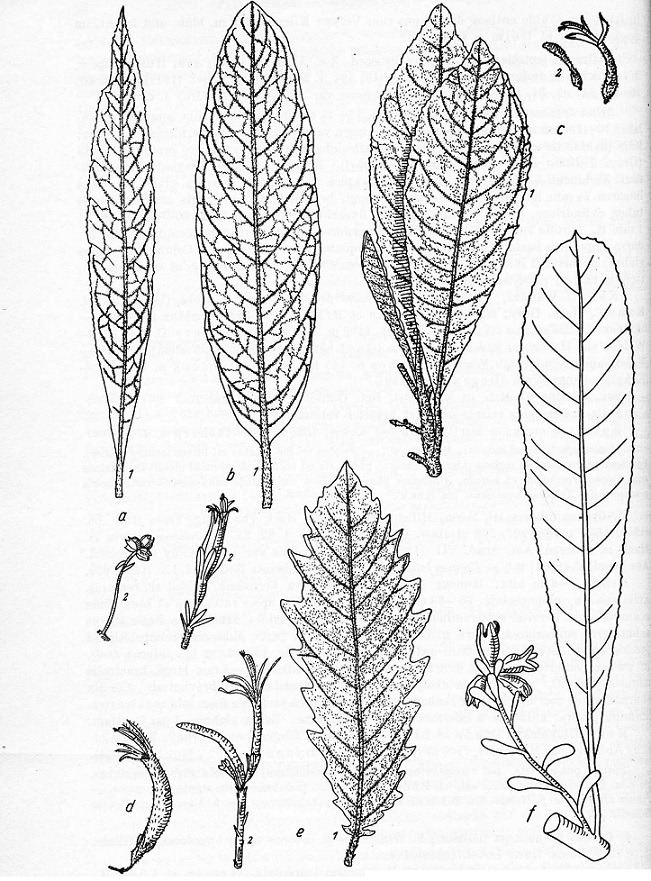
Fig 18. Cyanea. a C. pycnocarpa (Hillebr.) Wimm. 1 Folium, 2 Pedunculus fructifer 1/2. — b C. Mariana Wimm. — c C. Degeneriana Wimm. 1 Ramus foliatus, 2 Flores. — d D. scabra Hillebr. — e C. solanacea Hlb. 1 Folium, 2 Peduculus florifer. — f C. superba A. Gray.
Page 55
6 Cyanea pycnocarpa (Hillebr.) E. Wimm. — C. arborea var. γ pycnocarpa Hillebr. op. c. 262; Rock Haw. Lobel. (1919) 168.
Verisimilter habitu C. arboreae. Folia anguste lanceolata, 34 cm lg. et 4,5 cm lt., utrinque sensim acutata, margine callose denticulata et undulata, membranacea, supra glabra, sutus pallidiora et in nervis pubescentia, petiolus 3-4 cm lg. Peduculus gracilis, glaber, nudus, 6-7 cm lg., apice bracteis lanceolatis 1 cm longis et baccis subglobosis, 12 mm latis, sessilibus, lobis triangularibus 4-5 mm lng. — Fig. 18a!
Hawaii: Kohala Range (Hillebrand! Herb. Berl.).
7. Cyanea procera Hillebr. op. c. 262; Rock Haw. Lobel. (1919) 173, t. 88.
Arbor trunco simplici, laevi, 4-8 alta, aemulans Cyaneam arboream. Folia oblongo-oblanceolata, 63 x 14 cm, obtusa et brevissime acuminulata vel subacuta, ad basin sensim angustata in petiolum cr 1 cm longum, margine denticulata, supra glabra, subtus pubescentia. Pedunculi axillares, crassi, 3-4 cm longi, inferne nudi, versus apicem bracteati et multiflori; bracteae triangulari-lineares, ciliolatae, 1 cm longae; pedicelli hirtella, 6-10 mm longi, basi bracteolati; hypanthium obconico-cylindricum, glabrum, 10-14 mm lg., laciniae triangulares, ciliatae, 3-4 mm lg. Corolla glabra, carnosa, inferne caerulescens, superne virenti-lutea (in corolla nondum evoluta). Stamina glabra; antherarum tubus 15 mm lg., 2 inferiores penicillatae.
Molokai: Kamolo, 600m (Hillebrand!, Herb. Berl.).
Proxima C. arborea Hillebr. differt foliis sessilibus, angustioribus, pedunculo gracili, multo longiore, calyce subgloboso, corollae colore. in ambobus truncus constat e cingulo crasso-lignoso includente angustum medullae canalem multi-loculosum.
8. Cyanea hamatiflora Rock The Indig. Trees Haw. isl. (1913) 510 et Haw. Lobel. (1919) 187, t. 36, 96, 97.
Truncus simplex, erectus, glaber, laevis, 3-8 m altus et cr 14 cm in diametro, in vertice foliis horizontaliter patentibus coronatus. Folia sessilia, lineari-lanceolata, 60-70 cm lg. et 10-14 cm lt., subacuta, ad basin sensim paullumque angustata, supra puberula, subtus tomentella, coriacea, margine callose denticulata. Pedunculi crassi, puberuli, 2 cm longi; pedicelli 5-6 mm longi, basi bractea lanceolata et insuper 2 bracteolis puberulis; hypanthium obconico-oblongum, 15 mm lg. et 6-7 mm lt., lobi sublineares, obtusi, subaequales, 12-20 mm lg. et 4 mm lt. Corolla purpurascens, carnosa, subcurvata, apice hamosa, 7 cm lg., lobi hirsuti, deflexi. Antherarum tubus parce pilosus in suturis, 2 cm lg., 2 inferiores apice penicillatae. Bacca obovoidea, atropurpurea, 10-costata, 4 cm lg. et 2,5 cm lt. Semina badia.
Maui: In den dichten Regenwäldern an den Abhängen des Haleakala zwischen Waikamoi und Honomanu und gemein am Krater des Puukakai, 1200-1350m, blüh. August und Sept., frcht. im März (Rock n. 8514! Herb. Colleg. Hawaii; Rock et Hashimoto n. 13132). — Keanae Valley, Wald (Degener n. 7977!).
Tota inflorescentia, imprimis gemmae floriferae exsudant substantiam glutinosam. Species crescit in dictis pluviisilvis una cum Cyanea aculeatiflora, Cyanea macrostegia, Cyanea ferox var. horrida, Clermontia tuberculata, Clermontia arborescens (Rock).
9. Cyanea aculeatiflora Rock The Indig. Trees Haw. Isl. (1913) 509; Rock Haw. Lobel. (1919) 187, t. 34, 35, 55, 98. — C. solenocalyx var. schizocalyx Hillebr. l.c. 258.
Truncus simplex, superne cicatricibus foliorum notatus, 3-7 m altus, versus basin muricatus. Plantae novellae ubique muricatae. Folia oblonga, 40-60 cm lg. et 10-20 cm lt., obtusa, ad basin paullum cuneata et obtusa, margine repando-undulata et denticulata, crassa, coriacea, supra glabrata et in nervis muricata, subtus pallidiora, crispo-pilosa, costa et petiolus carnosus 15 cm longus muricati. Pedunculi 6-10 cm longi, muricati, bracteis sparsis, foliaceis, 3-4 cm longis ornati; pedicelli 10-15 mm longi; hypanthium turbinatum, muricatum cum lobis sublinearibus, obtusis, 25 mm lg. et 5 mm lt. Corolla purpurea, extus muricata, subcurva, 7 cm lg. et 1 cm lt., lobi lineares obtusiusculi, 3-2 cm longi, patentes, intus caerulescenti-albi. Stamina purpurea, glabra; antherarum tubus 15 mm lg., 2 inferiores pilis terminatae. Stylus versus stigma bilobum incrassatus. Bacca ignota.
Maui: Hamakua, im dichten Regenwald an den nordwestlichen Abhängen des Haleakala und entlang der Flüsse Waikamoi und Honomanu, 1200m (Rock n. 8513! Herb. College of Hawaii und Rock et Hashimoto n. 13133.) — Olinda (A. S. Hitchcock n. 14904, 14905; Degener n. 7980!). — West-Maui, Nordseite des Haleakala, 1200-1300m (Lydgate n. 27! Herb. Hillebrand Berl. sub Cyanea solenocalyx). — Waikamoi, Regenwald, 1275 m (Neal et Hartt!); Keanae Valley, VII. (Degener n. 7979!). Blüh. vom Juli bis Oktober.
Trunco decerpto nostra plant sicut et aliae plantae huius sectionis ramos novellos agunt a basi et videntur exinde occasionaliter ramosae.
Page 56
10. Cyanea macrostegia Hillebr. op. c. 263; Rock Haw. Lobel. (1919) 179, t. 49, 92, 93.
Truncus simplex, subscaber, 2-4 m altus. Folia oblanceolata, 45-62 cm lg. et 7,5-11 cm lt., acuta, ad basin sensim angustata in petiolum 5-10 cm longum, margine leviter repanda denticulata, supra papillosa, subtus pubescentia, membranacea. Pedunculi 15-30 mm longi, crassi, a basi bracteis linearibus obtusis et floribus praediti, hirsuti; pedicelli 15-20 mm longi, bracteolae 12 mm lg. Hypanthium ellipsoideum vel obconico-oblongum, 2 cm lg., glabratum vel hirsutum, lobi lineares, emarginati vel obtusi, integri, multinervii, glabri, basi parum connati, 30-52 mm lg. et 4-8 mm lt. Corolla obscure purpurea, carnosa, primo lutoso-hirsuta, saepe glabrescens, subrecta, 5-6 cm lg., dorso profunde fissa; lobi lineares, superiores 35, inferiores cr 25 mm lg. Staminum tubus purpureus, glaber: antherae 15 mm lg., 2 inferiores apice penicllatae. Bacca ovoidea, lutea, cr 2 cm lg.
Maui: In tiefen, bewaldeten Schluchten des Kaanapali, Honokahua, und Waihee, August 1870 (Hillebrand!). — Hamakua, Waikamoi-Olinda Trail, im dichten Regenwald, 1200m (Rock n. 8524!). — Honomanu (Rock n. 8524a). — Wald von Nahiku (Rock n. 11264). — Kapihulea Valley (Forbes n. 1652 M!). Blühend vom April bis August. — Hillebrand bemerkt dazu: "The flowers are hidden between the long crowded bracts and calycine lobes, which always retain a large quantity of water and organic debris, in consequence of which the fleshy corollas are apt to perish by rot and intact ones are rare."
var. viscosa Rock Haw. Lobel. (1919) 183, t. 94. — C. macrostegia β. var. Hillebr. op. c. 263.Folia lanceolta vel oblonga, 50 cm lg. et 7-8 cm lt., acuta vel acuminata, ad basin atenuata in petiolum crasso-carnosum, muricatum, 6-7 cm longum, margine irregulariter leviter dentata, supra sparse puberula et scabriuscula, subtus olivaceo-tomentella. Inflorescentia viscida. Bracteae foliacea, 3 x 1 cm, pubescentes. Calycis lobi 2 mm lg. et 8 mm lt. Corolla stigosa, 6 cm lg.
Maui: West-Maui (Lydgate n. 50!) — Honomanu (Rock n. 8791).
var. parvibracteata Rock in Coll. Haw. Publ. Bull. II. (1913) 43, t. 10 et Haw. Lobel. (1919) 183, t. 95.Folia oblongo-lanceolata, 45-65 cm lg. et 7-14 cm lt., margine irregulariter crenato- vel grosse-dentata, coriacea, supra scabra, subtus pubescenta. Pedunculus 4-6 cm lg., bracteis linearibus 5 x 1 mm in apice, pedicelli nudi 15 mm lg. Calycis lobi 20-30 mm lg. et 4-5 mm lt., cum corolla pubescentes.
Maui: West-Maui, Nord-Abhang des Haleakala, 1200-1500m (Lydgate n. 26½, Herb. Berl.! Rock n. 8792). — Nordwestlicher Abhang des Haleakala, Waikamoi-Olinda Trail, 1500m (Rock et Ceresole n. 10057).
Rock putat, hanc varietatem esse intermediam inter Cyaneam atra et C. macrostegiam.
Page 57
11. C. atra Hillebr. op. c. 263; Rock Haw. Lobel. (1919) 177, t.90. — Truncus 1,3-2 m altus, basi 10 cm diametiens, simplex, raro ad basin ramosus, superne aculeatus. Folia late lanceolata usque obovat-oblonga, acuta, basi sensim angustata in crassum et muricatum, 5-8 cm longum petiolum, margine crenulata, 40-50 cm lg. et 7,5-14 cm lt., coriacea, supra scabra vel sparse papillosa, subtus pubescentia. Pedunculi 2 cm lg., crassi, plerumque aculeati. Calycis tubus obconico-cylindricus, pubescens, 15 mm lg., lobi lineares, obtusi et mucronati vel emarginati, inaequales, basi paullum connati, (10)18-20 mm lg., 4 mm lt. Corolla atro-purpurea, hirsuta, subrecta, dorso usque fere basin fissa, 5-8 cm longa; limbus bilabiatus, lobi 2 superiores 36 mm, 3 inferiores 23 mm longi. Staminum tubus 8 cm lg., atro-purpureus, subhirtus. Antherarum 2 inferiores penicillatae. Bacca ovoidea, aurantiaca, cano-tomentosa, 20-25 mm lg. semina pallide lutea. — Fig. 19a.
Maui: West-Maui, Wailuku, auf dem Rücken des Lahaina, 900-1000m und auf dem Eeka (E. Bishop und Hillebrand, Herb. Berlin!). — Dicht bewaldete Schlucht des Honokawai im Gebirge Kaanapali, 1200-1300m (Rock n. 8204!). — Honokahua Valley (Rock et Hashimoto n. 13126). — Am Waikamai-Fluß, 1560m (G. C. Munro n. 808!). — Puu Kukui, 12-1500m (A. S. Hitchcock n. 14749, 14847). — Wahrscheinlich auch (nur 1 Blatt vorhanden) Nordabhang des Haleakala (Forbes n. 1160 M!). Mauika of McGregor, rainforest (Hb. Deg. n. 22245! 22067! - B.W.).(cf. supplement)
var. lobata Rock The Indig. Trees Haw. Isl. (1913) 511; Rock Haw. Lobel. (1919) 179, t. 91.Petiolus muricatus, 6-7 cm lg. Folia margine anguste lobata vel irregulariter pinnatifido-lobata, segmenta 1-3 cm longa, basi 6-15 mm lata, supra tuberculata, subtus tomentosa. Pedunculus 3-4 cm lg. Cetera ut in typo exceptis staminibus glabris.
Maui: Im dichten Regenwald: Von Ukulele in die Waikamoi Schlucht, 1500m (Rock n. 8637!). — Kula pipe line, 1270 m und Haleakala, 1550m (G. C. Munro n. 807!, 728!, 726!, 730!, 809!).
12. C. Gibsonii Hillebr. op. c. 263; Rock Haw. Lobel. (1919) 177, t. 89. — Truncus 1-1,6 m altus, laevis. Folia elliptica vel obovat-oblonga, 24-40 cm lg. et 10-14 cm lt., subacuminata, basi subacuta, crenato-dentata, membranacea, supra glabra, subtus viridia, in nervis et venis sparse hirsuta, petiolus 5-13 cm lg., parce muricatus. Pedunculi axillares, carnosi, bracteis linearibus, 12-18 mm longis ornati, 1-2(3,7) cm longi; pedicelli subhirsuti, 15-23 mm longi, bracteolati; hypanthium oblong-obconicum, subhirsutum, 15 mm lg., lobi lineares, 20-22 mm longi, 4 mm lati, subacuti vel obtusi, subhirsuti. Corolla in alabastra apice longe producto, obscure purpurea, hirsuta, curvata, 6-8 cm lg., lobi lineares, superiores longiores. Stamina glabra; antherae 2 inferiores pencillatae in apices. — Fig. 19d!
Lanai: Auf dem höchsten, bewaldeten Bergrücken (Hillebrand, Herb. Berlin!). — Auf der höchsten Erhebung des Mahana-Tales in der Nähe des Wasserfalles (Rcok n. 8051) und auf dem Gipfel des Lanaihale (Rock). — Kaiholena (G. C. Munro n. 208!); Hookio Valley (G. C. Munro n. 26!).
Species Cyaneae atrae arcte affinis et saepius difficulter distinguenda.
13. C. Mariana E. Wimm. n. sp. — Truncus simplex, 2 m altus. Folia oblonga, 47 x 12 cm, utrimque subacuta, margine subintegra denticulata, herbacea, supra glabra, subtus in nervis venisque puberula, pallida, nervi secundarii sub angulo recto ascendentes, petiolus crassus, puberulus, 6 cm lg. Pedunculi cr 2 cm longi, minute tuberculati, sparse hirti, bracteis oblanceolato-linearibus in apice; pedicelli 17-25 mm longi. Hypanthium obconico-oblongum, glabrum, 2 cm longum, 1 cm altum, lobi calycis sublineares, obtusiusculi, mucronati, multinervii, glabri, 26-35 mm lg. et 7 mm lt. Corolla purpurea, glabra, carnosula, subrecta, 75 mm longa et cr 10 mm lata; lobi lineares, patentes, cr 3 cm longi, extus muricati. Columna staminea glabra, longitudine corollae; tubus antherarum 12 mm lg., 2 inferiores pilis terminatae. — Fig. 18 b.
Maui: West-Maui, an einem Sumpf auf dem Puu Kukui, 1350m (Mary Neal et C. Hartt!; Ewart III. n. 92! Herb. Bishop Mus.).
Specimina allata non sufficiunt ad diagnosim omni modo accuratam conficiendam; constant e foliis et floribus sinularibus et peunculo vix completo. Secus Cyaneae antecedenti similis.
Page 58
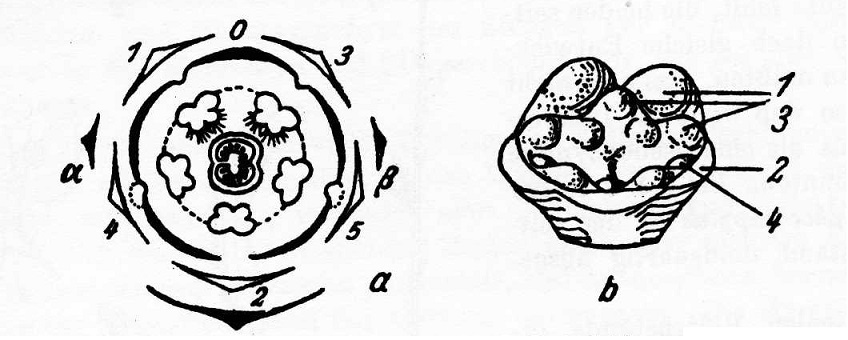
Fig 19. a Cyanea atra Hillebr. — b C. ovatisepala E. Wimm. Inflorescentia. — c C. wailauensis Rock, infloresc. — d C. Gibsonii Hillebr. — e C. undulata Forbes Pedunc. fructif. omnes 1/1, folium 1/3 magn. nat. — Orig.
Page 59
14. C. ovatisepala E. Wimm. n. sp. — Habitus non satis notus, verisimiliter e comparatione cum C. wailauensi: truncus simplex, extollens comam foliorum in vertice Petiolus 10 cm lg. Folia oblonga, 48 x 15 cm, subacuta, apice ipso obtuso, basi subrotundata, margine undulata et fortasse denticulata, glabra vel subtus sparse hirta. Pedunculus crassus, glaber, 5 cm lg., inferne nudus, superne bracteis linearibus, subhirtis, 5 mm longis parce obsitus; pedicelli 5-25 mm longi, glabri, invertice pedunculi, sensim in hypanthium obconicum cr 18 mm longum ampliati; lobi calycis ovati, apice rotundati, mucronati, margine integro reclinati, 5-8 mm longi et 5 mm lati, glabri. Corolla subrecta, 4 cm longa, subglabra, et basi latiore paullum angustiore (4 mm), lobi superiores 12, inferiores cr 7 mm longi. Staminum tubus glaber, antherae 7 mm longae, 2 inferiores apice penicillatae. — Fig. 19 b.
Molokai: Pukuo, im Regenwald nahe bei Conradt's (Hitchcock n. 15008! und wahrscheinlich auch 15073; vidi primum specimen in herb. Bish. Mus., ambo in herb. Washington).
Species nostra recedit a C. wailauensi foliis aliter formatis, pedunculo ecicatricoso, crasso, longiore, lobis calicis ovatis, corolla alia.
15. C. wailauensis Rock in Coll. Haw. Publ. Bull. II. (1913) 43 et Haw. Lobel. (1919) 173, t. 87, excl. speciminibus ab Hitchcock lectis). — Plant erecta, caule simplici 1,5m alto, in vertice foliis coronato. Folia obovat-oblonga, 30-40 cm lg. et 10-18 cm lt., acuta vel cuspidata, ad basin attenuata in petiolum 4-8 cm longum, margie subundulata, et repando-dentata vel denticulata, subcarnosa, in sicco chartacea, supra opaca et glabra, subtus puberula (folia novella hispida). Racemi in superiore parte caulis dispositi. Pedunculus hirsutus, 4 cm longus, a basi fere obtectus cicatricibus magnis et densis, bracteis linearibus hirsutis praeditus; pedicelli 1 cm longi, hirsuti; calicis tubus hirsutus, obconicus, 1 cm longus, lobi lineari-lanceolati, subacuti, 8-15 mm longi. Corolla sordide alba, hirsuta, dorso 2/5 longitudinis fissa, fere recta, 32 mm longa, lobi inaequales. Tubus staminum obscure purpureus, glaber; antherae 2 inferiores barbatae. Stigma in basi annulo pilorum cinctum. — Fig. 19c.
Molokai: Valley of Wailau, entlang dem Flusse am Ende des Tales, in Gesselschaft mit Cyanea grimesiana, blühend im April (Rock n. 8812! herb. Colleg. Hawaii). — Mapulehu, Mai 1915 (Rock).
Specimina a Hitchcock sub no. 15008 et verisimiliter etiam no. 15073 lecta et a Rockio pro ista specie requisita longe diversa sunt et pertinent ad C. ovatisepalam.
16. C. coronata E. Wimm. n. sp. — Folia late oblanceolata, 31 cm lg. et 8,5 cm lt., acuta, ad basin sensim angustata in petiolum hirtellum, 3 cm longum, margine inferiore denticulata, superiore irregulariter dentata, chartacea, supra glabra, subtus sparse et breviter pubescentia, nervi secundarii sub angulo subrecto ascendentes. Pedunculus dimidio tenuior quam petiolus, glaber, 30-37 mm longus, sparse cicatricibus et bracteis parvis obsitus, multiflorus; pedicelli 15 mm longi, hirtelli, ebracteolati; hypanthium obconico-oblongum, hirtellum, 6 mm longum; lobi triangulares, obtusi, 3-4 mm longi et lati. Corolla albida (?) glabrata (alabastrum adpresse hirtellum), subcurvata, ultra medium in dorso fissa, 5 cm longa et cr 5 mm lata; limbus subbilabiatus, lobi superiores 11, inferiores 5 mm longi. Staminum tubus 5 cm lg., glaber; antherarum tubus 7 mm lg., purpurascens, 2 inferiores antherae apice barbatae. Bacca obovoidea, lobis calycis coronata.
Oahu, anno 1908 (C.N.Forbes! Herb. Bishop Mus.)
Accedit ad C. proceram, sed habitus plantae mihi ignotus.
Page 60
17. C. tritomantha A. Gray in Proceed. Am. Acad. V. (1861) 149; Hillbr. Fl. Haw. Isl. (1888) 262; Rock Haw. Lobel. (1919) 189, t. 39, 53, 99, 100. — Truncus 1,8-3 m altus, scaber, tuberculatus. Folia petiolata, obovat-oblonga vel oblongo-lanceolata, 30-70 cm lg. et 13-20 cm lt., acuta vel obtusa et brevissime acuminata, basi angustata in petiolum muricatum 10-20 cm longum, margine undulata et crenato-dentata, crasso-chartacea, subtus sparse muricata in costa, pubescentia in nervis prominentibus. Pedunculus 2-6 cm longus, crassus, muricatus, a basi fere dense bracteis linearibus 14-42 mm longis praeditus, multiflorus; pedicelli 2-3 cm longi, bibracteolati. Hypanthium obconico-oblongum, scabrum vel subhirtum, lobi sublineares, acutiusculi, 11-13 (25) mm longi, 2 mm lati. Corolla purpurea vel tubo virenti-albo et apice purpureo, intus caesia, hirsuta, curvata, 60-75 mm longa, 6 mm lata, lobi lineares, cr 15 mm longi. Filamenta et antherae purpureae glabra, antherae 2 inferiores penicillatae.
Hawaii: Mauna Kea (U.S. Expl. Exped., Gray-Herb.). — Hilo (Lydgate! Bro. Mathias Newell n. 10261). — Kohala Gebirge (Hillebrand.) — In der Wald-region von Hilea an den südlichen Abhängen des Mauna Loa, Kau, 500-900 m (Rock n. 10013, 10013a!!). — Im dichten Wald gegen 29 Meilen vom Vulkan Kilauea nach Kulani (Rock et Hashimoto n. 13135). — Zwischen Glenwood und 29 Miles, Glenwood und dem Vulkan House (Degener n. 7864! 7877! 7863!). — Einheimischer Name: "Aku".
Folia cocta ab incolis eduntur ut olus (Lydgate).
var. Lydgatei (Hillebr.) Rock Haw. Lobel. (1919) 193. — C. tritomantha β var. Hillebr. op. c. — C. Lydgatei Hillebr. mss. ex Rock l.c. — Folia oblanceolat-oblonga, 31 x 8 cm, acuta, in petiolum crassum, sparse muricatum, 14 cm longum angustata, margine subintegra usque inaequaliter denticulata, coriacea, supra sparse muricata, subtus dense puberula. Petiolus et inflorescentia villosi. Lobi calycis lineares, acuti, 8-10 mm longi, glabri. Corolla fusco-hirta, lobis muricatis. Stamina glabra vel puberula; antherarum tubus in suturis hirsutus.Hawaii: Kona (Lydgate; Hillebrand!).
18. C. undulata Forbes in Occas. Pap. bishop Mus. V. (1912) 12; Rock Haw. Lobel. (1919) 221. — Caulis simplex, 1,8-3,6 m altus. Folia lineari-lanceolata, 30-36 cm lg. et 4-5 cm lt., cuspidata, apice ipso obtusiusculo, ad basin sensim attenuata in petiolum hirtum 2-3 cm longum, margine undulata et denticulata, subcoriacea, supra glabra, subtus fusco-tomentella. Flores in racemis axillaribus 5-6-floris. Pedunculus 3-4 cm lg., tomentosus; pedicelli 10-12 mm lg., tomentelli cum obovoideo hypanthio; lobi calycis triangulares, acuti, 3 mm longi. Corolla luteola, subcurvata, intus extusque hirsuta, cr 3 cm longa. Filamenta subhirta, 22 mm lg. Antherarum tubus glaber, 7 mm lg., antherae 2 inferiores pilis terminatae. Bacca obovoidea, hirtella, 20 mm lg., Semina ovoidea, fusca, nitida, 0,8 mm lg. — Fig. 19 e!
Kauai: Im feuchten Walde auf dem Wahiawa-Gebirge, fruchtend im August (C.N.Forbes n. 292K!). — Um den Waiawa-Sumpf, mit Blütenknospen im Mai (Lydgate).
Specimen Forbesii examinatum incompletum et corollis caret Verismilter ad hanc sectionem pertinet.
19. C. Gayana Rock The Indig. Trees Haw. Isl. (1913) 510 et Haw. Lobel. (1919) 225, t. 30, 122. — Truncus 1-1,5 m altus, simplex, erectus, laevis, vertice foliatus. Folia subsessilia, petiolo indefinito 1-2 cm longo, lamina lanceolata, 30-58 cm lg. et 5-9 cm lt., acuta, apice ipso obtuso mucronato, ad basin longe sensimque attenuata, margine subintegro dentibus callosis intra-marginalibus munita, membranacea, supra glabra nitida, subtus sparsissime pubescentia, costa purpurea. Pedunculus axillaris, carnosus strigoso-hirtus, a basi bracteis multis linearibus vestitus, cr 3 cm lg.; pedicelli 12 mm lg. Hypanthium obovoideum, hirtum, 6-8 mm lg., lobi calycis triangulares, acuti, 4 mm longi. Corolla caeruleo-rubra (Rock) vel alba (St. John) purpureo-striata, 3-4 cm longa, 4 mm lata, hirtella, in dorso usque fere basin fissa, lobi cr 15 mm longi. Staminum columna glabra, purpureo- et albo-striata, antherarum tubus 5-6 mm longus, 2 inferiores pilis terminatae. Bacca ovoidea, glauca (secundum Rock), fructus recentes purpurascentes, veteres aurantiaci (sec. St. John).
Kauai: In feuchten Wäldern des Waimea-Gebirges, 1200m, nur entlang der Flüsse Waialae und Waiakealoha (Rock et Forbes; Rock n. 2464! 2493, 4893! 9015; A. S. Hitchcock n. 15302). — Wahiawa Valley, Pfad zum Kahili-Sumpf, feuchter Farnwald (St. John, Andersen et Fosberg n. 13684!). — Haupu (Hoary Head Mountains), Kipu 300m (St. John et Fosberg n. 13656!). — Waipau Valley (Forbes et Dole n. 45K!).
Dedicatum in honorem Francisci Gay Kauaiensis. Species crescit in societate cum Cyanea recta, Cyanea spathulata, Clermontia clermontioides, Hillebrandi, Cyrtandra et aliis (Rock).
Page 61
20. C. sylvestris Heller in Minnesota Bot. Studies IX. (1897) 909; Rock Haw. Lobel. (1919) 231, t. 125 — Cyanea Feddei Lévl. in Fedde, Repert. Spec. Nov. X. (1911) 156. Arbor nana, truncus simplex, erectus, 1-2,6 m altus, 3-5 cm diam., vertice corona foliorum ornatus. Folia obovat-oblonga vel oblanceolata, 30-35 cm lg. et 7-10 cm lt., acuta vel breviter subacuminata, ad basin cuneata in petiolum crassum, 2-5(8) cm longum, subintegra, denticulis glandulaceis intramarginalibus munita, subcoriacea, glaberrima, supra dilute viridia et nitida, subtus pallidiora. Inflorescentia hirta. Peduculus crassiusculus, bracteis parvis sparsis et cicatricibus in 2/3 superiore obsitus, saepe multiflorus; pedicelli 7-10 mm longi. Calycis tubus turbinatus, lobi triangulares, 2 mm lg. Corolla purpurea, ± hirta, arcuata, 5 cm longa, medio 4 mm lata, in dorso ultra medium fissa, lobi deflexi. Stamina glabra; antherae 2 inferiores penicillatae. Bacca lutea, obovoidea, 40 x 12 mm. Semina fusca, vernicosa.
Kauai: In dichtem Wald zwischen den Flüssen Hanapepe und Wahiawa, 900 m (A. A. Heller n. 2691! 2494, 2607; St. John et Fosberg n. 13588 A!). — Okolele-Schlucht (Rock n. 13016; A. S. Hitchcock n. 1532). — Hanalei (U. Fauriè n. 567! sub C. Feddei Lévl.).
var. eriantha (Skottsb.) E. Wimm. — C. eriantha Skottsb. in Acta Horti Bot. Gothoburg. II. (1926) 266. — Folia oblanceolata, 18-23 cm lg. et 5-7 cm lt., acuminata, basi integra angustata in petiolum 30-35 mm longum, in parte dimidia superiore crebre, ceterum, parcius glanduloso-denticulata vel crenulata, subcoriacea, glabra vel subtus subhirta. Pedunculus hirtus, 1 cm (in typo sec. Skottsberg!), in aliis speciminibus 3-6 cm longus. Calycis lobi dentiformes. Corolla velutina, tubo 24 et lobis 6-7 mm longis. Stamina hirsuta.. Bacca ovoidea, flavescens, 12 x 7 mm. Semina lentiformia, badia, nitidissima, 0,4 mm lg. et 0,3 mm lt.Kauai: Pfad am Okolele (Skottsberg n. 1058). — Wahiawa-Gebirge (Forbes n. 293 K!). — Hanopu, Lihue (Forbes n. 26!).
Species quoad pubescentiam valde variabilis; inter typum et varietatem vix limites poni possunt.
Sectio 2. Genuinae Hillebr.
Genuinae Hillebr. Fl. Haw. Isl. (1888) 256; Rock Haw. Lobel. (1919) 105. — Vide supra.
21. C. grimesiana 1) Gaudich. Bot. Voy. Freyc. (1826) 457, t. 75; A.DC. Prodr. VII. (1839) 344; A. Gray in Proceed. Am. Acad. V. (1861) 148; Hillebrand op. c. 257; Rock Haw. Lobel. (1919) 247, t. 137, 138; Degener New Ill. Fl. Haw. Isl. (1932) fam. 339 c. t. — Lobelia (Cyanea) Grimesiana Hook.f et Arn. Bot. Voy. Beechey (1841) 88. — Frutex robustus, ramosus vel saepe trunco singulari, fistuloso, basi aculeato, 1-3,3 m alto. Petioli muricati, 7-20 cm longi. Lamina ambitu elliptica, 30-45 cm lg. et 20-30 cm lt., apicem versus pinnatisecta, secus pinnata: segmenta lanceolata, integra vel dentata, basi parum angustata, sessilia, saepius lobulis interrupta, 9-12 utrinque, infima saepe auriculiformia, folia membranacea, glabra. Pedunculus 5-7 cm lg., bracteatus (bracteae lineares 10-25 mm longae), 6-10-florus; pedicelli 25-37 mm longi, prope basin bibracteolati; hypanthium turbinatum, glabrum, 12-16 mm longum, lobi lineari-lanceolati, subacuti, integri, glabri, 20-36 mm longi et 8-12 mm lati. Corolla albida, purpurascens vel lilacina cum striis obscuris, glabra, falcata, 75 mm longa, 12 mm lata, dorso usque fere medium fissa, lobi cr 3 cm longi, interdum extus muricatuli. Staminum columna glabra; antherae omnes in apice pilosae. Bacca obovoidea, aurantiaca, 3 cm lg.
Oahu: Sandwich-Inseln (Gaudichaud n. 98! 143 et sine no, Herb. Del. et Paris; Chamisso!; Mann et Brigham n. 201). — Auf beiden Gebirgsketten (Hillebrand!). — Konahuanui (Wawra n. 1719! 2354!). — Pauoa Valley (Rock n. 1061, 10255). — Along Castle Trail on Pauoa side of Tantalus (Hb. Degener n. 7784!). — Manoa cliff trail (Rock n. 10349). — Niu Valley, Ostseite des wetlichen Bergrückens in einer dicht schattigen, sehr feuchten Mulde am Abhand, im August (Hb. Degener n. 4209!). — Wahiawa, November (Hb Degener n. 7857!). — Puu Hapapa, Waianae Range, im Oktober (Hb. Degener n. 7770!). — Punaluu, Pig-God Trail, in Juli (Hb. Degener n. 9950!). — Waikane-Waikole Trail (Topping n. 2956!).
Molokai: Wailau Valley (Rock; Hb. Degener n. 7775! 7776!).
C. Grimesiana est prima species inventa et typus generis Cyaneae. Grayi varietas citrullifolia l.c. est planta novella Cyaneae tritomanthae.
___________
1)A. M. Grimes, pharmacien en chef et savant professeur de chimie de la marine (Gaudichaud).
Page 62
var. mauiensis Rock Haw. Lobel. (1919) 251, t. 139; Degener op. c. — C. Grimesiana β var. Hillebr. op. c. 258.
Pinnae majores et latiores, laciniatae vel dentatae, per rhachim decurrentes. Calycis tubus obconicus, lobi 24-36 mm longi. Corolla fere alba.
Maui: West-Maui, Olowalu (Hillebrand!). — Waikapu Valley (Rock n. 10265).
Lanai: In feuchtem Gebirgswald (Hitchcock n. 14703).
var. Lydgatei Rock l.c. t. 140; Degener op. c. — C. Grimesiana γ var. Hillebr. l.c. Foliorum pinnae sinuato-dentatae basi attenuatae, subtus pubescentes. Hypanthium breviter cylindricum, 8 mm lg.; lobi usque ad medium connati, partes liberae ovatae, subacutae, in toto 20 mm lg. (lobi 12-16 mm longi ex Rock).
Maui: Makawao und Hamakua (Lydgate n. 62! Herb. Berlin).
var. cylindrocalyx Rock in Torrey Bot. club Bull. XXXIV. (1917) 235, t. 16 et Haw. Lobel. (1919) 251, t. 141. — Folia versus basin tantum pinnata, secus pinnatifida, segmenta sinuato-dentata, basi angustata. Hypanthium cylindricum, 25-35 mm longum, lobi inaequales, 4-10 mm longi. Corolla purpurea ± in calyce occulta. Antherae superiores nudae.
Hawaii: Waipio Bay (J. Remy n. 309, sine floribus et fructibus, Herb. Paris). — Waipio Valley (Rock n. 4629).
var. munroi (cf. supplement) Hosaka in Occas. Pap. Bishop Mus. XIV (1938) 30. — Hypanthium cylindricum glabrum 7-10 mm lg., lobi calycis lato-lanceolati 10-13 mm lg. et 4-6 mm lt. Corolla curvata glabra 45-55 mm lg. Tubus antherarum basi hirsutus.
Lanai: Kaiholena (G.C. Munro n. 166 - Bish Mus.); Mts. E. (C.N.Forbes n. 266L.; Munro n. 673); Mahana (Munro n. 276; Hitchcock n. 14703 delendum apud var. mauiensis.)
22. C. asplenifolia (H. Mann) Hillebr. Fl. Haw. (1888) 260; Rock Haw. Lobel. (1919) 267, 5. 47, 150. — Frutex ramosus, sparse aculeatus, 1,3-2 m altus. Folia ambitu oblong-elliptica, 32-42 cm lg. et 10-25 cm lt., pinnata vel pinnati-partita: segmenta basi decurrentia, interdum lobulis interrupta, lineari-lanceolata, sinuato-dentata vel integra, basi attenuata, membranacea, glabrata, sparse muricata in nervis et venis; petiolus 6-10 cm longus, muricatus. Pedunculus 5 cm longus, tenuis, nudus vel sparse bracteatus, vertice 10-15-florus; pedicelli 1 cm longi, muricatuli. Hypanthium obconicum, glabrum, 4-6 mm longum; lobi lanceolati-lineares, acuti, 4-5 mm longi Corolla 38 mm longa, sparse hirsuta vel glabrata, subrecta, lobi extus muricati. Stamina glabra; antherae 2 inferiores penicillatae. Fig. 2.
Maui: Waihee Valley (Mann et Brigham n. 464, Herb. Gray und Cornell Univ.; Hillebrand! Rock et Hashioto n. 13134). — Kaanapali (Hillebrand!).
23. C. ferox Hillebr. Fl. Haw. Isl. (1888) 259; Rock Haw. Lobel. (1919) 239, t. 131, 132. — Frutex vel arbor ramosus, 2,5-5 m altus, rami aculeati. Folia plantae novellae bipinnati-partita vel -secta, aculeata; lamina plantae adultae ambitu lanceolata, 25-30 cm lg. et 8-10 cm lt., pinnatifida, supra sparse muricata, subtus strigosa et parce muricata; segmenta anguste triangularia vel oblonga, irregulariter dentata vel lobulata, 25-50 mm longa; petiolus 4-5 cm longus. Pedunculus 16-28 mm longus, hirsutus, apice florifer; pedicelli cr 1 cm longi. Calycis tubus obconicus, muricato-hirsutus, lobi oblongi, obtusi, tubo calycis longiores, 12 mm longi. Corolla hirsuta.
Molokai: Bergrücken des Kamolo (Hillebrand! in Herb. Berlin sub Cyanea armata var. pinnatifida; Frau L. M. Dunbar n. 13117). — Auf den Höhen des Waikolu-Tales und zwischen Hanalilolilo und Pepeopae im Waikolu-Tal, Kawela, 1300m (Rock n. 8794; St. John and others n. 12548!). — Oberes Ende des Hanalilolilo im Regenwald Degener n. 7792!).
Page 63
var. horrida Rock in Torrey Bot. Club Bull. XXXXIV. (1917) 235 et Haw. Lobel. (1919) 245, t. 133-135. — C. ferox β. var. Hillebr. op. c. 259 — Frutex ramosus cr 2 m altus, truncus et rami plerumque jam a basi exeuntes aculeati. Folia pinnatisecta, vertices ramorum coronantia. Pedunculi 4-5-flori, apice bracteis 5 mm longis ornati; pedicelli medio bibracteolati. Hypanthium obconicum lobis linearibus, obtusis, mucronatis, in bacca 18 mm longis. Bacca obovoidea vel oblonga, lutea, glabra, laevis, 20-25 mm longa. Folia plantae novellae bipinnati-secta.
Maui: Haakua (Lydgate n. 55!). — Ulupalakua, Makawao (Hillebrand). — Westliche Abhänge des Haleakala in feuchtem Wald am Krater des Puukalai, 1500m, an Wasserläufen entlang, sehr zahlreich in Gesselschaft mit Cyanea hamatiflora (Rock et Ceresole n. 10056). — Olinda, along Pipeline Trail in forest (Degener n. 7982! 7982a!). — "Hahanui" (Hlb.).
Corolla speciei et varietatis ignota; ambo aliquantulum respectu affinitatis dubiae. Rock l.c. dicit: "It is very doubtful, however, if the Maui plant is a variety of Cyanea ferox from Molokai; it would rather appear from the habit of the two plants that the latter represents a distinct species (Cyanea horrida Rock), but as no mature flowers are known of either at present, the varietal rank may be adhered to."
24. C. pinnatifida (Cham.) E. Wimm. n. c. — Lobelia pinnatifida Cham. in Linnaea VIII. (1833) 220. — Rollandia pinnatifida G. Don Gen. Syst. III. (1834) 698. — Delissea pinnatifida Presl Prodr. Lobel. (1836) 47. — Cyanea selachicauda Degener, New Illustr. Fl. Haw. Isl. (1932) fam. 339 c. t. — Fructus eramosus vel a basi subramosus, 0,8-2,4 m altus, cortice superne saltem laevi, glabro vel parce muricato. Folia petiolata, petiolus 3-4 cm longus, vestigiis muricum notatus, glaber; lamina oblongo-lanceolata, remotissime pinnatifida, 23-60 cm lg. et 7,5-23 cm lt. inclus. lobis, lobi triangulari-oblongi vel lanceolati, 15-50 mm longi, callose denticulati, 2-3 utrinque, lobo terminali longe producto, folia ad basi angustata, membranacea, supra glabra et interdum in nervis parcissime muricata, subtus parce hirta. Racemi axillares; pedicelli 12 mm longi in pedunculo communi, carnoso, crasso, cr 5 cm longo, demum glabrato, bractea squamaeformi suffulti. Hypanthium obconicum, subhirtum, 1 cm longum, lobi calycis late ovati, obtusi, 4 mm longi et 5 mm lati. Corolla 45 mm longa, alba virescenti-ticta, basi purpureo-striata, subhirta, subcurvata, dorso usque ad medium fere fissa, limbo subbilabiato, Stamina glabra; antherarum tubus 8 mm longus, purpureus, antherae 2 inferiores barbatae.
Oahu: In den westlichen Bergen, anno 1817 (Chamisso, spec. orig. in Herb. Presl!). — Waianae-Gebirge, in feuchtem Tal, Puu Hapapa, Honouliuli, 500m (St. John n. 11125!; Hb. Degener n. 7769! 7769b! 4207).
25. C. solanacea Hillebr. op. c. 259; Rock Haw. Lobel. (1919) 263, t. 147, 148. — C. armata Hillebr. in herb. ex Rock l.c. — Frutex robustus, 2,5 m altus, ramis stricto-ascendentibus aculeatis. Plantae novellae valde muricatae, sed vetustae fere sine aculeis. Folia plantae novellae in lobos acute sinuatos partita, folia plantae adultae oblonga usque obovat-oblonga, 25-32 cm lg. et 8-13 cm lt., acuta, basi in petiolum 25-40 mm longum angustata, margine grosse sinuato-dentata (lobi triangulares 10-15 mm longi), crasso-chartacea, inermia, supra glabrata, subtus hirta. Pedunculus 25-50 mm longus, carnosus, a basi bacteis 2-4 mm longis vestitus; pedicelli 8-12 mm longi. Calycis tubus obconicus, glaber, 8 mm longus, lobi oblongi, obtusi, mucronati, 1-nervii, 4-8 mm longi. Corolla alba, violaceo suffusa, subcurvata, parce hirta vel glabrata, dorso ultra medium fissa, 50 mm longa, 4 mm lata, lobi superiores 3 cm longi, omnes muricati. Stamina pubescentia; antherarum tubus 12 mm longus, 2 inferiores penicillatae. Stylus lilacinus, stigma subtus annulo pilorum cinctum. Bacca obovoidea, aurantiaca, 16 mm lg. Semina rubicunda, laevia. — Fig. 18 e!
Molokai: Kalae, Mapulehu, 300-600m Hillebrand! Herb. Berlin). — Kamolo, fruchtend im Juni (U. Faurie n. 668!).
Nomen incolarum: "Popolo", sic nominata propter similitudinem foliorum cum quibusdam formis Solani incompleti (Hillebrand).
Page 64
26. C. Baldwinii 1) Forbes et Munro in Occas. Pap. Bish. Mus. VII. (1920) 43 c. t.; Degener New Illustr. Fl. Haw. Isl. (1936) fam. 339 c. tab. — Frutex ad 1,5 m altus, aetate a basi turiones emittens. Folia elliptico-oblonga, 30-40 cm longa et 11-14 cm lata, utrinque acuta, margine fere regulariter laciniata - laciniis cr 20 utrinque triangularibus, subacutis, 15-20 mm longis, repando-denticulatis - supra glabra et obscure viridia, subtus viridia et sparse muricata, membranacea, in petiolum cr 8 cm longum brevier angustata. Pedunculi 15-50 mm longi, bracteis anguste linearibus sparsis vestiti, laeves pilosum, 12 mm longum et 6 mm latum, costis prominentibus et submuricatis; lobi calycis lineari-oblongi, obtusi, mucronulati, 10-13 mm longi et 4 mm lati. Corolla purpurea, tenuiter strigosa, subfalcata, 6 cm longa, dorso profunde fissa. Filamentorum tubus glaber. Antherarum tubus glaber, atro-purpureus, 12 mm longus, apice omnes pilosae. Stigma albidum. Bacca aurantiaca. Semina lenticularia, badia, cr 0,3 mm diam.
Lanai: Lanaihale, am Fuße des Puu Aalii auf dem Hauptkamm, 1000m, blühend Sept. bis Feb. (G. C. Munro n. 674! Bish. Mus.). — Specimen cultum in Oahu, monte Tantalus, 500m (Hb. Degener n. 11473!).
27. C. quercifolia (Hillebr.) E. Wimm. n.c. — C. solanacea var. quercifolia Hillebr. F. Haw. Isl. (1888) 259, Rock Haw. Lobel. (1919) 265, t. 149. — Arbuscula 3 m alta. 1-2 m alta, ramosa, caule aculeato. (cf. supplement) Folia oblonga, 27-40 cm lg. et 8-12 cm lt., sinuato-lobata, versus basin sensim usque ad rhachin partita, lobi oblongi, obtusi, conferte irregulariter dentati, 1-3 cm longi, lamina membranacea, supra sparse muricata vel scabra, subtus plus minus fuscescenti-hirta; petiolus hirtus, 3 cm longus. Pedunculi axillares, horizontaliter patentes, parce muricati, 15-30 mm longi, a basi parvi-bracteati, floribus racemosis in vertice. Hypanthium oblonge campanulatum, hirtellum, 11 mm longum, lobi calycis basi paullum connati, oblongi, rotundati, 3-4 mm longi, 23 mm lati. Corolla albo-lilacina (?), subhirta vel glabra, curvata, cr 5 cm longa, limbus bilabiatus, lobi superiores cr 25 mm longi, labium inferius trifidum, cr 20 mm longum. Tubus stamineus pubescens; antherae 2 inferiores penicillatae. Bacca elipsoidea, hirtella vel glabrata, 15 mm longa, 7 mm lata, calycis laciniis coronata. Semina lenticularia, fusca, laevia nitida. — Fig. 20!
Maui: Ost-Maui, Ulupalakua, 1000-1400 m (Hillebrand!). — Hamakua, 1400 m (J. Lydgate n. 57! Beide Herb. Berlin). — Haleakala, Pipe Line im Regenwald und am Rand des Forest Reserve an nassen Felswänden, 1660 m (G. C. Munro n. 727, 725!! Bishop Mus.).
Molokai: South of Pepeopae, IV. (Hb. Degener n. 7787a! 7785!); Waikolu Valley (Hb. Deg. n. 22135!). (cf. supplement)
var. atropurpurea E. Wimm. n. var. — Caulis vel rami superne aculeati. Folia oblonga 28-35 cm lg. et 6-8 cm lt., obtusa, irregulariter lobata (lobi late ovati, obtusi, callose denticulati, 4-15 mm longi), ad basin in petiolum muricatum, 30-45 mm longum breviter attenuata, membranacea, supra parce muricata, subtus in nervis et venis adpresse hirta et parcissime muricata. Pedunculi axillares, hirti vel et muricati, sparse bracteati, 35 mm lg. pedicelli 1 cm longi, in medio bibracteolati. Hypanthium oblong-obconicum, lobi calycis triangulares acuti, 3 mm longi et basi 1-2 mm lati. Corolla atropurpurea, hirtella vel glabrescens, curvata, 35 mm longa. Stamina glabra.
Hawaii: In feuchten Waldschluchten, Puu, Hualalai, Puuwaawaa, 1800 m, blühend im Dez. (St. John, Coulter, Hashimoto, Lindsay et Mitchell n. 11401! Bishop Mus.).
Folio basi non pinnato, minus profunde lobato, lobis calycis minoribus, basi non connatis, staminibus glabris distat a specie et fortasse propria species est. Sed Habitus ignotus.
___________
1) D. D. Baldwin, collector plantarum.
Page 65
28. C. lobata Mann in Proceed. Am. Acad. VII. (1867) 183; Hillebr. l.c. 257; Rock Haw. Lobel. (1919) 247, 5. 136. — Frutex ramosus 2 m altus, sparse muricatus vel subinermis. Folia oblonga vel obovato-obonga, 40-50 cm longa et 15-17 cm lata, utrinque acuta, margine inciso-lobata (lobi inaequales, triangulari-oblongi, obtusiusculi, sinubus plerumque plus minus rotundatis), membranacea, glabra; petiolus muricatus 10-17 cm longus. Pedunculus 7 cm longus, a basi braceis sparsis linearibus saepe foliaceis, 8-12 mm longis ornatus, multiflorus, pedicelli 25-37 mm longi, sparse pilosi, medio bibracteolati. Hypanthium obconicum, 12 mm longum, lobi calycis oblongi, obtusi, mucronati, parce ciliati, obsolete denticulati, 5-9-nervii, 18-24 mm longi et 4-5 mm lati. Corolla 5-6 cm longa, falcata, glabra, inferne alba, superne purpurascens, dorso usque ad medium fissa lobi superiores altius soluti quam inferiores, 22 et 15 mm longi. Columna staminum glabra; antherae purpurascentes, 11 mm longae, 2 inferiores penicillatae (secundum Hillebrand omnes in apice pilosae). Bacca lutea, globos. Semine lutescentia.
Maui: West Maui, Waihee Valley (Mann et Brigham n. 467, Cornell Univ. et Gray Herb., vidi in herb. Delessert!). — In Schluchten des Kaanapali, Honokahua, Wailuku (Hillebrand!).
var. hamakuae Rock Haw. Lobel. (1919) 247. — C. lobata β var. op. c. 257. — Caulis aculeatus. Folia 30 cm longa et 15 cm lata, profundius lobata. Pedunculus 4 cm longus. Calycis tubus 6 mm longus, lobi 10-12 mm longi et 2 mm lati. Corollae lobi saepe muricati.
Maui: West Maui, Hamahua (Lydgate n. 61, Herb. Berlin!). — Nahiku, im September (U. Faurie n. 670!). — Am Keanae ohne Blüten und Früchte im Mai gesammelt von Rock n. 10350 dürfte auch hierher gehören. — Lobi calycini in fructu usque ad 2 cm aucti.
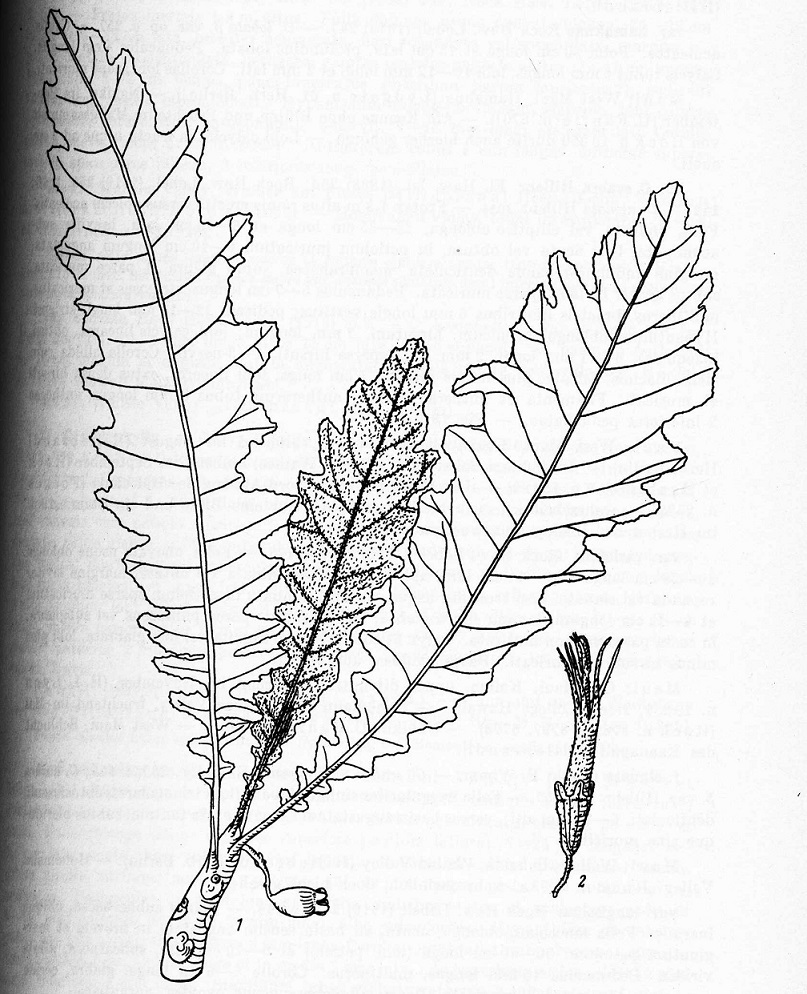
Fig 20. Cyanea quercifolia (Hillebr.) E. Wimm. 3/5. — Orig.
Page 66
29. C. scabra Hillebr. Fl. Haw. Isl. (1888) 256; Rock Haw. Lobel. (1919) 255, t. 46, 142. — C. armata Hillbr. mss. — Frutex 1,3 m altus ramis erectis versus apicem aculeatis. Folia obovata vel elliptico-oblonga, 25-35 cm longa et 8-13 cm lata, breviter subacuminata, basi acuta vel obtusa, in petiolum muricatum 6-10 cm longum angustata, marginen undulato-repanda denticulata, membranacea, supra glabra et parce muricata, subtus leviter hirta et sparse muricata. Pedunculus 5-7 cm longus, strigosus et muricatus, multiflorus, bracteis linearibus 8 mm longis vestitus; pedicelli 12-16 mm longi, strigosi. Hypanthium oblongo-obconicum, hirsutum, 7 mm longum; lobi calycis lineares, obtusi, inaequales, 6-11 mmm longi, 2 mm lati, sparse hirsuti, 1-3-nervii. Corolla albida cum striis lilacinis, falcata, plus minus hirsuta, 5 cm longa, lobi lineares, extus dense hirsuti et muricati. Filamenta et antherae glabra; antherarum tubus 8 mm longus, antherae 2 inferiores penicillatae. — Fig. 18d.
Maui: West Maui, Kaanapali, 500-600 m, blühend im August (Hillebrand! Herb. Berlin). — in dichtem Schatten am Flusse Waihee, blühend im September (Rock et Hashimoto n. 13129). — Ost Maui, Papaaea, Nord-Abhang des Haleakala (Forbes n. 2522! — wahrscheinlich auch hierher gehörend, nur eine Blüte und ein Stammstück im Herbar des Bishop Mus. vorhanden).
var. variabilis Rock Haw. Lobel. (1919) 265, 5. 143. — Folia obovata usque oblonga 20-38 cm longa et 7-14 cm lata, apice breviter acuminata vel obtusa, margine leviter repanda vel sinuata, basi truncata usque sensim attenuata in petiolum sparse muricatum et 4-12 cm longum, laina supra glabra, laevis, subtus parce pubescens vel subglabra, in costa parce vel non muricata. Calyx et corolla sparse hirsuta vel fere glabrata, lobi plus minus hirsuti et muricati. Bacca ovoidea, aurantiaca.
Maui: Ost Maui, Kailua, upper ditch trail, blühend im November (H. L. Lyon n. 10259, Herb. College Hawaii). — Honomanu und Keanae Valley, fruchtend im Mai (Rock n. 8789a, 8797, 8798). — Nahiku (U. Faurie n. 598!). — West Maui, Schlucht des Kaanapali (Hillebrand!).
f. sinuata (Rock) E. Wimm. — C. scabra var. sinuata Rock l.c. 259, t.145; C. scabra β var. Hillebr. l.c. 257. — Folia irregulariter sinuato-lobata (lobi triangulares, obtusiusculi, denticulati, 6-15 mm alti), versus basin angustatam saepe dentata tantum, subtus plerumque sine muricibus.
Maui: Waihee, Lahaina, Wailua Valley (Hillebrand! Herb. Berlin). — Honomanu Valley (Rock n. 8797a, wahrscheinlich, doch nicht gesehen).
var. longissima Rock Haw. Lobel. (1919) 259, t. 144. — Planta subherbacea, ubique inermis. Folia lanceolato-oblonga, acuta, ad basin sensim angustata in brevem et marginatum petiolum, 30-50 cm longa (incl. petiolo) et 5-10 cm lata, subcarnosa, dilute viridia. Pedunculus 15 mm longus, multiflorus. Corolla 4-6 cm longa, glabra, cerina cum striis lilacinis, lobi muricati. Bacca subglobosa usque ovoidea, aurantiaca.
Maui: Honomanu, in tiefen Einschnitten und an Wasserläufen, im dichten Schatten der Urticacee Touchardia latifolia auf den nördlichen Abhänge des Mt. Haleakala (Rock n. 8790).
Ista varietas videtur propria species, sed specimen non vidi et exinde judicium ferre nequeo.
Page 67
30. C. holophylla Hillebr. Fl. Haw. Isl. (1888) 257; Rock Haw. Lobel. (1919) 259, t. 146. — Frutex inermis 1,3 m altus. Folia oblonga usque obovat-oblonga, 24-35 cm longa et 8-12 cm lata, breviter acuminata, basi rotundata vel subcordata, margine repando-dentata vel denticulata, herbacea, glabra; petiolus anguste alatus, 7-10 cm longus. Pedunculus 2-3 cm longus, paucibracteatus (interdum parum muricatus?), pedicelli 12 mm longi, medio bibracteolati. Hypanthium oblong-obconicum, glabrum, lobi calycis sublineares, obtusiusculi, mucronulati, 3-nervii, 9-12 mm longi et 3 mm lati. Corolla glabra laevis, secus ut in C. scabra. Antherarum tubus 8 mm longus, antherae superiores in apice parce pilosae, 2 inferiores longe penicillatae.
Maui: Waiehu Valley, Waihee am Flusse (Hillebrand! Herb. Berlin; Bishop n. 4! Rock et Hashimoto n. 14079). — Honokahau Valley, blüht im September (Rock et Hashimoto n. 13128).
Species arcte affinis Cyaneae scabrae et fortasse ejusdem varitas tantum; specimen a Hillebrandio in herb Berolinensi Cyanea scabra var. inermis signatum quasi intermedium et ad sequentem varietatem spectare videtur.
var. obovata Rock Haw. Lobel (1919) 263. — C. holophylla β. var. Hillebr. l.c. — Folia obovata, 19-41 cm longa et cr 15 cm lata, apice subacuta, ad basin in petiolum 6-10 cm longum et anguste alatum angustata. Corolla glabra (puberula sec. Rock), in latere ventrali alabastri muricata.
Maui: Waihee Valley (Hillebrand! Herb. Berlin).
31. C. platyphylla (A. Gray) Hillebr. Fl. Haw. Isl. (1888) 264; Rock Haw. Lobel. (1919) 233, t. 127. — Delissea ? platyphylla A. Gray in Proceed. Am. Acad. V. (1861) 148. — Caulis gracilis, carnosus, 60-160 cm altus, in superiore parte muricatus. Folia obovata, 20-45 cm longa et 8-20 cm lata, obtusa et in apicem brevissimum obtusum acuminata, basi cuneata cum petiolo muricato 5-10 cm longo, margine undulato-crenata vel obtuse dentata, supra glabra, subtus puberula, subcarnosa. Pedunculus 3-4 cm longus, plerumque nudus, muricatus vel tuberculatus, vertice multiflorus; pedicelli 12-15 mm longi, basi parvi-bracteati et supra basin bibracteolati. Hypanthium subcylindricum, glabrum, 7 mm longum, lobi calycis subulati, 3-4 mm longi. Corolla alba, glabra, falcata, 5 cm longa, medio parum latior (6 mm lata), lobi lineares 14-17 mm longi. Staminum tubus glaber; antherae 2 inferiores pencillatae. Bacca obovoidea, 8 mm longa. Semina rubicunda, laevia.
Hawaii: District of Puna (U. S. Expl. Exped.). — Puna und untere Waldungen von Hilo (Hillebrand! et n. 168; Rock n. 10260, 12832! Bro. M. Newell n. 10259).
Forma corollae huius speciei simillima Rollandiae, sed filamenta a corolla sunt libera.
32. C. nolimetangere Rock in Torrey Bot. Club. Bull. XXXXIV. (1917) 229, t. 9 et Haw. Lobel. (1919) 231, t. 54, 126. — Plana subherbacea, undique aculeis luteis cavis conicis vestita exceptis corolla et fructu; caulis viridis, subcarnosus, erectus, 30-200 cm altus. Folia oblonga (saepe in parte superiore paullum latior), 9-21 cm longa et 4-7,5 cm lata, acuta, basi subrotundata, repando-crenata et callose denticulata, tenuia, dilute viridia, utrinque aculeata, petiolus 5-40 mm longus, glaber vel subpubescens, aculeatus, Pedunculus cr 2 cm longus, partim multibracteatus et aculeatus; pedicelli 6-10, post anthesin usque ad 20 mm longi, albo-pubescentes. Hypanthium obconicum, pubescens, lobi calycis triangulares 3 mm longi. Corolla virenti-alba, subpubescens, curvata, dorso paullum fissa, 40 mm longa et in medio 7 mm lata, lobi superiores altius soluti 12 mm longi, inferiores 8 mm longi. Staminum tubus glaber; antherae 2 inferiores penicillatae. Bacca ovoidea, aurantiaca, pubescens, 1 cm lg. Semina badia.
Hawaii: In den meist einförmigen Farnwäldern bei Glenwood, 1200 m, blühend von August bis Febr. (H. L. Lyon n 8847; Rock et Copeland n. 10351! Herb. College of Hawaii; Bishop!). — Kalanilehua, 1000 m (Rock n. 12834). — Östlich vom Honaunau-Gebirge, 660-1000m (A. S. Hitchock n. 14569).
Maui: Regenwald an en nordwestlichen Abhängen des Haleakala am Honomanu (Rock n. 8796a).
Page 68
33. C. rollandioides Rock in Torrey Bot. Club Bul. XXXXV. (1918). 135 et Haw. Lobel. (1919) 237, t. 130. — Caulis siplex, 1-1,5 m altus, versus basin lignosus, in parte superiore carnosus et aculeatus. Folia obovat-oblonga, 30-50 cm longa et 8-15 cm lata, acuta, basi cuneata, margine irregulariter crenato-dentata, utrinque puberula vel glabra, supra aculeis luteis, subtus atro-purpureis munita; petiolus crassus, aculeatus, 8-15 cm longus. Penduclus 3-6 cm longus, in parte superiore bracteis subulatis praeditus, multiflorus, non aculeatus; pedicelli 10-24 mm longi, bracteolis 2 distractis ornati. Hypanthium obconicum lobis linearibus 7-10 mm longis. Corolla colore varians: pallide lutea cum striis atro-purpureis usque obscure purpurea, falcata, tenuia, glabra, 45 mm longa, medio latior (5-8 mm), dorso breviter fissa. Stamina glabra; antherae 2 inferiores penicillatae.
Hawaii: Forst von Puna, in dichtem Wald entlang der Kalapana Road nicht weit von Pahoa, September (Rock et Newell n. 12831! Herb. College of Hawaii.)
Rock adnotat ad hanc speciem: "The plant grows in the wet forests of Puna, on Hawaii, a little explored district and one of the most primitive regions on the island of Hawaii. A stalwart Hawaiian gave the writer the native name "Aku-aku" for the species in question, of which he said the leaves were cooked with meat and eaten like cabbage. The name "Aku" alone is applied to Cyanea tritomantha, to which our plant has no resemblance.
33a. C. submuricata E. Wimm. n. sp. — (cf. supplement) Herba erecta 2 m alta, caule singulari tuberculis setiferis plus minusve sparsis vestito. Folia petiolata: petiolus 4,5-5,5 cm longus, submuricatus; lamina membranacea, supra glabra laevisque, 64-56 x 11-12 cm, apice subacuta, ad basin longe sensimque angustata in petiolum proportionaliter tenuem, margine callose denticulata. Pedunculus crassus, 15-20 mm longus, submuricatus, vertice bracteatus (bracteae lineares hirtellae circiter 15 mm longae); pedicelli pauci, glabri, 15 mm longi. Hypanthium oblongo-obconicum, glabrum, 11 mm longum, 5 mm latum; lobi calycini sublineares, acutiusculi, integerrimi, suberecti, 11 mm longi, nervis tribus perducti. Corolla 70 mm longa, sparse hirtella, pallide viridis, sed lobi in dimidio superiores fuscescenti-rosei, pars basalis tubi rosea: tubus 45 mm longus, in medio 6 mm latus; lobi corollini 5, falcati, superiores 25 mm longi patentes, inferiores deflexi et breviores. Filamenta glabra, 68 mm longa, tubum antherarum non vidi.
Hawaii: Kulani Prison Road in dense forest at 1300m, 3.II.192 (Hb. Degener n. 21796! - W.B.). — Pertinet ad sect. Genuinae, non longe distans a Cyanea rollandioide.
34. C. Fernaldii Rock in Torrey Bot. Club Bul. XXXXIX. (1917). 231 et Haw. Lobel. (1919) 235, t. 128. — Folia petiolata, lanceolato-oblonga, obtusiuscule subacuminata, sensim longeque angustata in petiolum 12-19 cm longum, carnosum, vestigia aculeorum gerentem, margine undulata subintegra, minute denticulata, 34-40 cm longa, 7-10 cm lata, obscure viridia, utrinque puberula, subtus pallida. Pedunculus 8-10 cm longus, nudus, pubescens et cicatricibus rotundis in apice, bracteis foliaceis, dentatis, 35 mm longis in apice vestitus; pedicelli 12-15 mm longi, filiformes, pubescentes. Calycis tubus oblongo-cylindricus, pubescens, 7 mm longus, lobi triangulares 2,5 mm longi. Corolla evidenter alba, pubescens, curvata, 40 mm longa, 6 mm lata, lobi non muricati. Stamina glabra; antherae 2 inferiores penicillatae.
Hawaii: Ohne nähere Ortsangabe (J Remy n. 301, Herb. Gray und Paris). — Waipio Valley, blühend im Juli (Rock n. 4663! "doubtfully referred to this species; they come very close to it and are perhaps intermediate between Cyanea platyphylla and Cyanea Fernaldii" (Rock). Dedicata in honorem professoris Fernald herbarii Gray.
35. C. truncata Rock in Torrey Bot. Club Bul. XXXXIX. (1917). 234, t.15 et Haw. Lobel. (1919) 193, t. 101; Degener, New Ill. Fl. Haw. Isl. (1932) fam 339 c. t. — Rollandia truncata Rock in Coll. Haw. Publ. Bull. II. (1913) 44. — Caulis 30-40 cm altus, carnosus, muricatus, demum glabrescens. Folia elliptica basi truncato-rotundata, apice acuminata, 40-42 cm longa, 18-20 cm lata, margine repando-dentata vel denticulata, chartacea, pallide viridia, supra glabra cum paucis muricibus, subtus puberula, petiolo 14 cm longo muricato. Pedunculus tenuis, hirtus, a basi bracteis linearibus vel oblanceolatis apicem versus auctis praeditus, 5 cm longus; pedicelli puberuli, 24 mm longi cr in medio bibracteolati. Calycis tubus obconicus, 1 cm longus, lobi oblongi, obtusi, 5-nervii, 5 mm longi. Corolla pallide purpurea, parce hirta, mox glabrata, subcurvata, dorso usque ad medium fissa, 32 mm longa, 5 mm lata, lobi superiores altius soluti et 13 mm longi, lobi inferiores 5-8 mm longi. Filamenta glabra, pallida; antherae caerulescentes, glabrae, 5 mm longae, 2 inferiores penicillatae.
Oahu: Punaluu Mountains, Weg im Tale, 300 m, blühend im August (Rock n. 8840, Herb. Colege of Hawaii und Gray). — In einer Seitenschlucht des Pig-God Trail (Hb. Degener n. 7797!).
var. Juddii (Forbes) St. John in Occas. Pap. Bishop Mus. XV. (1939) 22. — C. Juddii Forbes l.c. VI. (1916) 68 c.t. — C. truncata Rock op. c. 193 p.p. — Differt a typo foliis oblong-obovatis, basi cuneatis et fere abrupte contractis, petiolo, nervis et costa subtus, pedunculo 5-9 cm longo plus muricatis; lobis calycinis linearibus, truncatis, 6-9 mm longis. Corolla in specimine viso deest.
Oahu: Waiahole Valley, mit jungen Früchten in Dezember (Rock n. 17329! C.N.Forbes n. 1477 O!; H.L.Lyon n. 12830).
Page 69
36. C. solenocalyx Hillebr. Fl. Haw. Isl. (1888) 158; Rock Haw. Lobel. (1919) 168, t. 85, 86; Degener, New Illustr. Fl. Haw. Isl. (1934) fam 339 — Frutex robustus, 2-4 m altus, rami crassi rigidi, muricati. Folia plantae novellae late ovata vel cordata, irregulariter inciso- vel lobato-dentata, utraque facie muricata vel supra glabra; folia plantae adultae obovato-oblonga, 37-60 cm longa et 12-23 cm lata, breviter acuminata, basi obtusa cum petiolo muricato 10-25 cm longo, margine crenata vel sinuata, membranacea, supra glabrata, subtus pallida, sparse hirsuta, costa muricata. Pedunculus carnosus, 3-5 cm longus, bracteatus, strigosus; pedicelli 12-25 mm longi, bracteolis 2 infra calycem. Hypanthium obconicum, verrucosum, parce strigosum, 12 mm longum, lobi calycis usque ultra medium connati cum partibus liberis triangularibus 20-25 mm longi, strigosi: pars connatus 15 mm, partes liberae 6-10 mm longae. Corolla purpurea, parce hirsuta, demum glabrata, subrecta, dorso usque ad medium fissa, 30-40 mm longa et 8-10 mm lata. Staminum tubus glaber; antherae purpureae, 6-8 mm longae, 2 inferiores dense barbatae. Bacca ovoidea aurantiaca 16 mm longa. Semina luteola.
Molokai: In tiefen Schluchten am Kalae und in den Forsten von Mapulehu (Hillebrand! Lydgate n. 2, beide im Herb. Berlin; Rock n. 6112, 12521). — Bergrücken gegen Pelekunu (Rock n. 8813). — Pukoo (A. S. Hitchock n. 15009); oberes Ende der Hanalilolilo Pipe Line, Regenwald, und Olinda (Hb. Degener n. 7784! 7990!).
Nomen incolarum: "Puakala" (Hlb.). — Rock posuit hanc speciem in sectionem "Palmaeformes", sed melius mea opinione sequimur cl. Hillebrandium, qui eam recenset ad Genuinas.
f. glabrata (Rock) Degener op. c. cum tab. — C. solenocalyx var. glabrata Rock Haw. Lobel (1919) 171. — Caulis laevis, sine aculeis sicut et folia, sed petioli leviter muricati. Folia oblonga, supra glabra, subtus hispidula. Pedunculi 3 cm longi, muricati, bracteis lineari-lanceolatis hirsutis in apice. Lobi calycis glabri 2 cm longi. Corolla glabrata, cerina-alba cum striis purpurascentibus.
Molokai: Waihanau, entlang dem Flusse im Regenwald, blühend im August (L.M.Dunbar n. 13118, Herb. College of Hawaii). — Pepeopae bog, im Regenwald, und bei Puu o Wahaula (Hb. Degener n. 7781! 7782a, b! 7783!); Nualele Valley (Hb. Deg. n. 22140! - B.W.); Head of Waikolu Valley (Hb. Deg. n. 22137a!) (cf. supplement) .
var. latifolia E. Wimm. — Frutex eramosus 1,2-2,4 m altus. Petiolus 13-14 cm longus, glabratus vel sparse muricatus. Lamina folii ovalis, 36 cm longa et 17-20 cm lata, acuta, basi truncata, sinuato-lobata (lobi 9-25 mm alti), supra glabra, subtus parce hirsuta, membranacea. Pedunculus ut in typo, sed pedicelli paullo supra basin bibracteolati. Calycis lobi supra medium connati 12 mm longi tantum. Corolla evoluta deest, alabastrum subvillosum.
Molokai: Pfad auf dem Bergrücken östlich vom Mapulehu Tal im Regenwald, 733-1330 m (St. John et Fosberg n. 12848! — Hb. Bish Mus.).
37. C. Degeneriana E. Wimm. n. sp. — Caulis superne teres, fistulosus, pilosus, muricatus. Folia obovato-oblonga, 16 cm longa et 5 cm lata, subacuminata, apice ipso obtuso et mucronulato, ad basin cuneata et in petiolum 25 mm longum setosum angustata, margine repando-crenulata et denticulata, lamina supra glabra et plana, subtus in nervis fuscis prominentibus et venis fusco-hamato-setosa. Pedunculi patentes, pilosi, ad 15 mm longi. Pedicelli non visi. Hypanthium ovoideum, pilosum, cr 8 mm longum et 5 mm latum lobis dentiformibus vix 2 mm longis, in alabastro acutis, demum obtusiusculis. Corolla falcata, subhirta, purpurascens? 38 mm longa, in medio cr 3 mm lata, lobi superiores cr 17 mm longi. filamenta glabra e tubo corollae exserta. Antherarum tubus 8 mm longus, glaber, stramineo-et fusco-striatus (in sicco!), 2 inferiores apice penicillatae. — Fig. 18 c.
Hawaii (K.K.Park ex Hb. Degener, in cuius honorem planta denominata est).
Page 70
Sectio III. Delissoideae Hillebr.
Delissoideae Hillebr. Fl. Haw. Isl. (1888) 252; Rock Haw. Lobel. (1919) 103.
38. C. angustifolia (Cham.) Hillebr. Fl. Haw. Isl. (1888) 253; Rock Haw. Lobel. (1919) 195, t. 102. — Lobelia (Delissea) angustifolia Cham. in Linnaea VII. (1833) 219. — Delissea angustifolia Presl Prodr. Lobel. (1836) 47. — Delissea acuminata var. angustifolia A. Gray in Proceed. Am. Acad. V. (1861) 148. — Delissea Honolulensis Wawra in Flora LVI. (1873) 11. — Frutex ramosus vel simplex, 2,5-5 m altus, ramis suberectis, in vertice dense foliosis, glabris, medulla transverse multiloculosa Folia lanceolata vel oblongo-elongata, 15-25 cm longa et 2-5 cm lata, utrinque acuminata vel acuta, saepe undulata et antrorsum obtuse dentata (dentes callose apiculati), membranacea, glabra, sed secundum nervum medianum pubescentia; petioli 8-10 cm longi. Racemi axillares; pedunculus gracilis, glaber, nudus, 6-10 cm longus, vertice multiflorus. Pedicelli filiformes, 15-25 mm longi, bracteis et bracteolis minutis vel deciduis. Hypanthium campanulatum lobis triangularibus, minutis, ciliolatis. Corolla lilacina, glabra, subcurvata, 30-40 mm longa et medio 2 mm lata, dorso supra medium vel usque fere basin fissa, lobi superiores tribus ceteris altius soluti, cr 17 mm longi. Tubus staminum glaber; antherae 5 mm longae. Bacca ovoidea, pisi magnitudine. Semina obscure lutea.
Oahu: Gemein um Honolulu und auf dem Gebirgs-Hauptkamme; ohne Ortsangabe (Chamisso! Herb. Berlin; Gaudichaud no. 152! Mann et Brigham n. 231! 482! Remy n. 299; Wawra 1975!). — Nuuanu, Niu und Kalihi (Hillebrand! A. S. Hitchcock no. 14094). — Palolo Valley (Rock n. 107, 10272; A. S. Hitchcock n. 14132). — Pauoa, Manoa, Wahiawa und Punaluu Valley (Rock n. 1032, 10256, 35, 10357; Hb. Degener n. 7858! 7857!3 231!). — Maunawili (Swezey n. 13107; Rock n. 1060, 8799). — Südöslich von der Kahana-Bay auf dem Bergrücken, Aiea-Kamm (Hb. Degener n. 7892! 7896!). — Im Walde des kleinen Tales nordöslich von Puu Hapapa (Hb. Degener n. 7897!). — Im Walde des Niu-Tales auf dem westlichen und mittleren Bergrücken (Hb. Degener n. 7894! 7900!). — Waiawa, Wilhelmina Rise Ridge, Kipapa, Kanehoa (Hb. Degener n. 7907! 7912! 7914! 7967! 7930!). — Kahuku (Hb. Degener n. 7916b! 7928!); CCC Trail, Aiea, dark woods; Wiliwilinui Ridge, lower forest; in forest near Poamoho stream, 440m (Hb. Degener n. 11537! 19714! 19725!); Kapakahi ridge (Hb. Deg. n. 21671! 2162! - B.W.) (cf. supplement)
Lanai: Mahana Valley, blühend im August (Rock et Hammond n. 8105).
Molokai: Tal hinter Kaluaaha (Rock). — Halawa (Hillebrand!). — Schlucht des Halawa-iki (Hb. Degener n. 7840!).
Species valde varians quoad magnitudinem foliorum, petioli, pedunculi, corollae, quamobrem varietates sequentes difficulter tantum distingui possunt et parvi pretii sunt. Inventa est in omnibus insulis mediis, dum et in insula extrema ad occidentem (Kauai) et in insula extrema ad orientem (Hawaii), ut videtur, deest.
var. Hillebrandii Rock in Torrey Bot. Club Bull. XXXXIV. (1917) 234 et Haw. Lobel. (1919) 199; Skottsb. in Meddel. Goeteborg. Trädg. II. (1926) 265. — C. angustifolia Hillebr. l. c. pro parte. — Folia oblonga vel ovat-oblonga, 10-18 cm longa et 3-5 cm lata, utrinque acuta, petiolo 25-35 mm longo, lamina subtus secundum costam et partim ad nervos secundarios pubescens. Pedunculus brevis, 10-20(30) mm longus. Pedicelli 5-10 mm longi. Corolla 15-20 mm longa. Pedunculi per florationem demum usque ad 30-40 mm elongati.
Maui: An den nördlichen Abhängen des Mount Haleakala im Keanae Tal, 300 m (Rock n. 8799! Skottsberg n. 812). — Honomanu (Rock n. 8517!). — West Maui, Lahaina, Olowalu (Lydgate n. 140!). — Honokawai Valley, Amalu branch, 960m, blühend im Dezember (G. R. Ewart III et G. C. Munro n. 62!).
Page 71
var. lanaiensis Rock in Torrey Bot. Club Bull. XXXXIV. (1917) 235 et Haw. Lobel. (1919) 199, t. 103, 104. — C. angustifolia β var. Hillebr. l. c. 253. — Planta 3-4m alta, a basi fere ramosa. Folia elongato-oblonga, 10-18 cm longa et 4-5 cm lata, acuta, basi rotundata usque breviter acuta petiolo 5-9 cm longo. Pedunculus 3-5 cm longus. Corolla albida, cr 25 mm longa.
Lanai: Ohne nähere Ortsangabe (Remy n. 304, Herb. Paris; Hillebrand!). — Mahana Valley, blühend im Juli (Rock n. 8053! A. S. Hitchcock n. 14705). — Tal zwischen Waiopaa und Kaiholena, Dezember (G. C. Munro n. 76! 369!).
var. racemosa Hillebr. l.c. 253; Rock Haw. Lobel. (1919) 199 t.105. — Folia oblonga, 17-22 cm longa et 47,5 cm lata, utrinque acuta, petiolo 8-10 cm longo. Pedunculus dependens, 9-25 cm longus, inferne nudus, interdum pubescens. Corolla 3 cm longa.
Oahu: Kaala Mountains, Waipio, Halemano, Moanalua (Hillebrand! Herb. Berlin!). — Nordrand des Ewa Forest Reserve, 400-550 m (Christophersen et Wildern. 1615!). — Paumalu Ridge, Waialae (Hb. Degener n. 7929!). — Pupukea, 300m (E. H. Bryan jun.).
Lanai: Waiopaa (G.C.Munro; A.S..Hitchcock n. 15572).
var. tomentella Hillebr. l.c.; Rock Haw. Lobel. (1919) 203, t. 106. — Folia supra parce pubescentia, subtus tomentella, oblanceolata, 18-30 cm longa et 5-8 cm lata, acuta, basi longe cuneata in petiolum 7 cm longum. Pedunculus crassior, 7,5 cm longus, pubescens. Corolla 25-30 mm longa, parce puberula vel glabrata.
Oahu: Halemano (Hillebrand! Wawra n. 2225! 2287 a!).
f. subpubescens E. Wimm. — Differt foliis subtus parce pubescentibus, petiolo breviore (3-5 cm longo); pedunculis 2-4 cm longis.
Oahu: Waianae Valley, Halalua, rechtes Seitental, 630 m (Russ et Welch!). — Waianae Mountains, Kukuila Valley, 330-400 m, September (N.H.Kraus!).
Varietas ista a specie sequente aegre distinguitur dentatione folii, sepalis triangularibus, pubescentia levi florum.
39. C. obtusa (A. Gray) Hillebr. Fl. Haw. Isl. (1888) 254; Rock Haw. Lobel. (1919) 203, t. 108. — Delissea obtusa A. Gray in Proceed. Am. Acad. V. (1861) 148 incl. var. mollis. — Frutex multiramosus, 2,5-5 m altus (caulis compacti-lignosus cum canale angusto, ex Hillebr.; sed secundum Rock caulis fistulosus et transverse multi-loculosus); rami patentes, tomentosi. Folia oblonga vel oblanceolato-oblonga, obtusa vel brevissime acuminata, rarius acuta, basi acuta, 15-30 cm longa et 4-9 cm lata, margine conferte dentata (dentes triangulares, patentes), membranacea, supra parcius, subtus plus minus dense pubescentia. Pedunculus 3-5 cm longus, inferne nudus, superne bracteis 2 mm longis et pedicellis 16-24 mm longis, tomentellus. Hypanthium campanulatum, caerulescens, tomentellus lobis subulatis 2 mm longis. Corolla caesia, tomentella, subrecta, dorso usque ad basin fere fissa, 3 cm longa, lobi superiores 15 mm longi. Stamina glabra; antherarum tubus 8 mm longus, 2 inferiores penicillatae.
Maui: Im Gebirge (U.S.Expl. Exped.; Mann et Brigham n. 466). — Hamakua und Waikapu (Lydgate n. 58! 59!). — Honuaulu, Lahaina und Haleakala (Hillebrand! Faurie n. 563!). — Ohne Ortsangabe, Bishop n. 9!). — Kula pipe line, Olinda (Forbes n. 1270 M!).
Hawaii: Mauna Kea (U.S.Expl. Exped.).
Page 72
40. C. Mannii (Brigham) Hillebr. Fl. Haw. Isl. (1888) 253; Rock Haw. Lobel. (1919) 203, t. 107. — Delissea Mannii Brigham in Proceed. Am. Acad. VII. (1868) 182. — Habitus et magnitudo Cyaneae angustifoliae, cui proxime accedit. Folia oblonga, acuta, basi subrotundata et in petiolum 4-7 cm longum breviter acuminata, glabra, sed subtus secundum costam pubescentia, 15-20 cm longa et 5 cm lata. Pedunculus puberulus, 47 cm longus. Pedicelli 8-12 mm longi, infra medium bibracteolati. Bracteae lineares, 6 m longae, interdum foliaceae. Calycis tubus subcylindricus, subpuberulus, 6 mm longus, lobi sublineares, subacuti parce hirti, 6 mm longi, 1,5 mm lati. Corolla purpurea-caerulea, subrecta, glabra. Stamina glabra.
Molokai: Ohne nähere Ortsangabe (W.T.Brigham, Bishop Mus.). — Kalae (Hillebrand!).
41. C. profuga Forbes in Occas. Pap. Bishop Mus. VI. (1916) 186 c. t.; Rock Haw. Lobel. (1919) 237, t. 129. — Caulis simplex, 1,8-2,4 m altus. Folia elliptica, acuminata, basi acuta, 22 cm longa et 8,5 cm lata, margine dentata vel crenulata, chartacea, glabra, subtus pallida, petiolus 6-11 cm longus. Pedunculus 3-4 cm longus, glaber, inferne nudus, bracteae pedicellis 1 cm longis paullo longiores. Hypanthium oblongo-obconicum, lobi sublineares, obtusi, mucronati, 5 mm longi. Corolla alba, gracilis, subrecta, glabra, dorso usque ad basin fere fissa, 34 mm longa. Stamina glabra.
Molokai: Mapulehu Valley, blühend im Juli (C.N.Forbes n. 313 Mo.! Bishop Mus.). — Pelekunu Trail (ohne Blüten und Früchte, nach Forbes wahrscheinlich hierher gehörend — Forbes n. 240 Mo.).
42. C. coriacea (A. Gray) Rock in Torrey Bot. Club. Bull. XXXXIV. (1917) 237 et Haw. Lobel. (1919) 207, t. 109, non Hillebr. — Delissea coriacea A. Gray in Proceed. Am. Acad. V. (1861) 147 excl var. β — Frutex usque 5 m altus, glaberrimus, ramosus vel simplex, caule cr 10 cm in diametro. Folia coriacea, dilute viridia, conspicue reticulata, lamina oblonga usque lanceolata, 28-32 cm longa et 5-8 cm lata, apice subacuta usque obtusa, basi acuta et in petiolum 8-12 cm longum angustata, margine callose denticulata. Pedunculi 2-5 cm longi, petiolum haud superantes, inferne nudi, superne pluriflori, pedicellis 15-20 mm longis. Hypanthium campanulatum, lobi calycis dentiformes Corolla purpurascens, subrecta, 25 mm longa. Staminum tubus glaber; antherae 5 mm longae, 2 inferiores penicillatae.
Kauai: Ohne weitere Ortsangabe (Remy n. 302, Herb. Gray ex Rock). — Laaukahi (Hoary Head Range), Haiku, 400 m, blühend im Dezember (St. John et Fosberg n. 13477!). — Wainiha (U. Faurie n. 590!). — Waioli River Basin, 200 m (V.W.Hardy n. 12713).
var. Fauriei (Lévl.) E. Wimm. — C. Fauriei Lévl. in Fedde, Repert. Spec. Nov. X. (1911) 156; Rock Haw. Lobel. (1919) 207, t. 27, 29, 110. — C. coriaceae Hillebr. Fl. Haw. Isl. (1888) 254. — A typo discedit foliis subcoriaceis, quandoque oblanceolatis, pedunculis multo longioribus [(7)10-26 cm longis]; a varietate sequente differt foliis saepe latioribus, basi breviter acutis, petiolis paullo longioribus (8-12 cm lg.), fortasse anthesi priore (Octobri).
Kauai: Koloa (U. Faurie n. 565! Herb. Delessert). — Waimea, 500-600 m (Knudsen! Herb. Berlin). — Zwischen den Flüssen Hanapepe und Wahiawa, blühend im Juli (A.A.Heller n. 2597!). — Olokele canyon, blühend im Oktober (Rock n. 5378! 5826, 5826a! 13108; Rock et Marshall n. 5826b; A.S.Hitchcock n. 15243).
var. Hardyi (Lévl.) (Rock) E. Wimm. — C. Hardyi Rock in Torrey Bot. Club Bull. XXXXIV. (1917) 236 et Haw. Lobel. (1919) 209, t. 111. — Folia chartacea, lanceolata vel parum oblanceolata, acuta, basi in petiolum marginatum 5-8 cm longum angustata, 20-30 cm longa et 3-5 cm lata, margine crenulata usque denticulata, glaberrima. Pedunculus 17-25 cm longus. Corolla atro-purpurea, dorso usque ad medium fissa.
Kauai: Olokele canyon, 450 m, blühend im November (V.W.Hardy n. 12767, Herb. College of Hawaii; Rock n. 12765; A.S.Hitchcock). — Berge bei Kaholuamano, 900 m, Sept. Oktober (Rock n. 12766; C.N.Forbes n. 344K!). — Hii mountains (Forbes 634a K! 638 K!). — Lihue, Fort of Waialeale, Juli (Forbes n. 33K!). — Waimea, 1000 m (Faurie n. 591!). Ridge behind Papaa in lower forest, "single plant with extremely long pendent peduncles, I. (Degener n. 21739! - B.W.). (cf. supplement)
Multae formae transitoriae et intermediae occurunt etiam ad C. angustifoliam var. racemosam.
f. gratiosa E. Wimm. n.f. — (cf. supplement) Plantae valde variabiles tum consistentia foliorum tum longitudine petiolorum et pedunculorum, vacillantes inter var. coriaceam et jam notas varietates, Petioli 4,5-12 cm longi; lamina foliorum plerumque oblanceolata, rarius fere lanceolata, apice subrotundata et brevissime acuminata vel subacuta, ad basin longe sensimque attenuata in petiolum, glaberrima, subcoriacea vel chartacea nervis purpurascentibus vel virentibus, 12-23 x 3-4 cm. Pedunculi 5-12 cm longi, plerumque paulo longiores quam petioli. Corolla "pallide rosea, in basi purpurata". Bacca pisiformis, 5 mm diam. "1-3 m alta, eramosa".
Kauai: Ridges behind Papaa in lower forest, 6. I. 1952 (Hb. Deg. n. 21736! common form, 21737! rare form intermediate in coloration betw. n. 21736 and n. 21738).
var. degeneriana E. Wimm. n.v. — (cf. supplement) Folia late oblonga lateribus fere parallelis, apice subrotundato brevissime acuminata, basi inaequaliter longe decurrente subacuminata, petiolo 7,5-9 cm longo, margine crenulato-denticulata, subtus praeter nervu medianum parce pilosa, membranacea, 25-27 x 7-8 cm Pedunculi 12-14 cm longi.
Kauai: Ridge behind Papaa in lower forest, 16.I.1952 (Hb. Deg. n. 21736a! - B.W.).
Page 73
43. C. spathulata (Hillebr.) Heller in Minnesota Bot. Stud. IX. (1897) 909, t.65; Rock Haw. Lobel. (1919) 211, t. 33,112. — C. coriacea Hillebr. var. spathulata Hillebr. Fl. Haw. Isl. (1888) 254. — Rollandia Fauriei Lévl. in Fedde, Rep. Sp. Nov. XII. (1913) 506. — Frutex multi-ramosus, 2-3 m altus, saepe fere a basi ramosus. Folia oblanceolata-linearia, acuta vel obtusiuscula, basi in petiolum marginatum 1,5-6 cm longum attenuata, margine callose denticulata, subcoriacea, supra glabra, nitidia, reticulato-impressa, subtus sparse hirta, saltem ad nervos vel costam, pallida, 10-24 longa et 1,5-2,5 cm lata. Pedunculi 2-4 cm longi, nudi, in vertice multiflori, pedicelli 12-15 mm longi. Hypanthium semi-ellipsoideum, 3 mm longum, lobi dentiformes. Corolla lilacina, subcurva, glabra, dorso usque ad basin fere fissa, 2 cm longa. Filamenta glabra; antherae 5 mm longae, 2 inferiores penicillatae. Bacca globosa. Semina compresso-ovoidea, fuscecentia, foveolata, 1 mm longa.
Kauai: Waimea, 1300 m (Knudsen n. 11! Herb. Berlin; U. Faurie n. 568! Typus Rollandiae Fauriei). — Im Wald und am Waldrand des Forstes von Kaholuamano oberhalb Waimea, blühend im August (A. A. Heller n. 2768! Rock n. 2425, 5664, 9008, 13109; A. S. Hitchcock n. 15369; Forbes n. 387 K!. — Westseite des Waimea Drainage Basin, Kololau Pali (Forbes n. 826 K! 1026 K, 1026a K!
Haec species proxime accedit ad C. coriaceam et vix varietatis gradum excedit, sed habet ramos multos patento-ascendentes, dum C. coriacea simplex est vel paucis ramis suberectis gaudet.
44. C. acuminata (Gaudich.) Hillebr. Fl. Haw. Isl. (1888) 254; Rock Haw. Lobel. (1919) 269, t. 152; Degener, New Illustr. Fl. Haw. Isl. (1932) fam. 339 c. t. — Delissea acuminata Gaudich. Bot. Voy. Freyc. (1826) 457, t. 76; A. DC. Prodr. VII. (1839) 342. — Lobelia (Delissea) acuminata Hook. et Arn. Bot Beechey Voy. (1841) 88. — Caulis simplex, basi lignosus, vel parce ramosus, 1,3-1,6 m altus. Folia membranacea, supra obscure viridia, subtus albescentia, utrinque puberula, imprimis ad nervos; petiolus 2-6 cm longus; lamina lanceolata usque oblonga, utrinque acuminata, margine subintegra vel leviter dentata aut callose denticulata, 14-30 cm longa et 4-7 cm lata. Pedunculi graciles, totaliter fere cicatricibus obsiti, puberuli, 2-4 cm longi, apice pluriflori. Pedicelli filiformes, 7 mm longi. Hypanthium obovoideum, lobi anguste triangulares 2 mm longi. Corolla alba caerulescenti-suffusa, brevissime puberula vel glabrescens, subcurva, 3 cm longa, 3 mm lata, dorso usque ad basin fere fissa, lobi superiores 11 mm longi. Filamenta pubescentia; antherarum tubus 6 mm longus, albo-pilosus, 2 inferiores penicillatae. Bacca globosa, lutea, 4-6 mm diam. Semina pallida.
Oahu: Ohne nähere Ortsangabe (Voy. Bonite, Oct. 1836 — Gaudichaud n. 153! und ohne Nr.! Herb. Paris, Delessert; Mann et Brigham n. 233; Chamisso! Meyen!). — Manoa, Moanalua, Nuuanu und Kalihi Valley (Hillebrand!). — Waihee (Lydgate!). — Kaalaberge (Wawra n. 1793, 2286!). — Pauoa Valley, Punaluu und Koolau Gebirge, 300 m, blühend im August und Oktober (Rock n. 712, 450, 456! 8845; Forbes n. 1422!). Punaluu, Pig-God Trail im feuchten Gebirgswald (Hb. Degener n. 4107! 7799! 77800! 7801!). — Pauoa Honolulu, Pauoa Flats und am Tantalus (Hb. Degener n. 7968! 7969!). Middle Halawa Ridge (Hb. Degener n. 11483!).
f. latifolia (Wawra) E. Wimm. — Delissea acuminata var. latifolia Wawra in Flora LVI. (1873) 7. — Folia elliptica, acuta, basi abrupte acuta vel subrotundata, 20 cm longa et 8 cm lata, secus ut in typica planta.
Oahu: Kaala-Gebirge (Wawra n. 2251! Hb. Wien; U. Faurie n. 562!). — Koolau Range, blühend im Dezember (E. H. Bryan jun.!).
45. C. multispicata Lévl. in Fedde, Repert. Spec. Nov. X. (1911) 157; Rock Haw. Lobel. (1919) 269, t. 151. — Folia elliptica, acuminata, basi subrotundata vel late acuta, 30-40 cm longa et 5-9 cm lata vel minora (12 x 4 cm); margine denticulata, membranacea, supra parce, subtus densius puberula, nervi secundarii sub angulo fere semirecto ascendentes; petioli puberuli, 3-6 cm longi. Pedunculi breves subcrassi, 15 mm (in speciminibus mauiensibus usque 3 cm) longi, puberuli, pauciflori. Hypanthium obconico-oblongum, 6 mm longum, puberulum, lobi anguste triangulares, 2-5 mm longi. Corolla alba (?) puberula, subcurva, 3 cm longa, coriacea. Stamina glabra. Bacca oblongo-ellipsoidea.
Kauai: Waimea, 900 m (U. Faurie n. 576! 594!).
Maui: Berge links vom Kapulehua (?) und oberhalb Hana (C.N.Forbes n. 1680 M! 2675 M!). — Waikamoi Trail (Forbes n. 2616 M!).
Hawaii: in wet jungle between Glenwood and 29 miles, VI. (Degener n. 7870!). (cf. supplement)
Page 74
46. C. Copelandii Rock in Torrey Bot. Club Bull. XXXXIV. (1917) 231, t.10 et Rock Haw. Lobel. (1919) 279, t. 51, 156. — Herba plerumque epiphytica, rarius in terra ad basin arborum, simplex, 30-40 cm alta. Folia oblongo-elliptica, 25 cm longa et 7 cm lata, utrinque acuminata, margine undulata et callose denticulata, membranacea, supra glabrata, subtus puberula; petioli pubescentes, 5 cm longi. Pedunculi ferrugineo-hirti, 4-5 cm longi, pauciflori. Pedicelli 11-16 mm longi. Hypanthium oblongo-obconicum, viride et purpureo-suffusum, hirtellum, 10-costatum, 1 cm longum, lobi calycis dentiformes. Corolla lutescenti-carnea, subcurva, dorso ad medium fere fissa, lobi 2 superiores 2 cm, 3 inferiores 1 cm longi, omnes in nervis purpureo-hirsuti. Filamenta pallide viridia, glabra; antherarum glaberarum 2 inferiores penicillatae. Bacca aurantiaca, oblonga, 15 mm longa et 10 mm lata, leviter costata.
Hawaii: Glenwood im Regenwald, 700 m, blühend und fruchtend im Dezember (Rock et Copeland n. 10350! Herb. College of Hawaii; blühend im September, Rock n. 12848!; W.M.Giffard n. 13087). — Gegen 23 Meilen von Glenwood entfernt im dichten Farnwald auf Bäumen und Farnbäumen, blühend und fruchtend im August (Rock et Hashimoto n. 13138!).
Cyanea Copelandii and C. multispicata valde affines sunt cum C. acuminata et nihil aliud praestant nisi variationes insulares.
47. C. recta (Wawra) Hillebr. Fl. Haw. Isl. (1888) 555; Rock Haw. Lobel. (1919) 227, t. 123. — Delissea recta Wawra in Flora LVI. (1873) 30. — Caulis brevis simplex, Folia lanceolata, 25 cm longa et 3-5 cm lata, utrinque sensim angustata, apice fere cuspidata, integra, callose denticulata, supra glabra, subtus pallida, plus minus pubescentia imprimis ad nervos; petiolus cr 3 cm longus. Pedunculus 3-4 cm longus, squamulosus. Pedicelli 1 cm longi, puberuli. Hypanthium globosum, hirtellum, 5 mm diametiens, lobi dentiformes. Corolla purpurascens cum striis dilutis, subrecta, dorso ad medium fissa, 4 cm longa, lobi cr 15 mm longi. Tubus staminum glaber; antherae 6 mm longae, 2 inferiores pencillatae. Bacca subglobosa, 7 mm in diametro. Semina fusca, laevia, nitida.
Kauai: Wald am Kealia (Wawra n. 2062, Herb. Wien!; U. Faurie n. 569? — nur Blätter, diese fast kahl). — Auf dem Centralplateau von Kauai bei Waiakealoha, 1500 m, blühend im Oktober (Rock n. 10355).
48. C. Larrisonii Rock in Torrey Bot. Club Bull. XXXXII. (1915) 77, t. 8 et Haw. Lobel. (1919) 227, t. 124. — Caulis carnosus, hirtellus, verisimiliter non ramosus. Folia lineari-lanceolata, 20 cm longa et 1,2-2 cm lata utrinque acuta, integra vel minute denticulata, supra pallide viridia, subtus pallida, costa parcissime hirta, chartacea, petiolus 2-3 cm longus. Racemi 1 cm longi, 4-6-flori, bracteis 12 mm longis et 1 mm latis. Pedicelli in medio bibracteolati, 6 mm longi. Calycis tubus subglobosus, atropurpureus, 5 mm longus, tomentellus, minute dentatus. Corolla atro-caerulea, tomentella imprimis versus apicem, subcurva, dorso ad medium fissa, 30 mm longa, 4 mm lata. Filamenta obscure purpurea, glabra excepto fasciculo pilorum purpurascentium in basi; antherae glabrae, pallidae cum striis purpureis, 2 inferiores pencillatae.
Kauai: Im Tal des oberen Hanalei, Bergrücken zwischen dem Hanalei und dem Kalihinui, 600 m, blühend im Oktober (G.K.Larrison n. 10342, Herb. College of Hawaii!). — Ohne Ortsangabe (Rock n. 17247!).
Page 75
49. C. stictophylla Rock The Indig. Trees Haw. Isl. (1913) 509 et Haw. Lobel. (1919) 279, t. 157. — C. palakea Forbes in Occas. Pap. Bishop Mus. VI. (1916) 72 c.t. — Caulis simplex, erectus, 2 m altus. Folia lineari-lanceolata, 20-30 cm longa et 3-4 cm lata, acuta, margine undulata vel irregulariter repando-crenata, basi sensim angustata in petiolum 2,5-3 cm longum, supra glabra vel glanduloso-punctata, subtus imprimis ad nervos hirsuta. Pedunculi axillares, hirtelli, in apice bracteati, 10-25 mm longi, plerumque 5-flori; pedicelli 7-15 mm longi, infra medium bibracteolati. Calycis tubus viridis, hirtellus, ovoideus, lobi triangulares, cr 2 mm longi. Corolla lutescenti-alba, subglabra, falcata, 36 mm longa. Bacca globosa, aurantiaca.
Hawaii: Im Regenwald des Kaiholena-Gebirges, südliche Abhänge des Mauna Loa, 2000 m (Rock n. 10055, Herb. College of Hawaii). — Dichter Wald östlich von Palakea, ungefähr 10 Meilen von Kilauea (C.N.Forbes n. 1003 H).
Secundum Forbes caulis est aculeatus, sed Rock in specimine suo parcas murices ad basin caulis tantum vidit.
50. C. hirtella (H.Mann) Rock Haw. Lobel. (1919) 219, t. 115-117. non Hillebr.; Skottsb. in Acta Horti Bot. Gothoburg. III. (1927) 43, fig. 1-16. — Delissea hirtella H. Mann in Proceed. Am. Acad. VII. (1867) 179. — Cyanea communis Rock in Coll. Haw. Publ. Bull. II. (1913) 41. — Caulis simplex, carnosus, basi lignosus, 40 cm bis 3 m altus (secudum Mann frutex ramosus usque 6 m altus), in superiore parte hirsutus. Petiolus hirsutus, 25-60 mm longus. Lamina foliorum lanceolato-oblonga vel oblanceolato-oblonga, 10-20 cm longa et 3-5 cm lata, utrinque subacuminata vel acuta, dentata usque callose denticulata, pallide viridis, chartacea, supra glabra, subtus sparse hirsuta, folia juniora utrinque hirsuta. Pedunculus 15-30 mm longus, hirsutus, nudus vel braceatus, vertice 3-7-florus. Pedicelli 8 mm longi. Hypanthium obconico-oblongum, hirtellum, 6 mm longum, laciniae subulatae, 2-3 mm longae. Corolla rosea, subcurvata, tomentella, dorso 1/3 fissa, 30 mm longa et 4 mm lata. Staminum tubus glaber: filamenta caerulescentia; antherae fuscescentes, 8 mm longae. Bacca subglobosa, aurantiaca, 10-16 mm diametiens. Semina rubro-fusca, laevia, nitidia.
Kauai: Berge oberhalb Waimea und am Kaholuamano (Mann et Brigham n. 574! Bishop Mus. und Gray Herb.; A.A.Heller n. 2769! A.S.Hitchcock n. 15353, 15371; Rock n. 4885 559, 5658, 8865, 12784, 13103). — Kololau Trail, Waimea Drainage Basin, Westseite (C.N.Forbes n. 1023 K!). — Waialae Valley (Rock n. 5942). — Waialeale (A.S.Hitchcock n. 15843). — Kawaikoi-Fluß 1100 m (Skottsberg n. 1003).
Secundum observationes Rockii species valde variabilis est: Formae typicae obveniunt praeprimis praeter flumina cum Cyanea spathulata et C. leptostegia, dum formae cum lobis calycis longioribus foliis brevioribus et pallidis in altaplanitie et in silva densa palustri Waialeale occurrunt.
51. C. knudsenii Rock Haw. Lobel. (1919) 213, t. 114. — C. hirtella Hillebr. Fl. Haw. Isl. (1888) 255, non Rock. — Frutex ramosus, 4-6 m altus, turiones ferrugineo-hirsuti. Folia obovato-oblonga, 22-28 cm longa et 7-10 cm lata, breviter acuminata usque obtusa, ad basin cuneatim angustata in petiolum hirtum 5-8 cm longum, margine denticulata, membranacea, supra glabra, subtus pallidiora et imprimis in nervis et venis hirta. Pedunculus 2-5 cm longus, tomentellus cum calyce et corolla, inferne nudus, apicem versus pluriflorus, bracteae deciduae; pedicelli cr 12 mm longi, medio bibracteolati. Hypanthium obconico-oblongum, 8-10 mm longum, lobi anguste triangulares, 5 mm longi. Corolla purpureo-caerulea, subrecta, 4 cm longa, 5 mm lata, dorso usque ad basin fere fissa. Filamenta glabra; antherae glabrae, 9 mm longae. Bacca ellipsoidea, 14 mm longa, 6 mm lata. Semina pallide fusca.
Kauai: Waimea (Valdemar Knudsen! Herb. Berlin und Bishop Mus.). — Kopiwai, Wald unterhalb Halemanu, blühend im Febr (Rock n. 2418). — Opaiwela (Rock!).
var. glabra (Wawra) E. Wimm. nov. var. — Glaberrima. Foliorum petiolus 4-5 cm longus. Pedunculus 15-25 mm longus. Antherarum tubus 7 mm longus tantum.
Maui: Sclucht des Honomanu am Ufer des Flusses, blühend im Mai (C.N.Forbes n. 2598 M! Herb. Bishop Mus.).
Page 76
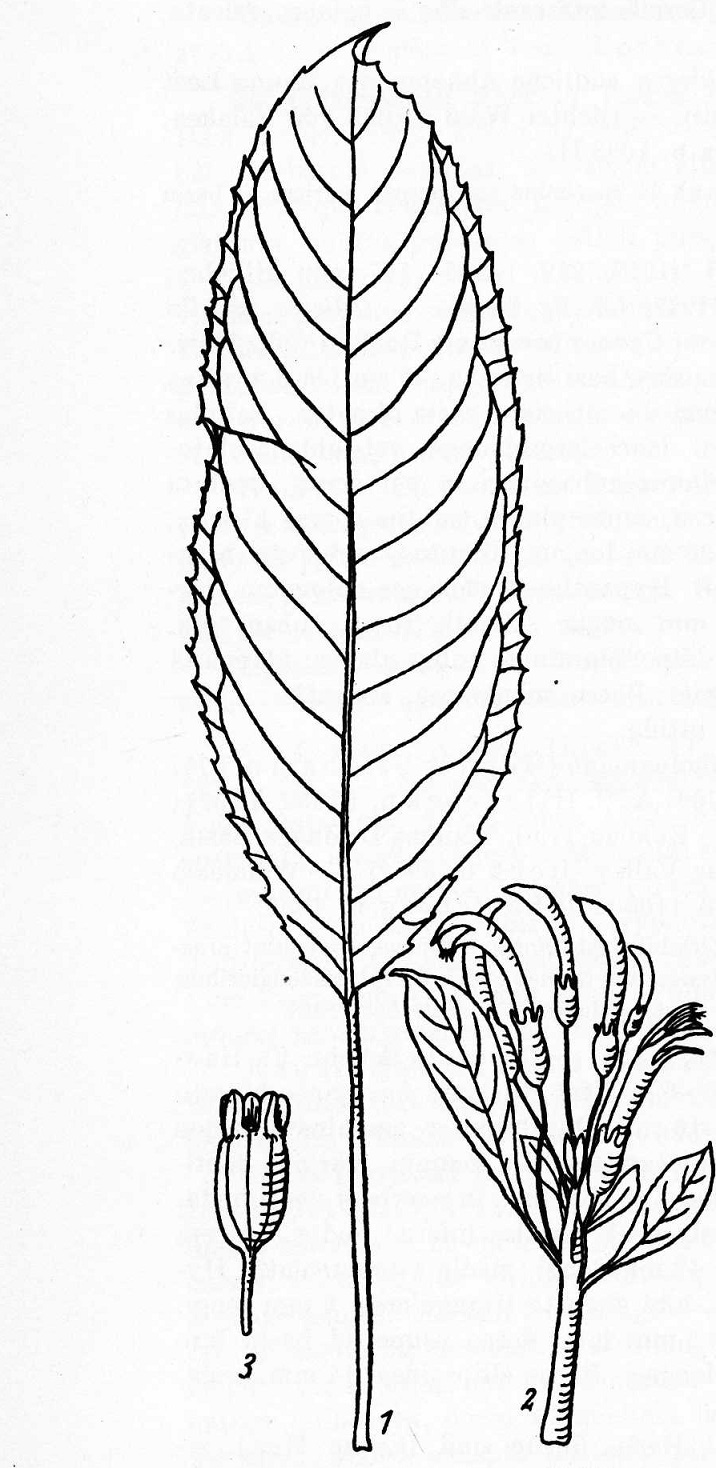 Fig. 21. Cyanea argutidentata E. Wimm. 1 Folium 1/2, 2 Inflorescentia 1/1, 3 Bacca 1/1. — Orig.
52. C. argutidentata E.Wimm. nov. sp. — Planta glaberrima. Folia chartacea, longe petiolata: petiolus 10 cm longus; lamina oblonga, 20 cm longa et 7 cm lata, apice breviter subacuminata, mucronata, basi subrotundata vel late cuneata et in petiolum breviter angustata, margine argute dentata, dentes callosi antrorsum versi et inter sese 5-6 mm distantes. Pedunculus 3-5 cm longus, inferne nudus, superne bracteis foliaceis petiolatis 15-30 mm longis et pedicellis multis 13 mm longis obsitus. Hypanthium cylindricum, 7 mm longum et 3 mm latum, lobi lineares, obtusi, 2 mm longi. Corolla virenti-alba (?), conspicue parva, subcurva, 16 mm longa, 2 mm lata, lobi superiores 6 mm longi, inferioribus brevioribus altius soluti. Filamenta glabra, 11 mm longa; antherarum tubus glaber, 5 mm longus, 2 inferiores apice penicillatae. Cetera ignota — Fig. 21.
Hawaii: Wald unterhalb Koa Kanehaha-Kona, blühend im Juni (C.N.Forbes 263 H! Bishop Mus.).
53. C. pilosa A. Gray in Proceed. Am. Acad. V. (1861) 149; Hillebr. Fl. Haw. Isl. (1888) 255; Rock The Indig. Trees Haw. Isl. (1913) 508 et Haw. Lobel. (1919) 271, t. 50, 153. — Delissea pilosa Mann in Proceed. Am. Acad. VII. (1867) 182. — Caulis erectus, subherbaceus, hirsutus, cr 1 m altus. Folia late obovata usque obovat-oblonga, 14-30 cm longa et 7-12 cm lata, acuminata, basi acuta vel rotundata, margine inaequaliter dentata, membranacea, utrinque dense hirsuta; petiolus hirsutus 3-5 cm longus. Racemi breves pauciflori in pedunculis hirsutis 15-20 mm longis, pedicelli 9 mm longi. Hypanthium oblongum, glabrum, lobi calycis subulati, 4-6 mm longi. Corolla cinereo-caerulea, glabra cr 2 cm longa. Bacca globosa, subhirta, 8 mm indiametro. Semina badia.
Hawaii: Unterer Waldrand auf der Windseite des Mauna Kea (U.S.Expl.Exped., Herb. Gray). — Waimea, Schlucht des Holokaiea, fruchtend im Juli (Rock n. 4769!). — Alakahi ditch trail (Rock n. 4753). — Nahe dem Gipfel im sumpfigen Walde des Gebriges von Kohala, 1500 m (Rock n. 8726! 8726a!). — Im Walde jenseits des Kalanilehua am Vulkan Kilauea (Rock n. 12833). — Wald "between 29 miles and Kulani" (Rock et Hashimoto n.. 131137). Kulani Prison Road in dense forest, c. 1300m, II. (Hb. Deg. 21776! 21777! - B.). (cf. supplement)
var. densiflora Rock The Indig. Trees Hawaii Isl. (1913) 508 et Haw. Lobel (1919) 273, t. 154. — Folia obovato-oblonga usque oblonga, subcarnosa, subtus alba vel argentea, supra virida. Pedunculus 15 mm longus, 10-16-florus. Corolla alba vel purpurascenti-tincta. Tubus filamentorum albus glaber; antherae albae, albo-hirsutae. Bacca aurantiaca, sparse hirsuta, 10-costata.
Hawaii: Kau, im sumpfigen dichten Wald am Naalehu, südliche Abhänge des Mauna Loa, 1300 m (Rock n. 10001! Herb. College of Hawaii und Bishop Mus.). — Insel Owhyhee am Berge Kaah (Macrae).
var. glabrifolia Rock The Indig. Trees Hawaii Isl. (1913) 508 et Haw. Lobel (1919) 273, t. 40, 41. — Folia elliptico-oblonga usque lanceolato-oblonga, utrinque acuta, supra glabrata, pallide viridia, subtus pallidiora et sparse hirta, petiolus 3 cm longus. Pedunculus 2 cm longus (7 cm ex Rock), hirsutus, supra medium bracteatus. Corolla virenti-alba, sparse hirsuta, 2 cm longa. Antherae dense hirsutae.
Hawaii: Ohne nähere Ortsangabe (J. Remy n. 303). — In dichtem sumpfigem Walde am Kilauea, 1200 m (Rock n. 8805! Herb. College of Hawaii und Bishop Mus.). — Häufig am Kalanilehua innerhalb des geschützten Besitzes des Herrn. Giffard, außerhalb spärlich (infolge dort weidender Tiere).
var. Bondiana Rock The Indig. Trees Hawaii Isl. (1913) 508 et Haw. Lobel (1919) 275. — Folia obovato-oblonga, utrinque acuminata, 10-14 cm longa et 3,5-5,5 cm lata, coriacea, supra glabra, subtus molliter dilute fusco-tomentosa, breviter petiolata. Pedunculus 3 mm longus, pauciflorus. Corolla purpurea, sparse hirsuta. Bacca globosa, lutea glabra.
Hawaii: Gebirge von Kohala, im dichtem sumpfigen Wald, 1500 m (Rock n. 8727, Herb. College of Hawaii).
Unum specimen tantum observavit Rock, quod cum specie typica ibi crescit. Dedicatum in honorem Dr. B.D.Bond, Kohala.
var. megacarpa Rock The Indig. Trees Hawaii Isl. (1913) 508 et Haw. Lobel (1919) 275. — Folia obovato-oblonga, 20-22 cm longa et 10 cm lata, apice obtusa, ad basin abrupte attenuata in petiolum carnosum 5 cm longum, supra parce, subtus sparse hirsuta. Bacca globosa, 22 mm in diametro, coronata lobis late triangularibus 8 mm longis. Flores ignoti.
Hawaii: Kohala-Gebrige, in sumpfigem Walde in der Alakahi-Schlucht, 1400 m (Rock n. 8728, Herb. College of Hawaii).
Page 77
53a. C. floribunda E. Wimm. nov. sp. — (cf. supplement) Partes summae saltem setoso-hispidae, excepta pagine superior foliorum, quae omnino glabra et laevis. Petioli tenuis, 10-30 mm longi. Lamina foliorum membranacea, supra subnitidia, glabra, subtus albescens, praesertim in nervis breviter pilosa, margine undulata et denticulis callosis peripheriam vix excedentibus munita, oblonga, 18-24 cm longa et 4,5-8 cm lata, apice obtuso subacuminata, basi acuta. Flores corymbosi in pedunculo axillari patente. Pedunculus circiter 15 mm longus, hispidus, nudus, 8-10 flores in apice gerens. Pedicelli circiter 5 mm longi, bractea lanceolata pedicellum aequante vel superante praediti. Hypanthium obconico-oblongum, subglabrum lobis sublinearibus subacutis parce pilosis 3-4 mm longis. Corolla virenti-alba et rubenti-striata, sparse pilosula, circiter 21 mm longa; tubus usque ad basin fissus, circiter 12 mm longus; lobi corollae 9-8 mm longi, sublineares. Filamenta glabra; antherarum tubus 4 mm longus, in dorso et in basi hirtus, 2 inferiores apice barbatae. Bacca ellipsoidea, aurantiaca, 1 cm longa.
Hawaii: Along Saddle Road, 19 miles from Hilo in dark rich rainy kipuka, 29, 30. VIII. 1949 (Hb. Degener n. 20274! 20007! - Deg., Wien); near Kulani Prison road, 1300 m, III. (Hb. Deg. n. 21795! - B. W.). — Eine Kipuka ist eine Oase inmitten eines Lavafelds (Degener).
54. C. Bishopii Rock The Indig. Trees Haw. Isl. (1913) 509 et Torrey Bot. Club Bull. XXXXIV. (1917) 233, t. 13,14 et Haw. Lobel. (1919) 277, t. 52, 155. — "C. Kunthiana?" Hillebr. Fl. Haw. Isl. (1888) 264. — Plant erecta, subherbacea, basi lignescens, raro ramosa, 1-1,4 m alta, vertice foliata. Folia elliptico-usque obovato-oblonga, 20-30 cm longa et 4-7 cm lata, in apicem obtusum acuminata, ad basin acuta et in petiolum hirtum 3 cm longum attenuata, margine repanda vel subintegra et denticulata vel obtuse dentata, membranacea usque subcoriacea, supra sparse hirsuta vel glabrescentia, subtus pallida et imprimis ad nervos densius hirsuta. Pedunculus 6-25 mm longus, hirsutus, bracteis linearibus instructus, multiflorus; pedicelli 6-10 mm longi, bibracteolati. Hypanthium obconico-oblongum, parce hirsutum vel hirtellum, 6 mm longum, lobi lineares, acuti, 5-6 mm longi, 1,5 mm lati. Corolla alba, lilacino-striata, 35 mm longa, 4 mm lata, subcurva, apicem versus plus hirsuta, dorso 1/3 fissa, lobi lineares, superiores cr 12 mm longi. Filamenta sparse pubescentia; antherarum tubus 6 mm longus, pilis lilacinis vel albis dense obsitus, 2 inferiores antherae longius penicillatae. Bacca subglobosa, purpureo-aurantiaca, 8 mm in diametro.
Maui: Bergrücken über dem Wailuku und Lahaina, 1200-1500 m (Bishop n. 5! und 47, Herb. Berlin). — Abhänge des Haleakala, in feuchtem Wald zwischen den Schluchten des Waikamoi und des Honomanu, 1200 m, blühend im Mai, fruchtend im Oktober (Rock n. 8572! 8806!). — Oberer sumpfiger Wald am Puu Kukui, 1500 m (St. John n. 10248! G.C.Munro n. 417! A.S.Hitchcock n. 14846). — Tal des Honokahau entland des Weges zum Berg Eeke, 1000 m (Rock et Hashimoto).
Oahu: Waiakole, blühend im Febr. (C.N.Forbes n. 4743 O!). — Forma foliis subcoriaceis, pedunculis parum longioribus et omnino minus et brevius pilosa, sed a species typica non discernenda. — Delissea Kunthiana Gaudich. Voy. Bonite t. 77 sine descriptione est et a cl. Hillebrandio non sine dubio ad speciem praesentem protrahitur, sed Rock identitatem prorsus negat. Cum specimen originarium non existat et talis planta post Gaudichaudium non jam inventa sit, species omittenda est.
Page 78
55. C. fissa (H.Mann) Hillebr. Fl. Haw. Isl. (1888) cum var. β.; Rock Haw. Lobel. (1919) 225. — Delissea fissa H. Mann in Proceed. Am. Acad. VII. (1867) 182. — Cyanea humilis Wawra in Flora XXXI. (1873) 47. — Frutex ramosus, 3-4 m altus. Folia obovato-lanceolata, 40-60 cm longa et 9-13 cm lata, apice acuminata, basi sensim in petiolum 2-4 cm longum angustata, margine callose denticulata, supra glabra, subtus sparse vel parce pubescentia. Pedunculus sicut flos hirsutus, pilis glandulaceis seape intermixtis 2-6 cm longus, multiflorus. Pedicelli 12 mm longi, medio bibracteolati, bracteae lineares, pedicellis sublongiores. Hypanthium turbinatum, 6 mm longum et latum, lobi calycis anguste triangulares, acuti, 6-10 mm longi. Corolla pallide purpurea, subcurva, dorso usque ad basin fere fissa, 32 mm longa, 4 mm lata, lobi superiores 12 mm longi. Tubus staminum glaber; antherarum tubus 7 mm longus, 2 inferiores penicillatae.
Kauai: In den Waldungen der Täler Kealia und Hanalei (Mann et Brigham n. 577, Herb. Gray und Delessert!; Faurie n. 592!; V.W.Hardy n. 13105; Wawra n. 2186, 2187! sub Cyanea humilis).
56. C. Remyi Rock in Torrey Bot. Club Bull. XXXXIV. (1917) 223, t 12 et Haw. Lobel. (1919) 282, t.158. — Planta glabra. Folia elliptica vel ovato-elliptica, 24-40 cm longa et 14-15 cm lata, acuminata, basi rotundata vel breviter cuneata, margine dentata, crassa, chartacea, glabra vel subtus parce hispida, petioli 10-12 cm longi (hispidi in specimine Forbes). Pedunculus 7-8 cm longus; pedicelli filiformes, 2 cm longi. Flores purpurascenti-rosea, glabri, textura valde tenui (gemmae floriferae in specimine originario tantum adsunt!).
Kauai vel Niihau: Ohne spezielle Ortsangabe, 1851-55 (J. Remy n. 302). — Hihi Mountains, Oktober (C.N.Forbes n 660K! — folia tantum!).
Species non satis nota et eius positio dubia.
57. C. Dunbariae Rock Haw. Lobel. (1919) 265. — Caulis ad 2 m altus, basi lignosus, superne carnosus, ramis nonnullis recte ascendentibus, vertice laxe foliatis. Folia ambitu ovato-elliptica, sinuato-lobata, 15-18 cm longa et 9-10 cm lata, apice acuta, dentata, basi obtusa, glaberrima, subtus pallida, petiolus 8-12 cm longus. Pedunculus 4-6 cm longus, parvi-bracteatus, superne floriferus; pedicelli 15 mm longi, medio minute bibracteolati. Corolla sicut tota planta glabra, alba, interdum lilacino-striata, subcurva, 3-4 cm longa, 4 mm lata, dorso vix ad medium fissa. Staminum tubus glaber; antherae virides, 2 inferiores penicillatae.
Molokai: Im Schatten entlang des Flusses Waihanau, 1000 m, blühend im August (Frau L.M.Dunbar n. 13119! Herb. College of Hawaii und Bishop Mus.). — Waialea Valley (junge Pflanze — Rock n. 14038!).
58. C. comata Hillebr. Fl. Haw. Isl. (1888) 256; Rock Haw. Lobel. (1919) 211, t. 113. — Frutex cr 2 m altus, ramis paucis ascendentibus, distanter foliatis. Folia obovat-oblonga, 15-30 cm longa et 6-9 c lata, apice rotundata et insuper brevissime acuminata vel breviter acuta, ad basin parum angustata et in petiolum 2-4 cm longum contracta, margine conferte callose denticulata, chartacea, supra glabra, subtus sparse hirta. Pedunculi 15-20(30) cm longi, penduli, nudi, vertice 6-12-flores gerentes, bracteis 3 mm longis ornati; pedicelli 2 cm longi, supra medium minute bibracteolati. Hypanthium depresso-globosum, glabrum, 6 mm longum et 7 mm latum, lobi calycis late triangulares, 1-2 mm longi. Corolla cinereo- vel pallido-lilacina, arcuata, glabra, dorso usque ad basin fere fissa, 55 mm longa et 5 mm lata, lobi superiores cr 2 cm longi, labium inferius trifidum, lobi 15 mm longi. Filamenta glabra, 5 cm longa; antherae 15 mm longae, glabrae, 2 inferiores penicillatae. Bacca subglobosa, 14 mm in diametro. Semina complanata, laevia, nitida.
Maui: Südliche Abhänge des Haleakala, 1000-1300 m, blühend im August (Hillebrand! Herb. Berlin).
Species ob characteres floris positionem singularem occupat et una formarum antiquissimarum esse videtur. Ceterum ista planta post Hillebrandium non iterum collecta et progressu Paspali conjugati et cultura Eucalypti in illa regione jam depressa est.
Page 79
Cyaneae dubiae:
C. salicina Lévl. in Fedde Repert. Nov. Spec. XII. (1913) 505; Rock Haw. Lobel. (1919) 384 inter dubias. — Folia flaccidissima elongata anguste lanceolata nervis arcuatis margine confluentibus, vix vel non subdenticulata, subtus secus nervos passim sparse pilosa, breviter petiolata, acuminata. A Cyanea spathulata foliis flaccidisimis valde acutis differt.
Kauai: Kealia, jan. 1910 (U. Faurie) n. 569). Typum non vidi.
Cyaneae excludendae:
| C. arborescens Mann | = | Clermontia arborescens Hillebr. |
| C. aspera A. Gray | = | Rollandia calycina G. Don |
| C. Blinii Lévl. | = | Clermontia parviflora Gaudich. |
| C. rivularis Rock | = | Delissea rivularis E. Wimm. |
| C. ? Rollandii A. Gray | = | Rollandia crispa Gaudich. |
3. Clermontia Gaudich.
Clermontia 1) Gaudich Bot. Voy. Freyc. (1826) 459; Reichenb. Conspect. (1828) 114; Bartl. Ord. (1830) 151; Presl Prodr. Lobel. (1836) 48; Endl. Gen. I. (1838) 513; A. DC. Prodr. VII. (1839) 341; Spach Vég. Phan. IX. (1840) 572; Benth. et Hook.f. Gen. Pl. II. (1876) 546; Hillebr. Fl. Haw. Isl. (1888) 239; Schönl. in Engler-Prantl Pflanzenfam. IV/5. (1894) 64; Rock The Indig. Trees Haw. Isl. (1913) 471 et Haw. Lobel. (1919) 285. — Clermontea G. Don Gen. Syst. III. (1834) 698. — Delissea sect. Clermontia Baillon Hist. Pl. VIII. (1886) 364; Post et Kuntze Lex. Gen. Phan. (1904) 166.
Hypanthium ovario globoso vel turbinato adnatum; calycis lobi 5 tam longi quam corolla, connati, apicem versus soluti, decidui, bilabiati, colorati, vel corolla multo breviores, liberi et persistentes. Corollae tubus aequilatus, arcuatus usque subrectus, dorso cum calyce saepe usque ad basin fissus; limbus inaequaliter 5-partitus, plus minus distincte bilabiatus; lobi 2 superiores ceteris longiores, falcati, plerumque usque ad medium corollae soluti. Filamenta a corolla libera, connata, tubo corollae longiora. Antherarum tubus cylindricus, subcurvatus vel rectus, cr quartam partem filamentorum attigens vel paulo superans, antherae 2 inferiores apice penicillatae. Stigma bilobum, ad finem antheseos e tubo antherarum prorumpens; lobi rotundi, divaricati, subtus vel infra eorum basin pilosi. Bacca globosa, oblonga vel obovoidea, disco lato epigyno, carnosa, 2-locularis, placentae 2 loculos implentes. Semina numerosa, compresso-ellipsoidea, laevia, nitida. — Frutices vel arbores ramosi, ramis divaricatis, succu glutinoso lactescente. Folia plerumque coriacea. Inflorescentia axillaris, cymae similis, 2-flora, rarius 3-11-flora.
Species 27, in insulis Sandwicensibus indigenae.
Nom en commune apud incolas pro omnibus speciebus huius generis est "Oha wai" (Hillebr.)
A ceteris tribus generibus differt ramificatione — rami horizontaliter patentes et dein ascendentes — et inflorescentia, vide p. 12. Plerumque epiphytice crescens altitudine 150-2100 m.s.m.
|
Die Verbreitung der Clermontia-Arten nimmt von Osten nach Westen ab: Auf Hawaii finden wir 12 Arten, auf der zunächst liegenden Insel Maui 10, dann auf Molokai 6 und der sehr nah gelegenen südlichen Insel Lanai 4, auf Oahu 6 und der am weitesten westlich gelegenen Insel Kauai 4 Arten. Am weitesten verbreitet sind Cl. arborescens, Cl. grandiflora, Cl. Kakeana und Cl. oblongifolia. An Individuenzahl reicher als die anderen 3 Genera, bestimmt Clermontia in vielen Gebieten den Charackter der Vegetation und ist wohl erst in seiner Entwicklung begriffen. — Der dicke Milchsaft wird von den Einheimischen als Vogelleim benutzt. |
The distribution of the Clermontia spp. decreases from east to west: on Hawaii, we find 12 species, on the first-lying island Maui 10, then on Molokai 6 and very close lying southern island of Lanai 4; on Oahu 6 and the furthest west lying island Kauai 4 species. The most widespread are Cl. arborescens, Cl. grandiflora, Cl. Kakeana and Cl. oblongifolia. In number of individuals, Clermontia is richer than the other three genera and it determines the character of the vegetation in many areas and probably only now is in its development. — The thick milky sap is used by locals as birdlime. |
________________
1) Marquis de Clermont-Tonnere, Ministre de la Marine Française 1821 (Gaudichaud).
Page 80
Page 81
Clavis generis Clermontiae.
| A. Calyx tam longus quam corolla vel paulo brevior; lobi calycis primo connati et corollam totaliter includentes, postea apice ad summum usque ad medium, summus lobus saepe usque ad basin corollae souti, maturitate cum corolla decidentes. | Sectio I. Genuinae Hillebr. |
| a. Pedunculi 2-flori, interdum 1- vel 2-5-flori. | |
| α. Folia subpetiolata, petiolo 2-9 mm longo, obovata, brevia | |
| I. Pedunculi 40 mm longi. 2-1-flori | 12. Cl. grandiflora var. subpetiolata. |
| II. Pedunculi 3-5 mm longi, 2-flori, folia subtus parce pubescentia vel glabrata | 10. Cl. hanaensis. |
| β. Folia longe petiolata, petiolo 2-10 cm longo. | |
| I. Pedunculi filiformes, circiter 1 mm diamet., 25-70 mm longi, pedicelli aequilongi vel paulo breviores | 12. Cl. grandiflora. |
| II. Pedunculi crassiusculi, circiter 2-3 mm lati. | |
| 1. Hypanthium saltem in dorso alato-costatum; pedunculi 2-6 cm longi pedicellis subaequalibus; folia subtus hispidula. | 3. Cl. hawaiiensis. |
| 2. Hypanthium vix aut leviter costatum. | |
| * Pedunculi duplo usque triplo longiores quam pedicelli. | |
| ▪ Pedunculi praelongi, arcuato-declinati, 60-75 mm longi, pedicellis 3-plo longiores. | 1. Cl. drepanomorpha. |
| ▪▪ Pedunculi 25-40 mm longi, pedicellis cr. 2-plo longiores. | 2. Cl. letoclada. |
| ** Pedunculi pedicellos cr aequantes, paulo breviores aut paulo longiores quam pedicelli, (5)10-45 mm longi. | |
| ▪ Folia hirtella, membranacea, opaca, obovato-oblonga, saepissime 5-6 cm lata. | 4. Cl. Kakeana. |
| ▪▪ Folia glabra vel raro subtus plus minusve hispidula, chartacea vel coriacea, plerumque angustiora, oblanceolata usque oblonga. | |
| ◦ Flores evoluti hamoso-curvati; pedunculi 10-20 (5-45) mm longi, 2-3-flori, pedicelli 10-45 mm lg. | 9. Cl. oblongifolia. |
| ◦◦ Flores evoluti subcurvati vel subrecti. | |
| □ Pedunculi 15-35 mm longi; folia lanceolato-oblonga, acuta, glabra, opaca; corolla 5-6 cm longa. | 5. Cl. kohalae. |
| □□ Pedunculi 3-14 mm longi; folia nitida. | |
| x Folia coriacea, oblanceolata usque lanceolato-oblonga, glabra; flos gracilis, leviter curvatus, 4-8 mm latus (Vide etiam Cl. epiphyticam) | 8. Cl. persicifolia. |
| xx Folia subcoriacea usque chartacea; flos supra 10 mm latus, subrectus. | |
| + Folia oblanceolato-oblonga, subtus pallida et saepe hispidula | 6. Cl. montis-loa. |
| ++ Folia elliptico-oblonga, fere concoloria, glaberrima | 7. Cl. calophylla. |
| b. Pedunculi 3-11-flori, raro 2-5-flori | |
| α. Folia sessilia, pedunculi 6 cm longi, 5-flori | 13 Cl. wailauensis. |
| β. Folia petiolata | |
| I. Petioli 6-10 cm longi; folia oblonga vel lanceolata. | |
| 1. Peduncuuli 7-11-flori, 10 mm longi. Videtur exstincta | 17. Cl. multiflora. |
| 2. Pedunculi 3-7-flori, 8-15 mm longi | 14. Cl. pallida. |
| II. Petioli 1,4-6 cm longi | |
| 1. Planta hirta foliis plerumque obovatis. | 11. Cl. Samuelii. |
| 2. Plantae glabrae (excepta Cl. parviflora cum foliis subglabris). | |
| * Folia oblanceolata; pedunculus 10-15 mm longus et 2-3-florus | 15. Cl. epiphytica. |
| ** Folia lanceolata usque oblonga vel obovato-oblonga; pedunculi 2-4-6-flori. | |
| ▪ Folia oblongo-elliptica vel obovato-oblonga, subtus tenuiter puberula | 18. Cl. parviflora. |
| ▪▪ Folia lanceolata vel lanceolato-oblonga glabra. | |
| ◦ Pedunculi 5-6 mm longi; corolla 25 mm longa | 16. Cl. micrantha. |
| ◦◦ Pedunculi 10-40 mm longi; corolla 40-50 mm longa. | |
| □ Petioli 2-3 cm longi; folia late lanceolata | 5. Cl. kohalae var. hiloensis. |
| □□ Petioli 4-6 cm longi; folia lineari-lanceolata | 2. Cl. leptoclada var. holopsila. |
| B. Calycis lobi muluto breviores quam corolla, persistentes. | Sectio II. Clermontioideae Hillebr. |
| a. Pedunculus 2-florus, raro 1-florus, interdum 3-florus | |
| α. Flores dense verrucosi | 19. Cl. tuberculata. |
| β. Flores laeves, sine tuberculis. | |
| I. Lobi calycis oblongo-triangulares 15-17 mm longi | 25. Cl. Rockiana. |
| II. Lobi calycis breves, triangulares vel dentiformes 1-8 mm longi. | |
| 1. Flores et pagina inferior foliorum puberula | 23. Cl. pyrularia. |
| 2. Planntae glabrae | |
| * Folia elliptica usque elliptico-oblonga, brevissime acuminata | 20. Cl. clermontioides. |
| ** Folia lanceolata usque oblonga vel obovato-oblonga. | |
| ▪ Corolla crasso-carnosa, ampla; pedunculus 5-10 mm longus; folia obovato-oblonga | 22. Cl. arborescens. |
| ▪▪ Corolla textura tenui; pedunculi multo longiores. | |
| ◦ Folia oblonga breviter acuminata; pedunculi 15-17 mm longi; corolla evoluta valde curvata | 21. Cl. Peleana. |
| ◦◦ Folia oblonga usque lanceolata, acuta, subtus subpubescentia vel glabrata; pedunculi 25-40 mm longi; corolla mediocriter curvata | 24. Cl. caerulea. |
| b. Pedunculi 3-6-flori; folia oblonga. | |
| α. Folia 2-3 cm longe petiolata, utrinque acuta; corolla purpurea, subpubescens | 26. Cl. waimeae. |
| β. Folia ad basin in petiolum marginatum sensim angustata et exinde subsessilia, apice obtusa; corolla albo-virens, glabra. Videtur exstincta | 27. Cl. haleakalensis. |
|
Clermontia carinifera Lévl. und Cl. fulva Lévl. blieben unberücksichtigt, da aus deren Diagnose weder Genus noch Species sicher festgestellt werden können Sie sind am Schlusse unter den Dubia angefügt. |
Clermontia carinifera Lévl. and Cl. fulva Lévl. were disregarded because their diagnoses to neither genus nor species is certain. They are placed amongst the Dubia at the end. |
Page 82
Sectio I. Genuinae Hillebr.
Genuinae Hillebr. Fl. Haw. Isl. (1888) 239; Rock The Indig. Trees Haw. Isl. (1913) et Haw. Lobel. (1919) 308. — Vida supra.
1. Cl. drepanomorpha Rock The Indig. Trees Haw. Isl. (1913) 473, t. 196 et Haw. Lobel. (1919) 327, t. 184, 185. — Arbor multi-ramosa 4-6 m alta. Folia obovato-lanceolata usque oblonga vel lineari-lanceolata, 8-18 cm longa et 1,5-4 cm lata, apice brevissime acuminata vel obtusiuscule acuta, basi in petiolum 2-5 cm longum angustata, margine crenulato-callose denticulata, a medio fere versus basin integra, coriacea, supra glabra, opaca, subtus pallida et sparse pubescentia. Pedunculus declinatus, glaber, 6-8, fructiger 10 cm longus, biflorus; pedicelli 2-3 cm longi. Calyx atropurpureus, hypanthium semi-ellipsoideum, 15-20 mm longum, lobi longitudine corollae, usque ad medium soluti. Corolla purpurea, carnosa, hirtella, subcurvata, 4-6 cm longa et 1,6 cm lata. Filamenta glabra, subpurpurea. Antherarum tubus lilacinus, glaber. Bacca globosa, aurantiaca, 3 cm in diam.
Hawaii: Kohala-Gebirge, nahe dem Gipfel im sumpfigen Wald und auf dem versumpften Hochplateau Zwischen Sphagnum blühend im Juli (Rock n. 4751! 88079!). — Kawaihae, Puu Ahia, Regenwald, 1600 m (St. John et Hosaka n. 11495!). — Waimea (A.S.Hitchcock). — Oberhalb Kamuela, sumpfiger Wald, c. 1100 m (Skottsberg n. 1128).
2. Cl. leptoclada Rock The Indig. Trees Haw. Isl. (1913) 477 et Haw. Lobel. (1919) 323, t. 183. — Arbor 6-7 m alta, ramis gracilibus laxe foliatis. Folia lanceolato-oblonga, 12-18 cm longa et 2,5-4 cm lata, apice acuminata, basi sensim acutata in petiolum 4-6 cm longum, margine callose denticulata, coriacea, viridia, supra glabra, subtus pallida et sparse pubescentia ad nervos. Flores per truncum gracilem dispositi in pedunculis hirtis 2,5-4 cm longis et 2-4-floris; pedicelli 15-35 mm longi, in medio bibracteolati. Hypanthium semiglobosum, hirtum, 14 mm diametiens; lobi calycis corollam aequantes, purpurascentes nervis prominentibus hirsutis. Corolla purpurea, albo-hirsuta, subcurvata, 45 mm longa. Filamenta purpurascentia, puberula. Antherae caerulescenti-purpureae, in suturis hirsutae. Bacca globosa, 25 mm diametiens. Semina fusca.
Hawaii: Auf dem sumpfigen, bewaldeten Hochplateau des Kohala-Gebirges oberhalb Waimea am Alakahi (Rock n. 4760! 4765! 8814!).
var. holopsila E. Wimm. nov. var. — Folia lanceolata, 17-20 cm longa et 2,7-3,3 cm lata, glabra vel subtus pilis paucissimis ad costam, in vertice congesta. Pedunculi brevissime hirtelli, medio 2 bracteolis filiformibus 15 mm longis, 25-30 mm longi et 2-5-flori; pedicelli cr 15 mm longi, medio similiter bibracteolati. Flores cum staminibus glabri.
Hawaii:Kohala-Gebirge, östlicher Abhand des Pololu Valley an sonniger, buschiger Stelle, blühend im August (Herb. Degener n. 2186!).
2a. Clermontia paradisia E. Wimm. n. sp. — (cf. supplement) Frutex glaberrimus ramis vertice foliosis et pedunculis 2-floris axillari-solitariis. Petioli tenues 3 cm longi. Foliorium lamina lanceolata (in medio latior), 12 x 2 cm, utrinque acuta, sed versus basin sensim angustata, margine callose denticulata, membranacea, fere opaca, plana, sed subtus nervus medianus prominens, nervi secundarii plani, sub angulo fere recto curvatim ascendentes et in denticulos marginis excurrentes, utrinque 14-16. Pedunculi solitarii in axillis foliorum 10 mm longi, bracteis mox deciduis; pedicelli 10-12 mm longi, basi et in medio plerumque bibracteolati. Calyx longitudine corollae: lobus dorsalis usque ad basin solutus, ceteri 4 lobi soluti ut illi corollae. Corolla 30 mm longa, in dorso fere usque ad basin fissa: tubus 12 mm longus et (exsiccata compressa) 5 mm latus, lobi lineares falcati patentes, 21 mm longi, 1 mm lati, videntur purpurascentes, dum tubus forsan virenti-albus est. Staminum columna glabra, exserta: antherae 11 mm longae, 2 inferiores apice penicillato-pilosae. Ovarium subcylindricum. Bacca subgobosa aurantiaca, circiter 15 mm in diametro. Semina nitido-fusca, compresso-ellipsoidea, 0,6 mm longa, numerosa.
Hawaii: Kohala Mts., along ditch trail west of Kaukini Cabin, open forest, 18.II.1952 (Hb. Degener n. 21880! 21881!); Pololu-Konokanenui region, along ditch trail in open forest and small gulches (Hb. Degener n. 21882! 21879! - B.W.).
Der Clermontia leptoclada ähnlich, doch durch pedunculi und Fehlen jeglicher Behaarung verschieden.
3. Cl. hawaiiensis (Hillebr.) Rock The Indig. Trees Haw. Isl. (1913) 477, t. 199 et Haw. Lobel. (1919) 317, t. 44, 45, 48, 178, 179; Skottsb. op. cit. 269. — Cl. macrocarpa var. Hawaiiensis Hillebr. Fl. Haw. Isl. (1888) 241. — Arbor vel frutex 3-9 m altus. Folia oblonga vel obovato-oblonga, 15-22 cm longa et 3-6 cm lata, obtusiuscule acuminata vel acuta vel obtusa, ad basin angustata in petiolum cr 3 cm longum, margine undulata et callose denticulata, chartacea usque subcoriacea, supra glabra, nitida vel subopaca, subtus pallida et sparse pubescentia imprimis ad nervos. Pedunculus 2-6 cm longus, puberulus vel glabratus, 2-, rarius usque 4-florus, pedicellis plerumque brevior; pedicelli 2-4 cm longi, infra medium bibracteolati. Hypanthium ovoideum vel obconico-oblongum, valde 10-costatum, costa dorsalis saepe alata, lobi calycis longitudine corollae viriduli vel purpurascentes, 60-65 mm longi, ante anthesin subcurvi. Corolla viridi-alba, lobi leviter violaceo-tincti, vel extus lilacina, intus eburnea. Stamina glabra vel antherarum tubus interdum in suturis hirsutus. Bacca obconica, 3 cm in diam., apice truncata, aurantiaca, alato-costata.
Hawaii: Von Hilo bis Waiohino (Hillebrand! U. Fauriè n. 581! Skottsberg n. 460, 461). — Mauna Loa, Kipuka Puaulu und Volcano Road (Rock n. 8771! 8801, 8802, 8803). — Puna, hier gemein und ganze Buschwälder in reinen Beständen bilden (Rock n. 12847). — Napau Trail, an den Kratern, 900 m (St. John and others n. 11261!). — Kilauea, Bird Park, in sonniger grasiger Gegend zwischen Gestein (Hb. Degener n. 7820!). — Nationalpark, Kipuka Neenee (Hb. Degener n. 7814! - costae baccae [37 mm lg. et 30 mm lt.] non alato-elevatae!).
Molokai: Maunakui in forest, 8 ft. high branching (Hb. Degener n. 726! - specimen minus typicum). (cf. supplement)
Cl. drepanomorphae proxime accedens, fortasse non diversa.
Species valde varians, sed varietates utiles vix segregari possunt, Rockio existimante: "These different forms range more or less into each other, and it is desirable to recognize them all as a species." Saepe crecit in arboribus filicum imprimis in truncis Cibotii.
Page 83
4. Cl. kakeana 1) Meyen Reise um die Welt II. (1835) 139; Meyen in Nova Acta Caes. Leop.Carol. XVI. Suppl. II. (1843) 358; Walpers Repertor. II. (1843) 708; Haw. Lobel. (1919) 308, t. 171; Skottsb. in Meddel. Göteborgs Bot. Trädg. II. (1926) 268. — Cl. macrocarpa Gaudich. Bot. Voy. Bonite (1839-5) t.49; Hillebrand Fl. Haw. Isl. (1888) 240; Bryan Nat. Hist. Hawaii (1915) t. 58 f. 4. — Cl. macrophylla Nuttall in Transact. Amer. Phil. Soc. II. (1843) 251. — Cl. grandifolia var. longifolia A. Gray in Proc. Am. Acad. V. (1861) 150. — Frutex vel arbor 3-6 m alta; turiones tomentosi. Folia obovato-oblonga vel oblonga, 15-25 cm longa et 5-8 cm lata, brevissime acuminata vel acuta, ad basin in petiolum 3-6 cm longum angustata, conferte callose denticulata, membranacea, opaca, subtus albescentia et sparse pubescentia. pedunculi pubescentes, 2-3,5 cm longi, plerumque biflori, interdum 5-7-flori (var. cymosa Hillebr. l.c.) vel et pedicelli biflori (ut in specimine Wawra n. 2246 in Herb. Wien); pedicelli 15-20 mm longi, bracteolis in vel supra medium sitis. Hypanthium subglobosum, 10-13 mm in diam., lobi connati longitudine corollae et colore viridi. Corolla lutescenti-viridis usque pallide rosea (var. rosea Hillebr l.c.), glabra, 5 cm longa et 8 mm lata, subrecta. Stamina glabra. Bacca globosa, leviter costata, lutea, 2-3 cm diametiens. Semina compresso-ellipsoidea, fusca, nitida, 0,8 mm longa.
Oahu: Gemein in Höhen von 300-1200 m an Waldrändern und in Schluchten, ohne nähere Ortsangabe (Meyen ! in Herb. Berlin, Gaudichaud n. 147! 151! und ohne Nr.! Mann et Brigham n. 232!). — Kaala-Gebirge, Halemanu, Waiolani (Hillebrand! Wawra n. 1685, 224! Hb. Degener n. 28877!). — Am Fuße des Kaala gegen das Ende von Schofield (Hb. Degener n. 7884!). — Am Krater des Tantalus in offenem Walde (A.A.Heller n. 2059! C.N.Forbes n. 1665O! Hb. Degener n. 7831! 7890! 7922! Skottsberg n. 662!). — Pauoa, Wahiawa, Kaukonahua, Waianu Valleys, blühend vom Juli bis Jänner (Rock n. 711, 1199, 8723, 8725!). — Pauoa flats (Hb. Degener n. 7849!). — Wahiawa-Gebirgsrücken und -Tal (Hb. Degener n. 7850! 7908! Bryan jun.!). — Waikakalau gulch (G.W.Schaw n. 12839). — Bergrücken nördlich der südlichen Halawa-Schlucht, Wald (Hb. Degener n. 7903!). — Moanalua Valley und Bergrücken östlich vom Nuuanu Valley (C.N.Forbes nn. 1185O! 1499O!). — Upper Palolo Valley und Crater (Topping n. 3093! Hb. Degener n. 7885!). — Pupukea-Kakuku Gegend in offenem Wald (Hb. Degener n. 7883! 7888! 7926!). — Lanihuli Trail (Frobes et Stockes!). — Laie, Kahawainui-Ihiihi (A. d'Welch!). — Aiea, C.C.C.Trail,, im unteren Wald (Hb. Degener n. 11536!). — Koolau-Gebirge, Manoa Valley (Hb. Degener n. 11380! — März, mit Knospen, H85!; Topping n. 3093! Skottsberg n. 350!). — Kalihi (U. Faurie n. 583!). In forest near Poamoho stream and Wiliwilinui Ridge (Hb. Degener n. 19726! 19711!.) (cf: Wimmer, 1953)
Molokai: Ohne nähere Angabe (Hillebrand!). — Mapulehu und Pukoo (A.S.Hitchock n. 14928). — Westliches Seitental des Mapulehutales (Hb. Degener n. 7847!). — Kolae (Forbes n. 32 Mo.!). — Kleine Schlucht nordwestlich vom Maunahui-Wald (Hb. Degener n. 7826! 7834!). Pukoo, Kainalu in open rain forest (Hb. Degener n. 20162!). (cf: Wimmer, 1953)
Maui: West-Maui, Regenwald nördlich vom Mt. Eke und an der Waihee-Seite (Hb. Degener n. 7944! 7949!). — Keanae Valley und eine halbe Meile von Keahikauo (Hb. Degener n. 7952! 7953!). — Haelaau, Berggipfel im unteren Regenwald, 900 m (Ewart III. n. 69!). — Puukukui (A.S.Hitchcock n. 14793, 14795). — Ost-Maui, Honomanu Trail, Kahikinui, südlicher Abhang des Haleakala, Olinda pipeline Trail, 1200 m (Rock n. 8688, 8815; A.S.Hitchcock n. 14928!). — Oopuloa streambed near lower ditch trail in forest (Hb. Degener n. 7951!). Paupau Ridge Mauka of Lahaina in dense shrubby forest, 1160 mm (Hb. Degener n. 20022!). (cf: Wimmer, 1953)
Bacca insipida, quae in Maui orientali magnitudinem Mali communis attingit, ab incolis editur.
_____________
1) "Kake" is the native name rendering the English name "Jack" (Hillebrand).
Page 84
5. Cl. kohalae Rock The Indig. Trees Haw. Isl. (1913) 476 et Haw. Lobel. (1919) 319, t. 25, 181. — Arbor parva, 5-6 m alta, laxe ramosa. Folia lineari- vel oblanceolato-oblonga, obtusiuscule acuta, basi in petiolum anguste marginatum 2-4 cm longum attenuata, conferte glandulose denticulata, 7-16 cm longa et 2-3,4 cm lata, glabra, chartacea, opaca, subtus pallida. Pedunculi 2-flori, subpubescentes vel scabri, 15-36 mm longi, sicuti pedicelli totidem longi in medio bracteolati. Hypanthium turbinatum, cr 1 cm longum et latum, lobi longitudine corollae. Corolla atropurpurea, glabra, subcurva, 5-6 cm longa. Filamenta glabra; antherarum tubus pallidus, in suturis hirsutus (Rock!) vel glaber, 2 inferiores antherae penicillatae. Bacca subglobosa, 2 cm in diametro. Semina pallide fusca, nitida.
Hawaii: Kohala-Gebirge, unterer Wald entlang der Flüsse, 600-800 m, blühend und fruchtend im Juli (Rock 8810!). — Wald oberhalb Hiilawe, Waipio Valley (Rock n. 4573).
var. robusta Rock in Coll. Haw. Publ. Bull. II. (1913) 41 et Haw. Lobel. (1919) 323, t. 182. — Arbor parva vel frutex; rami robusti, omnino lignosi; cortex crasso-suberosus et multo-cicatricosus; folia in vertice ramorum dense congesta, minora et brevius petiolata quam in typo; corolla cr 4 cm longa, crassiuscula et subcarnosa. Antherarum tubus atroviolaceus, glaber, 13 mm longus.
Hawaii: Kohala-Gebirge, an Flüssen und Wasserfällen, 500 m, blühend im Juli (Rock n. 8811 und ohne Nr.!). — Maunakea (U. Faurie n. 582!). Kohala, rainswept plateau at head of Alakahi Valley, 1260 m (Hb. Degener n. 20160!). (cf. supplement)
var. hiloensis E. Wimm. nov. var. — Folia late lanceolata vel parum obovato-lanceolata, utrinque acuta, in petiolum 2,5 cm longum angustata, margine minute callose denticulata, supra nitentia, nervi secundarii sub angulo recto arcuatim ascendentes. Pedunculi 2-3-flori. Corolla evoluta fere recta, 5 cm longa. Antherarum tubus glaber.
Hawaii: East of Hilo, in scrub vegetation in a plain, August im Beginn des Blühens (Hb. Degener n. 2190!). Along Saddle Road 16 miles from Hilo in rich rainy kipuka (Hb. Degener n. 20014!). (cf. supplement)
6. Cl. montis-loa Rock in Coll. Haw. Publ. Bull. II. (1913) 40, t. 9 et Haw. Lobel. (1919) 334, t. 190, 191. — Frutex 5-6 m altus, plerumque epiphyticus. Folia oblonga usque oblanceolata, 10-18 cm longa et 2,5-3,5 cm lata, obtusa vel obtuse acuta, ad basin sensim in petiolum 3-5 cm longum angustata, margine crenulata vel callose denticulata, coriacea usque chartacea, supra glabra, subtus sparse puberula, nervi secundarii sub angulo recto arcuatim ascendentes. Pedunculus 3-10 mm longus, biflorus; pedicelli 5-12 mm longi. Hypanthium turbinatum, viride, 12 mm longum, lobi calycis longitudine corollae et usque ad medium tubi soluti. Corolla glabra, purpurascenti-viridis, 35 mm longa, cr 7 mm lata, subrecta. Staminum tubus glaber; antherae 11 mm longae, 2 inferiores penicillatae. Bacca ellipsoidea, aurantiaca, 25 mm longa et 15 mm lata.
Hawaii: Wald von Naalehu, Kau, südliche Abhänge des Mauna Loa, 1300 m, blühend und fruchtend im Jänner (Rock n. 10002! Herb. College of Hawaii). — Abhänge zwischen dem Kilauea und Mauna Loa in der Nähe des Kalanilehua, blühend in August (Rock n. 12833; Rock et Hashioto n. 13121).
f. globosa Rock Haw. Lobel. (1919) 337. — Folia minora, brevius petiolata, glabra. Flores parum majores. Bacca globosa, non costata, 3 cm in diametro.
Hawaii: Wald am Kilauea nahe dem Kalanilehua, blühend und fruchtend im August (Rock n. 12835). — Epiphyta in Filicibus arboreis.
var. tenuifolia Skottsb. in Acta Hort. Bot. Gothoburg. II (1926) 269. — Folia chartacea, paulum latiora, 4-6 cm lata, minus distincte acuminata. Peduncuus cr 1 cm longus, interdum 3-florus. Corolla 35-45 mm longa, purpureo-viridis.
Hawaii: Kohala-Gebirge oberhalb Kamuela in feuchtem Walde, 1100m (Skottsberg n. 707). — Kawaihae, Puu Ahia im Regenwald, 1600 m (St. John et Hosaka n. 11498!).
Species proxime accedens ad praecedentem formas inter species ambas fluctuantes gignit.
Page 85
7. Cl. calophylla E. Wimm. nov. spec. — Frutex glaber, 5 m altus. Folia elliptico-oblonga, 14-19 cm longa, 4,5-6 cm lata, semper medio latiora, ad apicem obtusum breviter paulumque acuminata, ad basin acuta et in petiolum 6-7 cm longum angustata, margine callose denticulata, chartacea, subtus glaucescentia et purpurascenti-suffusa, nervi laterales sub angulo recto arcuatim ascendentes et ab invicem 6-11 mm distantes, nervis 1-3 debilioribus intercurrentibus. Inflorescentia axillaris, biflora. Pedunculus 10 mm longus, divergens; pedicelli 2 cm longi, bracteae delapsae. Hypanthium campanulato-cylindricum, 12 mm longum et latum, lobi longitudine corollae, virides, usque ad medium soluti. Corolla viridis, subrecta, tenuiter hirtella, 3 cm longa, medio 7 mm lata. Filamenta glabra, 3 cm longa; antherarum tubus 11 mm longus, glaber, antherae 2 inferiores penicillatae. — Fig. 22.
Hawaii: Puu Ahia, Kawaihae, Kohala Gebirge im Regenwald, 1600 m, blühend im Jänner (St. John et Hosaka n. 11503! Bishop Mus.).
Affinis Cl. montis-loa, a qua distat petiolis longioribus, forma et glabritie foliorum.
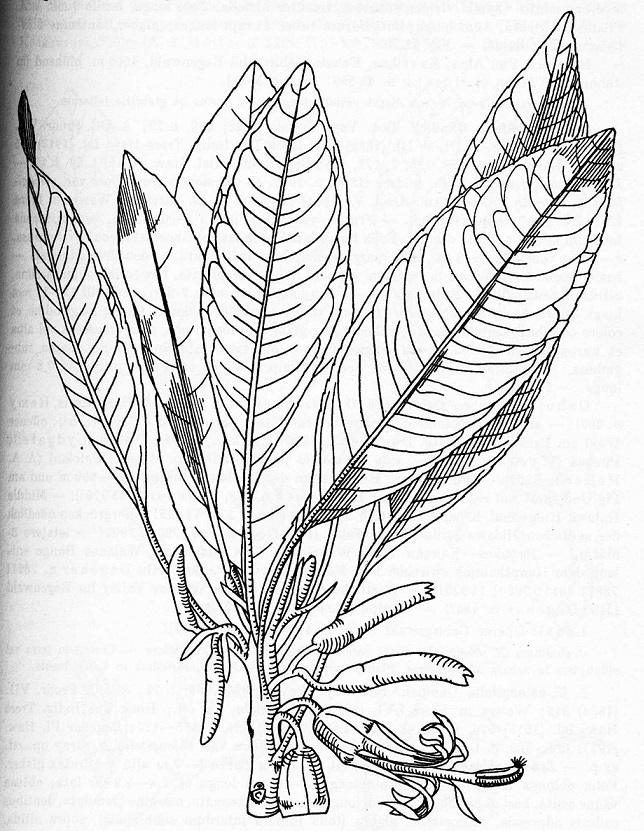 Fig. 22. Clermontia calophylla E. Wimm. 4/5 magn. nat. — Orig.
Page 86
8. Cl. persicifolia Gaudich. Bot. Voy. Freyc. (1826) 459, t. 72; A. DC. Prodr. VII. (1839) 342; Hillebr. Fl. Haw. Isl. (1888) 241; Rock The Indig. Trees Haw. Isl. (1913) 475 et Haw. Lobel. (1919) 313, t. 6, 7, 172, 174; Bryan Nat. Hist Haw. (1915) t. 59, f. 14. — Lobelia persicifolia Endl. Fl. Südsee (1836) n. 1062. — Clermontia grandiflora var. oblongifolia A. Gray in Proceed. Am. Acad. V. (1861) 150 p. p. — Cl. parviflora Wawra in Flora LVI (1873) 47, non Gaudich. — Frutex vel arbor parva 5-6 m alta, vertice corona foliorum lata et patente ornata. Folia lanceolata usque late oblanceolata, acuta vel obtusa, 8-13 cm longa et 1-3 cm lata, margine crenulato-denticulata - dentibus adpressis - basin versus integra, basi in petiolum 4-6 cm longum angustata, fere coriacea, glaberrima, nitida, subtus pallida. Pedunculi 10-14 mm longi, plurimum 2-flori; pedicelli 12-17 mm longi, supra basin bibraceolati. Calycis tubus semi-ellipsoideus. Calyx longitudine et colore corollae. Corolla gracilis subcurvata, glabra, primo virens, dein albescens vel alba et purpurascenti-tincta, 5 cm longa et 6-8 mm lata. Stamina glabra. Bacca subglobosa, aurantiaca, 3 cm in diam. Semina compresso-globosa, fusca, nitida, cr 0,8 mm longa. — Fig. 23 c.
Oahu: Ohne nähere Ortsangabe (Gaudichaud! et n. 148, beide Herb. Paris, Remy n. 307); — auf Gebirgskämmen, an Kratern im Walde. Kaala und Palolo (Hlb!); offener Wald am Palolo-Krater (Hb Degener n. 7886! Rock n. 12791); Wailua (Lydgate!); Puakea (Wawra n. 2206! — sub Clermontia parviflora in Hb. Wien); Waiolani (A.A.Heller n. 2391). — Punaluu am Hauptkamm des Koolau-Gebirges, 450-800 m und am Pig God Trail auf regenbestrichener Höhe (Rock n. 698, Degener n. 11376!). — Middle Halawa Ridge und Kipapa Trail (Hb. Degener n. 11374! 11375!); Bergrücken nördlich der südlichen Halawa-Schlucht im Walde (Hb. Degener n. 7901! 7902! — letztere 3-blütig). — Pupukea-Kahuku Trail, Wilhelmina Rise Ridge und Waianae Range entlang dem Hauptkamme zwischen Puu Manawahua und Palikea (Hb. Degener n. 821! 7887! 7911! 7920! 11925!). — Westlicher Bergrücken des Waialae Valley im Regenwald (Hb. Degener n. 484!). — Lanipo (Topping n. 3157!). Palehua-Palikea Trail, Waianae Mountains; Wiliwilinui Ridge, open forest (Hb. Degener n. 19278! 19712!). (cf. supplement)
Lanai: Oberer Gebirgswald (A.S.Hitchcock n. 14643).
A simillima Cl. oblongifolia distat corolla leviter curvata et angustiore. — Crescit in terra vel epiphytica in arbores Metrosideros. Planta vulgata in Valle Palolo, rarissima in Lanai insula.
Page 87
9. Cl. oblongifolia Gaudich. Bot. Voy. Freyc. (1826) 459, t. 71; A. DC. Prodr. VII. (1839) 342; Wawra in Flora LVI (1873) 47, Hillebr. op. cit.; Rock The Indig. Trees Haw. Isl. (1913) 476, t. 198 et Haw. Lobel. (1919) 315, t. 175-177; Degener Fl. Haw. (1937) fam. 339 c. tab. et f. kaalae — Cl. grandiflora var. oblongifolia A. Gray op. cit. ex p. — Lobelia oblongifolia Endl. op. cit. — Arbor parva 5-7 m alta vel frutex glaber. Folia oblonga usque oblanceolato-oblonga, 8-19 cm longa et 2,4-4,5 cm lata, obtusa usque acuta, basi in petiolum 3-9 cm longum sensim attenuata, margine crenulata, dentibus callosis adpressis, subcoriacea, glabra (folia juniora interdum subhirtella), supra nitida, subtus pallida. Pedunculi 2-flori, rarius 3-flori, 15-45 mm longi; pedicelli 20-45 mm longi, prope basin bibracteolati. Hypanthium semi-ovoideum, virens usque purpurascens, lobi calycis longitudine corollae, 6 cm longi et 12 mm lati, primo falcati, dein valde hamoso-curvati usque fere corollae basin. Corolla carnosula, virens usque purpurascens. Stamina longe exserta: filamenta alba; antherarum tubus albus, glaber vel in suturis pilosus. Bacca globosa, non sulcata. Semina compresso-ovoidea, badia, cr 1 mm longa — Fig. 23 b.
Oahu: "In insulis Sandwicensibus" (Gaudichaud sine no.! et sub n. 133! 145! — Hb. Paris et Deless.; Mann et Brigham! Wawra n. 1680! 2356!). — Manoa, Palolo, Niu, Waipio, auf den höchsten Kämmen des Hauptgebirges (Hillebrand!). — Manoa Valley zum Mt. Olympus, sonniger Bergrücken (Hb. Degener n. 7830! 11372!). — Konahuanui, 750 m (A.A.Heller n. 2239, Rock n. 938, 12783). — Pauoa Valley (Rock n. 106, 12784); between Pauoa Flats and Konahuanui open forest (Hb. Degener n. 7848!). — Punaluu, im Regenwald am Pig God Trail (Hb. Degener n. 7817! 11088! 11140!). — Mt. Kaala, 700-1300 m (Hb. Degener n. 7829 et 7905!; — f. Kaalae Deg., n. 12196! 12197! A.S.Hitchock n. 13933). — Middle Halawa Ridge und Ridge north of South Halawa Gulch (Hb Degener n. 11373! 7904!). — Honolulu Pali (U. Faurie n. 586! 587!). — Lanihuli Trail (Forbes n. 1468!). — Tantalus, along Castle Trail in woods (Hb. Degener n. 3079! 7828! Forbes!). Waianae Mts. Palikea (Hb. Degener n. 19276!, 19277!). (cf. supplement)
Molokai: Kamolo (Hb. Delessert!).
"Eine der gemeinsten Lobeliaceen im Koolau-Gebirge! (Degener).
f. brevipes E. Wimm. n. f. — Folia obovato-oblonga, 9 cm longa et 3,5 cm lata, breviter acuminata et apice obtusa brevi, basi cuneata et in petiolum 16-20 mm longum attenuata, coriacea, glaberrima, subtus albescentia. Pedunculi 3-5 mm tantum longi; pedicelli ad 1 cm longi. Corolla 6 cm longa, usque ad medium recta, dein falcata. — Fig. 23 a.
Molokai: Mts. above Puu Kolekole, Juli 1912 (C.N.Forbes n. 157 Mo!).
f. mauiensis (Rock) Degener Fl. Haw. (1937) fam. 339. — Cl. oblongifolia var. mauiensis Rock The Indig. Trees Haw. Isl. (1913) 476. — Cl. oblongifolia Rock Haw. Lobel. (1919) 315. p. p. — Folia ut in typo glabra vel subtus in nervis parcissime hirtella. Flos latior et minus curvata, 5 cm longa et 13 mm lata. Antherarum tubus obscure purpureus.
Maui: Olinda, pipeline, Juni (Hb. Degener n. 7947!); Honomanu, on the windward slopes of Mt. Haleakala along the Kailua ditch trail in rain forest, ca 1000 m (Rock n. 8804).
Lanai: Mahana und Kaiholena Valleys (Rock n. 8014 a, b).
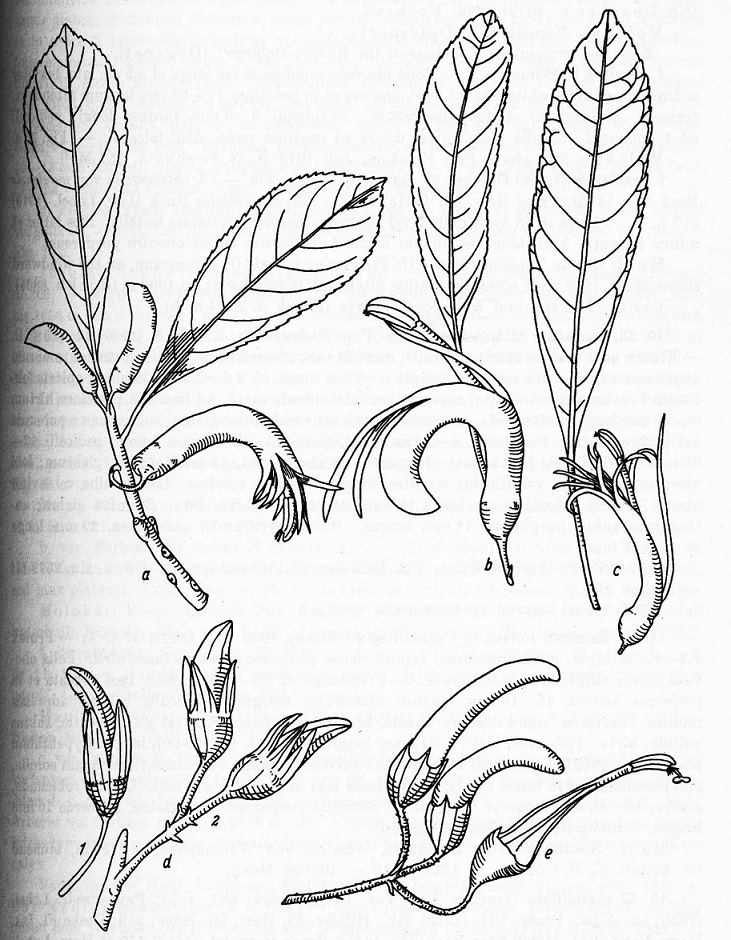 Fig. 23. a Clermontia oblongifolia f brevipes E. Wimm ⅗. —
b Cl. oblongifolia Gaudich. ⅗. —
c Cl. persicifolia Gaudich. —
d Cl. Rockiana E. Wimm. 1. Flos inapertus e specimine Remyi; 2. Inflorescentia et specimine Hillebrandii ⅗ —
e Cl. caerulea Hillebr. Inflorescentia ⅗. — Orig.
Page 88
10. Cl. hanaensis St. John in Occas. Pap. Bishop Mus. XV. N. 1. (1939) 12, t. 5. f. B. — Frutex ad 2 m altus ramis glabratis, ramulis subpubescentibus. Folia in vertice ramorum aproximata, obovata usque elliptica, 5-7 cm longa et 2,6-3,5 cm lata, ad apice obtusum brevissime acuminata, margine crenulato-denticulata, ad basin in petiolum hirtum 5-14 mm longum attenuata, chartacea, supra aeneo-virentia, glabra, subtus parce puberula vel gravescentia. Pedunculi 3-5 mm longi, puberuli, plerumque 2-flori; pedicelli 12-20 mm longi et basi braceolati. Hypanthium obconicum, 11 mm longum, glabrum; lobi virentes, apice albi vel dilutius virentes, longitudine fere corollae. Corolla alba vel leviter virens, glabra, falcata, 5 cm longa et cum calyce 8-10 mm lata. Stamina glabra; antherarum tubus purpureus, 11 mm longus. Bacca pyriformis, aurantiaca, 22 mm longa et 15 mm lata.
Maui: Berge oberhalb Hana, Puu Paki-Sumpf, blühend im Juli (Forbes n. 2679 M! - Bishop Mus.).
Affinis speciei sequenti vel tantum eius varietas?
11. Cl. Samuelii Forbes in Occas. Papers Bishop Mus VII. (1922) 37 t. X. — Frutex 1,2-1,8 m altus, a basi ramosus, ramuli dense purpureo- demum fusco-hirti. Folia obovata usque elliptica, subacuminata, 6-9 cm longa et 2,3-3,5 cm lata, basi cuneata et in petiolum hirtum 15-18 mm longum attenuata, margine denticulis callosis adpressis munita, chartacea, supra obscure viridia, breviter et sparse hirta vel glabrescentia, subtus pallida, hirta. Pedunculi hirti, 6-12 mm longi, 2-5-flori, 12-20 mm longi. Hypanthium obconicum, subglabrum, 1 cm longum; lobi calycis tam longi vel subbreviores quam corolla, glabrescentes, parte tertia soluti, 2 superiores lobi usque ad basin fissi. Corolla rubicunda, glabra, 40-46 mm longa et 6 mm lata. Stamina purpurascentia, glabra, antherae 10 mm longae, 2 inferiores barbatae. — Fig. 8d.
Maui: Nordabhang des Haleakala, westlich von Waianapanapa, 2150 m, blühend im August (C.N.Forbes n. 1225! 1215 - Bishop Mus.).
Page 89
12. Cl. grandiflora Gaudich. Bot. Voy. Freyc. (1826) 459, t. 73; Presl Prodr. Lobel. (1836) 48; A. DC. Prodr. VII. (1839) 342; Hillebr. Fl. Haw. Isl. (1888) 240; Drake Fl. Ins. Maris. Pacif. VII. (1892) 221; Rock The Indig. Trees Haw. Isl. (1913) 473 et Haw. Lobel. (1919) 327, t. 186, 187; St. John in Occas. Pap. Bishop Mus. XV, N.1. (1939) 2. — Cl. grandiflora var. brevifolia A. Gray in Proceed. Am. Acad. V. (1861) 150. — Cl. reticulata f. pilifera St. John l.c. 8. — Arbor vel frutex 2-6 m altus. Ramuli hirtelli vel mox glabrescentes vel glabrati. Folia obovato-oblonga usque oblongo-lanceolata, 4-14 cm longa et 2-4 cm lata, apice breviter acuminata vel acuta, apice ipso obtusiusculo, vel subrotundata, basi sensim in petiolum (3)10-50 mm longum attenuata et integra, secus in margine crenulato-calloso-denticulata, subcoriacea vel chartacea, supra glabra, opaca vel subnitida, subtus pallida, parce hispidula imprimis ad nervum medium, vel glabrescentia usque glabra. Pedunculi filiformes, saepe penduli vel divergentes, 2-11 cm longi, in medio et in apice 2 bracteolis linearibus vel oblanceolatis obtusis 10-20 mm longis interdum foliaceis ornati, 2-flori, rarius 1- vel 3-4-flori; pedicelli 2-6 cm longi, interdum iterum biflori, in medio bibracteolati. Hypanthium turbinatum, cr 1 cm longum; lobi calycis tam longi quam corolla vel parum breviores, curvati sicut corolla et virentes usque purpurascentes. Corolla viridula vel albescens, interdum purpurascenti-tincta, 55-75 mm longa et 8-12 mm lata. Stamina purpurascentia glabra; antherarum tubus purpureus, 10-13 mm longus. Bacca subglobosa, aurantiaca, 16-26 mm longa et 10-20 mm lata. Semina compresso-ovoidea, fusca, nitida, 0,5-0,7 mm longa.
a. Species typica Ramuli, petioli, folia subtus in nervis et pedunculi saepe hirtelli vel glabrati. Calycis lobi quadrante quam corolla breviores. Corolla mediocriter curvata. — Fig. 24 b.
Insulae Sandwicenses (Gaudichaud! - vidi in herb. Delessert; Remy n. 306.) — Maui: Berge von West-Maui. Puu Kukui, Wald unterhalb des Gipfels, 1500 bis 1600 m (Skottsberg n. 747 - Hb. Stockh.; Bryan jun. n. 683! M.C.Neil! Rock n. 8193, Munro n. 432, 619); Haelaau-Puu Kukui (Ewart III. n. 88! Eward III et Munro n. 102!). — Edge of Honokawai, 1400 m (Rock n. 8193 - ex St. John!). — Nakalalua, 1500 m (H. St. John n. 10237 - typus Cl. reticulata f. pilifera - Bishop Mus.).
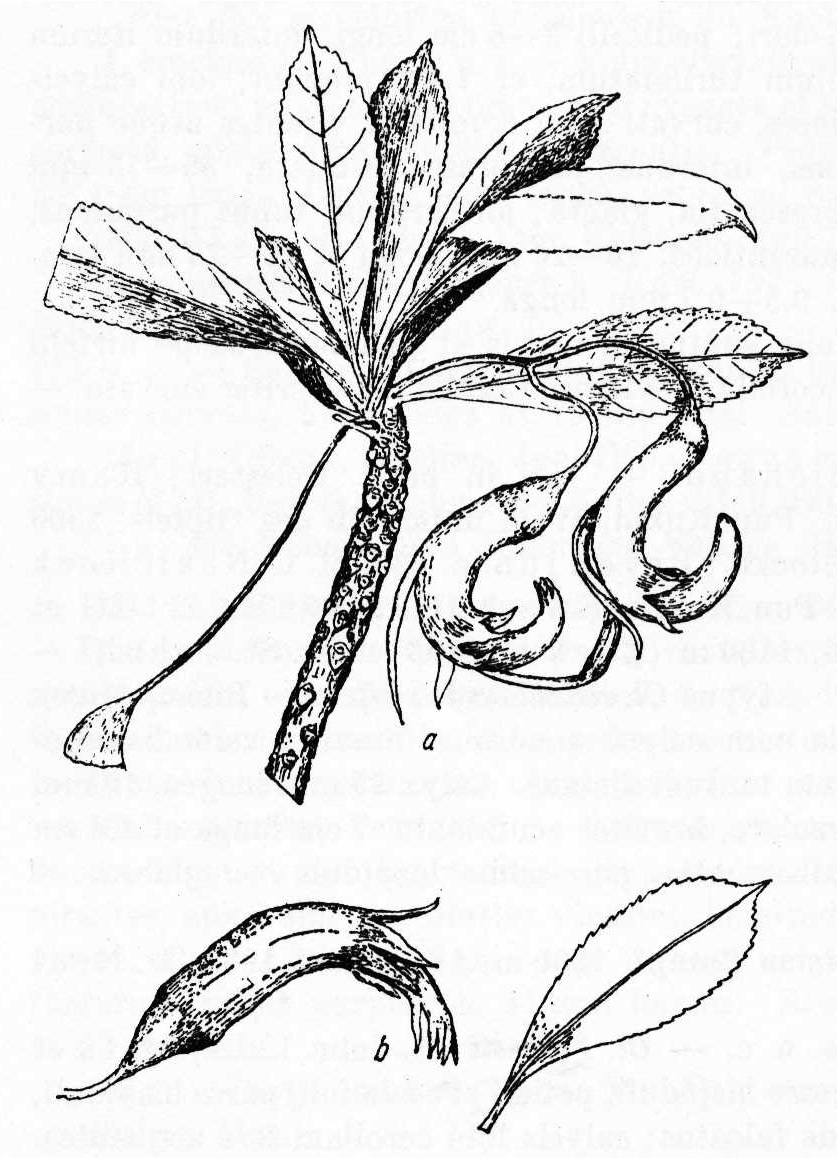 Fig. 24. a Clermontia grandiflora Gaudich. f. hamata Wimm. —
b Clermontia grandiflora Gaudich., typus ½
f. hamata E.Wimm. n.f. — Corolla cum calyce quadrante breviore valde hamato-incurvata, apex corollae a basi eiusdem 1 cm tantum distans. Calyx 35 mm longus, 10 mm latus. Corolla 50 mm longa. Folia oblanceolata, breviter acuminata, 7 cm longa et 1,8 cm lata, petiolo 10-12 mm longo, subtus albescentia, parcissime hispidula vel glabra. — Fig. 24 a.
Maui: West-Maui, Puu Kukui, in einem Sumpf, 1500 m, 16. August 1933 (M. Neal et C. Hartt! - Bishop Mus.).
b. var. Forbesii (St. John) E. Wimm. n.c. — Cl. Forbesii St. John l.c. 4, fig 1a et tab 1, fig. B. — Ramuli et pedunculi adpresse hispiduli, petioli et costa folii parce hispiduli, sed mox glabrati. Calyx cum corolla valde falcatus; calycis lobi corollam fere aequantes.
Molokai: Berge oberhalb Puu Kolekole (C.N.Forbes n. 186, 254!); Wasserfall unterhalb Kamoku (Rock n. 6117); Laianui im Regenwald (Hb .Degener n. 7793!).
f. hirsutinervis (St. John) E.Wimm. n.f. — Cl. hirsutinervis St. John. l.c. 6, fig 1b, t. 2. — Ramuli, petioli, pedunculi glabri; folia subtus albo-hirsuta imprimis in nervis. Calyx corollam falcatam fere aequans.
Maui, Ost: Wälder bei Ukulele, 1500-1700 m (C.N.Forbes n. 830, 929, 156 - Bishop Mus., non vidi).
c. var. vulgata E. Wimm. nov. var. complectens vix ab invicem discernendas species variantes: Cl. reticulata St. John l.c. 7 cum fig. 1c et t. 3 excl. f. pilifera; Cl. Munroi St. John l.c. cum fig. 1d et t. 1A; Cl. molokaiensis St. John l.c. cum fig. 1e et 5.4. — Arbores vel frutices glabri, 2,5-6 m alti. Corolla falcata, curvatura medium fere tenens inter typum et varietatem Forbesii, apice parum hamata, parum longior (2-5 mm) quam calyx.
Verbreitet auf Maui, Lanai und Molokai, in den feuchten Bergwäldern, 900-1300 m. Ost-Maui: Waikamoi (Rock n. 8503 - typus pro Cl. reticulata, Bishop Mus.). — Weg neben dem Westufer des Honomanu und Kipahuluflusses (C.N.Forbes n. 2583, 1711). — Kula pipeline, Haleakala (Munro n. 736, Skottsberg n. 876). — West-Maui, Olowalu Valley (C.N.Forbes n. 2398). — Lanai: Lanaihale, Palawei (St. John et Hosaka n. 18867 - typus pro Cl. Munroi, Bishop Mus.; Munro, 14.10.1931! et n. 25, 442, Rock n. 8018!). — Berge bei Koele (C.N.Forbes n. 41L!). — Kaiholena (Munro, 3.11.1913, et 20.4.1914 et sub n. 138, 402). — Kaiholena-Hookio divide, Kalalu (St. John et Eames n. 18723). — Molokai: Berge im östlichen Teil. Mapulehu (Rock n. 12781 - typus pro Cl. molokaiensis, Bishop Mus. - n. 7068); Höhen hinter Kamaloo (Hillebrand, Juli 1870! U. Faurie n. 585!).
Page 90
d. var. subpetiolata (St. John) E. Wimm. n.c. — Cl. subpetiolata St. John l.c. 10, fig. 1f, t. 5A. — Planta glabra. Petioli 2-5 mm longi. Folia oblongo-oblanceolata, breviter acuminata, basi in petiolum decurrentia. Pedunculi 4 cm longi, pedicelli 18-25 mm longi. Calyx corollam fere aequans, valde falcatus, similis flori varietatis Forbesii. Corolla roseo-magenta (?), 6-7 cm longa. Antherarum tubus 13-15 mm longus. (Diagnosis auctoris.)
Molokai: Gebirge im östlichen Teil, südliche Abhänge, 830 m Puniuohua, "flowers usually brightly colored", Juli (G.C. Munro n. 529 - typus in Hb. Bishop Mus., non vidi). West-Maui, Honokahau drainage basin (C.N.Forbes n. 463M - "may be this species as it resembles it in general" St. John).
|
Die Untersuchung des mir zur Verfügung stehenden Materials rechtfertigt nicht die Spaltung der Clermontia grandiflora in mehrere verschiedene Species, wie dies St. John a.a. O. durchgeführt hat, da die von ihm angeführten Merkmale äußerst variabel sind und nach seiner Arbeit die vorliegenden Exemplare unmöglich verläßlich bestimmt werden können. Behaarung, Blattorm, Kelchlänge, Krümmung der Corolle sind nicht klar befenzt, wohl aber ist der fadenförmige Pedunculus für die Gesamtart sehr charakteristisch. Ich glaube daher der Wahrheit näher zu kommen, wenn ich die auffallenderen Unterschiede nur zur Aufstellung von Varietäten oder Formen benütze. — Wie schon A. Gray und später Hillebrand bemerkten, ist die Abbildung in Gaudichauds Werk ungenau, besonders betreffs der Blüten, die übertrieben und deren pedunculi unrichtig wiedergegeben sind. |
After the investigation of the materials available to me, I cannot justify the division of Clermontia grandiflora into a number of different species as was done by St. John (see above) based on characteristics that are highly variable and the available specimens cannot be reliably determined based on his work. Indumentum, flower shape, calyx length, curvature of the corolla are not clearly delimited, but probably probably the filament-shaped peduncle for the overall style is very characteristic. So, I think to best approximate the truth, I use the more striking differences only for the establishment of varieties or forms. — As A. Gray and later Hillebrand noticed, the pictures in Gaudichaud's work is inaccurate, especially regarding the flowers, which are exaggerated and the pedunculi, as drawn, are inaccurate. |
13. Cl. wailauensis St. John in Occas. Pap. Bishop Mus. XV N. 1 (1939) 11, fig. 1g, t. 6. — Frutex glaber 3,3 m altus, ramis lignosis, fuscescentibus, in vertice foliosis. Folia sessilia, oblongo-obovata, 3-9 cm longa et 0,7-4,3 cm lata, subrotundata usque subacuta, apice triangulari brevissimo, ad basin cuneata, margine in superiore parte remote crenulata, firmo-chartacea, supra obscure viridia, subtus albescentia. Pedunculi 6 cm longi, deflexi, tenues, 5-flori; pedicelli bracteolati, 5-6 cm longi. Flores badio-purpurei: Hypanthium depresso-turbinatum, 6-7 mm longum; calyx 55 mm longus et 8-10 mm latus; corolla 7 cm longa, valde falcata. Stamina glabra, 7 cm longa; antherarum tubus solus 12-13 mm longus. Bacca ignota.
Molokai: Nordseite des öslichen Teiles derInsel in feuchtem Walde, Kukuinui Ridge, Wailau Valley, 360 m, Juli (H. St John et alii n. 13269 - Bishop Mus.). — Species Cl. grandiflorae affinis.
Page 91
14. Cl. pallida Hillebr. Fl. Haw. Isl. (1888) 241; Rock Haw. Lobel. (1919) 319, t. 180. — Arbor parva, glaberrima, 4-5 m alta. Rami apice dense foliosi. Folia oblonga, 10-15 cm longa et 3-4,5 cm lata, apice acuminata vel cuspidata, basi acuta, petiolo 7-10 cm longo, margine crenulata et callose denticulata, chartacea, pallide viridia, opaca, glabra. Pedunculi 8-16 mm longi, bibracteati, 3-7-flori; pedicelli usque 20 mm longi, infra medium bibraceolati. Calyx viridis rubro-tinctus; ovarium hemisphaericum, c. 1. cm longum; lobi calycis longitudine corollae, 4 cm longi et 9 mm lati, curvati. Corolla magnitudine et colore calycis, glabra. Filamenta caerulescenti-purpurea, pruinosa, puberula; antherarum tubus caerulescens, glaber. Bacca immatura globosa.
Molokai: Wailau Pali, auf dem höchsten Bergrücken (Hillebrand! Forbes! Rock n. 12788, 12790). — Kamalo, 1200 m (A.S.Hitchcock n. 12786; ;U. Faurie n. 579!). — Central Molokai, feuchter Wald (Hitchcock n. 15189).
Var. ramosissima Rock Haw. Lobel. (1919) 319. — Frutex valde ramosus, dense foliatus vel arbor parva. Folia lanceolata, 9 cm longa et 2 cm lata, subacuminata, basi in petiolum 5,5-7 cm longum angustata. Pedunculi et pedicelli breviores, flores majores. Pedunculi 2-flori.
Molokai: Gemein auf den Felsen von Waialeia und Waihanau (Rock n. 13116, 14034!).
15. Cl. epiphytica St. John in Occas. Pap. Bishop Mus. XV N.2. (1939) 21, t. 1. — Frutex glaber 5 m altus. Folia lineari-oblanceolata, acuta, ad basin integram sensim in petiolum 4-6 cm longum angustata, margine pauce crenulato-denticulata, 6-14 cm longa et 1,6-3 cm lata, supra vernicosa viridia, subtus pallide nitido-viridia. Pedunculi 10-15 mm longi, 2-3-flori; pedicelli 15-20 mm longi. Flores albi virenti-albi, subcurvati, lobi omnes bilabiatim recurvati. Hypanthium subglobosum, 6 mm diam. Calyx longitudine corollae 33-40 mm longus et 2-3 mm latus. Filamenta virenti-alba glabra; antherae virentes 10 mm longae. Bacca depresso-globosa, cr 10 mm diam., viridula usque fuscescens, costis 10 viridibus ornata. Semina alba (?) ellipsoidea, 0,5-0,8 mm longa. Epiphyta in Metrosideros collina. (Diagn. auct.)
Oahu: Waikakalaua Gulch, Waipio, Koolau-Gebirge neben einem Fluß, 400m, April, Sept. (H.St.John n. 10468; H.St.John et Hosaka n. 10566 — Typus, beide Bishop Mus.).
16. Cl. micrantha (Hillebr.) Rock Haw. Lobel. (1919) 334, t. 189; Skottsb. in Meddel. Göteborgs Trädg. II (1926) 269. — Cl. multiflora var. micrantha Hillebr. Fl. Haw. Isl. (1888) 242. — Cl. multiflora var. micrantha f. montana Rock The Indig. Trees Haw. Isl. (1913) 511. — Frutex 1-2 m altus, glaberrimus. Folia lanceolata, utrinque acuta, 5-10 cm longa et 1,5-2,5 cm lata, margine crenulata et callose denticulata, chartacea, in statu vegeto crassa, dilute viridia cum nervis rubicundis, petioli 2-3,5 cm longi. Pedunculi 5-7 mm longi, normaliter 2-flori, rarius 3-5-flori; pedicelli 8-12 mm longi, basi bibracteolati. Calyx virenti-rubens, longitudine corollae, ovarium turbinatum, 6 mm longum.Corolla rubra, subcurvata, 25 mm longa. Stamina glabra; antherae caerulescentes, pruinosae. Bacca ovoidea, aurantiaca, 15 mm in diametro.
Maui: Waihee, im Kies des Flusses (Hillebrand!). — Lahaina (Lydgate!). — Berg Puukukui, im Regenwald, offenen Buschwald, 1200-1600 m (Rock n. 8179! A.S. Hitchcock n. 14784, 14821; Skottsberg n. 76!; Eward III. n. 118! 131!; M. Neal!); — am Gipfel des Mauna Eeke (Rock et Hashimoto n. 13131). — Nakalalua, Dickicht neben dem Gipfel, 1500 m (St. John n. 10241!).
17. Cl. multiflora Hillebr. Fl. Haw. Isl. (1888) 242; Rock Haw. Lobel. (1919) 331, t. 188. — Frutex glaber 2-4 m altus. Folia lanceolato-oblonga, 12 cm longa et 3 cm lata, utrinque acuta, in petiolum 6-7 cm longum angustata, margine crenulata, chartacea, pallida. Pedunculi graciles, 17 mm longi, floribus umbellatis 7-10; pedicelli 17 mm longi, basi bibracteolati. Calyx pallide viridis, longitudine corollae, ovarium turbinatum, 8 mm longum Corolla apice purpurea, subrecta, 24-32 mm longa. Antherarum tubus purpureus.
Maui: In den Schluchten des Waihee und Lahaina (Hillebrand!). — Oahu: Wailupe Valley (Lydgate!), ambo in herb. Berlin. — A tempore Hillebrandii non recollecta.
Page 92
18. Cl. parviflora Gaudich. ex A. Gray in Proc. Am. Acad. V. (1861) 150; Hillebr. op. cit. 242 cum varietate pleiantha; Rock Haw. Lobel. (1919) 337, t. 24, 192, 193.; Skottsb. in Meddel. Göteborgs Bot. Trädg. II. (1926) 270. — Cl. oblongifolia Hook. et Arn. non Gaudich. teste A. Gray. l.c. — Cl. Byroni, pyrifolia seu parvifolia Gaudich. in herb. Mus. Parisiensi ex A. Gray l.c. — Cyanea Blinii Lévl. in Fedde Repert. Spec. Nov. X. (1911) 156. — Frutex multiramosus, 2-3 m altus. Folia elliptico-oblonga (raro obovato-oblonga), 10-18 cm longa et 3-5,5 cm lata, apice breviter acuminata, basi acuta, petiolo 2-4,5 cm longo, margine callose denticulata, chartacea, opaco-viridia, subtus pallidiora et tenuiter pubescentia vel subglabra. Pedunculi 10-12 mm longi, subhirti, bracteolati, 3-7-flori; pedicelli 8-10 mm longi, basi et medio bracteolati. Calyx breviter 5-lobus corollam hinc usque ad medium fissam aequans, purpureo-caeruleus, glabratus, ovarium cylindrico-campanulatum, 6 mm longum. Corolla caerulea (ex Gray) vel purpureo-caerulea (ex Rock), 25-40 mm longa, dorso usque ad basin fissa, subcurvata. Stamina glabra; antherarum tubus caerulescens. Bacca subglobosa, aurantiaca, 7 mm longa.
Hawaii: Insel Owhyhee, Byron Bai, jetzt Hilo Bay (Gaudichaud!, Herb. Paris; Macrae - Junio 1825; Remy n. 305!; Mann et Brigham n. 296!). — Hilo, Wald (Hillebrand und Lydgate!). — Hilo, Makahanaloa, Puu Kauku (Skottsberg n. 474). — Kohala-Gebirge, Waimea (Lydgate! Rock n. 4364! A.S.Hitchcock n. 14363, 14408). — Holokaiea-Schlucht, Waimea (Rock n. 4362, 4364, 4366). — Hamakua (Rock n. 4360). — Glenwood (U. Faurie n. 575!) und zwischen Glenwood und 29 Miles in dichtem Wald (Hb. Degener n. 2191!). — Kilauea Vulkan (Rock n. 8736, 8764, 13030). — Makaopuhi-Krater, in feuchtem Wald (Hb. Degener n. 7880!). Along Saddle Road, 7 and 15 miles from Hilo in forest (Hb. Degener n. 20177! 20332!). (cf. supplement)
a. var. umbraticola Skottsb. l.c. — A typo differt foliis longius acuminatis tenuioribus cum pedunculis etc. glaberrimis, calyce glabro. Flores plerumque 5-flori, interdum 4-6-flori, lilacin-fusci, intus cremeo-albi.
Hawaii: Hilo, Hiulani-Wald südwestlich von Olaa, cr. 500 m, epiphytisch, Sept. (Skottsberg n. 434).
b. var. grandis Rock Haw. Lobel. (1919) 339. — Flores 45 mm longi, inclusa parte ovarii calycis. Bacca 3 cm in diametro. Habitus et folia ut in typo.
Hawaii (Rock n. 4788, 4780, 12834 - ultimum specimen fructu oblongo-ovoideo et cr 15 mm diametiente). — verisimiliter ista et sequentia specimina varietatis calycinae exhibent formas hybridas inter speciem praesentem et Cl. montis-loa et Cl. waimeae, quaestio, quae observatione diligenti et experimento solvenda est.
c. var. calycina Rock, The Indig. Trees Haw. Isl. (1913) 512 et Haw. Lobel. (1919) 340, t. 194. — Folia obovato-oblonga vel oblonga, abrupte breviter acuminata, ad basin in petiolum 25-50 mm longum angustata, margine subundulata, textura subcrassiore. Pedunculi 15 mm longi, 3-flori; pedicelli validi 8-10 mm longi. Hypanthium cr 11 mm longum. Calycis lobi subulati, 5 mm longi, interdum ad 18 mm elongati et a basi liberi. Corolla cr 35 mm longa, cr 5 mm lata, subpubescens. Stamina glabra. Bacca globosa, 25 mm diam.
Hawaii: Hochplateau im Kohala-Gebirge, entlang dem Alakahi, 1300 m, Juli (Rock n. 4793 - typus in Hb. College Haw.). — Waimea-Berge (Rock). — Fortasse eadem species ac Cl. waimeae Rock.
|
Die Angabe, daß diese Art auch auf Oahu vorkommt, stammt von Macrae, Mai 1825, wurde schon von Gray angezweifelt und ist wohl ein Irrtum, da die Pflanze seithernie wieder dort gefunden worden ist. |
The statement that this species occurs also on Oahu, is by Macrae, May 1825, has been doubted by Gray and is probably a mistake, because the plant has never been found there since. |
Sectio II. Clermontioideae Hillebr.
Clermontioideae Hillebr. Fl. Haw. Isl. (1888) 240; Rock The Indig. Trees Haw. Isl. (1913) 472 et Hawaiian Lobel. (1919) 239. — Calycis lobi liberi, corolla multo breviores, persistentes, baccam coronantes.
Page 93
19. Cl. tuberculata Forbes in Occas. Papers Bishop Mus. V. (1912) 8 c.t.; Rock The Indig. Trees Haw. Isl. (1913) 485 t. 202 et Haw. Lobel. (1919) 291 t. 161.
Arbor 4-5 m alta, multiramosa. Folia obovato-oblonga, 15-20 cm longa et 3-4,5 cm lata, brevissime acuminata, apice obtuso, basi in petiolum 2-5,5 cm longum angustata, margine crenulato-denticulata, coriacea, viridia, subtus pallidiora et minutissime hirtella ad nervos vel glabrata. Pedunculus 5 mm longus, tuberculatus, 2-florus; pedicelli 2-3 cm longi, tuberculati. Calyx tuberculatus, eius tubus semi-ovoides, lobi breves, obtusi. Corolla carnosa, tuberculata, subcurvata, 35-40 mm longa. Antherarum tubus purpureus, glaber. Bacca globosa, verrucosa, 13 mm in diametro. Semina ovoidea, lutea.
Maui: Ost-Maui, westliche Abhänge des Haleakala, Ukulele Trail (C.N.Forbes n. 201 M!; Rock et Hashimoto n. 12837!). — Non communis.
20. Cl. clermontioides (Gaudich.) Heller in Minnesota Bot. Stud. IX. (1897) 906. — Delissea clermontioides Gaudich. Bot. Voy. Bonite (1839-52) t. 47. — Clermontia Gaudichaudii Hillebr. Fl. Haw. Isl. (1888) 243; Rock The Indig. Trees Haw. Isl. (1913) 479 et Haw. Lobel. (1919) 291. — Cl. Fauriei Lévl. in Fedde Repert. Spec. Nov. X. (1911) 156 teste Rock — Frutex vel arbor 4-7 m alta, coronam foliorum fere planam formans. Folia elliptica usque oblonga, 8-14 cm longa et 1,5-4,5 cm lata, apice breviter acuminata basi acuta, petiolo 2-4 cm longo, margine crenulata et adpresse denticulata, chartacea usque subcoriacea, glabra, nitida, subtus pallida et opaca. Pedunculi 1-3 cm longi, apice bibracteati, glabri; pedicelli eadem fere longitudine, circiter in medio bibracteolati. Hypanthium semi-ellipsoideum, 15 mm longum; lobi calycis triangulares, acuti, 2 mm longi. Corolla virenti-alba, glabra, falcata, 5-6 cm longa et 6-8 mm lata. Stamina glabra; antherarum tubus pallidus, 12 mm longus, interdum in suturis et apice hirsutus, antherae 2 inferiores barbatae. Bacca subglobosa, sulcata, 3 cm longa.
Kauai: "Iles Sandnwic., Octobre 1836" (Gaudich.! Herb. Delessert). — Waialeale und Pohakupili (Wawra n. 2043! 2189!). — Waialeale, Kaluitifluß, 1400 m (Rock n. 5062; A.S.Hitchock n. 15482). — Waimea (Knudsen! U. Faurie n. 478!). — Wald an der Quelle des Wahiawaflusses (Heller n. 2704). — Kaholuamano im Wald (Rock n. 2499, 12793; A.S.Hitchcock n. 15428).
Maui: Hamakua (Lydgate n. 56!). — Halehaku (Forbes n. 2531 M!).
Pro speciminibus ex Maui constituit Hillebrand et eum sequens cl. Rock varietatem. — Var. barbata Rock Haw. Lobel. (1919) 293, t. 162; Cl. Gaudichaudii var. β Hillebr. l.c. (Antherae in suturis et apice pubescentes, folia latiora et supra vernicosa; characteres parum constantes) — quae a specie typica non discernenda est.
Baccae luteae dulces ab incolis et avibus eduntur, inde nomen vulgare "Haha-ai-ka-manu" i.e. ab avibus esum; vox "Haha" vel "Oha" est nomen genericum pro omnibus Clermontiis.
|
Diese Art, die öfter auch epiphytisch auf Metrosideros collina polymorpha und Cheirodendron platyphyllum vorkommt, ist in der mittleren Waldregion von Kauai besonders zu Hause, wo dieselbe in Gesellschaft mit Trematolobelia macrostachys var. kauaiensis, Tetraplasandra waialealae und Gunnera wächst. |
This species, which often occurs epiphytically on Metrosideros collina polymorpha and Cheirodendron platyphyllum, is found in the middle forest of Kauai; it is especially at home in company with Trematolobelia macrostachys var. kauaiensis, Tetraplasandra waialealae and Gunnera. |
a. var. epiphytica Hochr. in Candollea V. (1934) 294. — Folia valde conferta, minora, 10 vel 2-5 cm longa et 3,7 vel 1,5 cm lata. Pedunculi 8-10 mm longi; pedicelli 5-10 mm longi; calycis lobi 0,5 mm longi.
Kauai: Waimea, im Zentrum des Berglandes, Wald, hie und da als Epiphyt auf Metrosideros, 1500 m (Hochreutiner n. 3570).
b. var. singuliflora (Rock) Hochr. l.c. — Cl. Gaudichaudii Hlb. var.. singuliflora Rock The Indig. Trees Haw. Isl. (1913) 512. — Cl. singuliflora Rock Haw. Lobel. (1919) 293, t. 163. — Frutex epiphyticus ad 2 m altus. Folia coriacea. pedunculus cr 8 mm longus, uniflorus, raro 2-florus; pedicelli 3-4 cm longi. Corolla virenti-alba.
Hawaii: Paauhu No. 1, nordwestliche Abhänge des Maunakea, ca. 1200 m (Rock n. 3252! — Hb. College Haw.). — Rarissima.
Kauai:; Wahiawa, Trail to Kalihi, moist woods, 700 m, 3 m hoher Strauch (St. John et Fosberg n. 13575!).
Page 94
21. Cl. Peleana Rock The Indig. Trees Haw. Isl. (1913) 483 t. 200 et Haw. Lobel. (1919) 297 t. 9, 164. — Arbor vel frutex glaberrimus, plerumque epiphyticus, cr 6 m altus. folia oblonga, 18 cm longa et 4 cm lata, breviter acuminata, basi acuta, petiolo 4-6 cm longo, margine crenulata et adpresse denticulata, supra obscure viridia, subnitida, subtus pallidiora, nervis purpureis, subcoriacea. Pedunculi 15 mm longi, in medio bibractati, normaliter 2-flori; pedicelli 3-4 cm longi, basi bracteolati. Hypanthium campanulatum, 18 mm in diametro, lobi minutis. Corolla atro-purpurea, textura tenui, valde curvata in statu evoluto, 4-5 cm longa. Stamina colore corollae, glabra; antherae 16 mm longae. Bacca globosa, aurantiaca, cr 33 cm in diametro.
Hawaii: Glenwood, entland der Straße zum Vulkan Kilauea in feuchtem Walde, 800-1000 m (Rock n. 8800! 12846). — Hilo (U. Faurie n. 577!). — Nomen a Pele, dea Hawaiiensi, habitante in volcano Kilauea, in cuius vicinitate plant occurrit.
22. Cl. arborescens (Mann) Hillebr. Fl. Haw. Isl. (1888) 242; Drake Illustr. Fl. Ins Mar. Pacif. VII. (1892) 221; Rock The Indig. Trees Haw. Isl. (1913) 483 t. 201 et Haw. Lobel. (1919) 287 t. 159, 160; Skottsb. Acta Horti Bot. Gothoburg. II. (126) 268. — Cyanea arborescens Mann in Proc. Am. Acad. VII. (1866) 183. — Delissea Waihiae Wawra in Flora LVI. (1873) 8. — Arbor 5-8 m alta, glaberrima. Folia obovato-oblonga usque oblonga, 12-16 cm longa et 4-5 cm lata, apice breviter acuminata, acuta vel rotundata, ad basin subacuminata et in petiolum 3-6 cm longum angustata, margine crenulata usque callose denticulata, coriacea, obscure viridia et nitida in pagine superiore, pallida in facie inferiore. Pedunculus 5-10 mm longus, crassus, 2-florus; pedicelli 20-25 mm longi, basi bracteolati. Hypanthium campanulatum, cr 2 cm longum; lobi calycis triangulares acuti vel obtusi vel emarginati, usque 5 mm longi, sinubus disjuncti vel continui. Corolla crasso-carnosa virenti-alba vel eburnea, et rubro-tincta, valde arcuata, 52-70 mm longa et basi 14-22 mm lata; lobi corollae expansae 4-5 mm crassi et tubo longiores, convergentes. columna staminea glabra; antherae glabrae vel hirsutae, antherarum tubus glaber vel in suturis hirsutus, 14 mm longus et 7 mm latus, antherae 2 inferiores barbatae Bacca subglobosa usque obovoidea, 26-38 mm diam., aurantiaca, sulcata. Semina pallide lutea, nitida, compresso-globosa, 0,8 mm diam.
Maui: West-Maui, Waihee, 600-1000 m (Hillebrand! Herb. Berlin; Wawra n. 1956! Herb. Wien). — Honokawai und Waikamoi — Olinda, 1300 m (Rock n. 8202, 8515, 6163; A.S.Hitchcock n. 14923; Neal et Hartt! Skottberg n. 884; Hb. Degener n. 7945! 7946! 7950! 11377! 11378!). — Keanae Valley (Hb Degener n. 7948!). — Haelaau, Bergkamm, 1200 m, gemein (St. John n. 10202!). — Puukukui (A.S.Hitchcock n. 14794). — Planta communis in silvis humidis Maui et Molokai.
Molokai: Im östlichen Teil der Insel, ziemlich gemein (Hillebrand!). — Auf den Höhen des Pelekunu (Rock n. 6109!). — Nordlich von Kamolo, 1300m (Rock n. 6176; A.S.Hitchcock n. 15074, 15080). — Wailau Valley, Kukuinui-Rücken, feuchter Wald, 900 m (St. John et alii n. 13285!). — Entlang dem Papaala Pali, Puu o Wahaula und Ohialele im Regenwald (Hb. Degener n. 7823! 7825! 7832!). Pukoo, Kainalu in open rain forest (Hb Degener n 20163!). (cf. supplement)
Lanai: Obere Gebirgsregion am Lanai Hale Haalelepakai (A.S.Hitchcock n. 14648). — minus vulgata.
Kauai: Koke, blühend und frucht. im Juni (Hb Degener n. 7856!).
Planta in omnibus fere partibus valde variabilis imprimis respectu loborum calycis, qui sunt triangulares, acuti vel emarginati, 1-3 mm longi aut ovati, obtusi, 2-10 mm longi; dein respectu corollae, quae maior vel minor, valde (lobi ad 4 mm crassi) vel minus crasso-carnosa (sic saepe in plantis molokaiensibus) invenitur.
23. Cl. pyrularia (Mann) Hillebr. Fl. Haw. Isl. (1888) 243; Rock Haw. Lobel. (1919) 303 t. 168. — Folia lanceolata, acuta et mucronulata, ad basin sensim angustata, in petiolum 2-3 cm longum et puberulum, margine conferte callose denticulata, 20-28 cm longa et 4,5-5 cm lata, chartacea, opaca, supra glabra, subtus albido-pubescentia. Pedunculi 35-60 mm longi, divergentes vel nutantes, 2-3-flori, occasionaliter 1-flori; pedicelli 1-2 cm longi, basi bibracteolati. Hypanthium oblongo-turbinatum, 14-20 mm longum, puberulum, 10-costatum, lobis subulatis, ad 4 mm longis. Corolla subcurvata, 45 mm longa, puberula. Stamina glabra; antherarum tubus 13 mm longus.
Hawaii: Hamakua im Walde (Hillebrand!). — Puu Huluhulu (C.N.Forbes n. 835H!). — Mauna Kea, nordöstliche Abhänge, 2100 m (A.S.Hitchcock n. 14305). Mauna Kea, near pit where David Douglas ws murdered, open rocky forest (Hb Degener n. 20356!); S. Kona, Koa forest, Papaloa, Kealakekua Ranch, 1400 m (small branching tree with white flowers and c. 10 f. h.), and Kealakeka 1160 m, 4 ft. tall (Hb. Degener n. 19615! 19626!). — In specimine ultimo flores 4-6 et fere umbellati. (cf. supplement) — Rara.
Page 95
24. Cl. caerulea Hillebr. Fl. Haw. Isl. (1888) 243; pp.; Rock The Indig. Trees Haw. Isl. (1913) 485, t. 203 et Haw. Lobel. (1919) 297 p.p.; Degener Fl. .Haw. (1934) fam. 339 c tab p. p. — Cl. caerulea var. brevidens Skottsberg in Acta Horti Bot. Gothoburg II. (1926) 268. — Arbor parva 46 alta, caule 12 cm in diametro. Folia oblonga, lanceolato-oblonga, 12-20 cm longa et 2-4 cm lata, breviter subacuminata, basi acuta, petiolo 1,5-5 cm longa, margine plano-crenulata vel minute denticulata, chartacea, supra glabra et opaca, subtus imprimis ad nervum medium pubescentia, rarius glabra. Pedunculi 25-40 mm longi, subpubescentes, 2-3-flori; pedicelli basi bibracteolati, 17-35 mm longi. Hypanthium semi-ellipsoideum, 12-15 mm longum in costis plus, secus parce pubescens; calycis lobi anguste triangulares, 3-5 mm longi. Corolla alba vel viridula (caerulescens sec Hillebr.) subcurvata (alabastro semi-falcato), adpresse hirtella vel subpuberula, 40-55 mm longa et 6-10 mm lata. Stamina glabra; antherarum tubus solus 13 mm longus. Bacca subglobosa, aurantiaca, cr 2 cm longa. Semina badia, compresso-ovoidea. — Fig. 23e.
Hawaii: Wälder von Kona (Hillebrand); dichter Wald zwischen Ohia and Koa Mills, blühend im März (Hb. Degener n. 7812! 7813!). — Kau, Wälder oberhalb pahula 1100m, hier selten (Skottsberg n. 584 - typus var. brevidens Skottsb.); Naalehu, Wald, 1000 m (Rock n. 10003). — Kealekahua und Pulehua, Süd-Kona (Rock n. 10031, 10032); an Rock n. 3737 et 3762 huc pertinent, nescio, quia non vidi; specimina reliqua Rockii citata et non visa, probabile! Kona, Papaloa, Capt. Cook, 1300-1600 m, and Kealakekua, Greenwell Ranch (Hb. Degener n. 19913! 19208! 19211! 19212! 19373! 20247! 20336! 20329! 19205!). (cf. supplement)
Hillebrands Typus im Berliner Herbar besitzt kurze, zahnförmige Kelchzipfel, weshalb die varietas brevidens Skottsb. hinfällig ist. In Kona dürften beide Arten vorkommen, die vorstehende mit kurzen Sepalen und die folgende mit langen Sepalen, abgesehen von den anderen Unterschieden (frutex, folia maiora, colore corollae).
f. flavescens n.f. (cf. supplement) — Corolla luteola, ochroleuca vel luteo-virens.
Hawaii: S. Kona, Kealakekua, Greenwell Ranch I. 1949 (Hb. Degener n. 19371! 19372! 19374! 19375!).
var. greenwelliana E. Wimm. nov. var. (cf. supplement) — A planta typica differt pedunculo (25-50 mm) et pedicellis (20-40 mm) longioribus, 1-3-floris, sepalis triangulari-linearibus 20-23(30) mm longis et basi 5 mm latis, sic Clermontiae rockianae similis. Frutex 1,2 m altus.
Hawaii: S. Kona, Kealakekua, A. L. Greenwell Ranch, 1000 m, 17.I.1949; Koa forest, Kealakekua Ranch lg. Anny Greenwell (Hb. Degener n. 19370! 19206! 19616! 19623! 19624! 19625!).
25. Cl. Rockiana E. Wimm. in Fedde Repert. Nov. Spec. XVI (1929) 4. Cl. caerulea Hillebr. et auct. supra citati p.p.! — Frutex usque ad 4 m altus. Folia 18-21 cm longa et 4-5 cm lata, oblonga, subacuminata, basi in petiolum ca. 3 cm longum attenuata, margine plano-crenulata, glaberrima vel subtus ad nervum medium et partim ad alios nervos subpubescentia. Pedunculi validi 2-3 cm longi, supra medium bracteati; pedicelli pedunculo fere aequales, infra medium bracteolati. Calycis tubus breviter turbinatus, 10 mm longus et 12 mm latus; laciniae calycis ovato-lanceolatae, 18-25 mm longae et 4-6 mm latae, glabrae. Corolla purpurascens, glabra, subcurvata, 4 cm longa. Cetera ignota. — Fig. 23 d.
Hawaii: Ohne nähere Angabe (Remy n. 308! — Typus in Hb. Mus. Paris). — Kona (Hillebrand!). — Specimina a Rockio collecta et fortasse huc spectantia non vidi. Vide in praecedente specie!
26. Cl. waimeae Rock in Coll. Haw. Isl. Publ. Bull. II. (1913) 40 et Haw. Lobel. (1919) 299, t. 167. — Frutex multiramosus, 3-5 m altus. Rami graciles glabri. Folia oblongo-lanceolata, utrinque acuta, 10-15 cm longa et 2-3,5 cm lata, petiolo 25-35 mm longo, margine callosa crenulata, subcoriacea, usque chartacea, dilute viridia, nitida, glabra, folia novella autem subtus puberula. Pedunculi puberuli 2-3 cm longi, 3-5-flori; pedicelli 10-15 mm longi, cr in medio bibracteolati. Hypanthium subglobosum, cr 7 mm diam., lobi calycis subulati, 5-10(22) mm longi, patentes. Corolla purpurea, subcurvata, puberula, 30-40 mm longa et 3-4 mm lata. Stamina glabra; antherarum tubus 11 mm longus. Bacca globosa, aurantiaca.
Hawaii: In dichtem sumpfigem Wald oberhalb Waimea, Parker Ranch, 1200 m, blühend im Juli (Rock n. 4794! 4794b!, c, d, e!). — Alakahi - Kawainui und am Kohala Reservoir im Kohalagebirge (Rock n. 4796! 8847!).
Variabiliitas notabilis sepalorum monstrat affinitatem aliquam cum Clermontia parviflora var. calycina, nisi ambo denique unam speciem efficiunt.
Page 96
27. Cl. haleakalensis Rock The Indig. Trees Haw. Isl. (1913) 489, t. 204, 205 et Haw. Lobel. (1919) 303, t. 8, 26, 169. — Arbor parva glabra 6 m alta. Rami pauci robusti. Folia oblongo-lancelata, ad apicem, obtusiusculum subacuta, margine superno crenulata, inferiore integra, carnosa, glabra, basi sensim decurrentia in petiolum brevem marginatum, exinde subsessilia. Pedunculi 2-5 cm longi, plerumque 6-flori pedicellis 10-15 mm longis, ambo bracteolati. Hypanthium oblongo-turbinatum, puberulum, 15 mm longus; lobi calycis subulati 5 mm longi. Corolla albido-viridis, mediocriter curvata, 35-40 mm longa, in medio 5-6 mm lata. Filamenta versus basin pubescentia, superne et antherae glabrae. Bacca oblonga. Semina albescentia.
Maui: Ost-Maui, westliche Abhänge des Haleakala, am Krater des Puunianiau, 2100 m, blühend im Oktober (Rock n. 8595! herb. College Haw.).
|
Seit Rock wurde diese Pflanze nicht wiedergefunden, so daß, wie Rock es schon seinerzeit voraussah, sie als ausgerottet betrachtet werden kann. Sie scheint eine der ältesten Formen aus dem Bereich dieser Gruppe zu sein und weist Merkmale auf, die ihre nahe Verwandtschaft zu Delissea beweisen. Sie besitzt nämlich so wie eine Delissea am Rücken der jungen Corolle einen Höcker an der Stelle, wo der Rückenschlitz endet; auch die Samen erinnern durch ihre weiße Farbe an Delissea, doch sind sie hier glänzend glatt und nicht wie bei Delissea wellig gerippt. |
Since Rock, this plant has not been recollected, so that, like Rock foresaw already at that time, they can be considered extinct. This species seems to be one of the oldest forms within this group and has features that proves its close relationship to Delissea. Namely, on Delissea there are bumps on the back of young corolla where the back slit ends; the seeds, while white in Delissea, ae here glossy and ribbed, wavy as in Delissea. |
Species dubiae:
Cl. carinifera Lévl. in Fedde Repert. Nov. Spec. XII. (1913) 505. — Folia ovata apice abrupte contracta, crenulata, glabra, membranacea, petiolo 1 cm longo. Pedunculus 1 cm lg. Calyx campanulatus dentibus acutis cucullatis remotis, tertiam corollae partem aequans. Corolla suberecta tomentella — Kauai: Koloa, Dec. 1909 lg. U. Faurie n. 10 — non vidi).
Cl. fulva Lévl. in l.c. 506; Rock Haw. Lobel. 304. t. 170. — Folia ovato-lanceolata, 23 cm lg et 8 cm lt., acuta-acuminata?, basi acuta, margine undulata crenulata et cum denticulis callosis numerosis, petiolo 25 mm longo, pallide viridia, subtus in nervis subpubescentia. Pedunculus 1 cm lg. basi bibracteolatus. Pedicelli 15 mm longi puberuli. Calyx ovatus, lobi 3 mm log. acuto-triangulares. Corolla subrecta luteola tomentella 3 cm longa (alabastrum). — Kauai: Kauhoa, März 1910 lg. U. Faurie n. 11 - herb. Léveillé - non vidi.
4. Rollandia Gaudich.
Rollandia 1) Gaudich Bot. Voy. Freyc. (1826) 458; G. Don Gen. Syst. III. (1834) 698; Presl Prodr. Lobel. (1836) 47; Endl. Gen. I. (1838) 513; A. DC. Prodr. VII. (1839) 344; Benth. et Hook.f. Gen. Pl. II. (1876) 546; Hillebr. Fl. Haw. Isl. (1888) 244; Schönl. in Engler-Prantl Nat. Pflanzenfam. IV/5. (1894) 64; Rock Haw. Lobel. (1919) 363. — Delissea sect. Rollandia Baill. Hist. Pl. VIII. (1886) 364; Post et Kuntze Lex. Gen. Phan. (1904) 166.
Calycis tubus ovario adnatus, oblongo-obconicus vel ellipsoideus lobis 5 corolla multo brevioribus, in alabastro imbricatis, persistentibus. Corolla tubulosa, sigmoideo-curvata, lateraliter compressa; tubus integer, dorso parum fissus, e basi longius attenuata sensim ampliatus, ad apicem iterum parum contractus; lobi corollae subaequales, lineares, acuti, patentes, quartam corollae partem vix superantes. Filamenta connata, inferne soluta, 3 superiora circiter in medio corollae adnata, 2 inferiora supra eius basin inserta. Antherarum tubus subcylindricus, subrectus, e tubo corollae exsertus; antherae 2 inferiores, rarius omnes in apice penicillatae. Stylus filiformis inclusus; stigma bilobum, lobi crassi, suborbiculares, ad basin extus fasciculo pilorum praediti. Bacca subcarnosa, bilocularis, plerumque obovoidea, polysperma. Semina ovoidea, fusca, laevia, nitida, vix 1 mm longa. — Plantae subherbaceae, basi interdum lignescentes, lactescentes, vulgo simplices, erectae, terrestres, vertice foliosae. Folia alternantia, saepe dimorpha: folia plantae novellae plerumque plus minusve lobata, folia plantae adultae margine integra, denticulata vel crenulata. Inflorescentia racemosa, axillaris, floribus purpureis, albis vel viridulis.
________________
1) A.M.Rolland, maître cononnier de l'epédition, à qui l'ornithologie doit les plus grandes services (Gaudichaud).
Page 97
Species 12 generatim parum variantes, 11 in Oahu, 1 in Kauai indigenae. Rollandia lanceolata typus generis est.
|
Das Vorkommen dieser Gattung ist in Oahu auf den Regenwald in der Gebirgskette des Koolau und Kaala beschränkt; sie tritt in der Regel in einer Meereshöhe von 50 bis 800 m auf. Es wird von Rock als ein im Niedergang befindliches Genus angesehen. — Den Stengel bezeichnet Gaudichaud merkwürdigerweise als ramosus bei den zwei von ihm aufgestellten Arten, während er wohl bei allen unverzweigt ist, oben fleischig und mit Mark erfüllt, welches mit zunehmendem Alter Fächer mit querliegenden dünnen Diaphragmen bildet und schließlich verschwindet, sodaß der dünnholzige Stengel hohl erscheint. Rollandia ist charakterisiert durch die fragezeichenförmge, am Rücken fast nicht geschlitzte Korolle und die Anheftung der oberen Filamente ungefähr in der Mitte der Korollenröhre. |
This species distribution is limited to Oahu in the rainforests in the mountain ranges of Koolau and Kaala; it usually occurs at an altitude of 50 to 800 m. It was regarded by Rock as a genus in decline. — The stems were described by Gaudichaud as ramosus, which is curious since the two species established by him are unbranched, they are fleshy and the pith, which eventually disappears with age forms compartments and transverse thin diaphragms, leaving a thin woody stem which appears hollow. Rollandia is characterized by question mark-shaped flowers, the dorsal lobe barely split and the attachment of the upper filaments to about the middle of the corolla tube. |
Clavis specierum.
| A. Folia sessilia, oblongo-lanceolata, obtuso apice, margine irregulariter grosse dentata | 5. R. sessilifolia. |
| B. Folia petiolata, petiolis (5)20-100 mm longis. | |
| a. Folia glabra et laevia, raro subtus parce pilosa. | |
| α. Folia lanceolata usque lanceolato-oblonga vel oblanceolata. | |
| I. Petioli breves, 5-10 mm longi; folia oblanceolata, subtus purpurascentia. | 3. R. purpurellifolia. |
| II. Petioli 2-5 cm longi. | |
| 1. Filamenta et antherae puberula. Kauai | 1. R. parvifolia. |
| 2. Stamina glabra. | |
| * Folia lineari-lanceolata, carnosula | 2. R. angustifolia. |
| ** Folia lanceolato-oblonga, tenuiter chartacea, interdum subtus ad costam hirta vel etiam parce muricata | 4. R. longiflora. |
| β Folia obovata vel obovato-oblonga, subtus plerumque subpubescentia | 11. R. crispa. |
| b. Folia utrinque vel subtus plus minusve muricata vel pilosa tantum. | |
| α Pedunculi pendentes, bracteolati, 10-40 cm longi; folia obovato-vel elliptico-oblonga, subtus hirta. | 12. R. Humboldtiana. |
| β Pedunculi 2-8 cm longi, erecti vel patentes. | |
| I. Folia oblonga, basi rotundata vel breviter acuta. | |
| 1. Petioli 10-15 mm longi; folia margine revoluta et denticulata. | 7. R. St. Johnii. |
| 2. Petioli 5-7 cm longi; folia bidentata, ad basin gressius dentata. | 6. R. bidentata. |
| II. Folia oblanceolata vel lanceolata, obovato-oblonga usque oblongo-elliptica, longe cuneata et in petiolum angustata (interdum glabra ut in R. lanceolata) | |
| 1. Folia utrinque muricata aut supra tuberculata (ex apicibus destructis) et subtus muricata et hirta (pili fasciculati!), rarius supra laevigata; corolla hirsuta. | 8. R. calycina. |
| * Folia elliptico-oblonga | typus |
| ** Folia oblanceolato-oblonga elongata, supra saepe laevigata. | var. Kaalae. |
| 2. Folia utrinque vel saltem supra laevia, subtus plus minusve hirta vel et parce muricata, interdum glabra (pili simplices! in plantis verisimilter hybridis pili permixti reperiuntur). | |
| * Folia oblanceolata usque lannceolata in petiolum 2-7 cm longum angustata. | |
| + Sepala triangularia vel oblonga, 2-4 mm lg. | 9. R. lanceolata. |
| ++ Sepala late ovata, basi fere cordata | 10. R. waianaeensis. |
| ** Folia obovata usque oblongo-obovata in petiolum brevem longe decurrentia, subtus sparse pubescentia vel glabrata. | 1. R. crispa. |
Page 98
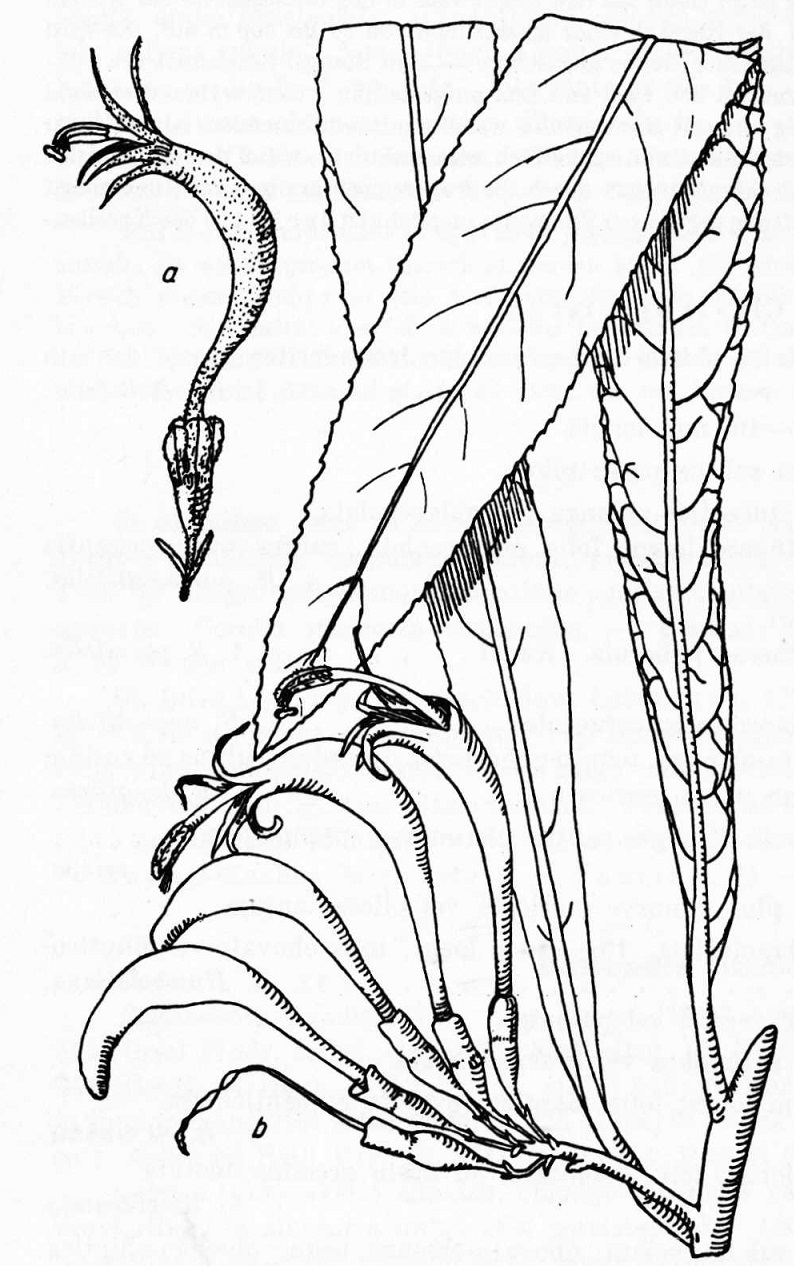 Fig. 25. a Rollandia crispa Gaudich. Flos ⅔. —
b R. angustifolia var. ochreata E. Wimm. ⅔ magn. nat. — Orig.
1. R. parvifolia Forbes in Occas. Papers Bishop Mus. V. (1912) 10 c. tab.; Rock Haw. Lobel. (1919) 365. — Caulis simplex 90 cm altus. Folia lanceolata, 18-22 cm longa et 2,3-4 cm lata, apice acuminata, in petiolum 2,8 cm longum sensim angustata, margine integra, glabra, coriacea, subtus albescentia. Pedunculi 3-4 cm longi cum 5-6 floribus racemosis; pedicelli 1 cm longi, supra medium bracteolati. Hypanthium cylindricum, 8 mm longum, lobis oblongis, obtusis, 1 cm longis. Corolla purpurea, glabra, 65 mm longa. Stamina puberula. Bacca matura non visa (Diagn. auctoris, specimen non visum).
Kauai: Waiioli Valley, florens Augusto (C.N.Forbes n. 103K - Bishop Mus.).
|
Die einzige Art, die außerhalb Oahu bisher gefunden worden ist und der folgenden Art sehr nahe steht. |
This is the only species so far found outside of Oahu. It is closely related to the following species. |
2. R. angustifolia (Hillebr.) Rock in Torrey Bot. Club. Bull: XXXXV. (1918) 136 et Haw. Lobel. (1919) 365, t. 206. — R. longiflora var. angustifolia Hlb. Fl. Haw. Isl. (1888) 246. — Caulis laevis ad 1,5 m altus. folia lineari-lanceolata, 18-35 cm longa et 2,5-3,7 cm lata, acuminata, basi in petiolum 20-45mm longum atttenuata, margine integra denticulata, crassa, carnosa, supra obscure viridia, subtus albescentia. Racemi 4-5-flori et 3-4 cm longi; pedicelli 14 mm longi, basi bracteati et infra medium bibracteolati. Hypanthium obconicum cr 1 cm longum; lobi calycis triangulares usque oblongi, acuti vel obtusi aut subemarginati et mucronulati, 3-5 mm longi, interdum parum connati. Corolla intense purpurea, glabra, 6-9 cm longa. Filamenta et antherae glabrae, 2 inferiores penicillatae. Bacca globosa.
Oahu: Palolo Valley, Konahuanui Trail (Hillebrand! H.L.Lyon n. 8816, Rock n. 1025!); Manoa Valley, Mt. Olympus und Mt. Tantalus (Hillebrand! Rock! W.B. Storey!); Kalihi Valley und Nuuanui-Kalihi Ridge (Hillebrand! Skottberg n. 184!); Ridge to Kaau, Crater Ridge (W. Garber n. 517!); Waiolani back of Honolulu (C.N.Forbes!); Middle Halawa Ridge im Regenwald und Anahuli Trail, Koolau Range, sonniges Gestrüpp nahe dem Gipfel (Herb. Degener n. 11475! 11474!) — Iles Sandwich (Gaudichaud! - Hb. Paris). Wiliwilinui Ridge, rain forest, 830 m (Hb. Degener n. 19716!). (cf. supplement)
var. ochreata E. Wimm. n. var. — Folia fere concoloria, in parte superiore obtusiuscule dentata. Sepala totaliter in tubum ochreae similem connata, 7 mm longa, atro-purpurascentia. Filamenta parcissime hirtella. Antherarum tubus in suturis setulosus. — Fig 25 b.
Oahu: Wainiano Valley above water intake along trail, florens Julio (W.Bush in Hb. Degener n. 11326!).
Page 99
3. R. purpurellifolia Rock in Coll. Haw. Publ. Bull. II. (1913) 244 et Haw. Lobel. (1919) 369, t. 207; Degener Fl. Haw. (1932) fam. 339 c. tab. — Planta glabra, caule simplici, carnoso, 30-50 cm alto. Folia subsessilia vel petiolo ad 8 mm longo, lineari-oblanceolata, 16-35 cm longa et 3-6 cm lata, breviter acuta, ad basin longe cuneata, margine minute denticulata, viridia, opaca, glabra vel subtus in nervis inconspicue hirtella (sed non in costa). Pedunculi 10-25 mm longi, 3-5-flori; pedicelli 5-15 mm longi, basi bracteati et in medio bibracteolati. Tubus calycis obconico-oblongus, 12 mm longus; lobi lineari-lanceolati, subacuti, mucronulati, 7 mm longi, inter se liberi vel plus minusve connati. Corolla purpurea, glabra, 8 cm longa. Stamina glabra, antherae 2 inferiores barbatae. Bacca obovoidea, ad 18 mm longa.
Oahu: Puraluu Mts. in dichtem Wald und auf dem Höhenrücken oberhalb Hauula in dichtem Schatten mit Lysimachia Forbesii Rock, fruct. Augusto (Rock n. 8824!); Pig-God Trail (Hb. Degener n 4171! 11476!).
|
Es scheint mir, daß diese Art nur eine Varietät zu R. angustifolia ist, doch reicht das Material nicht hin, dies zu entscheiden. |
It appears to me that this kind is only a variety of R. angustifolia, but as the material available is limited, a decision could not be made. |
4. R. longiflora Wawra in Flora LVI (1873) 44; Haw. Lobel. (1919) 369, t. 208 — R. sanguinea Hillebr. in Herb. — Planta novella caule muricato et foliis lobatis, in nervis muricatis. Caulis plantae adultae laevigatus, 1,3-3,3 m altus. Folia oblongo lanceolata, 30-40 cm longa et 6-8 cm lata, acuta, apice saepe obtuso et mucronulato, ad basin longe attenuata in petiolum 25 mm longum, margine denticulata vel dentata, membranacea, nitida, glabra vel subtus etiam ad costam sparse hirta vel et muricata. Pedunculi graciles, bracteati, interdum hirti et muricati, cr 3-6 cm longi, 5-10-flori; pedicelli 10-15 mm longi. Hypanthium obconico-oblongum cr 6 mm longum; lobi late triangulares, acuti, interdum parum connati, 2-3 mm longi. Corolla sanguinea, glabra, 6-7,5 cm longa. Stamina glabra; antherae nudae, vel in basi parce hirtae. Bacca pyriformis, cr 1 cm longa.
Oahu: Im westlichen Teil des Gebirgsrückens von Waipio nach Helemano (Hillebrand! Wawra n. 2285 - Hb. Wien und Berlin); entlang dem Waipio-Waiana Ridge, in dark rich pocket (Hb. Degener n. 7840a! 6840b!). — Koolau Range, Makaha Valley (C.N.Forbes!). — Makaleha Valley, steiler waldiger Abhang, 300 m (Rock n. 13110). — Am Ende des Makua Valley, wo der Höhenrücken beginnt, an sumpfiger Stelle, junge Pflanze (Hb. Degener n. 7810a!). — Schofield Barracks, östl. Bergrücken (A.S.Hitchcock n. 14033). — Puraluu (Faurie n. 574!). — Florens Aprili-Maio.
5. R. sessilifolia Degener Fl. Haw. (1932) fam. 339 c. tab. — Planta glabra, caule erecto, 0,9-1,5 m alto, laevi, sed juvenili muricato. Folia oblongo-lanceolata vel oblanceolato-oblonga, 45-55 cm longa et 9-12 cm lata, acuta, apice ipso obtuso mucronulato, ad basin cuneata et sessilia vel subpetiolata, margine inaequaliter obtusiuscule dentata, membranacea, nitentia, glabra et laevia. Pedunculi cr 3 cm longi, saepe 6-7-flori, breateati subhirti et parce muricati; pedicelli ad 1 cm longi, infra medium bibracteolati. Hypanthium ovoidum, glabrum, lobis oblongis obtusis, pro maxima parte connatis, 2-3 mm longis. Corolla rubra (very dark red), glabra, 6 cm longa, lobi superiores 2 cm longi, imus lobus paullo brevior. Stamina glabra, antherae autem 2 inferiores barbatae. Bacca globosa, cr 1 cm longa, longitudinaliter subsulcata.
Oahu: Zwischen Pupukea und Kahuku in Wäldern, blühend im Mai (Hb. Degener n. 4106, 7806!, 7818!, 7925! 7971! 11924!). — Malaekahana Trail, Laie forest (Hb. Degener n. 11477!).
|
Ob diese Art eine gute Species ist oder nicht vielmehr nur eine Varietät zu R. longiflora darstellt? |
It is questionable whether this type is a good species or rather constitutes only a variety of R. longiflora. |
Page 100
6. R. bidentata St. John in Occas. Pap. Bishop Mus. XV. (1939) 25, t. 6. — Herba caule muricato, simplici, 40 cm alto, 1,5 cm diametiente, superne albo-hispidulo. Folia remota, petiolo 5-7 cm longo muricato et hispidulo; lamina oblonga, 21-28 cm longa et 8-11 cm lata, breviter acuta, basi inaequali rotundata, supra sparse muricata, subtus bracteati, bracteis oblongo-deltoideis 2-5 mm longis, floribus 3-8 racemosis; pedicelli 12-20 mm longi, supra basin bibracteolati. Hypanthium oblongo-obconicum, 9-12 mm longum, costis 10 hispidulis, purpurascentibus; sepala inaequalia, late cordata, obtusa, 6-8 mm longa. Corolla 6 cm longa, in medio alba, atropurpureo-lineata et tincta, lobis atropurpureis et in nervis medianis hispidulis. Filamenta albo-hispidula. Antherarum tubus purpureus, albo-marginatus, dense hispidus, 2 inferiores apice penicillatae. Bacca matura ignota.
Oahu: Puu Kanehoa, Waianae Mountains, Honouliuli, wooded ridge, 800 m, blühend im März (St John n. 11038 - Bishop Mus, non vidi).
7. R. St. Johnii Hosaka in Occas. Pap. Bishop Mus. XI, N. 13. (1935) 14 c. fig. — Caulis erectus, eramosus, teres, glaber, in parte denudata scaber, 30-60 cm altus et basi ad 2 cm crassus Folia in apice congesta, oblongo-lanceolata, 6-13 cm longa et 1,5-2 cm lata, acuta, apice obtusiusculo, basi in petiolum carnosum, strigosum, marginatum, 5-20 mm lg. angustata, margine dentibus crasso-callosis munita et saepe revoluta, supra glabra, vernicosa, obscure viridia, subtus in costa prominente et venis ferrugineis strigosa. Pedunculi ad 15 mm longi, hispiduli, bracteati, floribus 15-20 racemosis; pedicelli 5-10 mm longi, hispiduli, supra basin bibracteolati. Calycis tubus oblongo-obconicus, hirtellus, 6 mm longus, eius lobi lingulati, subacuti et mucronulati, inaequales, 3-10 mm longi, sinus inter eos plani. Corolla alba, intus purpurascens, glabra, 4-6 cm longa, eius tubus rectus, apicem versus curvatus et ampliatus (1 cm), lobi sublineares, superiores ad 18, imus ad 10 mm longi. Filamenta glabra, 35-45 mm longa. Antherarum tubus purpurascens, 2 inferiores apice barbatae. Bacca ignota.
Oahu: Koolau Range, Waipio, Kipapa Gulch, on wet windswept main divide, cr 900 m (E.Y.Hosaka n. 1159, 1256, 743! - Bishop Mus.; F.R.Fosberg n. 8715). — Summit of Koolau Range, n.w. of Kaiwipoo and Mauka of Aiea, growing to height of other windswept bushes (Hb. Degener n. 11358!).
var. obtusisepala E. Wimm. nov. var. (cf. supplement) — Folia in petiolum brevem late decurrentia, oblonga, 6 cm longa et 1,5 cm lata, supra glabra, subtus in nervis strigosa. Sepala oblonga, apice rotundata, integerrima, subhispida, marginibus se tegentibus, in alabstris in nostro specimine tantum praesentibus 5 mm longa et 2 mm lata.
Oahu: Opposite Wiliwilinui Ridge overlooking Waimanalo fogswept precipitous slope, 27.6.1949 (Hb. Degener n. 19710!).
8. R. calycina (Cham.) G. Don Gen. Syst. III. (1834) 699; Rock Haw. Lobel. (1919) 381, t. 215, 216. — Lobelia calycina Cham. in Linnaea VIII. (1833) 222. — Delissea calycina Presl Prodr. Lobel. (1836) 47. — Cyanea aspera A. Gray in Proc. Am. Acad. V. (1861) 148. — Rollandia scabra Wawra in Flora LVI. (1873) 46. — Caulis erectus, muricatus, ad 2 m altus, tirones et inflorescentia fusco-tomentosa. Folia oblongo-lanceolata usque obovato-oblonga, 15-50 cm longa et 7-12 cm lata, utrinque acuta et in petiolum 3-7 cm longum muricatum angustata, margine crenulata vel dentata, supra sparse muricata ("pilis conicis brevibus raris aspersa"), subtus reticulato-venosa et in rete fuscescente praesertim hirta et parce muricata (pili fasciculati). Pedunculi 4-7 cm longi, crassi, subhirti, bracteati vel denudati; pedicelli 1-3 cm longi, bibracteolati. Hypanthium obconico-ellipsoideum, subhirtum, cr 1 cm longum; sepala lingulata, obtusa, subhirta, 3-9 mm longa, sinus eorum plani. Corolla purpurea cum striis nigrescentibus, glabrata vel limbo saltem hirtella, 6 cm longa filamenta subpubescentia. Antherarum tubus basi longius, in suturis breviter pilosus, antherae omnes apice penicillatae. Bacca olivaeformis, 2 cm longa.
Oahu (Chamisso! Meyen! Gaudichaud n. 140! 141!, Wawra n. 1794! 1682! sub Rollandia scabra). — Wailupe (Lydgate!). — Niu Valley, Waiolani (Hillebrand!). — Punaluu Mts. (Rock n. 410, 410a, 8844!). — Punaluu Summit of Pig-God Trail, in dichtem Regenwald (Hb. Degener n. 7899! 7932!). — Mt. Olympus (Topping n. 3233!). — West of Poamoho Trail, Laie (Degener n. 11488!). — Kaipapau Forest-Reserve, Hauula-Kaluanui, wet wooded valley, cr. 700 m (St. John n. 17645!).
Page 101
var. kaalae (Wawra) E. Wimm. n. c. — R. Kaalae Wawra in Flora LVI. (1873) 45; Rock Haw. Lobel. (1919) 373, t. 211, 212; Skottsberg Acta Hort. Bot. Gothoborg. II. (1926) 271. — R. Humboldtiana Hillebr. Fl. Haw Isl. (1888) 248, non Gaudich. — Folia lanceolata usque oblanceolata-oblonga, plerumque paullo angustiora quam in typo, petioli hirti, sed non muricati. Lamina supra tuberculata vel laevigata, subtus ferrugineo-tomentosa ex pilis fasciculatis et papillis cum pilis fasciculatis, pilis conicis non visis. Pedunculi multi-bracteati, floribus multis hirsutis. Sepala latiora, apice rotundata, truncata vel subemarginata. Stamina glabra.
Oahu: Kaala (Wawra n. 2241! - Hb. Wien). — Abhänge am Kaala und Moanalua (Hillebrand!). — Nordabhang des Kaala, Waianae, und Palehua Ridge, cr 700 m, im Walde (Skottsberg n. 360, 340!). — Westabhang des Kaala, 900 m (Hb. Degener n. 12195!). — Kawailoa, C.C.C. Trail (Hb. Degener n. 12055!). — Koolau Range am Gipfel, Anahulu Trail (Hb. Degener n. 11480 a et b!).
|
Diese Varietat läßt sich oft nur schwer von der typischen Art trennen, steht aber auch der R. lanceolata var. tomentella sehr nahe und kann sicher nur durch die Art der Behaarung (Büschelhaare) erkannt werden; doch scheinen zwischen R. calycina, der Varietät und R. lanceolata Hybriden vorzukommen, bei denen dann auch dieses Kennzeichen verwischt wird, indem einfache und Büschelhaare zugleich auftreten. Oder vielleicht gehören diese auch der so variablen Stammart R. lanceolata an, was sich wohl nur durch Beobachtung am natürlichen Standort beurteilen läßt. |
This variety can often be difficult to separate from the type, but also from R. lanceolata var. tomentella to which it is very close and can only be reliably recognized by the type of hair (hair tufts), which seem to occur on R. calycina, the variety and R. lanceolata hybrids on which this indicator is blurred by both simple and clumped hairs occuring simultaneously. Possibly they belong to the very variable ancestral species R. lanceolata which can probably only be told from observation in its natural habitat. |
9. R. lanceolata Gaudich. Bot. Voy. Freyc. (1826) 458, t. 74 sub R. montana; A. DC. Prodr. VII. (1839) 344 cum var. grandifolia; Hillebr. Fl. Haw. Isl. (1888) 246; Rock Haw. Lobel. (1919) 371 cum var. typica pp. — R. lanceolata var. grandifolia St. John et Hos. in Occas. Pap. Bishop oMus. XI, N. 13. (1935) 12. — R. Delessertiana Gaudich. Bot. Voy. Bonité (1839-522) t. 75. — R. Humboldtiana Wawra in Flora LVI. (1873) quoad specimen n. 1767. — Lobelia lanceolata Hook. et Arn. Bot. Voy. Beechey (1841) 88. — Delissea lanceolata A. Gray in Proc. Am. Acad. V. (1861) 147. — Planta variabilis caule simplici ad 3 m alto. Folia lanceolata usque oblanceolata, 24-60 cm longa et 5-12 cm lata, utrinque sensim acutata, basi in petiolum crassum 2-7 cm longum angustata, margine undulata denticulata vel dentata, chartacea, supra glabra, subtus pallida, glabra vel in venis hirtella usque tomentosa (pili simplices!) et rarius in costa et nervis et petiolis parce muricata (murices conici seta terminati purpurascentes). Pedunculi 3-6 cm longi, cicaricibus sparsis obsiti, multiflori; pedicelli 6-12 mm longi, basi bracteis oblongis praediti. Calycis tubus subobovoideus, cr 6 mm longus, lobis triangularibus vel oblongis obtusis, 1,5-3 mm longis. Corolla purpurea vel pallide rubra vel virens aut cinerea, 6-7,5 cm longa. Filamenta pubescentia, rarius glabra, antherarum tubus basi dense, secus brevius pilosus, rarius glabrescens, antherae 2 inferiores longius quam superiores in apice penicillatae. Bacca pyriforis, ad 18 mm longa.
Typus: — Oahu: Ohne näheren Standort (Gaudichaud! - spec. orig. in Herb. Paris, vidi in Herb. Delessert - Wawra n. 1767! sub R. Humboldtiana in Herb. Wien). — Moanalua, Halawa (Hillebrand! Lydgate!). — Middle Halawa Ridge, im Walde (Hb. Degener n. 11489! 11490!). — Ostrand des Manoa-Tales zum Berg Olympus (Hb. Degener n. 7843! 7862! 7878!). — Westlicher Rücken im Waialae-Tal, Regenwald (Hb Degener n. H86!). — Nuuanu-Kalihi ridge, Kalihi Valley (Skottsberg n. 141, A.S.Hitchcock n. 14115). — Palolo Valley (Skottsberg n. 904, Topping n. 3179). — Pauoa Valley (Rock n. 10252-10254). — Ziemlich häuflig auf Oahu; die größten Exemplare beobachtete Rock im Palolo-Tal. Junge Pflanzen sind bestachelt und haben kurze, ovat-oblonge, gelappte Blätter mit Weichstacheln auf der Oberseite (Hillebrand). Wiliwilinui Ridge, forest, 300 m, corolla et stamens dirty purplish white (Hb. Degener n. 19713! 19718!); Junction of St.Louis-Woodlawn Trail, Honolulu (Hb. Degener n. 19618!). (cf. supplement)
Page 102
Varietates:
| a. Corolla glabra; folia subtus hirtella vel glabra. | |
| b. Corolla purpurea | typus |
| b. Corolla viridula, purpurascenti-striata, carnosa. | var. viridiflora. |
| a. Corolla puberula vel hirta. | |
| c. Folia subtus glabra vel hirtella, corolla atropurpurea. | f. Rockii |
| c. Folia subtus tomentosa, corolla purpurascenti-cinerea vel cinerascens, hirta. | var. tomentella |
f. Rockii (St. John et Hos.) E. Wimm. n. c. — R. lanceolata var. Rockii St. John et Hosaka in Occas. Pap. Bishop Mus. XI, N. 13. (1935) 13. — R. lanceolata var. typica Rock l.c. p. p. t. 209 — Planta robustior. Folia parum latiora, subtus in costa et nervis et petiolis sparse muricata. Calycis lobi dentiformes. Corolla intus extusque obscure purpurea, hirtella.
Oahu: Pauoa Valley, 300 m (Rock n. 10254 - Hb. College of Hawaii, non vidi). — Palolo Valley, Manoa Ridge, 400m (Rock n. 13111).
var. viridiflora Rock l.c. 373, t. 210. — Folia lanceolata, 40 cm longa et 7 cm lata, acuminata, basi acuta, irregulariter crenulata, glaberrima. Racemi cr 3 cm longi, dense bracteati, dense congesti prope verticem caulis. Calycis lobi dentiformes. Corolla viridula, purpurascenti-striata, carnosa, parum minor quam in typica.
Oahu: Östlicher Manoa-Rücken, an der Scheide des Manoa vom Palolo-Tal, 300 bis 400 m, blühend im Mai (Rock et Tasartez n. 13112) — Moanalua Valley, Ridges (C.N.Forbes n. 1186!).
var. tomentella (Wawra) E. Wimm. n.c. — R. Humboldtiana var. tomentella Wawra in Flora LVI. (1873) 32. — R. lanceolata var. tomentella Hillebr. ex Drake Fl. Ins. Maris Pacif. VII. (1892) 218; Rock Haw. Lobel. (1919) 373. — R. lanceolata var. ε et ζ Hillebr. l.c. 248. — R. lanceolata var. kipapaensis Hosaka l.c. 14 c. fig. — Folia obovato-oblonga, 47 cm longa et 10,5 cm lata, acuta, basi cuneata, petiolo 2 cm longo hirto strigoso, lamina supra glabra, subtus hispidulo-strigosa, pili simplices. Pedunculi cr 3 cm longi, hispiduli, strigosi, pedicelli 1 cm longi, hirti, basi bracteolati. Calyx et corolla parce hirsuta. Calycis lobi lingulati, obtusi, 3 mm longi. Corolla parce, versus apicem densius hirsuta, 6,5 cm longa, purpurascenti-cinerea vel pallide cinerea. Stamina glabra; antherae 2 inferiores apice penicillatae, vel filamenta hirsuta et antherae pilosae.
Oahu: Kaala (Wawra n. 2238! Herb. Wien, wahrscheinlich hierher auch Wawra n. 2114! sub Delissea ambigua). — Wahiawa, Helemano (Halemanu), Kaala, Ewa (Hillebrand!). — Kipapa Trail, Wald (Hb. Degener n. 11487!). — Koolau Range, Waipio, Kipapa Gulch, 360 m (E.Y.Hosaka n. 1027).
___________________
Varieties added in 1953 supplement
var. brevipes E. Wimm. nov.var. (cf. supplement) — Folia lanceolata, glaberrima et laevia, iis R. sessilifoliae similia, 24 cm longa et 5,4 c lata, margine repando-dentata, petioli 8-15 mm longi tantum. Pedunculus 10 mm longus, pedicelli 5-7 mm longi. Sepala ovata, apice apiculata, basi subconnata, ad 2 mm longa et lata. Corolla 45-50 mm longa. Filamenta superne et antherarum tubus in parte inferiore pilosa.
Oahu: Mokuleai mauka, forest at 560 m, 2.V.1949 (Hb. Degener n. 19588!).
var. glaberrima E. Wimm. nov.var. (cf. supplement) — Omnino glabra, etiam filamenta et antherae, sed 2 inferiores antherae ut solet barbatae.
Oahu: Mokuleia mauka, shade slope near top. 2.III.1949 (Hb. Degener n. 19589!).
_______________
10. R. waianaeensis St. John in Occas. Pap. Bshop Mus. XV, N. 2. (1939) 27, t. 7. — Caulis simplex, 1-3 m altus et 2,5-4 cm diametiens, breviter hispidulus in vertice, demum glabratus et viridis. Folia numerosa in vertice caulis, oblanceolata, 33-61 cm longa et 7-14 cm lata, acuta, in petiolum 3-9 cm longum hispidulum interdum parce papillosum angustata, margine crenulata, undulata, supra glabra, obscure viridia nitida, subtus reticulata et in venis dense albo-hispidula. Racemi plurimi. Pedunculi validi (4-9 mm) puberuli, inferne bracteati, cr 3 cm longi; pedicelli 1-2 cm longi, infra medium bibracteolati. Hypanthium obconico-oblongum, sparse puberulum, ad 1 cm longum, lobi ovales, asi saepe cordati, obtusi vel emarginati, 3-7 mm longi. Corolla atro-purpurea, inferne albo-striata vel basin versus alba et ad apicem purpurea vel purpureo-striata tantum, ad apicem puberula, 5-7 cm longa et in medio 9-12 mm lata. Filamenta albo-pilosa. Antherarum tubus 8-14 mm longus, atro-purpureus, asi et in suturis albo-pilosus, apice glabrescens, 2 inferiores apice penicillatae. Bacca ignota. (Diagn. auct.)
Oahu: Waianae Mts. in Wäldern, 660-1000 m: Puu Kanehoa, Honouliuli, Kaala, Waianaeuka, blühend März-Mai (E.Y.Hosaka n. 373, — Typus in Herb. Bishop Mus., non vidi; E.P. Hume n. 149, 523; St. John n. 11093, 11094, 11634). — Waianae Range, Middle Palawai Ridge (Hb. Degener n. 11486!).
|
Diese Art steht der R. lanceolata var. tomentella sehr nahe, wenn sie nicht besser mit ihr zu vereinigen ist; doch da mir das typische Material nicht bekannt ist, kann ich die Sache nicht entscheiden. Noch wahrscheinlicher aber ist es, daß sie eine Hybride zwischen R. lanceolata und R. calycina darstellt, da ihre Eigenschaften zwischen beiden, wenigstens nach dem Exemplar Degeners, hin- und herschwanken und eine befriedigende Bestimmung schwer fällt. |
This species is very close to R. lanceolata var. tomentella and it might be better to combine them, but since the type material is not known, I could not decide the matter. Most likely, however, it represents a hybrid between R. lanceolata and R. calycina because their characteristics are intermediate between the two at least from Degener's specimen. A satisfactory determination is difficult. |
Page 103
11. R. crispa Gaudich. Bot. Voy. Freyc. (1826) 459; Rock Haw. Lobel. (1919) 377, t. 213, 214; Skottsb. Acta Horti Bot. Gothoborg. II. (1926) 271. — R. grandifolia Hillebr. Fl. Haw. Isl. (1888) 245. — R. grandiflora Drake Fl. Ins. Maris Pacif. VII. (1892) 218. — Cyanea? Rollandia A. Gray Proc. Am. Acad. V. (1861) 149. — Caulis subcarnosus, laevis, 0,3-1,3 m altus. Folia obovato-oblonga, 30-75 cm longa et 10-16 cm lata, breviter acuminata, basi in petiolum marginatum 8(-30) mm longum angustata, margine undulata denticulata usque sinuato-crenata, membranacea, supra pallide-viridia, glabra, subtus albescentia, sparse pubescentia vel glabrata. Pedunculi crassi, 2-3 cm longi, a basi bracteati, multiflori; pedicelli cr 1 cm longi, medio bibracteolati, cum pedunculo et calyce hispiduli. Hypanthium obconicum ad 1 cm longum, lobi calycis ovales vel ovati vel obovato-oblongi, rotundati et mucronulati, 7-9 mm longi et 4-7 mm lati. Corolla pallide purpurascens cum striis obscuris praeter nervos, hispidula praesertim in lobis, 5-6,5 cm longa. Filamenta et antherae glabrae, 2 inferiores apice penicillatae. Bacca globosa, cr 1 cm longa. — Fig. 25a.
Oahu: Insulae Sandwiceses (Gaudichaud - Typus in Herb. Paris, non vidi; Mann et Brigham n. 58! Faurie n. 597! Wawra n. 1800!); Pauoa Valley (Hillebrand!). — Kipapau Valley in schattigem, feuchtem Wald, Gebirgsgipfel südöstlich der Kahana Bay (Hb. Degener n. 7882! 7931!. — Upper Moanalua Valley (Topping n. 3053!). — Waianu und Palolo Valleys (Rock n. 1205, 10220). — Mt. Olympus Trail (Rock et Lyon n. 14078).
var. muricata Rock l.c. 381. — Folia obovato-oblonga. 50 cm longa et 13 cm lata, subtus olivaceo-tomentosa. Pedunculi ad 8 cm longi! Calyx viridis, pubescens; lobi oblongi tubum calycis aequantes. Corolla tenuis pubescens, lobi muricati vel scabri sicut in Cyanea scabra. Secus ut typus.
Oahu: Nuuanu Valley, 200 m, blühend im Sept. (Rock n. 10283).
12. R. Humboldtiana Gaudich. Bot. Voy. Bonité (1839-52) 459; Rock Haw. Lobel. (1919) 382, t. 217; Degener Fl. Haw. (1932) fam. 339 c. tab. — R. pedunculosa Wawra in Flora LVI. (1873) 46. — R. racemosa Hillebr. Fl. Haw. Isl. (1888) 246. — Delissea racemosa Mann in Proc. Am. Acad. VII. (1868) 181. — Lobelia ambigua Cham. in Linnaea VIII. (1833) 221. — Rollandia ambigua G. Don Gen. Syst. III. (1834) 698. — Delissea ambigua Presl, Prodr. Lobel. (1836) 47. — Calus scaber, non muricatus, 1-2 m altus. Folia obovato-oblonga, 26-40 cm longa et 8-15 cm lata, acuta vel breviter acuminata, margine repando-crenata usque dentata (sinuato-duplo-dentata), basi in petiolum marginatum 2-4 cm longum angustata, chartacea, supra glabra, subtus pallida et hirtella; folia plantae novellae brevia, ovata, basi truncata, supra cum petiolo et caule sparse muricata, subtus hirta, margine sinuato-dentata. Pedunculi dependentes, laxe bracteati, hirti, 10-40 cm longi, floribus racemosis; pedicelli 10-15 mm longi, basi bracteati et in medio fere bibracteolati. Hypanthium oblongo-obconicum, hirtellum, ad 1 cm longum, lobi anguste oblongi, obtusi, vel truncati, 6-7 mm longi. Corolla alba vel purpurascens, hirtella, 7 cm longa. Stamina glabra; antherae 2 inferiores apice penicillatae. Bacca ovoidea, pallide aurantiaca, ad 12 mm longa.
Oahu (Gaudichaud; Mann et Brigham; Chamisso! sub Lobelia ambigua; Wawra n. 2520! - Herb. Wien). — Konahuanui (Lydgate! Hillebrand!). — Punaluu Mts. (Rock n. 811, 8841) und westlicher Abhang am Gipfel des Punaluu, 500 m (Hb. Degener n. 7874!). — Palolo-Mt. Olympus (Rock n. 10251, Topping n. 2369!). — Along Wilhelmina Rise Ridge to summit of Koolau Range in party sunny rain forest (Hb. Degener n. 7910!). — Waimano Trail, rain-swept summit (Hb. Degener n. 11478!). — Nordwestlich der Kaiwipoo-Höhe (Hb. Degener n. 11540!). — Südost-Abhang des Kaala im unteren Wald zwisch Dicranopteris, junge Pflanzen, im Dezember (Hb. Degener n. 11567! 11567a!).
|
Daß R. racemosa (Mann) mit R. Humboldtiana identisch ist, hat Rock zur Genüge klargestellt. Daß auch die Lobelia ambigua Cham. hierher zu stellen ist, glaube ich auf Grund des allerdings recht dürftigen Materials aus Chamissos Sammlung im Herbar Berlin annehmen zu dürfen, da sich dort ein Pedunculus von 11 cm Länge befindet, der sicher auf R. Humboldtiana hinweist. Der beiliegende Blütenrest dürfte aber eher zu einer Cyanea gehören als zu einer Rollandia. |
R. racemosa (Mann) is identical to R. Humboldtiana as Rock clarified sufficiently. That Lobelia ambigua Cham. belongs here, though Chamisso's material in the Berlin herbarium is quite meager, may be assumed because the peduncle of 11 cm points to R. Humboldtiana. But the accompanying flowers appear more closely related to Cyanea than to Rollandia. |
Page 104
Species excludendae:
| Rollandia Fauriei Lévl. | = | Cyanea spathulata Heller |
| R. truncata Rock | = | Cyanea truncata Rock. |