Book 5
of
FLORA HAWAIIENSIS
or
New Illustrated Flora of the Hawaiian Islands
by
Otto Degener, B.S., M.S., Sc.D.
Printed in U.S.A.
(1946-1957)
Note: this book was printed in loose leaf pages that were issued with instructions as to were they were to be inserted in the complete series. Families were assigned numbers. Within families, the genera and species were arranged alphabetically. Each loose leaf was dated.
FLORA HAWAIIENSIS
* LOBELIACEAE LOBELIA FAMILY
Annual or perennial herbs or shrubs or rarely small trees which are sometimes palm-like in appearance, sometimes epiphytic, with armed or unarmed stems, with usually milky sap often poisonous. Leaves simple to pinnately or palmately parted, alternate or very rarely opposite, usually clustered at the ends of the branches, estipulate. flowers perfect or rarely dioecious, zygomorphic to rarely almost actinomorphic, usually large, often fleshy, single or spicate or racemose or paniculate, variously colored, more or less resupinate (normal position of flower altered mainly by twisting of pedicel during growth). Calyx adnate to ovary or rarely more or less free, 5-lobed or -parted with the lobes equal or unequal. Corolla epigynous, zygomorphic, often bilabiate, often dorsally slit, of 5 variously united petals, valvate in bud. Stamens 5, alternate with corolla lobes, epipetalous or free; filaments often cohering into a tube around the style; anthers united, introrse, opening longitudinally, all or only the 2 lower bearded at apex. Ovary 2- or rarely 3- or 1-celled, more or less inferior; ovules usually numerous, sessile, horizontal, anatropous; style simple, with usually 2-lobed stigma fringed below with hair. Fruit a 2- to rarely 3- or 1-celled variously dehiscent capsule or a berry with calyx lobes persistent or rarely deciduous. Seeds usually numerous, with smooth or furrowed testa, with small straight embryo and abundant fleshy endosperm.
About 30 genera and 1,200 species are known, of wide geographic distribution mainly in warmer regions; especially well developed in the Hawaiian islands where, of the 7 native genera, 6 are endemic. These last evolved probably from but three introduction in some past geologic age to the once cloud-topped, mountainous islands presently eroded to near sea level and extending west of Kauai a thousand miles. The family is often united with the Campanulaceae, mainly of colder regions, from which it evolved and from which it differs chiefly in possessing resupination, zygomorphic flowers, 2-celled ovaries, united anthers and microscopic biseptate hydathodes (water-expelling organs).
________________
* We follow largely the monographs of our contemporaries Drs. Rock and Wimmer, supplemented by volumnious personal correspondence with Dr. Wimmer and our own observations in the field and laboratory.
(Degener & Degener, 2/15/57) (Aided by National Science Foundation)
New Illustrated Flora of the Hawaiian Islands
LOBELIACEAE LOBELIA FAMILY
KEY TO THE LOCAL GENERA OF LOBELIACEAE:
1.
Fruit dehiscent, a capsule at times first fleshy;
corolla curbed or straight, evenly or unevenly 5-lobed: |
|
2.
Corolla salverform, straight, not dorsally slit, lobed evenly or nearly so: |
|
3.
Coarse perennial markedly halophytic shrubs with single
thick trunk crowned by a terminal cluster of obovate
leaves; latix obscure; capsule dehiscing by 2 lateral slits;
flower white to yellow (Endemic, several islands) |
Brighamia |
3.
Annual or rarely perennial non-halophytic herbs with
leafy stems; latex abundant; capsule dehiscing by 2 apical
valves; flower white to various colored (Naturalized
weed) (Syn. Hippobrama, Laurentia) |
Isotoma |
2.
Corolla tubular, more or less curved, dorsally slit, unevenly 5-lobed: |
|
3.
Capsule dehisent by 2 apical valves; inflorescence racemose,
more or less erect; flower color various (Native & cult., most islands) |
Lobelia |
3.
Capsule dehiscent by numerous irregular lateral pores
after decay of nonwoody elements; inflorescence racemose,
candelabra-like (Endemic, most islands) |
Trematolobelia |
1.
Fruit indehiscent, a berry; corolla curved, unevenly 5-lobed: |
|
2.
Corolla not dorsally slit (Cult.): |
Centropogon |
3.
Stamens free from corolla tube; flower color various;
seeds smooth or rugose: |
|
4.
Seeds shiny, smooth, yellow or dark: |
|
5.
Shrubs or small trees with candelabra-like branching;
inflorescence 2-flowered to rarely subumbellately
10-flowered; dorsal slit deep; flower green
or white or yellowish to pinkish purple or purplish black (Most islands) |
Clermontia |
5.
Coarse herbs or shrubs with more or less erect
branches or small palm-like trees; inflorescence a
many-flowered raceme; flower white through blue,
violet, purplish red and almost black (Most islands) |
Cyanea |
4.
Seeds *dull, transversely undulate-rugose, white;
flower white to greenish (Most islands) |
Delissea |
3.
Stamens adnate to base of laterally compressed corolla tube;
dorsal slit shallow; seeds not white, smooth; flower
claret to rarely purplish or white (Kauai, Oahu) |
Rollandia |
_________
* According to Skottsberg (1926), seeds of Delissea undulata are light grayish or brownish lilac.
(Degener & Degener, 2/15/57)
FLORA HAWAIIENSIS
LOBELIACEAE LOBELIA FAMILY
BRIGHAMIA A. Gray in Proc. Am. Acad. 7:185. 1867.
Glabrous perennials with thick fleshy rigid unbranched stems becoming 1 meter or more high, conically enlarging at base and densely foliose at apex, with glutinous milky sap present but not as abundantly as in most other genera. Leaves broadly ovate, entire or nearly so, subsessile. Flowers white to yellow, large, fragrant, subtended by small bracts, in suberect to horizontal racemes. Calyx tube oblong-cylindric, 10-ribbed, with persistent short lobes. Corolla salverform with long tube and 5 spreading lobes two of which are separated from the others by deeper sinuses; lobes in the bud valvate and with margins and tip inflexed. Staminal column glabrous, adnate to corolla below the middle; anthers subenclosed, all bearded at apex. Ovary inferior, 2-celled, with axillary placentation; style slightly exceeding staminal column; stigma with 2 flat ovate lobes finely pubescent on under surface. Fruit a 2-celled somewhat fleshy capsule later opening by 2 longitudinal slits on each side. Seeds ellipsoidal, minute.
Named in honor of William Brigham whose numerous publications on original research in the field of Hawaiian Botany, Ethnology and Geology will ever remain classics. For further information about this remarkable man, see under "Historical Sketch of Hawaiian Botany" D.
Type species: Brighamia insignis A. Gray
A strange endemic genus, related to Isotoma; only two species are known, but probably a third remains to be discovered on the palis of windward Oahu.
(Otto Degener, 7/12/'37)
FLORA HAWAIIENSIS
LOBELIACEAE LOBELIA FAMILY
CLERMONTIA ARBORESCENS (H. Mann) Hillebr. TREE CLERMONTIA; OHAWAI
Cyanea arborescens H. Mann in Proc. Am. Acad. 7: 183. 1866. Delissea Waihiae Wawra in Flora 56: 8. 1873. Clermontia arborescens Hillebr. Fl. Haw. Isl. 242. 1888. Clermontia arborescens sensu Rock, Indig. Trees Haw. Isl. 483. 1913. Clermontia arborescens sensu Rock, Monogr. Haw. Lobel. 187. 1919. Clermontia arborescens sensu Skottsb. in Acta Hort. Gotob. 2: 268. 1926. Clermontia arborescens sensu E.Wimm., Engl. Pflzreich. 106 (4.276b): 94. 1943. Clermontia arborescens sensu Skottsb. in Acta Hort. Gotob. 15: 495. 1944. Clermontia arborescens sensu E.Wimm., Engl. Pflzreich. 107 (4.276b): 762. 1953. Not Clermontia arborescens sensu Rock in Occas. Pap. B.P.Bishop Mus. 22(5):66. 1957.
Glabrous 5-8 meter tall tree with trunk up to 2 dm. thick or rarely shrub. Leaves obovate-oblong to oblong, with apex shortly acuminate to acute or obtuse, subacuminate at the base into a 3-6 cm. long narrow petiole, with margin crenulate to callous serrulate, coriaceous, dark green and shiny above, paler beneath, the blade 15-18 cm. long and 3.5-5 cm. wide. Peduncles 5-10 mm. long, thick, fleshy, 2-flowered; pedicels 20-25 mm. long, minutely bracteolate at base Calyx with ovarian part campanulate and about 20 mm. long; calyx lobes usually deltoid, fleshy, acute to obtuse or emarginate, up to 5 mm. long, separated by sinuses or more or less connate. Corolla thick, fleshy, greenish-white or ivory with a tinge of reddish-purple, very strongly curved, 52-70 mm. long and at base 14-22 mm. wide, the lobes of open corolla 4-5 mm. thick and the tube somewhat longer. Stamens purplish to dark violet: filaments glabrous; anthers thick, glabrous or along sutures hirsute, 14 mm. long and 7 mm. wide, the 2 lower penicillate. Berry subglobose to obovoid, 26-38 mm. in diameter, deep yellow, deeply longitudinally sulcate, crowned by calyx lobes or truncate. Seeds pale yellow, shiny, compressed-globose, 0.8 mm. in diameter.
Type Locality: "West Maui."
Local Range: This ohawai has the largest flowers of Hillebrand's Section Clermontioides, a section characterized by short calyx lobes. It is peculiar to rainy forests and glades of several islands: how many varieties and forms occur is not yet known due to the dearth of collected material. One specimen is recorded from Kokee, Kauai, where it was collected by Degener (No. 7856) in 1928; it is C. clermontioides. Wawra No. 1956 deposited in Vienna was labeled by him "Delissea Waihyae Wwr.", and as coming from "Hawaische Inseln, Kauai." Furthermore, in his text he lists it as collected on "Kauai, Berge ober Waihee 1956." This is an obvious slip of the pen regarding the island. For No. 1959 Mimosa pudica, on the other hand, Wawra cites the locality correctly: "Maui um Waihee." Waihee is on West Maui; no Waihee exists on Kauai. In the Bishop Museum herbarium lies MacDaniels 706 from "Kauai, power line trail, alt. 650 m. Branching shrub. Ht. 3 m." collected Feb. 14, 1927. Though labeled C. arborescens in the herbarium Jan. 9, 1957, we consider it to be definitely C. clermontioides because of its pubescent corolla and shorter, broader leaves. C. arborescens was common on East Molokai, There the plants tend to have short, dentiform calyx lobes and an often puberulous corolla. Thus in corolla character they approach C. clermontioides while retaining the typical leaf shape of C. arborescens. It is still common in the wet forests off both West and East Maui, where the specimens tend to have deltoid calyx lobes. Furthermore, West Maui plants at times have leaf apices somewhat cuspidate This tendency finds fulfilment in Lanai plants as, for instance in Munro 21 from "Kaiholena ridge," May 26, 1914. Besides Munro's valuable collections, both Hillebrand and Hitchcock collected this form on this isolated island. In short, this species complex, in some forms approaching C. clermontioides is thus far known from all the major island excepting Kauai, Oahu and Hawaii.
Extra Range: Not known elsewhere
(Degener & Degener, 11/11/60) (Aided by National Science Foundation)
New Illustrated Flora of the Hawaiian Islands
LOBELIACEAE LOBELIA FAMILY
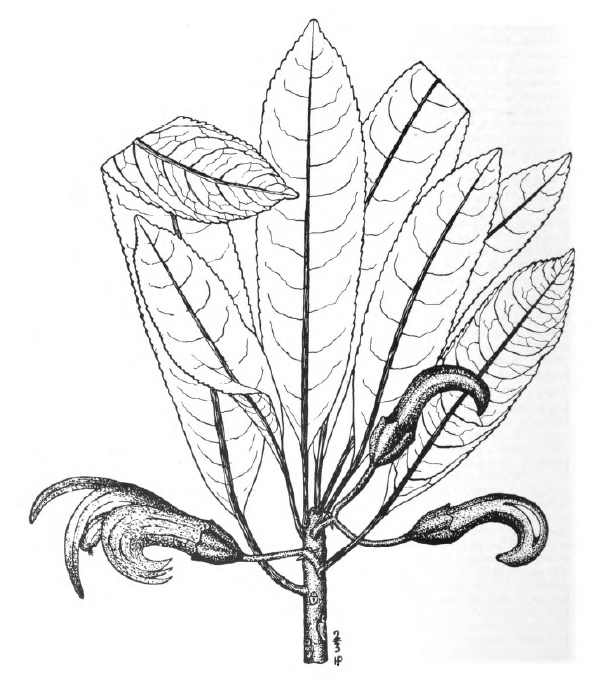
CLERMONTIA ARBORESCENS (H. Mann) Hillebr. (Original) (Described on preceding page)
(St. John 10,202, Maui)
FLORA HAWAIIENSIS
LOBELIACEAE LOBELIA FAMILY
CLERMONTIA COERULEA Hilleb. KONA CLERMONTIA
Clermontia coerulea Hilleb. Fl. Haw. Isl. 243. 1888.
Small tree or shrub 4-6.5 meters high. Leaves oblong to oblanceolate, 12-25 cm. long and 2-4.5 cm. wide, at apex shortly acuminate to mucronate or bluntly acute or rarely obtuse, at base acuminate and contracting into 1.5-7 cm. long petiole, minutely obscurely denticulate to subentire, membranous, above light green and glabrous, below pale and either entirely glabrous or with scattered whitish hair along midrib and basal part of largest veins or rarely entirely puberulent, when young often purplish. Peduncles slender, sparsely puberulent, 2-4 cm. long, bracteate considerably above the middle; pedicels sparsely puberulent, as long as or longer than peduncle or very rarely shorter, bracteolate below the middle. Calyx greenish-white to purple, with oblong to turbinate about 1 cm. long tube with either large 15-17 mm. long lobes or these minute dentiform. Corolla moderately curved, about 4 cm. long, glabrous to glabrate above and sparsely puberulent below, greenish to white or purplish, thin. Berry globose, slightly truncate, yellow, about 2 cm. in diameter, slightly longitudinally greenish-ridged. Seeds yellowish, shiny, sublenticular.
Type Locality: "Hawaii, woods of Kona."
Local Range: Endemic to the southwestern part of the Island of Hawaii, growing in the forest at an elevation of 2,000 to 4,000 feet from east of Kilauea to north of Hualalai. According to Rock, in Kau it is a freely branching tree 15 to 20 feet high with a 4 to 5 inch trunk, with calyx lobes minute dentiform and with corolla greenish; while in Kona, it is a shrub with calyx lobes broadly deltoid and with corolla purplish. Specimens collected by the writer in the forest below the Koa Mill mauka of Hoopuloa, Kona, bore white flowers. One of these plants had the lower leaf surface glabrous except for a puberulent midrib; another had the entire lower surface puberulent. The former was used for the accompanying illustration.
Extra Range: Not known elsewhere
(Illustrated on following page)
(Degener & Degener, 8/1/34)
New Illustrated Flora of the Hawaiian Islands
LOBELIACEAE LOBELIA FAMILY
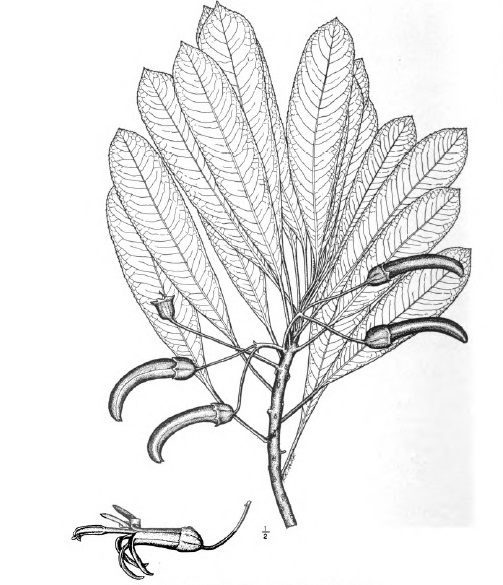
CLERMONTIA COERULEA Hillebr. (Described on preceding page) (Original)
(© Degener & Degener, 8/1/34) (Hoopuloa, Hawaii)
FLORA HAWAIIENSIS
LOBELIACEAE LOBELIA FAMILY
CLERMONTIA DREPANOMORPHA Rock KOHALA CLERMONTIA Clermontia drepanomorpha Rock, Indig. Trees Haw. Isl. 473. 1913. Clermontia drepanomorpha sensu Rock, Monogr. Haw. Lobel. 327. 1919. Clermontia drepanomorpha sensu Skottsb. in Acta Hort. Gotob. 2: 269. 1926. Clermontia drepanomorpha sensu Skottsb. in Acta Hort. Gotob. 15: 489. 1944. Clermontia drepanomorpha sensu E.Wimm. in Engl. Pflzreich. 106 (4. 276b): 81. 1943.
Much-branched 4-6 meter high tree with soft whitish wood. Leaves obovate-lanceolate to oblong or linear-lanceolate, with blade 8-18 cm. long and 1.5-4 cm. wide, with apex shortly acuminate to obtusely acute, at base narrowing into 2-5 cm. long petiole, with often revolute margin callous-denticulate for upper two-thirds but crenulate to entire below, coriaceous, above dark green and glabrous, below pale and along the prominent reddish midrib sparsely hispid. Peduncle drooping, glabrous, 2-flowered, 6-8 cm. long in flower and somewhat longer in fruit, naked; pedicels 2-3 cm. long, curved upward so flower is erect, with bracts triangular. Calyx with dark-purplish ovarian portion turbinate to globose and 15-20 mm. long; lobes as long as corolla, purple, connate for half their length except for dorsal slit. Corolla dark purple, fleshy, hirtellous, slightly curved, 40-60 mm. long and 16-20 mm. wide. Filaments glabrous, purplish; anthers bluish-lilac, hirsute along sutures on inner side but glabrous without, only the lower penicillate. Berry globose, orange yellow, 3 cm. in diameter. Seeds yellowish-brown, smooth.
Type Locality: "This remarkable species was discovered by the writer on the open swamp lands in the mountains of Kohala, Hawaii; also along Alakahi and Kawainui gorges at an elevation of 4000 to 5000 feet. It is a small tree 12 to 20 feet in height, and is peculiar to the boggy regions of West Hawaii, where the rainfall is enormous. It was collected flowering and fruiting in July, 1909, and again the following year during the same month on the high plateau, summit of Kohala; the type is No. 4745 in the Herbarium of the College of Hawaii."
Local Range: Endemic to cloud-swept regions of Kohala. According to Rock (1919) "the species occurs in thousands of trees, but each seems to have a different aspect. It is a very variable species as far as the foliage is concerned, but the inflorescence does not vary at all, only perhaps in color." It has the largest flowers of Hillebrand's Section Genuinae, characterized by having calyx lobes about as long as those of the corolla.
Extra Range: Not known elsewhere.
(Illustrated on following page)
(Degener & Degener, July/31/1958) (Aided by National Science Foundation)
New Illustrated Flora of the Hawaiian Islands
LOBELIACEAE LOBELIA FAMILY
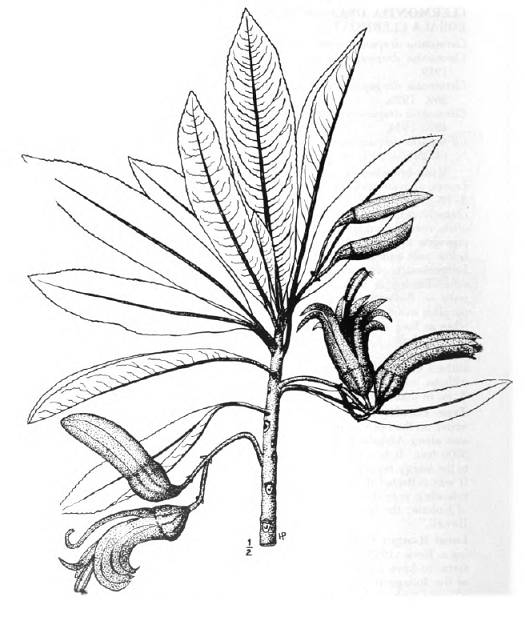
CLERMONTIA DREPANOMORPHA Rock (Original) (Described on preceding page)
(Rock 4751)
FLORA HAWAIIENSIS
LOBELIACEAE LOBELIA FAMILY
CLERMONTIA FURCATA E. Wimm. FORKED CLERMONTIA
Clermontia furcata E. Wimm., nov. sp. Frutex glaberrimus. Rami superne fistulosi, in vertice foliosi. Folia petiolata, luteo-viridia, subnitida, coriacea, subtus pallidiora; lamina oblonga usque lanceolata, 14-19 x 4.4-6 vel 3.5 cm., apice subabrupte et breviter acuminata vel subacuta in apicem brevem obtusum, ad basin in petiolum 3-5 cm. longum angustata, margine callose denticulata (Denticuli conferti, saepe adpressi), nervus medianus prominens, nervi laterales et venae fere planae, illi c. 20 utrinque sub angulo fere recto ascendentes. Pedunculi solitari-axillares, patentes, furcati, biflori, 6-10 mm longi, nudi, crassiusculi; pedicelli in basi bractea parva praediti, ebracteolati, 20-25 mm. longi. Hypanthium ovoideium, 16 x 10 mm., eius lobi sublineares, subacuti, integerrimi, erecti, 12-15 x 56 mm., nervis invisibilibus. Corolla (nondum satis evoluta) 20-30 mm. longa, 10-12 mm lata (in planta exsiccata), dilute viridis (?). Cetera no satis cognoscenda. (E. Wimm.)
Glabrous broad 2 meter high shrub with branches swollen above. Leaves coriaceous, somewhat glossy above, light green especially beneath, shallowly callus-serrulate, with oblong to oblanceolate blade 14-19 cm. long and 3.5 to usually 4.4-6 cm. wide, at apex acute to somewhat cuspidate, at base gradually acuminate to narrow 3-5 cm. petiole, with prominent midrib and about 20 ribs and innumerable veins moderately distinct. Peduncles solitary, axillary, 6-10 mm. long, naked, thick, with 2 widely spreading 20-25 mm. long naked pedicels each subended by subulate about 3 mm. long bractlet at base. Ovary 16 mm. long, 10 mm. wide, bearing erect, entire, obscurely nerved, narrowly oblong calyx lobes 12-15 mm. long and 5-6 mm. wide and acute at apex. Corolla (only immature specimens seen) 20-30 mm. long, 10-12 mm. wide, strongly falcate in bud. (Deg. & Deg.)
Type Locality: "Maui, Mauka of McGregor, 9... III. 1952 (Degener no. 22068 - holotype, 22248 - specimen cum alabastris minimis foliis magis oblanceolatis)."
Local Range: The nearest relative of this rare species, thus far known from the open rain-forest of the type locality, seems to be C. rockiana.
Extra Range: Not known elsewhere.
(Illustrated on following page)
(Degener & Degener 8/20/56) (Aided by National Science Foundation)
New Illustrated Flora of the Hawaiian Islands
LOBELIACEAE LOBELIA FAMILY
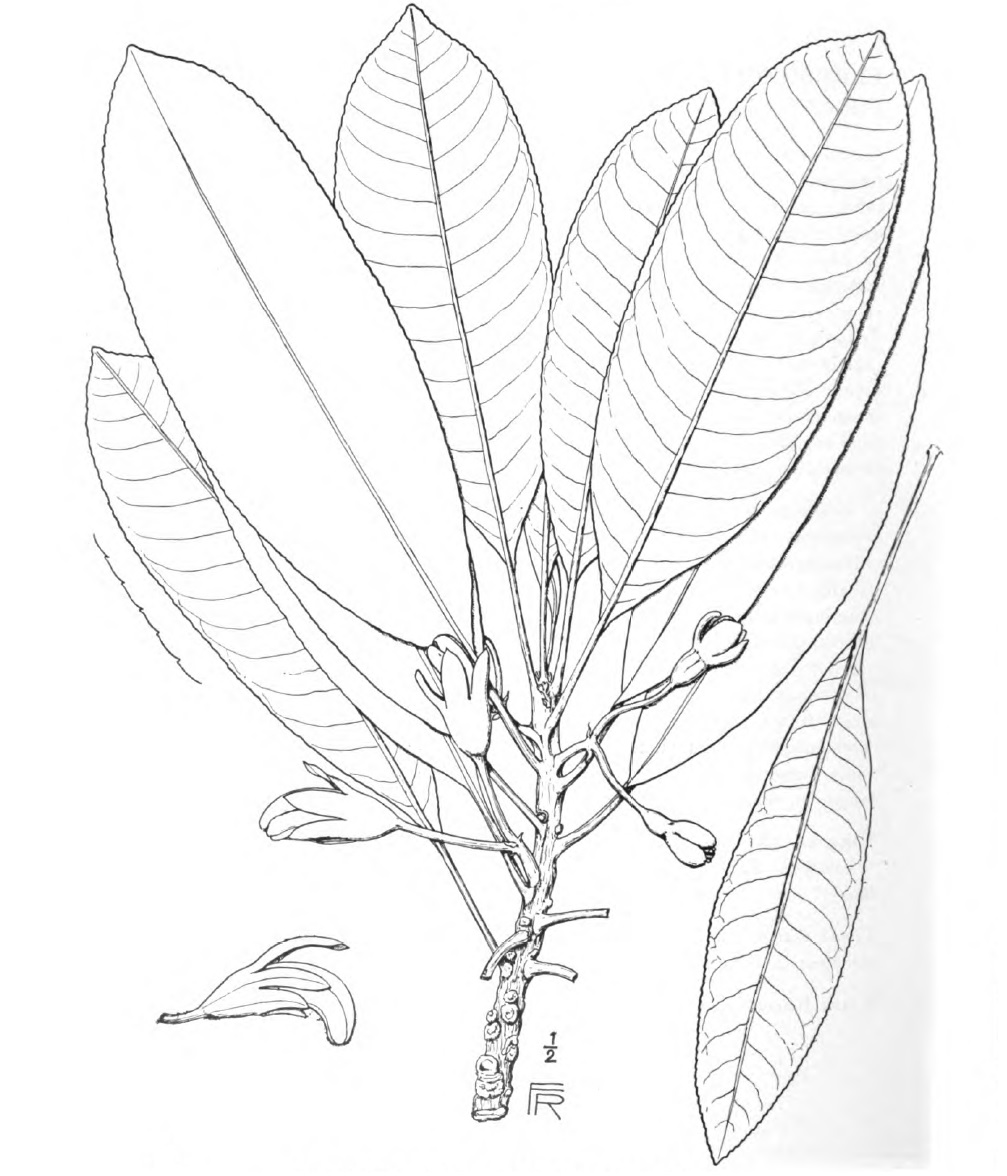
CLERMONTIA FURCATA E. Wimm. (Original) (Described on preceding page)
(Degener & Degener 8/20/56) (habit of 22068, flower & leaf of 22248)
FLORA HAWAIIENSIS
LOBELIACEAE LOBELIA FAMILY
CLERMONTIA HALEAKALENSIS Rock HALEAKALA CLERMONTIA; 'ŌHĀ-WAI
Clermontia Haleakalensis Rock, Indig. Trees Haw. Isl. 489. 1913. Clermontia Haleakalensis sensu Rock, Monogr. Haw. Lobel. 19, 27, 47, 73, 75,81, 303. 1919. Clermontia haleakalensis sensu E. Wimm. in Engl. Phlzreich. 106 (4.276b): 96. 1943.
Terrestrial 3-6.5 meter tall glabrous tree with few stout ascending branches conspicuously marked with crowded leaf scars and ending with crowded leaves. Leaves broadly oblanceolate, 20-30 cm. long, 1.5-4 cm. wide, fleshy, obtuse to somewhat acute at apex, long-acuminate to sessile or subsessile base, conspicuously veined on both surfaces, dark green with impresssed pellucid veins above, pale and with thick prominent midrib beneath, entire along lower half but crenulate along upper. Flowers about 6 per cyme, on 5-15 mm. long pedicels which are bibracteolate below the middle on 20-50 mm. long peduncle having linear-subulate about 7 mm. long bracts at top. Calyx tube oblong-turbinate, 15 mm. long, puberulent to glabrous; lobes linear-subulate, 5 mm. long. Corolla pale green, 35-45 mm. long and in middle 5-6 mm. wide, slightly curved, with dorsal slit extending half way or more to base; lobes linear-lanceolate, glabrous. Staminal column white-pubescent at base but glabrous in upper part; 2 lower anthers long-penicillate. Style slightly pubescent. Berry oblong. Seeds smooth, whitish.
Type Locality: "This particular species was discovered by the writer October 11, 1910, on the Island of Maui, on the western slopes of Mt. Haleakala, on the crater of Puunianiau, at an elevation of 7000 feet, in a locality where no one would expect to find a member of this wonderful tribe. It grows in open, dry scrub in company with plants belonging to the upper forest zone, such as Raillardia platyphylla, Argyroxiphium virescens, Sophora chrysophylla, Santalum Haleakalae, etc. Unfortunately, only three trees are in existence, and as they are peculiar to the above locality, it will not be long ebfore they will have shared the fate of so many of our native trees, becoming extinct, as cattle have free access and browse on the lower branches within their reach. The writer appealed to the manager of Haleakala ranch to protect these trees from the ravages of cattle, which he kindly promised to do. The type specimen is No. 8595 in the Herbarium of the College of Hawaii."
Local Range: This magnificent clermontia, resembling a hala-pepe in habit, is known only from the type locality. Wimmer agrees with Rock that it appears to be one of the oldest of the genus, indicating relationship to Delissea in bearing below the dorsal slit of the young corolla a knob and having the same color of seed. The area at time of discovery was not yet inviolate by being in a national park under the Department of the Interior. As a result, by 1919 "The writer's fears in regard to the destruction of this rare species, were well founded; the species has become extinct. While on Maui for the purpose of taking photos of Lobelioideae, he made a special trip to Puunianiau to see this species once more, but to his great sorrow not a vestige of this interesting species could be found; it had succumbed to the ravages of cattle."
Extra Range: Not known elsewhere.
(Illustrated on following page)
(Degener & Degener, 5/1/66) (Aided by Mrs. William Mitchell)
New Illustrated Flora of the Hawaiian Islands
LOBELIACEAE LOBELIA FAMILY
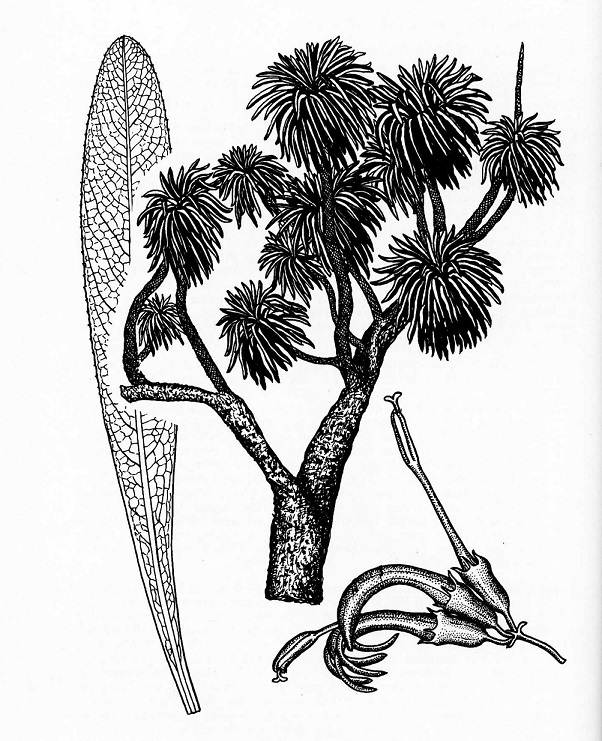
CLERMONTIA HALEAKALENSIS Rock (Original & redrawn after Rock) (Described on preceding page)
FLORA HAWAIIENSIS
LOBELIACEAE LOBELIA FAMILY
CLERMONTIA HANAENSIS St. John HANA CLERMONTIA; 'ŌHĀ-WAI
Clermontia hanaensis St. John in Occas. Pap. B.P.Bishop Mus. 15(1): 12. 1939. Clermontia hanaensis sensu Wimmer in Engl. Pflzreich. 106 (4.276b): 88. 1943.
Shrub up to 2 meters high with glabrate branches and more or less pubescent twigs leafy toward their ends. Leaves firm chartaceous, obovate to elliptic, obtuse with somewhat cuspidate apex, above glabrous and somewhat rugose and bronze-green (perhaps due to exposure), below pale green except for darker veins which are sparsely puberulent, crenate-serrulate almost to base, with 45-70 mm. long by 25-35 mm. wide blade tapering into 4-14 mm. long puberulent petiole. Flowers mostly 2, on 12-20 mm. long pedicels which are bibracteolate and puberulent at base but glabrous above, borne on 3-5 mm long puberulent peduncle. Calyx with slender turbinate 10-12 mm. long glabrous ovarial portion and 38-43 mm. long lanceolate pale green lobes. Corolla 50 mm. long, curved, with linear acuminate glabrous white to green-tinged lobes. Stamens with filaments about 42 mm. long and anthers 12 mm. long. Berry pyriform, orange, 22 mm. long, 15 mm. wide.
Type Locality: "Maui, swamp above Puki, Hana, shrub 4-6 ft. high, 2,000-3,000 ft. alt."
Local Range: Known only from Forbes' original discovery of July 5, 1920. This taxon was found less than 10 miles distant from Clermontia samuelii. We join with Wimmer in surmising it to be merely a variety of the latter, but refrain from deciding upon change of name until more material becomes available for study.
Extra Range: Not found elsewhere.
(Illustrated on following page)
(Degener & Degener, 11/11/60) (Aided by National Science Foundation)
New Illustrated Flora of the Hawaiian Islands
LOBELIACEAE LOBELIA FAMILY
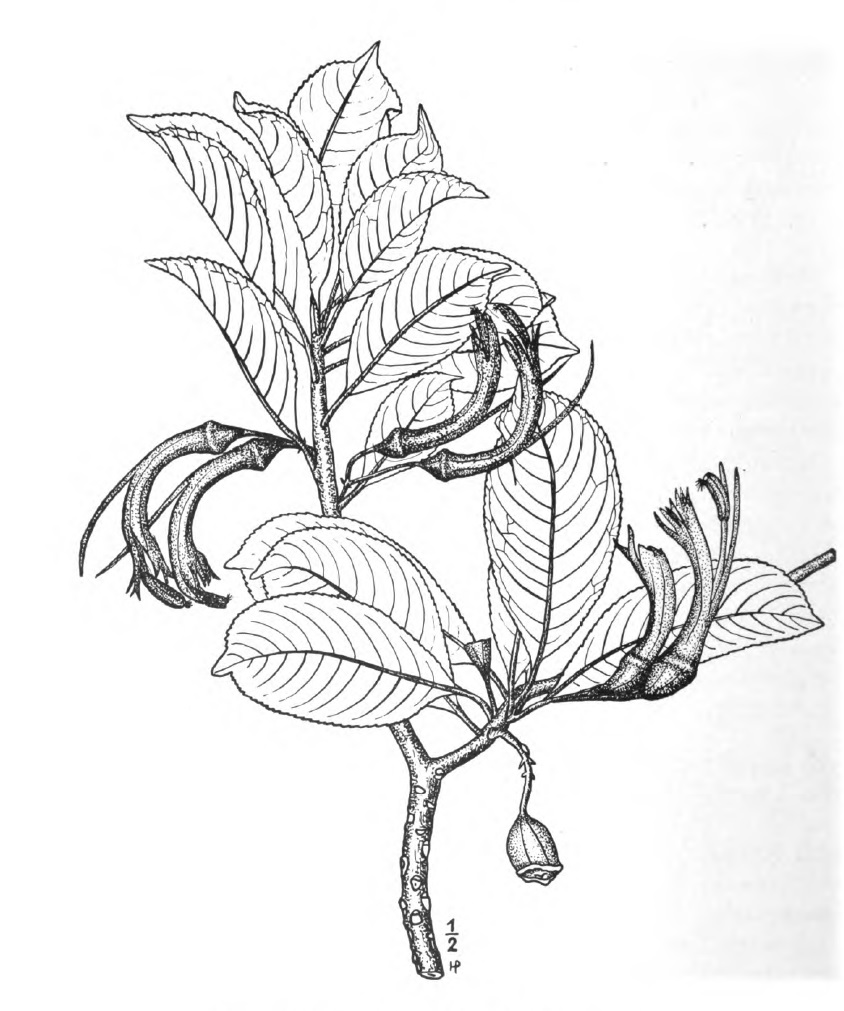
CLERMONTIA HANAENSIS St. John (Original) (Described on preceding page)
(Forbes 2679M, Hana, Maui)
FLORA HAWAIIENSIS
LOBELIACEAE LOBELIA FAMILY
CLERMONTIA HAWAIIENSIS (Hillebr.)* Rock HAWAII CLERMONTIA
Clermontia macrocarpa var. Hawaiiensis Hillebr. Fl. Haw. Isl. 241. 1888. Clermontia hawaiiensis Rock Indig. Trees Haw. Isl. 477. 1913. Clermontia hawaiiensis sensu Rock, Monogr. Haw. Lobel. 317. 1919. Clermontia hawaiiensis sensu Skottsb. in Act. Hort. Gotob. 2: 269. 1926. Clermontia hawaiiensis sensu Degener, Plants Haw. Nat. Park 286. 1930. Clermontia hawaiiensis sensu E. Wimm. in Engl. Pflzreich. 106 (4.276b): 82. 1943. Clermontia hawaiiensis sensu Fagerlund & Mitchell, Nat. Hist. Bull. [Haw. Nat. Park] 9:58. 1944.
Tree or shrub 3-9 meters high. Leaves oblong to obovate-oblong, blade 9-22 cm. long and 3-6 cm. wide, at apex acuminate through acute or obtuse to rounded, narrowing into reddish petiole about 3 cm. long, with undulate callous-denticulate to -serrulate margin, chartaceous to subcoriaceous, above dark green more or less shiny and glabrous, beneath pale and along veins and ribs sparsely pubescent. Peduncle 2-6 cm. long, 2- to rarely up to 4-flowered, bibracteate in the upper fourth with foliaceous 20-35 mm. long linear-oblong denticulate bracts; pedicels 2-4 cm. long, bibracteolate at middle and at their common base. Ovarian portion of calyx ovoid to obconic-oblong, turbinate, strongly longitudinally 10-ridged with dorsal ridge often subalate; lobes green to purplish, 60-65 mm. long as is corolla which they enclose, the dorsal slit extending to the base and lateral slits beyond the middle, each lobes strongly ribbed with each rib a continuation of ovaian ridge. Corolla slightly curved especially before anthesis, in bud thickened toward apex, greenish-white with lobes violet tinged or lobes lilac without and ivory within. Stamens with fiilaments glabrous, green to purple; anthers pale purple to dark, glabrous or hirsute along the sutures, the 2 lower penicillate. Berry obconic, 30 to rarely 37 mm. long and 30 mm. wide, orange-yellow, truncate, 10-ribbed.
Type Locality: "Hawaii! from Hilo to Waiohinu."
Local Range: A variable species almost endemic to Hawaii, being terrestrial or at times epiphytic especially on the trunks of treeferns. It is very common on the rainer aa lava flowers in Puna in a form that Rock considers close to C. kakeana. From there it ranges in several confusing varieties and forms over the southwestern part of the island past the Kilauea region to about Waiohinu. It goes almost without saying that a species complex thought related to C. kakeana by Rock and to C. drepanomorpha by Wimmer deserves further extensive collecting, the worker noting precise color of flower and other characters lost in a herbarium specimen. The precise locality of his find should also be recorded. Wimmer, noting its atypical character, places Degener 7826 under this species. It was discovered in 1928 in the beautiful lower rainforest about Maunahui, Molokai. Since this plant's collection, the area has been browsed over and denuded of native vegetation. This extermination of endemics transpired during a few years' negligence in hunting down fecund feral goats in the Forest Reserve. Appointment of Forester Peter to save the area was too late. Now it is planted to rather uninteresting exotic trees, and the peculiar Molokai Clermontia hawaiiensis appears to be extinct.
Extra Range: Not known elsewhere.
(Illustrated on following page)
* Henceforth this preferred abbrevation will be used instead of Hilleb., or Hbd.
(Degener & Degener, July/31/1958) (Aided by National Science Foundation)
New Illustrated Flora of the Hawaiian Islands
LOBELIACEAE LOBELIA FAMILY
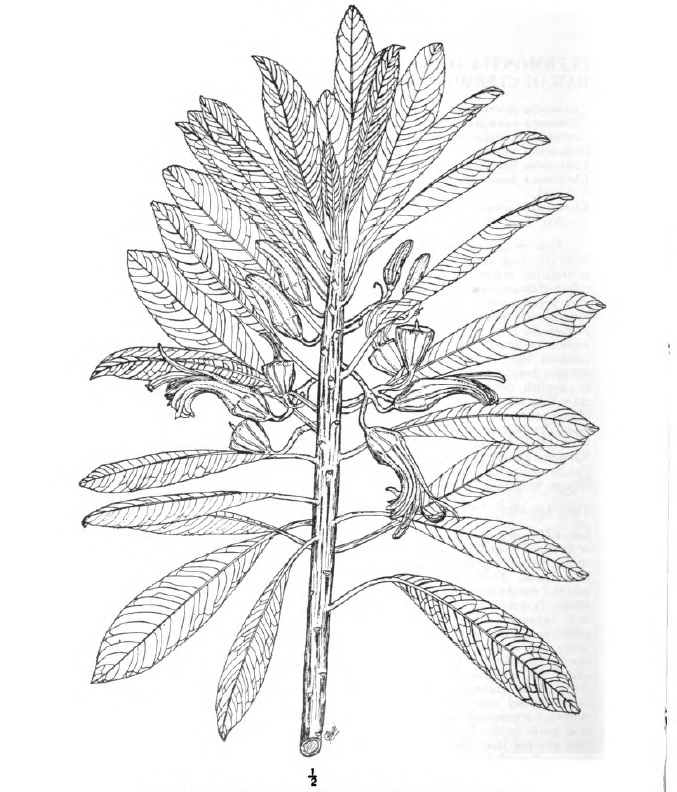
CLERMONTIA HAWAIIENSIS (Hillebr.) Rock (Original) (Described on preceding page)
(Kilauea, Hawaii)
FLORA HAWAIIENSIS
LOBELIACEAE LOBELIA FAMILY
CLERMONTIA KAKEANA Meyen KAKEA CLERMONTIA; OHAWAI, HAHA
Clermontia kakeana Meyen, Reise um die Erde 2: 139. 1835. Clermontia kakeana sensu Presl, Prodr. mon. Lob. 48. 1836. Clermontia kakeana sensu A. DC. Prodr. 7: 342. 1839. Clermontia macrocarpa Gaud. Bot. Voy. Bonite pl. 49 1842. Clermontia kakeana sensu Meyen in Walp. in Nova act. acad. caes. Lep.-Carol. 16 Suppl. 2 (19. Suppl. 1.) 358, 1843. Clermontia kakeana sensu Meyen in Walp. Report. 2: 708. 1843. Clermontia macrophylla Nutt. in Trans. Amer. Philos. Soc. 2: 251. 1843. Clermontia grandiflora var. longifolia A. Gray in Proc. Am. Acad. 5: 150. 1861. Clermontia kakeana [sic.] sensu Hillebr. Fl. Haw. Isl. 240. 1888. Clermontia kakeana [sic.] var. cymosa sensu Hillebr. Fl. Haw. Isl. 241. 1888. Clermontia kakeana sensu Heller in Minn. Bot. St. 1: 906. 1897. Clermontia kakeana sensu Bryan, Nat. Hist. Haw. pl 58, f. 4. 1915. Clermontia Kakeana sensu Rock, Monogr. Haw. Lobel. 308. 1919. Clermontia kakeana sensu Skottsb. in Act. Hort. Gotob. 2: 268. 1926. Clermontia Kakeana sensu E. Wimm. in Engl. Pflzreich. 106 (4.276b): 83. 1943. Clermontia Kakeana sensu E. Wimm. in Engl. Pflzreich. 107 (4.276b): 762. 1953.
Shrub or tree 3-6 meters tall with candelabra-like branching and twigs when young yellowish hirtellous. Leaves narrowly obovate to broadly oblanceolate, with blade 15-24 cm. long and 5-8 cm. wide, at apex cuspidate to rarely acute or rounded, acuminate at base, with slender 3-6 cm. long petiole, green and glabrous above, pale and more or less yellowish hirtellous beneath, callous-serrulate except perhaps toward base, somewhat thick when fresh but membranous when dried. Flowers glabrous or nearly so, fleshy; peduncle pubescent, 20-35 mm. long, 2-flowered or (in var. cymosa Hilleb.) very rarely up to 5- to 7-flowered, with pubescent 15-20 mm. long pedicels with a pair of 2-3 mm. long subulate bracts at or above the middle. Calyx with ovarian portion (hypanthium) 10-15 mm. wide and almost as long; lobes green, first connate and as long as the 50 m. long and 8 mm. wide corolla. Corolla yellowish green to pinkish. Stamens glabrous: anthers purple. Berry globose with somewhat truncate apex rimmed by enlarged perianth scar, weakly longitudinally 10-ribbed, yellow to orange, 2-3 cm. wide. Seeds compressed-ellipsoid, brownish, shiny, 0,8 mm. long.
Type Locality:
|
"Am 27sten Juni [1831]. Um keine Zeit zu verlieren, machten wir uns am heutigen Tage wieder auf und richteten unsere Excursion nach dem Berge Kakea, einer der höchsten Spitzen des Gebirgszugs, die östlich von dem Honoruru-Thale gelegen ist ... Endlich hatte der Fusspfad auf unserer Wanderung, welcher zur Höhe hinauffahrte, eine Ende, und nun mussten wir uns mit grösster Anstrengung Bahn machen ... Nirgends auf der Insel fanden wir mehr von jenen sonderbaren Lobeliaceen, die Herr Gaudichaud beschrieben hat, als gerade hier; ausser den schon früher bekannten sammelten wir noch eine neue Clermontia*) und viele andere schöne Pflanzen...." |
On the 27th of June [1831]. To lose no time, we started on this day again and turned our excursion to the mountain Kakea, one of the highest peaks of the mountain range, which is locatee east of the Honolulu Valley.... Finally, the the footpath, which had hearkened us up the height, ended and now we continued the path with the greatest effort... Nowhere on the island had we found more of those strange Lobeliaceae that Mr. Gaudichaud had described than just here; besides the earlier known, we collected another new Clermontia*) and many other beautiful plants. |
Local Range: Some writers thought Meyen named this haha for an Hawaiian assistant with the nickname Jack, rendered Kake in the vernacular. This is wrong as the above quotation shows Meyen collected the type on what we now commonly call Round Top, the cindercone roughly northwest of the University of Hawaii. Oahu specimens of the Clermontia occur in several forms, one difference being flower color. For instance, Degener, Topping & Swezey 7884 from the base of Kaala, Wainae Range, March 1932, has the ovary whitish with 10 greenish longitudinal ridges, perianth entirely green, and the lower half of staminal tube whitish but the uper half purplish red. Hillebrand's specimen (C. macrocarpa var. rosea Hillb., p. 241) from Halemanu, Koolau Range, has calyx and corolla "pale rose," and is here renamed C. kakeana forma rosea (Hilleb.) Degener & Degener. Apparently the center of distribution for the species is the Koolau Range of Oahu. Here it is common in the lower rain-forest, while in the Waianae Range it is very rare. So far as we know this species never reached Kauai, but it did cross the channel to Molokai. There it is now represented by plants having the tendency to bear smaller leaves usually more densely hirtellous beneath, the apex acute rather than cuspidate, and the petioles disproportionally shorter. Such plants are Stokes, without precise locality, collected in 1909; Rock 7038, "Mapulehu," April 1910; and Degener 7834, "Small ravine northwest of Maunahui," May 20, 1928. This last has flowers greenish yellow with purplish anthers. Forbes 243 Mo. "Pelekunu Trail" July 1912, with almost linear-lanceolate leaves up to 25 cm long and but 3.5 cm wide, constitutes the type of the new variety here named Clermontia kakeana var. forbesii Degener & Degener, folia 250 mm. longa et 35 mm. lata. C. kakeana is found on both West and East Maui, the plants as expected resembling those of Molokai rather than those of Oahu. Thus far we have seen no authentic material collected on the Island of Hawaii. Skottsberg's sheets 707 (one of which bears branches from two different plants!) "Hawaii, Kohala above Waimea," Aug 29, 1922, is the new Clermontia montis Loa var. tenuifolia Skottsb. (in Act. Hort Goteb. 2: 269. 1926.) This determination, however, he later corrected to "Most likely" C. parviflora var. grandis Rock (in Act. Hort. Goteb 15: 489. 1944.). Then Feb. 7, 1957 Rock annotates these sheets in the herbarium of the Bishop Museum C. kakeana Meyen. We join Skottsberg in calling this plant C. parviflora var. grandis Rock. This variety of northwest Hawaii is one link between the coarse C. kakeana Meyen of Oahu, Molokai and Maui and the more delicate C. parviflora Gaud., so common in the jungles about Kilauea, Hawaii.
Extra Range: Not known elsewhere.
(Illustrated on following page)
(Degener & Degener, July/31/1958) (Aided by National Science Foundation)
New Illustrated Flora of the Hawaiian Islands
LOBELIACEAE LOBELIA FAMILY
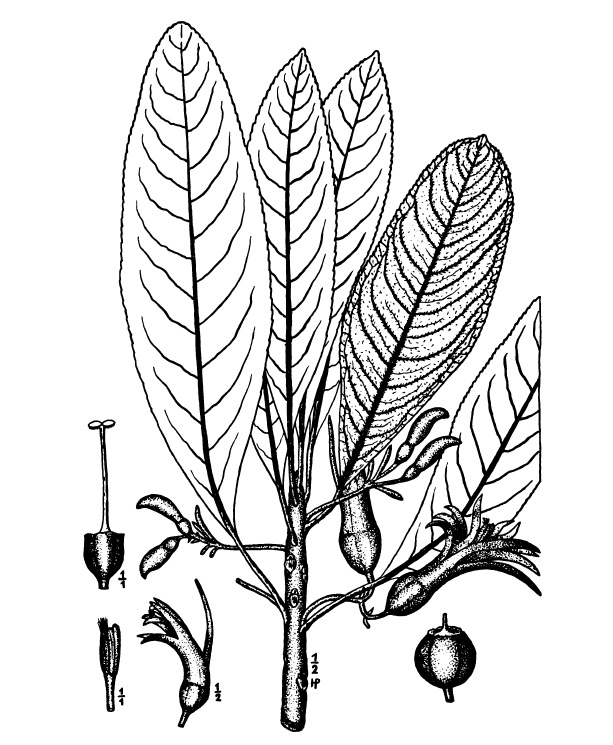
CLERMONTIA KAKEANA Meyen (Original) (Described on preceding page)
(Degener 11,536. Oahu)
FLORA HAWAIIENSIS
LOBELIACEAE LOBELIA FAMILY
CLERMONTIA KOHALAE Rock BLACK-FLOWERED CLERMONTIA
Clermontia kohalae Rock, Indig. Trees Haw. Isl. 476. 1913. Clermontia kohalae sensu Rock, Monogr. Haw. Lobel. 319. 1919. Clermontia kohalae sensu Wimmer in Engl. Pflzreich. 106 (4.276b): 84. 1943.
Tall 5-6 meter tree with candelabra-like branching. Leaves linear- to oblanceolate-oblong, somewhat acuminate to obtuse at apex and at times slightly emarginate, glabrous, chartaceous to membranous, dull, above green and with impressed veins, below pale, callous-denticulate to -serrate along upper two-thirds but entire elsewhere, the blade 7-16 cm. long by 2-3.4 cm. wide and narrowing into 2-4 cm. long petiole. Flowers 2, on bibracteolate 15-36 mm. long pedicels, borne on hispid to somewhat scabrous equally long peduncle bearing 2-triangular bracts above the middle; cymes scattered along twigs. Calyx with turbinate green ovarian portion 1 cm. long and almost as wide; lobes as long as those of corolla, purplish black, glabrous, slender, not fleshy, suberect to slighty arcuate. Corolla similar in shape and color to calyx lobes, 5-6 cm. long, glabrous. Stamens with glabrous filament column and pale anthers hirsute along sutures and only the two lower ones penicillate. Berry subglobose, about 2 cm. in diameter. Seeds pale brown, smooth, shiny.
Type Locality: "It was discovered by the writer in July, 1910, in the lower forests of Kohala, Hawaii, and in the gulches on the windward side, along the streams at an elevation of 1500 to 2500 feet, where it is not uncommon. It is exceedingly handsome when in flower; the numerous dark-purple corollae in the axils of the leaves give it a pleasing appearance. It flowers during the summer months."
Local Range: The species itself is limited to the Kohala District of Hawaii.
Extra Range: Not known elsewhere.
(Illustrated on following page)
(Degener & Degener, 11/11/60) (Aided by National Science Foundation)
New Illustrated Flora of the Hawaiian Islands
LOBELIACEAE LOBELIA FAMILY
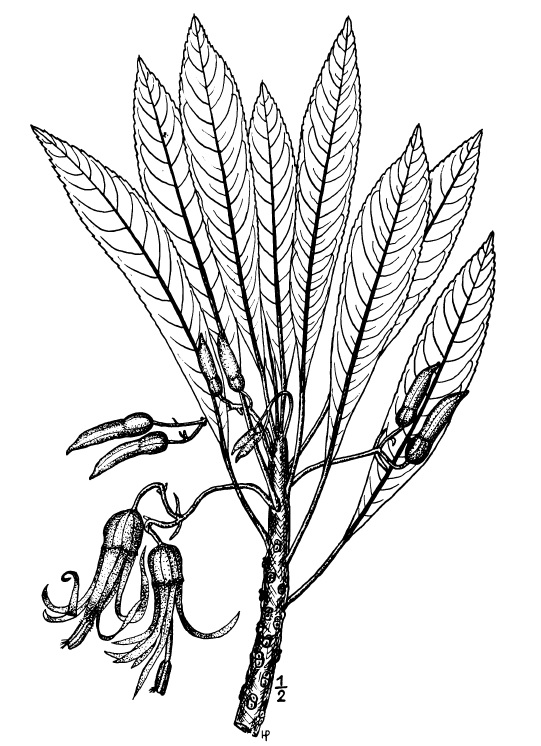
CLERMONTIA KOHALAE Rock (Original) (Described on preceding page)
(Degener 21878, Honokanenui; Degener 21900, Pololu)
FLORA HAWAIIENSIS
LOBELIACEAE LOBELIA FAMILY
CLERMONTIA KOHALAE var. HILOENSIS Wimmer
Clermontia kohalae var. hiloensis Wimmer in Engl. Pflzreich. 106 (4.276b): 84. 1943. Clermontia kohalae var. hiloensis [sic] sensu Wimmer in Engl. Pflzreich. 106 (4.276b): 762. 1953.
Leaves broadly lanceolate to somewhat obovate-lanceolate, acute at apex, minutely callous-serrulate, shiny above, gradually narrowing into 2.5 cm. long petiole. Peduncles 2- or 3-fowered. Corolla 5 cm. long. Tube of anther glabrous.
Type locality: "East of Hilo, in scrub vegetation in a plain."
Local Range: Known only from the collections made by Degener at the type locality, and in 1949 "Along the Saddle Road 16 miles from Hilo in rich rainy kipuka." A kipuka is relatively undisturbed area surrounded by a more recent lava flow - essentially a lava oasis.
CLERMONTIA KOHALAE var. ROBUSTA Wimmer
Clermontia kohalae var. robusta Rock in Coll. Haw. Publ. Bull. 2: 41. 1913. Clermontia kohalae var. robusta sensu Rock, Monogr. Haw. Lobel. 323. 1919. Clermontia kohalae var. robusta sensu Wimmer in Engl. Pflzreich. 106 (4.276b): 84. 1943. Clermontia kohalae var. robusta sensu Wimmer in Engl. Pflzreich. 106 (4.276b): 762. 1953.
Small tree or shrub with very stout branches woody to their very ends and with thick corky bark covered with numerous thick knobby leaf- and inflorescence-scars. Leaves densely crowded at ends of twigs, smaller and shorter-petioled than in the species itself. Cymes as in the species itself but these in axils of uppermost leaves rather than scattered along the twigs. Flowers thick, fleshier, with corolla about 4 cm. long. Tube of anthers black-violet, glabrous, 13 mm. long.
Type Locality: "Hawaii: Mountains of Kohala, along stream beds and near waterfalls at an elevation of 1500 feet, back of Kohala proper."
Local Range: Though discovered by Faurie somewhere on Mauna Kea, the type is Rock's specimen collected in 1910. O. Degener gathered additional specimens on the rainswept plateau at the head of Alakahi Valley, Kohala, at 1,260 meters in 1949.
Extra Range: Both varieties are limited to the Island of Hawaii.
(Var. hiloensis illustrated on following page)
(Degener & Degener, 8/8/60) (Aided by National Science Foundation)
New Illustrated Flora of the Hawaiian Islands
LOBELIACEAE LOBELIA FAMILY
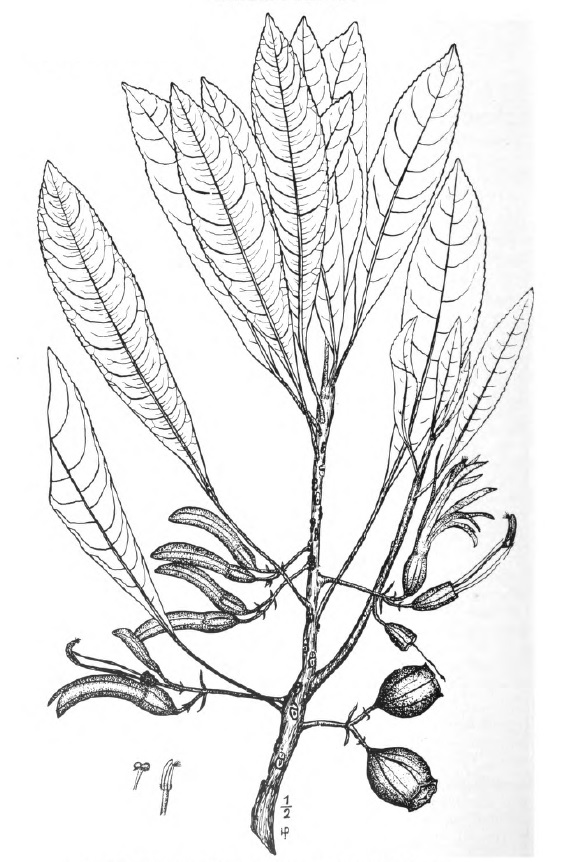
CLERMONTIA KOHALAE var. HILOENSIS Wimmer (Original) (Described on preceding page)
(Degener 20014)
FLORA HAWAIIENSIS
LOBELIACEAE LOBELIA FAMILY
CLERMONTIA LEPTOCLADA Rock SLENDER-BRANCHED CLERMONTIA; OHAWAI
Clermontia leptoclada Rock, Indig. Trees Haw. Isl. 477. 1913. Clermontia leptoclada sensu Rock, Monogr. Haw. Lobel. 323. 1919. Clermontia leptoclada sensu Wimmer in Engl. Pflzreich. 106 (4.276b): 82. 1943.
Tree 6-7 meters tall with candelabra-like branches and slender laxly leaves twigs. Leaves lanceolate-oblong, denticulate to serrulate with callous teeth, coriaceous, dark green and glabrous and with impressed veins above, pale and sparsely hispid along veins and ribs below, acuminate at apex, the blade 12-18 cm. long by 2.5-4 cm. wide and acutely decurrent into 4-6 cm. long petiole. Flowers in 2- to 4-flowered cymes scattered along slender twigs, on 15-35 mm. long pedicels bearing at middle pair of linear subulate 5 mm. long bractlets, borne on hirsute 25-40 mm. long hirsute peducle bearing pair of bracts at upper third. Calyx with subglobose 14 mm. thick ovarian portion and the remainder as long as corolla and purplish and with prominent hispid nerves. Corolla slightly curved, 45 mm. long, with linear-lanceolate dark purple lobes hispid with white hair. Stamens with purplish filaments puberulous and with bluish purple anthers hirsute along the sutures and the lower ones penicillate. Fruit globose, 25 mm. thick. Seeds brown, smooth, shiny.
Tyype Locality: "This species, which becomes a tree of 18 to 20 feet in height, was discovered by the writer near the summit of the Kohala mountains on Hawaii, along the Alakahi and Kawainui ditch trail at an elevation of 4200 feet, during the month of July, 1909, at which time it was found in flower and fruit. It is one of the many remarkable Lobelioideae which inhabits our high swampy plateaus."
Local Range With the variety known only from Kohala.
Extra Range Not known elsewhere.
CLERMONTIA LEPTOCLADA var. HOLOPSILA Wimmer
Clermontia leptoclada var. holopsila Wimmer in Engl. Pflzreich. 106 (4.276b): 82. 1943
Leaves crowded at ends of tiwgs, lanceolate, glabrous or below pubescent along ribs. Flowers with glabrous stamens, in 2- to 5-flowered cymes, on about 15 mm. long filiform-bibracteolate pedicels borne on 25-30 mm. long hirtellous peduncles bearing at middle 2 filiform 15 mm. long bracts.
Type Locality: "Hawaii: Kohala-Gebirge, öslicher abhang des Pololu Valley an sonniger, buschiger Stelle, blühend im August (Herb. Degener n. 2186!)."
Local Range: Known only from the type collection made by O. Degener many years ago.
(Species illustrated on following page)
(Degener & Degener, 11/11/60) (Aided by National Science Foundation)
New Illustrated Flora of the Hawaiian Islands
LOBELIACEAE LOBELIA FAMILY
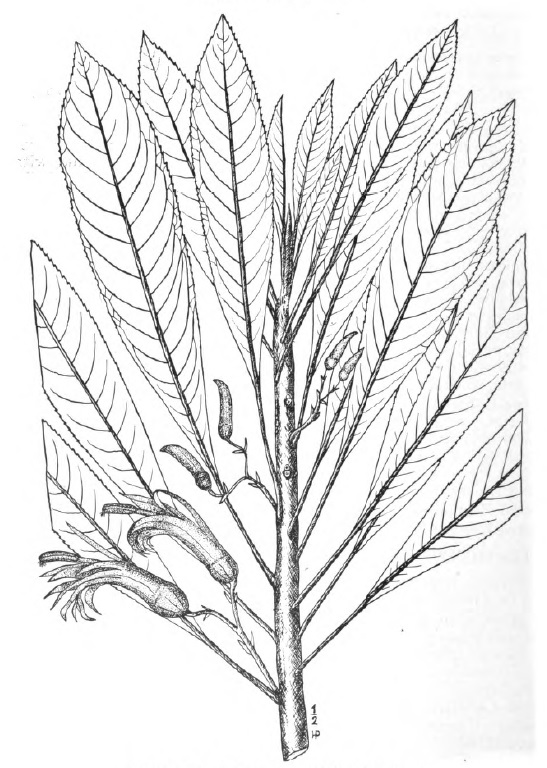
CLERMONTIA LEPTOCLADA Rock (Original) (Described on preceding page)
(Rock 8760, 8814)
FLORA HAWAIIENSIS
LOBELIACEAE LOBELIA FAMILY
CLERMONTIA MICRANTHA (Hillebr.) Rock WEST MAUI CLERMONTIA
Clermontia multiflora var. micrantha Hillebr. Fl. Haw. Isl. 242. 1888. Clermontia multiflora var. micrantha f. montana Rock, Indig. Trees Haw. Isl. 511. 1913. Clermontia micrantha Rock, Monogr. Haw. Lobel. 334. 1919. Clermontia micrantha sensu Wimmer in Engl. Pflzreich. 106 (4.276b): 91. 1943.
Shrub 1-2 meters tall, glabrous throughout. Leaves lanceolate, acute to acuminate at both ends, with crenulate and callous-serrulate margin, thick coriaceous when fresh, pale green with pinkish to purplish veins, with 5-10 cm. long and 1.5-2.5 cm. wide blade on 2-3.5 cm. long petiole. Peduncle 5-7 mm. long, 2-flowered or very rarely up to 3- to 5-flowered, pedicels 8-12 mm. long, with bibracteolate base. Calyx greenish pink, as long as corolla, with ovarial portion turbinate and 6 mm. long. Corolla pinkish purple, somewhat curved, 25 mm. long, glabrous, thin. Stamens glabrous: anthers with bluish bloom. Berry ovoid to subglobose, deep orange, 15 mm. in diameter. Seeds orange.
Type Locality: "Maui! Waihee, in the bare gravel along the stream."
Local Range: A handsome shrub endemic to West Maui. It has been seldom collected as it grows in the rather inaccessible cloud belt as, for example, about Mt. Eke and Puu Kukui.
Extra Range: Not known elsewhere.
(Illustrated on following page)
(Degener & Degener, 8/8/60) (Aided by National Science Foundation)
New Illustrated Flora of the Hawaiian Islands
LOBELIACEAE LOBELIA FAMILY
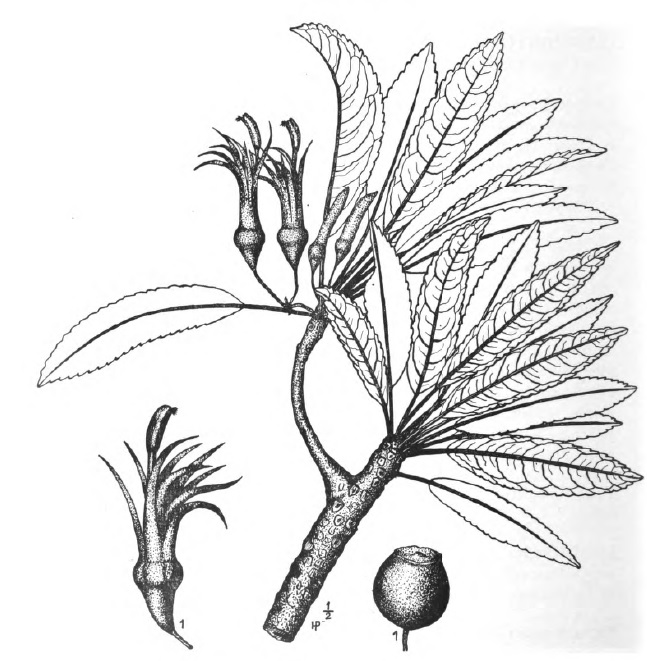
CLERMONTIA MICRANTHA (Hillebr.) Rock (Original) (Described on preceding page)
(Maui, Ewart III.)
FLORA HAWAIIENSIS
LOBELIACEAE LOBELIA FAMILY
CLERMONTIA OBLONGIFOLIA Gaud. OAHU CLERMONTIA; OHAWAI, HAHA
Clermontia oblongifolia Gaud. Voy. Freyc. Bot. 459, pl. 71. 1829. Clermontia grandiflora var. oblongifolia A. Gray in Proc.. Am. Acad. 5:150. 1861. (In part.)
Small tree 5-8 meters high or shrub. Leaves oblanceolate to elliptic, bluntly acute or more rarely obtuse at apex, acute to acuminate at base, coriaceous to subchartaceous, glabrous, shiny, pale to dark green above, lighter and prominently net-veined beneath, crenate with callous teeth, the blade 8-16 cm. long and 2.5-4.5 cm. wide, the petiole 3-9 cm. long. Peduncles usually 2- to rarely 3-flowered with flowers of different ages, usually 1.5-2 cm. long, faintly puberulent to glabrous, with 1-4 prominent scars of caducous subulate 1 mm. long bracts; pedicels usually as long as or longer than peduncle, similarly bracteolate near base and faintly puberulent to glabrous. Calyx glabrous or towards base rarely faintly puberulent, dull, pale green, with upper exposed surface usually purplish; the connate lobes as long as corolla, 6 cm. long measured along upper margin, 12 mm. wide and 7 mm. thick, the lower 3 free for about 1 cm. at apex, arcuate so that apex turns level with base. Corolla very similar but greenish-yellow and somewhat fleshy. Staminal column glabrous, white, 3-4 mm. thick; anthers glabrous or hirsute at sutures, 12 mm. long, white; pollen white. Ovary about 13 mm. long; style white with green tinge; stigma light green. Berry globose, not grooved. Seeds dark brown, 1 mm long.
Type Locality: "In insulis Sandwicensibus (Alt. 450-500 hex.)."
Local Range: One of the commonest lobelias of the Koolau Range of Oahu, growing in the wetter, open forests particularly mauka of Honolulu.
Extra Range: The following two closely related forms occur elsewhere:
CLERMONTIA OBLONGIFOLIA forma MAUIENSIS (Rock) Degener Clermontia oblongifolia var. mauiensis Rock in Indig. Trees Haw. Isl. 476. 1913.
Though Rock finally equated his variety with the species in 1919 in his very excellent monograph of the family, it proves to be at least a distinct form. It has a more compact flower, deep purple anthers, and more acuminate leaves which (Degener No. 7947) on the under side along the veins may be sparingly hirtellous.
Type Locality: "Island of Maui on the windward slopes of Mt. Haleakala along the Kailua ditch trail in the valley of Honomanu at an elevation of 2800 to 3000 feet in the rain forest."
Local Range: Known only from East Maui and from Mahana and Kaiholena Valleys of Lanai.
CLERMONTIA OBLONGIFOLIA forma KAALAE Degener Clermontia oblongifolia forma kaalae f. nov. A specie differt foliis subtus hirtellis
Differing from the species in having its leaves, especially when young, more or less hirtellous beneath.
Type Locality: Mt. Kaala, Oahu.
Local Range: Collected near the summit of Kaala by Degener in 1928 and by D. Anderson in 1932.
Type specimen: Degener No. 7829.
(Species illustrated on following page)
(Otto Degener, 9/27/37)
New Illustrated Flora of the Hawaiian Islands
LOBELIACEAE LOBELIA FAMILY
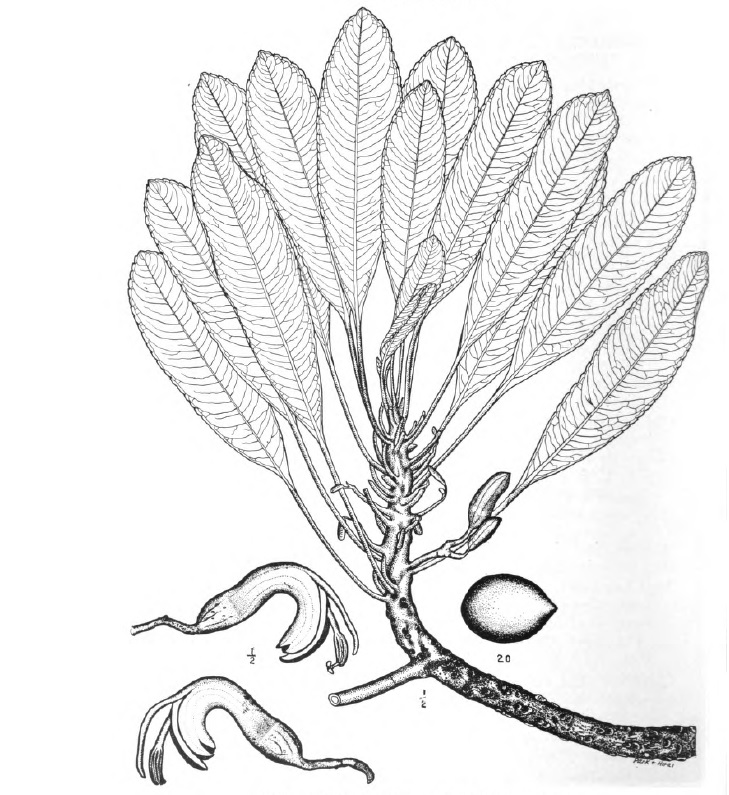
CLERMONTIA OBLONGIFOLIA Gaud. (Original) (Described on preceding page)
(© Otto Degener, 9/27/37) (Punaluu, Hawaii)
FLORA HAWAIIENSIS
LOBELIACEAE LOBELIA FAMILY
CLERMONTIA PALLIDA Hillebr. PALE CLERMONTIA
Clermontia pallida Hillebr. Fl. Haw. Isl. 241. 1888. Clermontia pallida sensu Rock in Monogr. Haw. Lobel. 319. 1919. Clermontia pallida sensu Wimmer in Engl. Pflzreich. 106 (4.276b): 91. 1943.
Glabrous 4-5 meters tall tree with branches densely leafy at tips. Leaves oblong to oblanceolate, pale green, chartaceous, dull and not shining, with apex acuminate or cuspidate, acute at base, with crenulate and callous-denticulate margin, with 10-15 cm. long 3-4.5 cm. wide blade and 7-10 cm. long petiole. Flowers on pedicels up to 20 mm. long which are bibracteolate below the middle, 3 to 7 on 8-16 mm. long peduncle; bracts paired, empty, 14 mm. long; bractlets 10 mm. long. Calyx with green hemispheric about 10 mm. long ovarial portion red-tinged, the glabrous moderately curved lobes corolla-like and 40-50 mm. long by 9-12 mm. wide. Corolla glabrous, of same size and color as calyx or slightly larger and darker. Staminal column puberulous, blue-purple, with bloom; anthers blue, glabrous. Fruit (only immature seen) globose, truncate.
Type Locality: "Molokai! on the highest ridge, near the palis of Wailau and Pelekunu."
Local Range: This haha, with such pale leaves that Hillebrand called it the species pallida, is endemic to the open rain-forests of central Molokai.
Extra Range: With its variety, peculiar to Molokai.
CLERMONTIA PALLIDA var. RAMOSISSIMA Rock
Clermontia pallida var. ramosissima Rock in Monogr. Haw. Lobel. 319. 1919. Clermontia pallida var. ramosissima sensu Wimmer in Engl. Pflzreich. 106 (4.276b): 91. 1943.
Much-branched densely leafy shrub or small tree. Leaves with lanceolate subacuminate bladee 9 cm. long and 2 cm. wide narrowing into 55-7 cm. long petiole. Flowers larger, in 2-flowered cymes having shorter pedicels and peduncle.
Type Locality: "On the cliffs of Waialeia and Waihanau a variety of the specieis is quite common ---."
Local Range: Known only from the localities mentioned above, where collected by Rock and Dunbar.
(Species illustrated on following page)
(Degener & Degener, 11/11/60) (Aided by National Science Foundation)
New Illustrated Flora of the Hawaiian Islands
LOBELIACEAE LOBELIA FAMILY
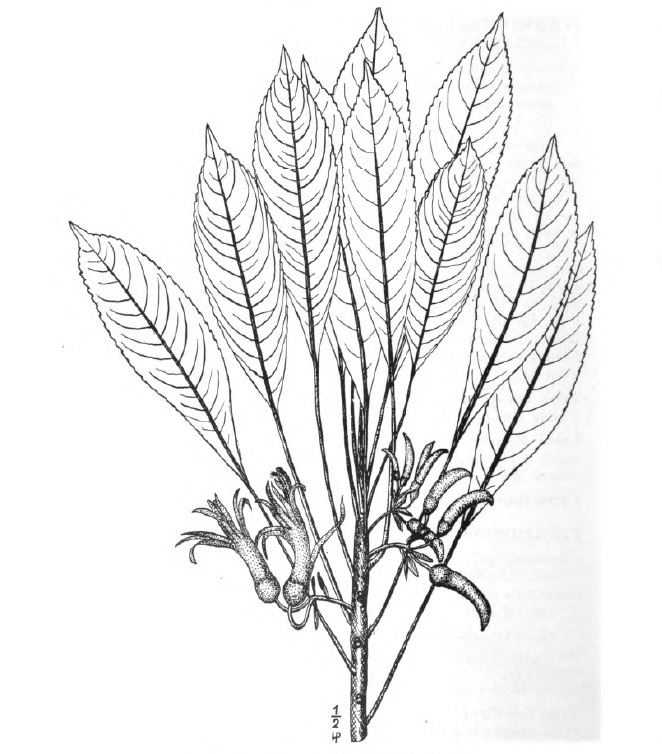
CLERMONTIA PALLIDA Hillebr. (Original) (Described on preceding page)
(Forbes, Sept. 1912, Wailau)
FLORA HAWAIIENSIS
LOBELIACEAE LOBELIA FAMILY
CLERMONTIA PARADISIA E. Wimm. PARADISE CLERMONTIA
Clermontia paradisia E. Wimm. in Engl. Pflzreich. 107 (4.276b): 761-762. 1953.
Glabrous shrub with leafy branches. Leaves about equally pale green on both surfaces, chartaceous to membranous, lanceolate-elliptic, the blade about 12 cm. long and 2 cm. wide, acute at apex, acuminate at base into slender 3 cm. long petiole, with 14-16 arcuately ascendng ribs per side extending into callus-dentate margin, with veins somewhat prominent beneath. Peduncles solitary, axillary, spreading, 2-flowered, naked, 10 to rarely 5 mm. long, subtended by subulate soon caducous bracts; pedicels 10-12 mm. long, each subtended by subulate persistent bract. Ovary oblong-cylindric, about 10 mm. long; free part of calyx as long as corolla, split dorsally to base, otherwise split about half way toward base into linear falcate lobes. Corolla about 30 mm. long, split dorsally to base, its pale green slightly curved tube 12 mm. long and 5 mm. wide; with 5 linear falcate 21 mm. long 1 mm. wide purplish lobes. Staminal column exserted, glabrous; anthers 9-11 mm. long, with the 2 lower ones bearded. Fruit globose, orange, about 15 mm wide. Seeds numerous, compressed-ellipsoid, about 0.6 mm. long.
Type Locality: "Hawaii: Kohala mountains, along ditch trail west of Kaukini Cabin, open forest."
Local Range: Discovered by Degener & Greenwell in 1952 in open forests and small gulches in the type locality and Pololu-Honokanenui region of Kohala, Hawaii. The plant is related to C. parviflora and Cl. leptoclada. The type specimen, according to a personal communication, is no. 21,880.
Extra Range: Not known elsewhere.
(Illustrated on following page)
(Degener & Degener, 3/15/56) (Aided by National Science Foundation)
New Illustrated Flora of the Hawaiian Islands
LOBELIACEAE LOBELIA FAMILY
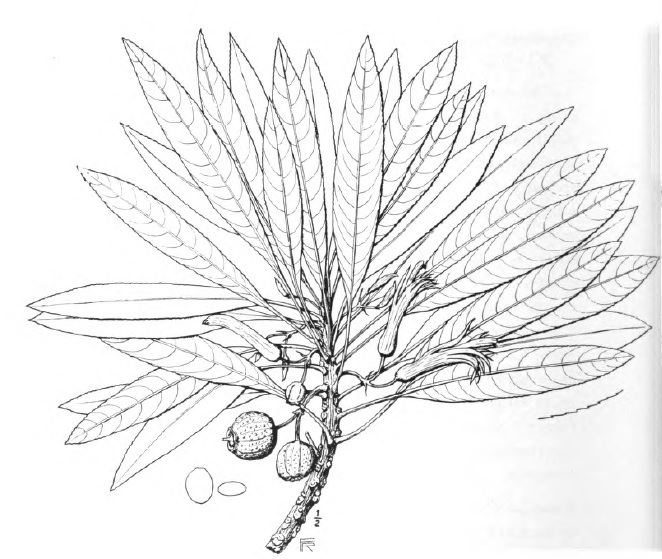
CLERMONTIA PARADISIA E. Wimm. (Original) (Described on preceding page)
(Degener & Degener, 3/15/56)(Aided by National Science Foundation)
FLORA HAWAIIENSIS
LOBELIACEAE LOBELIA FAMILY
CLERMONTIA PARVIFLORA Gaud. SMALL-FLOWERED CLERMONTIA; OHA WAI, PAPAA HEKILI
Clermontia parviflora Gaud.; A. Gray in Proc. Am. Acad. 5: 150. 1861. Clermontia oblongifolia sensu Hook. & Arn. Bot. Beech. 888. 1832. Not Clermontia oblongifolia Gaud. Bot. Voy. Uranie 459. 1826. Not Clermontia parviflora sensu Wawra in Flora 56: 47. 1873. Clermontia parviflora sensu Hilleb. et var. pleiantha Hilleb. Fl. Haw. 242. 1888. Clermontia Blinii Lévl. in Fedde Repert. Spec. Nov. 10: 156. 1911. Clermontia parviflora sensu Rock in Monogr. Haw. Lobel. 337. 1919. Clermontia parviflora sensu E. Wimm. in Engl. Pflzreich. 106 (4.276b): 92. 1943.
Much branched shrub 2-3 meters high. Leaves elliptic-oblong to rarely obovate-oblong, with blade 10-18 cm. long and 3-5.5 cm. wide, shortly acuminate and often mucronate at apex, acute at base, with petiole 2-4.5 cm. long, somewhat irregularly callus-serrulate at margin, chartaceous, dull green and glabrous above, pale and glabrate to faintly puberulent beneath. Peduncle 10-12 mm. long, glabrate, bracteate, with 3-7 suberect flowers; pedicel 8-10 mm. long, bracteolate at base and middle. Ovary 5-8 mm. long, oblong to turbinate; free part of calyx like corolla cleft to middle into 5 purplish-blue glabrate 25-40 mm. long lobes. Corolla dorsally slit to base, slightly curved, sometimes slightly shorter than calyx. Stamens glabrous; anther tube bluish. Berry subglobose, 7 mm. long, dark orange-yellow.
Type Locality: "Hawaii (and Oahu?), first collected by Macrae."
Local Range: C. parviflora and the following tentative segregates comprise one more of the many endemic species complexes that must remain imperfectly understood until far more material has been collected throughout all regions of the Island of Hawaii. It is suspected that some of the variability of this complex may be due to partial hybridization with such plants as C. montis-loa and C. waimeae As interpreted now, C. parviflora s.s., fits the above description and is peculiar to dense forests from about 600 to 3,000 feet elevation on Hawaii, having been collected repeatedly in the Kilauea region, and sporadically here and there all the way across the island to and including Kohala. It is terrestrial and epiphytic. Macrae's specimen, collected May 1825, was almost certainly collected on Hawaii though recorded as coming from Oahu.
Extra Range: Species and varieties endemic to the Island of Hawaii.
CLERMONTIA PARVIFLORA var. CALYCINA Rock
Clermontia parviflora var. calycina Rock, Indig. Trees Haw. 512. 1913. Clermontia parviflora var. calycina sensu Rock, Monogr. Haw. Lobel. 340. 1919. Clermontia parviflora var. calycina sensu E. Wimm. in Engl. Pflzreich. 106 (4.276b): 92. 1943.
Leaves obovate-oblong to oblong, cuspidate at apex, acuminate at base, with petiole 2.5-5 cm. long, slightly undulate at margin, somewhat thicker than in species. Peduncle 15 mm. long, usually 3-flowered; pedicel 8-10 mm. long, thick. Ovary about 11 mm. long, with subulate lobes 5 to rarely 18 mm. long and free at base. Corolla 35 mm. long, about 5 mm. wide, puberulent, bluish gray. Staminal column and anthers glabrous. Berry globose, 25 mm. in diameter.
Type Locality: "Hawaii: — High plateau of Kohala Mts., back of Waimea along Alakahi ditch trail, elevation 4,000 ft. (Rock no. 4793, flowering July 12, 1909)."
Local Range: Known from a few specimens collected by Rock near the type locality in 1909 and 1910.
CLERMONTIA PARVIFLORA var. GRANDIS Rock
Clermontia parviflora var. grandis Rock, Monogr. Haw. Lobel. 340. 1919. Clermontia montis Loa var. tenuifolia Skottsb. in Acta Hort. Gotob. 2: 29. 1926. Clermontia parviflora forma sensu Skottsb. in Acta Hort. Gotob. 15: 489. 1944. Clermontia parviflora var. grandis sensu E. Wimm. in Engl. Pflzreich. 106 (4.276b): 92. 1943.
Differing from the species in having flowers 45 mm. long, including ovarian portion of calyx, and fruit almost 30 mm. in diameter.
Type Locality: None given.
Local Range: Collected by Skottsberg in 1922 in the "Kohala Mts. above Kamuela, in wet forest c. 1100m." and by Rock apparently in the same general region some years previously. Perhaps it is largely hybridized with C. montis-loa or C. waimeae.
CLERMONTIA PARVIFLORA var. INTERMEDIA Skottsb.
Clermontia parviflora var. intermedia Skottsb. in Acta Hort. Gotob. 15: 489. 1944.
Leaves with blades 7-9 (12) cm. long and 2.5-3.5 (4.5) cm. wide, elliptic-lannceolate, below especially along nerves sparingly puberulent, with 1.5-2.5 (4) cm. long petiole. Peduncle 8-15 mm. long, 2-flowered. Corolla 30-35 mm. long.
Type Locality: None given, hence we select "Hawaii: Kohala Mts., above Kamuela (Skottsb. 1136)."
Local Range: This variety has been collected only by Skottsberg in the Kohala Mountains as, for example, at the type locality, along the Upper Hamakua ditch trail between Koiawa and Alakahi Valleys, and at the headwaters of Waipio Valley. It closely resembles C. montis-loa except for the leaves.
CLERMONTIA PARVIFLORA var. UMBRATICOLA Skottsb.
Clermontia parviflora var. umbraticola Skottsb. in Acta Hort. Gotob. 2: 270. 1926.
Differs from the species in having leaves longer acuminate and more slender, having mostly 5-flowered peduncles etc. less hairy and having flowers lilac-brown without and creamy white within.
Type Locality: "Hawaii: Hilo, Hiulani forest SW. of Olaa, c. 500 m, epiphytic and growing at a considerable distance from the ground, fl. 8/9 (n. 434)."
Local Range: Known only from the type specimen collected by Skottsberg in 1922.
(Degener & Degener, 8/20/56) (Aided by National Science Foundation)
New Illustrated Flora of the Hawaiian Islands
LOBELIACEAE LOBELIA FAMILY
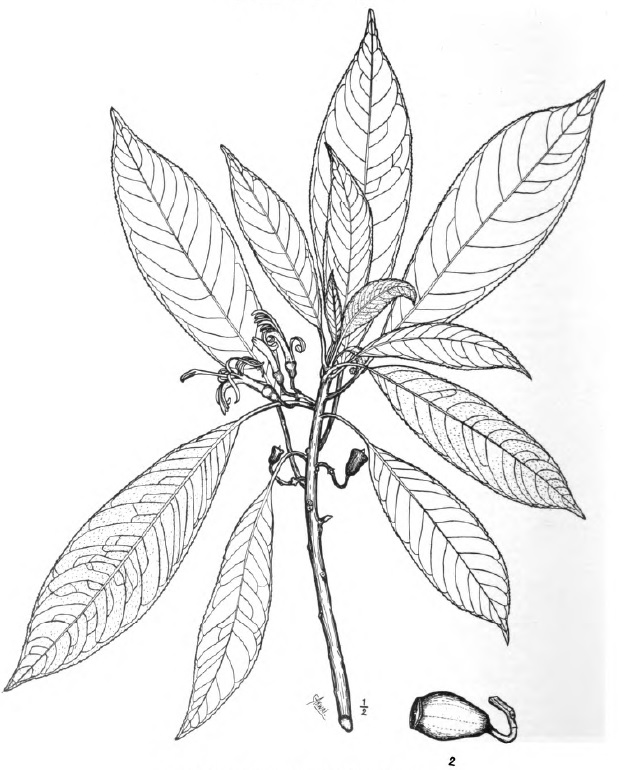
CLERMONTIA PARVIFLORA Gaud. (Original) (Described on preceding page)
(Degener & Degener, 8/20/56)(Betw. Glenwood & 29 Miles)
FLORA HAWAIIENSIS
LOBELIACEAE LOBELIA FAMILY
CLERMONTIA PELEANA Rock PELE CLERMONTIA
Clermontia peleana Rock in Indig. Trees Haw. Isl. 483. 1913. Clermontia peleana sensu Rock in Monogr. Haw. Lobel. 297. 1919. Clermontia peleana sensu Wimmer in Engl. Pflzreich. 106 (4.276b): 94. 1943.
Glabrous tree or shrub mostly epiphytic, up to 6 meters tall. Leaves oblong, short-acuminate, acute at base, irregularly crenulate and denticulate except toward base, above dark green, below somewhat paler, with purple ribs and veins, subcoriaceous, with blade 18-20 cm. long by 3.5-4.5 cm. wide and 4-6 cm. long petiole. Flowers usually 2 per cyme, on 30-40 mm. long pedicels bibracteolate at base, borne on 15 mm. long peduncle linear-bibracteate at middle. Calyx with dark green ovarial portion campanulate, 15-20 mm. thick, with lobes minute. Corolla curved almost circular at anthesis, black purple, 40-50 mm. long, thin and not fleshy. Stamens dark purple, glabrous, the two lower anthers penicillate and 16 mm. long. Style glabrous, with bluntly 2-lobed stigma. Berry globose, orange-yellow, about 30 mm. thick, truncate at apex. Seeds chestnut brown, shiny, about 1 mm. in diameter.
Type Locality: "It was discovered by the writer on the Island of Hawaii, in the middle rain forest zone, at an elevation of 3800 feet, four or five miles below Kilauea volcano, along the government road. Only three plants were observved, one of which had never flowered. ... It is named after the Hawaiian goddess Pele, whose abode is in the files of Kilauea, in the vicinity of which this tree grows."
Local Range: Discovered by Faurie at "Hilo", Hawaii. Rock, in his fascinating monograph, mentions that the tallest examples "were seen in the uppermost forks of giant Metrosideros collina (Ohia lehua) trees in the wet forest at an elevation of 2500 to 3000 feet; it is an exceedingly handsome species on account of its symmetrical growth, dark green glossy leaves with deep purple venation and dark purplish-black flowers. — Like Cl. Haleakalensis, Cl. Peleana is soon to be a thing of the past. It inhabits the tallest Ohia lehua trees, which, deprived of their native undergrowth, are ready to fall to their death, and with them this interesting Clermontia."
Extra Range: Not known elsewhere.
(Illustrated on following page)
(Degener & Degener, 11/11/60) (Aided by National Science Foundation)
New Illustrated Flora of the Hawaiian Islands
LOBELIACEAE LOBELIA FAMILY
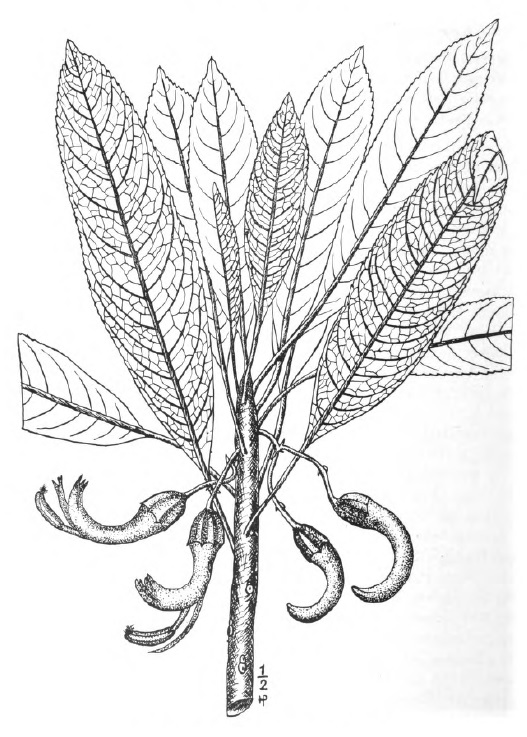
CLERMONTIA PELEANA Rock (Original) (Described on preceding page)
(Faurie 577, Rock 8800)
FLORA HAWAIIENSIS
LOBELIACEAE LOBELIA FAMILY
CLERMONTIA PERSICIFOLIA Gaud. PEACH-LEAVED CLERMONTIA
Clermontia persicifolia Gaud. Bot. Voy. Freyc. 459. 1826. Lobelia persicifolia Endl. Fl. Suedsee, n. 1061. 1836. Clermontia persicifolia sensu A. DC. Prodr. 7:342. 1839. Clermontia grandiflora var. oblongifolia A. Gray in Proc. Am. Acad. 5:150. 1861. (In part.) Clermontia parviflora sensu Wawra in Flora 56:47. 1873. Clermontia persicifolia sensu Hilleb. Fl. Haw. Isl. 241. 1888. Clermontia epiphytica* St. John in Occas. Pap. B.P.Bishop Mus. 15(2):21-22, 29. 1939. Clermontia persicifolia sensu E. Wimm. in Engl. Pflzreich. 106 (4. 276b):86. 1943. Clermontia epiphytica sensu E. Wimm. in Engl. Pflzreich. 106 (4. 276b):91. 1943. Clermontia persicifolia sensu Skottsb. in Acta Hort. Gotob. 15:490. 1944.
Quick-growing shrub or small tree 5-6 meters high with broad candelabra-like spreading leafy crown and smooth green bark becoming grayish brown and longitudinally fissured with age. Leaves lanceolate or obong to broadly oblanceolate, acute to obtuse and down-curved at apex, acuminate at base, glabrous, somewhat brittle-coriaceous, glossy, dark green above, pale and conspicuously veined below, coarsely and shallowly crenate to serrulate except toward entire base, the blade 6-15 cm. long and 1-3 cm. wide, on 4-6 cm. long petiole. Peduncle 10-14 mm. long, with a pair of bracts below the middle; pedicels usually 2, bibracteolate at or near base, 12-20 mm. long. Calyx and corolla slender, greenish when young, whitish to white with purplish tinge at anthesis, 55 mm. long, 68 mm. wide, slightly curved. Staminal column glabrous, greenish white; anthers whitish, glabrous, the lower 3 bearded. Berry subglobose, orange-yellow 3 cm. in diameter, with 10 green ribs. Seeds shiny, compressed-globose, about 0.8 mm. long.
Type Locality: "Iles Sandwich," on Gaudichaud's herbarium sheet.
Local Range: This handsome lobelia, mentioned by Rock as growing either terrestrially or epiphytically on Metrosideros trees," is endemic to the rainier forests of Oahu. It is the most common Clermontia of the Koolau Range but rather rare in the Waianae Range. Rock's and Wimmer's references to this species growing also on Lanai are based on A. S. Hitchcock's plant No. 14,643, apparently labeled by him in error as having been collected on Lanai: Upper forests of the mountains, September 21, 1916. We believe Hitchcock actually collected it on Oahu. Mr. G. C. Munro, to whom we owe so much of our knowledge of the flora of Lanai, states in a personal communcation dated November 25, 1955: "I am not familiar with Clermontia persicifolia, in fact I know little of the Lobelia family on Oahu but I do know those of Lanai. I also know that Hitchcock collected only those I know on Lanai as I guided him over the top of Lanai and pointed out the various Clermontias that he collected from there I was aware that he had got a label mixed and had reported a Clermontia as from Lanai that did not belong there but I don't think I ever called his attention to or reported it. But I am sure I have a record of it somewhere and anyway I can look up his report on Lanai plants and find just what it was. I thought it was a Maui plant but perhaps it was an Oahu one. I shall look it up and let you know Anyway I am quite sure that he had a Clermontia listed as collected on Lanai that was not collected there. Hitchcock and his son were our guests while he was on Lanai and I accompanied him I think everywhere he went."
Extra Range: Limited to Oahu.
____________
* Wimmer, unable to study a specimen of C. epiphytica and unable properly to distinguish this plant from C. persicifolia in his key, merely upheld this binomial on the basis of St. John's publication. Furthermore, according to Skottsberg, "From the description and plate I cannot find out how C. epiphytica St. John - - - differs from C. persicifolia; the small berries must have been immature, as the seeds are said to be white." As in the case of Scaevola, St. John goes too far afield to find the closest relative of his C. epiphytica when he states that its "closest relative is Clermontia micrantha (Hbd.) Rock of west Maui and Lanai, - - -." His specimens are actually Cl. persicifolia.
(Illustrated on following page)
(Degener & Degener, 10/26/56) (Aided by National Science Foundation)
New Illustrated Flora of the Hawaiian Islands
LOBELIACEAE LOBELIA FAMILY
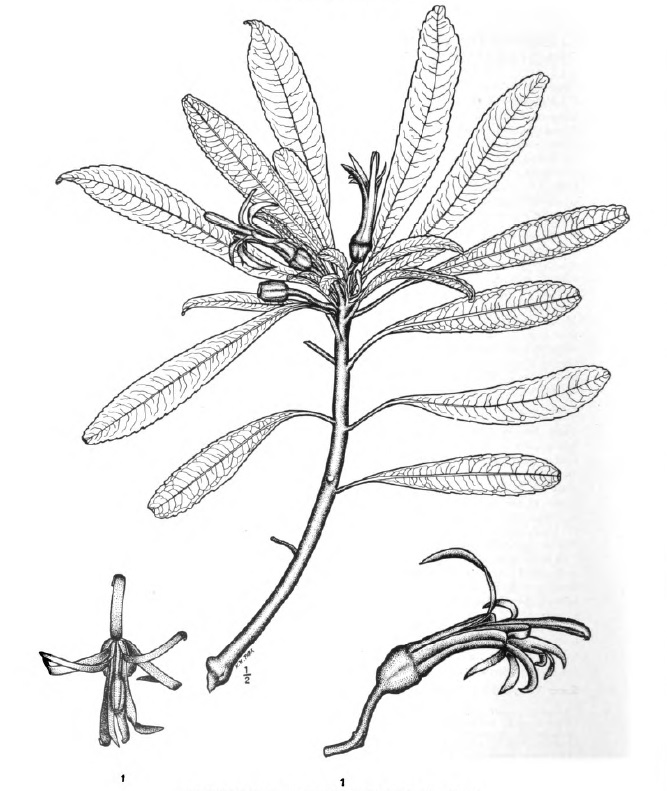
CLERMONTIA PERSICIFOLIA Gaud. (Original) (Described on preceding page)
(Degener & Degener, 10/26/56) (Halawa, Oahu)
FLORA HAWAIIENSIS
LOBELIACEAE LOBELIA FAMILY
CLERMONTIA PYRULARIA Hillebr. PEAR CLERMONTIA
Clermontia pyrularia Hilleb. Fl. Haw. Isl. 243. 1888. Clermontia pyrularia sensu Rock Monogr. Haw. Lobel. 303. 1919. Clermontia pyrularia sensu Wimmer in Engl. Pflzreich. 106 (4. 276b):94. 1943. Clermontia pyrularia sensu Wimmer in Engl. Pflzreich. 107 (4. 276b):762. 1953.
Branching tree up to 3 meters tall. Leaves lanceolate to oblanceolate, acute and mucronate at apex, gradually narrowed into puberulous 2-3 cm. long petiole, margin callous-serrulate, chartaceous, dull, above glabrous, below pale and white-pubescent, the blade 18-25 cm. long and 4.5- cm. wide. Flowers white, on 1-2 cm. long puberulous pedicels bibracteolate at base, mostly 2 or 3 but sometime 4-6 or rarely only 1 on 25-60 mm. long spreading to somewhat pendent puberulous peduncle. Calyx with oblong-turbinate 14-20 mm. long puberulous 10-ridged ovarial part bearing subulate obtuse lobes up to 4 mm. long. Corolla moderately curved, 45 mm. long and 6-8 mm. wide, puberulous, Stamens glabrous, with anthers 3 mm. long. Fruit "pear-shaped," 20-25 mm. long and 12-16 mm. thick, Seeds dark brown, shiny.
Type Locality: "Hawaii! woods of Hamakua."
Local Range: This strangely hairy clermontia with allegedly pear-shaped fruit, responsible for its trivial name, was discovered by Hillebrand. It was later collected by Forbes, at Puu Huluhulu (of which there are several on the Island of Hawaii); by Hitchcock on Mauna Kea at 2,100 meters elevation; and by Degener, Greenwell and associates in 1949 in the open forest near the pit where David Douglas was murdered, and at about 1,200 meters in the koa and other forests at Papaloa and elsewhere mauka of Kealakekua.
Extra Range: Apparently endemic to central Hawaii.
(Illustrated on following page)
(Degener & Degener, 8/8/60) (Aided by National Science Foundation)
New Illustrated Flora of the Hawaiian Islands
LOBELIACEAE LOBELIA FAMILY
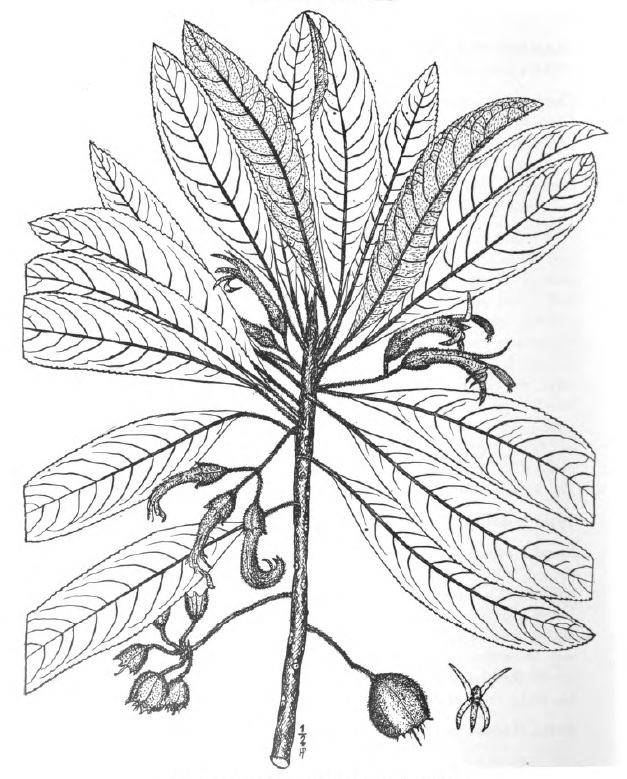
CLERMONTIA PYRULARIA Hillebr. (Original) (Described on preceding page)
(Degener 19,615, Papaloa)
FLORA HAWAIIENSIS
LOBELIACEAE LOBELIA FAMILY
CLERMONTIA SAMUELII C.N.Forbes BALDWIN CLERMONTIA
Clermontia samuelii C.N.Forbes in Occas. Pap. B.P.Bishop Mus. 7: 37 1922. Clermontia samuelii sensu E.Wimm. in Engl. Pflzreich. 106 (4. 276b):88. 1943.
Shrub 12-18 cm. high, much branched from base with branches densely covered with brownish pubescence which was purple on new growth. Leaves obovate to oblanceolate-obovate, at apex acute to shortly subacuminate with minutely rounded tip, at base acute to cuneate, crenulate with callous teeth, densely soft whitish hirtellous above, somewhat paler beneath, rather thick-chartaceous when dry, pubescent petiole 15-25 mm. long. Flowers slightly falcate, in 2- to 5-flowered raceme or flower rarely single, the hirtellous 6-12 mm. long peduncle marked by scars and 1 or more pairs of linear bracts 3 mm. long; pedicels filiform, hirtellous, 12-20 mm. long, with subulate bracts near base. Calyx with ovarian portion obconic, bright green, 11 mm. long; the remainder delicate purplish-pink, thin, glabrous to glabrate, slightly shorter than corolla, the upper linear acuminate lobes splitting to near base, the lower linear acuminate lobes splitting one-third the distance of tube. Corolla 40-46 mm. long, 6 mm. wide, glabrous to glabrate, slightly paler than calyx. Staminal column with glabrous filaments colored like corolla; anthers 10 mm. long, glabrous, dark purple, the 2 lower penicellate. Style and stigma light-green. Mature fruit unknown.
Type Locality: "While collecting botanical specimens on the northern slope of Haleakala, Maui, T.H., between Keanae Gap and Kipahulu, at an elevation of about 6500 feet, the writer observed a very beautiful species of an undescribed Clermontia, in the dense rain forest a short distance west of an old cone called Wai Anapanapa." ... "collected by C.N.Forbes on the north slope of Haleakala, Maui, T.H. at an elevation of 6500 feet on the west of Waianapanapa, August 22, 1919."
Local Range: This species, named in honor of Samuel A. Baldwin, is known only from the original collections made by Forbes. He saw but two trees, leaning on other trees "amongst dense tangle of shrubbery and branches."
Extra Range: Not known elsewhere.
(Illustrated on following page)
(Degener & Degener, July/31/1958) (Aided by National Science Foundation)
New Illustrated Flora of the Hawaiian Islands
LOBELIACEAE LOBELIA FAMILY
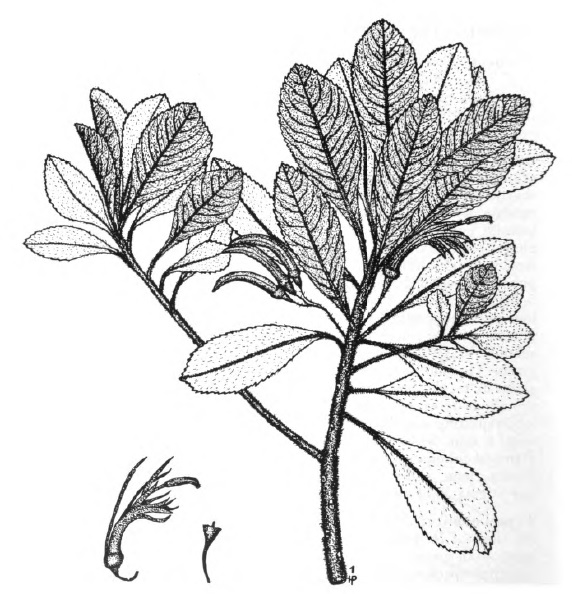
CLERMONTIA SAMUELII C.N.Forbes (Original) (Described on preceding page)
(Forbes 1225 M, Haleakala, Maui)
FLORA HAWAIIENSIS
LOBELIACEAE LOBELIA FAMILY
CLERMONTIA TUBERCULATA C.N.Forbes WARTY CLERMONTIA
Clermontia tuberculata C.N.Forbes in Occas. Pap. B.P.Bishop Mus. 5: 8. 1912. Clermontia tuberculata sensu Rock in Indig. Trees Haw. Isl. 485. 1913. Clermontia tuberculata sensu Rock, Monogr. Haw. Lobel. 291. 1919. Clermontia tuberculata sensu Wimmer in Engl. Pflzreich. 106 (4. 276b):93. 1943.
Many branched 4-5 meter tall tree. Leaves broad-oblanceolate to obovate- or spathulate-oblong, somewhat cuspidate at apex, acuminate at base, thick, brittle, coriaceous, crenate-serrulate, above dark green, below paler and minutely hirtellous along minutely tuberculate nerves or glabrate, with 15-20 cm. long by 3-4.5 cm. wide blade and 2-5.5 cm. long petiole which bears small scattered tubercles. Flowers 2 per peduncle. Calyx tuberculate without, with semi-ovoid to campanulate 17 mm. long ovarial portion and 3 mm. long obtuse segments. Corolla fleshy, reddish-tuberculate without, dark rich reddish within, curved mostly toward distal third, 35-50 mm. long. Staminal tube purple, glabrous; anthers dark red, glabrous. Berry globose, glabrous, verrucose, 13 mm. in diameters. Seeds ovoid, yellow, shiny, smooth.
Type Locality: "... wet woods on the slopes of Haleakala, Maui, to the east of and between Olinda and Ukulele."
Local Range: Discovered by Forbes in 1910. It is peculiar to the dense forest at about 5,000 feet elevation along the northern outer slope of Haleakala, Maui. This striking plant should be brought into the gardens of warmer regions of the World to save it from extermination by the spreading Florida blackbery and the present budding lumber industry.
Extra Range: Not known elsewhere.
(Illustrated on following page)
(Degener & Degener, 12/28/60) (Aided by National Science Foundation)
New Illustrated Flora of the Hawaiian Islands
LOBELIACEAE LOBELIA FAMILY
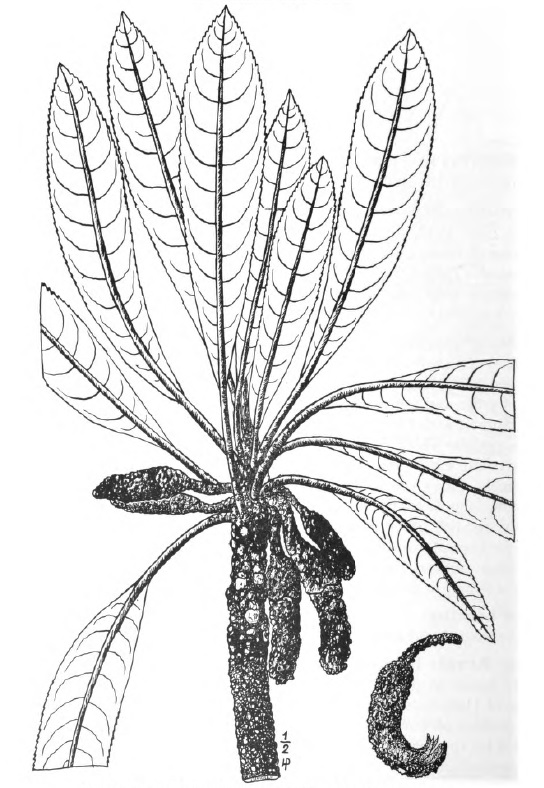
CLERMONTIA TUBERCULATA C.N.Forbes. (Original) (Described on preceding page)
(Forbes 201 M, Haleakala)
FLORA HAWAIIENSIS
LOBELIACEAE LOBELIA FAMILY
CYANEA ACULEATIFLORA Rock HĀHĀNUI; PRICKLY-FLOWERED CYANEA
Cyanea solenocalyx var. schizocalyx Hillebr. Fl. Haw. Isl. 258. 1888. Cyanea aculeatiflora Rock, Indig. Trees Haw Isl. 509. 1913. Cyanea aculeatiflora sensu Rock. Monogr. Hawl. Lobel. 23, 51, 61, 77, 79, 84, 87, 96, 187. 1919 Not Cyanea aculeatiflora sensu Skottsb. in Acta Horti Gotob. 2: 265. 1926; see also under C. atra. ibid. 15: 485. 1944. Cyanea aculeatiflora sensu Wimm. in Engl. Pflzreich. 106. (4. 276b): 10, 47, 55. 1943.
Trunk 3-7 meters tall, erect, single (or due to injury of terminal bud rarely several), covered with leafy scars especially prominent toward loosely leafy crown; juvenile trunk prickly but with age becoming muricate to finally unarmed; larger prickles up to 5 mm. long and horizontally half as wide, inflated, spreading to assurgent, acrid-mucronate. Leaves oblong, thick, stiff, above dark green and somewhat scattered muricate especially on veins, beneath paler and densely tawny tomentose-hispid throughout and on veins sparsely finely muricate, entire to irregularly sinuate along irregularly yellow-denticulate margin, acute to rarely obtuse at base, rounded with cuspidate apex, with blade 30-60 cm. long and 10-22 cm. wide, with midrib beneath and 10-15 cm. long thick fleshy petiole muricate; juvenile leaves deeply bipinnatisect, prickly on both sides but hispid only on lower side. Inflorescence densely muricate and prickly, not pubescent; flowers on 1-2 cm. long pedicels borne on 4-10 cm. peduncle with foliaceous 2-4 cm. long bracts scattered along entire length. Hypanthium turbinate, with oblong 1-2 cm. long muricate and hispid tube bearing linear obtuse 5 mm wide and 10-25 mm. long outwardly muricate lobes with prominent midrib. Corolla slightly curved, dark purple without, 7 cm. long, muricate and hispid without; tube 5 cm. long; lobes spreading-recurved, linear, somewhat obtuse at apex, muricate without, smooth and pale bluish within. Staminal column purple, glabrous, somewhat longer than tube; anthers dark purple, glabrous, only the lower two bearded. Style thickened toward the shortly bilobed hirsute stigma. Fruit (according to G. C. Munro) "rusty reddish on outside."
Type Locality: "Maui: — Northwestern slopes of Haleakala in dense rain forest along streams or swampy ground, terrestrial, from Waikamoi to Honomanu gorge, elev. 4000 ft.; flowering Sept., 1910, no. 7513, type Herb., Board of Agriculture & Forestry, T.H. It grows in company with Clermontia arborescens, Cyanea hamatiflora, Tetraplasandra, etc. The young plants are covered with spines throughout while the trunk of old ones is prickly only at the base."
Local Range: A specimen of this species, outstanding by being prickly when mature, was collected by Lydgate (No. 27) "in Hamakua, E. Maui, at an elevation of 3000-4000 ft.," a hundred or more years ago. It was described by Hillebrand "with hesitation" as C. solenocalyx var. schizocalyx. As much of this primeval rainforest has been long replaced by range grasses and exotic weeds, the area is hardly habitable for this cyanea any longer. Since 1910, according to written records and specimens available to us, C. aculeatiflora has been collected about two dozen times by Degener, Forbes, Hitchcock, Munro, Neal & Hartt, Rock & Hashimoto, and Skottsberg in a belt of rain-forest, not much cluttered with underbrush, between about 3,000 and 5,000 feet elevation, from Waikamoi around the northern slope of Haleakala to mountains "back of Hana." Wimmer's statement that the species occurs also on West Maui is obviously an error. Remaining armed throughout life appears to be a primitive characteristic that other species, prickly in the juvenile state, outgrow with maturity. C. aculeatiflora is archaic.
Extra Range: Not known elsewhere.
(Illustrated on following page)
(Degener & Degener, 5/1/66) (Aided by Irma Degener)
New Illustrated Flora of the Hawaiian Islands
LOBELIACEAE LOBELIA FAMILY
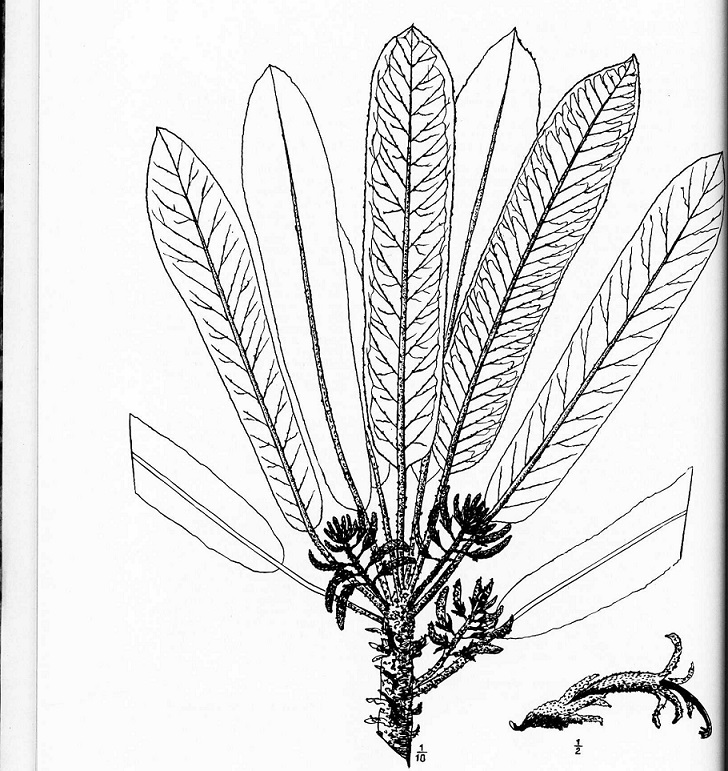
CYANEA ACULEATIFLORA Rock (Original) (Described on preceding page)
(Degener 7980)
FLORA HAWAIIENSIS
LOBELIACEAE LOBELIA FAMILY
CYANEA ACUMINATA (Gaud.) Hilleb. ACUMINATE-LEAVED CYANEA
Delissea acuminata Gaud. Voy. Freyc. Bot. 457, pl. 76. 1826. Cyanea acuminata Hilleb. Fl. Haw. Isl. 254. 1888.
Stem simple and erect or sparingly branched, 13-16 dm. high. Leaves broad-oblong, acuminate at both ends, dark green above, whitish beneath, puberulous on both surfaces especially beneath with the pubescence on lower surface concentrated chiefly along veins and veinlets while on upper surface more evenly scattered, flaccid, thin-chartaceous, entire or faintly denticulate, 14-30 cm. long, 4-7 cm. wide, on petioles 2-7 cm. long. Peduncles numerous along the stem for about 18 cm., in the axils of leaves that have or have not fallen, 2.5-6 cm. long, upright at about 45°, often somewhat narrowed at base, puberulous, either naked or covered with knobby scars from the base, bearing from 5-20 flowers near the apex; pedicels slender, puberulous, 1 cm. long, with subulate 8-12 mm. long bracts and minute deciduous bractlets. Calyx faintly pubescent, greenish, with 4-5 mm. long tube and narrow acute lobes 2-3 mm. long. Corolla white or sometimes with a slight bluish tinge, puberulous, suberect, about 3 cm. long, 4 mm. broad and 3 mm. wide, with dorsal slit extending to near slightly swollen base. Staminal column white, pubescent; anthers blue to purplish red, subequal, about 6 mm. long, hirsute with whitish hair, only the 2 lower bearded. Pistil glabrous, exceeding anthers by 3-4 mm.; stigma glabrous, bluntly lobed, greenish. Berry subglobose, truncate, yellow, 9 mm. long and 6 mm. wide. Seeds pale.*
Type Locality: None given.
Local Range: In the rainier forests of the Koolau Range, Oahu. Collected in Manoa, Moanalua, Nuuanu, Pauoa and Punaluu Valleys.
Extra Range: Apparentely endemic to the Koolau Range of Oahu. A specimen collected on Mt. Kaala, Oahu and described by Wawra as the variety latifolia evidently is not related to the species. The specimen was in such fragmentary condition when studied by J. F. Rock that its affinity could not be ascertained.
* Rock's description emended to include Degener, Park & Nishina No. 4107, Punaluu, Oahu, Aug. 11. 1931.
(Illustrated on following page)
(Degener & Degener, 6/30/32)
New Illustrated Flora of the Hawaiian Islands
LOBELIACEAE LOBELIA FAMILY
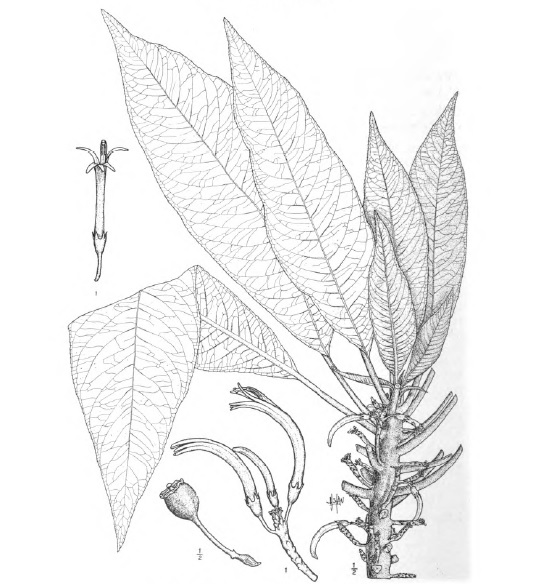
CYANEA ACUMINATA (Gaud.) Hilleb. (Original) (Described on preceding page)
(© Degener & Degener, 6/30/32) (Punaluu)
FLORA HAWAIIENSIS
LOBELIACEAE LOBELIA FAMILY
CYANEA ATRA Hilleb. BLACK-FLOWERED CYANEA
Cyanea atra Hilleb. Fl. Haw. Isl. 263. 1888.
Shrub with 13-20 dm. tall usually unbranched trunk tuberculate in upper portion. Leaves broadly lanceolate to obovate-oblong, crenulate, coriaceous, with prominent nerves, the blade 40-50 cm. long and 7.5-14 cm. wide, pubescent beneath with somewhat olivaceous hair, papillose above, acute at apex, gradually tapering into thick muricate 5-8 cm. long petiole. Peduncle short, 15-20 mm. thick. 4- to 10-flowered, the pedicels 10-25 mm. long and bearing near middle 3 mm. long bractelets; bracts 6-15 mm. long, 2 mm. wide. Calyx purplish-black as is corolla, pubescent to hirsute, with 15 mm. long cylindrical tube and with thick oblong obtuse mucronate to emarginate 1-nerved lobes of variable length but usually about 2 cm. long. Corolla suberect, purplish-black and hirsute with reddish-brown hair, with linear lobes. Staminal column dark purple, hispid (or glabrous?), the 2 lower anthers bearded. Berry ovoid, 2-2.5 cm. long, orange, densely gray-tomentose. Seeds pale yellow.
Type Locality: "W. Maui! back of Lahaina, Wailuku (3000-4000 ft.)".
Local Range: This rare species is peculiar to West Maui, growing in the dense forest above about 3,000 feet elevation Besides having been collected in the type locality, it has been found in Honokawai Gulch back of Kaanapali, in Honokahau Valley, on on Puu Kukui.
Extra Range: The species and its single variety are limited to Maui.
CYANEA ATRA var. LOBATA Rock
Cyanea atra var. lobata Rock, Indig. Trees Haw. 511. 1913.
Unbranched shrub. Leaves coriaceous, subentire to more often irregularly coarsely serrate-dentate or subirregularly lobed and then with margins sinuate-dentate, rough-tuberculate above, olivaceous-pubescent beneath, with 6-7 cm. long muricate petiole.
Type Locality: "Maui: Upper ditch trail leading from Ukulele, elevation 5000 ft. to Waikamoi gulch in dense rain forest. Only few plants observed, when in company with Mr. L. v. Tempsky of Makawao."
Local Range: Known only from the type locality.
(Variety illustrated on following page)
(Otto Degener, 12/21/38)
New Illustrated Flora of the Hawaiian Islands
LOBELIACEAE LOBELIA FAMILY
CYANEA ATRA var. LOBATA Rock (Original) (Described on preceding page)
(Otto Degener, 12/21/38) (Cotype)
FLORA HAWAIIENSIS
LOBELIACEAE LOBELIA FAMILY
CYANEA BALDWINII Forbes & Munro BALDWIN CYANEA
Cyanea Baldwinii Forbes & Munro in Occas. Pap. B.P.Bishop Mus. 7:43.1920.
Shrub 15 dm. high but beginning to flower when only 5 dm. high, branching from base with age. Leaves obovate-elliptic, acute and mucronate at apex, narrowed to about 15 mm. wide subtruncate base, rather regularly and acutely sinuate into about 20-25 commonly 15 mm. long pairs of teeth which are themselves repand and beset with yellowish ends of veins, above glabrous and dark green, below pale and sparingly scabrous on veins and veinlets, with 7-9 cm. long petiole and lower side of midrib scabridulous with forward-pointing pubescence and muricate with thickish forward-pointing fleshy projections up to 3 mm. long, with blade 30-40cm. long and 11-14 cm. wide. Racemes with upper half bearing up to 10 spreading-upright flowers; peduncle 1.5-5 cm. long, shiny, green to dark purple, smooth to sparingly muricate; pedicels shiny, entirely purplish or toward base greenish, 2-3.5 cm. long, beset with short forward-pointing linear hair arising from muricate base, in axil of linear-lanceolate 5-10 mm. long green bract and bearing 2 opposite or subopposite bractlets below middle. Calyx shiny, the narrowly obconic glabrate purplish 12-15 mm. long and 8 mm. wide tube slightly longitudinally wrinkled and sparingly muricate; lobes shiny, green with usually purplish tinge about midrib, glabrous, entire, subequal with the upper one slightly longer, oblong to oblong-elliptic, 10-15 mm. long and 36 mm. wide mucronate at rounded to somewhat acute apex. Corolla curved, purple, about 6 cm long, not muricate, glabrous within, lower third sparingly white-pilose without and remainder glabrous except along midrib and line between ribs which are beset with whitish hair, the tube about 5 mm. thick and 10 mm wide, the lobes narrow and on inner surface pale along margins. Staminal column glabrous, 75 mm. long the filaments pale purple and the 11-12 mm. long anthers very dark purple but all tufted at apex with long stiff hair. Style purplish; stigma whitish. Fruit orange. Seeds smooth, dark brown, lenticular, about 0.3 mm. in diamenter.
Type Locality: "Collected at Lanaihale, Lanai, Hawaii, September 1919, at an elevation of about 3000 feet, by G. C. Munro."
Local Range: Another Hawaiian plant on the verge of extinction! Extracts from G. C. Munro's letter, dated Sept. 2, 1935, are worth quoting: "— collected when flowering in September 1919, at the foot of Puu Aalii on the main ridge of Lanai, at about 2750 feet elevation. I had seen it some months before when riding past with Mr. Frank Baldwin*. I thought at the time it was a different plant, rare to that locality. Later I visited it but it was not in flower but in September I secured the specimen from which Forbes described it. On September 10, 1927 I collected by No. 207 of the collection made by me for the Hawaiian Sugar Planters Experiment Station. It was then beginning to flower. Again on February 10, 1928 I collected No. 302 when it was fruiting and had some flowers. From 1919 to 1934 I searched many times for other plants of this species but found none on Lanai in that time. So that the original plant is the only one so far discovered in nature despite much combing of the Lanai woods and always on the lookout for it. As found it was a branched straggling shrub with one of the branches taking root again in the ground. It was mixed in with ieie vine and other plants. The original plant was alive in 1934. Shoots were taken off from near the root and planted out on the summit of Lanaihale at 3370 feet and Waikeakua 2250 feet. At the last place they grew to about five feet high, flowered and fruited but at Lanaihale they grew much slower and had not flowered in 1934. A number of plants grew well, flowered and fruited at Tantalus, Oahu, 1500 ft., but the finest died in 1934 when in full flower from a disease of the stem below the ground. These plants grew with a single stem till they flowered when they put out shoots from near the roots." In September 1935 Mt. Munro took me to his Tantnalus home, best described as surrounded by a private botanical garden, where I had the opportunity to study his two remaining specimens and had the accompanying illustration drawn. On a second visit two weeks later one plant, its root decayed, was found dying.
Extra Range: Endemic to Lanai. At the present writing no more than four plants of this ornamental species are in existence.
(Illustrated on following page)
_________
* Manager of the Hawaiian Commercial and Sugar Co., and at one time represented the owners of the Lanai Cattle Range. He is the nephew of D. D. Baldwin, ardent collector of the last century.
(Otto Degener, 1/15/36)
New Illustrated Flora of the Hawaiian Islands
LOBELIACEAE LOBELIA FAMILY
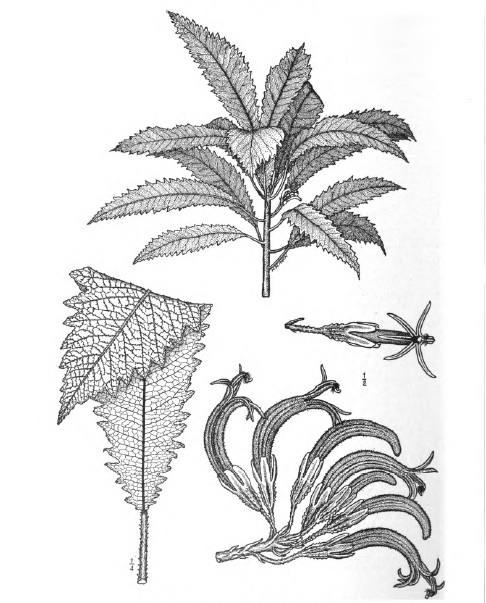
CYANEA BALDWINII Forbes & Munro (Original) (Described on preceding page)
© Otto Degener, 1/15/36
FLORA HAWAIIENSIS
LOBELIACEAE LOBELIA FAMILY
CYANEA CORIACEA (A.Gray) Rock LEATHERY-LEAVED CYANEA
Delissea coriacea A. Gray in Proc. Am. Acad. 5: 147. 1861. (Excluding var. b.) Cyanea coriacea Rock in Bull. Torr. Bot. club 44: 237. 1917. Cyanea coriacea sensu Rock, Monogr. Haw. Lobel. 207. 1919. Cyanea coriacea sensu E. Wimm. in Engl. Pflzreich. 106 (4.276b): 72. 1943.
Shrub up to 5 meters high, simple or (mainly when injured) sparingly branched, with stem up to about 10 cm. thick. leaves thick-coriaceous, with about 13 ribs per side, entirely glabrous, pale green, especially below, conspicuously reticulate, with blade oblong to lanceolate, 28-32 c. long, 5-8 cm. wide, with apex obtuse to somewhat acute, with acute base narrowing into 8-12 cm. long petiole, with margin callus-denticulate. Peduncles erect to spreading, 2-5 cm. long, toward base naked but toward top bearing many flowers on 15-20 mm. long pedicels. Ovary campanulate, crowned with 5 dentiform calyx lobes or these obsolete. Corolla purplish, little curved, 25 mm. long, glabrous. Staminal column glabrous; anthers 5 mm. long, the 2 lower ones bearded.
Type Locality: "Kauai, Remy"
Local Range: First collected in 1851-55 by Remy somewhere on Kauai, and next in 1915 by V.W.Hardy in the Waioli River Basin at 500-700 feet (not "5,000-7,000" as misprinted in Bull. Torr. Bot. Club). Thereafter it was found by Faurie at Wainiha, and by St. John & Fosberg on the Hoary Head Range.
Extra Range: Not known elsewhere. Our knowledge of this Kauai assemblage of plants centering about Cyanea coriacea will remain woefully incomplete until more material is collected and made available for study. There are transitional forms between some of the taxa of C. coriacea here named, and even transitional forms between these taxa and C. angustifolia var. racemosa, native chiefly to the Waianae Range of Oahu.
CYANEA CORIACEA forma GRATIOSA E. Wimm.
Cyanea coriacea f. gratiosa E. Wimm. in Engl. Pflzreich. 107 (4.276b): 760. 1953.
Very variable unbranched shrub 1-3 meters tall. Leaves chartaceous to somewhat coriaceous, entirely glabrous, with nerves green to purple below, with blade oblanceolate to rarely almost lanceolate, 12-23 cm. long, 3-4 cm. wide, wth obtuse apex abruptly short-acuminate to subacute, at base gradually tapering into 4.5-12 cm. long petiole. Peduncles pendent, mostly somewhat longer than petioles. Ovary purplish. Corolla pale pink tinged purple at base. Stamens pink with violet-purple apex. Fruit spherical, 5 mm. thick.
Type Locality: "Kauai: Ridges behind Papaa in lower forest."
Local Range: Discovered by Degener & Greenwell in the type locality in 1952.
CYANEA CORIACEA var. DEGENERIANA E. Wimm.
Cyanea coriacea var. degeneriana E. Wimm. in Engl. Pflzreich. 107 (4.276b): 761. 1953.
Leaves membranous, with about 18 ribs per side, above pale green and glabrous, below paler and with ciliolate midrib and sparsely pilose veins, with blade broadly oblong with conspicuously parallel sides, 25-27 cm. long, 7-8 cm. wide, at top rounded to a cuspidate apex, obliquely decurrent and subacuminate into 7.5-9 cm. long petiole, with margin crenulate-denticulate. Peduncules pendent, 12-14 cm. long.
Type Locality: "Kauai: Ridge behind Papaa in lower forest."
Local Range: Known only from the collection made by Degener & Greenwell in 1952.
CYANEA CORIACEA var. FAURIEI (Lévl.) E. Wimm.
Cyanea Fauriei Lévl. in Fedde Repert. Spec. Nov. 10: 156. 1911. Cyanea coriacea sensu Hillebr. Fl. Haw. Isl. 254. 1888. Not Cyanea coriacea Rock in Bull. Torr. Bot. Club 44: 237. 1917. Cyanea Fauriei sensu Rock, Monogr. Haw. Lobel. 207. 1919.
Sparingly branching shrub 2.5-4 meter high or sometimes simple. Leaves chartaceous to somewhat coriaceous, entirely glabrous. dark green above, pale and with prominent midrib and veins beneath, with blade obovate-oblong to oblanceolate, 24-30 cm. long, 6-8 cm. wide, with apex shortly acuminate, with shortly acute base and 6-12 cm. long petiole, crenate to denticulate except for lower more or less entire portion. Peduncles pendent, (7) 10-26 cm. long, naked four-fifths of length; pedicels filiform, about 2 cm. long, with minute evanescent bracts and bractlets. Ovary obovate, about 5 mm. long, crowned with 5 minute dentiform lobes. corolla purplish to pale violet, slender, moderately curved, glabrous, 25-30 mm. long, 3 mm. wide, split dorsally to near base. Staminal column and anthers glabrous. Fruit globose.
Type Locality: "Kauai: Koloa; Waimea, 1000 m, ....."
Local Range: Discovered by Faurie at Koloa, by Knudsen at Waimea, by Heller between the Hanapepe and Waimea Rivers; by Rock and by Forbes near Kaholuamano; by Rock, Marshall and Hitchcock several times in Olokele Canyon.
CYANEA CORIACEA var. HARDYI (Rock) E. Wimm.
Cyanea Hardyi Rock in Bull. Torr. Bot. Club 44: 236. 1917. Cyanea Hardyi sensu Rock, Monogr. Haw. Lobel. 209. 1919. Cyanea coriacea var. Hardyi sensu E. Wimm. in Engl. Pflzreich. 106 (4.276b): 72. 1943. Cyanea coriacea var. Hardyi sensu E. Wimm. in Engl. Pflzreich. 107 (4.276b): 761. 1953.
Sparingly branced tree 5-7 meters tall. Leaves chartaceous, entirely glabrous, dark green above, pale with prominent midrib and purplish veins beneath, closely reticulate, with blade lanceolate to somewhat oblanceolate, 20-30 cm. long, 2.5-5 cm. wide, with apex acute to somewhat acuminate, narrowed into margined petiole 2.5-8 cm. long, with margin entire toward base but above more coarsely and distantly crenulate-dentate than toward upper third. Peduncles pendent, 17-25 cm. long, naked in the lower three-fourths; pedicels filiform, bibracteolate at middle. Ovary turbinate, crowned with 5 minute dentiform lobes. Corolla deep purplish black, semi-curved, glabrous, slit dorsally half way to base. Staminal column and anthers glabrous, the 2 lower ones bearded.
Type Locality: "Kauai: Olokele Canyon, at an elevation of 1400 feet. ....."
Local Range: Collected by Faurie at Waimea; by Hardy, by Rock and by Hitchcock in Olokele Canyon; by Rock and by Forbes at Kaholuamano; by Forbes in the Hii Mountains and at the foot of Waialeale near Lihue; and by Degener & Greenwell on a ridge behind Papaa.
(Degener & Degener, 8/20/56) (Aided by National Science Foundation)
New Illustrated Flora of the Hawaiian Islands
LOBELIACEAE LOBELIA FAMILY

CYANEA CORIACEA forma GRATIOSA E. Wimm. and (bottom, right) var. DEGENERIANA E. Wimm. (Original) (Described on preceding page)
(Degener & Degener, 8/20/56 (Papaa, Kauai)
FLORA HAWAIIENSIS
LOBELIACEAE LOBELIA FAMILY
CYANEA FLORIBUNDA E. Wimm. HAWAII CYANEA
Cyanea floribunda E. Wimm. in Engl. Pflzreich. 107 (4. 276b):761. 1953.
Coarse few-branched shrub with younger branches setose-hispid and terete. Leaves with 1-3 cm. long sparsely setose petiole; blade oblong, 18-24 cm. long, 4.5-8 cm. wide, equally narrowed at both ends, somewhat obtuse at apex, with margins slighty repand-dentate and just within them furnished with minute denticulate callosities, with about 10 ribs per side, smooth and glabrous and somewhat glossy above, pale and shortly pilose below especially along veins and prominent midrib. Flowers 8-10, corymbiform, on pedicels about 5 mm. long and subtended by sublanceolate sparsely setose bractlets of equal length or a little longer, on more or less erect hispid thick about 5-15 mm. long naked peduncles. Ovary obconic-oblong, glabrate, with sublinear acute sparsely pilose erect calyx lobes 3-4 mm. long and with narrowly rounded sinus between each lobes. Corolla greenish-white with lavendar stripe per petal, about 1 mm. long, sparsely and minutely appressed-hairy, with tube about 12 mm. long and with sublinear spreading lobes. Staminal column exserted; filaments glabrous; anthers 4 mm. long, hirsutulous, the 2 lower bearded at apex; style filiform, endng with shortly bilobed stigma. Fruit ellipsoid, orange, commonly 8-10 mm. long, crowned by calyx lobes. Seeds compressed-ovoid, shiny, wax-colored, about 0.6 mm. long.
Type Locality: "Hawaii: Along Saddle Road, 19 miles from Hilo in dark rich rainy kipuka."
Local Range: As yet known only from the jungle between Hilo and the slopes of Kilauea and Mauna Loa, Hawaii. Here it has been collected numerous times in 1949-50, growing on the ground and sometimes epiphytically, by Degener, Greenwell, Kerr and Murashige.
Extra Range: Not known elsewhere.
(Illustrated on following page)
(Degener & Degener, 3/15/56) (Aided by National Science Foundation)
New Illustrated Flora of the Hawaiian Islands
LOBELIACEAE LOBELIA FAMILY

CYANEA FLORIBUNDA E. Wimm. (Original, courtesy of Dr. Wimmer) (Described on preceding page)
(Degener & Degener, 3/15/56 (Degener 20,274) (Aided by National Sciencne Foundation)
FLORA HAWAIIENSIS
LOBELIACEAE LOBELIA FAMILY
CYANEA GRIMESIANA Gaud. GRIMES CYANEA
Cyanea Grimesiana Gaud. Voy. Freyc. Bot. 458, pl. 75. 1829.
A stout erect shrub which is unbranched or sparsely branched from near base, 10 to rarely 33 dm. high, with hollow or solid stem aculeate toward base. Leaves broadly oblong to obovate in outline, 20-30 cm. wide, 35-75 cm. long of which the petiole measures 7.5-20 cm., imparipinnate, membranous, glabrous, shiny especially beneath, pinnate below, pinnatisect toward apex, with 18-24 alternate to opposite segments of which the lower diminish to mere auricles; segments commonly 3 cm. wide, linear-lanceolate, entire to sinuate, mucronate, broadly and obliquely sessile at base, often separated by small auricle-like lobes, with nerves armed or not; petiole muricate or prickly except for prominent area corresponding to downward extension of upper surface of midrib; rachis on lower surface sparsely muricate or prickly. Racemes 5-15 cm. long, spreading-upright, bracteate from near base, with upper half or four-fifths 6-to12-flowered; pedicels 2.5-6 cm. long, smooth or obscurely muricate, arising from axils of lanceolate about 12-14 mm. long undulate persistent mucronate bracts. Calyx glabrous, shiny, green or when young somewhat reddish; tube narrow-obconical, 12-17 mm. long and about 9 mm. wide, deeply longitudinally 10-grooved; lobes lanceolate, more or less crisp and brittle, 10-36 mm. long, 8-12 mm. wide, foliaceous, many-nerved, undulate, very acute, with prominent midrib. Corolla falciform, upper side 7.5 cm long, 12 mm. wide, whitish or light purple to lilac, with area along the 5 midribs more intensely colored, glabrous but the lobes sometimes warty. Staminal column glabrous, similarly colored, with anthers purplish and all 5 tufted at apex with long stiff hair. Style greenish toward tip. Berry obconic, 25-37 mm. in diameter, orange, crowned with calyx lobes.*
Type Locality: None given.
Local Range: Found in wet, dark forests of the Koolau Range of Oahu as, for example, on Konahuanui and Tantalus; in Pauoa, Niu and Punaluu Valleys; along the Waikane-Waiahole Trail; and near Wahiawa. The writer collected it near Puu Hapapa of the Waianae Range. Hillebrand recorded it from Mt Kaala adding that the specimens from there bore "lobules between the pinnae." This condition, as the following plate shows, exists in the plants collected by the writer in Niu Valley. J. F. Rock, in his excellent monograph, states that he observed this species "without flower or fruit" in Wailau Valley, Molokai. The writer believes that when the Molokai plant becomes better known, it will very likely prove to be a distinct variety. Observed flowering from August to January and found fruiting in February and April.
Extra Range: Probably endemic to Oahu only.
1. CYANA GRIMESIANA var. LYDGATEI Rock Cyanea Grimesiana var. γ Hillebr. Fl. Haw. Isl. 258. 1888.
Pinnae sinuately notched, contracted at base. Calyx with 8 mm. long cylindrical tube and 12-16 mm. long lobes.
Type Locality: "Hamakua", East Maui.
Local Range: Known only from the type specimen which was collected by Lydgate near Makawao, Maui
2. CYANEA GRIMESIANA var. MAUIENSIS Rock Cyanea Grimesiana var. β Hilleb. Fl. Haw Isl. 258. 1888.
Pinnae larger and broader than in the species, laciniate, decurrent along rachis. Calyx with cylindrical tube half as long as the 24-36 mm. long lobes. Corolla almost white.
Type Locality: "Oloalu", West Maui.
Local Range: A rare variety collected on West Maui at Olowalu by Hillebrand in 1870, in Waikapu Valley by Rock in 1910; on Lanai by A. S. Hitchcock in a mountain ravine in 1916.
* Rock's description emended to include Degener, Park & Yamamoto No. 4209, Niu Valley, Oahu, Aug. 21, 1932.
(Species Illustrated on following page)
(Otto Degener, 11/3/32)
New Illustrated Flora of the Hawaiian Islands
LOBELIACEAE LOBELIA FAMILY
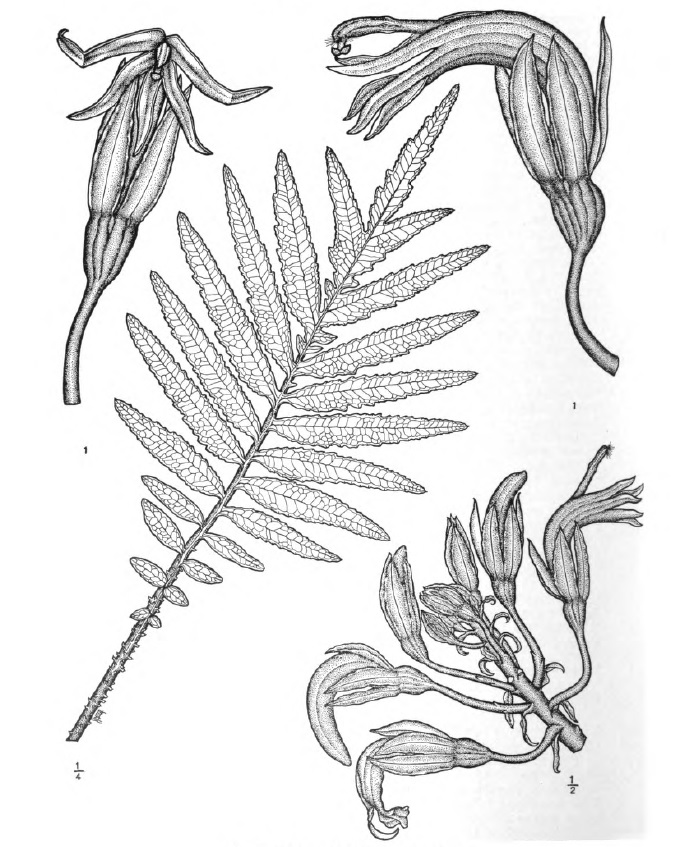
CYANEA GRIMESIANA Gaud. (Original) (Described on preceding page)
(© Otto Degener, 11/3/32) (Niu Valley, Oahu)
FLORA HAWAIIENSIS
LOBELIACEAE LOBELIA FAMILY
CYANEA HORRIDA (Rock) Degener & Hosaka PRICKLY CYANEA
Cyanea ferox var. beta Hilleb. Fl. Haw. Isl. 259. 1888. Cyanea ferox var. horrida Rock in Bull. Torr. Bot. Club 44:235. 1917. Cyanea horrida nom. nud. Rock, Monogr. Haw. Lobel. 245. 1919. (citing Molokai in error for Maui.) Cyanea horrida comb. nov.
Sparingly milky shrub about 7 dm. high with a few spreading about 2 dm. thick solid branches arising from base, the purplish-green stems when young densely muricate with somewhat assurgent often purplish prickles and with age less acrid muricate. Leaves about 50 cm. long and 15 cm. wide of which petiole measures one-third, rugose broadly oblong-elliptic in outline, with about 24 lobes irregularly and often deeply dentate-serrate with apically imbedded callous teeth, acute at apex, subtruncate at base, above evenly muricate with greenish-yellow spines especially on midrib and veins, below pale similarly muricate and on nerves and veins hirtellous; petiole similar to midrib but more sparingly and coarsely muricate with laterally flattened assurgent fleshy prickles up to 3 mm. long. Racemes with upper third bearing up to about 10 spreading-upright flowers; peduncle 2-7 cm. long, shiny, green to somewhat purplish, muricate with thickish forward-pointing green to purplish fleshy glabrate projections up to 2 mm. long; pedicels about 2.5 cm. long and 4 mm. thick, assurgent, bibracteolate in upper half or third with 2 mm. usually purplish bractlets, in axil of linear somewhat conduplicate thickish acuminate often purplish 2-3 cm. long and 2 mm. wide bracts smooth above and finely muricate beneath. Calyx tube about 12 mm. long and as thick, somewhat compressed, longitudinally unevenly shallowly 10-ridged, puberulent, entirely green or on dorsal side usually more or less purple; lobes thick, stiff, having green somewhat blotched with purple especially acute to cuspidate tip, more or less conduplicate with margin unevenly muricate-denticulate, 4 mm. wide, the 3 upper about 16 mm. long and the 2 lower about 13 mm. long. Corolla 8 cm. long measured along upper surface, strongly curved, pale green but toward base especially along midribs dark purple as well as the lobes and often midrib extending from lobes to corolla base, within smooth but on outside strongly muricate-pubescent with forward-pointing prickles usually green even on purplish lobes and toward their apices less numerous but increasing in size to 3 mm.; tube about 4 cm. long, 12 mm. wide, 7 mm. thick; upper lobes about 25 mm. long and others somehwat shorter. Staminal column glabrous, shiny, red-purple, 70 mm long, the filaments dull dark purple 15 mm. long and all long white-tufted; pollen pale yellow. Style green; stigma purple. Berry unknown.
Type Locality: "E. Maui! Ulupalakua, Makawao, Hamakua."
Local Range: Besides Hillebrand's early finds, this odd Maui lobelia was found by Rock in 1912 in Puukakai Crater, by Forbes in 1919 a dozen times about the northern slope of Haleakala, and by Degener, Ordonez and Salucop (No. 12,543) in 1939 in a dense jungle north of Kuiki just beyond the boundary of the Haleakala Section of Hawaii National Park.
Extra Range: Known only from East Maui.
(illustrated on following page)
(Degener & Hosaka, June 4, 1940)
New Illustrated Flora of the Hawaiian Islands
LOBELIACEAE LOBELIA FAMILY
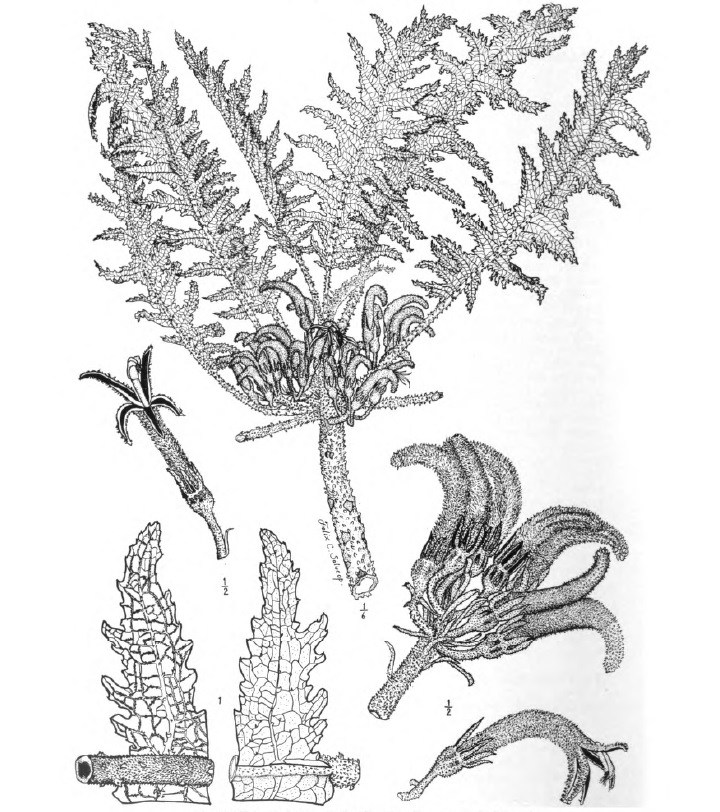
CYANEA HORRIDA (Rock) Degener & Hosaka (Original) (Described on preceding page)
Degener & Hosaka, June 14, 1940(Degener 12,543, Kukui, Maui)
FLORA HAWAIIENSIS
LOBELIACEAE LOBELIA FAMILY
CYANEA LEPTOSTEGIA A. Gray HAHALUA; GIANT KOKEE CYANEA
Delissea Delessertiana var. pinnatiloba (A. Gray in Proc. Am. Acad. 5:147. 1861.), based on a juvenile specimen, is discarded for the name published two pages later for a mature specimen. Cyanea leptostegia A. Gray in Proc. Am. Acad. 5:149. 1861. Cyanea leptostegia sensu Mann in Proc. Am. Acad. 7: 184. 1867. Cyanea leptostegia sensu Wawra in Flora 56:47.1873. Cyanea leptostegia sensu Hillebr. Fl. Haw. Isl. 261. 1888. Cyanea leptostegia sensu Drake, Ill. Fl. Ins. Mar. Pacif. 7:219, 1892. Cyanea leptostegia sensu Heller in Minn. Bot. St. 1:908. 1897. Cyanea leptostegia sensu Rock, Indig. Trees Haw. Isl. 494. 1913. Cyanea leptostegia sensu Rock in Monogr. Haw. Lobel. (21, 2, 57, 68, 73, 77, 80, 84, 87, 94, 97) 165. 1919. Cyanea leptostegia sensu Selling in Pop. Biol. Revy (Stockholm)1:2.1941. Cyanea leptostegia sensu Wimmer in Engl. Pflzreich 106 (4.276b):46. 47, 53, 75. 1943. Cyanea leptostegia sensu Degener in Gard. Journ. (N.Y.) 1(1):3. 1951.
Erect unbranched palm-like up to 10-14 meters tall tree with smooth more or less hollow trunk up to 10 cm. thick densely covered above with prominent closely packed rhomboidal leaf scars 10 mm. wide with suborbicular obcordate leaf trace scar in center and with orbicular 3 mm. wide inflorescence scars; sap abundant, thick, canary yellow. Leaves crowded at summit to form subspherical cluster up to 1.5 meters wide, sessile or nearly so, narrowly oblanceolate, 75-100 cm. long, 5-8.5 cm. wide, undulate, subentire to denticulate with callous teeth, thick, at apex shortly acuminate to submucronate, shiny and glabrous above, dull and glabrous or nearly so beneath, with hollow midrib prominent especially beneath: juvenile leaves distinctly petiolate; earliest linear-oblanceolate and sinuately lobed but older ones (on trees up to 2-3 meters tall) lobed to parted or rarely divided, with posterior side of lobe rounded and anterior more or less truncate, apex mostly obtuse and sometimes obscurely cuspidate. Racemes axillary in lower leaves, with slender glabrous 2-6 cm. long peduncle naked below but toward apex crowded with 12-25 dark red-purple flowers; bracts linear, 24 mm long; pedicels 10-20 mm. long; bractlets linear, 12 mm. long. Hypanthium glabrous, 18 mm. long, cylindrical, with short tube; lobes linear-filiform, flat, 30-55 mm. long and up to 1 mm. wide. Corolla glabrous, suberect, slender, thin 5 mm. long, 3 mm. wide, dorsally split almost to base; lobes linear, unequal, 12-18 mm. long Staminal column glabrous; lower 2 anthers penicillate. Fruit ovoid, 20-35 mm. long, 8-12 mm. wide, yellow, crowned by the persistent calyx lobes.
Type Locality: "Upper edge of the forest near the tubular summit of Kauai." p. 149.
Local Range: Growing in open woods, not rain-forest, chiefly at 2,500-4,000 feet at and about the Kokee region of Kauai and there still common where not crowded out by Larsen's folly (Rubus penetrans). This is the tallest of cyaneas, truly a magnificent plant with a forty foot trunk and a leaf spread close to six feet. It has been collected frequently, since its discovery by the U.S.Exploring Expedition under Commodore Wilkes, by such workers as Mann & Brigham, Wawra, Hillebrand, Heller, Forbes, Hitchcock, Rock, Neal, Chock, Hatheway and Degener. Juvenile and adolescent plants with their lobed leaves apper so different from the mature onees that there is little wonder Gray described and named this species twice. We do not agree with Rock that such palm-like species are more ancient than the branching ones The former have evolved from the latter type by reduction of the branching habit. When C. leptostegia and similar strict species lose their crown by accident, they readily revert and may grow more than one branch as replacement. This taxon grades imperceptibly from entirely glabrous plants to plants with leaves densely tomentulose beneath. We consider the former the species proper and the tomentulose plants the variety described below. As it is up to the personal judgement of each worker where to draw the line between species s.s., and var. velutina, part of the above synonymy properly may belong to the variety.
Extra Range: With the variety known only from the region in and about Kokee, Kauai.
CYANEA LEPTOSTEGIA var. VELUTINA Skottsb.
Cyanea leptostegia var. velutina Skottsb. in Acta Horti Gotob. 22:264. 1926. Cyanea leptostegia var. velutina sensu Wimmer in Engl. Pflzreich 106 (4. 276b):53. 1943. Cyanea leptostegia var. velutina sensu Skottssb. in Acta Horti Gotob. 15:484. 1944.
Differing from the species itself in having leaves beneath sparsely to densely soft-tomentulose.
Type Locality: "Kauai: Waimea, in the woods near Kokee, c. 1050m, young fr. 28/10 (n. 976)."
Local Range: Growing with the species itself and intergrading with it. In what we like to call the Marie C. Neal Herbarium in Honolulu is Skottsberg's 976 collected in 1922. This he labeled C. leptostegia f. hirsuta, a name he later changed in print to var. velutina. There also is a specimen collected by Degener & Hatheway Feb. 1950, which Wimmer annotated questionably as a new species; Rock's 10,256 of Oct. 1911; Degener's 2189 of June 25, 1926; and Cranwell, Selling & Skottsberg's 3023. All these sheets are definitely the variety. Many of the remaining specimens in the Herbarium are more or less transitional between the variety and the species itself.
(Species illustrated on following page)
(Degener & Degener, 2/15/66) (Aided by National Science Foundation)
New Illustrated Flora of the Hawaiian Islands
LOBELIACEAE LOBELIA FAMILY

CYANEA LEPTOSTEGIA A. Gray (Original)
(Degener 23,938, Kokee, Kauai)
FLORA HAWAIIENSIS
LOBELIACEAE LOBELIA FAMILY
CYANEA PINNATIFIDA (Cham.) E. Wimm. SHARKS TAIL CYANEA
Lobelia pinnatifida Cham. in Linnaea 8: 220. 1833. Rollandia pinnatifida G. Don, Gen. Syst. 3: 698. 1834. Delissea pinnatifida Presl, Prodr. Lobel 47. 1836. Cyanea selachicauda Degener, Degener, Fl. Haw. fam 339 1932. Cyanea selachicauda sensu Degener, Fl. Haw. fam. 339. 1946. Cyanea pinnatifida E. Wimm. in Engl. Pflzreich 4 (276b): 63. 1943.
Erect shrub unbranched or branching sparingly only from near base, 8-24 dm. high, with fleshy smooth to sparingly muricate stem. Leaves obovate- oblong in outline, the upper two-thirds cleft into 4-8 subopposite divisions of which usually one side of leaf bears one more than the other with the upper divisions longer than the lower, 3.5-6 cm. long, 3.5-8 cm. wide between the divisions and 8-23 cm. wide across the divisions from their tips, green shiny glabrous smooth above, light green faintly puberulent prominently veined below, the margins irregularly and bluntly dentate to undulate and with yellow callous streaks, with apex of leaf and apices of divisions obtuse but mucronate, with base more or less acute; petiole green to purplish green, about 4 cm. long and 5 mm. wide usually sparsely muricate on upper surface in 2 lines which represent downward prolongation of blade; the larger leaves having upper side of midrib and main veins very sparsely armed with forward-pointing sharp-triangular isolated prickles. Peduncles spreading slightly upward, green to purplish, glabrate, about 4 cm. long, lower half naked but nodose, upper half about 10-flowered; pedicels slender, commonly 1-1.5 cm. long, green to purplish, puberulent, with broadly deltoid about 2 mm. long bract at base and 2 subopposite subulate bractlets near lower third or half. Calyx light green, puberulent; tube 10 mm. long, 8 mm. wide, with triangular 3 mm. long lobes having spreading darker green coriaceous margins. Corolla puberulent without and finely puberulent within, white with greenish tinge, with 5 more or less noticeable purplish longitudinal streaks on nerves near base, about 45 mm. long and 6 mm. wide and 8 mm. broad. Staminal column almost white, glabrous except for the 5 connate margins of the filaments which are ciliate from base for about 5 mm.; anthers purple, only the 2 lower bearded. Upper part of ovary purplish pink, shiny; style light green.
Type Locality: "In montibus occidentalibus insule O-wahu legimus anno 1817."
Local Range: First collected by Chamisso in 1817. This is a very rare Oahu species known from Honouliuli and from shaded, damp side of seasonally dry streams in two small valleys approximately southeast of Puu Hapapa.
Extra Range: Not known elsewhere
(Illustrated on following page)
(Otto Degener & Amy Greenwell, 7/25/'52, to replace C. selachicauda, 11/3/'32 & 9/15/'46)
New Illustrated Flora of the Hawaiian Islands
LOBELIACEAE LOBELIA FAMILY
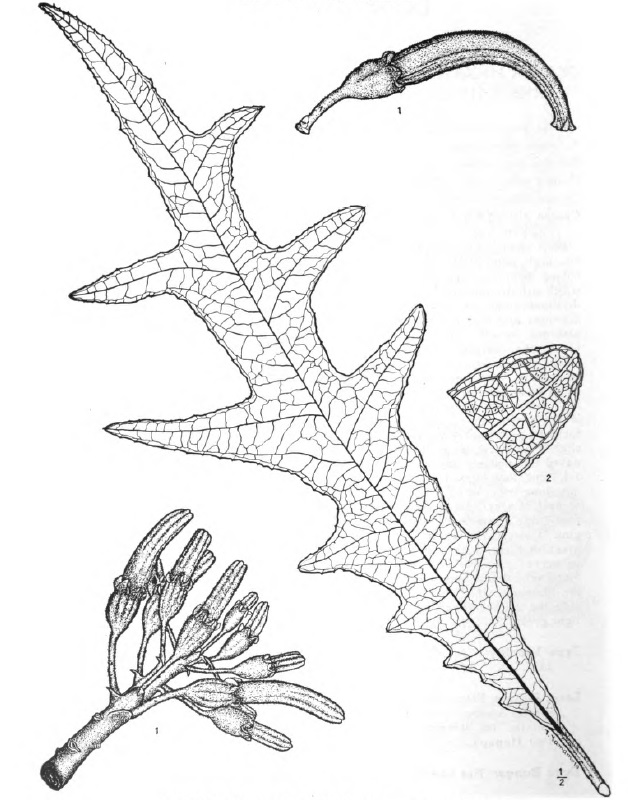
CYANEA PINNATIFIDA (Cham.) E. Wimm. (Original) (Described on preceding page)
(© Otto Degener, 7/25/'52, to replace C. selachicauda, 11/3/'32 & 9/15/'46) (Puu Hapapa, Oahu)
FLORA HAWAIIENSIS
LOBELIACEAE LOBELIA FAMILY
CYANEA SELACHICAUDA Degener SHARKS TAIL CYANEA
Cyanea selachicauda sp. nov. Frutex 8-24 dm.; foliis 4- ad 8-fissis, 3.5-6 dm. longis et 8-23 cm. latis; pedunculis 4 cm. longis; circa 1-floribus; pedicellis 1-1.5 cm. longis; lobis calycis triangularis, 3 mm. longis; corolla alba, 45 mm. longa.
Erect shrub unbranched or branching sparingly only from near base, 8-24 dm. high, with fleshy smooth to sparingly muricate stem. Leaves obovate-oblong in outline, the upper two-thirds cleft into 4-8 subopposite divisions of which usually one side of leaf bears one more than the other, with the upper divisions longer than the lower, 3.5-6 cm. long, 3.5-8 cm. wide between the divisions and 8-23 cm. wide across the divisions from their tips, green shiny glabrous smooth above, light green faintly puberulent prominently veined below, the margins irregularly and bluntly dentate to undulate and with yellow callous streaks, with apex of leaf and apices of divisions obtuse but mucronate, with base more or less acute; petiole green to purplish green, about 4 cm. long and 5 mm. wide, usually sparsely muricate on upper surface in 2 lines which represent downward prolongation of blade; the larger leaves having upper side of midrib and main veins very sparsely armed with forward-pointing sharp-triangular isolated prickles. Peduncles spreading slightly upward, green to purplish, glabrate, about 4 cm. long, lower half naked but nodose, upper half about 10-flowered; pedicels slender, commonly 1-1.5 cm. long, green to purplish, puberulent, with broadly deltoid about 2 mm. long bract at base and 2 subopposite subulate bractlets near lower third or half. Calyx light green, puberulent; tube 10 mm. long, 8 mm. wide, with triangular 3 mm. long lobes having spreading darker green coriaceous margins. Corolla puberulent without and finely puberulent within, white with greenish tinge, with 5 more or less noticeable purplish longitudinal streaks on nerves near base, about 45 mm. long and 6 mm. wide and 8 mm. broad. Staminal column almost white, glabrous except for the 5 connate margins of the filaments which are ciliate from base for about 5 mm.; anthers purple, only the 2 lower bearded. Upper part of ovary purplish pink, shiny; style light green.
Type Locality: Small valley southeast of Puu Hapapa, Oahu.
Local Range: About ten plants were found, all growing on the shaded, damp sides of seasonally dry streams. Flowering in August. The specific name of this plant alludes to the fancies resemblance of the upper part of the leaf to the tail of a shark.
Extra Range: A rare known only from the type locality and from a small valley north of it.
Type specimen: Degener & Bush No. 4207
(Illustrated on following page)
(Otto Degener, 11/3/'32)
New Illustrated Flora of the Hawaiian Islands
LOBELIACEAE LOBELIA FAMILY
CYANEA SELACHICAUDA Degener (Original) (Described on preceding page)
(Otto Degener, 11/3/'32) (Puu Hapapa, Oahu)
FLORA HAWAIIENSIS
LOBELIACEAE LOBELIA FAMILY
CYANEA SOLENOCALYX Hilleb. MOLOKAI CYANEA
Cyanea solenocalyx Hilleb. Fl. Haw. Isl. 258. 1888.
Sparingly branching or unbranched 1-4 meters high stout variable shrub with hollow stem which is almost entirely smooth or muricate below and aculeate above with stramineous conical downward-spreading slightly laterally compressed prickles; juvenile plant very prickly. Leaves oblong to obovate-oblong, usually 30-50 cm. long and 8-16 cm. wide, shortly acuminate to obtuse at apex and base, undulate to entire with margin unevenly thickened by more or less aborted teeth, thin-chartaceous when dry, above glabrate and more or less faintly sparsely muricate-prickly on and between main veins, beneath coarsely hispidulous with stramineous hair on veinlets; petiole commonly 8-16 cm. long, thick, fleshy, more or less muricate; leaves of juvenile plant broadly ovate to subcordate, with shallow deltoid acute cuspidate lobes, more densely hispidulous and prickly on both sides, with conspicuously muricate very long petiole. Peduncles fleshy, 1-5 cm. long, thick muricate, spreading-upright, bracteate; pedicels 12-24 mm. long; bracts linear-lanceolate, 18-35 mm. long, more or less hispid; bractlets 8-12 mm. long. Calyx greenish, glabrous from the beginning or first scabrous and hirsute to hirsute but becoming glabrate with age, often shallowly muricate; ovarian portion 12 mm. long, conical; calyx lobes obscurely several-nerved, completely connate or partly so to form a broad cylindric to funnelform sheath 18-22 mm. long which persists and slightly enlarges in fruit. Corolla fleshy, 30-45 mm. long and 8-10 mm. wide, glabrate to scabro-hispid, dark purple. Staminal column glabrous; anthers purplish, 8 mm. long, the upper ones beardless. Fruit ovoid, 16-18 mm. long, orange-yelow, erect when ripe, with persistent calyx lobes yellowish. Seeds pale, yellow, shiny, smooth.
Type Locality: "Molokai, in deep gulches of Kalae, Mopulehu and elsewhere."
Local Range: As it is impossible to distinguish the species from the form in case of flowerless specimens gathered, the exact range of each cannot yet be given. The species, or perhaps the form, have been collected by Hillebrand, Rock, A. S. Hitchcock or the writer at Kalae, Mapulehu, ridge leading to Pelekunu, Pukoo, Pepeopae, upper end of Hanalilolilo pipeline, and Puu o Wahaula, Molokai.
Extra Range: Endemic to Molokai.
CYANEA SOLENOCALYX forma GLABRATA (Rock) Degener
Cyanea solenocalyx var. glabrata Rock. Monogr. Haw. Lobel. 171. 1919. Cyanea solenocalyx forma glabrata Degener comb. nov.
Differing from the species in flower color chiefly and possibly in being more glabrate. Corolla waxy white with light purple extending from its base to near base of anthers with the color darkest along median line of petal. Staminal column light purple with white longitudinal streaks; anthers purple.
Type Locality: "Molokai: Gulch of Waihanau in rainforest along streambed."
Local Range: Waihanau Gulch, nenar Pepeopae bog, and probably elsewhere in dense forests of Molokai.
Extra Range: Relative abundance or scarcity of prickles in the species seems dependent largely on the age of the individual plant and on the age at which it loses its juvenile characteristics. Hence Rock's concept of the occurrence of a distinct glabrate variety is not followed here. Instead, his white-flowered specimen and the writer's are considered representatives simply of a white-flowered form.
(Form illustrated on following page)
(Otto Degener, 8/1/'34)
New Illustrated Flora of the Hawaiian Islands
LOBELIACEAE LOBELIA FAMILY
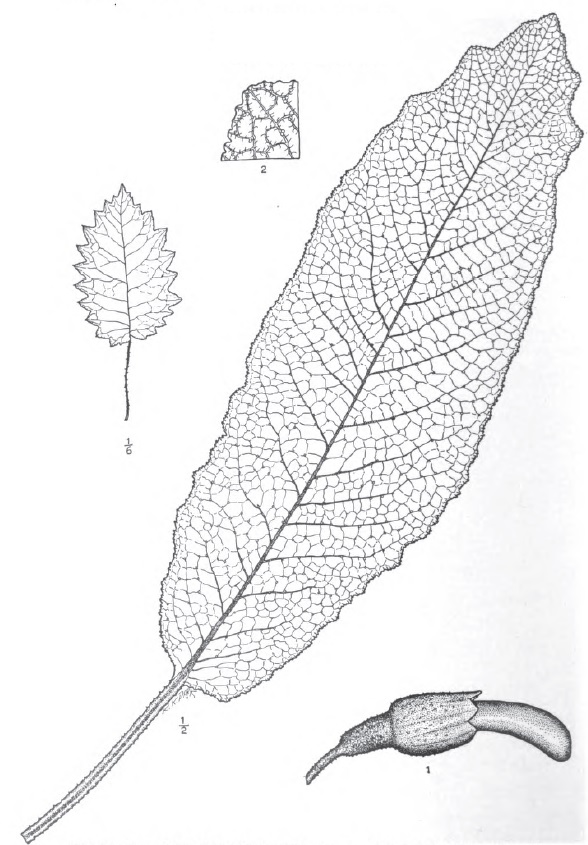
CYANEA SOLENOCALYX forma GLABRATA (Rock) Degener (Original) (Described on preceding page)
(© Otto Degener, 8/1/'34) (Pepeopae, Molokai)
FLORA HAWAIIENSIS
LOBELIACEAE LOBELIA FAMILY
CYANEA SUBMURICATA E. Wimm.
Cyanea submuricata E. Wimm. in Engl. Pflzreich. 107 (4.276b): 760. 1953.
Coarse 2 meters high erect herb with thick stem more or less sparsely muricate especially above. Leaves with blade oblanceolate, 64-66 cm. long, 11-12 cm. wide, membranous, above glabrous and smooth, with irregularly callus-denticulate margin, beneath with ribs and veins and submuricate midrib hirtellous, with apex subacute, with base acuminate and gradually tapering into submuricate 4.5-5.5 cm. long petiole. Peduncles thick, 15-20 mm. long, submuricate, more or less crowned with linear hirtellous about 15 mm. long bracts; pedicels few, glabrous, 15 mm. long. Ovary oblong-obconic, glabrous 11 mm. long, 5 mm. wide; crowned by sublinear acute suberect entire 11 mm. long calyx lobes with prominent midrib. Corolla 70 mm. long, sparsely hirtellous, pale green and pink below but reddish above, with 45 mm. long tube about 6 mm. wide at middle, with narrowly linear lobes of which the upper 2 are 25 mm. long and moderately straight while the lower are shorter and deflexed. Filaments glabrous, reddish, 68 mm. long; stamens not observed.
Type Locality: "Hawaii: Kulani Prison Road in dense forest at 130 m."
Local Range: This Cyanea, related to C. rollandioides of Puna, Hawaii, is known only from Degener's type collection of Feb. 3, 1952.
Extra Range: Not known elsewhere.
(Illustrated on following page)
(Degener & Degener, 8/20/56) (Aided by National Science Foundation)
New Illustrated Flora of the Hawaiian Islands
LOBELIACEAE LOBELIA FAMILY
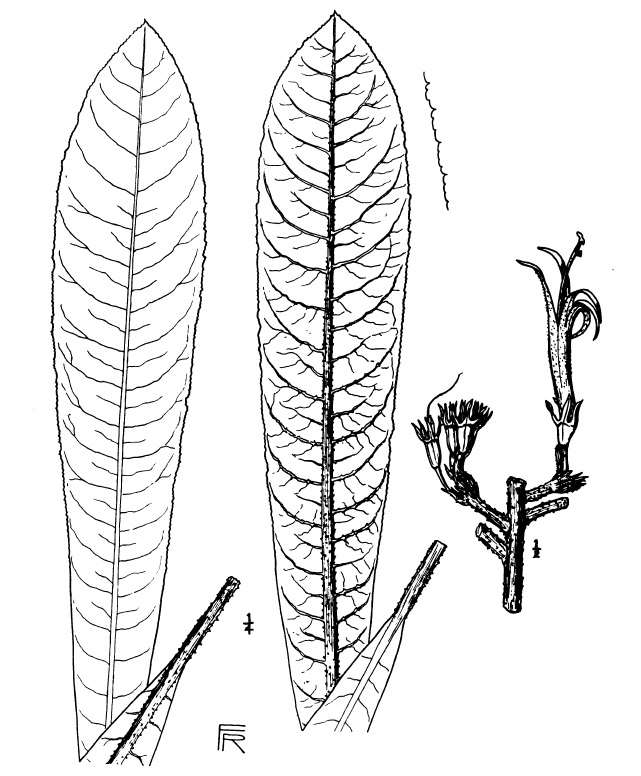
CYANEA SUBMURICATA E. Wimm. (Original) (Described on preceding page)
(Degener & Degener, 8/20/56)
FLORA HAWAIIENSIS
LOBELIACEAE LOBELIA FAMILY
CYANEA TRUNCATA Rock PUNALUU CYANEA
Rollandia truncata Rock in Coll. Haw. Publ. Bull. 2:44. 1913. Cyanea Juddii Forbes in Occas. Pap. B. P. Bishop Mus. 6.3:68. 1916. Cyanea truncata Rock in Bull. Tor. Bot. Club, 44:234, pl. 15. 1917.
A plant 3-18 dm. high, with fleshy densely muricate (especially when young) to almost smooth stem. Leaves large, chartaceous, broadly obovate-oblong, acute at apex, obtuse or sometimes decidedly truncate at base with perhaps slight indication of becoming subcordate, pale green, glabrous above except for a few minute conical to curved spines which are scattered especially on the veins, 35-55 cm. long and 14-20 cm. wide, puberulous and pale beneath, with margin undulate to coarsely dentate especially toward base, and with muricate to spiny petioles 8-14 cm. long. Flowers on long slender 18-26 mm. long pubescent pedicels which are single in the axil of a bract and are bibracteolate at or below the middle; racemes axillary, slender, about 55 mm. long, bracteate from the base, hispidulous, the number of bracts increasing toward the apex so that the entire inflorescence is rather broadly contracted and bears mature flowers below while the apical ones yet occur as minute buds. Calyx 10 mm. long, with ovarian portion obconic and about 5 mm. long, and with subequal lobes about 5 mm. long and broadly obtuse but the 2 lateral lobes slightly narrower than the others. Corolla pale purplish-pink, slender, sparingly puberulous in the bud and glabrous to glabrate later, slightly curved or almost straight, with dorsal slit extending to the middle, 32 mm. long and 5 mm. wide, almost of even width, the lobes conpicuously white (even while very immature) and the 3 lower lobes 5-7 mm. long. Staminal column glabrous, free, pale; anthers bluish-purple, glabrous, the 2 lower bearded.
Type Locality: "Mountains of Punaluu, valley trail, elevation 1000 feet", Oahu.
Local Range: In the mountains of Punaluu and Waiahole, Oahu. An interesting species superficially resembling a Rollandia. The specific name truncata is unfortunate as the leaf base of the plant is not typically truncate. The habit sketch on the following plate depicts a plant bearing an almost smooth stem. The section of muricate stem, shown below it, came from another specimen growing in the same locality.
Extra Range: Not known elsewhere.
(Illustrated on following page)
(Otto Degener, 9/10/'32)
New Illustrated Flora of the Hawaiian Islands
LOBELIACEAE LOBELIA FAMILY
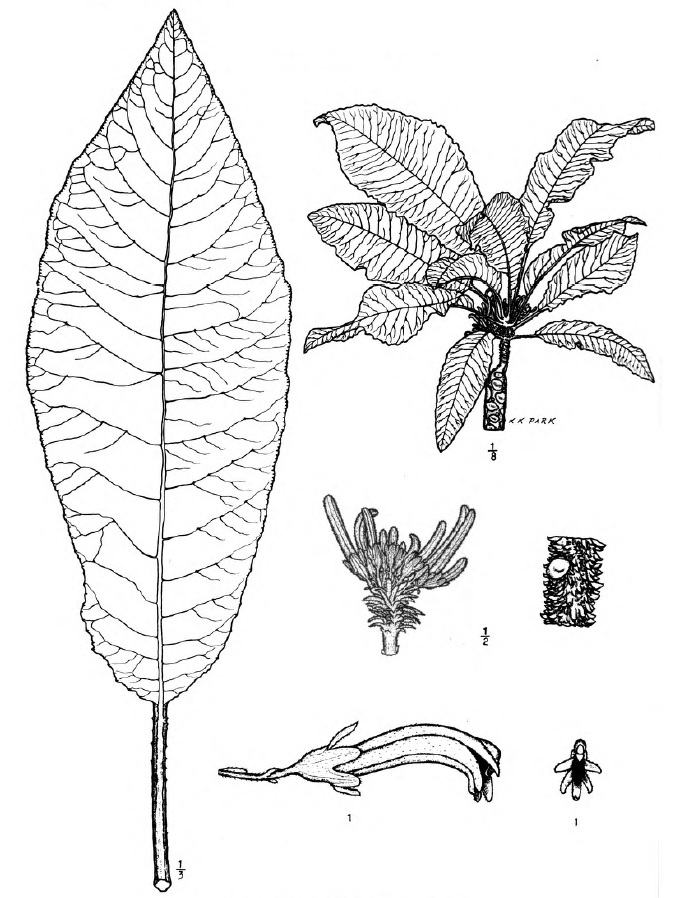
CYANEA TRUNCATA Rock (Original) (Described on preceding page)
(© Otto Degener, 9/10/'32) (Pig God Trail, Punaluu, Oahu)
FLORA HAWAIIENSIS
LOBELIACEAE LOBELIA FAMILY
DELISSEA SUBCORDATA Gaud. HEART-SHAPED DELISSEA
Delissea subcordata Gaud. in Freyc. Voy. Bot. 457, t. 77. 1829. Lobelia subcordataEndl. in Ann. Wien. Mus. Naturgesch. 1:170. 1836. Delissea subcordata sensu A. DC. Prodr. 7:342. 1839. Delissea undulata sensu A. Gray in Proc. Am. Acad. 5:148. 1861. (In part.) Delissea subcordata sensu H. Mann in Proc. Am. Acad. 7:180. 1866. Delissea subcordata sensu Wawra in Flora 56:7. 1873. Delissea subcordata sensu Hillebr. Fl. Haw. Isl. 249. 1888. Delissea subcordata sensu Rock, Monogr. Haw. Lobel. 345, t. 195. 1919. Delissea subcordata sensu Wimmer in Engl. Pflzreich. (4. 276b) 106:42. 1943.
Glabrous often much-branched shrub 15-30 cm. tall. Leaves thickish, thin-membranous when dried, glossy above, paler and dull and strongly ridged beneath with subhorizontal ribs, ovate to ovate-oblong, acute to cuspidate or acuminate at apex, evenly or sometimes somewhat obliquely subcordate to truncate at base, serrulate to uncinate-serrulate with sharp cartilaginous somewhat unequal teeth and toward base occasionally laciniate to subentire, the blade 15-23 cm. long and 7-12 cm. wide, the petiole 7-18 cm. long. Flowers 12-24 on 7-10 cm. long fleshy racemes naked in the lower fourth; pedicels 16-18 mm. long; bractlets 3 mm long. Ovary oblong-obconic, 6-7 mm. long, pale green or toward apex reddish, surmounted by 5 minute dentiform reddish calyx lobes. Corolla falcate, 45 mm. long, enlarging above, with single dorsal knob above the middle, with connivent lobes about 12 mm. long, basal 10 mm. faint pink and remainder white tinged progressively upward with more green except for the 1 mm. white margins of lobes. Fruit ovoid-oblong, 15 mm. long and 8 mm. thick. bluish. Seeds whitish, deeply wrinkled.
Type Locality: None given in text; "Iles Sandwich" on herbarium sheet.
Local Range: A delissea of dark, Oahu forests, in the Waianae range it has been collected often about Kaala and once in 1933 by E. W. Russ in far distant Huliwai; in the Koolau Range, from early times from Niu to Nuuanu Valleys, and in more recent times along the Waikane-Schofield Trail, an area rather inaccessible to earlier collectors. Besides Oahu, Hillebrand records the species from Kauai, without further citation of locality. One sheet, deposited in the Bishop Museum and collected by Mann & Brigham, bears the two separate notation of "Kauai" and "Vicinity of Makawao." A gazetteer of the Islands lists Makawao from southeast Oahu and from Maui; none from Kauai. Until substatiating evidence turns up to the contrary, we believe these records erroneous. According to personal correspondence with the late Dr. Ziegenspeck, the uncinate leaf-serrations bear at their tips two or three large hydathodes. This is, of course, an adaptation for the excretion of excess water in a dense, moiture-laden forest where the necessary loss of water from the plant would be ordinarily difficult.
Extra Range: Known definitely, with the following variety, from Oahu only:
DELISSEA SUBCORDATA var. OBTUSIFOLIA Wawra
Delissea subcordata var. obtusifolia Wawra in Flora 56:7. 1873. Delissea subcordata var. obtusifolia sensu Hillebr. Fl. Haw. Isl. 249. 1888. Delissea subcordata var. obtusifoiia sensu Rock, Monogr. Haw. Lobel. 345, t. 196. 1919. Delissea subcordata var. obtusifolia sensu Wimmer in Engl. Pflzreich. (4.276b) 106: 43. 1943.
Leaves elliptic, obtuse at apex, the blades 22-30 cm. long and 10-17.5 cm. wide. Calyx lobes often almost as long as ovary. Corolla with drosal knob often wanting.
Type Locality: "Oahu, (aus Hillebrands Herbar) 2355."
Local Range: Known only from old collections from Helemano (misspelled Halemanu) and Waipio Valleys, and from N. H. Krauss' 1932 find along the Waikane-Schofield Trial, Koolau Range, Oahu.
(Species illustrated on following page)
(Degener & Degener, 12/28/60) (Aided by National Science Foundation)
New Illustrated Flora of the Hawaiian Islands
LOBELIACEAE LOBELIA FAMILY
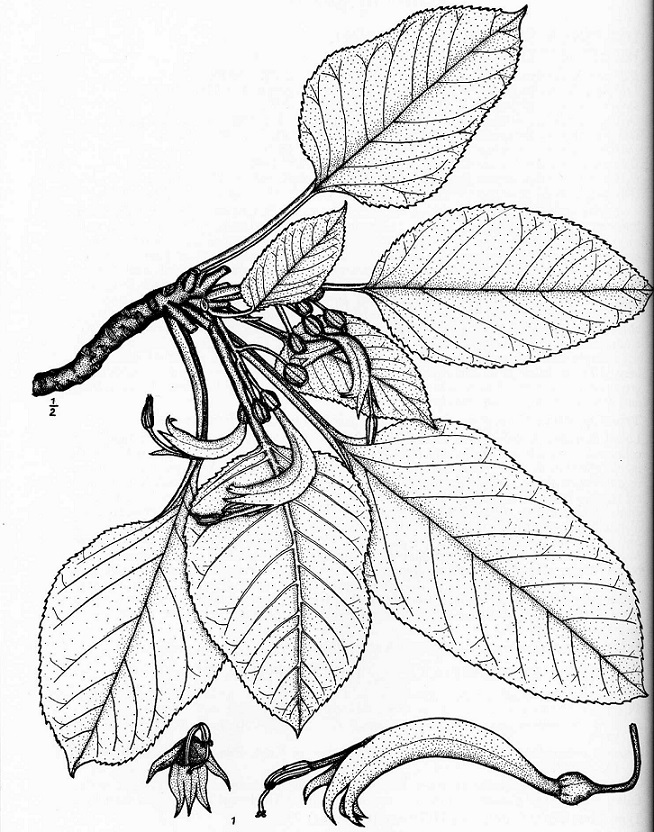
DELISSEA SUBCORDATA Gaud. (Original) (Described on preceding page)
(Degener 23,633, Mokuleia)
FLORA HAWAIIENSIS
LOBELIACEAE LOBELIA FAMILY
GALEATELLA Deg. & Deg.
Lobelia Subgenus Tupa Section Galeatella E. Wimm. in Ann. Naturh. Mus. Wien 56: 369. 1948. Galeatella Deg. & Deg. gen. nov.
Glabrous to pubescent unbranched or sparsely branched erect giant herbs or shrubs with stiff thick mostly hollow stems thickly beset with leaf scars. Leaves tufted at ends of branches, sessile or nearly so, more or less coriaceous, linear to linear-lanceolate or rarely linear-spatulate. flowers numerous, large, somewhat fleshy, in simple or rarely branched massive racemes. Corolla in bud thick-falcate; corolla in flower with tube large and with 2 upper lobes not spirally twisted but falcate and longer than the curved trifid lower lip, whitish-green or creamy white or crimson or reddish purple but never blue. Stamens with tube long exserted; anthers all apically bearded; pollen probably about 59 x 34 μ. Ovary more or less obconical, with long slender style bearing 2 divergent stigmatic lobes. Fruit a pedicellate glabrous to pubescent capsule shaped like two unequal cones joined by their bases along calyx lobes scars; lower usually thicker and shorter part longitudinally conspicuously ribbed and indehiscent; upper often narrower and longer part not ribbed but dehiscing loculicidally to base. Seeds reniform, somewhat alate 1 mm. or more long.
Name derived from the Latin for "little helmet" in allusion to the shape of the corolla.
Type Species: Lobelia kauaensis var. villosa Rock
An endemic genus of fog-swept cliffs and mountain bogs, often so inaccessible that helicopter search is needed to unearth many additional taxa. We believe it a taxonomic advance to consider the Hawaiian Lobeliaceae, with their large pollen, greater chromosome number and other unusual features, not congeneric with Lobelia typified by the Eastern North American herb L. cardinalis Linnaeus. For the proper understanding of the accompanying key, the following revised synonymy is given below:
1. G. GAUDICHAUDII (A. DC.) Deg. & Deg. s.s. comb. nov. Lobelia Gaudichaudii A. DC. in DC. Prodr. 7: 384. 1838.
2. G. GAUDICHAUDII var. KOOLAUENSIS (Hosaka & Fosb.) Deg. & Deg. comb. nov. Lobelia Gaudichaudii var. koolauensis Hosaka & Fosb. in Occas. Pap. b. P. Bishop Mus. 14: 4. 1938
3. G. GLORIA-MONTIS (Rock) Deg. & Deg. s.s.comb.nov. Lobelia gloria-montis Rock Haw. Lobel. 117. 1919.
4. G. GLORIA-MONTIS f. SANGUINEA (St. John & Hosaka) Deg. & Deg. comb. nov. Lobelia Gaudichaudii var. gloria-montis f. sanguinea St. John & Hosaka in Occas. Pap. B.P.Bishop Mus 14:123. 1938
5. G. GLORIA-MONTIS var. BRYANII (St. John & Hosaka) Deg. & Deg. comb. nov. Lobelia Gaudichaudii var. gloria-montis f. Bryanii St. John & Hosaka in Occas. Pap. B.P.Bishop Mus. 14:123. 1938.
6. G. GLORIA-MONTIS var. KUKUIENSIS (St. John & Hosaka) Deg. & Deg. comb. nov. Lobelia Gaudichaudii var. gloria-montis f. kukuiensis St. John & Hosaka in Occas. Paper. B.P.Bishop Mus. 14:123.1938.
7. G. GLORIA-MONTIS var. LONGIBRACTEATA (Rock) Deg. & Deg. Lobelia Gaudichaudii var. longibracteata Rock in Coll. Haw. Publ. Bull. 2:47. 1913.
8. G. KAUAENSIS (A. Gray) Deg. & Deg. s.s. comb.nov. Lobelia Gaudichaudii var. kauaensis A. Gray in Proc. Am. Acad. 5:150. 1861. Lobelia kauaensis Heller in Minn. Bot. St. 9: 911. 1897.
9. G. KAUAENSIS var. HIRSUTA (St. John & Hosaka) Deg. & Deg. comb. nov. Lobelia Gaudichaudii var. kauaensis f. hirsuta St. John & Hosaka in Occas. Pap. B.P.Bishop Mus. 14:121. 1938.
10. G. VILLOSA (Rock) Deg. & Deg. comb. nov. Lobelia kauaiensis villosa Rock in Bull. Torr. Bot. Club 44:237. 1917.
11. G. GLORIA-MONTIS var. MOLOKAIENSIS (Deg.) Deg. & Deg. comb. nov. Lobelia gloria-montis var. molokaiensis Degener, Fl. Haw. Fam. 339. Feb. 11, 1928.
Each one of the above species s.l., is limited to a single island. The variety molokaiensis, not found since 1928 and still incompletely known, may be the one exception where a species complex is found on more than one island.
KEY TO TAXA OF GALEATELLA: (Molokai taxon omitted)
1.
Plants pubescent: |
|
2.
Leaves 90-140 mm. long, oblong; plant villous; corolla pale green with purplish streaks (Kauai) |
G. villosa |
2.
Leaves 130-300 mm. long, oblong-spatulate or linear-lanceolate; plants hirsute: |
|
3.
Leaves glabrous, linear-lanceolate; corolla white with purplish streaks (Kauai) |
G. kauaensis var. hirsuta |
3.
Leaves hirsute both sides, oblong-spatulate; corolla cream with purplish streaks (Maui). |
G. gloria-montis var. bryanii |
1.
Plants glabrous to glabrate: |
|
2.
Floral bracts 60-75 mm. long; calyx lobes 28-35 mm. long; corolla cream with purplish streaks (Maui) |
G. gloria-montis var. longibracteata |
2.
Floral bracts 15-40 mm. long; calyx lobes 8-20 mm. long: |
|
3.
Bracts 22-35 mm. long, 6-10 mm. wide: |
|
4.
Leaves often with midrib hirsute beneath; corolla red purple (Oahu) |
G. gaudichaudii s.s. |
4.
Leaves glabrous beneath: |
|
5.
Bracts 25-30 mm. long; leaves 120-170 mm. long; corolla 58-65 mm. long, whitish to greenish (Oahu) |
G. gaudichaudii var. koolauensis |
5.
Bracts 15-25 mm. long; leaves 150-300 mm. long; corolla 45-60 mm. long, whitish with purplish streaks (Kauai) |
G. kauaensis s.s. |
3.
Bracts 30-45 mm. long, 8-20 mm. wide: |
|
4.
Corolla cream with purplish streaks: |
|
5.
Calyx lobes ciliate (Maui) |
G. gloria-montis s.s. |
5.
Calyx lobes not ciliate (Maui) |
G. gloria-montis var. kukuiensis |
4.
Corolla crimson (Maui) |
G. gloria-montis var. sanguinea |
:::
(Degener & Degener, 7/16/62) (Aided by National Science Foundation)
FLORA HAWAIIENSIS
LOBELIACEAE LOBELIA FAMILY
ISOTOMA Lindl. Bot. Reg. pl. 964. 1826.
Herbs with copious milky juice. Leaves entire to pinnately parted. Flowers large, axillary or in terminal racemes. Calyx tube with 5 narrow segments. Corolla with long cylindric tube and 5 spreading almost equal lobes. Stamens borne above the middle of corolla tube; filaments connivent; 3 upper anthers larger and more curved than the 2 lower. Ovary 2-celled; style linear; stigma 2-lobed. Fruit an oblong to cylindric loculicidally many-seeded 2-valved capsule Seeds miinute, not winged.
Name derived from the Green for equal and division, in allusion to the almost equal lobes of the corolla.
Type species: Isotoma axillaris Lindl.
About 8 species, almost all Austalasian.
(Otto Degener, 12/5/'32)
FLORA HAWAIIENSIS
LOBELIACEAE LOBELIA FAMILY
ISOTOMA LONGIFLORA (L.) Presl STAR-OF-BETHLEHEM
Lobelia longiflora L. Sp. Pl. 930.1753. Isotoma lonigflora Presl, Prodr. Monog. Lobel. 42. 1836.
Simple or sparingly branched pubescent leafy 3-7 dm. high perennial with white tap root. Leaves oblong-oblannceolate, 5-15 cm. long, erect, sessile, with usually 14-20 large irregular teeth and about 4 times as many small teeth, with tapering base and acute apex. Flowers numerous, solitary in the axils of unmodified leaves, short-peduncled. Calyx tube oblong-cylindric, 7 mm. long, with 5 longitudinal ribs that project to form 10-12 mm. long linear sparingly serrulate calyx lobes. Corolla tube greenish white, 7-9 cm. long, with 1.5 cm. long linear-lanceolate spreading brilliant white lobes. Stamens borne near top of corolla tube; filaments free at base, united toward tip; anthers united into a short curved tube with apical hairs. Capsule nodding, about .5 cm .long. Seeds cylindric, about 0.5 mm. long, slightly reticulate, brown.
Type Locality: "Habitat in Jamaica ad ripas."
Local Range: Common near Hanalei, Kauai, where it was first collected in 1913 and near Hilo, Hawaii, where it was first collected two year later. Locally it is a conspicuous weed of roadsides and fields at lower elevations where the rainfall is moderately heavy. This plant is extremely poisonous and therefore should be eradicated as soon as possible. In doing so, great care must be exercised lest the milky juice get into the eye, a drop being sufficient to cause blindness.
Extra Range: Native to tropical America, but now widely disseminated.
(Illustrated on following page)
(Otto Degener, 6/14/'33)
New Illustrated Flora of the Hawaiian Islands
LOBELIACEAE LOBELIA FAMILY
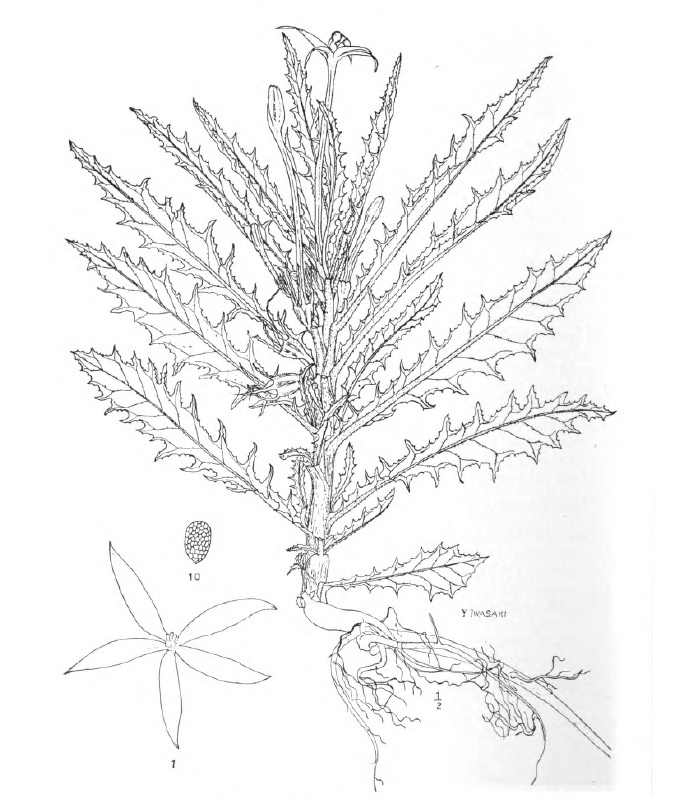
ISOTOMA LONGIFLORA (L.) Presl (Original) (Described on preceding page)
(© Otto Degener, 6/14/'33)
FLORA HAWAIIENSIS
LOBELIACEAE LOBELIA FAMILY
LOBELIA GAUDICHAUDII DC. GAUDICHAUD LOBELIA
Lobelia Gaudichaudii DC. Prodr. 7: 384. 1838. Lobelia Gaudichaudii var. coccinea Rock in Bull. Torr. Bot. Club 44:238. 1917.
Perennial with almost always single unbranched hollow about 3 cm. thick stem densely beset with diamond-shaped leaf-scars below dense tuft of spreading leaves, in flower 3-7 dm. long or longer; after seeding apparently dying. Leaves oblong-oblanceolate, entire but with margin of upper third thickened or revolute with callous teeth, acute at apex, narrowed to sessile base, 15-18 cm. long, 1.5-2.5 cm. wide, the strong midrib white-pubescent beneath. Flowers about 50, on about 3 cm. long compressed pedicels as long as or slightly longer than subtending lanceolate acute bracts to form open simple raceme up to 6 dm. long. Calyx tube arcuate, deep red-purple, glabrous, 5-6 cm. long and 7 mm. wide, widened at apex, bilabiate with lower lobe tridentate at apex. Staminal column purple, glabrous; anthers glabrous, 12 mm. long, as 5 penicillate. Capsule ovoid, with conical apex, dehiscent loculicidally. Seeds compressed, ovate-reniform, margined.
Type Locality: "ad acumen montis O-Wahu Sandwicensium."
Local Range: A beautiful species peculiar to the windswept summit of the Koolau Range of Oahu, particularly between Puu Lanipo and Punaluu. It flowers in summer and fall, and seeds in winter. It grows with Trematolobelia.
Extra Range: Not known elsewhere.
(Illustrated on following page)
(Otto Degener, 2/11/'38)
New Illustrated Flora of the Hawaiian Islands
LOBELIACEAE LOBELIA FAMILY
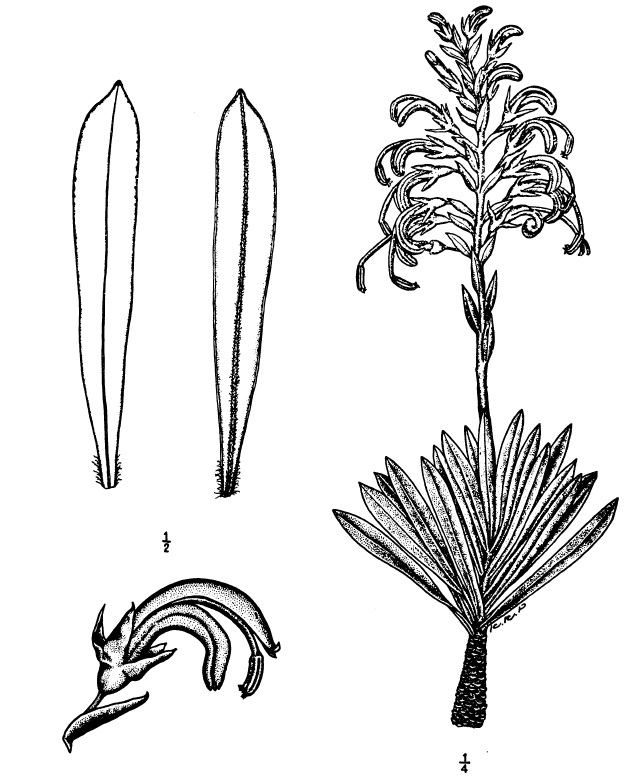
LOBELIA GAUDICHAUDII DC. (Original) (Described on preceding page)
(© Otto Degener, 2/11/'38) (Konahuanui, Oahu)
FLORA HAWAIIENSIS
LOBELIACEAE LOBELIA FAMILY
LOBELIA GLORIA-MONTIS Rock GLORY-OF-THE-MOUNTAIN
Lobelia Gaudichaudii Hilleb. Fl. Haw. Isl. 236. 1888. (As to Maui specimen only.) Not Lobelia Gaudichaudii DC. Prodr. 7:384. 1839.
Glabrous perennial with single unbranched hollow about 4 cm. thick stem densely beset with diamond-shaped leaf scars 12 mm. wide and 5 mm. high below dense tuft of spreading leaves, in flower 1-1.5 meters high; juvenile plants with leaves loosely covered with long white pubescence (and resembling some composite); after seeding apparently dying. Leaves oblanceolate, thick and rather stiff, 10-20 cm. long and 2-4 cm. wide, acute at apex, broadly sessile at base, pale green, glabrous except for ciliate base, upper margin revolute and with thickened dark, obscure teeth. Flowers about 100, on 2-4 cm. long pedicels in axils of 3-4.5 cm. long 1-1.5 cm. wide acute obovate-spathulate bracts denticulate above and ciliate at base to form 50-60 cm. or more glabrous raceme. Calyx tube turbinate, 1.5 cm. long and 1-1.5 cm. wide, with subequal about 1.5 cm. long deltoid-lanceolate acute pale lobes with purplish tinge. Corolla about 6 cm. long, 1.5 cm. wide at base, broader at apex, beautifully cream-colored with faint longitudinal purplish streaks. Staminal column glabrous, cream-colored; anthers 12 mm. long, graying-blue, all glabrous but penicillate. Young capsule with thick yellowish calyx rim devoid of sepals, with only lowest 10 mm. of staminal column persistent; mature capsule unknown.
Type Locality: "West Maui, Mauna Eeke [Puu Kukui]."
Local Range: A magnificent lobelia peculiar to Mt. Eke and Puu Kukui where it grows among the thick moss of the bogs. In 1927, while botanizing extensively on Mt. Eke, the writer found this species on the mossy slopes 50 or so feet below the summit. It does not grow on the flat sedge-covered clay summit where Argyroxiphium Caligini is so abundant. Flowering in late summer.
Extra Range: With the following variety peculiar to the summit of West Maui.
LOBELIA GLORIA-MONTIS var. LONGIBRACTEATA Rock Lobelia Gaudichaudii var. longibractetata Rock in Coll. Haw. Publ. Bull. 2:47. 1913. Lobelia gloria-montis var. longibracteata Rock, Monogr. Haw. Lobel.. 119. 119.
Plant 3-5 meters high, branching candelabra-like into 5-7 erect ascending branches. Leaves oblong-lanceolate, nearly of even width, 18-20 cm. long, 3-3.5 cm. wide, glabrous, not ciliate at base. Flowers on 5-6 cm. long pedicels in axils of 6-8 cm. or more long and 8-10 mm. wide linear-lanceolate bracts to form 50-60 cm. or more long 5- to 7-branched raceme. Calyx tube 1 cm. long, with 3-3.5 cm. long lobes. Corollas as before.
Type Locality: "Maui, On the highest point of West Maui on the very edge overlooking Iao Valley, 5700 feet elevation...."
Local Range: In forests on the edge of Iao Valley, summit of Puu Kukui, Maui.
The leaves of the species may attain the same length as that of the variety, a fact not noted by Rock.
LOBELIA GLORIA-MONTIS var. MOLOKAIENSIS Degener Lobelia gloria-montis var. molokaiensis var. nov. Herba caule 4 dm. alta; foliis 12 cm. longis, 15-18 mm. latis, glabris.
About 4 dm. high. Leaves about 12 cm. long and 15-18 mm. wide, entirely glabrous. Flowers unknown.
Type Locality: Along Papaala Pali, Molokai.
Local Range: Three or four plants were observed growing on the ground and one epiphytically along fog- and windswept pali of central Molokai. As the plants were so rare and not yet flowering, only 1 or 2 were collected at the time. The others were left for further observation. Illness, however, prevented a visit to the locality during the flowering season. When better known, ths lobelia may prove specifically distinct.
Type Specimen: Degener No. 7,778, June 6, 1928.
(Species illustrated on following page)
(Otto Degener, 2/11/'38)
New Illustrated Flora of the Hawaiian Islands
LOBELIACEAE LOBELIA FAMILY
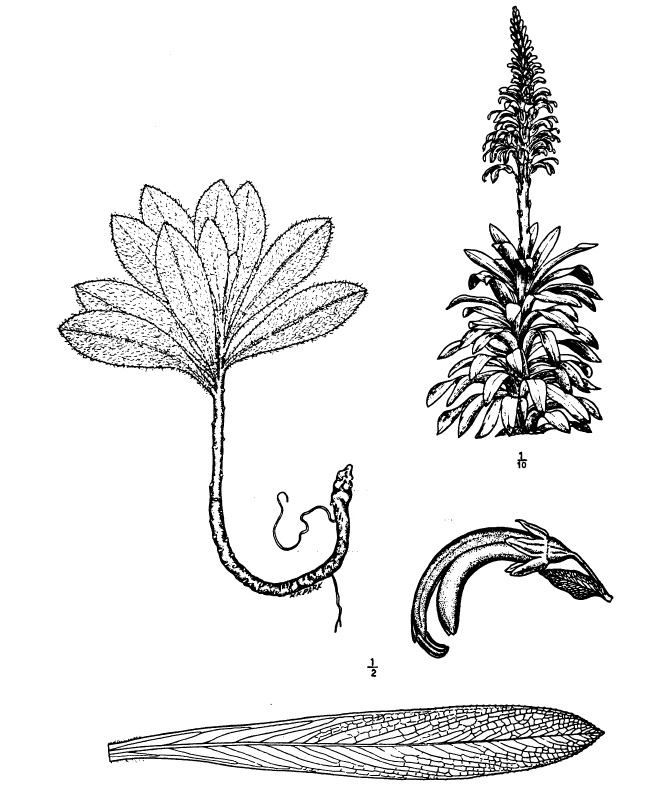
LOBELIA GLORIA-MONTIS Rock (Original) (Described on preceding page)
(© Otto Degener, 2/11/'38) (Eke, Maui)
FLORA HAWAIIENSIS
LOBELIACEAE LOBELIA FAMILY
ROLLANDIA ANGUSTIFOLIA (Hillebr.) Rock NARROW-LEAVED ROLLANDIA
Rollandia longifolia [sic] var. angustifolia Hilleb. Fl. Haw. Isl. 246. 1888. Rollandia angustifolia Rock in Bull. Torr. Bot. Club 45: 136. 1918. Rollandia angustifolia sensu Rock, Moonogr. Haw. Lobel. 365. 1919. Rollandia angustifolia sensu E. Wimm. in Engl. Pflzreich. 106 (4.276b): 98. 1943. Rollandia angustifolia sensu E. Wimm. in Engl. Pflzreich. 107 (4.276b): 762. 1953.
About 10-15 dm. high usually unbranched shrub with smooth thick stem. Leaves linear-oblanceolate, 20-35 cm. long, 1.5-3.7 cm. wide, glabrous, thick, fleshy, dark green and shiny above, pale beneath with purplish thick midrib and ribs, apex acuminate and with callous mucronate tip, gradually narrowed into fleshy 2-4 cm. long petiole, margin for lower two-thirds entire to faintly undulate and rest faintly serrulate with on upper surface submarginal callous impressed teeth. Flowers deep claret, 4-6, on slender 5-15 mm. long pedicels bracteate at base and bibracteolate near middle, with 2-4 cm. long peduncle. Calyx turbinate, 1 cm. long; lobes of irregular length, 3-5 mm. long, narrowly deltoid, usually acute to obtuse, mostly more or less irregularly connate. Corolla glabrous, 7-8 cm. long, 1 cm. wide, with lobes 1.5 cm. long, and dorsal slit extending one-fifth length of tube. Staminal column glabrous, adnate for half the length of corolla tube; anthers glabrous, the lower bearded. Fruit globose, crowned by calyx until near maturity.
Type Locality: "Oahu! Eastern division of the main range, from Kalihi to Niu."
Local Range: Endemic to the dense forest of the southeastern part of the Koolau Range of Oahu, where it flowers from about June through September. It is a variable plant, especially in respect to the shape of the calyx lobes. As noted by Rock, juvenile leaves are linear-oblanceolate and not sinuate as are those of R. longifolia Wawra.
Extra Range: Not known elsewhere.
ROLLANDIA ANGUSTIFOLIA var. OCHREATA E. Wimm.
Rollandia angustifolia var. ochreata E. Wimm. in Engl. Pflzreich. 106 (4.276b): 99. 1943.
Differing from the species in having the leaves almost uniformly colored and more sharply denticulate toward upper part, the 7 mm. long dark purplish sepals connate into an ocrea-like tube, the filaments very sparsely hirtellous and the anther tube finely setose along sutures.
Type Locality: "Oahu: Wainiano [Waimano] Valley above water intake along trail."
Local Range: Known only from the type specimen collected by Will Bush (Degener No. 11,326).
(Illustrated on following page)
(Degener & Degener, 6/15/62) (Aided by National Science Foundation)
New Illustrated Flora of the Hawaiian Islands
LOBELIACEAE LOBELIA FAMILY
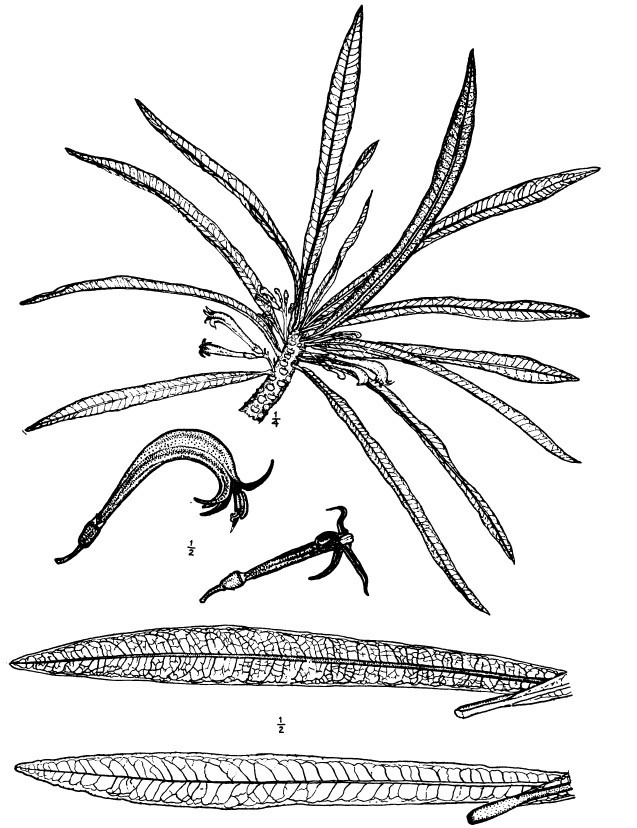
ROLLANDIA ANGUSTIFOLIA (Hillebr.) Rock (Original) (Described on preceding page)
(Wiliwilinui, Oahu, June 1949)
FLORA HAWAIIENSIS
LOBELIACEAE LOBELIA FAMILY
ROLLANDIA DEGENERIANA E. Wimm. DEGENER ROLLANDIA
Rollandia degeneriana E. Wimm., nov. sp. Planta fortasse hybrida inter Rollandiam calycinam et R. lanceolatam, set notis pluribus insignis. Caulis (in specimine nostro) digiti parvi crassitie, glaber, virenti-luteus. Folia subcoriacea, supra sparse tuberculata (bases aculeorum), subtus densius hirta (pili simplices furcatis intermixtis), subobovato-oblonga, 20-30 x 7-10 cm, acuminata, basi sensim in petiolum crispo-hirtum 4-8 cm longum angustata, margine crenulato-denticulata. Pedunculi solitari-axillares, subglabri vel hirtelli, 3-4 cm longi et c. 3 mm in diametro, bracteis deciduis, 5-6 flores in vertice gerentes; pedicelli 1 cm longi, hirtelli, in medio interdum bibracteolati. Hypanthium obconicum, c. 1 cm longum: lobi plus minusve connati, 4-6 mm longi, glabri. Corolla purpurascens (?), glabra, sigmoideo-curvata, c. 8 cm longa; tubus longitudine circiter 45 mm connatus et supra medium latior (7 mm); lobi 5 anguste lineares, lobi 2 superiores 22 mm longi, 3 inferiores parum breviores et labium tripartitum formantes. Stamina e tubo corollae longe exserta; filamenta glabra vel in parte superiore parum pubescentia; antherarum tubus 13 mm longus, basi except glaber, apice omnes, sed inferiores longius pilosae. Stigma bilobum, lobi ovales et in facie inferiore pilosi. Fructum non vidi. (E. Wimm.)
Small erect shrub with glabrous yellowish green about 6-12 mm. thick branches. leaves more or less obovate-oblong, subcoriaceous, above sparsely and moderately muricate, below densely somewhat hirsute with simple and branched hair, the blade 20-30 cm. long and 7-10 cm. wide, acuminate at apex, somewhat acuminate at base, crenulate-denticulate, with somewhat hirsute 4-8 cm. long petiole. Peduncules solitary in the axils of the leaves, glabrate to hirtellous, 3-4 cm. long and about 3 mm. thick, with more or less deciduous bracts, bearing near top usually 5-6 flowers; pedicels 1 cm. long, hirtellous, at times bibracteolate near middle. Ovary obconic, about 10 mm. long, crowned by more or less connate 5-6 mm. long glabrous calyx lobes. Corolla apparently purple, glabrous, somewhat S-shaped, narrow, about 80 mm. long, the tube connate for 45-50 mm. and about 7 mm. wide at widest part, with the 2 upper narrow-linear lobes 22 mm. long and the 3 lower narrow-linear lobes somewhat shorter and forming a 3-parted lip. Stamens long exserted from corolla tube: filaments glabrous or toward top pubescent; anther tube 13 mm. long, pubescent at bottom and top, the lower anthers bearded. Stigma bilobed, with oval lobes pilose on lower surface. fruit unknown. (Deg. & Deg.)
Type Locality: Oahu: Punaluu mountains, Pig-God trail, in forest at summit, 4.VII.1935 lg Degener, Park, Bush, Potter and Topping (Hb. Deg. No. 11484).
Local Range: Known only from the type specimen. This plant may be a hybrid between Rollandia calycina and R. lanceolata. This specimen shows again how futile it is with our present fragmentary knowledge of the native flora to produce a firmly bound book impossible of easy revision. This sheet like so many others draws the reader's attention to a plant that needs further collecting, ,and study in the field and laboratory. The results then should be incorporated in a properly emended, illustrated description to replace the present one.(Deg & Deg.)
(Illustrated on following page)
(Degener & Degener, 5/28/56) (Aided by National Science Foundation)
New Illustrated Flora of the Hawaiian Islands
LOBELIACEAE LOBELIA FAMILY
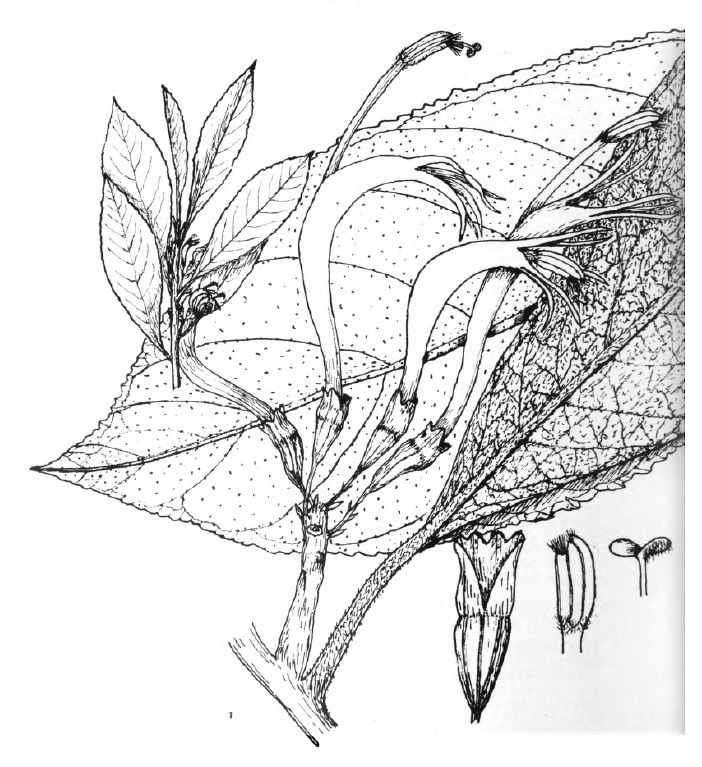
ROLLANDIA DEGENERIANA E. Wimm. (Original, courtesy Dr. Wimmer) (Described on preceding page)
(Degener & Degener 5/28/56)(Degener 11,484)
FLORA HAWAIIENSIS
LOBELIACEAE LOBELIA FAMILY
ROLLANDIA HUMBOLDTIANA HUMBOLDT ROLLANDIA
Rollandia Humboldtiana Gaud. Bot. Voy. Bonité, pl. 76. 1839-52. Not Rollandia Humboldtiana Hilleb. Fl. Haw. Isl. 248. 1888. Delissea racemosa Mann in Proc. Am. Acad. 7:181. 1868. Rollandia pedunculosa Wawra in Flora od. Allgem. Bot. Zeit. 31:46. 1873. Rollandia racemosa Hilleb. Fl. Haw. Isl. 246. 1888.
Stem 1-2 meters high, dark green above. Leaves thick-chartaceous, obovate-oblong, 25-40 cm. long and 8-16 cm. wide, at apex shortly acuminate and mucronate, at base abruptly decurrent into a slightly margined 3-4 cm. long petiole, above glabrous and dark green, below densely puberulent and pale but with veins darker, with margins crenulate-dentate. Flowers in axillary 8-40 cm. long somewhat horizontal to usually drooping puberulent loosely bracteate racemes floriferous in the upper third; pedicels 10-15 mm. long, borne in the axils of persistent subulate bracts 7 mm. long or less and bearing a pair of about 2 mm. long subulate bractlets below the middle. Calyx puberulent, with cylindric to ovate tube 1 cm. long and with subequal acute to truncate lobes 3-10 mm. long. Corolla white or purple, 6.5-7.5 cm. long, strongly falcate and laterally compressed, puberulent below to glabrate above, with upper pair of lobes having median slit 25 mm. long and lower slit 15 mm. long. Staminal column adnate to corolla for about 3 cm., glabrous; anthers 7-9 mm. long, pale reddish purple even in white flowered forms, glabrous, only the 2 lower bearded. Fruit ovate to obovate, pale orange.
Type Locality: "Iles Sandwich."
Local Range: A rare plant known from the rain forest between Puu Lanipo and Konahuanui, and twice collected in the mountains of Punaluu, Oahu. Its flowering season seems to be during October and November. The specimen collected on Lanipo was the white-flowered form.
Extra Range: Not known elsewhere.
(Illustrated on following page)
(Otto Degener, 12/15/'32)
New Illustrated Flora of the Hawaiian Islands
LOBELIACEAE LOBELIA FAMILY
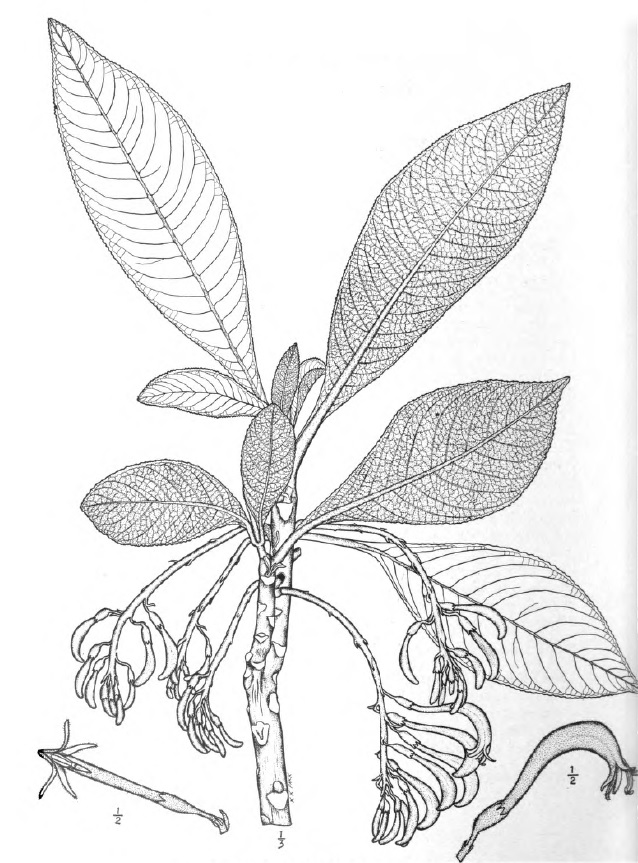
ROLLANDIA HUMBOLDTIANA Gaud. (Original) (Described on preceding page)
(Otto Degener, 12/15/'32) (Lanipo, Oahu)
FLORA HAWAIIENSIS
LOBELIACEAE LOBELIA FAMILY
ROLLANDIA LANCEOLATA Gaud. LANCEOLATE-LEAVED ROLLANDIA
Rollandia lanceolata Gaud. Voy. Freyc. Bot 458. 1829. Lobelia lanceolata Hook. & Arn. Bot. Beech. 88. 1832. Rollandia lanceolata var. grandifolia DC. in Prodr. 7: 344. 1839. Rollandia Delessertiana Gaud. Bot. Voy. Bonité pl. 75. 1939 - 52. Delissea lanceolata *A. Gray in Proc. Am. Acad. 5: 147. 1861. Rollandia lanceolata sensu Hilleb. Fl. Haw. Isl. 246. 1888. Rollandia lanceolata var. typica Rock, Monogr. Lobel. 371. 1919. Rollandia lanceolata var. grandifolia St. John & Hosaka in Occas. Pap. B. P. Bishop Mus. 11:12. 1935.
Variable plant with thick unarmed stem up to 2 meters tall. Leaves lanceolate to oblanceolate, 24-60 cm. long, 5-12 cm. wide, gradually acuminate at both ends, denticulate to sinuate, somewhat fleshy, above glabrous, below glabrous but with veins hirtellous to tomentose with simple hair, the midrib and nerves somewhat muricate, with distinct 2-7 cm. long petiole. Peduncle 3-6 cm. long, with many flowers; pedicels 6-12 mm. long; bracts 2-8 mm. long, oblong. Calyx purple, with more or less obovoid about 6 mm. long tube and 1.5-3 mm. long triangular to oblong-obtuse lobes. Corolla purple usually with paler stripes, 6-7.5 cm. long, glabrous. Filaments hirsute especially toward top or rarely glabrous; upper anthers tufted or ciliate at apex. Berry pyriform, 16-18 mm. long, dark purple. Seeds smooth, shiny.
Type Locality: "Waohoo, Maio 1825."
Local Range: This species is found in dense dank woods, often at lower elevations from about Waikane southeastward along the Koolau Range, Oahu, as far as suitable terrain exists. It is not rare mauka of Honolulu. Juvenile plants are exceptionally ornamental with densely prickly stems and ovate-oblong, lobed leaves covered above with soft tawny prickles.
Extra Range: Species and its subdivisions not known elsewhere.
____________
* Many Hawaiian plants described or mentioned by Asa Gray were printed under one date yet actually published under a different one. This has been the cause of many errors in bibliographic citations by later workers. To aid in forestalling such errors in the future, information pertinent to the Hawaiian flora is here abstracted from Joseph Ewan's article in Amer. Midl. Natur. 22:218-222. 1919. Proc. Am. Assoc. Adv. Sci. 2: 397-298. "1850" but actually published in 1849; Proc. Am. Acad. 3: 48-54. "1857" but publ. 1853; 3: 127-129. "1853" but Publ. 1854; 4: 33-50. "1860" but publ. 1858; 4: 306-318. ..., publ. 1859; 4: 319-324. ..., publ. 1859; 4: 326-327. "1860" but publ. 1859; 5: 114-146. "1862" but publ. 1861; 5: 146-152. "1862" but publ. 1861; 6: 37-55 "1866" but publ. 1862.
:::
(Otto Degener & Amy Greenwell, 7/25/'52)
New Illustrated Flora of the Hawaiian Islands
LOBELIACEAE LOBELIA FAMILY
KEY:
| 1. Corolla glabrous; leaves below hirtellous to glabrous: | |
| 2. Corolla purple | R. lanceolata s.s. |
| 2. Corolla greenish with purplish stripes | var. viridiflora |
| 1. Corolla pubescent: | |
| 2. Corolla dark purple; leaves glabrous to hirtellous | f. rockii |
| 2. Corolla purplish gray to gray; leaves below tomentose | var. tomentella |
ROLLANDIA LANCEOLATA var. VIRIDIFLORA Rock, Monogr. Lobel. 373. 1919.
Stem with large crown of leaves extending horizontally and with inflorescences clustered near top. Leaves glabrous throughout, lanceolate, acuminate at apex, acute at base, about 40 cm. long and 7 cm. wide, dark green and shiny above, irregularly crenulate with prominent midrib and nerves and about 4 cm. long petiole. Racemes about 3 cm. long, closely bracteate, stout, deep purple. Calyx purplish, with minute triangular teeth. Corolla greenish with purplish stripes, fleshy, smaller and narrower than in f. Rockii but with similar staminal column.
Type Locality: "Oahu; Eastern Manoa ridge dividing Manoa from Palolo Valley, at lower elevations (1000-2000 feet)."
Local Range: A rare variety growing in the dense forest mauka of Honolulu.
ROLLANDIA LANCEOLATA f. ROCKII (St. John & Hosaka) E. Wimm.
Rollandia lanceolata var. typica Rock, Monogr. Haw. Lobel. 373. 1919. Rollandia lanceolata var. Rockii St. John & Hosaka in Occas. Pap. B. P. Bishop Mus. 11:13. 1935. Rollandia lanceolata forma Rockii E. Wimm. in Engl. Pflzreich. 106 (4.276b): 102. 1943.
Stouter plant. Leaves often somewhat wider, beneath with midrib and nerves sparsely muricate as is also entire petiole. Calyx lobes dentiform. Corolla dark purple, puberulous.
Type Locality: "Pauoa Valley, Oahu, Hawaiian islands."
Local Range: Found in the dense, lower forest of Palolo, Manoa and Pauoa Valleys, Oahu with its close relatives.
FLORA HAWAIIENSIS
LOBELIACEAE LOBELIA FAMILY
ROLLANDIA LANCEOLATA var. TOMENTELLA (Wawra) E. Wimm.
Rollandia Humboldtiana var. tomentella Wawra in Flora 56: 32. 1873. Rollandia lanceolata vars. e & f Hilleb. Fl. Haw. Isl. 248. 1888. Rollandia lanceolata var. tomentosa Hilleb.; Drake, Ill. Fl. Ins. Mar. Pacific. 7: 218. 1892. Rollandia lanceolata var. tomentosa sensu Rock, Monogr. Haw. Lobel. 373. 1919. Rollandia lanceolata var. kipapaensis Hosaka; St. John & Hosaka in Occas. Pap. B. P. Bishop Mus. 11:14. 1935. Rollandia lanceolata var. tomentella E. Wimm. in Engl. Pflzreich. 196 (4.276b): 102. 1943.
Leaves obovate-oblong, 47 cm. long, 10 cm. wide, acute at apex, cuneate at base, with strigose 2 cm. long petiole, above glabrous, below pale hispid-strigose with simple hair. Peduncles about 3 cm. long, hispid-strigose; pedicels 1 cm. long, hirtellous. Calyx green, sparsely hirsute, with obtuse to acute up to 4 mm. long often purplish lobes. Corolla hirtellous especially toward tip, 65 mm. long, purplish to gray. Filaments glabrous to puberulous toward tip; anthers glabrous to puberulous without, the 2 lower tufted at apex.
Type Locality: "Oahu am Kaala."
Local Range: Growing under similar conditions as the species proper, but in the Waianae as well as the Koolau Range. As the Waianae Range is the drier one, the plants there tend to grow at higher elevations where the clouds supply them more moiture. Some wriers describe the under side of the leaf as "brown tomentose." This is their appearance in the herbarium. The living plants are nearer white-tomentose.
(Rollandia lanceolata var. tomentella illustrated on following page)
New Illustrated Flora of the Hawaiian Islands
LOBELIACEAE LOBELIA FAMILY
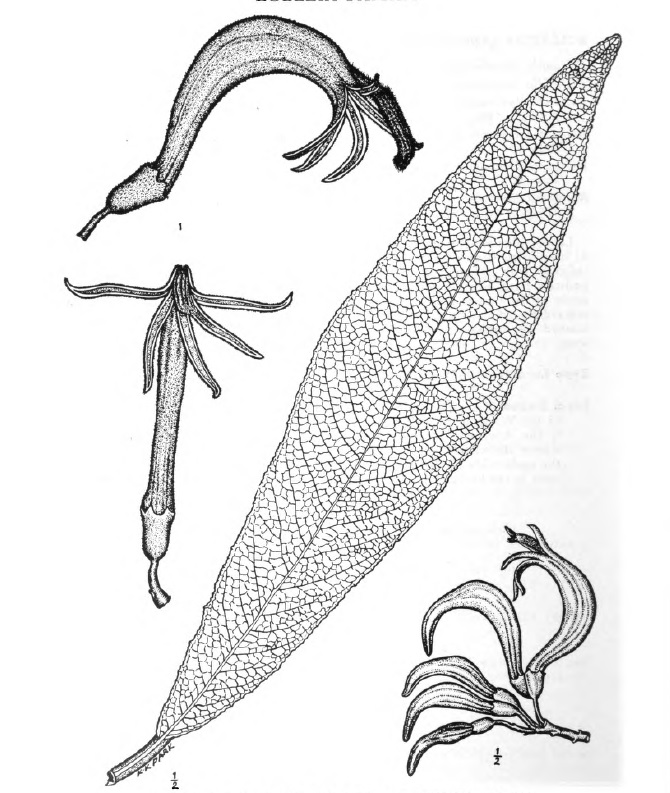
ROLLANDIA LANCEOLATA var. TOMENTELLA (Wawra) E. Wimm. (Original) (Described on preceding page)
(© Otto Degener 7/25/'52)(Kipapa, Oahu, 6/2/35)
FLORA HAWAIIENSIS
LOBELIACEAE LOBELIA FAMILY
ROLLANDIA PURPURELLIFOLIA Rock PURPLE-LEAVED ROLLANDIA
Rollandia purpurellifolia Rock* in Coll. Haw. Publ. Bull. 2:44. 1913.
Stem 2-5 dm. high, unbranched, unarmed, glabrous. Leaves 12-35 cm. long, 3-6.5 cm. wide, linear-oblong to oblanceolate, somewhat rounded to shortly acute at apex, subsessile or with somewhat margined petiole up to 8 mm. long, above deep green dull to shiny glabrous, beneath deep purple shiny glabrous or slightly hirtellous on the nerves only, with margin minutely denticulate except for lower fourth or third which is entire. Flowers up to about 6 in axillary thick dark purplish-red glabrous suberect loosely subulate-bracted racemes which are floriferous in the upper third or fourth; peduncles 5-25 mm. long, bibracteate toward apex; pedicels up to 8 mm. long, bearing a pair of subulate bractlets usually above the middle. Calyx so dark reddish-purple to appear almost black, 9-10 mm. long, uniformly 4 mm. thick, consisting of 4-5 mm. long tube and 2 lips; upper lip 4-7 mm. long with three 1.5-3 mm. long acute deltoid lobes of which central one is the largest and widest; lower lip about 2 mm. shorter, of two 1.5-2 mm. long acute deltoid lobes; calyx tube because of thickness of corolla usually with 1 split to its base which arises from sinus separating lips of more rarely from sinus between lobes of lower lip. Corolla dark purplish-red, about 6 cm. long, strongly falcate, laterally compressed, glabrous, with upper pair of lobes having median slit about 20 mm. long and lower slit about 13 mm. long. Staminal column adnate to corolla for 33 cm., glabrous, purplish-red, longitudinally 5-grooved; anthers 7-9 mm. long, bluish-purple, the 2 lower bearded. Ovary slender-pyriform, of same color as calyx, 10 mm. long and 5 mm. wide. Fruit dark purple to black, obovoid, 15-18 mm. long, crowned by the calyx lobes.
Type Locality: "Oahu: dense forests of Punaluu Mts., at the summit ridge above Hauula in dense shade with Lysimachia longisepala and numerous ferns, etc."
Local Range: A little-known species as yet collected only in dense, wet forests above 1,000 feet in and around Kaluanui Valley, Hauula, Oahu. Found flowering in June and fruiting in August.
Extra Range: Not known elsewhere.
(Illustrated on following page)
(Otto Degener, 8/10/'32)
New Illustrated Flora of the Hawaiian Islands
LOBELIACEAE LOBELIA FAMILY
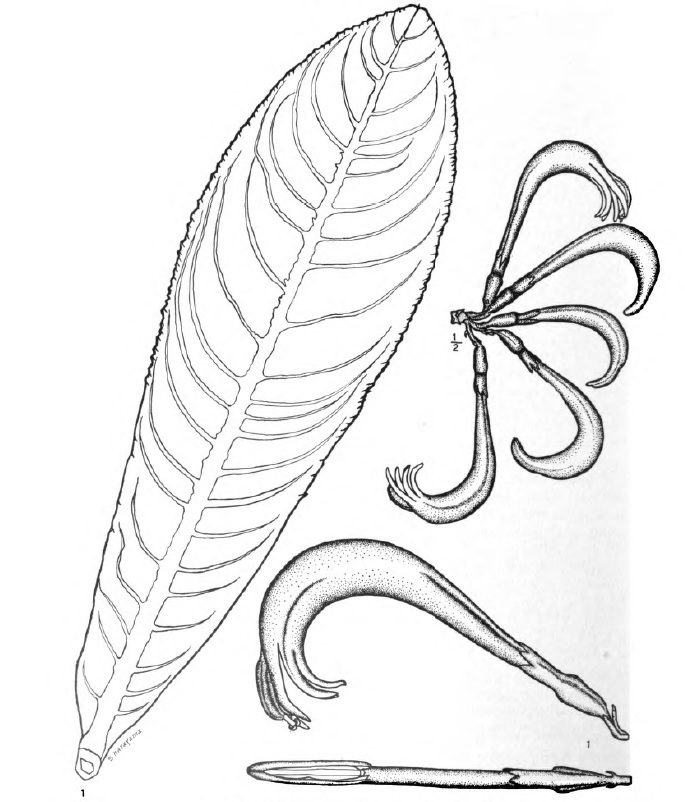
ROLLANDIA PURPURELLIFOLIA Rock (Original) (Described on preceding page)
(© Otto Degener, 8/10/'32) (Punaluu, Oahu)
FLORA HAWAIIENSIS
LOBELIACEAE LOBELIA FAMILY
ROLLANDIA ST.-JOHNII Hosaka ST. JOHN ROLLANDIA
Rollandia St.-Johnii Hosaka in Occas. Pap. B.P.Bishop Mus. 11. 13:15. 1935.
Erect unbranched or branched perennial 3-6 dm. high with terete rough 1-1.5 cm. thick stem bearing large leaf scars and occasionally 3 mm. thick subglobose peduncle bases. Leaves crowded toward top, thick, brittle, coarsely revolute, 6-13 cm. long and 1.5-2 cm. wide, oblanceolate, at apex acute, shiny throughout, above dark green glabrous and with nerves and especially midrib impressed, beneath pale with thick midrib and veins either green or somewhat rusty-muricate-hispidulous, the margin with crisped callous teeth, the base acute to fleshy thick muricate-hispidulous about 1-1.5 cm. long petiole margined or not. Flowers 2-20 on 5-10 mm. long glabrous bracts at lower third, the 5-15 mm. long hispid thick peduncle with 4-7 mm. long linear-lanceolate hispidulous bracts. Calyx green, thick, glabrous to sparsely hispidulous, somewhat warty, the funnelform tube 4-7 mm. long and at apex 4-5 mm. wide; the 3 upper linear-lanceolate lobes about 5 mm. long and almost 2 mm. wide, sharply acuminate, the 2 lower lobes similar but about 4 mm. long and only acute. Corolla pure white or within toward apex tinged light purple, about 45 mm. long, 10 mm. broad, 4 mm. thick, entirely glabrous and smooth, the tube 30-35 mm. long, with dorsal slit extended to about 30 mm. from base, the upper 2 lobes about 20 mm. long and the lower 3 lobes about 12 mm. long. Staminal column adnate to corolla for about 22 mm., glabrate with spreading hair (Degener No. 11,538) or glabrous, white; anthers 5-8 mm. long, dull, dark purplish, the 3 upper glabrous and the 2 lower white-bearded; pollen white with yellowish gray tinge. Pistil at length protruding about 2-3 mm.; stigma 2-lobed. Fruit obviously a berry (and not " capsule").
Type Locality: "Oahu, Koolau Range, Waipio, Kipapa Gulch: on wet wind-swept main divide, altitude 2,800 feet."
Local Range: This interesting white-flowered Rollandia with brittle leaves was collected at the type locality first by Hosaka & Fosberg in 1932, by Hosaka alone a year later in the same region, and by Degener and assistants in 1937 about 8 miles distant. This last station is situated on the very summit of the Koolau Range northeast of Kaiwipoo and mauka of Aiea, Oahu. There it is exposed to the full force of the wind sweeping over the mountain from Kaneohe Bay, and appears stunted like the Labordias and Gouldias with which it grows. The Kaiwipoo plant was used for the present amended description and for the accompanying illustration. Its flowers are smaller than those of plants growing about the type locality. although this specimen lacked fruit, I judge R. St.-Johnii must bear a berry, and not a capsule as originally described.
Extra Range: Known only from the summit ridge of the Koolau Range of Oahu.
(Illustrated on following page)
(Otto Degener, 11/15/'38)
New Illustrated Flora of the Hawaiian Islands
LOBELIACEAE LOBELIA FAMILY
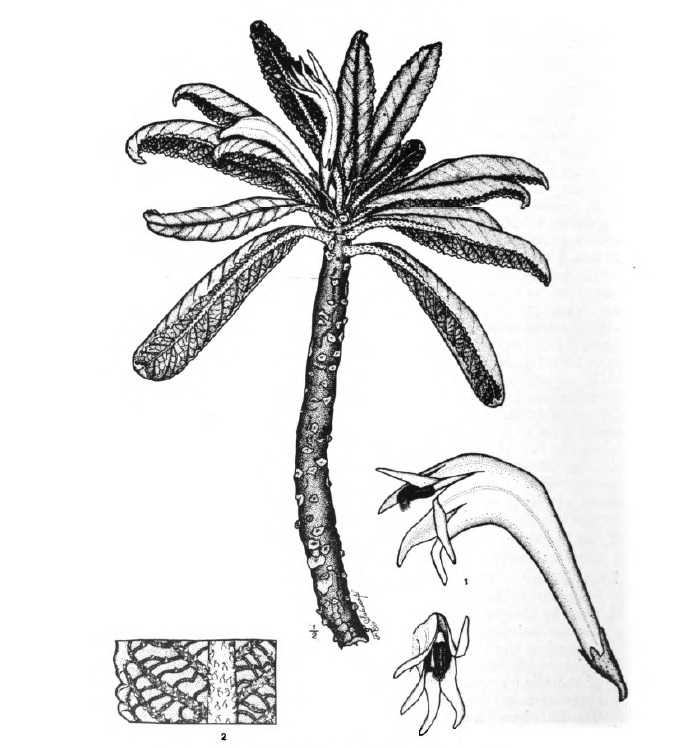
ROLLANDIA ST.-JOHNII Hosaka (Original) (Described on preceding page)
(Otto Degener, 11/15/'38) (Kaiwipoo, Oahu)
FLORA HAWAIIENSIS
LOBELIACEAE LOBELIA FAMILY
ROLLANDIA SESSILIFOLIA Degener
Rollandia sessilifolia sp. nov. Herba caule 9-15 dm. alta; foliis glabris, oblanceolatis, 45-55 cm. longis, 9-12 cm. latis, dentatis, sessilibus; calyce 15 mm. longo, 5-dentato, rubro; corolla rubra.
Stem 9-15 dm. high, 25 mm. thick, smooth except when seedling and immature at which time the stem is prickly or muricate. Leaves smooth and glabrous and shiny on both sides, oblanceolate, 45-55 cm. long and 9-12 cm. wide, coarsely mucronate, shallowly dentate with callous teeth for entire margin or often toward base faintly laciniate, sessile, with midrib prominent and purplish-red or rarely greenish beneath. Flowers mostly 6-7 in bracteate racemes having reddish peduncle about 3 cm. long and dark red pedicels about 8 mm. long; bracts flattened-subulate, about 3 mm. long on peduncle and about 1 mm. long on pedicels. Calyx very dark red, glabrous, with free part tubular and 2 mm. long and about 3 mm. wide, with upper lip having 3 teeth less than 1 mm. long and with lower lip having 2 teeth about 1 mm. long. corolla very dark red, glabrous, 6 cm. long to sinus on upper side, 3 mm. in diameter at base and at widest part 4 mm. wide and 1 cm. broad, upper lobes 2 cm. long and at base 2 mm. wide, median lower lobe slightly shorter. Staminal column adnate to corolla 4 cm. from its base, dark red, glabrous, with only the lower anthers tufted. Ovary 1 cm. long and 5 mm. in diameter, faintly grooved longitudinally.
Type Locality: Between Pupukea and Kahuku, Oahu.
Local Range: Known only from the type region where it grows in the forest, Flowering in May.
Extra Range: Probably most closely related to Rollandia longiflora Wawra.
Type Specimen: Degener, Hirai & Park No. 4106, May, 1931.
(Illustrated on following page)
(Otto Degener, 9/10/'32)
New Illustrated Flora of the Hawaiian Islands
LOBELIACEAE LOBELIA FAMILY
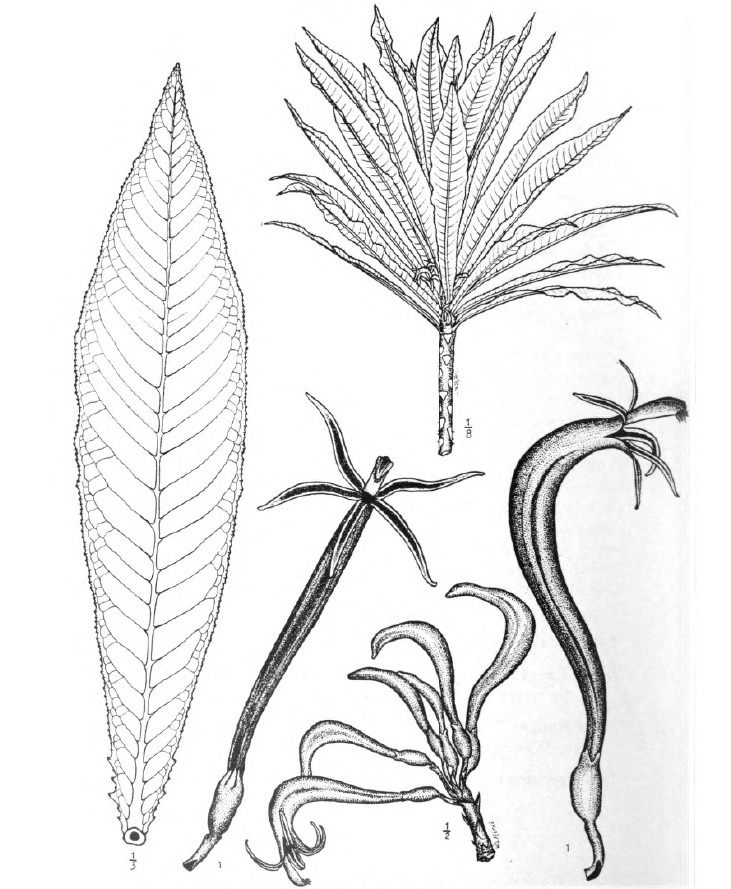
ROLLANDIA SESSILIFOLIA Degener (Original) (Described on preceding page)
(Otto Degener, 9/10/'32) (Pupukea, Oahu)
FLORA HAWAIIENSIS
LOBELIACEAE LOBELIA FAMILY
TREMATOLOBELIA Zahlbr.
Trematocarpus Zahlbr. in Annal. Naturh. Hofmus. Wien. 6:430. 1891. Not Trematocarpus Kuetz. Phyc. Geen. 410. 1843. Trematolobelia Zahlbr.; Rock in Coll. Haw. Publ. Bull. 2:45. 1913.
Simple erect shrubs 1-4 meters high with single hollow stem closely beset with leaf scars; plants dying after flowering. Leaves clustered alternately in compact terminal tuft, entire to crenate, simple, glabrous, linear-lanceolate to obovate-oblong. Inflorescence of 5-20 more or less terminal and horizontal racemes; flowers proterandrous. Calyx tube adnate to ovary, subglobose, with 5-parted limb. Corolla more or less curved, white to scarlet or purplish-red, deciduous, fleshy, thick, 5-lobed, dorsally split to near base and with 3 central lobes connate to form a tridentate lip while the 2 lateral lobes are about half the length of the corolla. Staminal tube free from corolla and much longer than corolla, almost straight; anthers 5, subequal, the 2 lower apically penicillate while the 3 upper are glabrous. Ovary inferior, 2-celled; style thick; stigma conical with basal ring of hair. Capsule persistent, inferior, subglobose, with depressed umbonate top, indehiscent but finally liberating its seeds by the deliquescence and decay of soft outer layer to leave woody longitudinally ridged structure fenestrated with oval to circular holes between the ridges for seed-dispersal. Seeds small, margined, with radicle next to hilum.
Name derived from the Greek for hole and from lobelia because of the fenestrated capsule of the plants.
Type Species: Trematocarpus macrostachys Zahlbr.
A few species, all endemic to the Hawaiian Islands where they grow characteristically on fog-swept mountain slopes.
(Otto Degener, 4/20/'34)
New Illustrated Flora of the Hawaiian Islands
LOBELIACEAE LOBELIA FAMILY
KEY TO SPECIES OF TREMATOLOBELIA:
1.
Leaves wider than 4 cm., apex acute to obtuse; calyx about 24 mm. long; corolla white, obscurely S-shaped (Kohala only) |
T. grandifolia |
1.
Leaves narrower than 4 cm., apex acuminate; calyx commonly less than 15 mm. long; corolla pink to purplish red: |
|
2.
Leaves lanceolate, 25-30 cm. long; corolla pink, 5-6 cm. long, more or less curved (Oahu, Molokai, Maui, Lanai, Hawaii excepting Kohala) |
T. sandwicensis |
2.
Leaves linear-lanceolate to oblong, commonly 16 cm. long; corolla scarlet to deep purplish red, smaller, strongly arched into semicircle (Kauai only) |
T. macrostachys |
(© Otto Degener, 4/20/'34)
FLORA HAWAIIENSIS
LOBELIACEAE LOBELIA FAMILY
TREMATOLOBELIA SANDWICENSIS Degener HAWAIIAN TREMATOLOBELIA
Lobelia macrostachys Hook. & Arn. in Bot. Beech. 88. 1832. Delissea (?) macrostachys Pres. Prodr. Monogr. Lobel. 47. 1836. Not Trematocarpus macrostachys Zahlbr. in Annal. Naturh. Hofmus. Wien. 6:432. 1891. Not Trematocarpus macrostachys Zahlbr.; Rock in Coll. Haw. Publ. Bull. 2:45. 1913. Trematolobelia sandwicensis nom. nov.
Plant 15-40 meters high, the woody hollow dull greenish stem erect, 2.5-3.5 cm. thick, dividing at apex candelabra-like into 5-22 stiff horizontal-ascending racemes which when young are densely pubescent but finally become glabrous and 3 dm. to rarely 10 dm. long. Leaves glabrous, membranous, lanceolate, 25-30 cm. long and 2-2.5 cm. wide, acuminate, faintly crenate in the upper portion with a small gland under each crenature, gradually narrowing into margined petiole. Pedicels attached to upper half or third of leafy racemes on all sides but those which lie on under side of the horizontal-ascending racemes are abruptly curved and twisted to be in more vertical potion, obcompressed, about 2 mm. thick and 2-3 cm. long, bibracteolate in the lower third with 2-3 mm. long oblong obtuse bractlets and in axil of backward-ascending straight commonly 2-3.5 cm. long and 2-3 mm. wide leafy bract. Calyx glabrous, coriaceous, with light green tube about 8 mm. long and 9 mm. wide, with obscure longitudinal ridges one leading to each lobe and sinus; lobes 5 (or exceptionally 6), equal or nearly so, 4-5 mm. long and 2 mm. wide, ovate-lanceolate, somewhat spreading. Corolla glabrous, pink and sometimes with lighter areas, slender, 5-6 cm. long and about 5 mm. wide, suberect before anthesis, more or less curved when open; the 2 upper lobes spreading-recurved, about equal in length to tube and 2 or more mm. wide, acute; lower lip about 3 cm. long and 7 mm. wide, with 3 acuminate lobes about 6 mm. long; corolla toward end of anthesis strongly contorted and deciduous. Staminal column sparingly pubescent (to glabrous?) and with small hairy patch at base of each anther on each side of thick connective, 4.5 cm. long and 3 mm. wide, longitudinally sulcate and on under surface flattened; anthers 1 cm. long, only the 2 lower penicillate, pale bluish-purple. Style greenish; stigma dark green, 1 mm. long, with stigmatic hairs annular; pistil longer persistent than corolla. Capsule before seed dispersal: greenish, outwardly somewhat thin-fleshy, flattened-subglobose, about 10 mm. high and 10 mm. broad and 7 mm. wide, longitudinally 10-ridged, with persistent calyx lobes and stylar base; capsule when scattering seed: devoid of fleshy covering, strongly ligneous, stramineous, with broad umbonate indehiscent flattened fenestrated apex having definite rim beyond which the 10 lateral longitudinal ridges project, with sides pierced by numerous oblong holes which have a thickened periphery and are between the unbroken ridge or more rarely interrupted by the ridges. Seeds yellow, flattened-ovoid, almost 1 mm. long, marginally winged.
Type Locality: Oahu, "Sandwich islands."
Local Range: Typical of fog-swept cliffs and steep, exposed mountain slopes above 2,000 feet; rarely elsewhere. Found on the Koolau Range of Oahu, expecially north of Honolulu and at the top of the Pig-God Trail, Punaluu. It also grows, though rare, on the high cliffs above Waikolu Valley and Pukoo, Molokai; on Puu Kukui and Mt. Eke on West Maui, as well as along the Olinda pipe-line trail and Waikamoi Gulch on East Maui; on Lanai; and in the open forest of Naalehu, on the southern slope of Mauna Loa, and in the Fern Forest at Kilauea on Hawaii. The plant flowers from late April to October, producing a few flowers at the end of the racemes occasionally as late as December. Its lower flowers begin to fruit around July, while the youngest mature their fruit in January or even later.
Extra Range: Not known elsewhere. The fact that this species has been recorded from so many islands immediately suggests that our present knowlege of the genus may be fragmentary. When the plnats now lumped as T. sandwicensis have become better known, they will be found to belong to several distinct forms and varieties - probably even species! A specimen collected by Skottsberg in Kohala may be one of these.
(Illustrated on following page)
(Otto Degener, 10/15/'34)
New Illustrated Flora of the Hawaiian Islands
LOBELIACEAE LOBELIA FAMILY
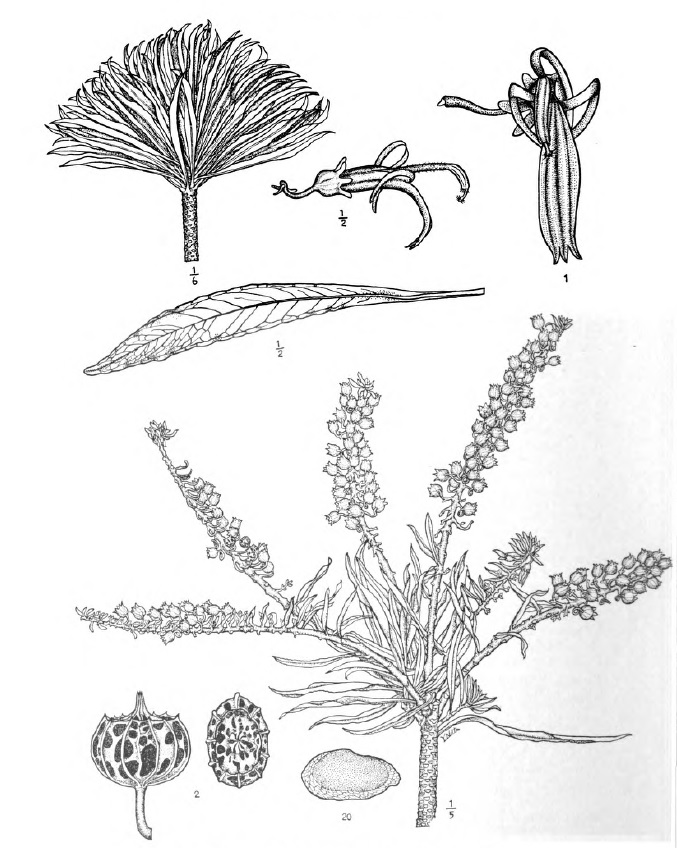
TREMATOLOBELIA SANDWICENSIS Degener (Original) (Described on preceding page)
(© Otto Degener, 10/15/'34) (Punuluu, Oahu)
FLORA HAWAIIENSIS
LOBELIACEAE LOBELIA FAMILY
TREMATOLOBELIA SANDWICENSIS var. KAALAE Degener
Lobelia macrostachys Hilleb. Fl. Haw. Isl. 237. 1888. (as to Waianae Range of Oahu only.) Not Lobelia macrostachys Hook. & Arn. in Bot. Beech. 88. 1832. Trematolobelia sandwicensis var. kaalae var. nov. A specie differt principaliter corolla magenta.
Similar to the species from which it differs chiefly in shape and color of the flower. Calyx glabrous, coriaceous, with green truncate tube about 6 mm. long and 9 mm. wide, with very obscure longitudinal ridges one leading to each lobe and sinus; lobes 5, equal or nearly so, 4-5 mm. long and 3 mm. wide, lanceolate, somewhat spreading, with 2 mm. truncate space at base between each lobe. Corolla glabrous, uniformly dark magenta, very slender, with prominent depression just beyond base on upper surface, about 7 cm. long and 7 mm. wide, erect, somewhat curved when open; the 2 upper lobes spreading-recurved, about 37 mm. long which is about equal in length to tube and 1.5 mm. wide near base but 3 mm.wide toward top, acute; lower lip 3.5 cm. long and 9 mm. wide, with 3 acuminate lobes about 8 mm. long; corolla toward end of anthesis strongly contorted and deciduous. Staminal column glabrous except toward end, and with small hairy patch at base of each anther on each side of thick connective, 6 cm. long and 3 mm. wide, longitudinally faintly pinkish-sulcate and on under surface flattened, whitish; anthers 12 mm. long, all penicillate but the upper ones faintly so; pale bluish-purple.
Type Locality: Summit of Kaala, Oahu.
Local Range: A rare plant growing on Mt. Kaala and probably other cloud-swept peaks of the Waianae Range of Oahu. It was collected by D. LeRoy Topping in 1925 and by Alfred Meebold seven year later. The Meebold plant was used for the accompanying illustration.
Extra Range: Endemic to the Waianae Range. Because further study of the Kaala plant in the fresh state may well prove it to be specifically distinct, it is considered worthy of an illustration of its own.
Type Specimen: Degener's No. 7803 collected by Meebold.
(Printed under patronage of John F. Degener, Jr.) (Illustated on following page)
(Otto Degener, 1/15/'36)
New Illustrated Flora of the Hawaiian Islands
LOBELIACEAE LOBELIA FAMILY
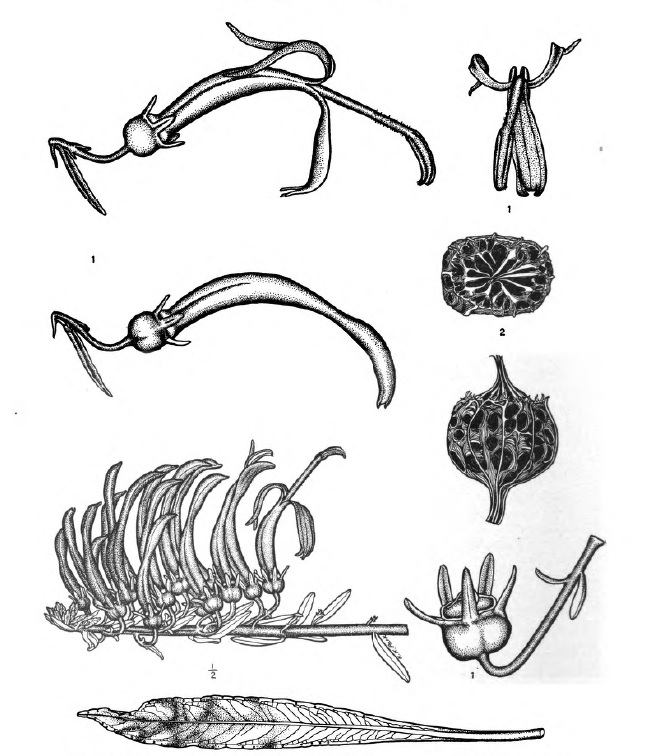
TREMATOLOBELIA SANDWICENSIS var. KAALAE Degener (Original) (Printed under patronage of John F. Degener, Jr.) (Described on preceding page)
(© Otto Degener, 1/15/'36) (Kaala, Oahu)