
Delissea subcordata
Genus: Delissea
Range: O'ahu; southern and central Ko'olau mountains; mesic forest, 120-460m. USGS map includes plants formerly placed here but found on the Wai'anae range which have been transferred to D. waianaeensis and D. takeuchii.
Status: Extinct, both subspecies. Last collected in 1934.
Growth form: Shrub, branched, 1.5 to 3 m tall.
Delissea subcordata is the first species described in Gaudichaud's Voyage of the Uranie. Nevertheless, Delissea undulata is the type species since the publication of the image of Delissea undulata preceded the publication of the text describing the two species. The only anchorage of the Uranie on O'ahu was at Honolulu, so the specimen collected by Gaudichaud is almost certainly from the southern Ko'olau Range.
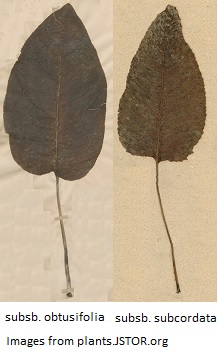
The species is split into two geographic subspecies subsp. subcordata found in the southern Ko'olau Range and subsp. obtusifolia found in the central Ko'olau Range. Both subspecies are presumed extinct. The leaves of subsp. obtusifolia are larger and more cordate with smaller teeth than the larger toothed, smaller leaves of subsp. subcordata. Integrades between the two exist, they were formerly called var. waikaneensis, but Lammers believes they do not merit subspecies rank and includes them in subsp. subcordata.
How to identify: Presumed extinct. Within the O'ahu Delissea, this particular species belongs to the section with large flowers (> 3 cm long, white, arcuate) which includes D. subcordata, D. waianaeensis, D. takeuchii, D. laciniata, and D. sinuata. Of these, only D. subcordata and D. laciniata are found on the Ko'olau Range. D. subcordata has ovate-cordate leaves whereas D. laciniata has lanceolate leaves.
Description: Except for the four tree-like species, Delissea are human-heighted shrubby things. Lammers (2005, p.7) says Delissea are either tree-like or shrubby with erect, ascending branches originating from the primary stem which do not branch in turn. D. subcordata, follows this second model; it was a woody, many-branched shrub, 1.5 to 3 m tall, glabrous. Rock said (1919, p. 345) the main stem was rarely more than 1 m tall (4 feet) before branching.
Sources: Prior to Lammers, 2005, D. subcordata was more widely circumscribed and included the specimens that have been now transferred to D. waianaeensis and D. takeuchii. This split falls geographically with both subspecies of D. subcordata having had been found in the Ko'olau Range and the other two species both endemic to the Wai'anae Range. The first species outside of the Ko'olau range was collecteded by Mann in 1867, so until that time the described species were:
The following descriptions include the broader conscription which include the specimens from the Wai'anae Range.
- Mann, 1868 (in part);
- Wawra, 1873 (in part);
- Wawra, 1873 (var. obtusifolia);
- Hillebrand, 1888 (in part, including var. obtusifolia);
- Rock, 1919 (in part, including var. obtusifolia);
- Wimmer, 1943 (in part, including var. obtusifolia);
- Degener, 1960 (in part, including var. obtusifolia);
- Wagner et al., 1990 (in part);
- Lammers, 2005.