GEOLOGICAL AND NATURAL HISTORY SURVEY OF MINNESOTA
CONWAY MACMILLAN, State Botanist
MINNESOTA
BOTANICAL STUDIES
____________
Vol. I
____________
EDITED BY
CONWAY MACMILLAN
____________
BULLETIN NO. 9 OF THE SURVEY
BOTANICAL SERIES
II
____________
1894-1896
MINNEAPOLIS, MINNESOTA
HARRISON & SMITH
PRINTERS
MINNEAPOLIS, MINNESOTA
Page 760
XLVIII. OBSERVATIONS ON THE FERNS AND FLOWERING PLANTS OF THE HAWAIIAN ISLANDS. *
____________
A. A. HELLER
____________
The Hawaiian group of islands has long been known as possessing peculiar botanical features, and has been visited during the past one hunred years by a number of botanists, the first of whom was David Nelson, who collected there in 1778 and 1779, during the third voyage of Captain Cook.
The principal published accounts of Hawaiian plants are by Chamisso, in Linnaea; by Gaudichaud, in Botanique du Voyage de l'Uranie, incorrectly cited by Mann and Hillebrand as Bot. Freyc. Voy.; by Meyen, in Nov. Act. Acad. Caes. Leop. Carol. Nat. Cur.; by Asa Gray, in the Proceedings of the American Academy of Arts and Sciences; by Nuttall, in the Transactions of the American Philosophical Society; by Horace Mann, in the Proceedings of the Boston Society of Natural History, and Proceeedings of the American Academy, by Wawra, in Flora, and by Hillebrand, in his Flora of the Hawaiian Islands. Gaudichaud also issued a folio atlas, in which are plates of the plants collected on the voyage of the Bonite, but unaccompanied by descriptions. The Hawaiian plants to which these plates refer have mostly been described by different wrtiers, and credited to Gaudichaud.
The main part of the group, composed of the islands of Hawaii, Maui, Kahoolawe, Lanai, Molokai, Oahu, Kauai, and Niihau, is situated between 18° 55' and 22° 20' N., and 154° 50' and 160° 40' W. Scattered in a northwesterly direction for a distance of 600 or 700 miiles, are occasional rocks and small, low islands, now belonging to the young republic. Of these, Laysan island is perhaps the largest, though only a narrow strip of land a few miles long. It is of value only on account of its large guano deposits. The plants found on it are the same as those which occur along the beach on the lee sides of Oahu and Kauai, as Gossypium tomentosum and Scaevola koenigii.
__________________
* A complete series of this collection, amounting to over one thousand specimens of ferns and flowering plnats, and including some sixty type specimens, has been presented by Mr. A. A. Heller to the herbarium of the Geological and Natural History Survey. The whole makes an addition of quite inestimable value to the state collections. C. M.
Page 761
Kauai, the third in size, is the oldest in point of formation, and usually considered to be the best botanically. On the lee side, separated by a channel nine miles in width, is Niihau, a small and rather low island, the maximum height not exceeding 1,000 feet. In the early part of the century it was of considerably more importance than now, as ships were accustomed to put in there to get a supply of yans, which were very abundant. There also the famous Niihau mats were made from Cyperus laevigatus.
Following the trend of formation from northwest to southeast, Oahu, the fourth island in size, comes next, separated from Kauai by a channel sixty miles in width.
Next in order is Molokai, fifth in size. It is a long, narrow island, with precipitous cliffs along the windward side. Conflicting statements are made as to the height of the mountains on this island, some giving 3,500 feet as the maximum, others 6,000 feet. The highest, and consequently the wettest portion, is toward the eastern end. The western end is composed of the ancient crater of Maunolaa. On a small peninsula, which juts out near the middle of the north side of the island, is situated the leper settlement. This point of land is cut off from the main portion of the island by a pali, as precipes are there called. This pali is about 3,000 feet high, and practically impassable, so that the only approach is by sea. Some years ago the lepers, or as many of them as could be captured, were sent off to Molokai, and now, whenever a case develops, the victim is promptly sent there too. The government provides them with habitations, food and medical attendance, so that many of them are really much better off than they were before. This method has undoubtedly done much to check the spread of the dread disease.
Immediatley south of Molokai, separted by a narrow channel, is Lanai, a small island, with a maximum elevation of perhaps 2,500 feet. Lying as it does on the lee side of Molokai and Maui, it receives but a small amount of moisture, and has only one permanent stream of water.
Just east of Lanai, lies Maui, the second in size of the group. It is composed of two mountains, connected by a low, sandy isthmus. The western part consists of precipitous mountain ridges, while the larger eastern part is occupied by the great mountain of Haleakala, 10,000 feet high. The slope of this mountain, at least on the western side is easy and gradual. The immense extinct crater of Haleakala — "House of the Sun" — is the largest in the world. It is triangular in shape, and from 1,000 to 2,000 feet deep.
Page 762
Kahoolawe, southwest of Maui, is a small, barren island, devoted to sheep raising, and has never been considered of much interest botanically.
Last, but not least, for it is the largest, is the island of Hawaii, from which the group derives its name. It is 100 miles long and 90 miles wide. The northern end is occupied by the Kohala range of mountains, with a height of 6,000 feet. The remainder of the island is composed of three peaks, Mauna Kea, 13,805 feet high; Mauna Loa, 13,675 feet, and Hualalai, 8,273 feet. These three mountains form the three points of an equilateral triangle, with an elevated plateau of from 5,000 to 6,000 feet between them. On the southeastern slope of Mauna Loa, at 4,041 feet, is the famous crater of Kilauea.
Considering their proximity to the Equator, the Hawaiian island enjoy an unusually mild climate, the mean annual temperature at Honolulu being about 79° F. The minimum is 50° F and the maximum 90° F, but the latter figure is rarely reached. The northeast trade winds, which blow during about three-fourths of the year, are the cause of the pleasant and equitable temperature. During the winter months, when the wind shifts to the south or southeast, bringing with it some of the equatorial heat and sultriness, is the most disagreeable time of the year. This is the season, too, when the heavy "Kona" storms of wind and rain usually make their appearance.
The topography has much to do with the rainfall, as the islands are practically all mountains, with very little low land along the coast. In nearly all cases a mountain barrier being presented to the prevailing wind, the moisture is condensed, and a heavy precipitation follows on the windward side, while the lee side may be comparatively rainless. At Hilo, on Hawaii, and at Hanalei, on Kauai, the average rainfall is 180 inches, while at points opposite on the lee sides of the same islands, the average is about 25 inches.
As the soil is composed of disintegrated lava rock, it is very porous, and very little water can be found on and near mountain summits, although there are exceptions on Maui and Kauai, where bogs have been formed. Usually the rainfall which is precipitated on the summits and upper slopes, percolates through the soil and makes its appearance as streams somewhere upon the lower slopes of the mountains, or wells up as springs on the beach. Along the beach, between Diamond Head and Koko Head, on Oahu, in a region where rain rarely falls except in winter are a number of springs of fresh water, covered at high tide by the sea. Just beyound Diamond Head it is a common sight to see cattle go down to the beach, and apparently take a drink of salt water.
Page 763
Judging from the uniformity of the geological formation, we should expect a great similarity in the vegetation of the several island, but such is not the case. True, there are many species common to all of the islands, but the bulk of the native species found on any given island, are different from those which occur on the other islands, and when a species is found on two or more islands, it differs somewhat in leaf form, or in some other particular. This is especially true of strictly endemic plants. The introduced species show a much great uniformity in habit and growth.
Isolated from a continental area, and almost equally so from the other islands of the Polynesian system, Hawaiian vegetation has developed independent of extraneous modifying conditions. That it has done so in a satisfactory way, is evinced by a summing up of the proportion of endemic species in Hillebrand's Flora. This work published in 1888, enumerates 999 species of phanerogams and vascular cryptogams. Of this number, 139 are introduced, and 653 are endemic, leaving 207 native species which are found elsewhere.
Of the 653 endemic species, 250 belong to 40 endemic geenera. These endemic genera are found principally among the Rubiaceae, Compositae, Lobeliaceae, and Labiatae. The distribution of the species in the larger of these endemic genera is quite interesting.
Schiedia is represented on all of the islands, but principally on the northern islands of Kauai and Oahu. The same holds good, too, with Pelea and Platydesma.
Of the Araliaceae, Cheirodendron is pretty well divided. Dipanax is northern, one species out of three being found on Lanai. Triplasandra is confined almost exclusively to Oahu.
Of the Rubiaceae, Kadua, Gouldia, Bobea, and Straussia are distributed over all of the islands, but Hawaii has a smaller number than the other islands.
Page 764
In the Compositae, Remya is found on Kauai and Maui, with no species recorded from the intermediate island of Oahu. Tetramolopium ranges over all of the islands, but is most abundant on Maui and Hawaii, only one species finding its way to Kauai. Lipochaeta, which may be considered a Hawaiian genus, ranges over all of the islands, but principally from Hawaii to Oahu. The same may be said of Campylotheca. Argyroxiphium is confined to the high mountains of Maui and Hawaii. Wilkesia is represented by two species, one on Kauai, and one on Maui. Dubautia is confined pricipally to Kauai, four of the six species being found there, while none occur on Hawaii. Raillardia, on the contrary, is found principally on Hawaii, with one species on Kauai. Hesperomannia is of central distribution, occurring on Lanai, Maui, and Oahu.
In the Lobeliaceae, Clermontia is of central distribution, few species being found on Kauai and Hawaii. Rollandia is found only on Oahu. Delissea is northern in range, growing principally on Oahu and Kauai, with one species on Hawaii. Cyanea, with about thirty species, occurs on all of the islands, but is most abundant on the islands of Maui and Hawaii, thus being principally of southern distribution.
Of the Labiatae, Haplostachys is central or southern, ranging from Molokai to Hawaii, with a form on Kauai. Phyllostegia predominates on Hawaii and Maui, with a few species on Molokai, Oahu, and Kauai. The same is true of Sphacele, except that even fewer species are found on the northern islands.
Besides these larger genera, there are smaller ones, which have representatives only on the northern islands, and when they are taken into account, the endemic species are found to be pretty evenly distributed over the entire group. But we also find that in the larger and more differentiated genera, the greatest number of species are found on the later formed islands of Maui and Hawaii, where also the greatest elevations are found.
The great number of ferns appeal to the eye of the botanist, when he ascends to the region of native vegetation. Omitting the lower cryptogams, they comprise one sixth of the native vegetation. The comparative scarcity of grasses, Compositae, and Leguminosae, in opposition to the unusually large number of Rutaceae, Rubiaceae, Lobeliaceae, and Labiatae, is a matter of astonishment ot the collector from more temperate regions.
Page 765
To the student of the lower cryptogams, an immense field is open. Near the summits of the mountains, and in other places where there is a large amount of moisture, the trees, bushes and ground are draped and carpeted with mosses and Hepatics. Lichens seem to be most abundant on the trees and rocks of the lower and middle regions, at least on Oahu and Kauai. Aleurites moluccana, the "Kukui" tree, which flourishes only in the lower forest region, is the host of more species of lichens than perhaps any other tree. Next comes Acaciai Koa, the "Koa" tree, which harbors many interesting species, but, as a rule, different from those which are found on the Kukui tree. Parasitic fungi are common on thee leaves and stalks of many plants, but fleshy fungi seem to be scarce. Marine algae are abundant, as one would expect, and fresh water forms are probably plentiful in suitable situation.
In the remarks concerning the geographical features of the islands, Oahu and Kauai were purposely omitted, or merely mentioned, in order to speak of them later, as they are the only islands which were visited by the writer.
Oahu,the fourth island in size, upon which is situated the capital city of Honolulu, is about thirty-five miles long, and twenty file miles wide at the point of its greatest breadth. The eastern portion, beginning at the point just west of Honolulu, is only ten or twelve miles wide. Two mountain ranges traverse the length of the island, the main range skirting the northeastern coast, and the Wainai range following the northwestern coast. Between these two ranges is a stretch of low land, which is often very dry, and hot.
Judging from the contour of the main range, the windward side, at least as far north as Ka Oio point, must once have been the rim of a vast crater. It presents a wall with a sheer descent of from 1,000 to 2,500 feet, all along between Makapuu and Ka Oio points. Rock walls like this, or precipices of all sorts, are called pali in the Kanaka, or Hawaiian language. At the head of Nuuanu valley, is the only pass where it is possible to make a road across the mountain. This point, which is 1,200 feet above sea level, is always spoken of as the Pali. here a small ridge projects toward the windward side, and by making use of this slope, a steep, zigzag road has been cut, which leads to the plain below. Here, on either side of Nuuanu valley, are the two high peaks of the main range, Konahuanui on the east side, and Waiolani on the west side. The former has an elevation of 3,500 feet, the latter of 3,700 feet. On the Konahuanui side, the ridges all have steep slopes, but on the Waiolani side, especially near the extreme northwestern end, they spread out and become rather broad. The largest streams on the island rise here.
Page 766
As mentioned above, the windward side of the range is a precipice, but on the lee side the conditions are different. Here numerous narrow ridges just out, with deep valleys between. The sides of these ridges are so steep, that they are entirely inaccessible at most places. The lower ends, however, slope gradually toward the sea, so that by following along the backbone, one can ascend to the main ridge, although is is accomplished only by great labor, difficulty, and danger, as a misstep in some places would mean a plunge of 1,000 feet into the valley below.
The Waianae range extends along the shorter western coast. Its highest point is flat-topped Mt. Kaala, which has an elevation of 4,000 feet, and is the highest point on the island.
Although the subbterranean fires were extinguished ages since on this island, there is abundant evidence to show that there once was great volcanic activity. There are four tufa cones in the vicinity of Honolulu. A short distance west of the city is the twin crater of Moanalua, containing a lake of salt water, which does not appear to be connected with the ocean. Punchbowl stands like a sentinel on the northeastern edge of the city. Diamond Head, the most imposing of the four is four miles east. It has a height of 700 feet. Four or five miles beyound, near the extreme eastern end of the island is Koko Head. A short distance beyond Diamond Head, are the remains of an ancient lava flow, where the immense black rocks are piles up in picturesque confusion Just opposite, on the heights of Palolo, are the remains of a crater, and probably this flow emonated from thence, although there is not much trace of it in the intervening low ground.
This open country, or "lowland zone," as Hillebrand calls it, is almost rainless during the greater part of the year, and has few native species. It is the home of introduced species, a number of which are annuals, and spring up after the winter rains. In the dry and dusty regions, both east and west of Honolulu, the Algaroba tree, a species of Prosopis, flourishes, as do also large number of Acacia farnesiana, which here is always a shrub. Opuntia tuna is a familiar figure of the landscape. Argemone mexicana has all the appearance of an introduced plant, yet it must be a native, as it was found on the Islands when Captain Cook first touched there.
Lantana camara is perhaps the most noxious of all the introduced plants. It has spread over all of the islands of the group, and rendered useless many acres of pasture land.
Page 767
To the 139 introduced species enumerated by Hillebrand, some 20 more have been added by the writer. The bulk of the were collected in the vicinity of Honolulu.
Of the few native trees mentioned as growing in the lowland zones, Erythrina monosperma and Reynoldsia Sandwichensis appear to have become extinct, at least on the eastern side of the island. On this island, the five zones into which Hillebrand divides the flora of the Islands, are not very applicable. The lowland and lower forest zones are distinct enough. The latter, characterized by thee Kukui tree, ascends to between 1,500 to 2,000 feet. Polypodium pellucidum, which Hillebrand records as occurring in the fourth, or upper forest zone, I have found only in the lower zone. The other forms of higher elevations, are all referable to new species, described in this paper.
The third, or middle forest zone, extends to the summits of the mountains. In this zone it is said that "the prevailing trees are indeed Metrosideros polymorpha and Acacia Koa, but, although they reach here their greatest development in size and number, they are not confined to this one, but extend above, and descend below it." On the contrary Acacia Koa is here more fully developed within the lower forest, and extends very little above it. Metrosideros is found sparingly in the lower forest, but is nowhere of any size, and higher is inclined to be shrubby. As the summits are approached, it disappears altogether.
The upper forest zone, as limited by Hillebrand, and the bog flora seem to be altogether wanting.
The flora of Oahu may be divided primarily into two divisions, that of the lowland, and that of the mountains. It is possible that the former may again be divided into windward lowland flora and lee side lowland flora, but as I did not collect on the windward side, this is a mere matter of conjecture. The mountain flora falls into three divisions. Two of these are found on the main range, and the third is on the Waianae range. The broad, low valley of Nuuanu, with the deep gap at the Pali, prevents the spread of species along the entire length of the main range, thus forming the boundary line of two floral areas. Many species grow on the east side of Nuuanu, which do not occur on the mountains on the west side, and vice versa.
Another peculiarity about the distribution of species, is that a species may occur in any given valley, but is not found in the valleys adjacent. One explanation of this fact may be that they are not species which are capable of ascending high enough to cross the ridge, and the conditions are such that they cannot extend along the sides, and thus work around the ends.
Page 768
The parts explored are only a small propotion of the whole island. The little valley of Pauoa, back of Honolulu, and the heights above it, received the most attention, especially the slopes of Konahuanui, which overlook upper Pauoa and Monoa valleys. Monoa valley itself was not explored. Some work was also done on the western slope of Makiki, and on "Tantalus," just above. Several trips were made up Nuuanu valley to the Pali, one about half way up Waiolani, one up Kalihi valley to its head, and several to the region of Diamond Head. one trip was also made to Pearl river. Marine algae were collected at Diamond Head and on the coroal reef at one side of Honolulu harbor.
About four months were spent on the island of Kauai, the most northern of the group, and credited with having the most attractions for the botanical collector. This island is almost circular in outline, and enjoys the distinction of often having an annual rainfall of 200 inches at Hanalei, on the windward side, while Waimea, on the lee side, is one of the hottest and driest places on the group. The highest point is Mt. Waialeale, situated a little east of the centre. It is credited with an elevation of 6,000 feet, but in reality is under 5,000 feet.
The configuration of the island is very different from that of Oahu. Instead of a long main ridge, with secondary ridges branching out at right angles there is a central elevation in Mt. Waialeale, with ridges radiating from it in all directions, something like the spokes of a wheel. These ridges, at least their lower portions, are broad, and easy of ascent. There is usually a good trail along the backbone of each ridge, made by the wild cattle, which are numerous, and range through the forest everywhere. The lower limit of the forest is at much greater elevations here than on the island of Oahu. It is about 700 feet in Hanapepe valley, which is situated beneath Waialeale, and enjoys considerable rainfall, while above Waimea, it is almost 4,000 feet. The point, then, to which the forest descends, depends upon the proximity to the central high point, and to the windward rainy side.
There are three, and perhaps four distinct floral areas on the lee side of the island, but as my explorations did not extend to the table land on the west side of the Waimea river, I cannot vouch for the fourth.
Page 769
The deep cañon of the Hanapepe river, which cuts into the heart of the island, constitutes the dividing line between two of these floral reas. To the east of it lies a high, heavily timbered tract, with the lower limit of the forest at about 2,000 feet. Back, and a little southeast of Hanapepe falls, at an elevation of 3,000 feet, is a bog, situated in an ancient crater, the wall of which is broken down on the west side, and flanked there by wet woods. The Wahiawa river has its source in this bog. The Wahiawa does not cut deep enough in the upper part of its course to hinder the spread of species in an easterly direction. the flora of this region is essentially different from that on the west side of the Hanapepe cañon.
The second area is situated between the Hanapepe and the east fork of the Waimea river, which also cuts deeply in towards the centre of the island. This tract is somewhat subdivided by the main tributary of the Hanapepe, which has eroded a deep cañon opposite Gay & Robinson's house. This stream, like the Wahiawa, does not cut deep enough near its sources to make an impassible barrier to the spread of the species, and many species are found in common on the ridges on either side. This second area is, as a whole, much driver than the first one.
The third area is situated between the deep cañons of the east and west forks of the Waimea river. Here the forest proper does not begin until an elevation of 4,000 feet is reached. The timbered portion is mostly made up of a broad plateau, which ends abruptly on the southern, or Waimea side, and is sometimes called the "tabular summit." Somewhere on this plateau back towards Waialeale, is located an extensive bog, the "Lehua makanoe" of the natives. Near the edge of the plateau is where we find Wilkesia, Raillardia latifolia, Cyanea leptostegia, and other endemic Hawaiian species.
Kauai gets the credit of being the best botanical ground on the islands but perhaps it is because collectors have spent less time there than on some of the other islands. Mr. Perkins, who has visited the entire group, while collecting birds and insects for the British Museum, tells me that he considers Molokai the best collecting ground. Although not a botanist, he is a keen observer, and as many insects are found only on certain plants, he has become acquainted with many of the native species. From my own observation, I would say that the island of Oahu is perhaps as good collecting ground as Kauai.
Page 770
There is no doubt but that Hillebrand's sum total of 999 species of flowering plants and ferns is entirely too small. My own explorations covered only a small part of the lee side of Oahu and less than half of the lee side of Kauai, yet these limited areas have yielded 500 species, in round numbers. Taking into consideration that the native flora of any given island of the group is different practically from that of the other islands, it is safe to say that careful study of the flora in the field, will increase the sum total to at least 2,000 species.
In describing the new species, I have taken a certain number as the type, and described only the specimen under that number. When a slightly different form, but undoubtedly the same species was collected, I have not made my description of the type to include that also, but refer it to the same species, and point out in what particulars it differs from the type. Much mischief has been done by mixed descriptions including several forms, but it is to be hoped that such a faulty practice will be discarded by every botanist.
I wish to express my thanks to Professor Wm. T. Brigham, curator of the Bernice Pauahi Bishop Museum at Honolulu, for many kindnesses which made pleasant my stay in Honolulu, and also for the privilege of consulting the Mann & Brigham collection, preserved in the Museum. Here I was able to verify many of my specimens, and received much aid in determining others. To Mr. Francis Gay, of Makaweli, Kauai, I am much indebted for the privilege of occupying the Gay & Robinson house in Hanapepe valley, and the Kaholuamano house on the plateau, above Waimea.
The drawings for the plates were made by my wife, Mrs. E. Gertrude Heller, who has greatly aided in the preparation of this paper.
:::Page 906
LOBELIACEAE.
CLERMONTIA GAUD. Bot. Voy. Uranie, 459, pl. 71-73.. 1830.
Clermontia clermontioides (Gaud.)
Delissea clermontioides Gaud. in Mann, Proc. Am. Acad. 7:178. 1867. Clermontia gaudichaudii Hillebr. Fl. Haw. Is. 243. 1888.
Figured by Gaudichaud, but not described, in the atlas of the Botany of the Voyage of the Bonite, as plate 47. The first description appears to have been drawn up by Mann, and credited to Gaudichaud as cited above. It occurs at intervals in wet woods near the source of the Wahiawa river, Kauai. A much branched bush, eight or ten feet high, with thick, pale green, elliptical-oblong, pointed, crenulate leaves. The yellow fruit is almost an inch in diameter.
August 12 (2704).
Page 907
Clermontia kakeana Meyen, Reise, 358. 1843
Clermontia macrophylla Nutt. Trans. Am. Phil. Soc. (II) 8;251. 1843. Clermontia macrocarpa Gaud. Bot. Voy. Bon. pl. 49, without description.
Hillebrand takes up the specific name macrocarpa, and remarks as follows: "Meyen's name is older than Gaudichaud's, but, as it was published without description, and the word Kake is the native rendering of the English name Jack, probably adopted by the travelers guide, I forbear from introducing it." Meyen's name was published with description, as cited above, and also in Walp. Rep. Bot. Syst. 2:708, 1843, where it is given thus: "CL. KAKEANA Meyen, mss. in Hb. Regio Berolin," followed by a description. It is possible that C. macrophylla Nutt., may have precedence of a few months, but it would be a hard matter to find out definitely. At any rate, it was described twice in 1843 under the name kakeana, and C. macrocarpa Gaud., is the name without a description, Hillebrand's statement to the contrary. The species is plentiful on the heights of Pauoa and Tantalus, above Honolulu. A small tree, eight or ten feet high, with branching top and light green leaves, six to eight inches in length. They are elliptical-oblong, rather thin, finely serrate, puberulous beneath. The flowers are large, nearly two inches long, and half inch broad, yellow green, slightly curved. The anthers are purplish.
April 11 (2059); original locality, Oahu.
Clermontia oblongifolia Gaud. Bot. Voy. Uranie, 459, pl. 71. 1830.
A small tree, fifteen to twenty feet high, wth straight trunk and spreading top; leaves oblong, on long petioles, thick and leathery, serrate; flowers dull green, tinged with purple, over two inches in length, strongly curved. Collected on Konahuanui, Oahu, at 2500 feet elevation.
May 2 (2239).
Clermontia persicaefolia Gaud. Bot. Voy. Uranie, pl. 72. 1830.
A branching bush, five or six feet high. The leaves and flowers are shaped like those of C. oblongifolia, but the former are much narrower and shorter, on shorter petioles, with different serration, and are brighter green and shining above, instead of dull. The flowers are more numerous, smaller, less curved and almost white. Collected at an elevation of 2500 feet, on Waiolani, back of Honolulu.
June 6 (2391).
Page 908
CYANEA GAUD. Bot. Voy. Uranie, 457, pl. 75. 1830.
Cyanea coriacea (A. Gray) Hillebr. Fl. Haw. Isl. 254. 1888.
Delissea coriacea A. Gray, Proc. Am. Acad. 5:147. 1862.
This species is abundant along the banks of the Hanapepe and Wahiawa rivers, and probably also along the Waimea and its tributaries, since Hillebrand records it from "Waimea, at elevations of about 2000 feet." He attributes to it the erroneous character of "branching shrub." It must be remembered that Hillebrand personally knew nothing about the vegetation of Kauai. He received all of his Kauai specimens from Mr. Vladmir Knudsen, of Waimea, who owns a large tract of land west of the Waimea river. The plant in question is simple, with a trunk five to ten feet high, an inch or two in diameter, and topped by a dense cluster of long, obovate-oblong leaves on long petioles. The flowers are long peduncled, numerous in the axils of the leaves. They are about an inch in length, almost white or purple tinged, somewhat curved. It is figured as Plate LXIV, which shows only a small portion of the top of a plant.
Cyanea hirtella (Mann) Hillebr. Fl. Haw. Isl. 255. 1888.
Delissea hirtella Mann, Proc. Am. Acad. 7:179. 1867.
In making his key for this genus, Hillebrand appears to have paid little attention to the original descriptions. To this species he attributes "calycine lobes nearly as long as the tube." Mann's description is plainly contrary to this, for he says "lobis calycis lanceolatis ovario multo brevioribus." The chances are that Hillebrand had an entirely different plant. At an elevation of 4000 feet, on the plateau above Waimea, Kauai, I collected specimens which Mr. Fernald has kindly compared with Mann's type, and pronounced them identical. It is described as "a large branching shrub, 20 feet high, hirsute with short rusty hairs." The leaves are "oblanceolatis utrinque acuminatis crebre serrulatis, supra glabris petiolatis." My specimens are from branching shrubs, eight to ten feet high, which grew only on the banks of a forest stream. The leaves are four to six inches long, on petioles of an inch or more in length. The specimens are in fruit only.
August 30 (2769); from the original locality, "mountains above Waimea, Kauai."
Cyanea leptostegia A. Gray, Proc. Am. Acad. 5:149. 1862.
The trunk of this species is usually about twenty feet high, although much taller ones are sometimes found. It is three inches or more in diameter, hollow, but here and there closed by a white membrane, simple, and topped by a dense, round crown of leaves, which are slightly drooping. The flowers are crowded at the bases of the lower leaves, and from the remains of old ones, it would seem that both corolla and staminal column are somewhat pubescent. The juice is yellowish and thick. Collected at the type locality, "upper edge of the forest, near the tabular summit of Kauai."
September 9 (2793).
Page 909
Cyanea longifolia n. n.
Delissea arborea Mann, Proc. Am. Acad. 7:180. 1867, not Presl. 1836. Cyanea arborea Hillebr., Fl Haw. Isl. 261. 1888.
The earlier Delissea arborea of Presl invalidates Mann's later one, and I have assigned to it the name given above. The leaves are described as being two feet long.
Cyanea spathulata (Hillebr.)
Cyanea coriacea, var. spathulata Hillebr. Fl. Haw. Is. 254. 1888.
This is described as having "leaves narrowly spathulate, 4-6 x 3/4-1 inch, on petioles of 1/2-1 1/2 inches, coriaceous, slightly pubescent underneath along the prominent rib and veins." My 2768, collected at an elevation of 4000 feet, above Waimea, Kauai, seems to belong here. The specimens came from a shrub eight or ten feet high, branching above, the branches slender, and often curved at the ends. It grew along the banks of a forest stream on the plateau. The calyx and corolla are the same as those of C. coriacea, and the leaves are of the same general shape, but much narrower, more acute, and on petioles very much shorter. In that species the racemes, although on long peduncles, are only as long as the petioles, while in this they are half the length of the leaves. The habit of the two plants is also different. C. coriacea never branches, except in rare cases where the stem has been broken or injured, while C. spathulata always branches, and grows at much higher elevations, and in deep forests, instead of along river banks in open places on the edge of the woods. The type came from the west side of the Waimea river, "at heights of 4000 feet." C. coriacea has not been found higher than 2000 feet, or, at most, 2500 feet, along the Wahiawa. Figured as Plate LXV, which shows a single branch.
August 30 (2768).
Page 910
Cyanea sylvestris n.sp. (Plate LXVI.)
An unbranched shrub, four to eight feet high, with a trunk one to two inches in diameter; leaves large, disposed at the summit of the erect stem, lanceolate or ovate-lanceolate, twelve to fourteen inches long, three to four inches wide, thin, glabrous, light green and shining above, paler beneath, serrulate, acute, narrowing below into a stout petiole, veins prominent on both sides, the midrib raised on the upper side, flat and broad on the lower side; petioles one to two inches long; inflorescence somewhat pubescent with short, brownish hairs; flowers mostly in the axils of the upper leaves; peduncles shorter than the petioles, several flowered; calyx somewhat campanulate, the lobes narrowly lanceolate, much shorter than the tube; corolla nearly two inches in length, slender, curved, purple; staminal column glabrous; berry yellow, obovate, nearly three-fourths of an inch in length, with a diameter of nearly a half inch, crowned by the persistent style; seeds brown, very glossy.
The type is No. 2691. collected in wet woods near the Wahiawa river, Kauai, at elevations of 2,500 to 3,000 feet. It is always found back in the forest, never in open places, and is rather common. There is a possibility that it may be the same as Cyanea recta (Wawra) Hillebrand, but does not quite agree with the description of that species. Nearly all of my specimens were in fruit, but several had unopened flowers, one of which is shown in the plate, and a few were found which had old, withered flowers attached. The fruit is larger than that of any other Cyanea which I have seen.
To this species is also referred No. 2494 of which a few specimens were collected on the ridge west of the Hanapepe river. They are in neither flower or fruit, but merely have undeveloped buds.
DELISSEA GAUD. Bot. Voy. Uranie, 457, pl. 76-78. 1830.
Delissea rhytidosperma Mann, Proc. Am. Acad. 7:180. 1867
Delissea kealiae Wawra, Flora (II)31:10. 1873
It is possible that Wawra's species is distinct from Mann's and in that case my specimens are not D. rhytidosperma, but D. kealiae, for they were collected on the east side of the Hanapepe river in wet woods near the source of the Wahiawa, not many miles from the place where Wawra collected his type. Mann's type, on the contrary, came from the "mountains above Waimea, Kauai," in what is practically a different floral area, neither did I see this same plant above Waimea.
July to October (2487).
Page 911
Delissea undulata Gaud. Bot. Voy. Uranie, 457, pl. 78. 1830
As stated by Dr. Gray, in Proc. Am. Acad. 5:148, D. subcordata seems to be nothing but a form of this species, for, as he remarks, "leaves with the base subcordate, obtuse, or acute, being found on the same stem." Scattered plants may be found on the grassy slopes west of the Hanapepe river, Kauai, at elevations of about 2000 feet. On an individual plant may be found young leaves which answer to the description of D. undulata, while the old leaves agree wth description of D. subcordata. The blades of the mature leaves are often seven inches long, with petioles six inches long. The slender, greenish corollas are curved.
June 25 (2430).
Lobelia kauaensis (A. Gray)
Lobelia gaudichaudii var. Kauaensis A. Gray, Proc. Am. Acad. 5:150. 1862.
Had Dr. Gray seen these two plants in the living state, he certainly would not have considered the one a mere form of the other, worthy of varietal rank only. My specimens were collected in the bog at the head of the Wahiawa river. The trunk three or four inches in diameter, is covered with leaf scars, and rises to a height of five or six feet, when it sends out five candelabra-like branches of nearly two feet in length. The upper half of these branches is covered with very large, curved flowers, two inches or more in length, usually of a pale purple or pink, with deep purple stripes, and on pedicels of an inch in length. The calyx is slightly over a half inch in length, the lobes oblong, blunt, longer than the tube. The oblong-lanceolate leaves are a foot and more in length, sessile, with a broad base, acute. Those on the branches are of the same shape, but gradually decrease in size, until just below the flowers they are only an inch or two long.
October 19 (2888).
I saw L. gaudichaudii on the summit of Konahuanui, but it was just out of flower. It is a species of very different growth. The stems are simple, as a rule, and only an inch or two in diameter. The original description of it in DC. Prodr. 7:384, calls for "planta 3 pedalis medulla farcta. Folia 3-4 poll. longa, 6-12 lin. lata, erectiuscula." The corolla is described as only three times longer than the calyx.
Page 912
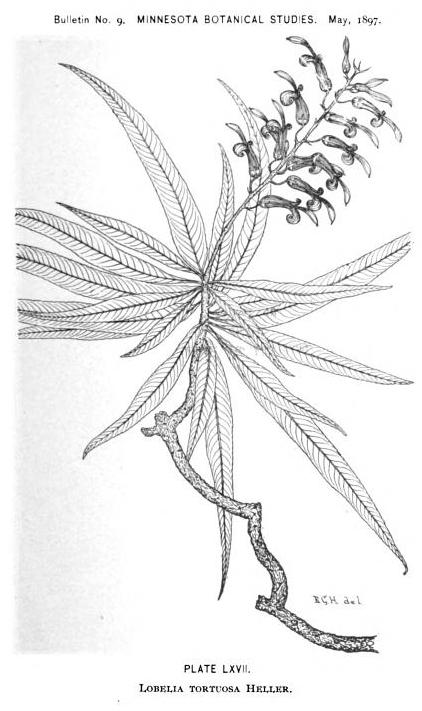
Lobelia tortuosa n. sp. (Plate LXVII).
Woody; stems clustered from a thick mass of roots, the older ones almost an inch in diameter at the base, gnarled and twisted, the young flowering and leaf bearing ends ascending and sparingly branching, closely studded with leaf scars; leaves narrowly lanceolate-oblong, slightly cyathiform, acuminate at the apex, tapering at the base into a short winged petiole, six inches in length, three-fourths of an inch wide, light green and somewhat pubescent above, pale and densely soft pubescent beneath, with prominent midveins; flowering branch angled; pedicels a half inch in length, horizontal for half their length, then twisted and curved upward, each subtended by a subulate bract, tomentose; calyx shallow cup-shaped, truncate, shortly pubescent, the lobes linear, almost as long as the tube; corolla an inch and a half in length, garnet colored, somewhat contracted near the middle, pubescent, lobes revolute; stamens glabrous, or occasionally with a few scattered hairs; lower anthers tufted at the ends with white hairs; style with a pubescent ring at the base of the stigma.
The type is No. 2443, collected on perpedicular cliffs along the Hanapepe river, Kauai. The thick, knotted mass of roots protrude from crevices of the rocks, and from them spring the at first declined and twisted, finally ascending, sparingly branched stems. Its nearest relative seems to be L. neriifolia A. Gray, from east Maui. Mr. Fernald has compared the two, and finds them quite distinct.
ROLLANDIA GAUD. Bot. Voy. Uranie, 458, pl. 74. 1830.
Rollandia lanceolata Gaud. Bot. Voy. Uranie, 458, pl. 74. 1830
There seems to be some doubt as to whether R. lanceolata is the proper name since Dr. Gray says it is quoted as R. montana on the plate. Hillebrand has recorded a number of forms and varieties. To one of these belong my specimens, collected on the lower slopes of Konahuanui. The stems are simple, smooth, nearly an inch in diameter, inclined to be decumbent. The leaves are often two feet long, acute at each end. The flowers are red-purple, over two inches in length, curved. Rollandia is a genus which is found only on the island of Oahu.
April 25 (2184).
Plate LXIV: Cyanea coriacea
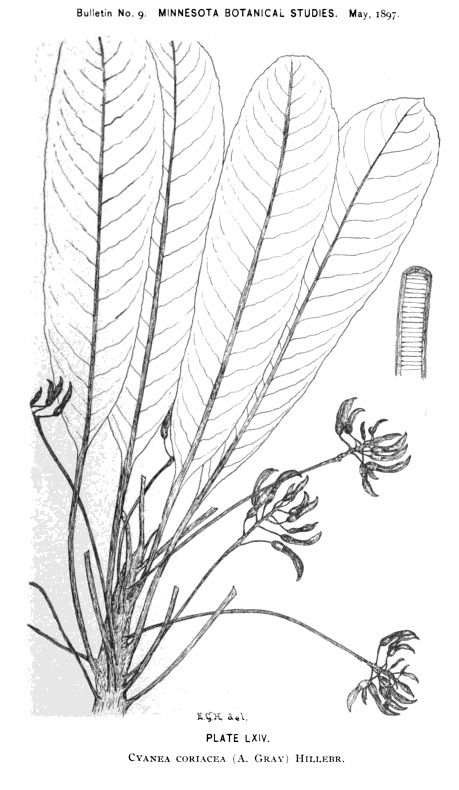
Plate LXV: Cyanea spathulata
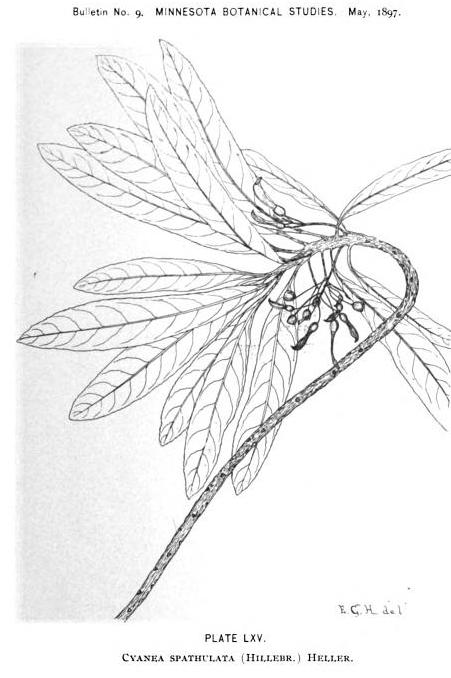
Plate LXVI: Cyanea sylvestris
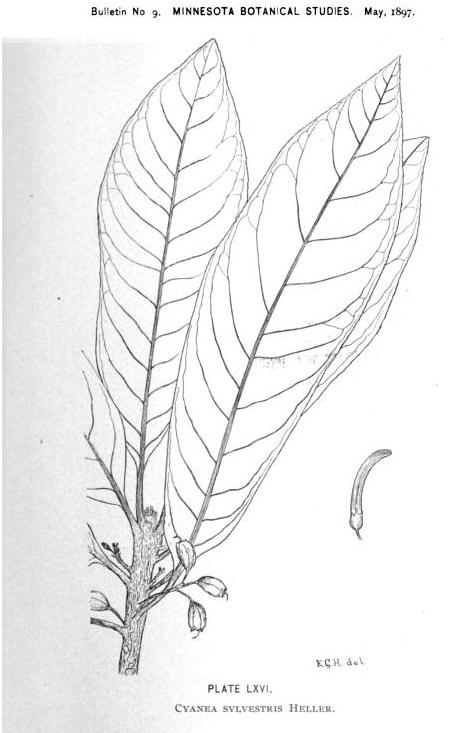
Plate LXVI: Lobelia tortuosa