Clermontia
Twenty-two species with the center of diversity on the big island. Possibly nested within Cyanea, they are distinguished by their growth form; they are generally shrubbier than Cyanea and in particular, they have multiple levels of branching - i.e. their branches have branches which have branches and so forth. This is not true for all species in the genus (e.g. Cl. arborescens which has a tree-like habit, but it is true for the majority. Rock described the branching habit as candelabra-like, but because of the twisted nature of most of the specimens, I don't see it as clearly as he describes.
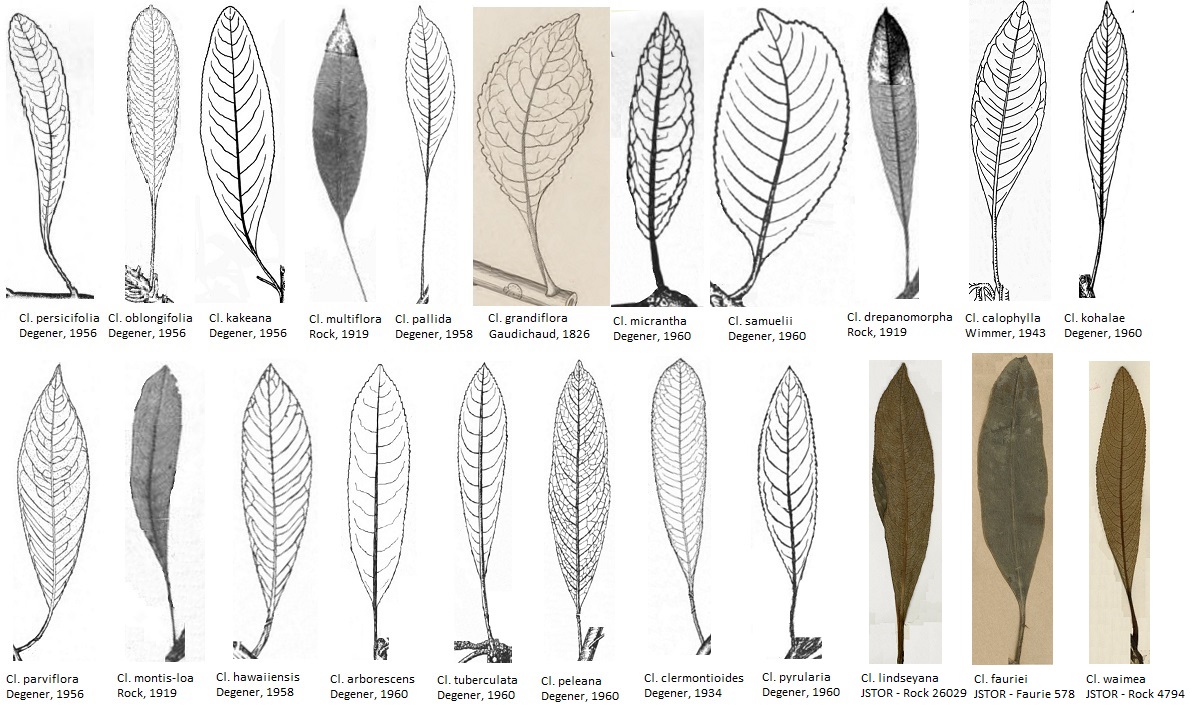
The genus has been traditionally been split based on sepal morphology: the species either have small, persistent sepaloid sepals like all other lobeliads or they have sepals that are quite similar to petals in size and color. The three species collected by Gaudichaud, Cl. oblongifolia, Cl. persicifolia and Cl. grandiflora were all of the later type with petaloid sepals. This was the original, defining characteristic of the genus "Calyx ... longitudine corollæ coloratus, caducus". It was Hillebrand who shook things up and defined Clermontia instead by its cymose inflorescence (which Wimmer later corrected, he showed the inflorescences to be reduced racemes), unilabiate corolla, bushy habit and pale foliage. This allowed in species without the petaloid sepals and thus he created two sections: Clermontiae genuinae with the petaloid sepals and Clermontioideae with short sepals. These sections continued with Rock (1919) and Wimmer (1943). Lammers (1990) replaced the name Clermontiae genuinae with simply Clermontia.
The initial molecular phylogenetic work, however, is not supporting the simple division of the genus, but rather points to a geographic pattern of speciation. Loosely, the Hawaiian specimens form a clade, the Maui Nui species form two clades and the Kaua'i and O'ahu species are sister to all other species. The distinct non-petaloid sepals show up interspersed amongst most of the clades. This could either be explained by loss of the trait or by hybridization.
Nevertheless, below we split the species in the traditional manner, based on sepal morphology:
Sect. Clermontia - petaloid sepals
| Species | Islands | Volcanoes | When first collected | Flower size | sepal type | perianthsymmetry |
| Cl. persicifolia | O | 1817-1820 | 4.8-6.0 cm long | petaloid | bilabiate | |
| Cl. oblongifolia | O, M, Mo, L | 1817-1820 | 5.0-6.5 cm long | petaloid | tubular | |
| Cl. kakeana | O, M, Mo | 1830-1832 | 4.5-5.5 cm long | petaloid | bilabiate | |
| Cl. multiflora | O, M | 1850-1871 | 2.4-3.2 cm long | petaloid | rotate | |
| Cl. pallida | Mo | 1850-1871 | 4.5-6.0 cm long | petaloid | bilabiate | |
| Cl. grandiflora | M, Mo, L | 1817-1820 | 5.5-8.0 cm long | petaloid | tubular | |
| Cl. micrantha | M, L | 1850-1871 | 1.8-2.8 cm long | petaloid | rotate | |
| Cl. samuelii | M | 1908-1920 | 3.6-5.5 cm long | petaloid | tubular | |
| Cl. lindseyana | M, H | Ha, MK, ML | 1957-1962 | 5.5-6.5 cm long | petaloid | bilabiate |
| Cl. drepanomorpha | H | Ko | 1909-1913 | 4.0-5.5 cm long | petaloid | bilabiate |
| Cl. calophylla | H | Ko | 1909-1913 | 3.5-4.5 cm long | petaloid | rotate |
| Cl. kohalae | H | Ko, MK | 1909-1913 | 5.0-6.5 cm long | petaloid | bilabiate |
| Cl. parviflora | H | Ko, MK,ML | 1836-1837 | 1.5-2.8 cm long | petaloid | rotate |
| Cl. montis-loa | H | MK, ML | 1912-1913 | 3.8-5.0 cm long | petaloid | bilabiate |
| Cl. hawaiiensis | H | MK,ML | 1838-1842 | 5.0-6.5 cm long | petaloid | tubular |
Sect. Clermontioideae - sepaloid sepals
| Species | Islands | Volcanoes | When first collected | Flower size | sepal type | perianthsymmetry |
| Cl. fauriei | K, O | 1838-1842 | 5.0-7.0 cm long | sepaloid | unilabiate | |
| Cl. arborescens | M, Mo, L | 1864-1865 | 5.5-8.5 cm long | sepaloid | bilabiate | |
| Cl. tuberculata | M | Ha | 1908-1911 | 5.0-7.0 cm long | sepaloid | bilabiate |
| Cl. peleana | M, H | Ha, MK, ML | 1850-1871 | 5.0-7.0 cm long | sepaloid | unilabiate |
| Cl. waimeae | H | Ko | 1909-1913 | 3.0-4.5 cm long | sepaloid | bilabiate |
| Cl. clermontioides | H | ML,Hu | 1836-1837 | 4.0-6.0 cm long | sepaloid | bilabiate |
| Cl. pyrularia | H | MK,ML | 1838-1842 | 4.0-4.5 cm long | sepaloid | bilabiate |
Sources:
- Gaudichaud, 1826;
- G. Don, 1834 (as Clermontea);
- Presl, 1836;
- Meyen, 1835;
- De Candolle, 1838;
- Walpers Enum., 1843;
- Walpers Repert., 1843;
- Nuttall, 1843;
- Gray, 1861;
- Mann, 1868;
- Wawra, 1872;
- Hillebrand, 1888;
- Heller, 1897;
- Rock, 1913a;
- Rock, 1919;
- Wimmer, 1943;